|
By: Paul S. Cilwa |
Posted: 6/4/2026 |
|
Page Views: 23 |
| Hashtags: #HistoricalFiction #LucianOfSamosata #Pirates #Antioch #SeleuciaPieria #Hebrews |
| Lucian's ship is boarded by pirates! |
| Estimated reading time: 23 minute(s) (5271 words) |
Lucian and Demetrios had their two horses, and a stack of papyrus larger than Lucian had
owned in his entire life before. The horses went into a pen on the foredeck, lined with
straw, with the patient resignation of animals who had decided long ago that men were going
to do strange things to them and there was no use objecting. The papyrus went into a sealed
cedar chest that Demetrios had commissioned from a carpenter in the Brucheion at considerable
expense, and which Demetrios treated for the rest of the voyage with the careful suspicion of
a man who had not entirely forgiven the sea for the things it had done to other men's
manuscripts. Veritas went wherever Veritas pleased, which by the second day included the
captain's shoulder, the mate's wine cup, and, on one memorable afternoon, the inside of a
rope locker from which Veritas emerged smelling so strongly of tar that Lucian had to wash
him twice in fresh water while apologizing to him for the indignity.
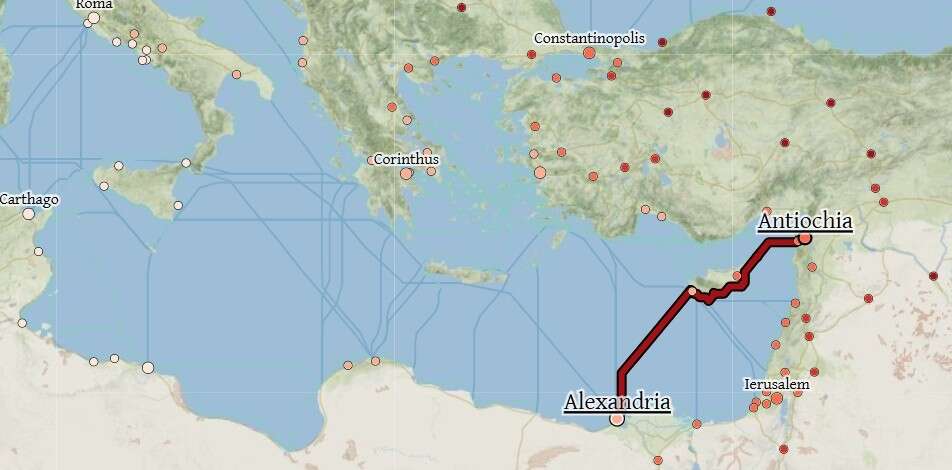
The route was the standard one: north and a little east, with the prevailing summer wind on
the starboard quarter, across the open mouth of the Levant to Seleucia Pieria, the port of
Antioch. Ten days if the weather held. Twelve if it did not. Eshmunazar expected eleven, and
it would not have surprised Lucian if the weather generally consulted Eshmunazar before
taking liberties.
Homeward Bound
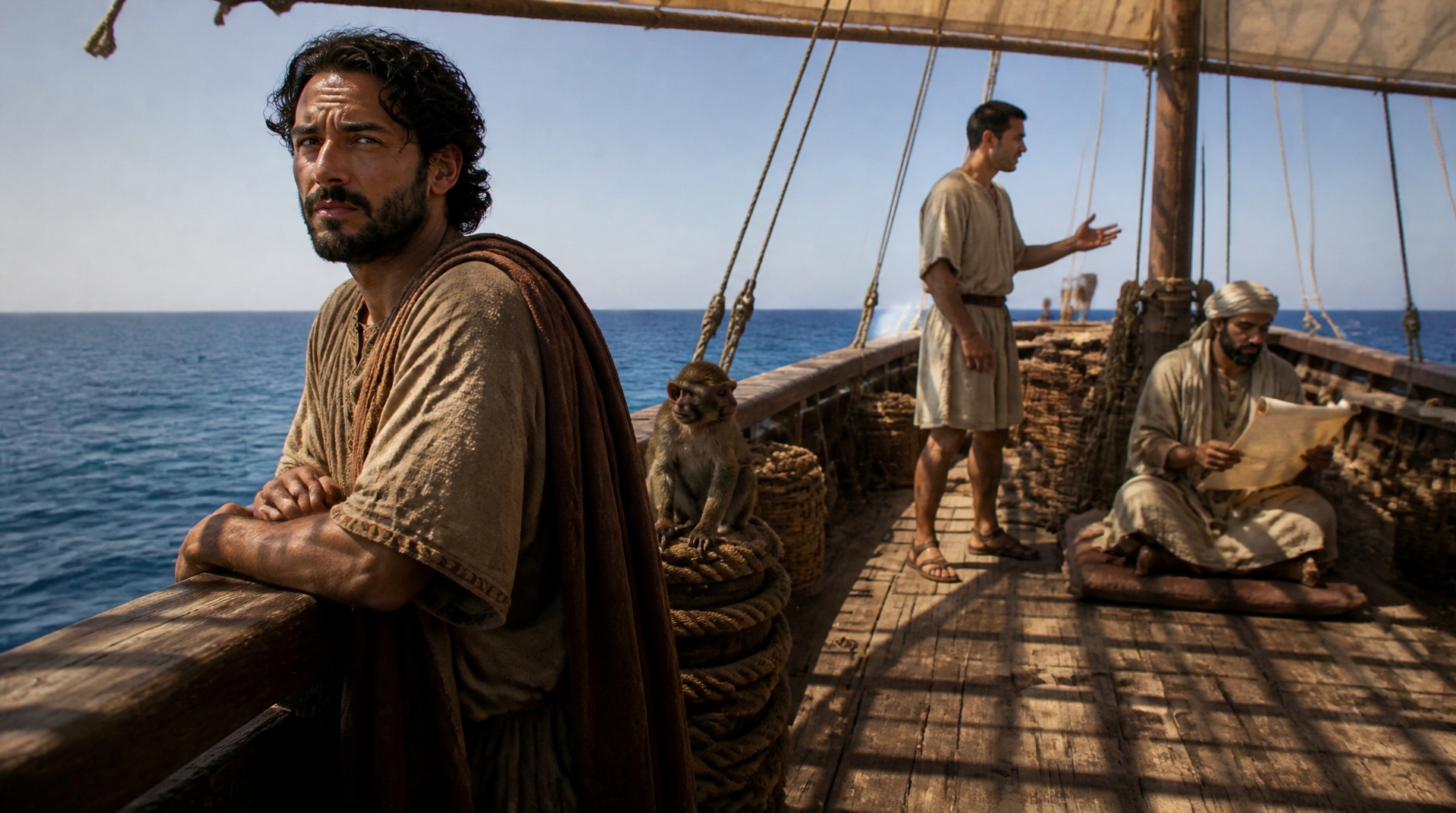
Lucian stood at the stern as Alexandria slid away. The Pharos kept its place on the horizon
longer than seemed possible; it was the highest thing the human race had built outside of
Egypt's own pyramids, and it did not give up its visibility easily. For perhaps two hours
after the city itself had sunk below the swell, the lighthouse was still there, a thin white
stroke against the haze. Then it too was gone, and there was only the sea.
Lucian watched the manner of its going with a satisfaction he could not quite hide.
Alexandria had not faded into the haze; it had gone down, in pieces, from the bottom
up, like a thing being lowered behind a wall. First the docks and the lower town had
vanished, then the houses on the slope, then the bulk of the Pharos itself, then at the end
only the polished cap of the lantern, hanging by itself above the water as though held up by
a hand that finally, reluctantly, let it drop.
Lucian turned to Demetrios. "The Stoics in Smyrna used to say one could prove the world
was a sphere by watching a ship leave port. I never had the patience to stand at a rail
long enough to test it."
Demetrios followed his gaze back to the empty horizon. "And now?"
"Now I finally have. If the world were flat, my brother, the Pharos would have grown small and
gone gray and finally winked out, the way a lamp goes out at the far end of a long
corridor. It would not have sunk. The lighthouse cannot have walked down a staircase
into the sea. The sea must therefore be curving away from us, which is to say that the
world is round, which is to say that Eratosthenes was right."
Demetrios laughed. "You sound almost cheerful, Lucian."
"I have just watched a fact prove itself in front of me without my having to argue with
anyone. It is a rare pleasure."
The first three days were uneventful in the particular way that sea travel is uneventful
until catastrophe strikes: the sun rose, the sail filled, the horses ate, the
monkey stole, the chest of papyri stayed dry. Lucian wrote a little. Demetrios transcribed. Veritas
groomed both of them in rotation and a few of the crew besides. Eshmunazar marked off his
days with a small stick he notched at each sunset.
There were two other families aboard. At the bow, a Jewish silk-merchant named Yochanan ben
Yitzhak from Antioch, his wife Devorah and their two children, on their way home from a
summer with cousins in Alexandria. At the stern, an Alexandrian Christian family named
Demas and Phoebe with three children, on their way to a community somewhere up the Orontes.
Demas had apparently decided early that the long voyage was an opportunity to convert Yochanan, and
Yochanan had decided early that the long voyage was an opportunity to read his scroll.
Their negotiations were polite, repetitive, and, to Lucian, faintly familiar; he had heard
the same opening verses from a Christian in Miletus when he was twenty-two, and he had been
dismissive then and was dismissive now. Yochanan, on the other hand, was new to him; Lucian
had never met one of his people to speak to, and made a quiet promise to himself to do so
before the voyage ended. He liked the bearded man's stillness. There was a great deal of
shouting on the world's deck, generally, and not enough sitting and reading.
That was the rhythm of the first six days. It broke on the seventh.
Guess Who's Coming to Dinner?
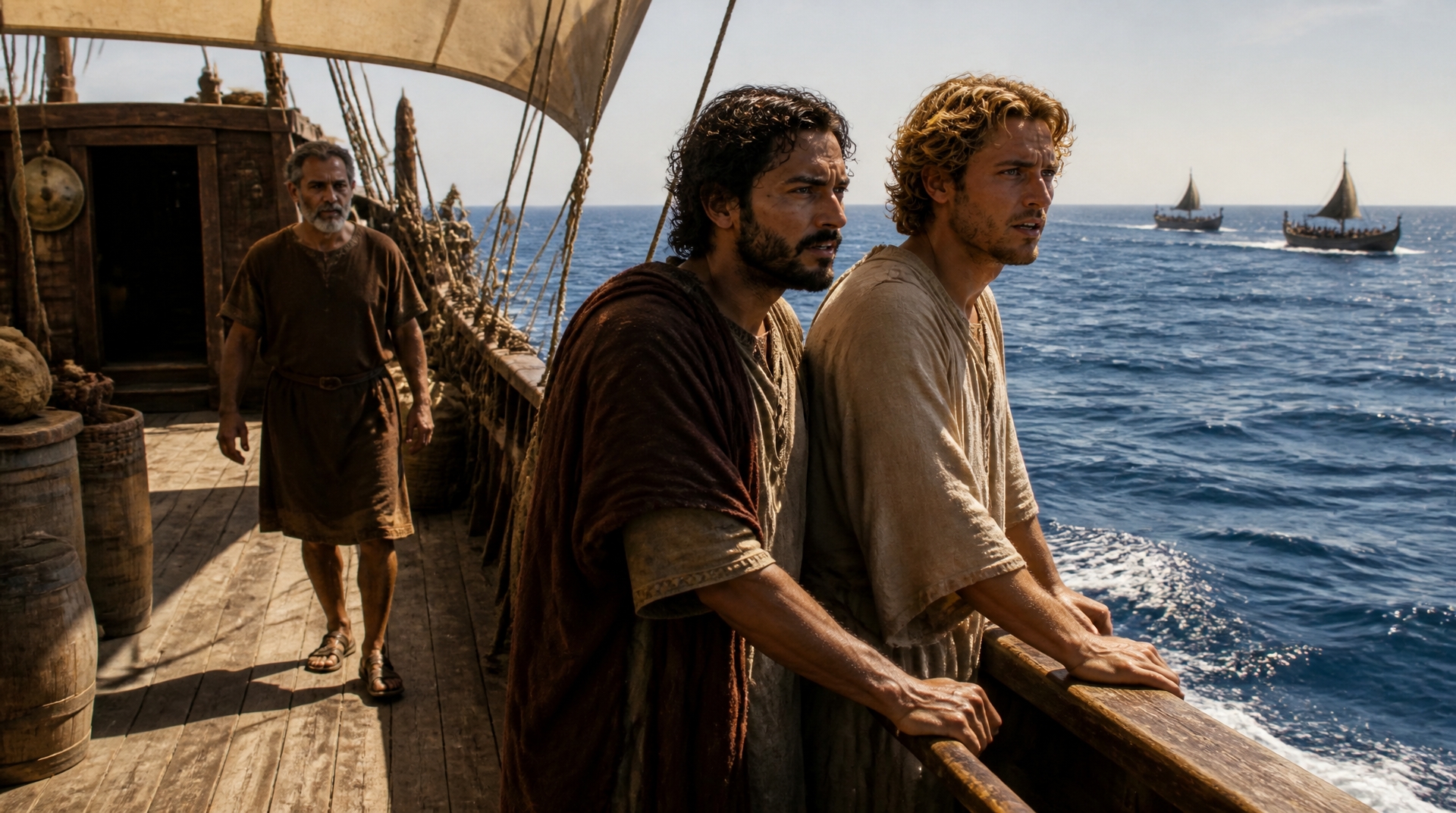
"Sails ho!" came down from the masthead in the second hour of the morning watch. Then,
after the small calculating pause of a lookout making sure of his count: "Two sails on the
starboard bow!" A second pause, longer. "Pirates!"
The word froze the deck. The sailor coiling rope by the cargo hatch set down his coil. The
cook, halfway up the ladder with a pot of barley, came back down with the pot. Eshmunazar
emerged from his cabin in the same tunic he had been wearing at breakfast, walked to the
starboard rail without hurry, and looked.
Lucian came up beside him. Two ships were running down on them out of the haze on the
northern horizon—long, low, lean, with the unmistakable cut of vessels built to do one
thing only. They were perhaps two miles off and closing fast on a converging course. The
nearer of them, Lucian could now see, was rigged with the small dark sail he had heard
described in tavern stories all his life and had never thought, until this moment, that he
would see.
Demetrios appeared at his elbow. Demetrios's face had gone the particular color a Greek's
face goes when he has rapidly recalculated the value of his cedar chest, his horses, his
papyrus, his monkey, and his person, and arrived at a sum he does not wish to lose.
"Would it help if we tell them we're all orphans?" Lucian asked the captain hopefully. But
Eshmunazar was not behaving like a man about to die, instead watching
the approaching ships with the expression of a customs official watching a familiar
merchant come up the queue. He nodded, once, to the mate. The mate disappeared below.
Eshmunazar turned to the gathering of frightened passengers.
"Sit down, my friends," he said in his unhurried Phoenician Greek. "Drink some
water. You will not need your blades, and I would ask you to put them away.
These particular pirates and I have an…arrangement.
We shall welcome them as guests."
Demetrios's voice came out half an octave higher than usual. "Real pirates,
captain? I thought Pompey got rid of them all hundreds of years ago?"
Eshmunazar permitted himself the smallest possible smile.
"Pompey did get rid of the ones who would not take a free farm as inducement. The ones
who took a farm became olive-growers in Cilicia, and behaved themselves for the most
part, and their grandsons kept a little of the family business going quietly in the back
valleys, the way men keep a little of any business going when no one is watching too
hard. The empire winks at it. The alternative is patrolling every cove between Tarsus and
Cyprus, and the empire's eyes are on the German frontier and the Parthian one, not on us.
Sadly, Pompey is not coming back, my friend. They keep tokens now."
"These are Isaurians," Eshmunazar went on. "I have known
the master of that vessel for twenty-one years. He has a wife who
scolds him about his drinking. His youngest son is about to be married. We will give him a
cup of wine and a fish dinner, and he will give us a token, and we will all go on about
our business with a minimum of inconvenience."
The mate came back up the ladder carrying a small locked box, which he set down beside
Eshmunazar without opening it.
The two ships closed. The nearer one came up under the Tyche's lee, dropped her sail
in a single coordinated movement that Lucian had to admire as a piece of seamanship, and
ran out a grappling hook of unusual politeness—it was padded with linen at the point so as not
to scar the wood. Lines were exchanged. A boarding plank was set across. And then, in the
manner of a man stepping into his own dining room, a single weathered Isaurian in a blue
cloak walked across the plank and dropped down onto the Tyche's deck.
Eshmunazar embraced him.
Lucian, watching, decided that the entire morning was best framed as a weird combination
of Homeric epic and a wine-fueled nightmare.
My Dinner With Trokondas
The Isaurian's name was Trokondas. He was perhaps fifty-five, with the deeply
creased face of a man who had spent the better part of half a century looking into salt
spray, and the steady gray eyes of a man who had never lost an argument by raising his
voice. He wore the blue cloak of his people, a heavy gold ring in one ear, a knife at his
belt that he never once touched in Lucian's presence, and an expression of mild,
professional contentment.
Trokondas inspected the deck without seeming to. He noted the horses, the papyrus chest,
the passengers grouped in their corners, the Greek rhetor watching him from beside the
captain. None of these things appeared to surprise him.
Eshmunazar opened his small locked box and brought out a clay disc the size of his palm,
stamped on one face with a mark Lucian could not read and on the other face with the year.
He handed it to Trokondas. Trokondas examined it, turned it over, weighed it in his hand,
nodded, and gave it back. From his own belt he drew a similar disc, stamped slightly
differently, which he handed to Eshmunazar. Eshmunazar put it in the box. The whole
exchange took perhaps the time required to peel a fig.
"Empty hull?" Trokondas asked.
"Empty hull," Eshmunazar confirmed. "Six passengers, two horses, and a monkey."
"A monkey," Trokondas repeated, in the careful neutral tone of a man establishing
whether he has heard correctly.
"His name is Veritas," Lucian volunteered, since Veritas had at that moment leaped onto
Lucian's shoulder. "He is friendly, in his way."
Trokondas considered Veritas. Veritas considered Trokondas back, with the bright untroubled
attention of a creature who had not yet been informed that the man before him was supposed
to be terrifying.
"I have seen one of these before, in Tarsus," Trokondas said at last. "It bit a man
who had it coming. I approved of it. Eshmunazar, my friend, are you going to feed me, or am
I going to have to go back to my ship with only a monkey to eat?"
Eshmunazar laughed. "Captain's dinner. As always." He
looked at Lucian, with whom he had eaten politely once or twice on the voyage, and at
Demetrios, who was still rather pale. "Won't you join us, please?" Eshmunazar asked.
"Trokondas is surprisingly well-educated,
and you are the most articulate Greek I have had aboard in a year. And, Demetrios,
eat. You are too skinny, anyway, and you will feel better if there is bread in you."
They went below.
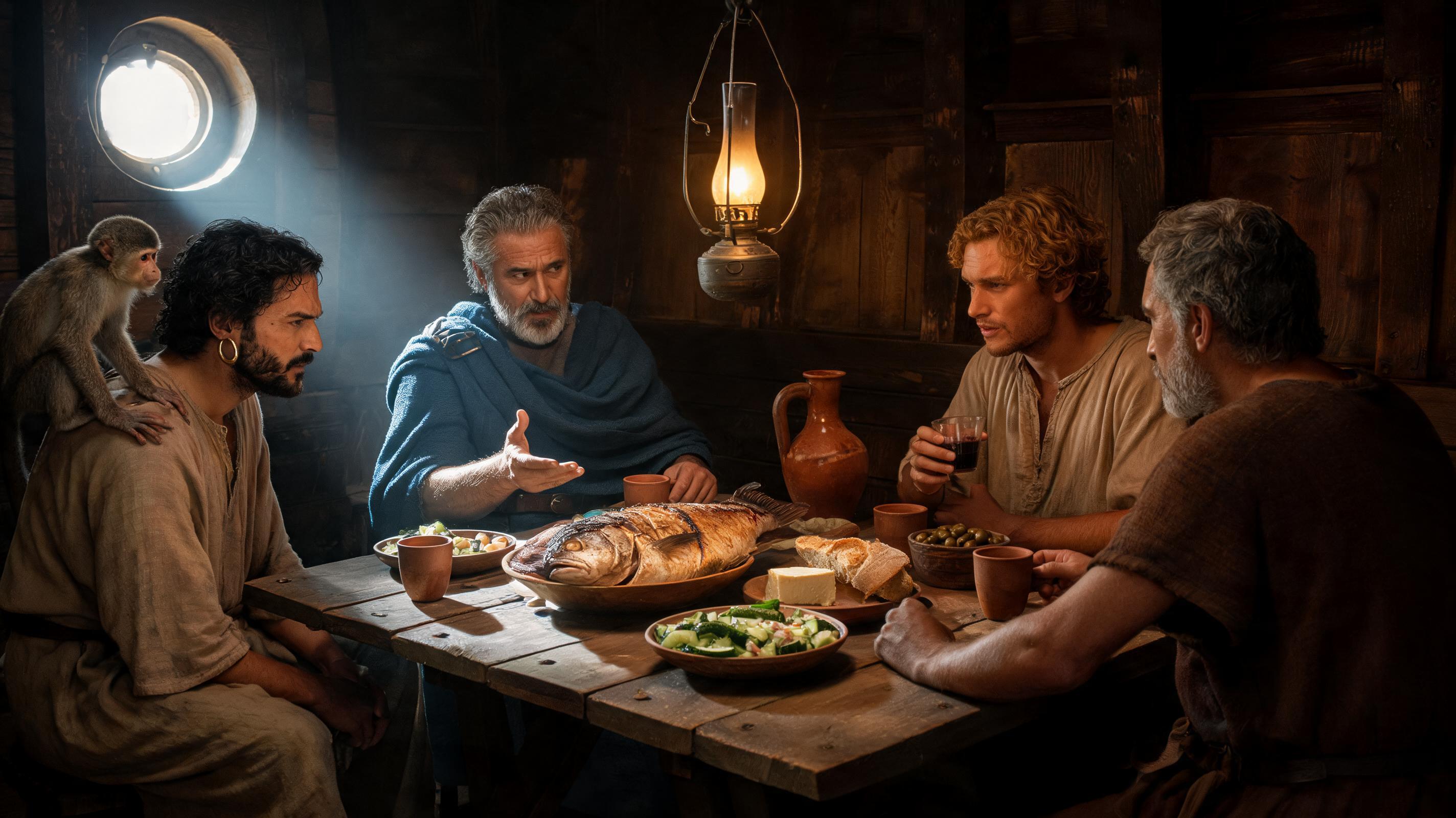
The captain's cabin on the Tyche was small but well-appointed: a folding table that
bolted to the deck, four stools, a hanging lamp on a gimbal, a chest under the bunk that
held, among other things, the captain's private wine. Eshmunazar set out four cups.
They ate. The cook had outdone himself: grilled tunny, a salad of cucumber and onion, bread
that was still soft, a small round of cheese, olives. The wine, which Eshmunazar produced
with a small ceremonial flourish, was a Lebanese red better than anything Lucian had drunk
since Krocodilopolis. Trokondas pronounced it adequate, which Eshmunazar indicated with
a grin and a wink was Trokondas's way of saying very good.
For perhaps a quarter of an hour they spoke only of weather and family. Trokondas's son was
indeed about to be married, to a Pamphylian girl whose father owned a vineyard; Trokondas
was philosophical about this. Eshmunazar's eldest daughter had given him a third
grandchild in the spring. Both men complained at length about the prices in Cyprus.
Then Trokondas turned, with the politeness of a host noticing a guest who has not yet been
drawn into the conversation, to Lucian.
"And you, master rhetor. Eshmunazar tells me you are the famous Greek who undid the
grain-thieves in the Arsinoite this spring."
Lucian inclined his head. "The Prefect was kind enough to oversell my part."
"Prefects always do. It is their training. Still. I make my living by reading other men
quickly, and Eshmunazar makes his by carrying men I would not bother with. So when he
carries a man who undid grain-thieves, I take an interest." Trokondas refilled his cup
without asking. "Where are you bound?"
"Antioch, and then up to Samosata. I have family there. Or had. I am trying to find out
which."
Trokondas's gray eyes settled on him with a different attention than before.
"Samosata. Saracens, then. The Parthian doesn't ride that far up the river without his
desert Arabs going first."
"That would be them." Lucian had grown up hearing the Saracens named at supper the
way his parents might have complained about a neighbor's dog. They had been raiding
the upper Euphrates as long as anyone in Samosata could remember. The new thing in his
grandfather's time had been the Parthians paying them in shares instead of chasing them
off the road.
Trokondas was quiet for a moment.
"I am sorry, friend. We had a year of that. Cornelianus thrashed in his own province,
Severianus and his legion cut down at Elegeia, the upcountry in flames from Hierapolis to
Zeugma, Vologases riding to the Euphrates as if it were his own back garden. A bad year
for everyone who was not Parthian."
Lucian set down his cup carefully.
"Captain," he said. "I would like, with your permission, to ask you something about
your trade. I have been told a thing by a man in
Alexandria that I cannot quite credit, and I would rather hear from someone who knows the
work than from someone who only knows the rumor."
Trokondas spread his hands. "I have eaten Eshmunazar's tunny. Ask."
"The captives the Parthians took, in those raids. Where are they likely to have been taken?"
Trokondas considered the question with the seriousness of a man asked about the workings of
his own shop.
"From Samosata? Most went east. That is the answer you do not want, my friend, but it is the answer.
Vologases takes captives for his own cities. He is building a new town on the Tigris with
his own name on it, and settling it with Greek-speakers on purpose; Babylon and Seleucia
on the Tigris are full of Syrians these days, and the satraps further east are buying. Most
slaves that came out of the upcountry the year of the raids went over the Tigris in chains and
are now laying brick or weaving rugs or nursing Parthian children. That is the bulk of the
answer."
Lucian's heart, against his will, sank.
Trokondas saw it, and held up a hand.
"I said the bulk. There are exceptions. Two kinds I know of personally."
Lucian leaned forward.
"First. Parthian armies move fast. Some captives never make it east. Small bands of
auxiliaries—Saracens paid in shares, mountain men the Parthian lets off the leash for
a week—took captives for themselves and sold them south, to the nearest market that
would pay coin and ask no questions. Some of those captives came down the road to Edessa,
then to Tarsus, and then to me. Not many. A handful per raid. But some."
"Second. The Parthian is selective about whom he resettles. He wants craftsmen. He wants
young women. He does not particularly want plague survivors—he is afraid of them, like
any sensible man—and he does not want the very old or the very sick. The ones he passes
over are sometimes left behind for the auxiliaries to dispose of, which means sold. Those
too come south."
Trokondas drank. He set the cup down.
"The plague survivors are the interesting case. The pox does not touch anyone twice,
as you know. Still, nursing plague victims is terrifying work. So we call the
survivors who are brave enough to go into a quarantine camp and nurse the sick,
The Fearless Ones. They are the most valuable
women in the slave market right now, more valuable than virgins, more valuable than dancers.
Any wealthy house with a sick child in a plague year will pay a year's income for an immune
nurse. The biggest market for them is Antioch, where money is thick and plague comes round
every other summer. The next is Cyprus, which is rich, and Caesarea Maritima, which is
richer than people think. A girl of the right age, immune, healthy, who can speak two
languages and read a little—that is the prize of the trade. I have handled perhaps a
dozen in five years. There is always a buyer for such."
Lucian felt Demetrios's hand close, gently, on his wrist under the table.
"You said captives from the upcountry," Lucian said, keeping his voice level. "From
Samosata specifically?"
Trokondas spread his hands.
"Friend, I do not get the towns by name when I get the goods. The road comes down through
Edessa and the names get lost on the way. Some surely came from Samosata. Some from
Edessa or Zeugma, some from villages I have never heard of and you have never heard
of. I cannot tell you which were yours. I cannot even tell you whether yours came down the
road at all. Most did not. Most went east. I am telling you only the general reality,
which is: it is not impossible. That is all I can give you."
Lucian considered that for a long moment.
"That is more than I had this morning, which was nothing."
Trokondas inclined his head. "I would not raise hopes, friend. I
have known men spend years following this clue and that and finding nothing at the end of them, while
other men stumble over the truth in their first market. The trade does not arrange itself
for the convenience of relatives. If you are going to look, look. But do not let the looking
be the whole of your life. There are too many of us with that kind of grief on board
already, and the boats are small."
"I will try to remember," Lucian said.
They finished the wine. Trokondas spoke a little of other trades—the Mauretanian
crews in the west (they kept to the African coast), the Aegean fleet at Misenum
still serious enough that nobody he respected
bothered working those waters), the Cypriot understanding with the Isaurians ("they
don't take from this coast, we don't take from theirs, it has held for forty
years")—with the dry professional pleasure of a man explaining his guild to an
interested apprentice. He stood at last.
"Eshmunazar, my friend, thank you. The tunny was honorable. Master rhetor, master
Demetrios, master monkey: peace to your voyage."
He embraced Eshmunazar a second time, and walked up the ladder, and across the plank, and
down onto his own deck. The grappling hook came back. The lines were cast off. The black
sail rose. The Isaurian ship and her consort drew away to the northwest, and inside an hour
they were gone over the curve of the world that Lucian had so recently and proudly
confirmed.
Lucian stood at the rail watching the place where the two ships had been, with Veritas on
his shoulder and Demetrios beside him and Eshmunazar back at the wheel, until there was
nothing left to watch but water."Well, that's it, then," he stated with finality.
"Now we'll never be able to say we've never been attacked by pirates."
A Friendly Ear
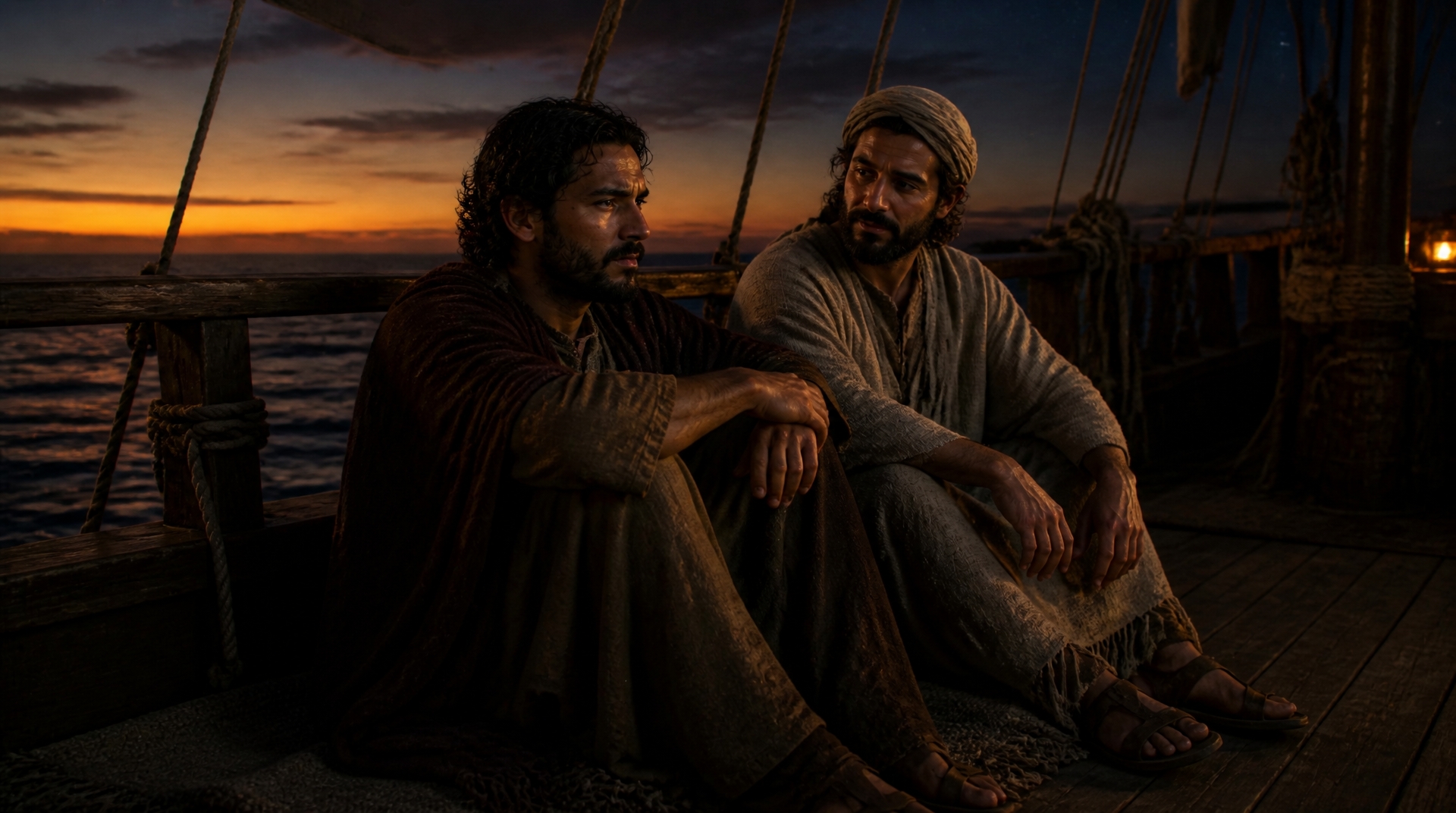
Lucian spent the four days after the pirates' visit in a quiet that even Demetrios knew better
than to break. Lucian sat at the bow for most of two days. Demetrios let him. Veritas
groomed whichever shoulder needed grooming, and the wind did the rest.
On the third evening, while Lucian was watching the sea go dark, someone sat down beside
him. The someone was Yochanan, the Jewish dad who boarded with his family.
"Friend," Yochanan said, in his careful Greek. "I have been on enough boats to know
the look of a man carrying more weight than the deck was meant to bear. I will not ask
you what it is. But I have a friendly ear, if you want it."
Lucian was quiet for a long moment.
"I had taken you for a silk-merchant," Lucian said.
"I am a silk-merchant. That is the half of me that travels. The other half teaches a
little in a synagogue near the Daphne Gate, when I am at home and have anything worth
saying. We do not have a word for it in Greek that quite fits. The Hebrew word is
rabbi, which means only "my teacher," and is the most overworked title in our
culture. But you should just think of me as a friend."
Lucian didn't think he wanted to talk; but in trying to explain that to the rabbi,
he found himself spilling his guts. An unexpected
letter at Saturnalia in Corduba, a mother and a father and a sister gone in three weeks,
a house burned by order of the magistrate, an uncle alive at the time of the writing and
perhaps alive still, but all of that having taken place years before he even knew about it.
Then a Prefect in Alexandria with a piece of his uncle's stonework on
a shelf, and a rumor about raiders that did not match the rumor about plague. And then,
three days before, an Isaurian who had described what raiders that year had done
with what they took, and who had been careful not to promise anything.
Yochanan listened without interrupting. When Lucian was done, Yochanan was quiet for a
while of his own, and then he spoke.
"I regret what happened to your family, friend. May their names be remembered."
"Thank you. Though I'm not sure I'm entitled to mourn them yet."
Yochanan looked at him and waited.
"I have a letter," Lucian said, "from a man who may or may not be my uncle. I
thought I recognized his hand, but I haven't seen his writing in nineteen years, and the letter
is short, so who knows? I wouldn't have questioned it, and didn't, until the
Prefect in Alexandria mentioned raiders. Then when we had the pirate come for dinner,
he confirmed that raiders that year had indeed hit Samosata. So I have three
accounts, none of them quite agreeing, and no way to choose between them until I get to where
my house is or was, and ask the neighbors. My parents and my sister may be dead in the manner
the letter described. They may be dead in a different manner. They may be alive and well
and wondering why I haven't written. The letter may be a hoax played by a creditor of my
father's who wanted the house empty. I won't know for three weeks. Until then, rabbi, I'm
standing at the doorway of Hope, not certain if I should go in."
"In that case, I'd say the weight you carry is not the weight of grief, but the weight of uncertainty."
Lucian, with the small dry smile of a man who has decided the only available response to
a bad situation is a worse joke, looked at Yochanan.
"Then, Rabbi, give me your professional opinion. If I want my family back—assuming I've
actually lost them, which is still an open question—to which god do I sacrifice?
I would like to choose the right altar before I go to the trouble of gutting the
goat."
Yochanan inhaled sharply, caught between horror and amusement.
"None of them, friend," he grinned. "The gods at your local temples aren't in that line of work. Mine
isn't either, on the terms you're asking—He doesn't accept goats and He doesn't
take requests. Whether you and He have anything to say to each other is between the two of
you; we don't recruit. We have enough trouble keeping our own people on the path without
going around looking out for yours."
Lucian was puzzled. "But if a god can't grant favors, what's the point? Either
of being a god, or of worshiping one?"
"You're asking the question a temple customer might ask. To a pagan priest,
that's exactly what a god is for—receives favors, grants them; the priest keeps
a cut. It's the whole business model. But you're a rhetor. You're too educated to fall
for that. But your philosophers, for example the Stoics and the Platonists, they aren't in that
business at all. The Truth they're after isn't a favor-merchant. The Truth is what holds the
universe together. You don't bargain with the Good; you acknowledge it because it's
there. For a Stoic, worship is thinking clearly. For my people, worship is keeping a Law
and mending what's broken. Neither of those involves a dead goat. The goat trade was invented
by your priests, and the dead goats, also known as goat-meat, is their salary."
Lucian listened closely. He'd had no idea Yochanan was so well educated. "I had
heard your people kept to themselves. I didn't realize you knew of the Greek philosophers
at all, much less their ideas."
"I'm a silk-merchant," Yochanan laughed. "How much to myself do you think I could keep,
and stay in business? —So, the Atargatis with her hand out at the temple door is
one thing. The Stoic's Logos, the Platonist's Good, and the Truth my fathers heard are a
different thing entirely. What your philosophers are reaching for is closer to the one, true God
than what your priests are selling. It sounds to me like you and I are nearer
philosophically than you would be to the man with the drum in Hierapolis."
Lucian smiled, slightly, for the first time in three days.
"That is exactly what I needed to hear from a teacher who promised not to teach!"
"I'm sorry," Yochanan said with a twinkle. "I broke the promise.
I'll be more careful in the morning." He rose, then before going,
he stopped and looked down at Lucian.
"One thing more. You'll be at this question for some weeks. Hope is permitted. Hope is
also dangerous. If shattered, hope's edges can cut. But in the meantime,
do the next small thing you were going to do anyway, because
the next small thing isn't waiting on your answer. We have a phrase for it: tikkun
olam. The mending of the world. We do the small mending because the great
mending—setting it all right at one stroke, undoing what's been done—isn't
ours to do. That belongs to God, in His own time. The small piece in front of you
is yours."
Lucian considered him.
"That is an intriguing answer."
"It isn't my answer. It's the answer as arrived by a great many people
over a great many years. I'm only the man passing it on tonight, on a boat."
Yochanan set a hand on Lucian's shoulder for the span of a breath, and went back to his
family at the bow.
The Tyche raised the coast of Syria on the eleventh morning—Eshmunazar had been
accurate as to the day—and came into Seleucia Pieria on the evening tide. Yochanan, at the
head of the gangway, took Lucian's hand in both of his own.
"You will pass through Antioch," Yochanan said. "The house of Yochanan ben Yitzhak
the silk-merchant, me, is by the synagogue near the Daphne Gate. The door will open.
You are welcome anytime! Come for Sabbath dinner!"
Antioch
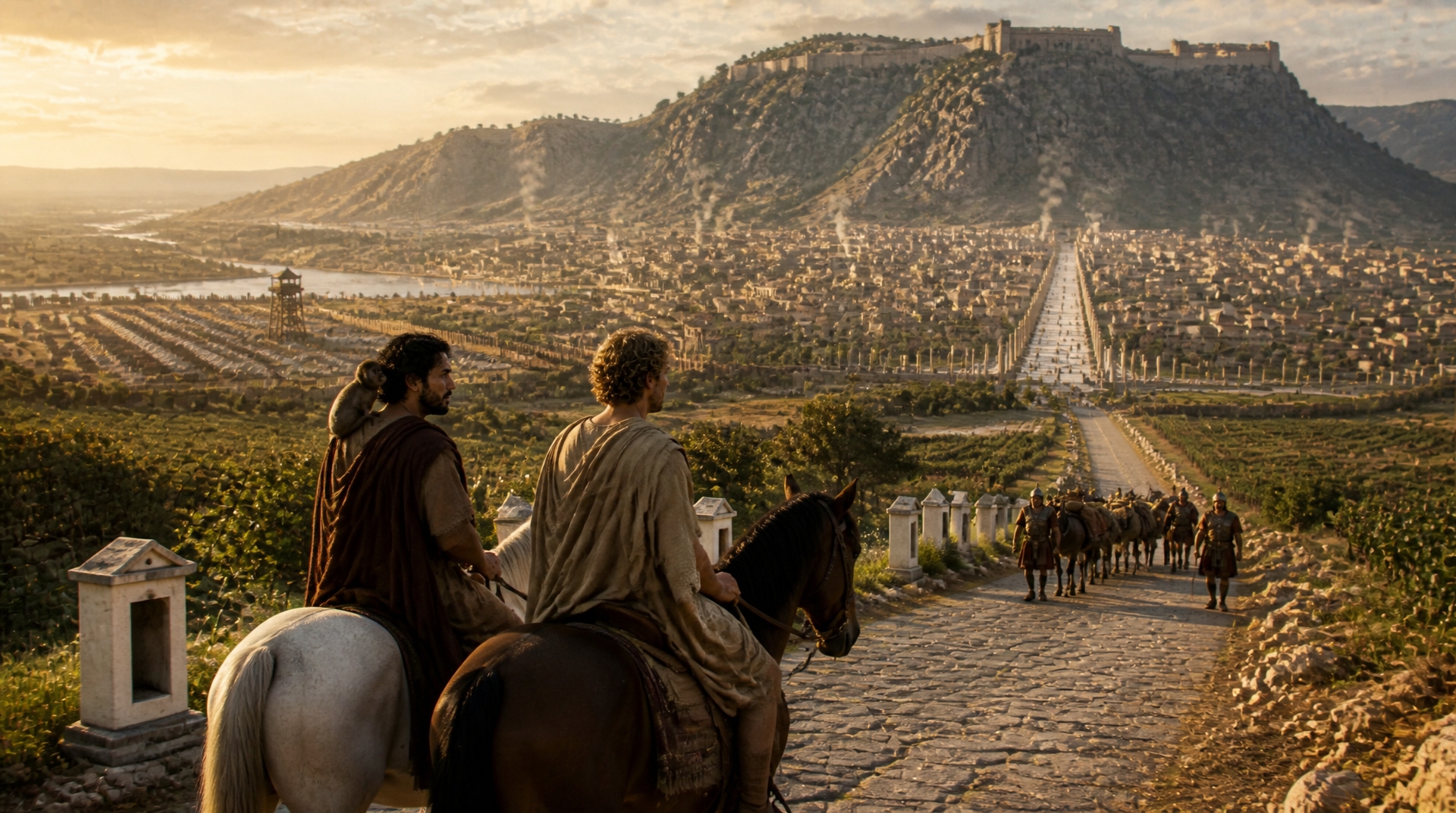
Lucian and Demetrios spent the night in Seleucia Pieria and rode up the Orontes road in the
morning. Antioch announced itself from a great distance: a smudge of smoke over a fold in
the hills, then the long colonnade of the main street catching the afternoon sun, then the
cliff of the citadel above, then the city itself, third city of the empire after Rome and
Alexandria, a great rambling polyglot beautiful and disreputable city in the lap of a
mountain beside a river. Antioch had been on a war footing for two years now, with the
legions of Lucius Verus camped in the suburbs and merchants' coin pouring in from a hundred
supply contracts; the streets were thicker with armor and donkey-trains than Lucian
remembered. Antioch was the kind of city that did not stop being itself for anything as
transient as a war.
Lucian had been here before, at seventeen, on his way out to the coast and his life;
Antioch had bewildered him then. Antioch bewildered him less now, but he found, to his
surprise, that he could not bring himself to walk through the slave market, which lay
between his inn and the forum and which he had to go around twice to avoid. Demetrios did
not remark on this, and Lucian was grateful.
Lucian and Demetrios stayed two nights. The second they spent at the house of Yochanan ben
Yitzhak, by the synagogue near the Daphne Gate, where his wife Devorah lit two small lamps as the
sun went down and sang a blessing in a language Lucian did not understand, and Shimon read
aloud from a scroll, and there was bread and wine and a fish baked in herbs.
After the meal as Lucian and Demetrios were leaving, Yochanan said, "When you return from
Samosata, if you return, come back here. I'll be here. My door is always open to you both.
If you get good news, we will rejoice with you. If not, we will mourn with you.
And if there's no news, perhaps we can come up with the next small thing together."