|
By: Paul S. Cilwa |
Posted: 6/5/2026 |
|
Page Views: 61 |
| Hashtags: #HistoricalFiction #LucianOfSamosata #Hierapolis #Atargatis #Zeugma #Samosata |
| Lucian returns to Samosata to find clues to the fate of his lost family. |
| Estimated reading time: 21 minute(s) (4975 words) |
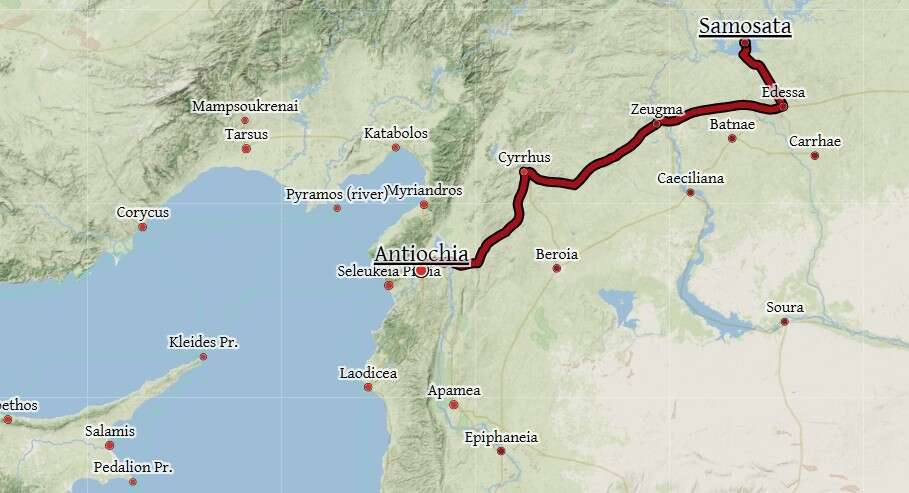
The road east, after the first day, ran through olive country and the small Aramaic-speaking
hill villages that had been Aramaic-speaking when the great Alexander came through and
hadn't changed since. Lucian and Demetrios rode it at a modest pace for eight days.
Hierapolis was the last reasonable stop before the Euphrates, and that was a temple Lucian had wanted
to see since he was a boy.
Lucian had made this ride a hundred times in his head since his uncle's letter caught
up with him in Spain. In his head it had always been simple: ride east, stand where the
graves were, settle whatever wanted settling, ride away. Now that the actual road was
under him, it declined to be simple. He had ridden this road once before, at seventeen,
in the other direction, too angry to see any of it; the country might as well have been
new to him. But the memories didn't wait for familiar ground. A fig seller at a
crossroads brought back his father buying him figs at the Samosata bridge. A woman
calling a child in from a courtyard brought back his mother's voice. And every memory
arrived with the same postscript: the man who bought the figs is dead, and you were on
the other side of the world.
Demetrios knew most of it and guessed the rest, and had the good sense to fill the
silences with the ordinary business of travel: which horse was favoring which foot,
whether the last village's melons had been worth the price, what Veritas had stolen out
of whose saddlebag while the packs were being loaded. The monkey rode Lucian's shoulder
as usual, entirely unimpressed by Syria, and was for that reason the best company on
the road.
Nearer to Her Ears
Hierapolis was a Syrian city, not a Greek one in any but the official sense, and it was
the home of the great temple of Atargatis—whom the Greeks called the Syrian Goddess.
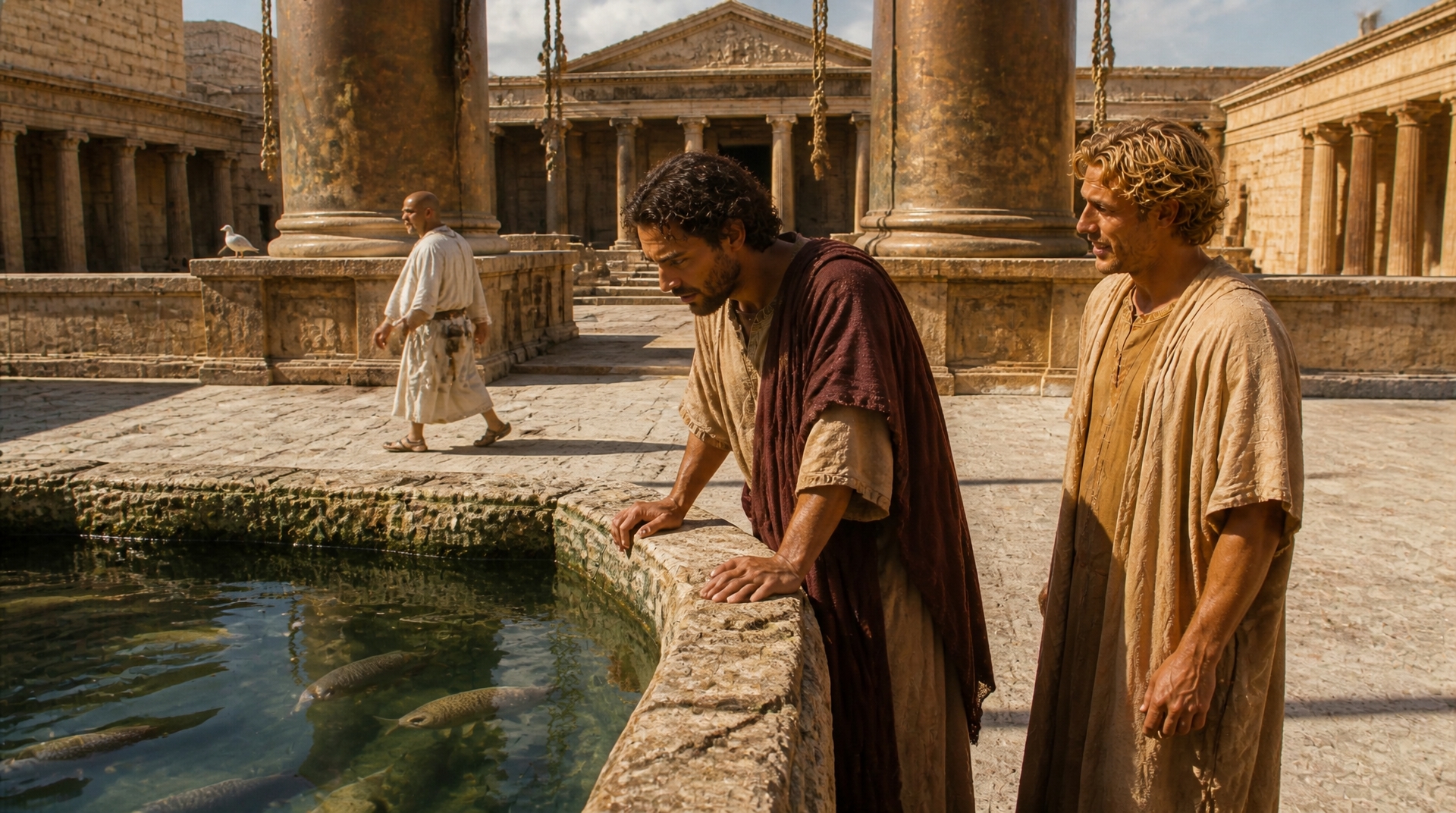
The town was small. The temple was not. It stood on a great platform of stone at the head
of the town, with a pair of enormous brass columns in front of it that pilgrims climbed
at festival time on ropes, sleeping at the top for seven nights and praying down to the
goddess from a height nearer to her ears. Sacred fish-pools that no man could fish. Tame
doves that no man could eat. And the priests were eunuchs—men who had given
themselves to the goddess in her ecstasy on her own feast day, with the ceremonial knife
and the great drum and the running through the streets that Lucian had heard about all his
life and never actually seen.
Lucian walked through it all with the attention of a man taking notes. He left a coin in
the box at the door. He inspected the columns. He looked at the fish, who looked back at
him with the bored attention of fish who had been looked at by pilgrims for a thousand
years. He watched one of the eunuch priests go past in the small white robe of his
office, the bell on his belt chiming once at each step. The priest did not look at
Lucian. The priest was thinking about something else.
Demetrios, walking beside him, watched Lucian's face.
"You're being very quiet," Demetrios said.
"I not sure what I feel. The goddess at the door with her hand out. The man with the drum. He named
this place by name and now I'm standing in it."
Lucian looked up at the brass columns rising against the September sky.
"You know what's strange, Demetrios? I came here expecting to be impressed. Or to be
moved, or to be amused, or to want to write a treatise. I'm none of those things.
I'm underwhelmed. I'm a
man with a coin in a box looking at a fish that won't look back. The place somehow feels
smaller than my grandmother's blessing at the back of our house in Samosata, and she
didn't have a brass column to her name."
Lucian and Demetrios left Hierapolis in the morning. The brass columns caught the rising
sun behind them as they rode east. Neither of them looked back.
Visible Wounds
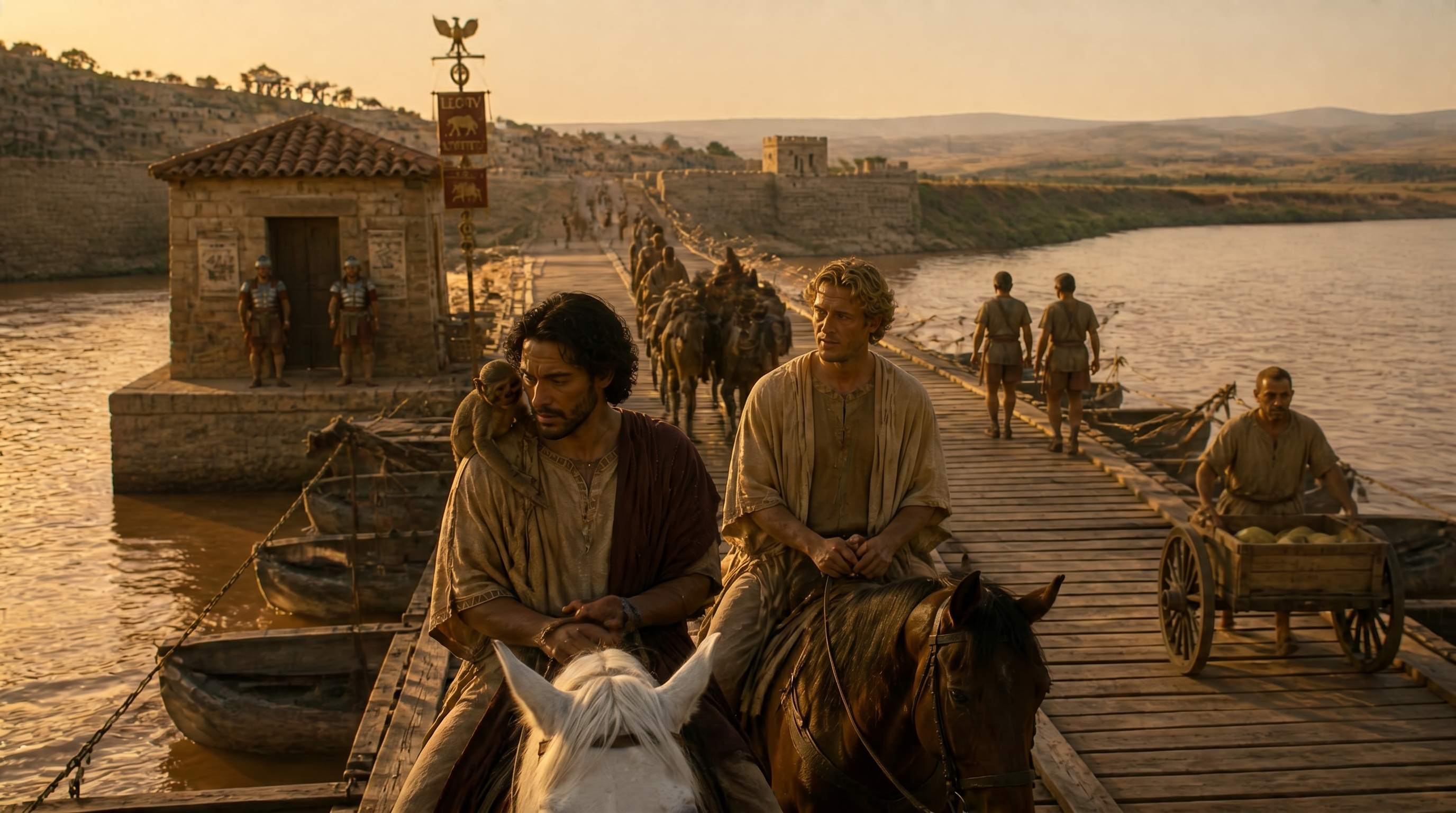
Zeugma was a working frontier town, all soldiers and customs clerks and merchants waiting
their turn at the pontoon bridge that gave the place its name. The Roman pontoon ran on
linked barges across the Euphrates; the standards of Legio IV Scythica stood at the head
of it, and a centurion at the customs post looked at Lucian's manumitted-Greek papers and
Demetrios's Athenian ones and waved them through without much interest. The legion was at
full strength for the war that had ended last year and the campaign that was rumored to be
starting again next year, and a pair of dusty Greeks with two horses and a monkey was not the
most interesting thing the centurion would see that morning.
Lucian and Demetrios rode north for four days. The river ran on their right; the Taurus
foothills rose on their left; the road was paved for the first day and packed dirt after
that, with milestones every Roman mile and small road-shrines at the crossroads. Villages
Lucian had not thought of in twenty years went past him with names that came back into his
mouth one syllable at a time.
Demetrios watched Lucian quietly. There are some kinds
of weights a friend cannot help with by talking; he can only help with by being there. The
best friends know which.
On the afternoon of the fourth day, Samosata came up around a bend in the river. Lucian
saw the citadel first—the white limestone of the old Commagenian palace on the
height, exactly where he remembered it. Then the pontoon bridge below, and then the lower
town spread along the western bank in the curve of the bend, with the smoke of a hundred
small fires rising into a clean September sky. The temple of Apollo on the slope. The
shopping mall by the bridge. The old bath-house near the south gate, which he had not
been able to see from his own roof but had passed every day on his way to school.
Lucian sat on his horse on a rise above the road and looked.
Demetrios drew up beside him and waited.
From the rise, the silhouette was the silhouette Lucian had grown up under. The citadel,
the bridge, the temple roofs, the curve of the river. He had known the line of it before
they came round the bend. But the lower town was different in three places. Along the river
road, three dark plots stood empty where the magistrate had burned plague-houses and the
ground had been left to weed and goat. North of them, a longer charred scar ran two
streets wide where, perhaps, the raid had come through and where the rebuilding had stopped
halfway, with new tile bright among the old. And at the edge of town, on the open ground
above the river, three long shallow trenches showed pale against the autumn green—the
plague pits, healed over by grass that had come in a darker green than the grass
around them, in the way grass does over a thing the earth has been asked to hold.
Lucian saw all of it at once, the way one sees a face in a crowd one has been looking for.
"It looks like itself," Lucian said. "From here. Until you look at it. Then
it's…itself, wounded."
A Goat in My Bedroom
The inn was where it had always been: two
streets from the bridge, a yellow-plastered building with a fig tree in the courtyard.
More to the point, it still stood.
The innkeeper was new. Lucian paid for a room and a stable
for the horses, left the satchel and the papyrus chest under Demetrios's eye—as
in, "Watch these, I'll be back soon"—and walked alone to his own street.
It was four streets north of the inn. He could have walked it blindfolded. The corner
fountain was the corner fountain, with the same crack across the basin lip and the same
worn place where two hundred years of jars had been set down. The smell of stone dust
hung over the lane at the end of the workday the way it had hung over it when he was
eight years old.
Lucian stopped where the gate that had been his father's should have been.
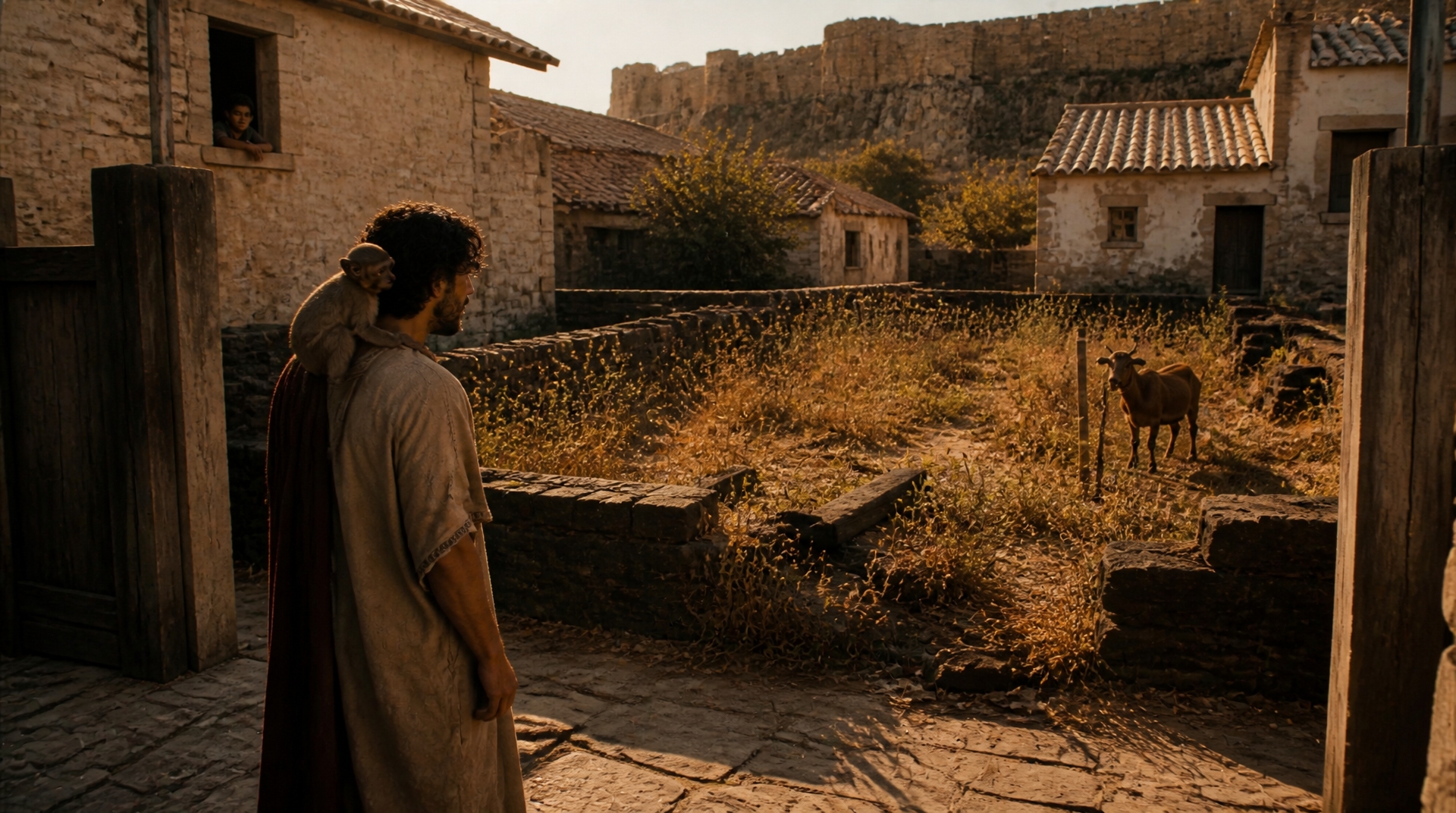
The gate was gone. The house was gone. What stood in their place was a roughly
rectangular plot of charred limestone foundation, three feet high in the corners and
nothing in the middle, with three years of weeds growing up through what had once been
the kitchen floor. A goat was tethered in the corner where Lucian's bedroom had been.
The goat looked at him with disinterest.
The neighboring houses on either side had already been partly rebuilt. The walls
Lucian could see were the walls he remembered, with the same crack above the same window
where the same earthquake had cracked it when he was nine years old. A child he did not
know was watching him out of that window.
Lucian stood at the gate for a long time. He didn't weep. He had thought he would
and was a little surprised that he did not. What he felt was something closer to the
grim justification a man feels when he has confirmed his worst imaginings.
He spent a few minutes prowling around the wreckage, looking for anything that
might have survived. He found a small rag under rubble that had once been his mother's
bedroom. Who knows if it hadn't been used to cool his dying mothers' brow? Somehow
he felt that it had, and that it had been the last thing his mother had touched.
He kissed it, and then when tears finally came, he used it to wipe them away.
But in the end, Lucian left it behind and walked back to the inn. Demetrios met him in the courtyard, took one
look at him, poured him a generous cup of the local wine, and made him drink it before he sat down.
"The house?" Demetrios asked.
"Gone. There's a goat in my bedroom."
"Of course there is."
"Tomorrow we go to my uncle's shop, under the sign of the Chisel and Mallet. If he's alive, he'll be
there. If he isn't, someone there will know what happened."
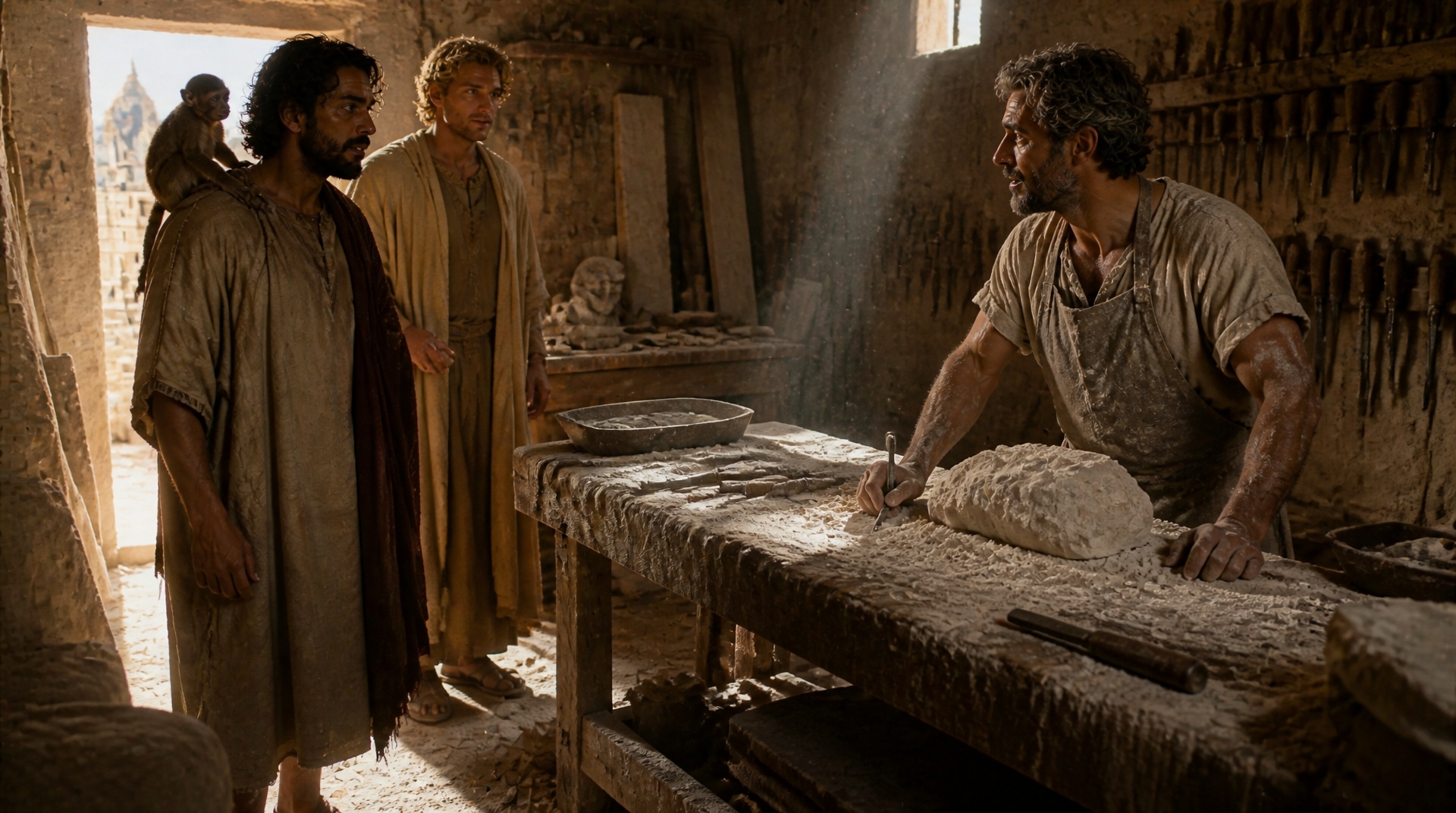
The Chisel and Mallet
The sign was the same. A chisel and a mallet, crossed, painted on a board that had been
repainted at least once but not recently. Lucian had spent one morning in this shop when he
was seventeen and had thought he never wanted to see it again. He had been wrong about a
great many things at seventeen, and that was perhaps the one he had been wrongest about.
Lucian pushed the door open. The smell came up at him—stone dust, linseed oil, a
faint mineral coolness from the limestone slabs leaning against the back wall. He had not
smelled that smell in twenty years and he knew it before his eyes adjusted to the inside
light.
The man behind the bench was not Zenodoros. The man behind the bench was perhaps
thirty-five, broad-shouldered, with a beard cut shorter than the eastern fashion and the
permanent gray of limestone dust in his hair. He looked up when the door opened, and his
face changed in a way Lucian could not at first read.
"You'd be Lucian," the man said.
"I would be. And you'd be?"
"Phokas. Zenodoros's apprentice. After the plague I was his journeyman. After the new
year I was his partner. Since last winter I'm the master here."
Lucian sat down slowly on the customer's stool by the door. He had thought he was prepared
for this. He was not.
"When?"
"Last winter. The cold came in hard in February and his lungs never came back. He went
out at the end of March. He was eighty-one. He had been telling me for a year and a half
that he was going to die any minute. I had stopped believing him, which served me
right."
Phokas wiped his hands on his apron. He came around the bench and held out his right hand.
Lucian took it.
"He talked about you," Phokas said. "Every day, near the end. He said you were a
famous rhetor somewhere in the western provinces. And I know about the letter. The end of
it is in my hand—he wrote until the pen got away from him, and then he told me what
to say and I set it down. He hoped to God it had reached you. And there were things in it
he had since discovered he had been wrong about, and if I ever met you I was to tell you
so before I told you anything else. So I am telling you. He was wrong about some things,
Lucian. He wanted me to say so."
Lucian's throat moved. He could not, for a moment, produce a sound.
"The letter reached me," Lucian managed. "At Saturnalia, in Hispania. Year before
last."
"Then you've been traveling."
"I have."
Phokas nodded. "He saved a box of your mother's things. He kept it under the bench here for two years
on the chance you might come. When he started to fail, he made me promise to keep it
where it was. I still have it. It's yours."
Phokas went to the bench, knelt, opened a small cedar chest set into a recess in the floor,
and lifted out a square wooden box about the size of a man's two hands. The wood was
olive, oiled. Lucian recognized it. It had stood on his mother's table for the whole of
his boyhood.
Lucian took the box. It was lighter than he remembered. He set it on his knees and lifted
the lid.
Inside: two combs of polished bone, the teeth of one of them broken short the way they
had been broken short by the time Lucian was old enough to notice them. A pair of small
bronze bracelets, the pattern around the rims still bright where the verdigris hadn't
taken. A folded square of fine wool, his mother's color—a deep red she had
favored. And a small clay flask that had held her perfume, dry now, despite the stopper still in
place after twenty years.
What was not in the box was a small carved wooden bird.
Lucian sat very still. He went through everything in the box a second time. Then a third.
Phokas was watching him.
"You're looking for the bird," Phokas said.
"I am."
"That's the part Zenodoros got wrong. He wrote you that the bird was in the box. He
thought it was. He hadn't seen it in years and he assumed it had gone in there with the
rest, but it hadn't. Your sister had it. She'd been wearing it on a leather cord around her
neck since your grandmother died. Your
uncle remembered only after he sent the letter, and of course by then there was no way to take the
letter back."
Lucian closed the lid of the box. He set it on the bench beside him.
"Phokas," Lucian said. "I think you'd better tell me what happened to my sister."
Phokas looked at the door. "You should hear that part from Hermippus, the old physician.
He saw it all, Lucian, a great deal more than your uncle ever did.
You remember where he lives?" Lucian nodded; and he and Demetrios bid Phokas farewell.
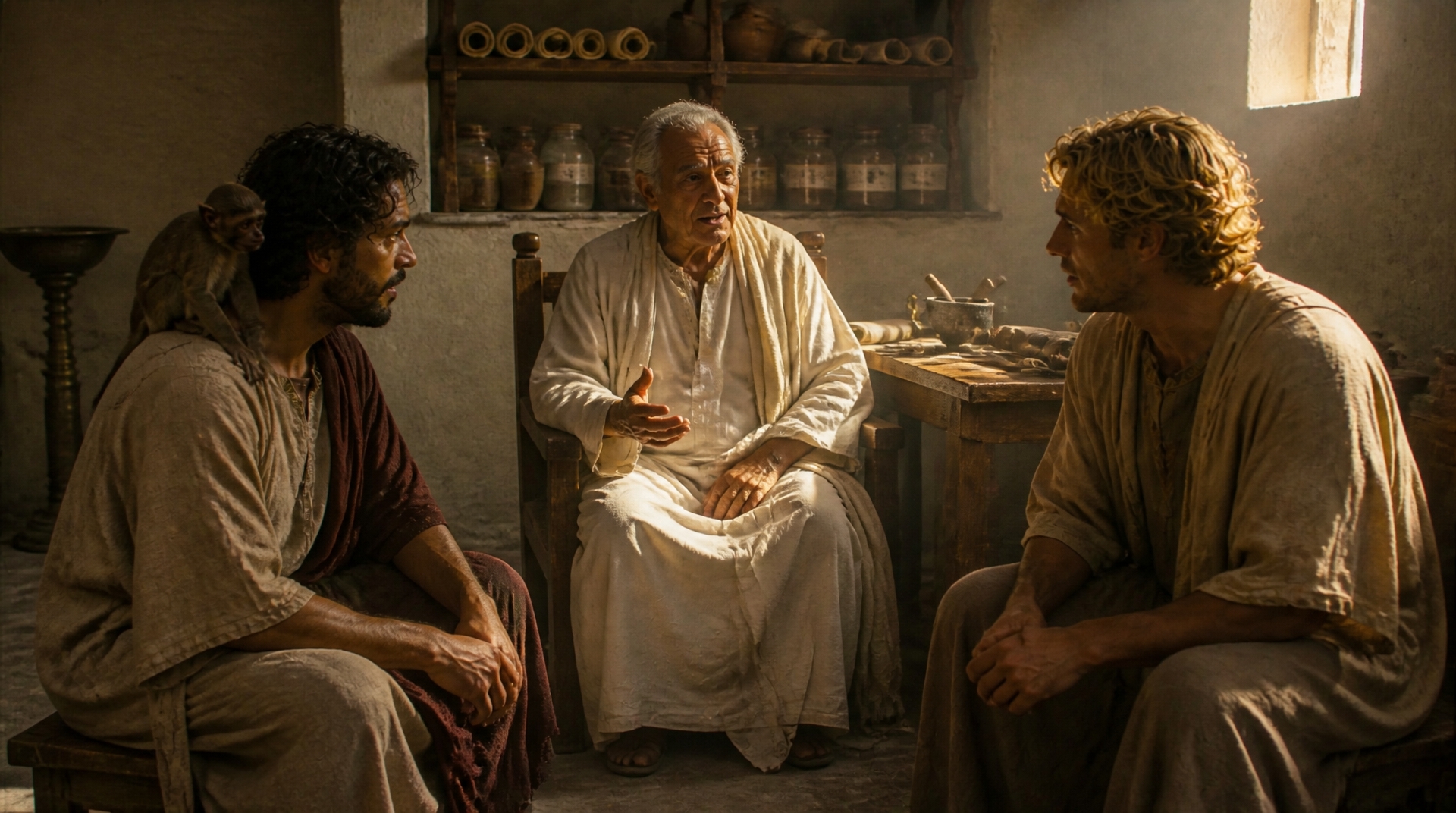
She Was Ours First
Hermippus was eighty. He was the town's doctor, or at least his family's,
but he had aged considerably since Lucian had last seen him.
His hands shook a bit but his mind was clear as the
river off Carteia. Lucian and Demetrios had been
shown into the small bright back room of his house at the ninth hour, where
he looked Lucian up and down, said "You've certainly grown," and gestured them into chairs.
"I have wanted to tell you this for three years," Hermippus continued, "and could not,
because I did not know where you were. So I will tell you now. You will not interrupt me
until I am finished. The story is short, but the parts of it have to be told in order, or
none of it makes sense."
Lucian nodded. Demetrios listened intently.
Hermippus began.
"The sickness reached Samosata in the autumn of the year of the war. Your mother caught
it in the first week. Poor thing was dead by the end of the second. Well, she never had
the strongest constitution, anyway. Your father didn't catch
it. Some men don't, and your father was one of them, but that did not save him.
When your mother passed he sat down on the kitchen bench and stopped eating. He
stopped drinking the day after that. He was gone in a week. I have seen it before. We
call it melancholia—the black-bile death. Galen will tell you it's a humor out of
balance, and Galen is a good man and probably right, but you and I can call it what it
looks like, which is a man whose wife of thirty years has gone out the door ahead of him
and who has decided that he is going to follow her."
Hermippus paused. Lucian bit his lip.
"Your sister Tabitha nursed your mother to the end. She caught the sickness on the
day of your mother's burning, which is why she couldn't cheer your father.
Her fever broke on the morning of the fourth day. She sat
up and asked for soup. She drank it and got up. By the end of the week she was on her
feet and helping me in the quarantine the priest of Apollo had set up in the temple
courtyard—he had thrown the precinct open to anyone the magistrate's men were
going to burn out of their houses, because by then they were burning houses by the dozen
and there was nowhere else for survivors to go. Apollo is the god of plague, as you know.
He sends it and he ends it, and his priest knew his business. Your sister was one of
perhaps eighty people in that courtyard. She nursed there. She was, as best I could tell,
immune. As you know, a person can be infected by the plague only once;
it either kills them, or they become immune. She was the most useful pair of hands I had."
"By then your father was dead and your uncle, who also caught it, was nearly dead himself by then.
He survived. He did not know where Tabitha
had gone, because he was in his own room with his own fever and no one told him.
By the time he was strong enough to walk, Samosata was raided."
Hermippus took a sip of water from the cup at his elbow.
"The raid came two weeks after Tabitha moved to the temple. The Parthians were halfway
down the river and had let the Saracens off the leash for a fortnight. The Saracens came
over the eastern hill in the night and went through the lower town like a comb. They took
everyone they could carry who was on his feet. They left the dying. They killed perhaps
a dozen who fought. They were gone before the garrison from the citadel could come down.
The temple courtyard was emptied. The priest was killed at his own altar. About fifty of
the people in that courtyard were taken. Your sister was among them. The plague pyres
were still smoking at the edge of town the next morning and the magistrate's clerks did
not have time to count the missing properly, so when your uncle finally came looking for
Tabitha and could not find her, the clerk wrote her name down with the dead. That was
the count your uncle had when he wrote you."
Hermippus looked at Lucian with the steady professional kindness of a man who had broken
this kind of news a great many times in his life and had decided long ago that softening
it did nobody any good.
"About six months after he sent you the letter, the rumors came back. Survivors of the
raid were being ransomed by their families from the markets in Edessa and Tarsus.
Reports came up the road of who had been seen alive in what holding pen. A girl
answering your sister's description was named by two different ransomed captives as
having been with them at Edessa. One of them said she had been sold south, the other
said east. Regardless, your uncle was too weak to go look for her."
"I can," Lucian said.
"Well, you have come a little late for your uncle and exactly on time for the rest
of this. We know your sister was alive three years ago. She was wearing a small wooden bird on a
leather cord around her neck when she went into that courtyard. If she's alive now, she
is wearing it still, because she is your mother's daughter and your mother's daughter
does not let go of things her grandmother carved. Where she is now I cannot tell you. She
is in the market that buys plague survivors, son, and that market is large and runs
from Antioch to Caesarea to Salamis of Cyprus and all the way down to Alexandria.
Wherever the rich live and the sickness comes around in summer, there are buyers. That
is what you have to work with."
Hermippus folded his hands in his lap.
"I'm sorry for your losses, Lucian. Your sister I
cannot give you, but I can tell you that the last time I saw her face she was angry, and
she was strong, and she was not done. She may be somebody else's now, but she was ours first."
Hermippus stopped. He had not interrupted himself and he had not been interrupted, and
when he was finished he sat back in his chair and waited.
Lucian was silent for a long time.
"Thank you," Lucian said. "That's the first cogent information that I've had in a long time."
Demetrios, responding to Lucian's positive reception, relaxed visibly. The news of Lucian's
parents' passing had been known for over a year, and he had grieved for them. The only way to
cheer his partner's spirits was to give him information about his sister.
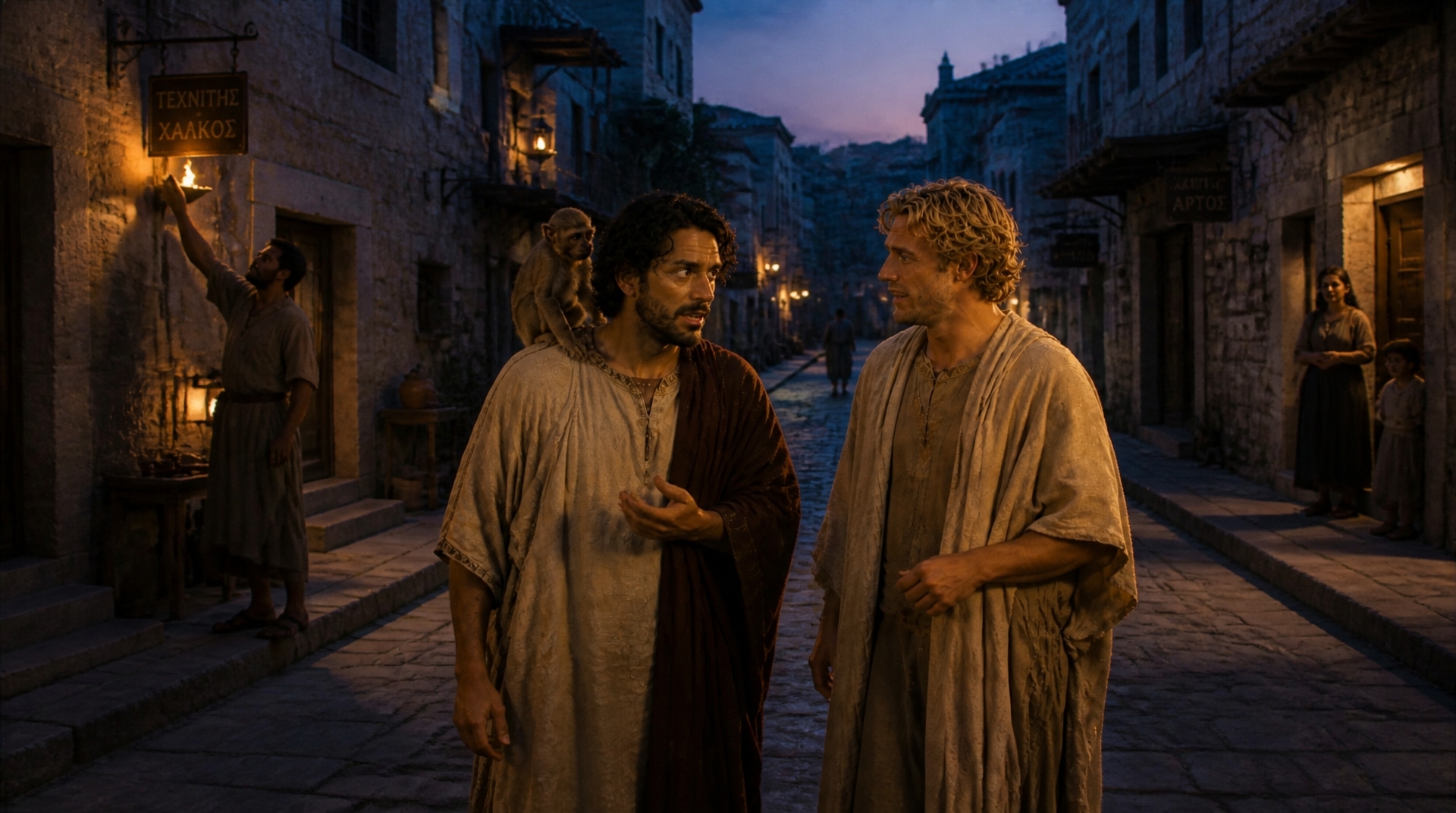
Sold South, Sold East
Lucian and Demetrios walked back from Hermippus's house through the falling light. The
shop signs were being lit by lamp. Children Lucian did not know were being called in to
supper by mothers he did not know, in a language that was the language of his own first
words but now seemed archaic, voices from the past.
Lucian and Demetrios were five streets along before Lucian spoke.
"Two witnesses. Two ransomed captives, neither of whom is alive in front of me. Both put
Tabitha in the same pen at Edessa on the same days. They disagree on what happened next.
One says she was sold south. One says she was sold east. What do you make of that?"
Demetrios considered. "If you were arguing it in front of a magistrate, you'd say one of
them was lying or mistaken."
"Or both."
"Or both. There are four possibilities, not two."
"Name them."
"One: she was sold south. Two: she was sold east. Three: she was sold somewhere neither
of them saw and they both guessed wrong on the question of direction. Four: she's dead, or was never there,
and the girl in the pen was somebody else who resembled Tabitha."
Lucian nodded slowly. "That's the field." He sighed.
"I've spent my working life telling other people the difference
between truth and a good story. I make a living from it. And now we have two witnesses I
can't question, contradicting each other about the one person I most want to find, and
I'm standing in a street in my own town trying to decide whether to ride south or east
on the basis of testimony I'd laugh out of any court I've ever appeared in."
"What does the rhetor in you say?"
"The rhetor says: the part both witnesses agree on is the strong part. She was at Edessa.
She was alive. She was sold. That's where we have to start."
"Then go to Edessa," Demetrios said. "We're a week away, less if we push.
Both witnesses put her there. The market has to keep records—Rome takes its
four-percent cut, and the tax doesn't get paid if the clerk doesn't write the sale down.
Walk in, find the entry for a Syrian girl of the right age on the right week, get the
name of the buyer."
Lucian nodded. "I've been thinking about Edessa since Trokondas named it on the ship.
It's not a simple quest, though. First, I expect the records to be kept by date and by seller,
not by description of the goods. Second, those records may not be open to a private inquirer from
another province. They are, after all, tax records of the imperial fisc. A Greek rhetor with no
Edessene kin and no provincial patron would not get to walk in and read them. He gets to
stand in a hallway and be told to come back tomorrow until he goes away. I'll have to buy my
way in, possibly, with enough coin and enough time and the right introduction, but the
coin and the time would be substantial and the right introduction I don't yet have."
Lucian stopped to take a breath. "Three. They say Edessa changed hands twice in the war.
The Parthians held it for parts of two
seasons. The records office burned once, from what I hear, and was patched together
afterward from what survived and what the senior clerk could remember. The entries from
the year of the raid are the entries most likely to be missing or wrong. Even a clean
record search might come back with nothing where the sale should be, because the page
has been lost."
Lucian paused before finishing. "And four, since I'm counting—even if I find the entry, what I have is the name
of the buyer who walked her out of the market one afternoon three years ago. He may have
sold her again by harvest. He may have died. He may have moved. He may have been taken to
Olympus by Zeus Himself. Slave records don't
chain. Each transaction starts fresh and stops at the moment of sale. So, to follow her past
that first buyer, I'd need to find him and ask."
"That's a lot of points against going."
"I've made the rhetor's case against. Rhetoric is my trade, not my heart.
In my heart, I am a brother who wants to find his sister."
Demetrios looked at him. "Where you go, I go, dear man."
"You're my strength, Demetrios. I wouldn't be able to get through any of this without you."
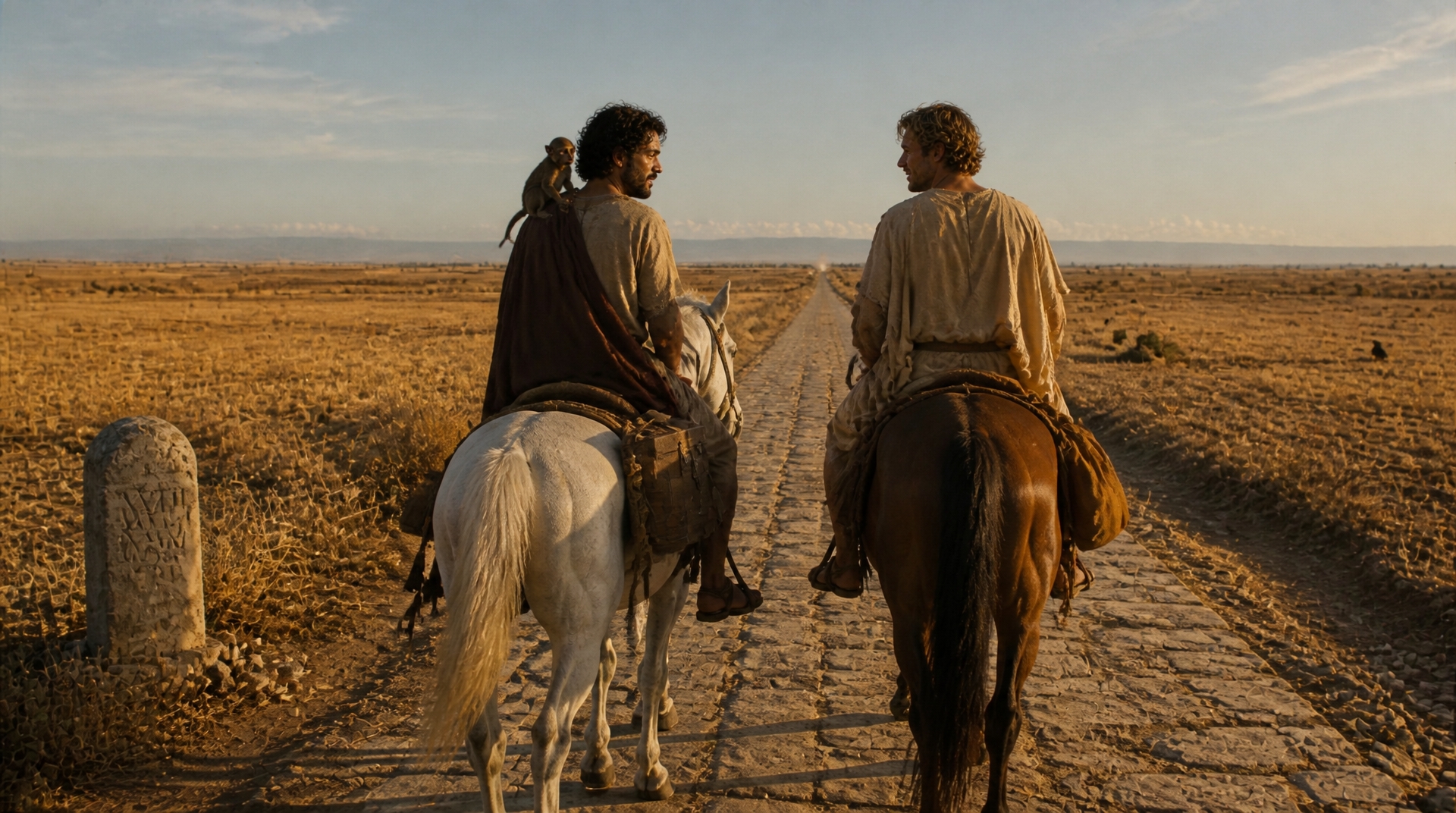
An Answer of Some Kind
Lucian and Demetrios spent five more days in Samosata, putting together supplies for the
eastern road and waiting on a saddler to repair Lucian's tack. Lucian thanked Hermippus
once more. Phokas refused payment for the keepsake box; Lucian left coin in a dish by the
door when Phokas wasn't looking. On the morning of the third day, Lucian went to the burned plot one last
time and stood at the gate that wasn't there. The goat was gone. The child in the
neighboring window raised a hand. Lucian raised one back. That was as much goodbye as
Samosata required.
They rode out at the second hour and crossed the pontoon bridge with the morning sun in
their eyes. On the east bank they turned south for half a Roman mile and then east towards
Edessa, the town from which they could continue their way west.
The olive box rode in Demetrios's saddlebag. The papyrus chest rode
behind Lucian. Veritas rode on Lucian's shoulder, watching Samosata recede across the
brown river.
The country opened out as they left the river valley behind—gold-brown wheat
stubble in every direction, the harvest already in, the long shadows of late September
stretching ahead of them across the cooling ground. Three or four days at an easy pace
would put them at Edessa, and Lucian had decided on the easy pace. There was no use
riding into the city of his sister's first sale at a gallop
three years after the fact, and even less use riding into it tired.
They stopped that evening at a roadside inn that catered to merchants moving in either
direction along the Roman line. Lucian ate, drank a cup of wine, and slept badly.
In the morning Lucian's head throbbed with a dull ache. Demetrios said it was probably the unfamiliar
bed. Lucian agreed. But his head still ached.
Lucian and Demetrios mounted and rode on. The road to Edessa ran level and Roman ahead
of them, the ground rising slowly under the horses' feet toward the long pale line of
hills where, some days from now, a city was waiting to give them an answer of some
kind.
Whatever kind it was going to be.