|
By: Paul S. Cilwa |
Posted: 6/2/2026 |
|
Page Views: 28 |
| Hashtags: #HistoricalFiction #LucianOfSamosata #Alexandria #LibraryofAlexandria #Serapeum |
| Lucian faces his most demanding audience yet: scholars. |
| Estimated reading time: 8 minute(s) (1810 words) |
The merchant who directed them to their lodgings, when asked about the Library, waved his hand
vaguely eastward. "The old one? It's ruins mostly. Fire, you know. Centuries ago. Some
of it's still there if you want to see where the great collection used to be."
A scholar they passed in the market had a different answer. "The Library? You mean the
Mouseion? Or the collection at the Serapeum? Most of the serious work happens at the Serapeum
now. The Temple of Serapis. That's where the books are."
An old woman selling fish gave them yet another perspective. "The Library of Alexandria,"
she said, as if reciting something sacred. "The greatest repository of knowledge in the world.
Or it was. The Romans burned parts of it. Then the city burned more of it. Now it's
scattered—some here, some there. But the Serapeum, that's where they keep what
matters."
By the time they'd asked three more people and gotten three more variations on the same
story—destruction, displacement, survival, the gradual migration of the collection eastward
to the Temple of Serapis—Lucian understood: the Library of Alexandria wasn't one
place anymore. It was a ghost haunting multiple locations, its glory dispersed but never
extinguished.
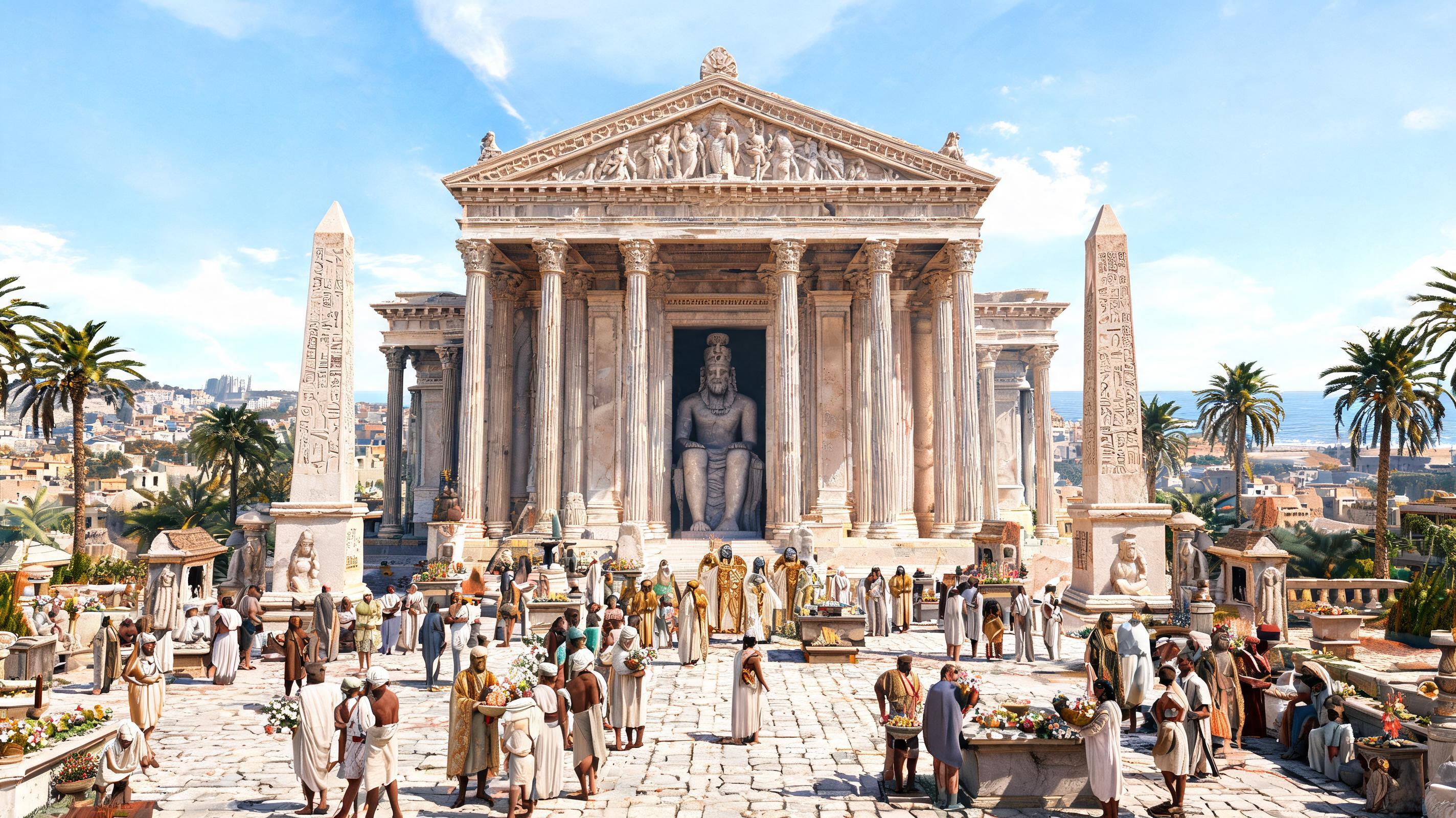
The Serapeum itself was impressive: a massive temple complex, rose-colored stone, courtyards and
colonnades. And yes, libraries. Rooms devoted to scrolls and codices, organized with the kind of
systematic care that suggested serious scholarship.
The Presentation
A scholar at the entrance directed Lucian to a librarian—a man with the weary competence
of someone who'd read ten thousand manuscripts and forgotten more than most people would
ever learn. Lucian presented his work: the transcriptions from the voyage, the new pieces, The
Fly recitation, his thoughts on rhetoric and observation.
The librarian read through the first few pages, then set them down and looked at Lucian with an
expression that suggested mild surprise. "You wrote these?"
"Yes."
"And you're offering them to the Library?"
"If you think they're worth preserving."
The librarian picked up the pages again and read more carefully. "I would say they are, yes indeed!
Yes. Let me show you how we handle this."
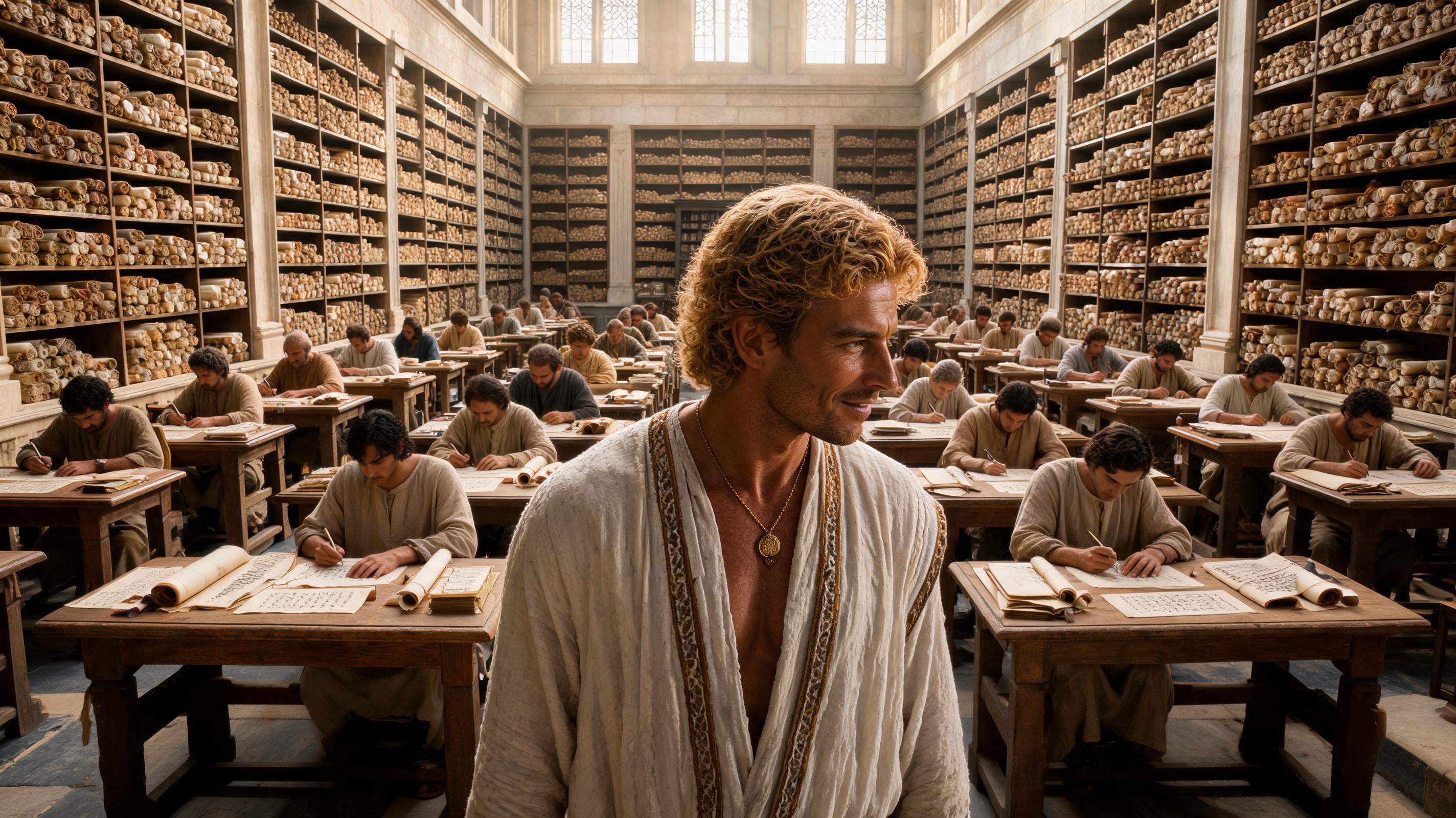
He led them through the archives to a large room where perhaps twenty scribes sat at long tables,
working in careful unison. Each had a manuscript before him. Each copied, line by line, with the
focused intensity of someone performing sacred work.
"The copying process," the librarian explained. "Everything we preserve has to be copied.
It takes time. It takes money. But it's how knowledge survives."
Demetrios stood watching the rows of copyists, and Lucian saw something shift in his expression.
Finally, he said quietly: "Y'know…if only there was some way of making thousands of copies at
once. It might make the cost of publishing profitable enough to pay something back to the
authors."
The librarian looked at him with interest. "Well, unless your monkey is a genie, this is how we do it."
The Head Librarian
Later that afternoon, after the men had lunched, a young scholar appeared at their quarters with an invitation. The head of
the Library wished to meet Lucian. Lucian wasn't sure whether to be excited or concerned, but they
hurried back to the temple to meet her.
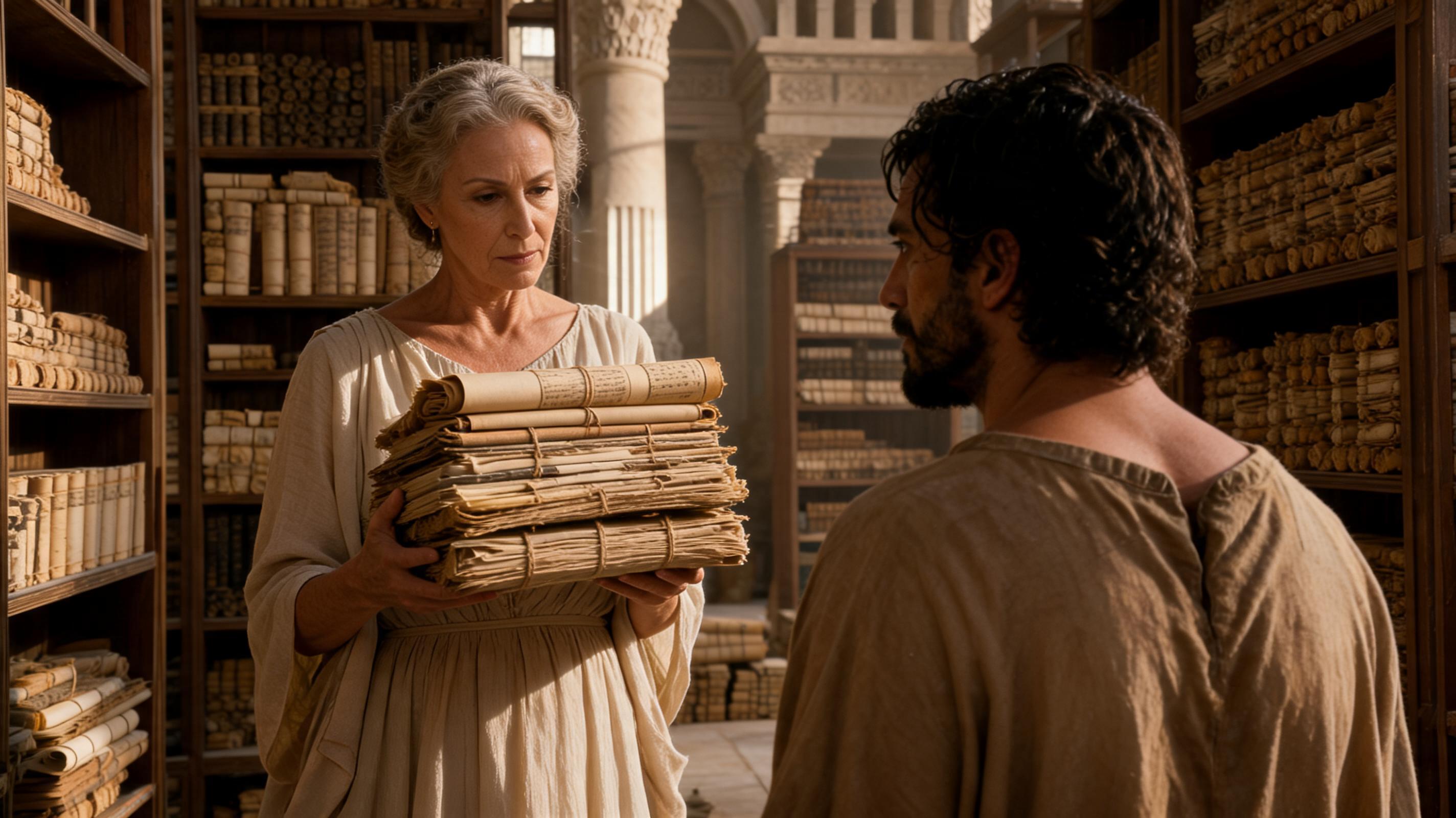
Her name was Marian. She was perhaps fifty, with the kind of presence that suggested she'd
been taken seriously her entire life. She held Lucian's manuscripts in her hands like they
were precious objects, which, in this context, they were.
"These are good work, young man," she said without preamble. "Your voice is clear. You observe
carefully. You have something to say. You have promise."
Lucian felt something settle in his chest—not just validation, but recognition. She
wasn't flattering him. She was reading his work the way a teacher reads a student's
work, seeing both what was accomplished and what was possible.
"I want you to meet someone," Marian said. "He's here for the season. Galen, the
physician and philosopher. He has thoughts about rhetoric and knowledge that I think you'd
find interesting."
Galen turned out to be a compact man with sharp eyes and the bearing of someone used to being
listened to. He was in the library examining medical texts when Marian brought them over.
They exchanged the customary greetings. And then Demetrios, who had been quiet until that
moment, said: "You're a doctor?"
"Among other things," Galen said.
"This man," Demetrios said, gesturing to Lucian, "once saved an entire village in
Mauritania from plague. He brought in fresh water, organized the sick, kept people calm while
they recovered. He was brilliant."
Lucian felt his face warm. He hadn't told Demetrios to say anything.
Galen looked at Lucian with new interest. "You're trained in medicine?"
"Oh, no," Lucian said, his face flushing. "I just…I watched what
was happening and saw a way to fix it.
Observation, really. Noticing what was wrong and trying something different."
"That's half of good medicine," Galen said. "The observation part. People get
trained in the theory and forget to actually look at what's in front of them."
"He's brilliant," Demetrios said. "He just doesn't know it."
Galen smiled. "The good ones never do. The ones who believe themselves to brilliant,
never are."
Over the next few days, a conversation developed between Lucian, Marian, and Demetrios about the
economics of manuscripts.
The Library would copy Lucian's work. That was certain. But copies were expensive. If
Lucian wanted to keep his own originals—which Demetrios argued he should, in case the
Library's copies were lost or damaged—those copies would have to be paid for
somehow.
"Does the Library host rhetors?" Demetrios asked Marian one afternoon. "For lectures,
performances, that sort of thing?"
"We do," Marian said. "It brings people in. Donors. Scholars from other cities. Good
rhetoric is a form of knowledge, after all. The art of persuasion, the craft of language—it
matters."
"What if," Demetrios said carefully, "Lucian were to give performances here? Once a
week, say. In exchange for payment. And that payment can go toward the cost of making copies of
his own work."
Marian considered this. "You're suggesting we hire him as a performer, and use part of
that payment to fund the reproduction of his own manuscripts?"
"Exactly," Demetrios said.
"It would be good for the Library," Marian mused. "A known rhetor giving performances
would draw an audience. And it would be good for him—he'd have a guaranteed income,
and he'd have control over his own work." She turned to Lucian. "What do you
think?"
Lucian had been quiet through this conversation. He was thinking about what this meant. Not just
money, though that was practical. But a place. A role. Work that used his gift while also
supporting his own creation.
"I think," he said slowly, "that I would like that very much."
The Performance
Three weeks later, Lucian stood backstage—if you could call it that in a temple—waiting
to be introduced. His hands were trembling slightly. This was different from the other crowds
he'd played.
In Carthage, in other cities, he'd always known his audience: a mix of wealthy patrons, idle
nobles, merchants wanting to be entertained. He could construct a speech with layers, meanings
that worked on multiple levels. A joke that landed differently depending on how much education
you had. A reference that the truly learned would catch while the others felt clever anyway.
But this audience—he'd peeked through the curtain. They looked very educated.
Scholars, philosophers, physicians. And women. Remarkably, women. Egyptian women, he'd learned,
had freedoms that Roman women could only dream of. They attended lectures. They studied. They
had minds that expected to be engaged.
There was no second level here. No clever tricks for the uneducated masses. There was only truth,
only genuine skill, only authenticity.
His nervousness crystallized into something else: clarity. This was the test Demetrios had meant.
Not the Library accepting his work. This. Standing in front of people who would know immediately
if he was performing versus actually saying something true.
Marian introduced him. He stepped out into the light.
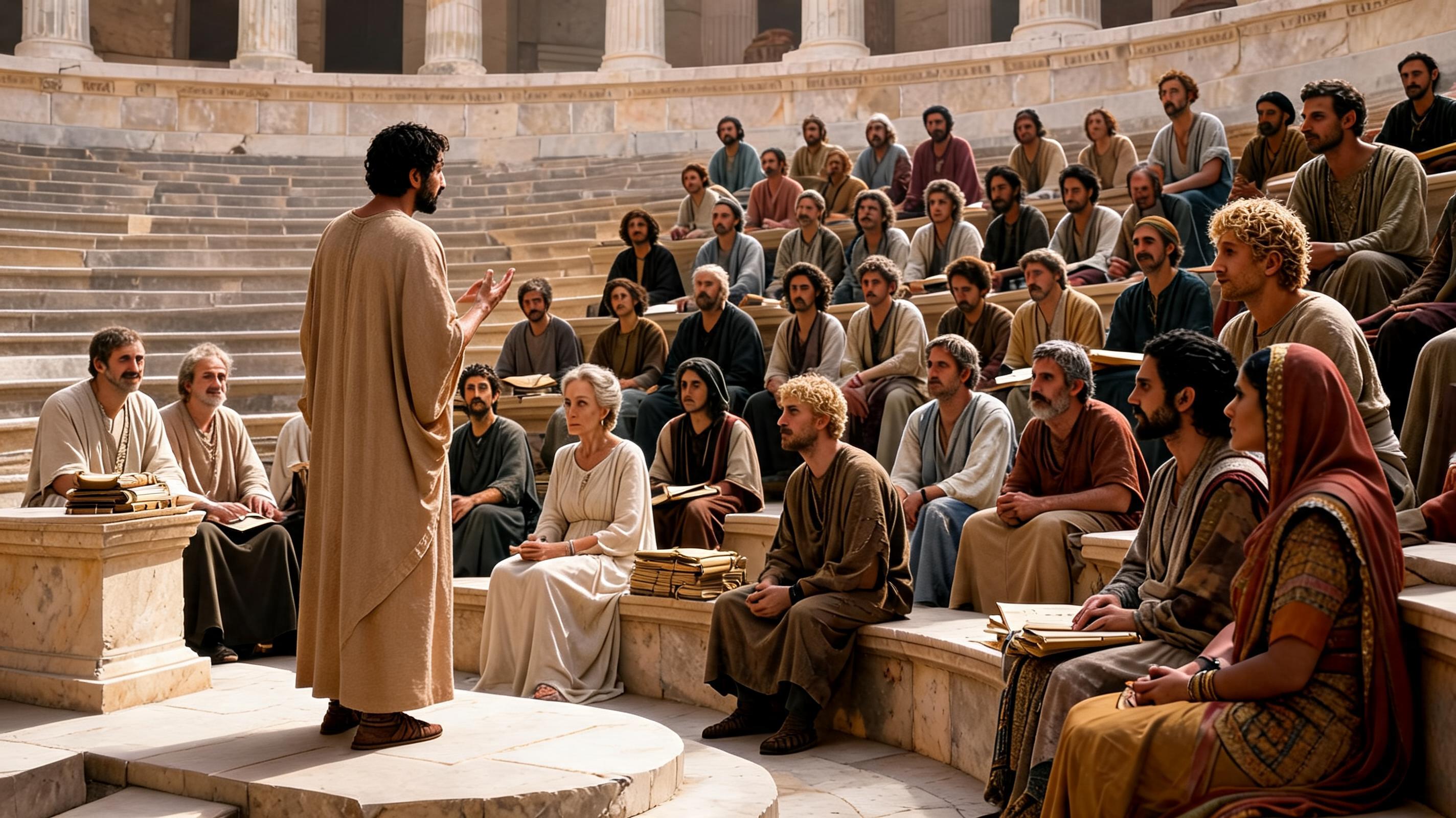
The auditorium was perhaps thirty people. Small enough to be intimate. Large enough that
nervousness could still bloom. He saw Marian in the front row, nodding encouragement. Galen
beside her, watching with clinical interest. Demetrios in the back, transcribing, as always.
And then he saw Celer, their friend last seen in Carthage. Standing to the side,
grinning like they were old friends running into each other at market.
Lucian began. Not with bombast, not with empty flourish. He began with observation.
"I want to talk about what it means to look at something," he said, "and actually see
it."
He talked about Tala's winter camp in Mauritania. Not to brag, but to illustrate. What he'd noticed.
How observation had saved lives. How most people move through the world half-asleep, seeing
what they expect to see rather than what's actually there.
He talked about the monkey—Veritas—and what that small creature had taught him about
presence and attention.
He talked about rhetoric itself. Not as a tool of manipulation, but as a way of saying true
things in ways that actually reach people. The art of observation turned into the art of
communication.
And as he spoke, something shifted. The nervousness didn't disappear, but it transformed. It
became focus. He wasn't performing for these people. He was thinking alongside them. Inviting
them into observation with him.
When he finished—not with a flourish, but with a simple statement: "We are all asleep
until we are woke"—there was a moment of silence. Then applause. Not the
thunderous approval of a crowd wanting to be entertained. But the intense recognition of people
who had been genuinely engaged.
Afterward, people approached him. Questions. Genuine questions. One scholar wanted to discuss
Stoicism and observation. A physician asked whether he'd formally studied medicine. An older
woman—Egyptian, dressed in linen that spoke of wealth—simply said, "That was true.
Thank you."
And then Celer, their occasional travel companion, pushed through the crowd, embracing him like a brother.
"What are you doing here?" Lucian asked, genuinely surprised.
"I live here now. As I told you in Carthage, I have accepted a position as
Chief of Staff to the Prefect of Egypt. " Celer's expression shifted. "But I'm glad I caught you. There's a
problem. A peculiar one. And I think you might be the only person who could help."
"Help with what?" Lucian asked.
"Not here," Celer said. "Not now. I'll meet with you tomorrow.
Where are you staying? I need to show you something. Something strange."