|
By: Paul S. Cilwa |
Posted: 6/1/2026 |
|
Page Views: 23 |
| Hashtags: #HistoricalFiction #LucianOfSamosata #Voyage #Alexandria #Hemp #Cannabis |
| Lucian and Demetrios discover cannabis. |
| Estimated reading time: 12 minute(s) (2626 words) |
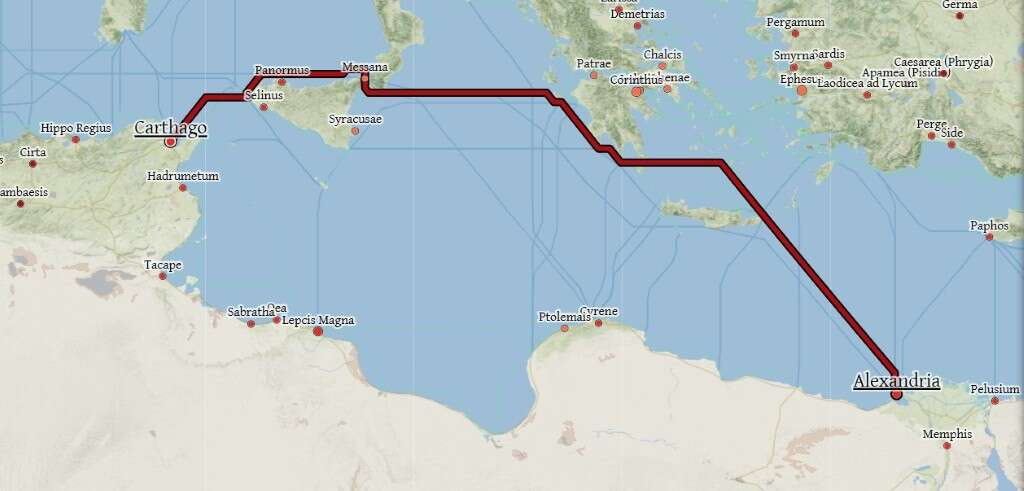
They left two days later, as Lucian, having resigned himself to continuing their
eastward journey, found himself looking forward to seeing Alexandria for the first time.
Ships left with the morning tide. Their ship would make two brief stops in Sicilia,
and then toward Alexandria. The ship was not grand. It was functional,
smelling of rope and salt and the practical business of moving cargo from one place to another.
Veritas accompanied them. It wasn't Lucian's choice; the monkey simply wouldn't leave his or Demetrios' side.
And apparently this sort of thing wasn't uncommon; the ship's crew were used to animals on board,
and Veritas took up virtually no space, riding on Lucian's shoulder.
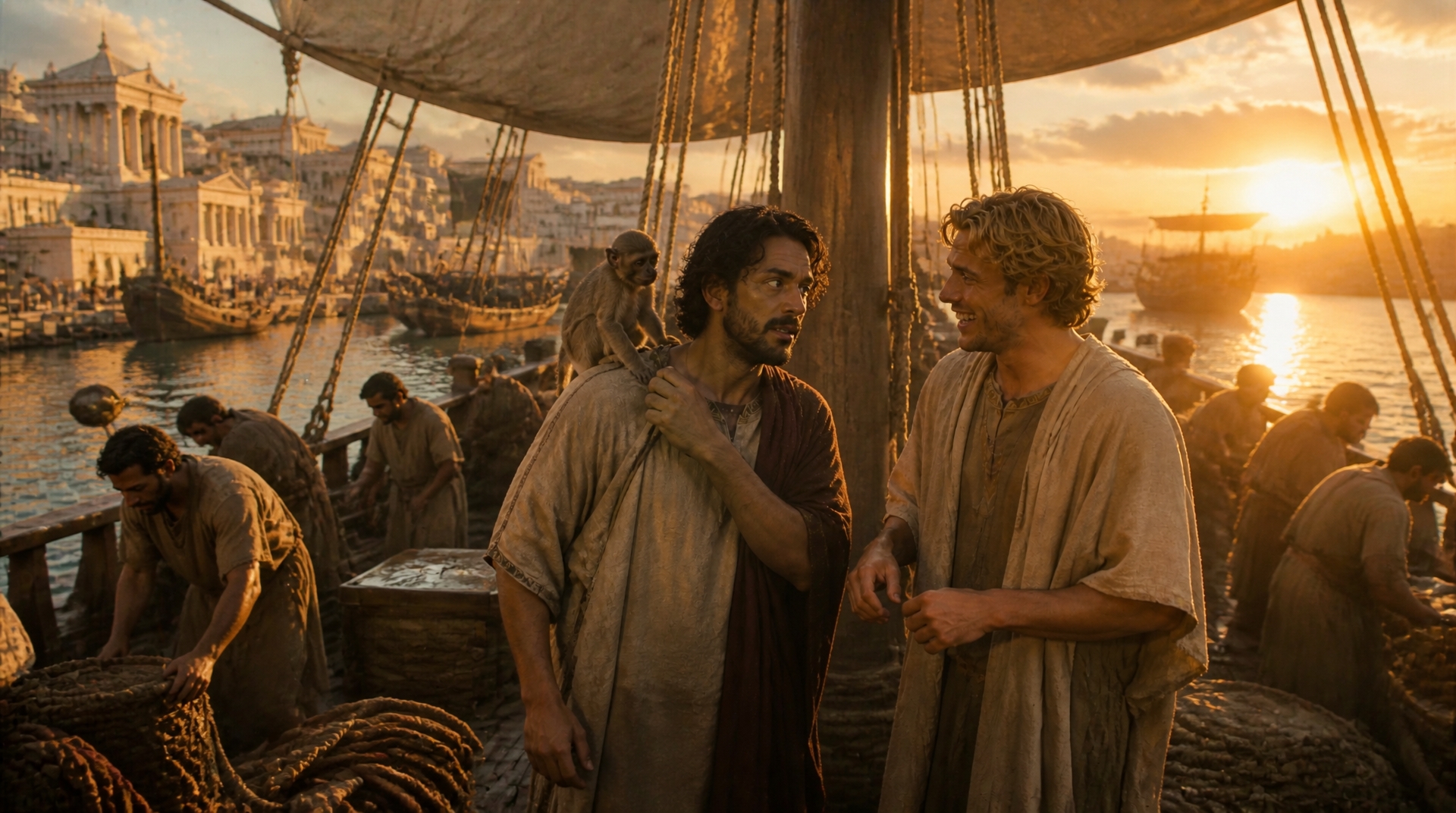
As they boarded, a sailor—an old man with the color of mahogany from years in the sun—was coiling
rope near the rail. He nodded to them as they came aboard.
"Where are you bound?" he asked, the way sailors do.
"East," Lucian said.
"Syria, eventually," Demetrios quickly added.
The sailor nodded. "Good sailing for it. Rome is just three days north if you wanted to
visit. Port as big as this one. But Syria is prettier. Smaller. You'll like it."
Call of the Sea
Lucian stood at the rail and watched Carthage recede. The white marble caught the morning light and
threw it back, glittering. Beautiful. False. A beautifully packaged grave with glitter on top.
Rome was only three days sailing north. Safety. Distraction. The center of everything. He could have gone. He
could have turned the ship around. Well, okay, maybe not. So instead
he stood there and watched Africa's coast slide past, and felt
Demetrios beside him, steady as stone.
"I couldn't face it without you, you know," Lucian said. Demetrios squeezed his hand.
Veritas kissed his cheek.
The ship turned south. Syria waited. And Lucian turned to face it, toward the home that had burned,
toward the family that was ash, toward the only thing that might matter: that he had chosen not to
hide.
When Demetrios joined him at the rail, he said, "I've been considering something.
My speeches. The ones that went well. I should have them written down. Properly. On papyrus. With
scribes making copies. They could be distributed. Circulated among people who care about rhetoric.
They could last. That could be my road to immortality."
Demetrios considered this. "How does that work, exactly? The writing and copying?"
"A scribe writes out what I dictate. Or what someone remembers I said and writes it down later. Then other scribes copy it
by hand, carefully, on papyrus. It's slow. Expensive. You need patrons willing to pay for the work.
But once it's done, it exists. It lasts. Long after I'm gone, people could read my words."
Lucian could hear the appeal in his own voice—the desire for immortality, for permanence, for
proof that he had mattered. For proof that he could matter without having to be present,
performing, alive in the moment. He could be dead, and still be brilliant. Still be preserved.
"That's not a bad thing," Demetrios said. "I think your words are worth preserving.
Why, I repeat them as my own at every opportunity!"
The Stash
Later that same afternoon, Lucian was sitting on a coil of rope near the rail, half-dozing in the
warm salt air. Demetrios was nearby, organizing some notes. Veritas had wandered off to explore the
ship, as he did every day.
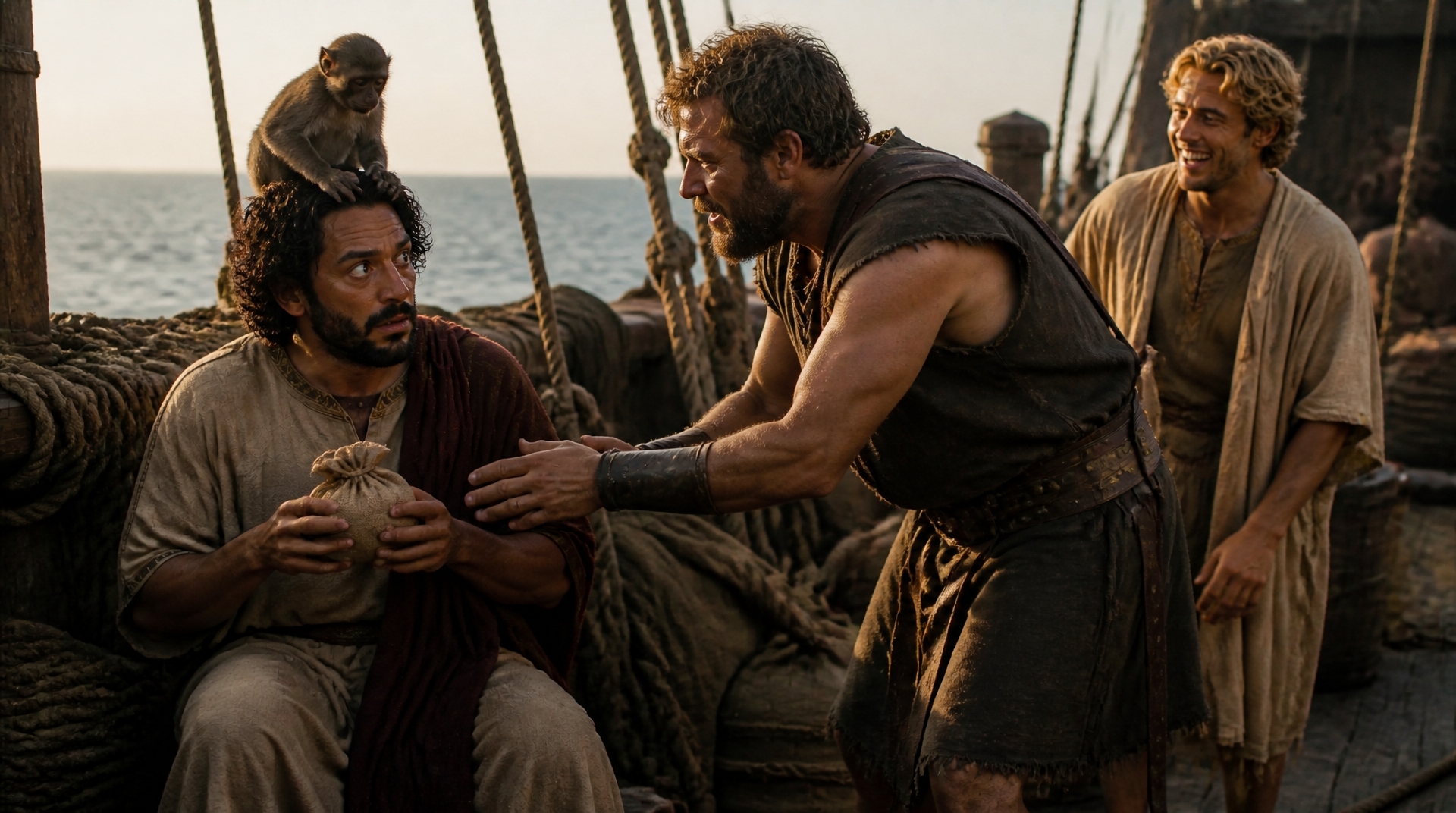
Lucian didn't see the monkey coming. One moment he was drifting toward sleep, the next Veritas had
launched himself directly into his lap, chittering frantically, clutching a small cloth pouch.
Lucian jerked awake, startled. "What—?"
Behind the monkey, moving fast, came the weathered Thracian sailor who'd greeted them when they
first boarded, red-faced and breathing hard. "Your monkey!" the man gasped. "That's mine!"
Veritas leaped away, but not before dropping the pouch directly into Lucian's hands. Then the monkey
scampered up the rigging.
Lucian sat there, holding the cloth pouch, confused. Demetrios began to laugh.
"What is this?" Lucian asked.
The Thracian approached them, catching his breath. "That's my hemp. He stole it!" Lucian
handed over the pouch. The man examined it for damage, and shrugged. "He's got good instincts,
anyway. Better a monkey that steals than one that doesn't know what's worth taking.
I'm Buces. See you around. I'll be here all month."
That evening, Buces found them in their quarters. Demetrios was organizing notes. Lucian was
staring at nothing. Veritas was grooming himself with the focus of someone who took his appearance
seriously.
"Your monkey," Buces said, without preamble. "Do you know what he stole?"
"No," Lucian admitted.
"My hemp. For smoking."
"People smoke rope?" Lucian blurted incredulously.
"Not rope. Hemp. It's not the same thing when it's prepared. We smoke it where I'm from, in Thrace.
It's what we do." Buces paused. "I'm going to smoke some tonight. On deck. If you want to
try it, you're welcome to come. No obligation. It's the least I can do after you rescued my stash!"
Lucian and Demetrios exchanged a glance. Demetrios shrugged. "Why not? I'll try anything once.
Twice, if I like it!"
The Ritual
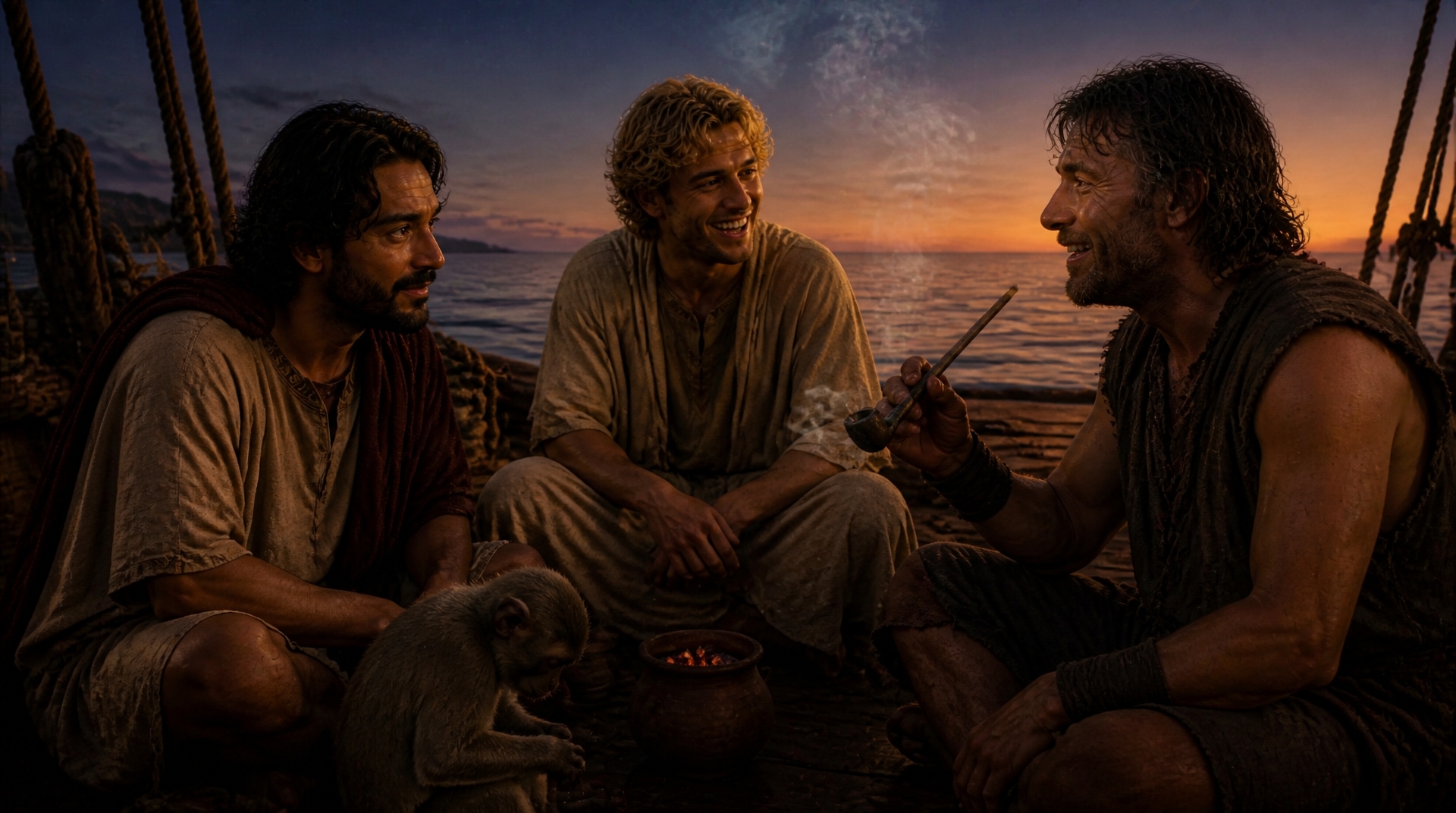
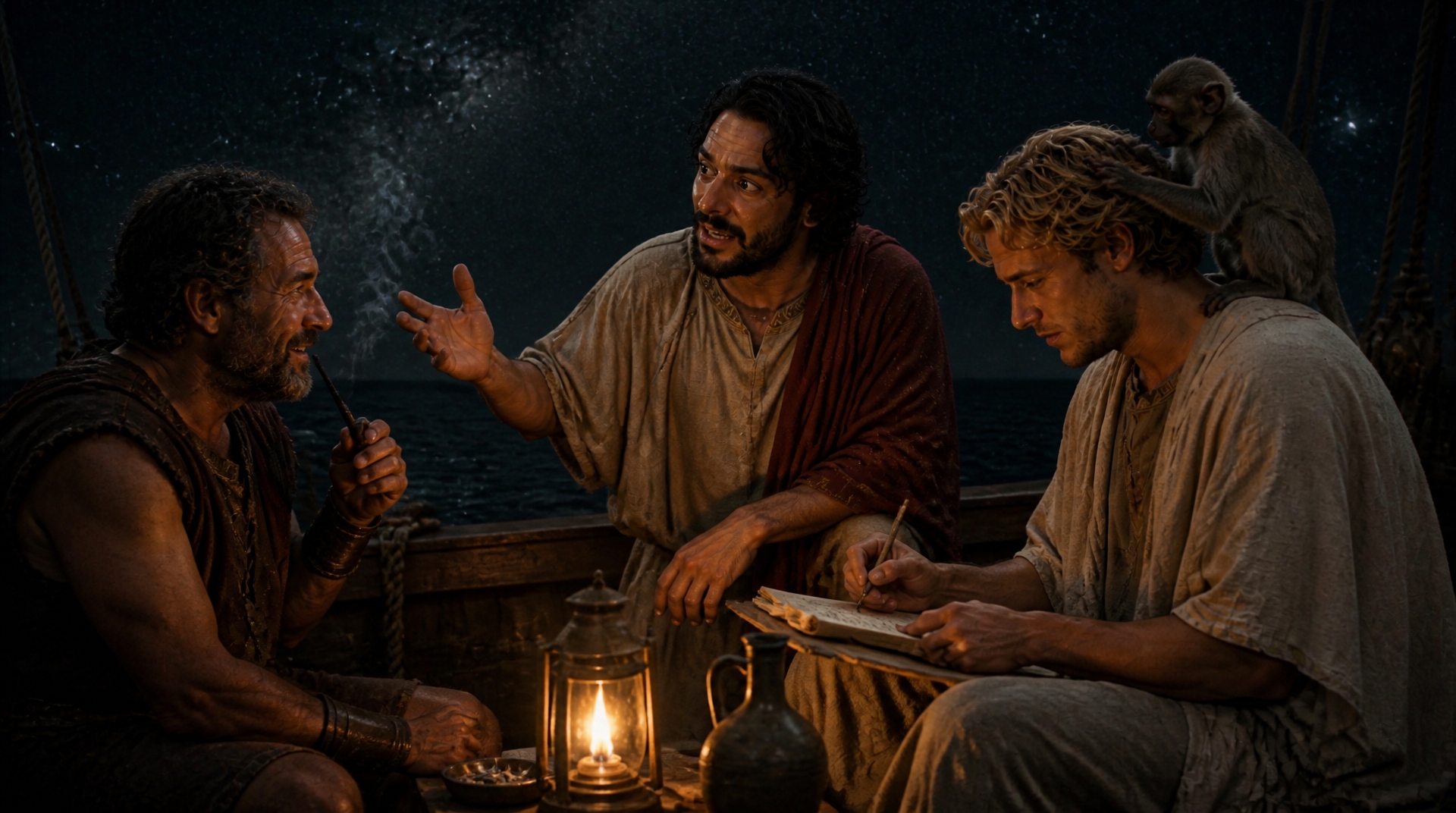
They gathered on deck as the sun was setting. The ocean was calm. The ship moved through water that
had turned the color of bronze in the fading light. Buces had brought his pipe.
It was clay, carved with simple patterns that had been worn smooth by years of handling. The stem
was long enough that heated air wouldn't burn one's lips. The bowl at the end was just large enough to hold
a pinch of the dried material.
"Watch," Buces said. He showed them how to pack it—loosely, not tight. "You want air to
move through. Not too much, not too little." He positioned it in his mouth at an angle. "You
inhale gently. Let the heat do the work."
He held a glowing coal from a small brazier he'd prepared, brought it close to the bowl, and drew
slowly. The hemp caught. The coal glowed brighter. He exhaled slowly, and smoke curled into the
darkening sky.
"Now you," he said to Lucian, and handed him the pipe. "Just suck air through it, into your mouth and lungs."
Lucian hesitated for just a moment, then put it to his lips. He drew in, the way Buces had shown
him. The smoke was harsher than he expected. It filled his throat and lungs. He coughed
violently.
Demetrios laughed. Buces handed him water. "Easier the second time," he said.
Lucian tried again. Better. He held the smoke, felt it settle, exhaled. The world was already
becoming slightly softer at the edges.
Demetrios took his turn. Also coughed. Also eventually found the rhythm.
The pipe passed between them. Buces kept the coal ready. The rhythm became almost meditative: draw,
hold, exhale, pass. The stars were beginning to appear.
And then Veritas jumped over and swiped the pipe right out of Buces' hand.
He brought it to his mouth—or tried to, the angle was awkward for a monkey's face—and inhaled
with the casual confidence of someone who had done this before. He exhaled slowly, his eyes
narrowing with something that looked very much like satisfaction.
"Not your monkey's first time, I take it," Buces observed.
"Not even almost," Lucian said in awe.
Veritas passed the pipe back to Buces with the dignity of someone performing a sacred ritual. Then
he curled up at Lucian's feet, grooming his own fur with the contentment of a creature who knows he's loved.
Buces's expression grew serious. "I need to warn you about something. Don't drink much
wine if you'll be smoking. The hemp dulls your gagging reflex. You drink too much, you get
unconscious, you vomit while you're asleep on your back, and you suffocate yourself.
Understand?"
Demetrios looked up. "Really? You can swallow anything and not gag?" he asked with interest.
"That's right. That's the danger, if you're unconscious."
So they drank water instead. And then, after a bit, they found themselves snacking on bread.
And olives. And dried fish. And just a few more olives. And as the mellowness began to settle over them like
a warm blanket, conversation started.
"Where are you from?" Buces asked.
Lucian found himself actually answering. Not performing. Not curating. Just…speaking.
"Syria. A small town. Called Samosata. My mother lived there. She was a good woman. Patient."
He chuckled absently. "She
used to say that the only thing that mattered was knowing who you were, not where you were."
He stopped. The mellowness had made the memory vivid, and almost unbearable.
"She's dead now. Three years. The plague. My whole family. My sister Tabitha, she was brilliant. She
would have been a better rhetor than me. But girls don't get to be rhetors. So she helped run the
household instead. And then there was no household to run."
He was quiet for a while.
"I've been running since I heard. Performing. Making people laugh and think I was brilliant. But
mostly just running. Until Demetrios made me get on this ship and leave everything behind."
He looked with love at Demetrios.
As he spoke, Veritas climbed onto his shoulder and began grooming Lucian's hair. Methodically. Carefully.
Picking. It should have been strange. Instead, it was oddly comforting. The small, warm weight of
the monkey. The gentle attention.
Demetrios reached over and held Lucian's hand.
Buces listened. He didn't offer platitudes. He just sat with them, and when it was his turn, he
told stories of Thrace. Of the Black Sea. Of what it meant to be far from the place you came from.
"My father's a wool merchant," Demetrios confessed when Buces was finished. "I've been traveling
with him since I was 5. So, yes, my home in theory is Athens. But in reality, it's here. Next to
this guy."
And the stars came out, and the hemp smoke swirled away over the sea in their wake, and for the first time in
years, Lucian found himself not performing. Just being. Just grieving. Just alive.
The Recitation
As the evening deepened, and the mellowness had fully settled into his bones, Lucian
mock ordered Demetrios to take dictation. "They loved this one, I'm pretty sure I can remember
it, do you? The Fly?"
Demetrios nodded. "Of course. I know it. That's the one where the sophist heaps praise on anything
he's paid to praise, deserving or not."
Lucian began with the opening lines: "O Fly, you who have conquered the air, who move faster than thought,
who are everywhere and nowhere, who beg from the table of every man and feast at the banquet of
gods—I praise you. I honor you. I celebrate your excellence!"
But then he continued piling on increasingly absurd praise upon the lowly pest.
Describing the Fly's legs in rapturous detail. Celebrating the miracle of its eyes, comparing them
to stars and moons and the divine fire itself. Waxing philosophical about the moral superiority of
insects to men. The sophistic bombast became almost ridiculous, as intended. He was laughing
at himself, at the empty flourishes, at the profession he was part of.
"And yet," he concluded, his voice clear and whole, "for all your magnificence, you are
still only a fly. You live for a season. You trouble the evening and then you are gone. And that,
perhaps, is enough. And the same, I believe, can be said of sophists!"
Demetrios had been transcribing, his stylus moving steadily. Veritas, perched on Demetrios's
shoulder, had paused in his own grooming to listen, then returned to his work, picking lice from
the scribe's hair with the focus of someone doing important labor.
When Lucian finished, Buces began to clap. Slowly. Deliberately. Like a man paying respect to
something true. "Why, you're right!" he declared. "The fly is an underappreciated
beast!" He sighed, bade goodnight, and went down to his hammock.
Lucian and Demetrios stared at each other until he was gone, then burst out laughing.
A Month At Sea
Lucian woke clear-headed. No headache. No nausea. Just thirsty. He drank water. A lot of it.
And then he realized something that made him sit still for a long moment.
In one evening, he had learned something new. About hemp. About the Thracians. About himself. He
had made a friend. And, with Demetrios' help, he had actually created something permanent,
something that might outlast him.
Weeks in Carthage: he had learned nothing. Hidden from everything. Performed his brilliance while
his soul died in small increments.
"Demetrios was right," he said aloud.
Demetrios, sitting across from him with his notes and transcriptions, smiled. "Usually am."
Veritas was grooming peacefully in the morning light, occasionally plucking at his own fur
and eating whatever he found there.
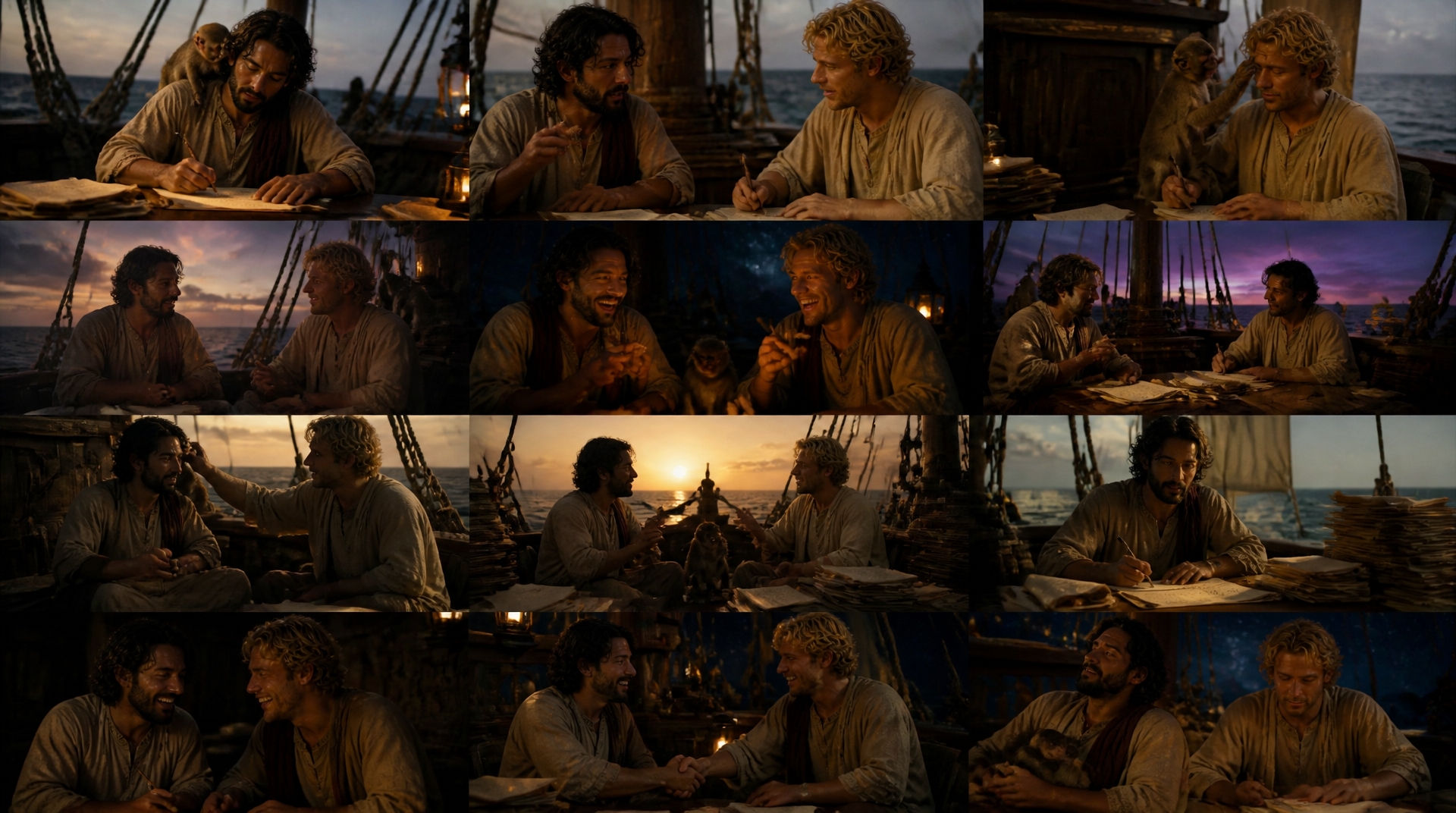
The voyage became a rhythm.
By day, Lucian dictated. Transcriptions of his greatest hits.
He created new material, reworked old pieces, let his mind wander across the
water and find the one, precise word for each concept. Demetrios transcribed. They went
through papyrus quickly. In Panormus, and again in Messana, they bought more. It wasn't cheap,
but they bought it anyway.
By evening, there was the ritual. The pipe. The hemp. The mellowness. Buces' stories. And always,
Lucian talking. Processing. Finding language for his grief.
Veritas had become part of the routine. Each afternoon, he would make the rounds: Demetrios' hair,
picking through it with meticulous care. Lucian's beard, which he seemed to find particularly
fascinating. Even Buces', who sat patient and grateful for the grooming, nodding with satisfaction
when the monkey found a louse and ate it.
By the end of the month, Lucian had stacks of papers. His words, his voice, poised to outlast him.
Alexandria
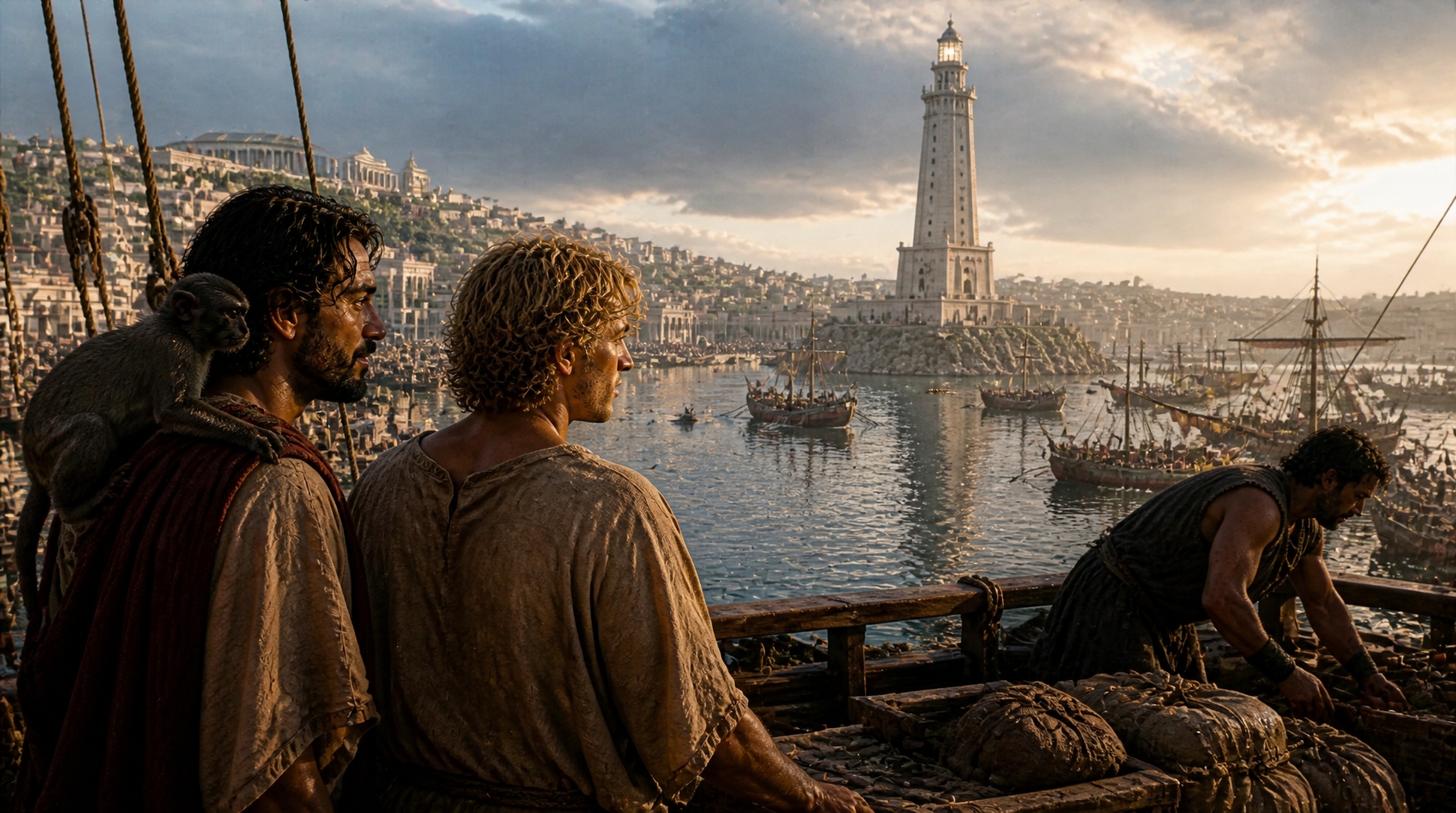
The ship approached Alexandria in the late afternoon.
The harbor announced itself long before they saw the city: the noise, the congestion, the smell of
a thousand ships and ten thousand workers. The Pharos lighthouse stood on its island, white and
impossible and real. The city rose beyond it, dense and chaotic and utterly unlike Carthage's
manufactured glitter.
This was a city built by conquest and maintained by necessity. This was a city where people
actually lived.
Lucian stood at the rail with Demetrios beside him. Veritas sat on his shoulder, grooming around his ear
absently. Buces was already organizing the unloading of cargo, but he paused to stand with them for
a moment. "I enjoyed meeting you guys," he said. "You really made this trip an enjoyable one.
Trust me, that's not true of all passengers. Fare well."
"Celer will be here, somewhere," Demetrios remarked as they disembarked.
"And then?" Lucian asked.
"Then on to Syria! And then Antioch or Athens, wherever you decide. Not a place
to rot in, but one you can blossom in. And, remember, we aren't limited to the
lands around the Inner Sea. There's Hindustan, and Britain, and even explorers who travel the coast
of Africa that faces the Outer Sea."
Lucian felt the weight of it. The reality of it. Three years of running had led him here, to this
moment, standing on the deck of a merchant vessel, approaching the greatest library in the world,
knowing that his childhood home awaited him further south and east.
But he was different now. A month of writing and smoking and grooming and grief had changed
something in him. He had learned that creation was possible even when you were afraid. That
friendship could happen unexpectedly. That a monkey could be wise in ways no man could be.
And whatever lay ahead—the reckoning with Syria, the confrontation with loss, the work of actually
living life instead of merely performing it—he was beginning to think he might be ready for that.