|
By: Paul S. Cilwa |
Posted: 5/31/2026 |
|
Page Views: 19 |
| Hashtags: #HistoricalFiction #LucianOfSamosata #Carthage |
| A thieving monkey uncovers a truth Lucian can't outrun. |
| Estimated reading time: 13 minute(s) (2925 words) |
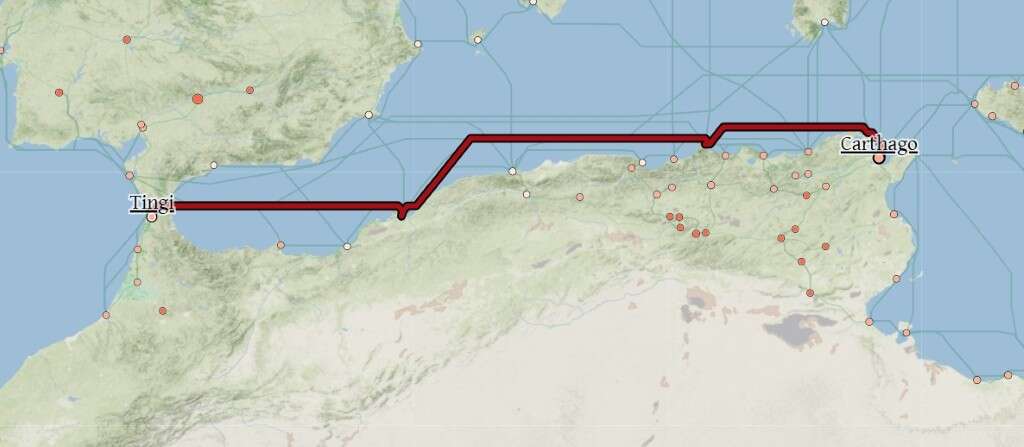
After a little over two weeks at sea, Lucian thought he'd never seen anything more beautiful.
The ship docked. Lucian, Demetrios and Celer collected their things.
By evening Lucian and Demetrios had taken rooms in a house near the
forum—Carthage was too grand a city to lodge in a taberna—and Celer
confirmed his passage to Egypt. They bid fond farewells, and Lucian and Demetrios promised to
look him up when they got to Alexandria.
Carthage was not what Lucian expected. He had expected ruins. He had expected some sense of the
city that had been destroyed, the great Carthage that had nearly conquered Rome itself. What he
found instead was glitter.
Not the authentic gleam of a city earned through honest trade and honest living. This was the
glitter of something constructed, something painted over, something determinedly, aggressively
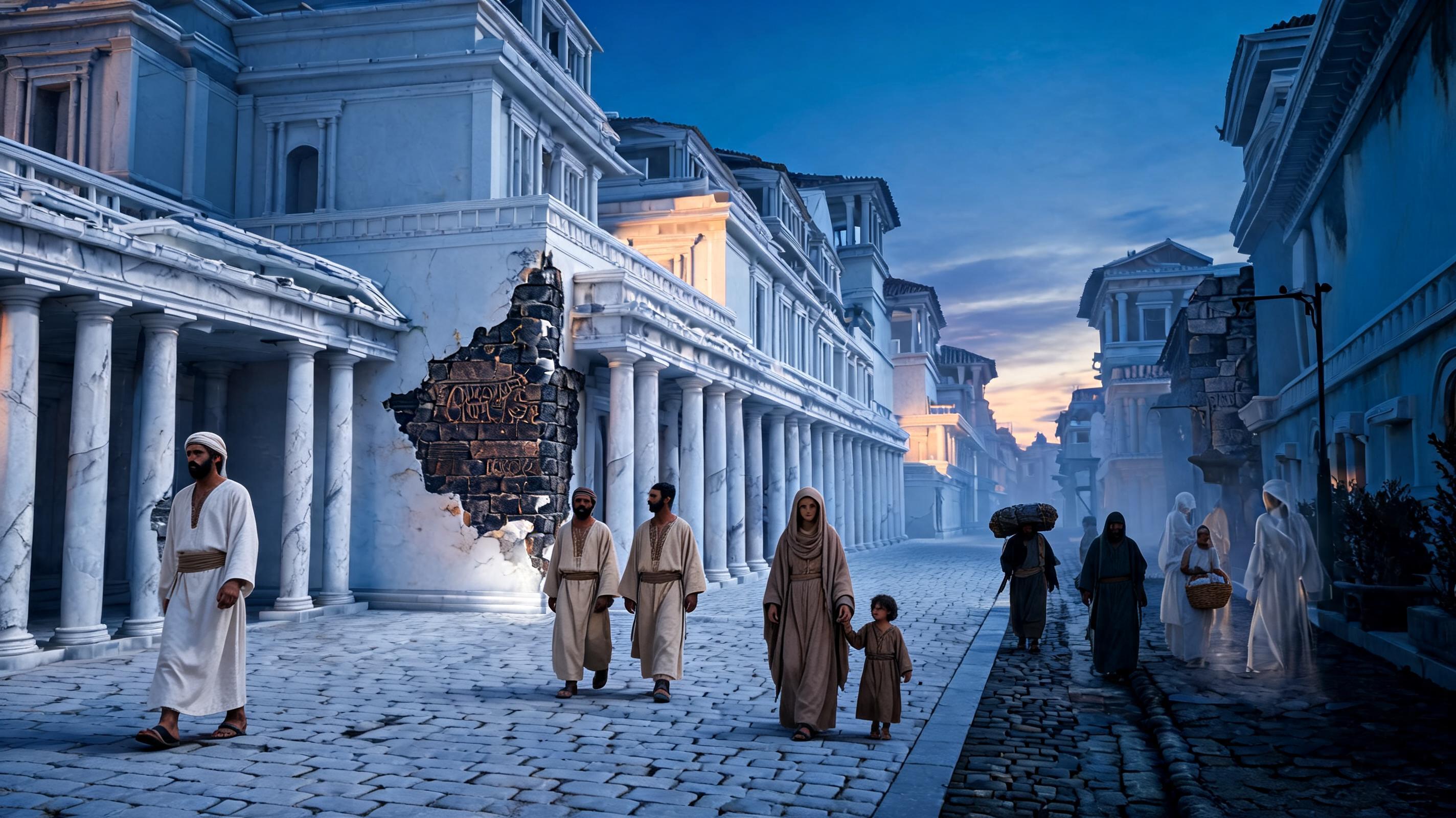
there on top of everything else that had come before. The forum was vast, paved in marble
that had not aged a day, with temples to Roman gods set at precise intervals. The streets ran in
perfect Roman lines. The theater was brand new, the amphitheater spotless, the houses of the
wealthy stood in rows like a thing designed rather than grown.
Ghosts
But beneath it all, if you looked, if one knew where to look, were the ghosts.
A wall of an older building showing through the whitewash. A street that curved where the Roman
street went straight, as if the older path was still there, still insisting on its own way. In the
markets, the merchants spoke Latin to the officials and Greek in the counting-houses, but when they
thought no one was listening, they spoke something older, something that had survived the
destruction and the rebuilding and the two hundred years of Roman rule. Punic. The language of a
people who had been there before Rome, who would be there after, speaking to each other in the
gutters and alleyways of a city that Rome had rebuilt in Rome's image.
Lucian loved it immediately. It was a city that seemed filled with secrets.
Demetrios arranged performances. The theater-master was eager—a famous rhetor passing through
Carthage was exactly the sort of prestige the city wanted. Lucian performed an extemporaneous
declamation on the nature of prosperity in a city built on trade. It was good work, well-received.
He made coin. Plenty of it. The audiences were sophisticated, wealthy, hungry for the kind of
rhetoric that made them feel clever about being rich.
For the first week, everything was perfect.
They would wake late. They would breakfast in the courtyard of their rented house, then walk
the city in the afternoon, watching how the light fell on marble, how the merchants negotiated, how
the language of the streets changed depending on which quarter you wandered into. In the evening he
would perform. After the performance, wealthy patrons would invite them both to dinner, and they would go,
and he would talk while Demetrios listened, and he would be brilliant, and he would come home
with a purse heavier than it had been.
Demetrios arranged it all with his usual efficiency. But something had changed in him. Lucian
noticed it in small ways at first: The way Demetrios would stand in the courtyard in the morning and look at the marble walls as if
they tasted bad. The way he would walk the markets and not speak, just watch, his mouth set in a
line that Lucian had learned to recognize as disapproval.
On the third day Demetrios made Lucian walk the city with him, and pointed things out the way a
man points out birds to a child.
"That temple." They were passing a gleaming shrine to Eshmun, whom the Romans had renamed for
their own Aesculapius. "Watch." A man went in limping. At the first door a priest sold him a clay
tablet that promised a cure. At the second door a second priest sold him a blessing for the tablet.
At the third door a third priest explained, very kindly, that the supplicant was not pure enough to
carry his own prayer into the inner sanctum, but that for a consideration it could be carried for
him. The man paid three times and limped out exactly as he had limped in.
"And this." Demetrios steered Lucian to a stall hung with green-crusted bronze. "Coins of Hannibal.
The knucklebones of Dido. A splinter of the very keel of the ship that founded the city." He picked
up a coin, turned it over, set it down. "Minted last month. They bury them in dung to age them, then
sell them to Romans who want to own a piece of the city their grandfathers burned. Watch this."
He pointed to a small skull on a back shelf. "What is that, sir?"
The proprietor, excited at the prospect of a prospect, smiled proudly. "That, sir, is the skull
of Hannibal himself!"
Demetrios winked at Lucian. "How can that be? Two blocks over, I saw a merchant who also claimed to
have Hannibal's skull, and it was bigger than this one!"
"Very simply, sir. This is the skull of Hannibal when he was a little boy!"
Lucian guffawed, and Demetrios quickly guided him away by the elbow.
"The wine is watered," Demetrios went on. "The weights are shaved. The fortune-tellers on every
corner will sell you a future, and the oracle by the forum will sell you a better one if the first
does not suit. Every man in this city is selling something, Lucian, and not one of them is selling
what he says he is."
"It is a city of merchants," Lucian sighed. "Merchants do exaggerate."
"Merchants lie. This whole place is one long lie told over a graveyard, and it has gotten very,
very good at telling it." He looked at the marble as if it tasted bad. "Too much fake gold. Too
much fake everything."
"Well, we won't be here forever," Lucian said.
"That's what gets me up in the morning."
The Monkey
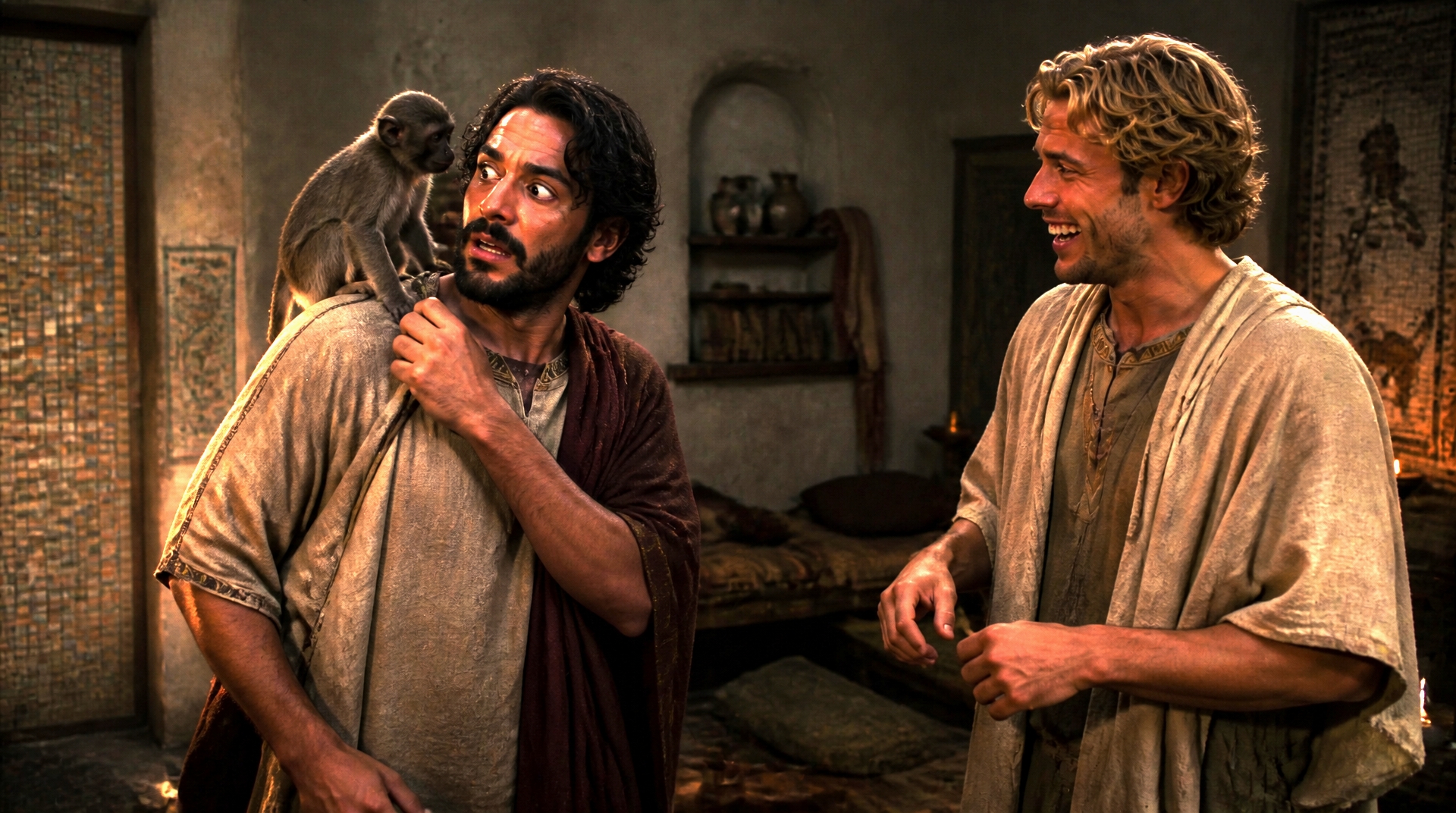
Their rental came with a monkey.
When Lucian first saw it, he jumped. He'd never seen anything like it before.
Small, quick, with gray-brown fur and a face that held an expression of permanent amusement, it
appeared in their courtyard in the late afternoon and sat on the rim of the fountain and made a sound
like a creaking door. It stole a piece of bread from the table where they were having wine. It ran
up the colonnade. It came back.
"There are monkeys in the hills," the landlord said when he came by to check on them. "They
come down sometimes. Looking for food. This one is braver than most. If you feed it, it will
stay. It will also steal anything that is not tied down."
Lucian fed it. Bread, dates, once a piece of fish that the monkey made a face at before eating
anyway. The monkey ate and screeched and performed elaborate acrobatics on the fountain rim, as if
it were giving a show in return for the food.
It was, Demetrios said, the most honest thing in Carthage. "And so I shall name him Veritas!"
"Veritas it is!" Lucian agreed, laughing. And then there were three.
By the third week, Demetrios' silence had become something else. Not quite anger. More like a man
who was listening to music no one else could hear, and that he did not like.
He still arranged the performances. Lucian still performed. The coin still came in. But Demetrios
stopped coming to the performances themselves. He would arrange the details, and then he would
walk away, and Lucian would not see him again until late at night, when Demetrios would be sitting
in the courtyard with the monkey, feeding it bread in the darkness.
"Where are you going?" Lucian asked one afternoon.
"Out," Demetrios said.
"Where?"
"Everywhere. Nowhere. Into the parts of the city that are not new. Into the markets where they
speak the old language. Into the houses that are not marble. Looking at the people who live in a
city that Rome built for them and calls it prosperity." He stopped. "Lucian. We should
leave."
Lucian was surprised. "Leave, already? We've only been here two weeks. We spent that long on the boat
from Tingis! The performances are going well. I could do this for months."
"That is exactly why we need to leave," Demetrios said. "Because you could do this for
months. Because you would do this for months. Because this city will let you hide here forever, and
you will let it, and that's not good for you."
Veritas the monkey had been listening intently, as he did. And his face, if it could be
trusted to reveal things as a human face does, scrunched up in concern.
"Hide? From what?" Lucian asked.
Demetrios did not answer. He stood up and walked away into the courtyard, where the monkey was
waiting.
A sinking feeling in his gut told Lucian he was in danger of losing Demetrios. It joined the
sunken feeling already there, when he thought of traveling further eastward. Further toward
Samosata.
And he didn't know what to do about either.
The Tomb
The next morning the three of them went to the market—Lucian, Demetrios, and Veritas riding
Demetrios' shoulder like a small, disreputable god. They were deep in the old quarter, where the
streets curved and the Punic language hung in the air like incense, when Veritas committed his
crime.
A woman stood haggling over a bolt of cloth. At her throat hung a necklace of old gold, worn thin
with handling, the kind of thing that is inherited rather than bought. Veritas was on her shoulder
and away again before she felt the clasp give. She shrieked. The monkey went up a colonnade with the
gold shining in his fist, paused at the top to be certain they were watching, and ran.
"Veritas!" Demetrios roared, and then the two of them were running too.
The chase went through half the old city. Down the curving streets, away from the Roman light,
under arches and around corners and straight through a yard where a man sat mending nets, the monkey
always a dozen feet ahead and plainly delighted with himself, until he slipped through a gap in a
crumbling wall and was gone.
Lucian and Demetrios pulled up, breathing hard, and squeezed through after him.
The gap opened onto a scrap of waste ground wedged between the backs of older buildings, and in the
middle of it the earth had fallen away into a dark mouth of dressed stone. Heaped around that mouth
was Veritas' fortune. A bronze spoon. A single sandal. A fistful of glass beads. A lady's mirror
gone black with age. A child's bone ring, a fisherman's hook, a scatter of coins, a brooch, a silver
pin—and, newly added and gleaming at the very top of the pile, the old woman's necklace.
Veritas sat above it all with the air of a man surveying his estate.
"He's been at this for years," Demetrios said, wonder in his voice. He crouched and began to sort
through the hoard. He freed the necklace, and weighed the silver pin in his palm a moment before it
vanished into his belt, along with a gold coin that did not look as though it had ever been buried in
dung. "Some of this is worth real money. He has better taste than the antiquities men."
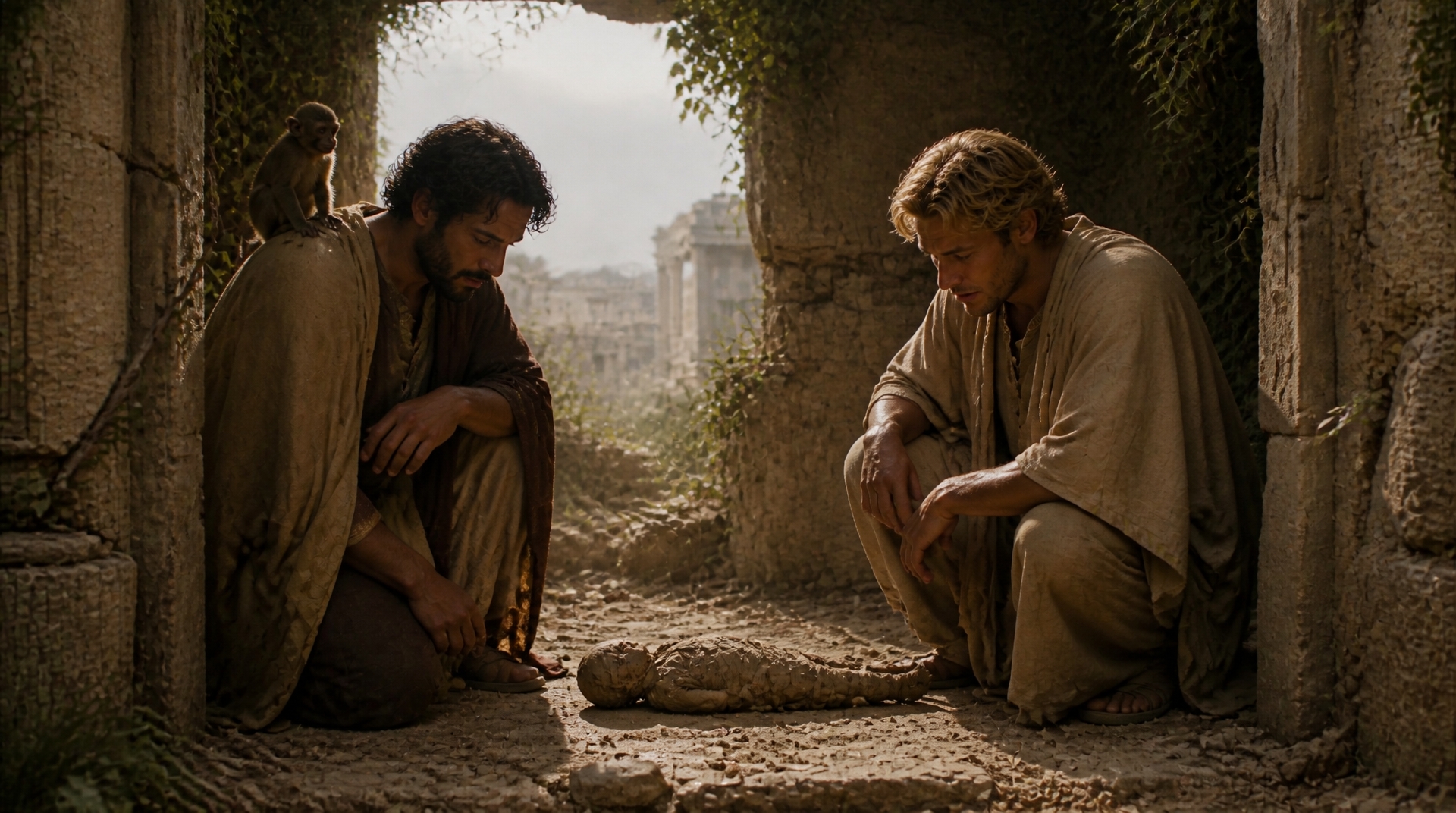
For the dark mouth in the ground was a tomb entrance. Old. Very old. The kind of old that predated
Rome, that had been here before the destruction and survived somehow, buried under new growth and
urban expansion until a monkey dug it open to make himself a treasury. And there, lying on the
ground just inside it, was another monkey. But not just a monkey; this one was mummified.
Perfectly preserved. Ancient beyond measure. Small enough to have fit in a man's hands,
and someone had loved it enough to do this: to wrap it, to place it here, to seal it in stone, to
keep it forever.
"Well, what do you know?" Demetrios quipped. "He did take us to see his family!"
Lucian stared at it for a long time.
They left the little mummy as they had found it, and carried the rest of Veritas' plunder back to
the cloth market. The woman with the bare throat wept when Lucian handed her the necklace, and tried
to press a coin on him for his trouble. He declined. Demetrios, who had a silver pin and a gold coin
in his belt that he did not mention, declined even more graciously.
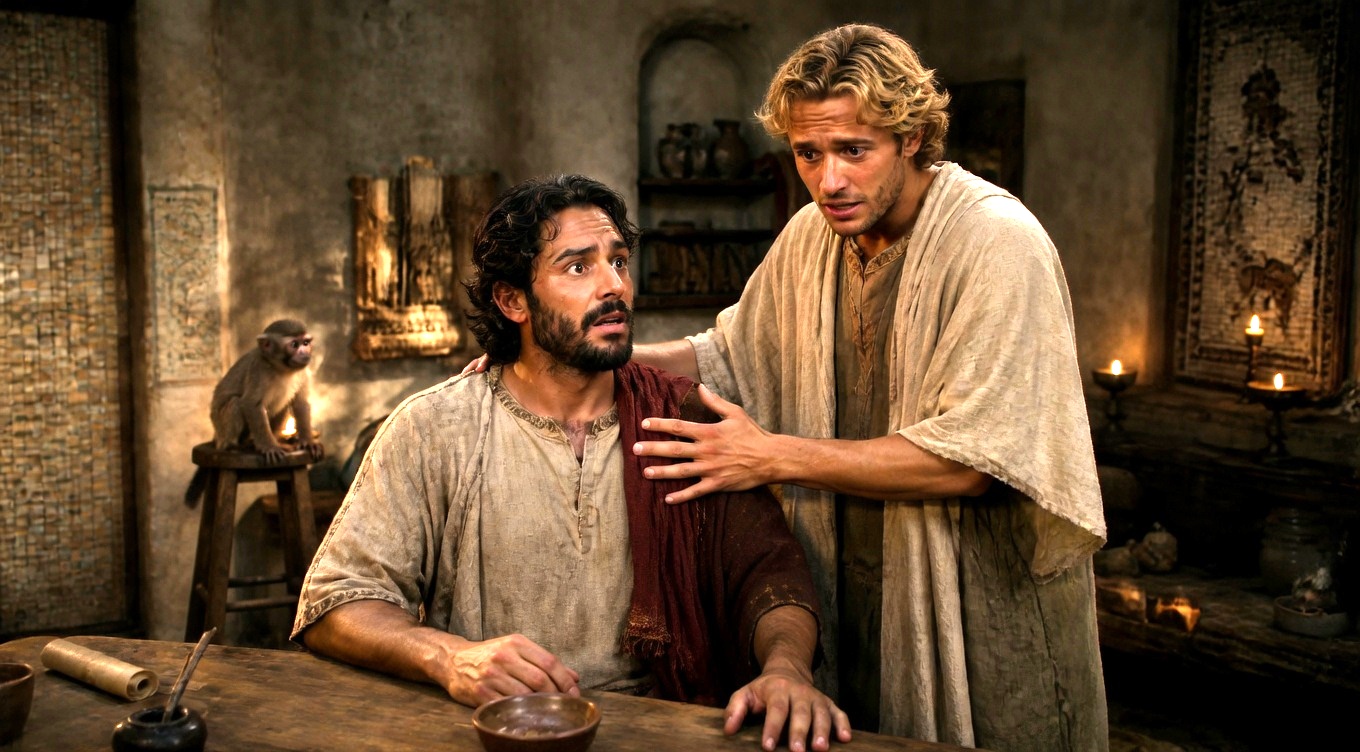
Ultimatum
That night, Demetrios said the thing he had been carrying all week.
They were sitting in the courtyard. Veritas had come back and lay asleep on a cushion
near Lucian's feet, no doubt dreaming of plunder. The city had gone quiet around them. The marble
was black in the darkness, and the stars were very bright.
"That thing in the tomb," Demetrios said. "That beautiful, dead, thing. In a whole city selling fake
knucklebones of Dido and skulls of Hannibal at every age, it was the one true ancient
thing we found. And no one was selling it. It was lying in the dirt where a monkey hides his stolen
spoons." He paused. "That is what this place does, Lucian. It takes a real thing and buries
it, and sells you a copy."
"It is just a monkey," Lucian said.
"It is what someone loved enough to preserve," Demetrios said. "To wrap in linen and
seal in stone because they could not bear to let it go. Perfect. Dead. Kept forever and
meaning nothing." He looked at Lucian for a long moment. "There's a
ship for Alexandria, four days from now. I really think we should be on it.
I—this place gives me a feeling of such dread, Lucian. I don't know whether
it's the ghosts of the past warning me, or a premonition of what you and I will become
if we stay. Or both."
"Four days—"
"We don't have to be on it." Demetrios leaned forward. "In Corduba I told you I was
your home, and I meant it, and that has not changed and it will not. I am not leaving you. I will
never leave you. If you want another month in Carthage, another year, another decade—I
will stay, and arrange your performances,
and bring your purse home heavier every night, and I will not say one word against it."
"But?"
"But it will break my heart to watch." He was quiet a moment. "Because this city will hide you
here forever, and you will let it. You came here and saw everyone performing, and you decided to
perform too—which is fine, that's what you do. But, Lucian—to be a performer among
performers is nothing special. And you are special. But instead of sharing your gift
in a world where you can teach, you can stay here, where all you can do is entertain,
without teaching anyone anything, or changing them in any way. That's what you do best.
I've seen it. But that's not what you're doing here.
"We've only been here a few weeks. Don't you think you're overreacting a little?"
"Maybe. But I've come to know you pretty well, and I can tell when you dig in your heels
to avoid doing something you know you have to do but don't want to do it. You decided
that if you perform well enough, and make enough coin, and stay long enough, you will not have to
think about returning to Syria. About the fact that your family is dead, and your home is ash, and there is
nothing you can do about it."
Lucian opened his mouth to argue, and nothing came out.
"That is the curse of this place," Demetrios went on, gently now. "It's easy. And easy doesn't
let anyone grow. I will stay as long as you ask me to, Lucian. But every day you stay, you
mummify a little more, like that poor creature in the tomb. And I do not think I can make myself
enjoy the show."
Lucian sat in silence. He thought about his mother. He thought about Tabitha. He thought about the
house that had been burned. He thought about the candles burning all night in Corduba, and
Demetrios whispering: I am your home.
He thought about standing on Mount Abila, pouring wine onto stone for people who were gone, and
Iarbas saying: We just remember who was at home.
He thought about the poisoned water, and Damya saying nothing, just going back to work with clean
water. Observing. Not performing.
"You're right," Lucian said at last. He reached down and scratched Veritas behind the ears; the
monkey did not wake. "Four days, then. We'll see the rest of the city with honest eyes."