|
By: Paul S. Cilwa |
Posted: 5/29/2026 |
|
Page Views: 28 |
| Hashtags: #HistoricalFiction #LucianOfSamosata #Tingis #Tangier #Mauretania #Abila |
| Lucian and Demetrios meet the mystery man. |
| Estimated reading time: 18 minute(s) (4252 words) |
"Following you?!" Lucian repeated in disbelief.
"Since Caesaraugusta. Possibly before. I am not a vain man, and I do not imagine myself
interesting, so I have spent some weeks asking why two Greeks—one of them a famous rhetor,
which is the opposite of inconspicuous—should turn up on every road, every boat, and every
inn between here and the Ebro. And now you are on my ship. So I will ask once, politely, and
then I will ask the captain to put one of us ashore at the next anchorage. Why are you
following me?"
Lucian began to laugh.
It was not the response the man had expected. The pale eyes narrowed.
"Forgive me," Lucian said, getting hold of himself. "It is only that we have been asking
each other the same question about you since Toletum. You came down the stairs of our
inn as we were going up. You were on our riverboat. And now you are on our crossing. We had
decided you were following us."
"And we had a theory," Demetrios added. "It was not a good theory. It involved you being
an assassin. I want to say, in my own defense, that I argued against it."
"It was your theory," Lucian reminded him, drily.
The man looked from one of them to the other. Something in the pale eyes shifted by a
degree.
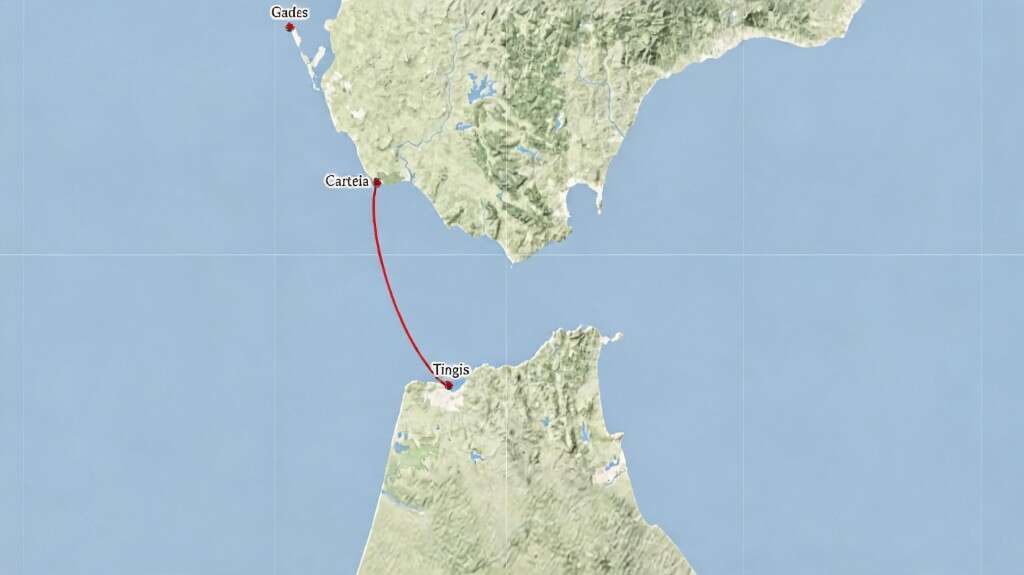
And there, on the heaving deck of a Mauretanian coaster halfway across the strait, with the
gulls screaming and Calpe sinking astern, the three of them worked it out: that no one had
been following anyone; that the road east is a funnel, and the funnel has a narrow end, and
everyone bound for the same far country pours through the same few ports and inns and boats,
and meets, and meets again, and decides the other man is a spy. A comedy worthy of the stage.
The Courier
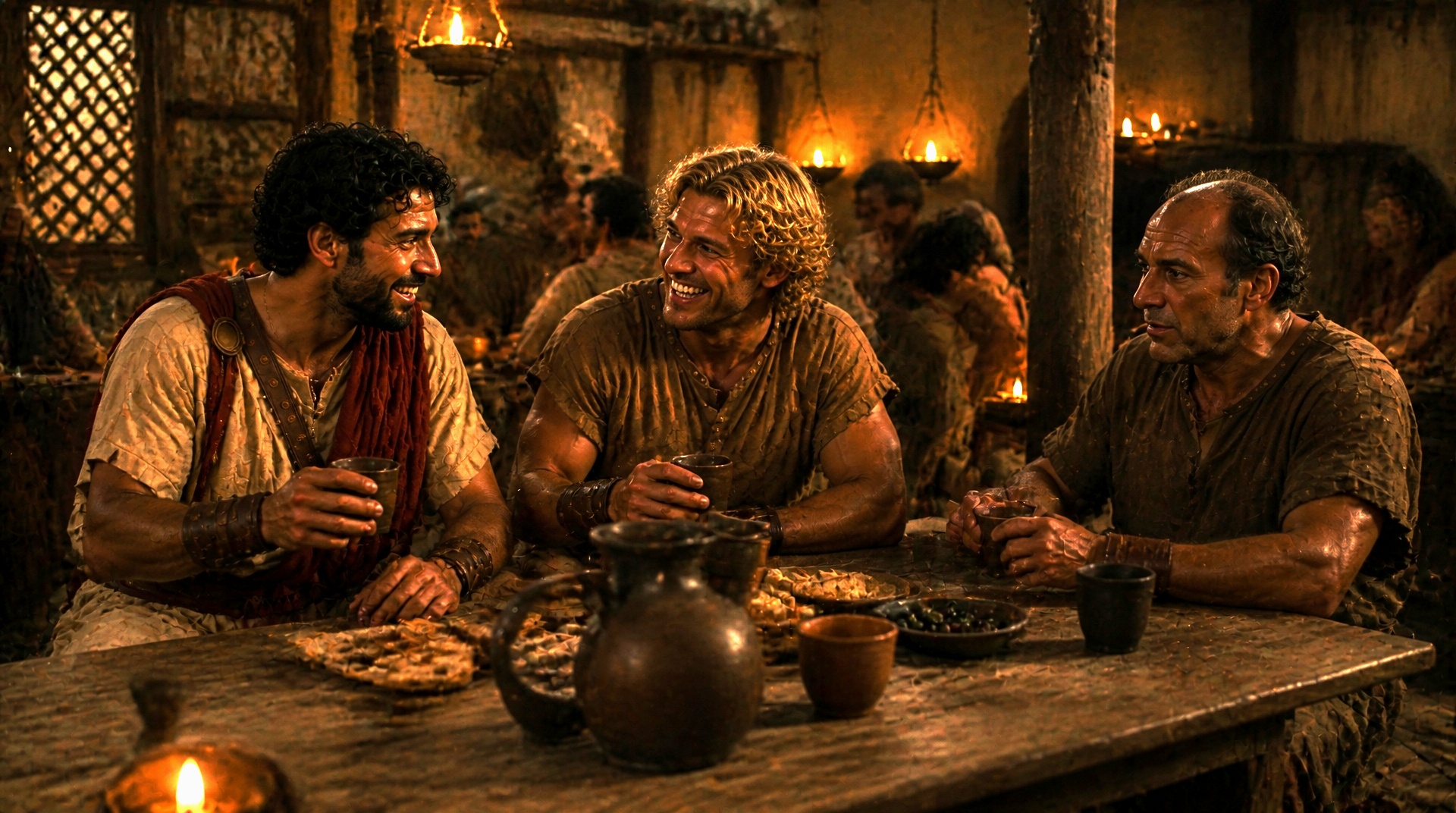
His name was Titus Aelius Celer. They had it out of him over a jug of bad wine in a Tingis
dockside taberna that first evening, once the ship was unloaded and the horses were stabled
and the question of who was stalking whom had collapsed into the particular weary good humor
of men who have frightened each other over nothing.
He was, he allowed, a military courier—which sounded simpler than the work was. A soldier,
technically, seconded out of the legions to the imperial service, who
carried dispatches the length and breadth of the empire and who, while carrying them, kept
his eyes open and reported what they saw.
"So you are a spy!" Lucian exclaimed in delight.
"A messenger," Celer repeated, "to whom it is unwise to lie. I am carrying letters from
the procurator at Corduba to Alexandria."
Lucian was fascinated. "I don't suppose travel gets boring after a while?" he asked.
"At least, I haven't found it to be so, though I've only been at it a few years."
Celer poured himself another cup of wine. "As it happens, I will shortly be done with carrying letters.
This is my last road. There is a posting waiting for me in Egypt—a desk, an office, a stool that does not
move under me, and a roof. After twenty-six years of other men's roads I
look forward to sitting in one place while the letters come to me for a change!"
He then laughed awkwardly, as if he weren't sure whether he'd said something funny or not,
and gulped the wine quickly, as if to avoid tasting too much of it.
"I have seen you perform, by the way," he said to Lucian.
"Twice. Once in Tarraco, at the games, the speech about the
tiger. Once in a courtyard in Corduba. As a rhetor, you are…"
he searched for a word that would cost
him as little as possible, "…tolerable."
"High praise," Lucian laughed. "I shall have it carved over a door."
"It was the tiger speech that particularly impressed me.
You made an amphitheatre full of Romans applaud
themselves for cruelty and feel ashamed of it at the same time. That was an amazing trick. The
service could find a use for a man who can do that, if he ever tired of doing it for
loose change."
It was Demetrios who raised the practical question. "How soon do you think we can
get a ship east? We're bound for Carthage, and beyond."
Celer looked at him as a schoolmaster looks at a boy who has asked when the sun will rise in
the west. "The next ship east," he said, "isn't until March. Didn't you know?
How could you not know?"
Lucian set down his cup. "March?!"
"The sea is closed for the season. No captain with a family and a functioning
brain would take a loaded ship out of sight of a friendly harbor between November and March. The
winds are wrong, the weather kills, and the insurers will not cover a hull that sails in
January. Oh, you could find a fool who would carry you down the coast, if the weather held good, to the next
town, and then you can wait for March there. But across to Carthage? Around to Egypt? Not
a chance. We'll be here for the next three months, so you may as well make yourselves comfortable."
Lucian had genuinely not thought of this. He had been so fixed on the great circle of his
plan—the coast, the cities, the road past his former home, that the most obvious
fact of travel had simply not occurred to him. One did not sail in winter. Everyone
knew it. Even he had known it, as an abstract concept presented some time in the past.
He had not thought it.
"So we are here," he said, blinking, "until March."
"We are here until March," Celer agreed.
Winter Quarters
Tingis sat at the very corner of the world, where the Outer Sea poured into the Middle Sea and
the land of Africa turned south and ran away to places no map agreed on. It was an old city,
ancient Phoenician under its fresh Roman paint like Gades, with a good harbor and a temple to Melqart and a
forum and a small theater and a population that spoke Punic in the markets, Latin to the
officials, Greek in the counting-houses, and, in the hills behind the town, a language older
than any of them. The light was different here—cleaner, harder, an Atlantic light—and the
winters were wet and mild and gray.
It was Celer who found them the house. He knew cities the way other men knew their own
street—which quarter was sound, which landlord cheated, what a fair winter rent was in a town
where half its houses stood empty until spring—and he walked them round Tingis for two days,
dismissing place after place with a single word. He was more thorough than either Greek had
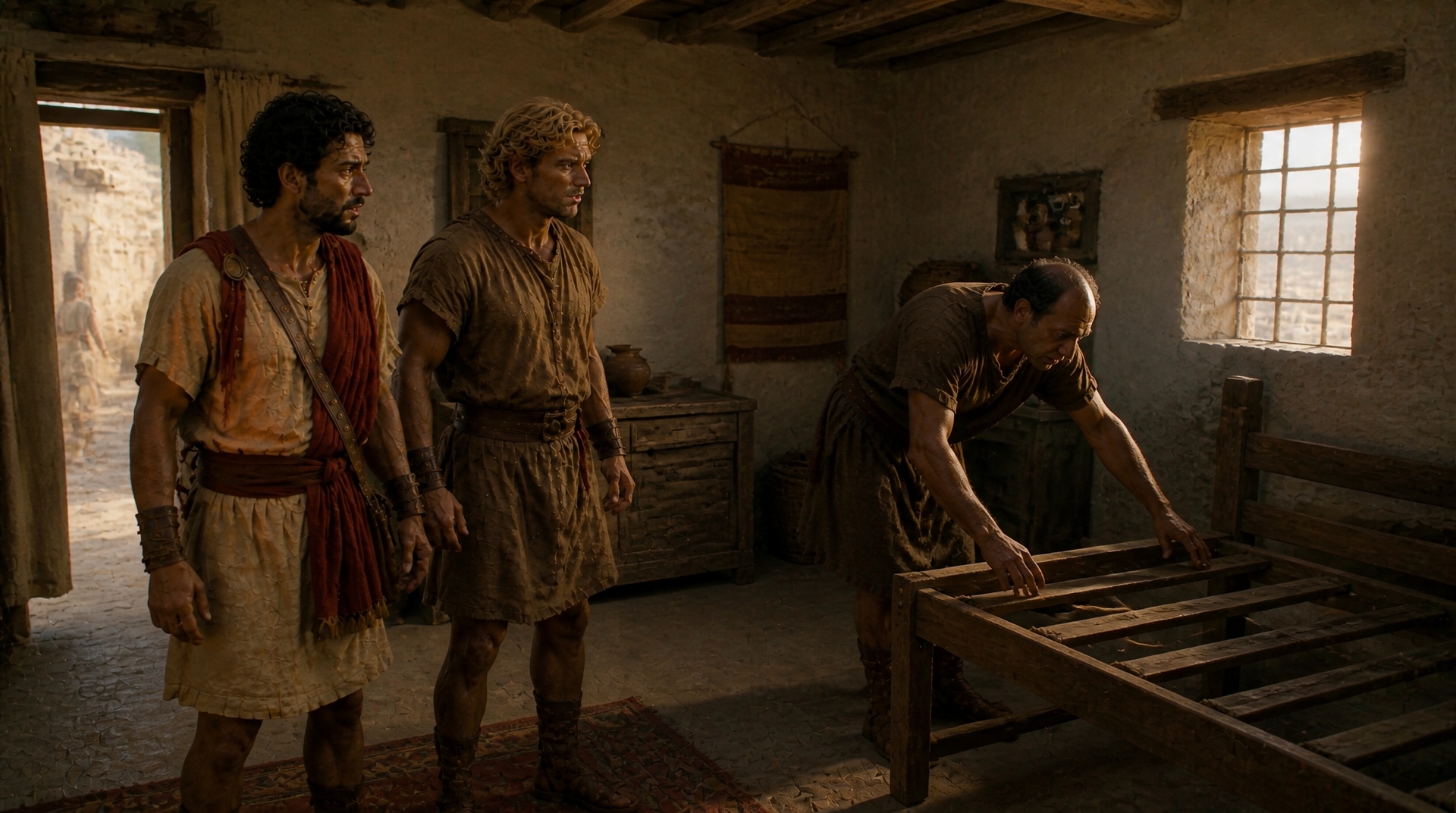
expected: at each house he stripped back the bedding and ran a thumb along the joints of the
bed-frames, hunting the small rust-dark seams that meant bedbugs. Two otherwise
pleasant houses failed on that count alone. "I have slept in every kind of bed the empire
owns," he said, "and been eaten in most of them. I prefer to sleep alone, thank you very much."
The house he finally approved stood near the forum: snug, sound, two bedrooms off a small
courtyard, a brazier that drew properly, and a landlord who did not haggle past the point of
decency. The frames, Celer pronounced, were clean.
Lucian looked at the two bedrooms. "We only need one," he said.
Which left a second bedroom standing empty, and the man who had announced he meant to keep his
distance standing in front of it.
"So far, all the single-bedroom places are already rented," Lucian went on. "But if
someone—you, for instance—is willing to take the second bedroom, we can split the rent
and save a little money."
Lucian and Demetrios had shared a bed since that boat out of Seleucia a great many
years before. Both realized it wasn't really the idealized, romantic arrangement
of younger man to older mentor. Demetrios was only a couple years older than Lucian.
Still, Greeks wouldn't have cared. As a Roman, Celer could be
expected to be less tolerant of Greek relationships. But he was also a world traveler,
which should have opened his mind some.
And, in any case, if he were going to be uncomfortable with the men's relationship,
it would be better to know that now.
"The government will cover my share," Celer observed, to the wall, as though the wall had
raised the matter. "It is a waste of imperial money to pay it to a garrison cot while a room
goes begging. I will take the smaller one; it only makes sense."
Demetrios, who trusted nothing he had not arranged himself, had the house fumigated before they
gave up their rooms at the inn—sulfur burned behind shut doors and windows, the old way of
purging a house of vermin and ill luck at a single stroke—so that what the three of them moved
into smelled of brimstone and fresh lime-wash and nothing at all that bit.
(At least, not without being asked!)
Demetrios went to work as Lucian's advance man, his
manager, the one who called on the council and the theater-master and the rich men's stewards, who
set the price and named the date and salted the town with the rumor that a celebrated rhetor was
wintering among them and would not be among them long. By the time Lucian opened his mouth in
public, Demetrios had already half-filled the hall. The council paid well, glad to prove to
themselves that Tingis was the sort of place where such men paid visits. Lucian performed; the coin came
in.
He told himself he was being careful—that a military courier does not befriend two clever Greeks
he is half inclined to suspect. But the truth, which Lucian saw before Celer did, was simpler:
they were the only interesting conversation in Tingis, and Celer, for all his gray flat dryness,
was a man starved of it. He came out of his room for dinner, and out again the next night, and the
next; and soon he was arriving in the common room before he was wanted, with a jar of better wine
than the taberna sold, to sit in the corner saying nothing until something was said that was wrong,
at which point he would correct it in six words and go quiet again.
They learned the shape of him over those winter evenings. He did not laugh, but he could be
made to make a short exhalation through the nose that Lucian came to treasure more than the
applause of theaters. He had a horror of exaggeration, which made him the ideal audience for
Lucian, who exaggerated professionally, and the ideal victim for Demetrios, who could keep a
straight face through anything.
"I once," Lucian announced one evening, "told a story so well in a tavern in Gades that
two men were turned into grapevines."
"No," Celer said, without looking up from the cheese.
"Metaphorically."
"No."
"You weren't there. You don't know what I said."
"I know that men are not turned into grapevines," Celer said, "in Gades or anywhere
else, and I know that you know it, and I am too old to applaud a thing simply because it is
said with confidence. I spent twenty-six years listening to men say untrue things with
confidence. It is most of what the job is."
Demetrios grinned. "And yet you keep coming to dinner."
Celer considered this with the seriousness he brought to everything. "The wine here is
terrible," he said, "and the two of you are the only men in this town who have use for a
book other than to put under the leg of an unsteady table.
A man chooses his evenings from what is available." It was, from Celer, practically
a declaration of love.
For Celer was not, in fact, merely waiting out the winter. He was working, in the patient
invisible way of his trade, and what he was working on, were the tribes.
Tingitana was a strange province, Lucian came to understand: a thin painted coast with a wild
interior that Rome had never conquered and had stopped pretending it could. Beyond the last
Roman milestone lived the Mauri—the people the Greeks lumped together as Libyans and the
Romans called by a dozen tribal names—and the largest of the confederations, the Baquates,
Rome dealt with not by the sword but by treaty. There were altars inland, Celer said, at
Volubilis, recording solemn peace-conferences between Roman procurators and Baquates chieftains
whom the procurators were careful to address as kings, because a king will sign a treaty
that a chief's pride will not.
"And the treaties hold?" Lucian asked.
"The treaties hold," Celer shrugged, "until they don't. That is what I am here to investigate.
Whether they still hold. Who leads the Baquates now, and whether the man who leads them can
make the young men sit still. There is a wind coming off those mountains that I do not like.
In ten years, in five, I think the Mauri will be across that strait and burning Baetica, the
good green country you just walked through. I would like to be at my desk in Alexandria when
that happens, if it does, and not here."
Three men, three ways of seeing the same people. To Celer they were a problem to be measured—
a weather front, a column of figures, a thing that might burn Baetica in five years. To
Demetrios they were a market: he wanted to know what they would buy and what they would sell
and whether a clever Greek could stand profitably in the middle of it. And to Lucian, who had
stood on Calpe a month before and understood that the edge of the world was somebody else's
center, they were the most interesting thing in Africa: a people who had never been conquered,
who looked at Rome the way Rome looked at wasps, and who told their own stories in which they,
and not the Romans, were the heroes.
He wanted to meet them. Celer told him he was a fool. The argument went on, in a friendly way,
for much of the winter.
The Other Pillar
On a clear bright day in the dead middle of the winter, when the Atlantic light came down hard
and cold and the strait lay flat as hammered pewter, Lucian and Demetrios went to climb the
southern Pillar, Mons Abila.
Abila stood east of Tingis along the strait coast, a day's easy ride: the African twin of
Calpe, a great bare mountain shouldering up out of the sea. Celer declined to come. "I have
no quarrel with mountains," he said, "but I have climbed enough things in my life that
other men climbed for pleasure, and I climbed because a dispatch had to get to them. You go.
Take a guide. Do not fall off. The rent is due tomorrow."
The guide was a local man named Iarbas, half Berber and half something else, with the easy
mountain stride of a man who had been going up and down this coast since he could walk. He took
them up by a goat-track much like the one on Calpe, and the climb was much like that climb, and
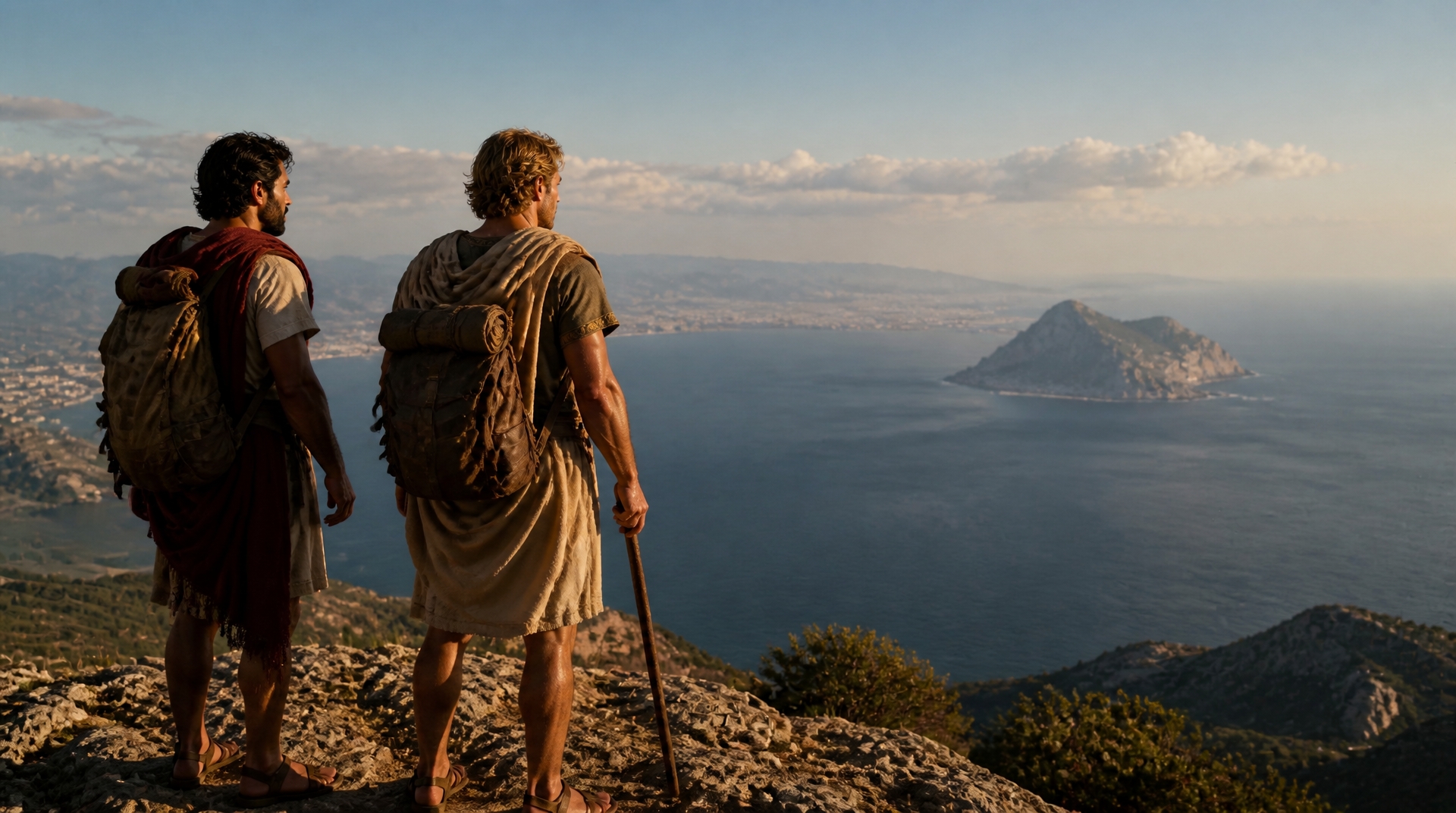
near the top Lucian turned, and there it was.
Calpe. Across fifteen miles of pewter water, the rock he had stood on a month before, looking
back at him. He had stood on the European pillar and looked at the African one across the
strait; now he stood on the African one and looked at the European. The two of them like the
gateposts of a country, and the strait running between, and the gray-blue Ocean to the left
and the turquoise inner sea to the right, the same as before but reversed, the way a thing looks
in a mirror.
Demetrios had surmised what the day was for. He drew Iarbas a little aside,
on the pretext of asking the names of things, and left Lucian alone on the height with a small
flask he had carried up without comment.
Lucian had promised himself this on Calpe and had not been able to do it there, because there
had been a priest, and a story, and the wind had been wrong. Here there was only the wind,
which was right. He uncorked the flask. He poured the wine out slowly onto the bare stone at
the edge of the world, where it ran into a crack and was gone, and he said his mother's name,
and his father's, and Tabitha's, out loud, once each, into the wind that would carry them
nowhere. It was not a prayer. He had finished, on Calpe, with prayers. It was only that some
things should be said aloud in a high place, to no one, so that the saying of them exists
somewhere in the world even if not even a god is listening.
Then he corked the flask and rejoined the others, and nobody remarked
on his wet face because the wind at that height made everyone's eyes tear.
It was on the way down that Iarbas told them about Antaeus.
There was a tomb near Tingis, the guide said—everyone knew it—a long mound by the shore
where the giant Antaeus was buried. A Roman general had dug into it once, generations back, to
see if the stories were true, and had found a skeleton sixty cubits long, and had been so
frightened he covered it up again and made offerings. "Antaeus was ours," Iarbas said,
with a simple proprietary pride that Lucian had never heard anyone use about a myth. "A son
of the earth here. The strongest who ever lived, because the ground was his mother, and every
time he was thrown down he touched her and stood up stronger."
"And he died," Lucian said, because he knew this story; every Greek knew this story. "He
wrestled Heracles, and Heracles—"
"Heracles murdered him," Iarbas said.
Lucian stopped on the trail.
"Your Heracles," the guide went on, not unkindly, "the foreigner, the one who came
through here taking whatever he wanted—cattle, apples, women, it is always cattle and apples
and women with him—he could not beat Antaeus while Antaeus could touch the earth. So he
lifted him up. Held him off the ground, away from his mother, until the strength drained out of
him, and then crushed him in the air. You tell it as one of his Labors. A glory. The
eighth, the ninth, I forget which." Iarbas shrugged. "We tell it as the day a stranger
came and lifted a man away from his own country and squeezed him until he died. Same wrestling
match. We just remember who was at home."
Lucian walked the rest of the way down in silence. He was thinking about a valley under a sea,
and a hero who pushed mountains, and how the labors of Heracles were sung as triumphs, and how
nobody counted the dead—except here, at last, was a people who had counted them, who had kept
the count for a thousand years, who knew exactly who had been lifted away from his own ground
and crushed in the empty air. He turned the thought over and over, all the way
back to Tingis, like a stone in the mouth.
Beyond the Last Milestone
In the last weeks of the winter, with the sea still closed but the worst of the weather past,
Celer announced that he had to go inland. There was a man he needed to see—a trader who came
down out of the hills to a market at a place beyond the last Roman milestone, who knew which way
the Baquates were leaning and would say so, for a price, to the right buyer. Celer needed to
make the buy before he sailed. He would be a few days. He mentioned it the way a man mentions
an errand.
Lucian announced that he was coming.
They argued about it for an evening and most of a jar. Celer said it was tribal country, treaty
or no treaty, and no place for a famous Greek who could not hold a sword. Lucian said he had
wanted, all winter, to meet the people Celer kept measuring and Demetrios kept pricing, and
that he would never again be this close, and that a man who would not walk one day past the
last milestone to meet the only unconquered people left in the west had no business calling
himself curious.
Celer gave in with the bad grace of a man who knows he is being unwise and cannot construct an
argument the others will respect. "Stay in the middle," he said. "Say nothing clever.
For one day in your life, Lucian, be boring. It may keep you alive."
"Count me in," Demetrios inserted, unnecessarily.
They rode out on a gray morning, the three of them and a hired muleteer who knew the track. The
country changed as the milestones gave out: the painted Roman coast fell behind, the cultivated
strip thinned to scrub and then to open rough hill, and the few people they passed watched them
go by with faces that gave away nothing at all.
It was somewhere in this stretch, to fill a silence that had begun to feel too large, that
Lucian decided to pull out his education for purposes of amusement.
"So, Demetrios, remember: if a woman offers you a leather anklet, for any reason, you're in luck!"
"A what? Why?"
"Herodotus says the women of the Gindanes wear a leather anklet for every man they have lain
with, and the one with the most anklets is the most admired—"
"The Gindanes," Celer said, without turning around. "East of Cyrene. A thousand
miles from here and six hundred years ago, if it was ever true at all, which it was likely not. Stop
reading Herodotus."
"He also says the Nasamones—"
"Stop reading Herodotus. He treats sailor's myths as travelogs. Plus, he wrote 600 years ago.
Have we not changed in 600 years? Then why wouldn't other nations?"
Lucian was scandalized by the criticism of one of Greece's most revered writers, but also had to
admit that Celer had a point.
The market, when they reached it, was smaller than Lucian had imagined and more ordinary—a
scattering of tents and pens in a fold of the hills, men trading horses and leather and salt and
dates, women moving freely and unveiled among them with an authority that Lucian, who had met
Mari, recognized at once and Celer's Herodotus had entirely failed to note. Celer found his
man. The buy was made, quietly, over mint tea, in a tent that smelled of smoke and animals.
And it might all have gone exactly as Celer planned, and they might have ridden home with their
secret and their lives, if the buy itself had not been the thing that someone, somewhere up in
those hills, had been waiting to see a Roman make.
They were a mile out from the market, in open country, when the muleteer stopped, lifted his
head, and said one word in his own language that needed no translation.
Then Lucian heard hat he'd heard: hoofbeats, many of them, coming fast over the rise behind, and more
ahead, and more on the flank, the sound closing from three sides at once with the unhurried
confidence of men who have done this many times and know that the closing is already finished
before the prey has heard it begin.
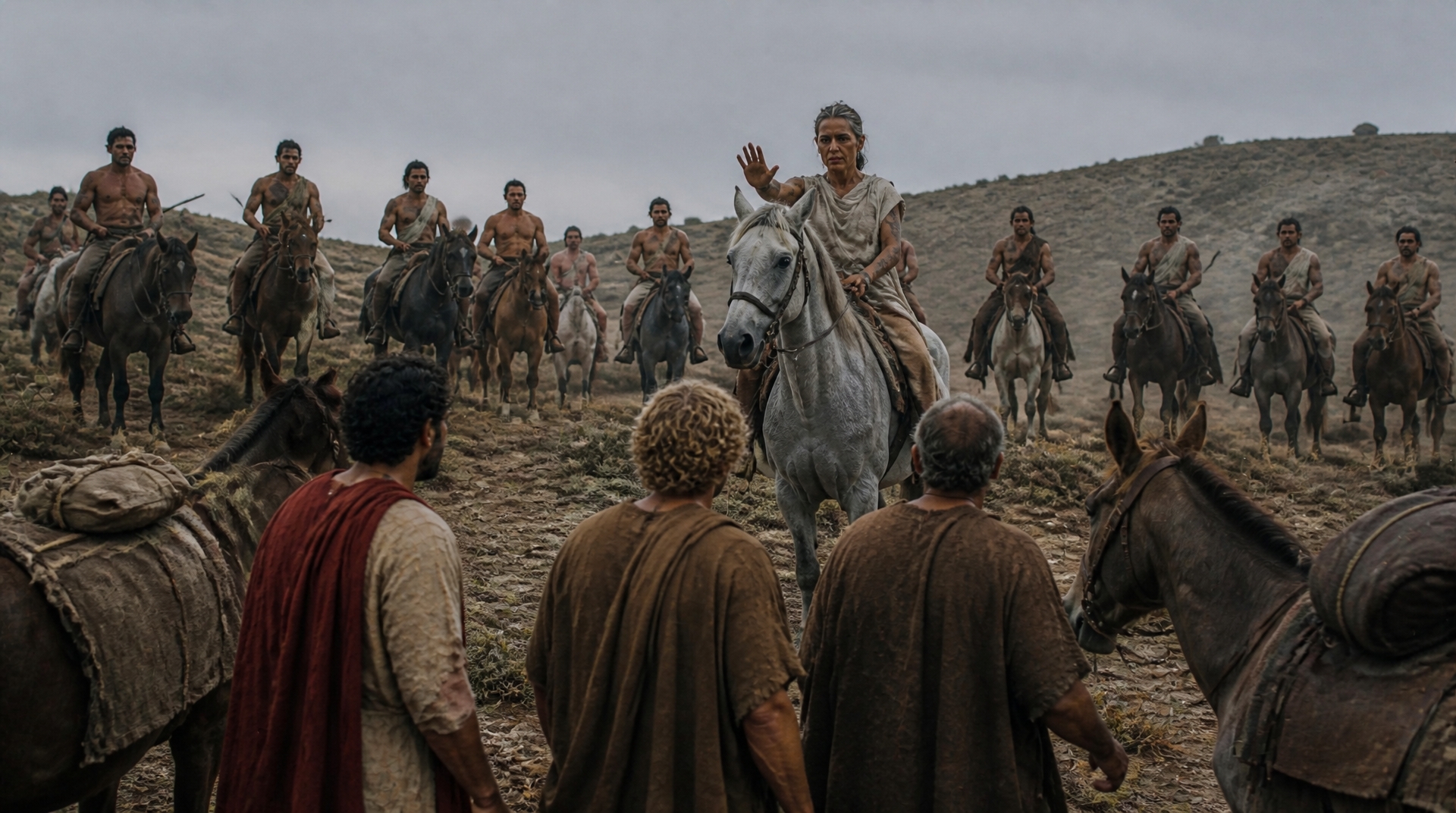
The riders came over the hills like a thing the land itself had decided to do.
They were sun-dark and sharp-featured, tattooed in lines of blue across cheek and chin, their
cloaks slung from one shoulder, and they rode bareback with the loose unbreakable seat of
people born to it, javelins balanced easy across their thighs, reining in a wide ring around
the four travelers without any of the shouting Lucian had braced for. They did it in near
silence, which was worse.
And at the head of them, on a gray horse, holding up one hand to halt the ring, was a woman.
She was perhaps forty, weathered and unhurried, with gray-streaked hair bound back and the
flat appraising stare of someone deciding what a thing was worth. Her eyes went over Lucian,
over Demetrios, over the muleteer, and came to rest, with evident professional satisfaction, on
Celer—on the Roman, on the buy, on the thing she had ridden out to collect.
She looked at them for a long moment. Then, in Latin—the only words of it, they would later
learn, that she possessed, learned for occasions exactly like this one and delivered with the
dry relish of a punch line—she announced:
"Resistance is futile."