|
By: Paul S. Cilwa |
Posted: 5/28/2026 |
|
Page Views: 12 |
| Hashtags: #HistoricalFiction #LucianOfSamosata #Calpe #PillarsOfHeracles #Abila #Mauretania #Tingis #Hispania #Spain |
| Lucian and Demetrios hike to the top of the Pillar of Heracles. |
| Estimated reading time: 19 minute(s) (4377 words) |
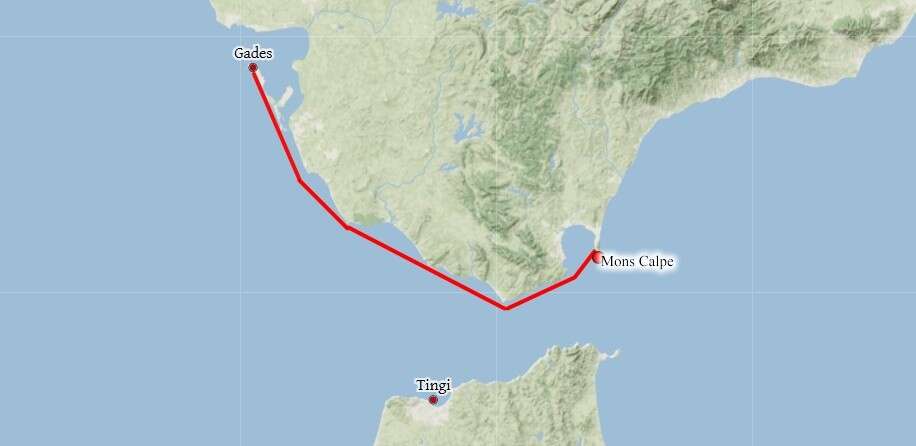
Carteia was a small Roman town, half fishing port and half way-station, set in the lee of
the rock on the inner side of the bay. It had a small forum, a smaller bath, and a single
inn near the waterfront whose proprietor the captain recommended. They were ashore by the second
hour after noon. They stabled the horses at the inn.
The fishmonger at the second stall confirmed the sailors' account. Yes, there was a trail.
Yes, it began at the old shrine of Mercury on the inland road, perhaps a mile out of town.
Yes, a healthy man could be at the summit by midday if he started before sunrise,
and down again by sunset if he did not linger. The fishmonger then asked, very politely,
whether they were planning to climb the rock in the clothes they were standing in.
Lucian looked at his cloak. The cloak was a perfectly reasonable cloak for the streets of
Gades in winter. It was, he realized, a fairly silly cloak for the top of a mountain.
"You'll want more water than you think," the fishmonger said. "A skin each is not
enough. Two each, and one to spare. There is no spring on the rock. The Mauretanian who
minds the shrine at the top has a cistern for catching rain-water, but he will sell you
a cup of his water for what a cup of water has no business costing, and you will buy it
anyway, because you will be thirsty enough by then to think that price a bargain."
"And the cold?" Demetrios asked. "I suppose it will be colder at the summit."
The fishmonger laughed. "It will be colder, and it will be windier, and the wind will not
stop the whole time you are up there. Take your warmest cloaks. Oil them tonight against
the damp; the rock is thirsty and gives nothing back, but the wind off the strait carries
spray when it has a mind to. And take bread and figs. There's nothing to eat up there."
The goatherd's wife, two stalls down, said the same things in slightly different words, and
added that the trail was a fair trail in dry weather and a bone-breaker in wet, and that
the forecast for the morning was dry, but the rock made its own weather and one should not
be surprised at the summit by weather one had not seen at the foot. She sold them a coil
of rope, because she said one might want a rope, though Lucian suspected the rope was a coil she had
been trying to be rid of for some time.
By dusk they had what they needed. Two large leather water-bags apiece, freshly waxed at the
seams. A second cloak for each of them, heavier than the first, the wool oiled until it
was almost waterproof. A satchel of hard bread, dried figs, and a sausage of Bocchus's
brother's making which Bocchus had pressed on them at the tavern and which Lucian had been
afraid to open until now. The coil of rope. Boots checked and
tied. Nothing Lucian had brought from Samosata at seventeen was on his back. He had
become, over the years, the kind of man who carried what the situation required and no
more.
They went to bed early. The wind picked up around midnight, rattling the inn's shutters in
their frames. Lucian lay listening to it. Tomorrow the wind would be louder,
and they would be in it.
Up, Up and Away
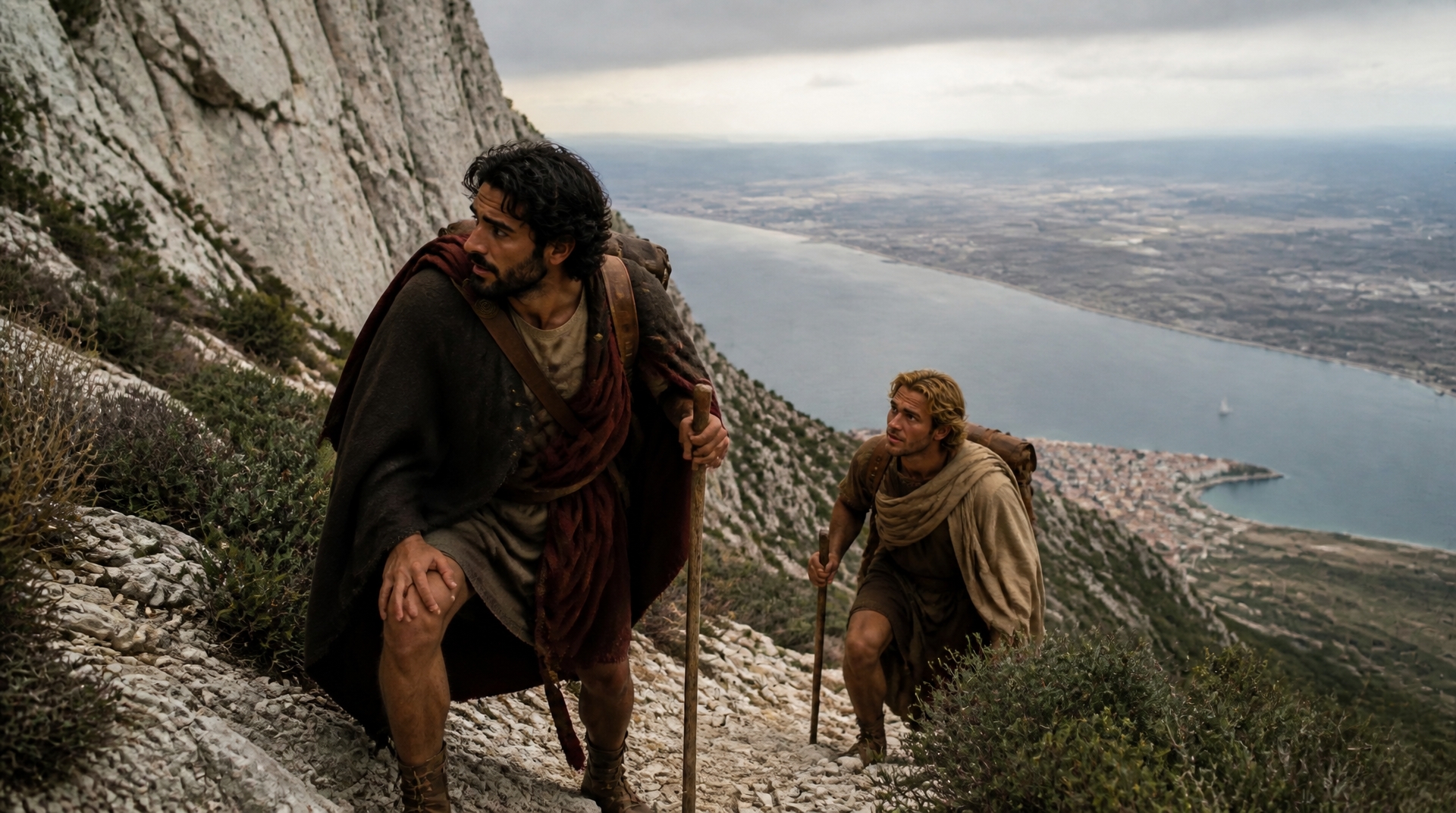
The horses stayed at the inn. The trail, the fishmonger had said with the small derisive
laugh fishmongers reserved for people who have to be told things fishmongers consider
obvious, was no place for a horse; and even if it had been, no man with sense left a horse
tied to a tree at the foot of a mountain for the whole of a winter's day. The stableman
promised hay and a brushing and a quiet stall, and Lucian and Demetrios—packs roped to
their backs, staves in hand—walked the mile from the inn to the trailhead on their own
legs in the dark before sunrise. The road out of Carteia was deserted at that hour except
for a single farmer driving an ox-cart in the other direction, who nodded at them as if
dawn climbers of Calpe were a thing he had seen often enough not to remark on.
They reached the trailhead as the sky began to lighten. The shrine of Mercury was a small
whitewashed niche with a copper coin or two left in it by previous climbers; Demetrios
added one, on the principle that it could not hurt. The path itself began as a goat-track
winding up through scrub—juniper, wild olive, the low gray-green of rosemary—and rose
at a grade that was steady rather than steep, the way goat-tracks do, because
even the most mountainous of mountain goats prefer
not to expend more effort than the terrain demands.
The bulk of the rock loomed on their left, southeast of the trail, an enormous pale wall
that grew less enormous only because they were climbing into it. The strait lay on its
other side, hidden from them by the whole mass of Calpe. What opened beneath them as they
climbed was not the strait but the bay of Carteia, the Spanish coast running away east
toward Malaca and the invisible cities beyond, and behind them the salt-marshes and the
green winter fields of Baetica spread out flat and brown to the horizon.
The wind found them halfway up. It came down off the rock in slow heavy gusts that pressed
against their cloaks and pulled at their hoods and made the juniper hiss beside the path.
By the time they paused for water—the first stop, perhaps a third of the way—both of
them were already glad of the second cloak.
Lucian drank, capped the bag, and looked back the way they had come. Carteia was a small
smudge of red tile far below. The coaster they had come on was visible at its mooring as
a single white scrap of sail. Beyond it, the bay was wrinkled gray with wind.
They went on. The path steepened in the second third, became rougher, made them use their
hands in two places where the limestone had shed pieces of itself across the way. The
temperature kept dropping. The wind kept rising. Lucian's face, which had been cold at
the foot of the trail, was now numb in the cheekbones, and he could no longer feel the
tip of his nose.
But his head was clearer than it had been in a month. There was something to be said, he
discovered, for a kind of effort that left no spare attention for anything else. His
grief over his lost family was still there; it had simply been outshouted, for the present hour, by the lungs
and the legs and the wind.
Forty Years A Priest
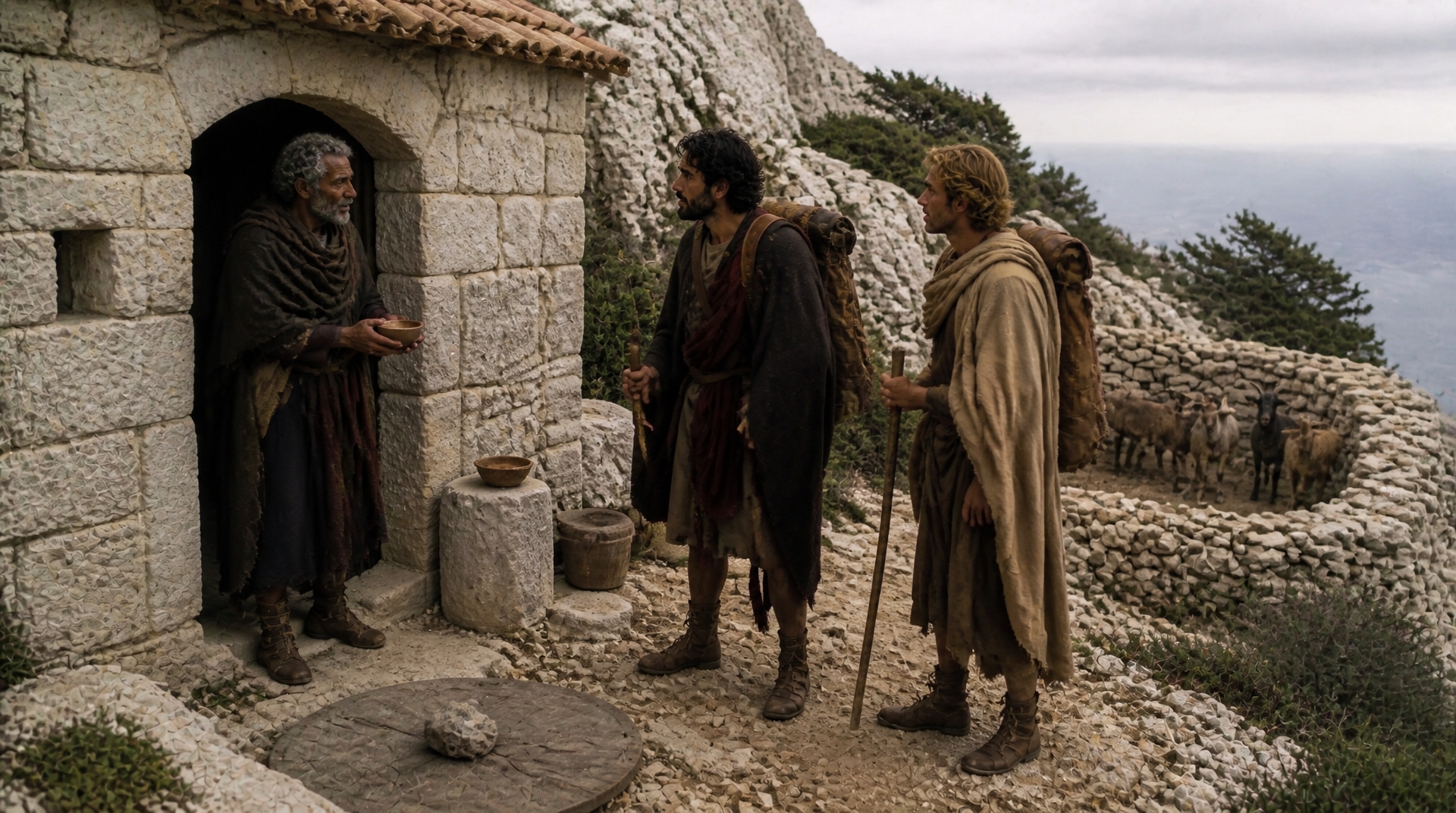
The shrine was set into a hollow just below the summit, on the inland side, in the small
lee the rock afforded against the southwesterly wind. It was a one-room structure of fitted
limestone, roofed with red tile, with a low arched doorway and a single window the size
of a man's hand. Beside it, a small cistern cut into the living rock, covered with a
wooden lid. Beyond the cistern, a goat-pen with three goats in it, all of them regarding
the visitors with the bored indifference of goats everywhere.
The priest emerged before they reached the door. He was perhaps seventy, dark of skin in
the Mauretanian way, his hair the gray of old iron, his eyes bright. He wore three cloaks.
He had been watching them climb, he said, since they had reached the second stop, because
there was nothing else to watch up here and a man with new visitors made the most of them.
He sold them, as the fishmonger had predicted, a cup of his cistern water at a price Lucian
paid without flinching, because he realized this was the old priest's only source of
income. (Gods are notoriously stingy.) He also offered them a small clay bowl
of warmed wine with honey and cumin in it, on the
house, because they had climbed in the cold and he liked the look of them. They drank it
standing in the lee of the shrine, where the wind could not quite reach.
"I have been here forty years and more," the priest announced, in the slightly over-careful
Greek of a man who had learned the language as an adult and used it rarely. "I came up
the trail the first time with my father, who held the post before me. I came up the
second time with the body of my father, who died at the foot of the rock and asked to be
buried at its top. I have not been down since."
"Forty years on a rock," Demetrios said.
"The god is here," the priest said simply. "And I am the one who feeds his goats.
There are worse posts in the empire."
Lucian asked, because he had been wanting to ask: "What name do you give him? The god. At
Gades, the priest called him Melqart, and added that the Romans called him Hercules and
of course we Greeks call him Heracles."
"Melqart," the Mauretanian said, with a slight nod, as if the answer were so obvious
he was a little disappointed in being asked. "That is his name. The other names
are of a Greek or Roman demi-god. Melqart is our chief god, not a mere demi-god."
"And Melqart's story?" Lucian asked. "How do you tell it?"
The priest led them around the side of the shrine to a
flat ledge of stone that served as a viewing place. From this ledge, for the first time,
the strait opened beneath them. The wind, which had been bad in the lee, was fully on
them now—cold and strong and smelling of salt and distant lands.
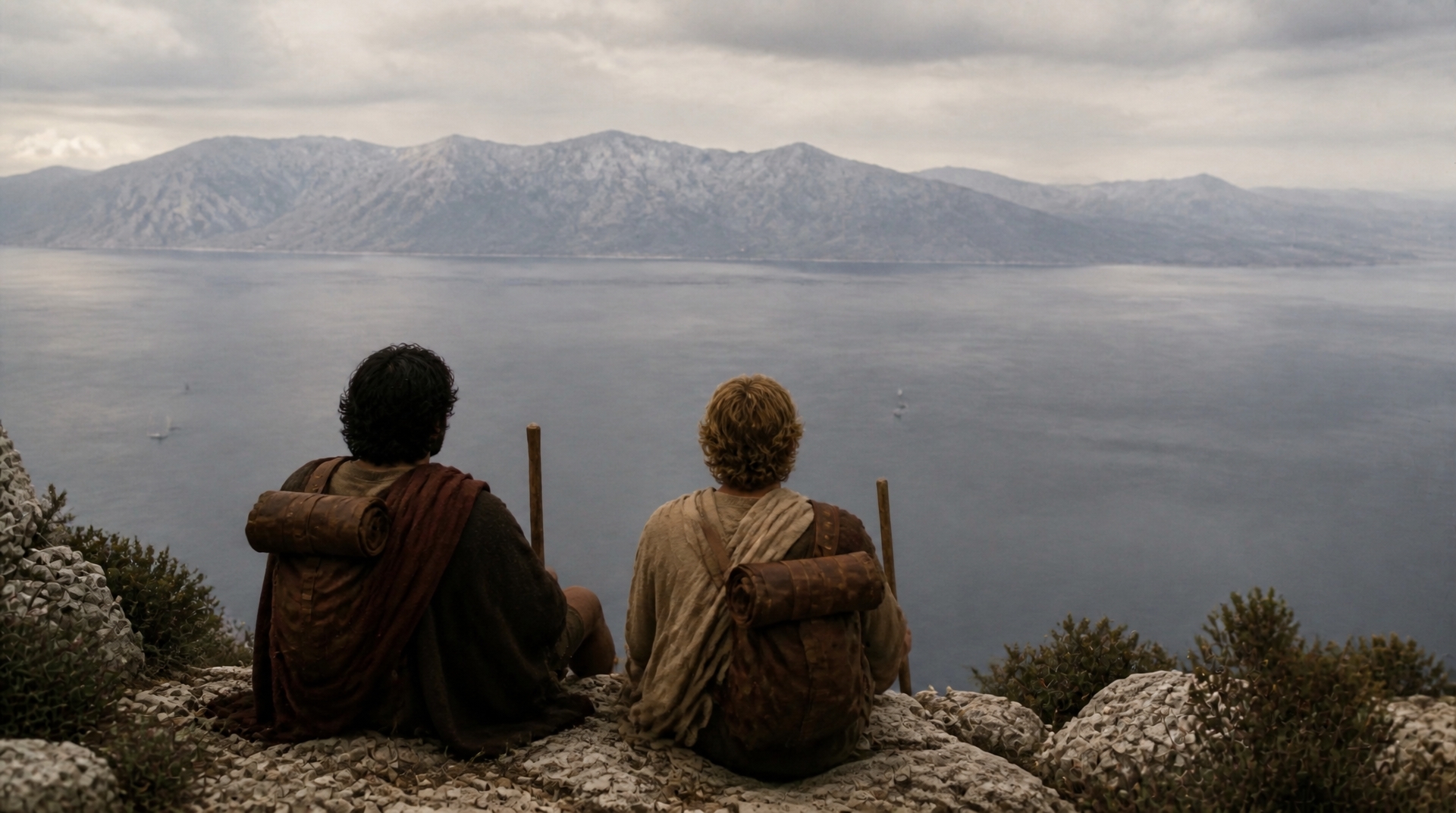
And there, across the strait, about fifteen miles away, was the second pillar.
Abila. Mons Abila. A mountain in Mauretania, much like Calpe in shape but softer in profile,
its summit bare and clear in the noonday light. The water was a deep, intent blue,
scattered with whitecaps where the wind drove against the eastward current. On the
African shore Lucian could make out, with squinting, a small settlement at the
mountain's foot.
"That is where I was born," the priest said, pointing. "That little town. I have not
walked it in forty years either. From here I see it every clear day. It
looks the same. That is the privilege of being the one who looks."
He turned to Lucian.
"The story. Yes. The story is that Melqart, on his way to fetch the cattle of the giant
Geryon—this is the tenth of his twelve labors, you understand—came to this place and found
the mountains here joined as one. There was no sea between Calpe and Abila, just a
wall. Melqart set his shoulder against the wall and pushed. The mountains parted. The
water came in. And so the strait was made, and the inner sea joined to the outer, and
Melqart walked on to Geryon's island, which is somewhere west of here, beyond the
Pillars."
He shrugged.
"That is the story. I have told it perhaps four thousand times. Once I told it to the
Emperor Hadrian, who came here on his tour of Hispania, and who listened politely, and
who afterwards endowed the shrine with a small annuity, which is the only reason I am still
able to feed the goats."
Lucian thanked him for the story and the wine. The priest nodded, returned to his shrine,
and left them on the ledge.
View From The Top
For a long time neither of them spoke. The wind made speech difficult anyway, and they had
reached, both of them, the point in a hard climb where the body is too pleased with
itself to want to do anything but rest. They sat on the ledge with their backs against
the lee of a great limestone outcrop and ate bread and figs and pieces of Bocchus's
brother's sausage, which turned out to be excellent, and they looked at Abila across the
strait.
After a while Demetrios pointed. "Look," he said. "On the left, the Middle Sea. On
the right, the Outer Sea. You can see where they meet."
Lucian followed the finger. The boundary was plain once one looked for it. To the east,
the water was a clear bright turquoise, the color of the bay at Rhodes in summer. To the
west, it was a deeper, colder blue—almost gray—with longer swells and a darker
undertone, the sea that fed itself from oceans Lucian had never seen and could not yet
imagine. A line ran between them, not perfectly straight but distinct, as if someone had
smudged it with a wet finger across the surface of the world.
"The same water," Lucian said, "and not the same water."
"So strange," Demetrios agreed, "the color difference."
Lucian sat with that for a moment. Then something shifted in his face.
"That side," he said, pointing west. "The gray-blue side. We sailed on it."
"From Hispalis to Gades, yes."
"I had not realized. I had not thought about it. I sat on that boat for two days and did
not look at the water once. I have already been on the Outer Sea, Demetrios. I was actually
on it without noticing!"
Demetrios said nothing for a moment. Then: "You were not in a noticing mood, those two
days."
"No. But still. The first man in my family ever to set sail on the Ocean—and I do
not even remember the color of the water under the keel." He shook his head. "What
do the Romans call it? Besides Outer Sea."
"Oceanus, mostly. The old Greek word, the river that was supposed to run around the rim
of the world. Pliny called it Mare Atlanticum, after the mountains the Mauretanians sit
on. The educated use one or the other depending on whether they wish to sound learned or
current."
"And the people who live on it?"
"The Gaditani? I heard they call it the Sea. Just the Sea. For them, the Middle Sea is the
foreign one—the inland one, the smaller one their Phoenician ancestors had to sail
through to reach a proper coast. The Outer Sea is the sea their fathers fished. For them, it does
not need a name to distinguish it from anything. It is just water, and home."
Lucian filed this away. The Outer Sea was somebody else's Inner Sea. The edge of the world
was somebody else's center. That was probably true of every edge, if one stood far
enough back from it.
Then Lucian, around a mouthful of fig, said: "I have been thinking about Melqart's story."
"Me, too. Heracles was also a special devotion of mine. A hero. But the Melqart story is
older, so I can't help but feel that Heracles either never really existed, or had a
completely different story that somehow became conflated with Melqarts'."
Lucian nodded. "And imagine what the geography was like before Melqart pushed the mountains apart.
The Outer Sea was over there, but because there was a wall of rock, there wouldn't have been
a Middle Sea at all—it would have been a Middle Earth, a landlocked place with no
access to the outer ocean. Think of it—all the sea floor between here and Antioch,
would have been dry land. Probably as fertile as the land is on the shores now.
And when Heracles, or Merqart, or whoever, pushed the mountains apart,
the water from the Outer Sea rushed in and filled the Middle Earth, and thousands, perhaps
millions, of people would have drowned."
Demetrios chewed. "Wow—Heracles as villain. It's never told that way."
"But everyone has a flood story," Lucian added. "The Greeks, the Syrians, the Egyptians.
Even the Jews have one. Maybe they are all memories of the same event, the same flood that came in when
the mountains were pushed apart."
Demetrios looked out at Abila. He worked it.
"Suppose Melqart never came," he said slowly. "But suppose the wall was there. A
dam of stone. And suppose, one day, an earthquake. The dam cracks. The crack is
small. The crack lets in a finger of the Outer Sea."
"Yes," Lucian said, nodding. "And the water
widens the crack as it pours. Stone gives.
In a day, in a week, in a month, the trickle is a torrent, an
ocean falling into a valley. The valley fills. The new sea finds its level. And
when it is over, what is left is the strait, and a story about a hero who pushed
mountains."
"It was not empty," Demetrios said, his eyes darting as he envisioned it.
"It cannot have been empty. A long valley between
two mountain ranges, watered by rivers running down from the Alps and the Atlas, with a
climate gentler than either—it would have been one of the great basins of the world.
People would have lived in it. Many people. Cities, possibly. Civilizations."
"And the flood drowned them all," Lucian said.
"Plato spoke of Atlantis," Demetrios pointed out.
"Plato put Atlantis outside the Pillars. In
the Outer Sea. Not here. That is a different flood, if it is a flood at all. The
Atlanteans drowned by the will of the gods, because they had grown
corrupt. That story is moral. This story would not be moral. The people in this valley
would have done nothing to deserve a sea falling on them. They would simply have been
there."
"So they get no name," Demetrios said.
"They get no name, no story. They get no Plato. They get a hero pushing
mountains, and four thousand recitations of the story by a priest on a rock, and not one
word of mourning. It is the largest crime in the history of the world, perhaps.
Millions, possibly. And no one even knows it happened."
Demetrios sighed. "The labors of Heracles are sung as triumphs. Nobody counts the dead."
"Nobody ever does," Lucian said.
The wind blew. The whitecaps on the strait continued their disorderly procession. Across
the water, Abila stood unchanged, as it had stood for however long it had been since the
wall broke.
"And against that," Lucian added, very quietly, "my mother and my father and Tabitha
make three. Plus whoever else died in town. A handful. A handful versus a flood."
Demetrios did not say anything for a long time. When he did, he chose his words with the
same care a man chooses his footing on the steep part of a trail.
"However many millions there were," he said, "They weren't your family."
"The priests tell us the gods want our love and our worship," Lucian continued.
"But we know what the gods do. We can see what the gods
did here. And so we fear and placate them andd hope to be
spared. But a man cannot love what he fears, Demetrios. He cannot. The one feeling chases
out the other. So either the gods do not really want our love, or they have
a really stupid way of trying to engender it. Either way, it is not love that they get from us."
He looked at Demetrios then.
"What we have, that is love. From the candles. From the road.
From the friend who climbs a cold rock with me because he cannot bear to let me climb it alone.
That is all. That is enough."
They started down in the early afternoon. The descent was harder on the knees than the
climb had been on the lungs—this is the way of all descents—but the wind eased as
they dropped, and by the time they reached the halfway point the cold had gone out of
their faces and they were able to talk again without raising their voices to be heard.
Demetrios stopped suddenly on the trail. "If the priest has not been down off this rock
in forty years," he said, "and we pay him coins for his wine—how does he eat?
Where is the wine from?"
Lucian looked around. They had the mountain to themselves. The path ahead twisted down
through scrub. The path behind ran up toward the shrine, which was already out of sight
around the shoulder of the rock. There was no one. There was nothing. There was wind, and
the goats, presumably, and a single elderly Mauretanian sitting alone in a stone room
drinking honeyed wine he had not personally fetched.
"I suppose," Lucian said, "he has someone making regular trips to supply him, in
exchange for the coins."
"What a great idea for a business!" Demetrios exclaimed. "Going around to taverns and
bringing meals to people who don't want to leave their home—or shrine!"
Lucian laughed. "I can't imagine enough people paying extra for a service like that to
make such a business profitable."
"I suppose you're right," Demetrios said, and they went on down the trail.
It was on the descent that Lucian announced the plan.
"I want to keep going," he said.
"I assumed you would."
"Not back the way we came. Across. To Tingis, in Mauretania. And then east along the
African coast. Caesarea, Carthage, Cyrene, Alexandria. And from Alexandria up through
Judaea and Syria, and home."
He paused on a switchback to let Demetrios catch up.
"The whole circle. Around the Middle Sea. We have done half of it without meaning to. We
should finish the other half on purpose."
"And Samosata?" Demetrios said, gently.
"Samosata is gone. The house is burned. There is no one to go to. So I wouldn't
go out my way to go there. There are other places more worthy of my attention."
Demetrios laughed, a small wind-blown laugh. "Then, Tingis tomorrow."
Unexpected Encounter
They reached Carteia at dusk, their legs trembling under them, and ate at the inn the
kind of dinner one eats when one has been climbing all day and no longer cares what is
served, only that there is a great deal of it. They slept like dead men.
In the morning, before sunrise, Demetrios went down to the harbor and came back with
passage on a Mauretanian coaster bound for Tingis on the next tide.
"The captain," he said, "is Bocchus's brother."
Lucian looked up from his bread. "Of course he is."
"His name is Iuba. The family runs eight ships between Tingis and the western ports.
Bocchus wrote ahead from Gades, apparently, on the chance that we might end up in
Carteia. The note found Iuba yesterday. He is expecting us. The fare is reasonable
and he can accommodate the horses."
Iuba was a smaller, quieter version of his brother, with
the same gold ear-hoops and an even longer beard. He greeted them without ceremony, showed
them where to stow their satchels, supervised the loading of the horses into a deck pen
lined with straw, and went forward to deal with his crew.
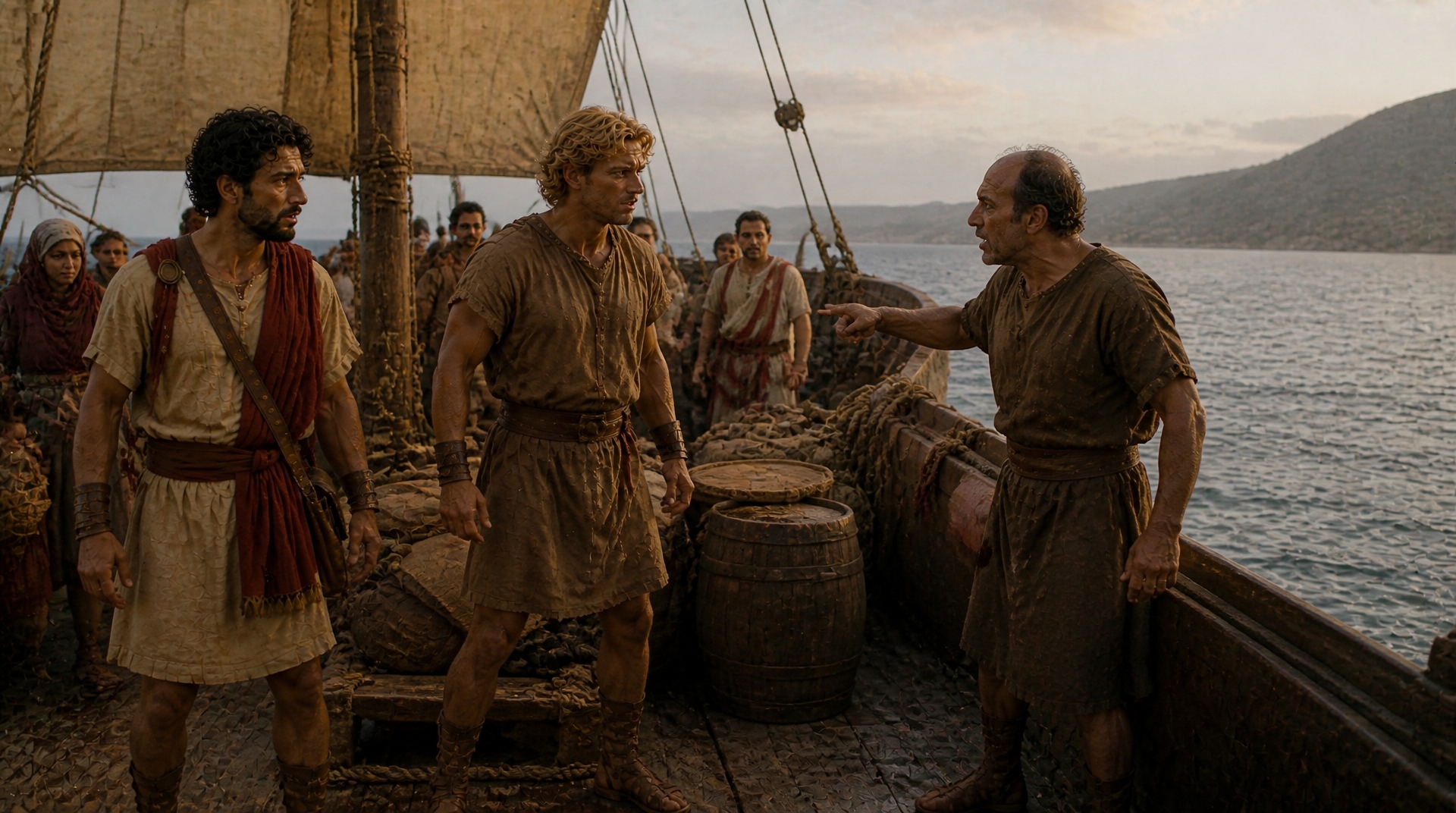
The coaster was perhaps sixty feet long, broad-beamed for cargo, with a single square sail
and a deck divided fore and aft by the horse-pen and the cargo hatch. There were perhaps
a dozen other passengers—merchants mostly, a Berber family with two small children, a
Roman officer in undress with the look of a man heading back to a posting he had been on
leave from. Lucian and Demetrios found a place along the port rail and stood watching
the sailors do what sailors did.
The horses were settled. The lines were cast off. The sail filled. The coaster moved out
into the inner bay, then turned south for the strait, and Carteia began to recede behind
them.
It was as they came clear of the shelter of Calpe and into the full chop of the strait
that Lucian noticed the passenger settling himself near the stern.
He was thin. He was balding. He was perhaps fifty. He had taken his place on a coil of
rope with the small efficient movements of a man who travels often and packs little, and
he had drawn his cloak around him against the wind, and he was looking out at the water
with the abstracted expression of a man whose work has just begun.
Lucian stared.
Then he turned, very slightly, and put his hand on Demetrios's arm.
"Don't look now," he said, low. "The stern. The man on the coil of rope."
Demetrios, with the discipline of a thousand performances opened by his scouting, did not
turn at once. He waited. He looked at the sail. He looked at the horizon. Then,
casually, he allowed his eyes to brush past the man on the coil of rope.
He looked back at Lucian, jaw slack. "That is the man from the river," he said.
"That is the man from Toletum," Lucian added.
"The man from the dock at Caesaraugusta, the one I caught!"
"Why," Lucian asked, "is he following us?"
The man's head turned. In a moment he spotted them, staring at him,
and his eyes widened with recognition. He stood up, and the wind caught his
cloak and billowed it out behind him, and he looked at them with annoyance
as he walked straight toward them, saying,
in a Latin that betrayed no provincial origin whatsoever,
"All right. I have had enough. Why are you two following me?"