|
By: Paul S. Cilwa |
Posted: 5/20/2026 |
|
Page Views: 15 |
| Hashtags: #HistoricalFiction #LucianOfSamosata #Consabura #Eclipse #Celtiberian #Roman #Denarii #Hispania #Spain |
| Lucian finds himself caught between two warring factions in the town of Consabura. |
| Estimated reading time: 10 minute(s) (2356 words) |
"A few months?" Lucian asked. "You mean, since Marcus Aurelius has been emperor?"
The landlord considered. "Well, now that you mention it…it was about that time. The first
I saw him was in spring, so yes. In fact…it may have been he who brought the news
of Aurelius' ascension."
Lucian and Demetrios exchanged a glance. A courier for the new emperor, racing south with urgent
business. That explained the speed, the evasiveness, the way he had somehow managed to get ahead of
them despite traveling on the same roads. But it didn't explain everything. Why was he on their
route? He couldn't be following them if he'd left ahead of them. But still.
That evening, as they were preparing for bed, the proprietor of the mansio knocked on their door. A
local merchant, he explained, had heard rumors that a traveling rhetor had arrived in the city.
Would Lucian be willing to speak to a small gathering of merchants and notables the following
morning? There would be coins in it—enough to help considerably with supplies for the long road
south.
With Demetrios' encouraging nod,
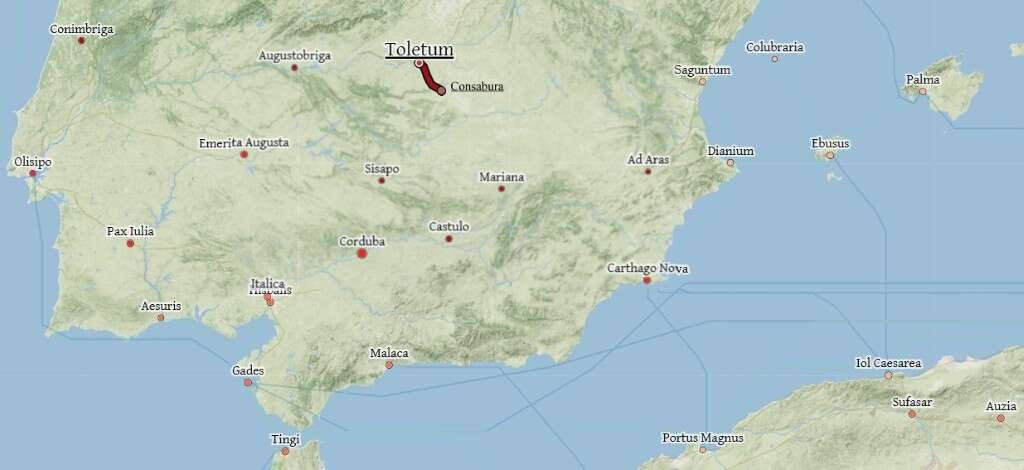
Lucian agreed, and the next morning found himself in the modest forum of Toletum, speaking to
perhaps a hundred listeners who had gathered for the occasion. He chose to tell them the story of
the bandits they met on the road, so surprised to find that
the targets they thought were trembling merchants were actually protected by a woman with
the strength of Hera and the swordsmanship of Athena. The crowd was delighted, and Lucian
received many coins as tips, more than enough to replenish their supplies for the next leg of the journey.
They left Toletum the next morning, refreshed and better resourced, heading south toward Baetica
and the coast. The road was good, the weather held, and their journey was largely uneventful.
Consabura
Consabura was a town caught between two worlds. It lay in territory disputed by Roman authority and
Celtiberian resistance. The Romans occupied it, administered it, taxed it. But the local
Celtiberian population resented the occupation and looked to their own leaders for justice and
protection. It was a precarious balance, and everyone in the town felt the tension.
It was into this tension that Lucian and Demetrios arrived on the 30th of October, the day
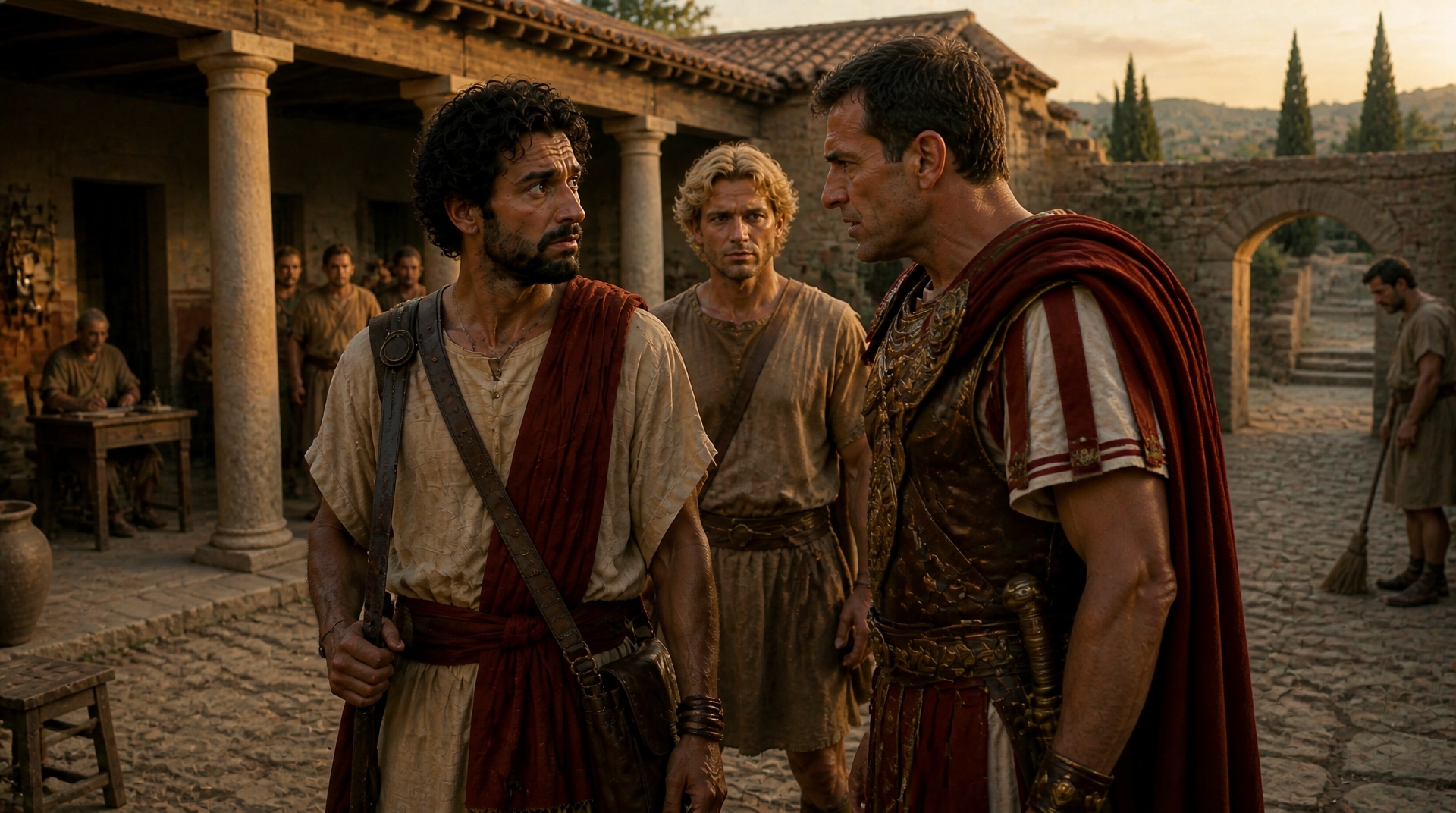
before the Kalends of November. They had barely dismounted at the inn when they were approached by
Duglassus, a Roman official who informed them, politely but firmly, that a distinguished visiting rhetor was
always expected to speak to the town. It was customary. Lucian should speak the next morning,
and what he should speak on was the inevitability of Roman rule, and how everyone benefited from it.
"You will speak tomorrow morning," the Roman official said. "You will speak about the
virtues of civilization, of order, of the Roman way. You will not leave Consabura before you have."
He then turned and left, leaving Lucian and Demetrios to go inside and register for the night.
But before Lucian could greet the landlord, a Celtiberian dignitary entered and made essentially the same
request, with one crucial addition: Lucian would speak of the Celtiberian people, praising their
virtue and strength, and their noble resistance to oppression.
"You will speak tomorrow morning," the Celtiberian leader—a man named Rammius, with fierce
eyes and the bearing of a warrior—had said. "You will speak about the nobility of freedom, of
resistance, of the Celtiberian spirit. You will do this, or you will not leave Consabura."
And then he left.
"I apologize for the poor manners of my countrymen," the landlord said as he accepted their payment.
Those two are the heads of the biggest families in Consabura. They loathe each other,
and use politics as an excuse to kill each other."
"You're kidding!" Lucian exclaimed.
"I wish I were," the landlord replied. "Just last week, they actually had a swordfight in the
forum! Three men were killed. —Yes, right where you'll be speaking!"
Demetrios was wide-eyed as they reached their room. "We are trapped," he said. "Caught between
two sides, each demanding we praise only them!"
"Like a merchant between two thieves," Lucian agreed. But his mind was already working. There
had to be a way out of this. There always was.
Here Comes The Sun
The next morning, just before ten o'clock, Lucian stood in the forum of Consabura with both
audiences gathered. Romans on one side, Celtiberians on the other, eyeing each other with barely
concealed hostility. In the center stood Lucian, and behind him, the sun was beginning its customary
journey across the sky.
He began to speak. He spoke about the nature of civilization, about Rome's achievements, about the
order and law that Rome brought. The Roman official nodded approvingly. But then Lucian shifted, began
to speak about the nobility of resistance, about the courage of people who would not bend, who
valued freedom above safety. Rammius leaned forward, listening intently.
As he spoke, Lucian gesticulated, as was his habit, his hands moving to emphasize his words, to
shape the air into meaning, and to hide the fact that Lucian was making it all up as
he went along. And somewhere around ten-fifteen, he noticed something strange.
The light was…different.
Not dramatically different—not yet. But subtly, almost imperceptibly different. The shadows on the
ground seemed weird, somehow. The sun, which was halfway toward its zenith, seemed
somehow diminished. The very colors of the world around him seemed subdued, as if the
world was turning itself into a ghost.
Lucian continued speaking, but his awareness had split. Part of him still engaged the crowd, still
shaped words and meaning. But another part of him was puzzled, searching for an explanation.
And, as he did so, he also caught something else: the crowd was also noticing.
If he didn't acknowledge the phenomenon soon, he would lose them.
He gestured with both hands, the fingers of each crossing the other,
emphasizing a point about the relationship between the conquered and
the conqueror. And as he did, he glanced down at his shadow stretching on the ground before him.
In the shadow of his crossed hands, were four small crescents of light. Not the
fingers themselves, but the light passing between the holes he'd left between them.
Four little crescents, each one perfect.
And, with a gasp of recognition, Lucian suddenly realized what they meant.
Around him, he heard the first murmurs of consternation. Someone called out in Latin. Someone else
called out in Celtiberian. The light continued to fade, imperceptibly but measurably. People looked
up at the sky, shielding their eyes, seeing the sun diminished.
Panic was beginning to set in.
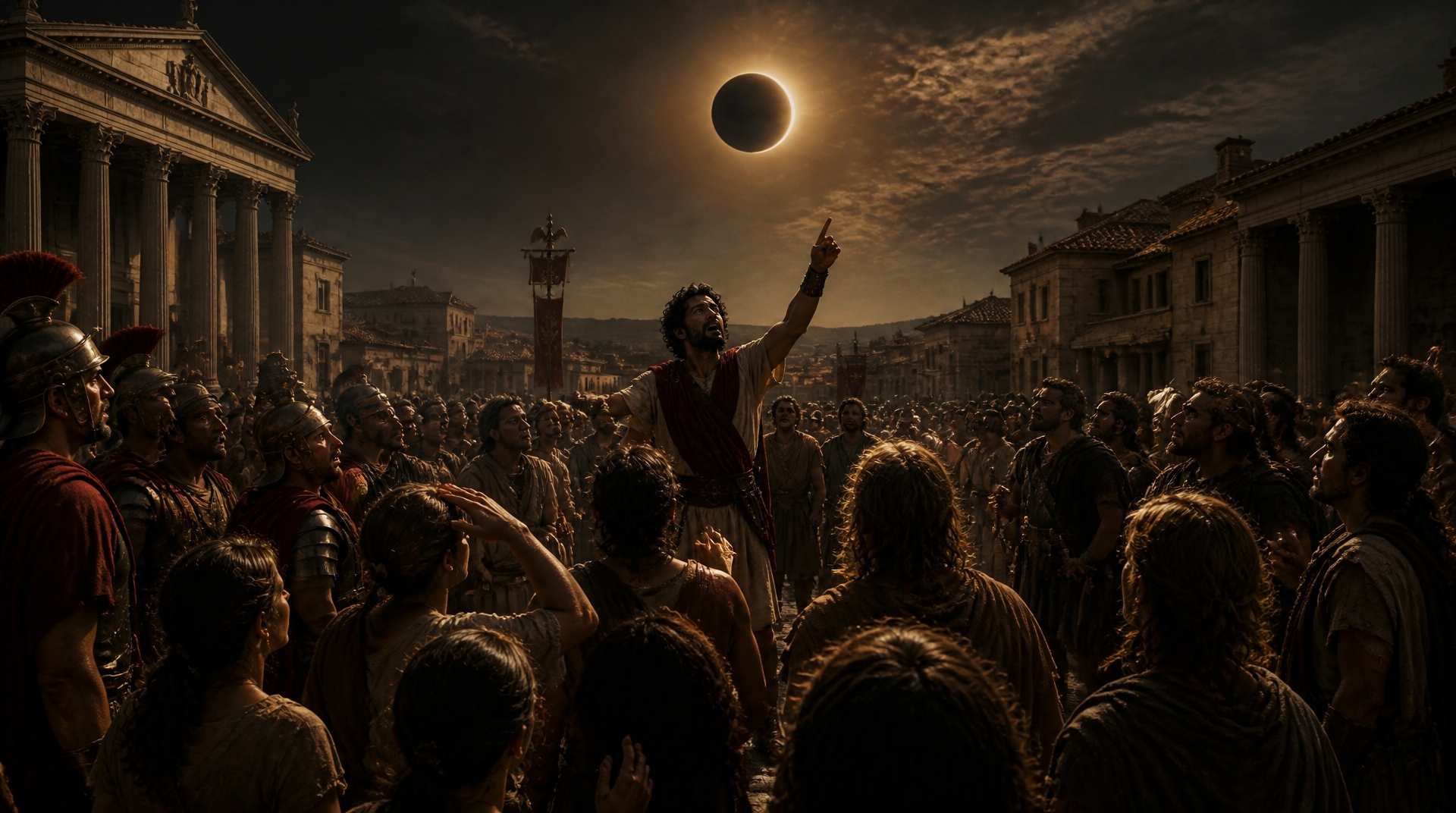
Without thinking, without planning, Lucian raised his hands. He pointed upward at the darkening
sun. His voice, when he spoke, rang with prophetic authority.
"The gods!" he cried out. "Do you see? Do you see what the gods are doing?"
The crowd went silent. All eyes turned to him.
"The gods are taking the sun away!
I did not do this. No man did this. The gods did this!" He paused, letting the weight of
his words settle. "And they did it because you have angered them. With your quarrels. With your
petty hatred. With your inability to live together as human beings should live."
He lowered his hands, pointing now at the Roman official, now at Rammius. "You," he said to
each in turn, "you have both demanded that I praise only you. You have both threatened me
if I did not. But the gods have spoken."
The sun continued to dim. Women in the crowd had begun to cry out. Men looked up in fear and
confusion.
"The gods are angry!" Lucian cried. "Not at me. At you. At your endless conflict. At your
refusal to find peace."
He let the moment stretch. He could feel the fear in the crowd, the gathering panic. The light was
becoming noticeably dimmer now. It was as if twilight were falling at mid-morning.
"But the gods are merciful as well as angry." Lucian continued, his voice carrying the
weight of absolute certainty. "They have shown us their displeasure. And now, if you will listen
to me—if Romans and Celtiberians can find common ground, can stop this endless quarrel—the gods
will relent. They will return the sun."
He turned to face both leaders directly. "But only if there is peace. Only if you agree to stop
the bloodshed. Only if you swear before this crowd and before the gods themselves that you will
find a way to coexist. Come down here, Duglassus! Come to me, Rammius! Make your peace before the gods!"
Duglassus and Rammius looked at each other. In the dimming light, with the crowd in a near
panic, with the testimony of the sun itself apparently backing Lucian's words, they understood that
they had no choice. The gods had spoken. And Lucian was their interpreter. They came down from
their platforms and joined Lucian in the center of the forum.
"We swear it," the Roman official said quietly.
"We swear it," Rammius echoed.
Lucian waited. He had no way of knowing how long the eclipse would last. It could be ten minutes or
fifty. He would have to trust that it would be brief enough to maintain the illusion of divine
intervention. The crowd stood in horrified silence, watching the sun disappear, praying for the
gods' mercy.
"It takes time for prayers to reach the heavens," Lucian mentioned helpfully.
Then, gradually, almost imperceptibly at first, the sun began to return. The crescents between his
finger shadows began to shrink, to become less pronounced. The shadows on the ground began to sharpen. The
twilight began to recede.
As the sun emerged from the shadow of the moon, the crowd erupted. Not in the usual way of a crowd
recognizing a speaker's skill. But in raw relief, in gratitude, in the kind of joy that comes from
being saved from annihilation.
The gods had shown their anger. And at the pleading of a stranger, a Syrian rhetor with knowledge
that went far beyond what any man in Consabura could comprehend, the gods had relented.
That evening, as Lucian and Demetrios prepared to leave town, both the Roman official and Rammius
came to see them off. There was an understanding between them now, tentative and fragile, but real.
They would find a way to coexist. They had promised it before the gods. They could hardly break
that promise.
"Who are you?" Rammius asked as Lucian and Demetrios prepared to mount their horses.
"Just travelers," Lucian said. "Heading south. Toward the Pillars of Heracles."
"You are no ordinary traveler," the Roman official said. "The gods speak through you."
Lucian smiled but said nothing. Let them believe what they needed to believe.
Escape
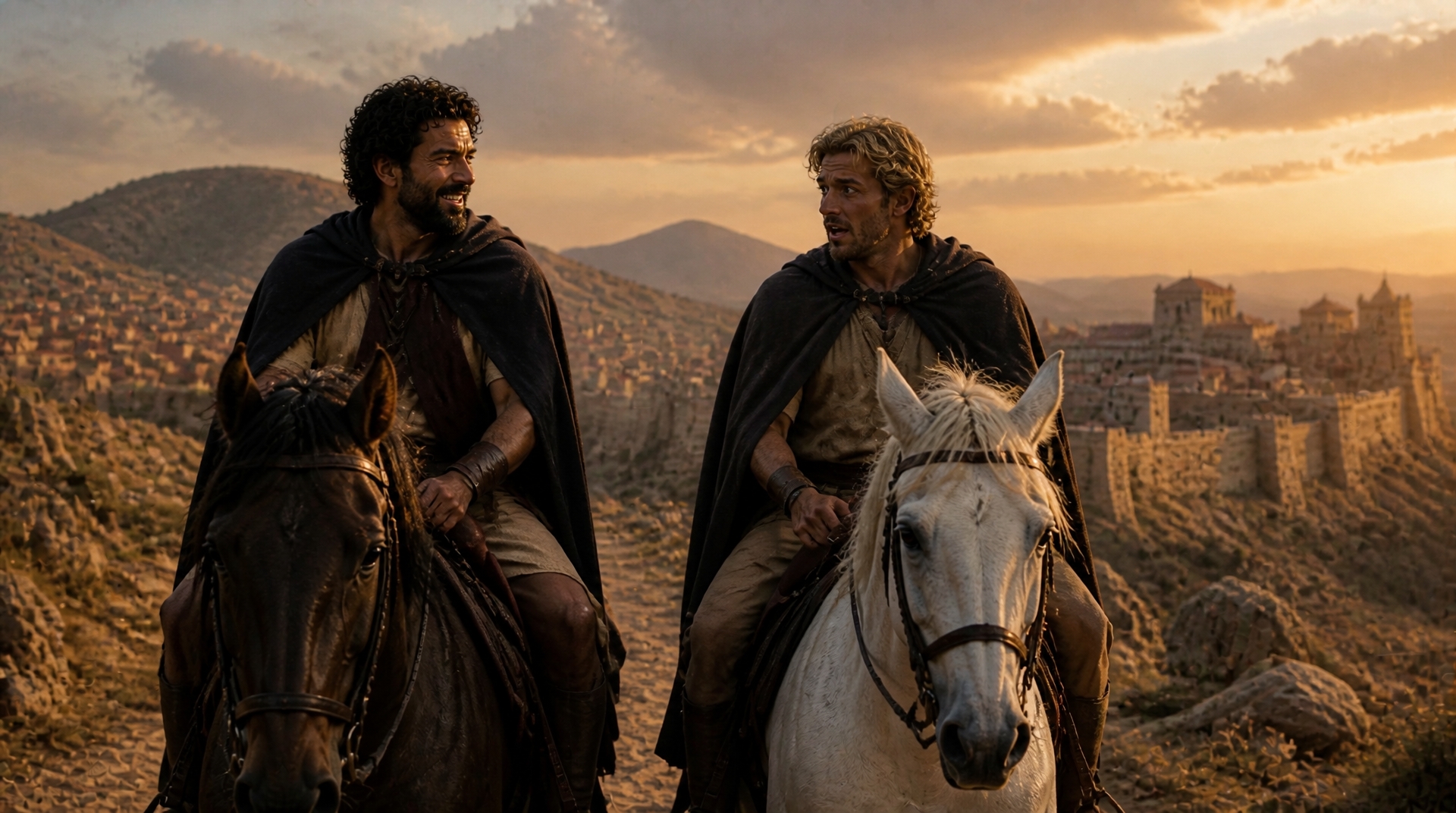
They rode for nearly an hour before Demetrios could contain himself any longer. He pulled his horse
alongside Lucian's and demanded: "How in Hades did you manage to pull that off?"
Lucian looked straight ahead, trying not to grin. "Pull what off?"
"Make the sun disappear! Convince an entire city that you commanded the gods! Lucian, I have
never seen anything like it in my life." Demetrios's eyes were wide with a mixture of awe and
confusion.
Lucian laughed. "I didn't make the sun disappear, my friend. The moon did it."
"What?"
"You do remember the Earth is a sphere, don't you? And the moon, also a sphere,
goes around the Earth, just like the Sun does?"
"Of course I do!" Demetrios protested. But what does that have to do with what happened?
"The Moon is much closer to Earth than the Sun is. And while the Sun takes a year to go around
the Earth, the Moon takes only about a month. And sometimes, it goes directly between
us and the Sun, blocking its light."
Demetrios thought. "That must also explain those times when the moon itself appears to be
extinguished—the Earth's shadow falling on it!"
"Exactly!" Lucian grinned.
"Think about this," Lucian said. "When I was gesturing with my hands,
I glanced down at my shadow. And I saw something unusual."
He held up his hands, fingers crossed. "When sunlight passes through the gaps between your fingers,
what do you see? Look down at the shadow."
"Dots of light," Demetrios said uncertainly.
"Yes, but what shape is it?"
"The shape of…Circular. Like little suns."
"Exactly," Lucian said. "Aristotle noticed, 600 years ago,
that when sunlight passes through a small hole, it creates an image of the sun on the ground.
Now imagine that the sun itself becomes a crescent—diminished,
bitten away by something blocking the light. The reflection cast would be
crescents; and that's what I saw. So then I knew what was happening, and that
it wouldn't last too long. So I decided to use it to my advantage."
Demetrios shook his head slowly. "You used a natural phenomenon to create peace," he said.
"You took the gods' own work and made it serve human purposes."
"I doubt I'll ever be able to use such a trick again," Lucian said ruefully. "Few people see
even one eclipse in their lifetime, much less two."
"Still," Demetrios said, "you used knowledge to prevent bloodshed. You used understanding to
forge peace. Not every man could do that."
They rode south, leaving Consabura behind, leaving the warring factions to attempt their fragile
reconciliation. The Pillars of Heracles still called, still drew Lucian forward, and this next leg
of the journey was to take them to Mariana, a small mining town that ought not to cause any trouble.