|
By: Paul S. Cilwa |
Posted: 5/21/2026 |
|
Page Views: 80 |
| Hashtags: #HistoricalFiction #LucianOfSamosata #Mariana #Sisapo #Mining #Murder #Mystery #RomanHispania #Hispania #Spain |
| Lucian and Demetrios are invited to dine at a house of secrets. |
| Estimated reading time: 11 minute(s) (2546 words) |
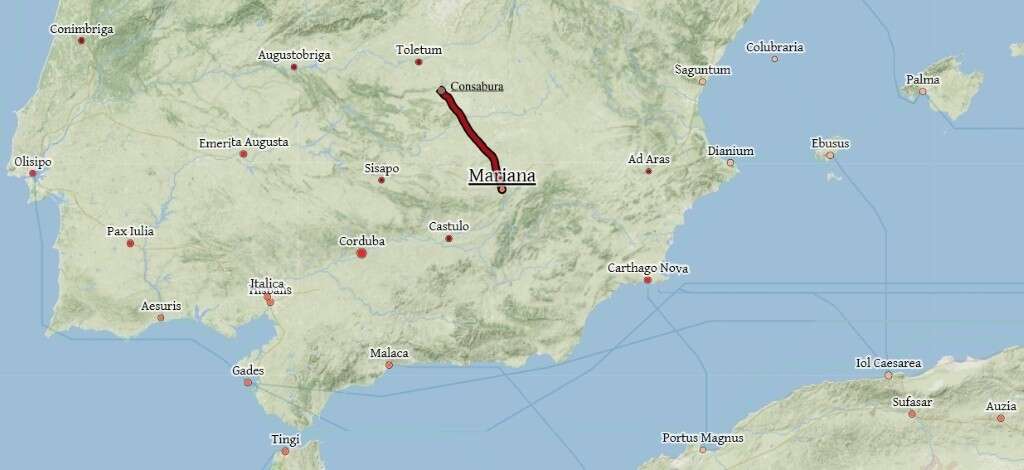
The mines of Sisapo were legendary—cinnabar, the precious red ore, the source of the mercury that
the Empire valued above gold. Mariana was merely the satellite village that serviced those mines:
housing for the laborers, a waypoint for the ore shipments, a collection point for the endless
stream of taxes that Rome extracted from the earth and the people who dug it. The price of that
wealth was written on every face they passed.
Lucian had read Pliny's account of these very mines. The elder had been precise: Sisapo was a death
sentence. The cinnabar dust was poison, and the men condemned to work the pits—and many were
forced to—filled their lungs with it until they could no longer breathe. Pliny had written of workers
wearing bladders over their faces, and even that precaution was only partial. The wealth of the
Empire, it seemed, was built on the suffering of men Rome did not count.
They had barely cleared the forum when a slave intercepted them on the road—a young man with the
bearing of someone accustomed to delivering commands.
"The Overseer invites you to dine and stay as his honored guests," the slave said, his eyes not
quite meeting theirs. "Word reached him before you did. He would be honored by your company."
Lucian grinned at Demetrios. This was not the first such invitation, and would likely not be
the last. Every town wanted a performance. Every man of wealth wanted to attach himself to the
prestige of a traveling philosopher. And here he was!
"The Overseer is generous," Lucian said. "Tell him we accept."
The House of Crispinus
The house was exactly what Lucian expected, and more. Ostentatious; cluttered with expensive things;
the accumulated wealth of a man who used luxury as proof of his own importance. Imported Campanian
wine in jars stacked four deep. Marble figurines from the East. Tapestries hung in rooms no one
ever entered. Gilding of mercury and gold on every available surface, including, Lucian noted, the
lamp brackets—where the fumes would slowly poison anyone who lit them often. The same poison that
was killing the miners outside was, more elegantly, killing the household within.
The members of that household came forward to greet the guests in a careful procession, and Gaius
Vibius Crispinus, the Overseer of Mines himself, presented them one by one.
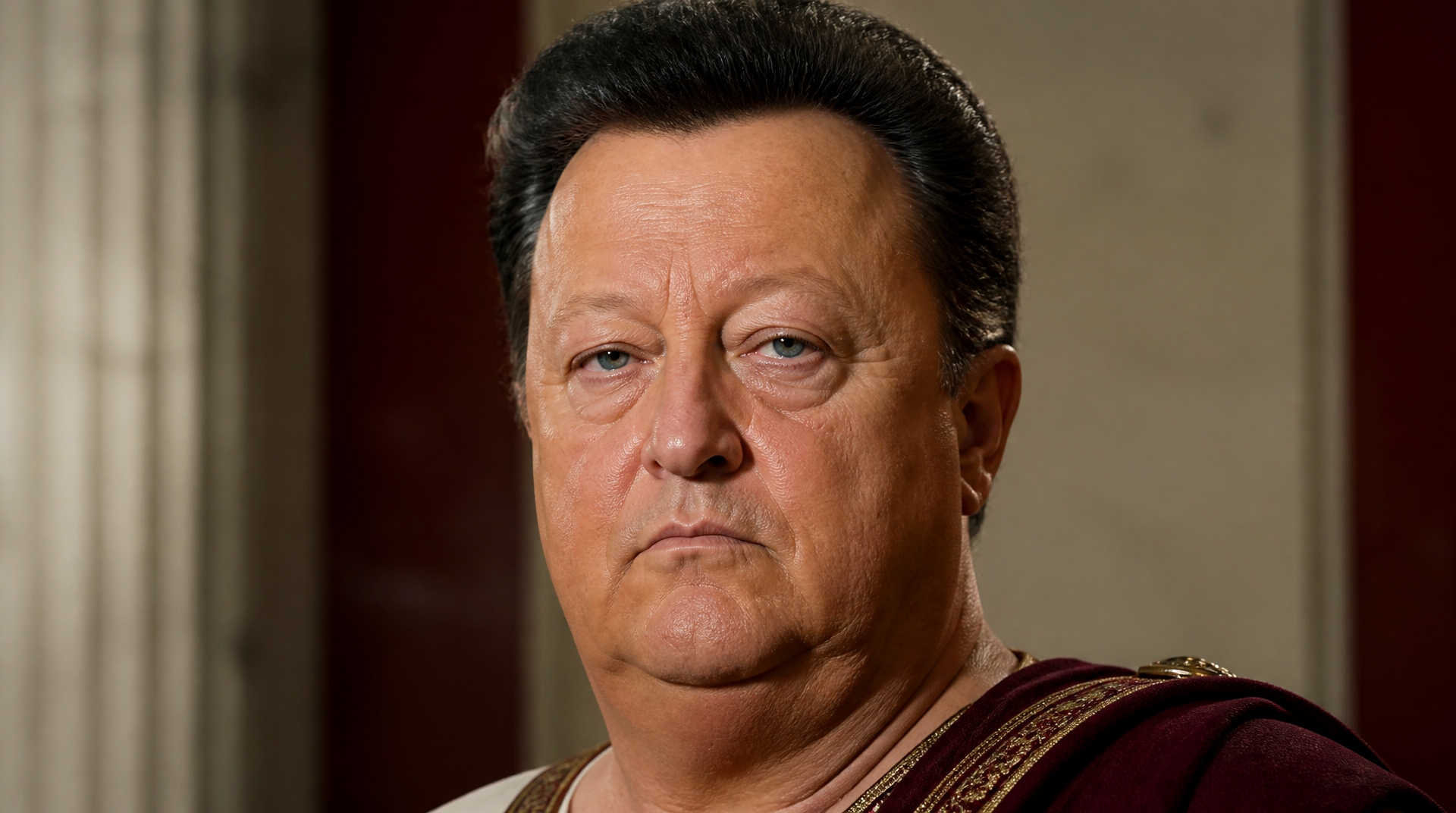
He was broad-shouldered and red-faced, with the bearing of a man who had never been successfully
contradicted. He clasped Lucian's hand with a heartiness that contained nothing warm. His eyes—Lucian
saw it at once—had already moved past him to Demetrios.
"My wife, Cornelia," Crispinus said, gesturing without looking. "From Italica. Her family
raised olives for three generations before they raised her."
Cornelia inclined her head. She was perhaps forty—handsome rather than beautiful, with the
deliberate composure of a woman who had learned long ago not to flinch. "You honor our house,"
she said to Lucian. Her voice was low, almost musical. The smile she offered did not reach her
eyes, but it was not meant to. It was the smile of a Roman matron performing her duty.
"My son, Marcus."
Marcus was perhaps twenty-eight, slim, with his father's coloring and none of his weight. He bowed
without enthusiasm. He had the look of a young man whose debts were larger than his prospects.
"My steward, Onesimus. From the eastern edge of the empire.
I freed him myself eight years ago. He runs the household so I don't have to think about it."
Onesimus was thin, neat, with the watchful eyes of a man who knew exactly what every coin in the
house was doing. He bowed lower than his station required.
"Severus, my clerk."
Severus was perhaps thirty-five, with ink-stained fingers and the hunched shoulders of a man
accustomed to being unseen. He flinched at his own name. He did not look up.
"Thalia, my wife's companion."
A young Greek woman, no more than twenty-three, beautiful in the way of expensive things. She did
not curtsey. Her eyes met Lucian's for an instant—long enough to communicate that she knew exactly
how she was being introduced, and exactly what the truth was. Then she looked away.
"And this," Crispinus added, almost as an afterthought, "is Hermogenes. My physician. He
treats my gout and my wife's nerves and earns his keep besides by being the most boring man at
table."
Hermogenes was perhaps fifty, gray-bearded, with the patient amusement of a man who had heard worse.
"I do my best," he said dryly, in a Greek so cultured that Crispinus appeared not to recognize
the insult buried inside the courtesy.
Lucian observed all of this with the practiced stillness of his trade. A household, he thought. A
household with a great many things to hide.
A Cruel Table
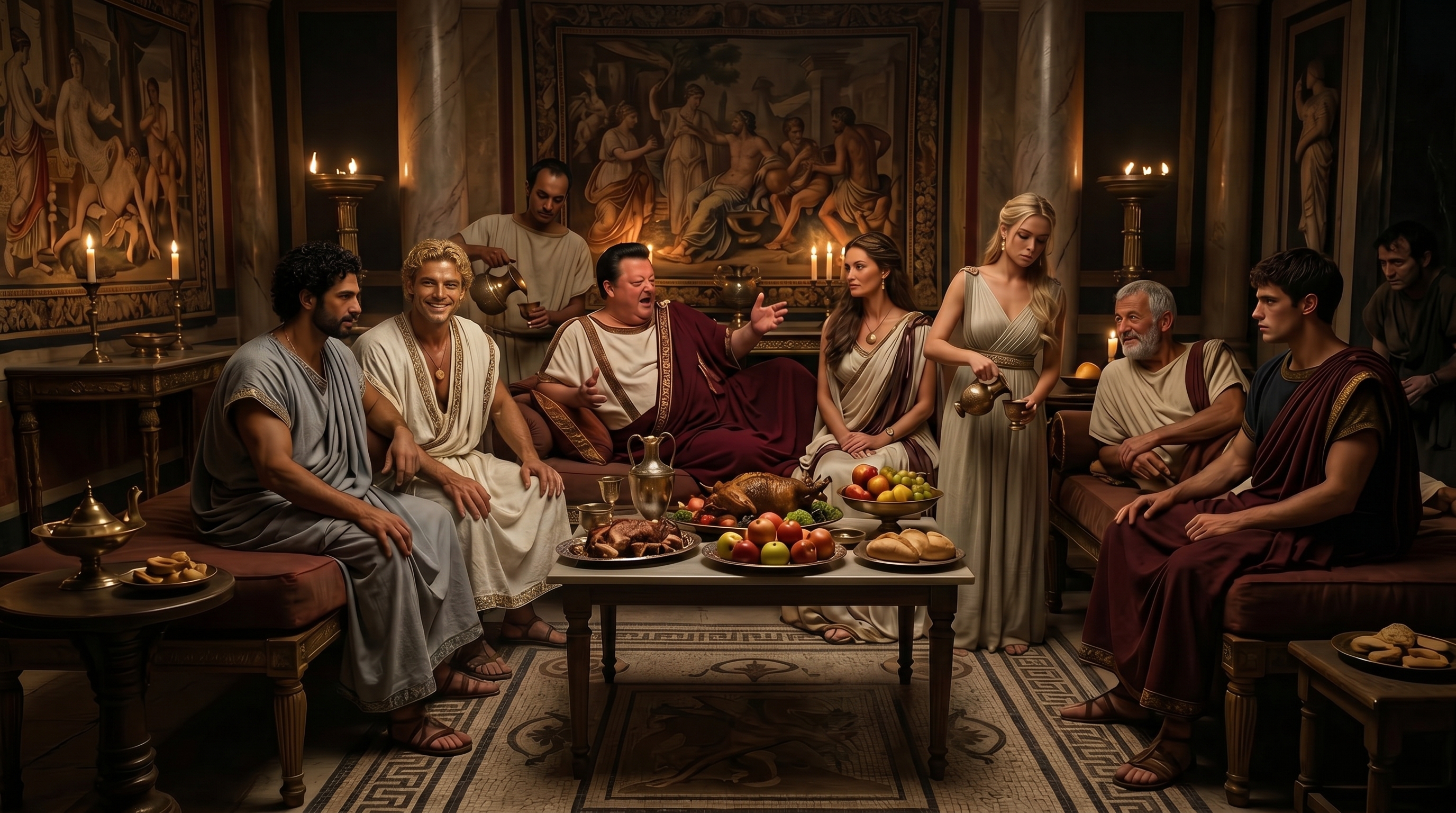
The dinner that followed was a performance, and Crispinus was its star. He drank heavily, and the
more he drank the more thoroughly he demonstrated that every person at the table was an extension
of his own importance.
To his son: "Marcus lost six thousand sesterces at dice last month. Did I tell you, Lucian? Six
thousand. I asked him what he had to show for it. Do you know what he said? Nothing. Not even a
story. Six thousand sesterces and not even a story."
Marcus's wine cup was very steady in his hand. The knuckles were white.
To his steward: "Onesimus tells me the household accounts are in order. I trust him. I freed him
myself. Of course"—here a wink to Lucian—"a freedman who manages your money is a freedman
who must be watched. They never quite forget what they were, do they, Onesimus?"
"No, master," Onesimus said quietly. "We do not."
To his wife: "Cornelia is from Italica, did I say? Old family. Olives. They are very dignified
about being poor. She brought her dignity with her when she married me. It is one of her best
qualities. She keeps it even now, when she has had ample reason to abandon it."
Cornelia smiled. The smile did not change. "My husband enjoys a joke at table," she said to
Lucian.
"I do," said Crispinus. "I do. I enjoy many things. And lately I have been thinking I might
enjoy others."
His eyes drifted across the room and settled on Thalia, who was pouring wine. Then to Demetrios.
Lingered there.
The clerk, Severus, stood at his post against the wall. Lucian, placed where he could see the man's
face, watched Severus watch the Overseer watch Demetrios. He watched the clerk's jaw set, then
relax, then set again. He watched Severus's hand on the wine flagon tighten until the knuckles
looked like they might burst.
Hermogenes the physician caught Lucian's eye and gave the smallest possible shrug.
When the meal ended, the Overseer rose unsteadily. "Demetrios. You will join me in my chamber. I
have questions about the eastern provinces."
Demetrios looked at Lucian. Lucian looked at Crispinus. Crispinus was smiling the smile of a man who
had already decided what came next.
"I shall retire," Cornelia said. She inclined her head precisely. "I am unwell tonight.
Hermogenes has prepared a draught."
She walked from the room without looking back.
Voices in the Colonnade
Lucian woke, realizing Demetrios had not yet come to bed.
Lucian knew that his friend had, in years past, sold himself out to powerful men.
But it had been a long time since Demetrios had done anything like that,
and Lucian found he just couldn't sleep without his feet and Demetrios's feet
being entangled. Besides, the wine had been too rich; the dinner had left a taste in his mouth that
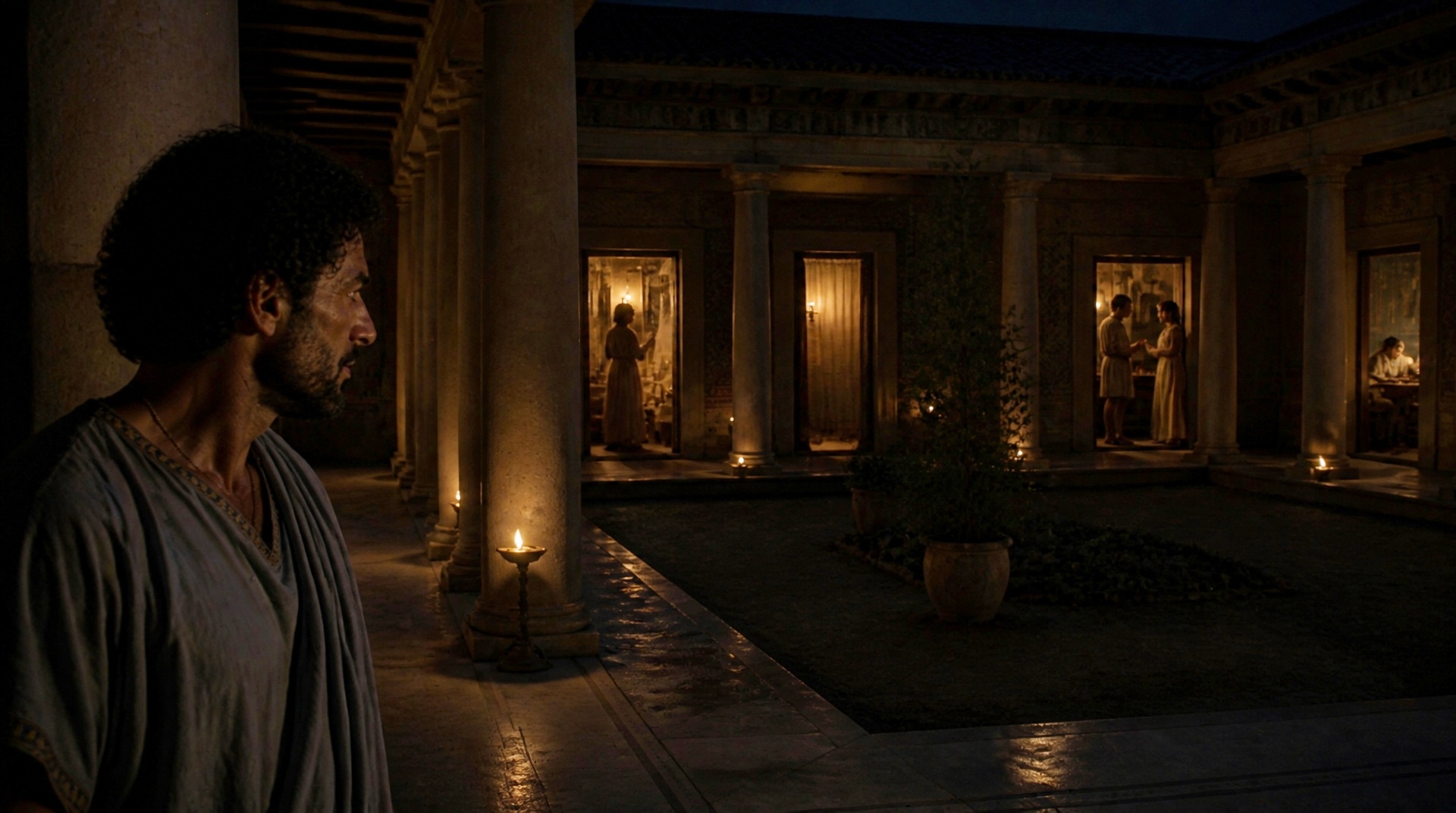
wine could not wash out. He rose, wrapped himself in his cloak, and walked the colonnade that
surrounded the peristyle, ostensibly to clear his head and in truth because a peristyle at night
was the place in any Roman house where the truth of the household could most reliably be heard.
The first voices came from a curtained doorway near the tablinum.
"…the papers are with the magistrate. He has only to file them. I am telling you this as a
kindness, Cornelia. A last kindness."
"You would not dare."
"I would. And when I do, you will discover that adultery is a remarkably elastic accusation. The
witnesses are already paid. You will be exiled to one of the islands. The dowry returns to my hand.
Your family will not receive you back. I have already written to them."
"Gaius. There is no need for this. I have done nothing."
"You have done nothing because you are nothing. That is the point. I am tired of nothing. I
am tired of a wife who arrives at my table like an inscription on a tomb. Find your peace with it.
It will be done by the Kalends."
Lucian heard a long silence. Then Cornelia's voice, low and even: "Will it."
He moved on.
The second voices came from a side passage near the kitchen.
"—I have told you. I have told you. The cook reports to me. If the lady wants
something in her kitchen, she sends word to me, not to the cook. That is how a household
works."
"The cook is perfectly capable of receiving an instruction from the lady directly. He
has been doing it for years, in front of you, and you do not notice."
"If you say one word, Thalia—"
"What? You will tell him I share his bed? He sent me there."
"He knew. Past tense. Has he told you what he is replacing you with?"
A silence.
"You are lying."
"Ask him. Tonight. Ask him about the girl from Corduba. Ask him about the contract he had drawn up
last week. Ask him whether his wife knows. Ask him whether you do."
Footsteps. A door opening. Lucian stepped back into the shadow of a column.
Onesimus the steward
passed within an arm's length of him, breathing hard, and did not see him.
The third voice was a single voice, and it was Marcus's, and it was muffled by a curtain and by
drink.
"I will not. I will not. Father, I will not. Let me go to Rome. Let me go anywhere. I will work. I
will—Father—"
There was the sound of a slap, casual and contemptuous, the kind of slap a man delivers to a slave
he has had for too long.
"Go to bed, Marcus. We will speak of this when you are sober. Which, I suppose, will be never."
A door closed. A young man wept somewhere on the other side of it.
Lucian was about to turn back to his own chamber when he heard the fourth voice.
It came from a small cubiculum off the colonnade, where a lamp still burned. The voice was male, and
unguarded, and weeping—not loudly, but as a man weeps who has been weeping for a long time and is
past the point of caring whether he is heard.
"Tonight. He said tonight. He said—he said—"
Lucian stopped. The voice was Severus's.
A second voice answered. Low. Female. Composed.
"Hush. You have done nothing yet. We have spoken of it only. You can still choose."
"I cannot bear it. I cannot bear another night of it. To see him—to see him with that—"
"Then choose. But choose tonight, Severus. There will not be another."
Lucian held very still. He could not see the speakers. He could see, on the wall opposite the
cubiculum, the wavering shadows of two figures cast by the lamp—one seated, one standing. The
standing figure was tall, and wore the long stola of a Roman matron.
The shadow moved. The standing figure bent and laid a hand on the seated one's shoulder. The seated
figure shuddered.
Then the standing figure left by the far door, and Lucian, very softly, moved on.
Just Say No
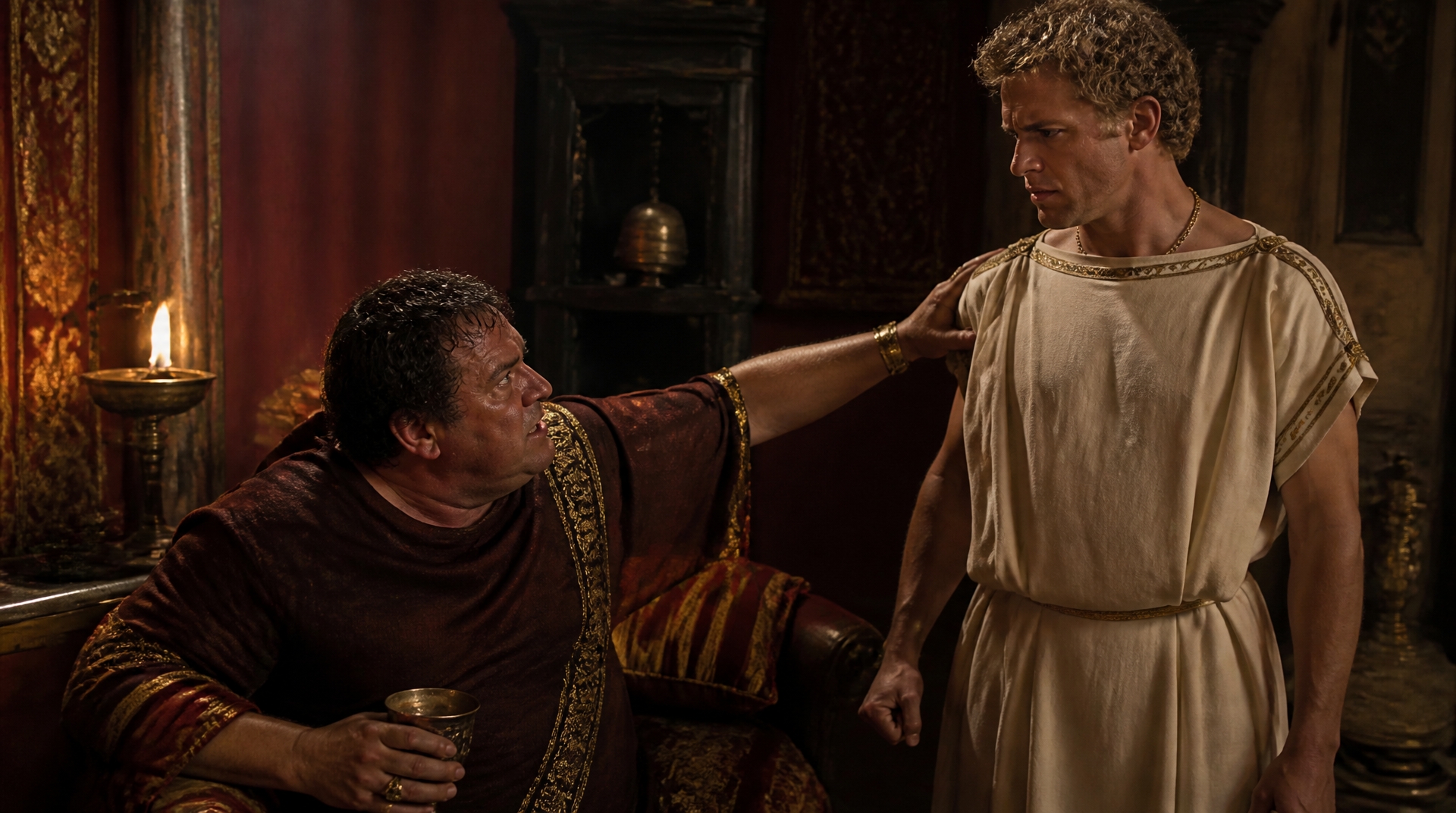
Demetrios was acutely aware of the moment the Overseer turned his full attention toward him. It was
like being caught in the beam of a lighthouse—inescapable, relentless. The private chamber was
lit by oil lamps and draped in expensive fabrics. The Overseer waited, wine cup in hand. The doors
closed behind them.
"You are a handsome man," the Overseer said without preamble. "Uncommon. Different from the
Romans and Syrians we usually see passing through."
"Well, thanks, I guess…"
"Stay." Crispinus set down his cup and moved closer.
"I could be generous to a man like you.
Lucian probably doesn't pay you well enough. Rhetors are notoriously stingy. I could offer you
something better. Comfort. Security. A position of real authority."
The Overseer reached out and touched Demetrios's arm. His fingers were warm, slightly damp.
Demetrios pulled back, laughing. "Thanks, but no thanks!"
"No?" The Overseer's expression hardened. "Do you understand who I am? Do you understand what
I could offer?"
"I'm sure I do. Which is exactly why my answer is no."
The Overseer's hand clenched. "You are a fool. A beautiful fool, but a fool nonetheless. You
travel with that charlatan, performing philosophy for pennies, when you could have wealth. Power.
Respect."
"I could have those things," Demetrios said, nodding. "If I wanted them. But you see…"
and at this, Demetrios shrugged, palms out. "I don't."
Crispinus's face went red. He reached out again,
gripping the Greek's arm hard enough to hurt,
this time with intent that went beyond seduction.
"You do not refuse me. No one refuses me. You will learn that."
Demetrios, unable to wrench himself free from the heavy man, struck him.
It was not premeditated; it was reaction. His
fist connected with the Overseer's face, and he felt the satisfying crack of cartilage beneath his
knuckles. The Overseer staggered backward, his hand flying to his nose, blood streaming between his
fingers.
"Get out!" the Overseer hissed. "Get out, you ungrateful bastard! When the soldiers come—and
they will come—you will regret the day you were born!"
Demetrios, who hadn't waited for the invitation, was already leaving the chamber,
his hand still burning, his chest heaving. As he passed back into the
colonnade, he did not notice a figure waiting in the shadow of a column. He did not see the figure
detach itself, soundless, and slip into the room he had just left.
He did not notice, because he was angry, and he was on his way to awaken Lucian
and escape this crazy household, and because he did not yet know all the secrets
the house contained.
A slave, carrying a tray of wine and cheese, passed him in the colonnade and entered the chamber a
heartbeat later.
And screamed.