|
By: Paul S. Cilwa |
Posted: 5/19/2026 |
|
Page Views: 20 |
| Hashtags: #HistoricalFiction #LucianOfSamosata #Toletum #Hispania #Numantia #Clunia |
| Lucian and Demetrios ride across Hispania toward Toletum and an unexpected encounter. |
| Estimated reading time: 9 minute(s) (1941 words) |
Lucian and Demetrios, dressed in their merchant's cloaks and carrying the supplies Mari had
provided, rested their horses for a day before beginning the journey north. They set out at
dawn, their animals recovered and ready, the Ebro receding behind them.
The Highlands
The first day was long but not difficult. The Roman road ran straight and true, lined with
milestones counting the distance back to Caesaraugusta. They passed villas set in irrigated
fields, the land flat and agricultural. But as the day wore on, the terrain began to change. Low
hills rose on the horizon, and the landscape shifted from the green of river valleys to the
drier, rockier terrain of the uplands.
They saw mule trains on the road, merchants heading north and south, soldiers on patrol. Nobody
questioned them. They were simply two more travelers on the imperial roads, indistinguishable
from a hundred others.
By late afternoon, the landscape had transformed entirely. The irrigated fields fell away behind
them, and the world became all rock and scrub grass. The sky, which had been pale blue in the
morning, deepened to a fierce azure, unbroken and merciless. The mountains rose up before them
like the ribs of some ancient beast, stripped of flesh, all bone and shadow.
Bilbilis appeared suddenly, perched on a steep hill that seemed to have been wrung out of the
earth itself. Terraced buildings clung to the slope like barnacles to a ship's hull. The wind
here was constant and dry, carrying the scent of stone and thistle. The town clung to its rocky
perch with a kind of desperate defiance, as if daring the earth to try to shake it loose.
The inn was clean and the food was adequate. Lucian lay in his and Demetrios' bed listening to the wind
howl around the building, thinking of Mari a hundred kilometers away in Pompelo, wondering what
she was doing, whether she thought of him. The wind sounded like the voice of the mountains
themselves, old and indifferent to the small concerns of human travelers.
The next two days blurred together: climbing into forested hills, passing shepherds with flocks
of sheep and goats, crossing cold streams that tasted of pine. They saw fortified farmsteads
perched on ridges, small outposts of Roman civilization clinging to the Celtiberian highlands.
At Augustobriga, a small town that seemed to have been half-built and then abandoned by its own
builders, they rested the horses and ate a meal of bread and cheese. A woman at the inn asked
where they were going. "South," Demetrios said, smiling brightly as if that was all the answer
there was, and she accepted it as given.
Numantia
On the third day, they reached Numantia.
Lucian knew the history. Every educated man knew the history. Numantia had been the last great
stronghold of Celtiberian resistance against Rome. The city had held out for months under siege
by Scipio Aemilianus, its people starving, refusing to surrender. When the end came, they chose
mass suicide over slavery. The city had burned.
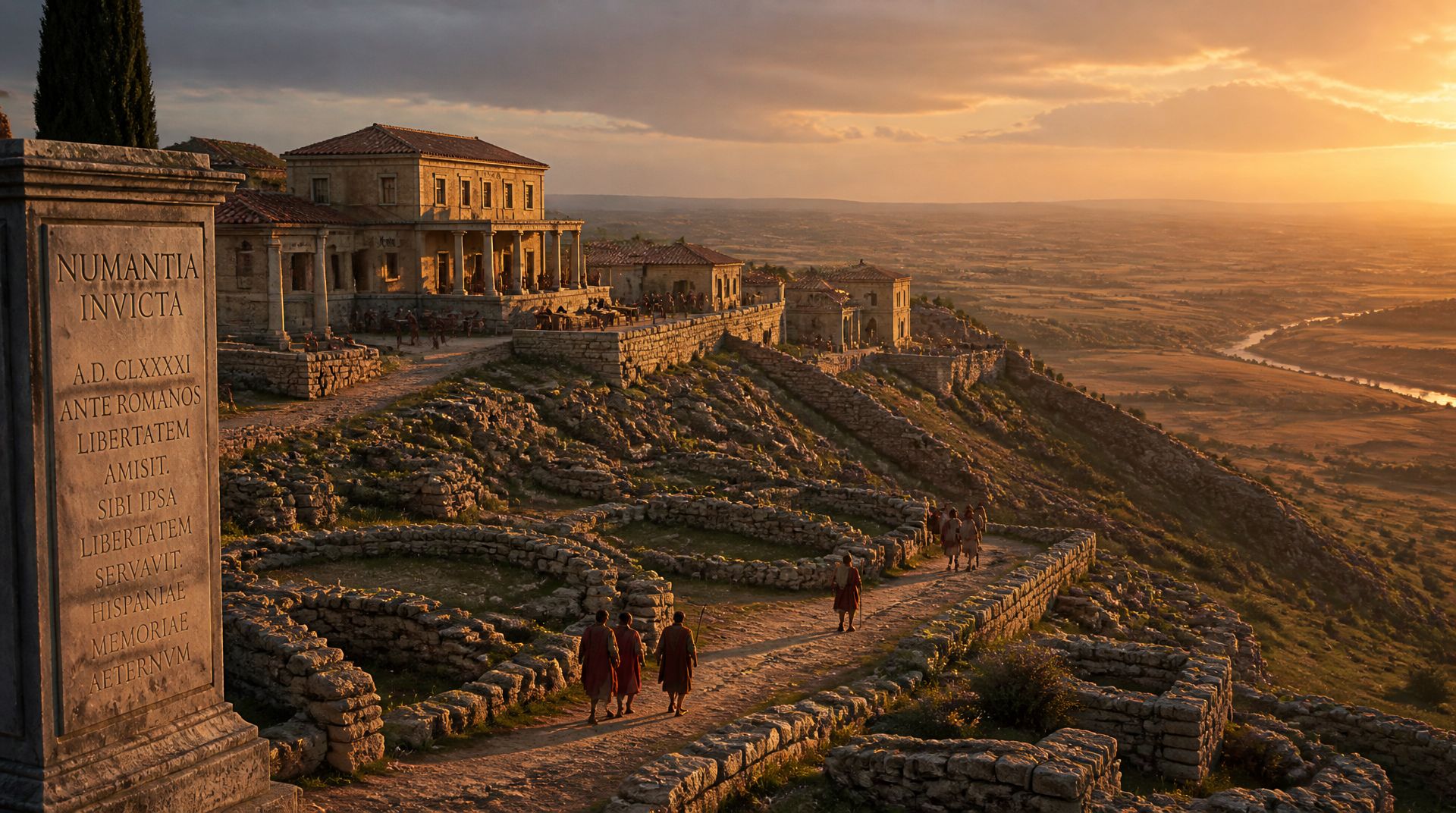
Now it was a quiet Roman town, rebuilt in the shadow of the old ruins. The new structures were
efficient and orderly, laid out in the grid pattern that marked Roman civilization. But the old
stones were still visible if you knew where to look—the foundations of the ancient city,
darker and rougher than the Roman work, a reminder of what had stood here before.
There was a mansio with clean rooms and a view of the Duero valley spreading out below like a map
of all the lands Rome had claimed. Lucian stood on the terrace at sunset and thought about the
men and women who had chosen death over submission. He tried to imagine it: the hunger, the
thirst, the knowledge that surrender meant slavery. And still, they had chosen the fire.
He thought about Mari's speech to her people, teaching them resistance without violence. Different
strategies, the same defiance. But Mari's people were still alive. The Numantians were ash and
memory.
The valley below was beautiful—green and fertile in the late afternoon light, rivers
threading through it like veins. It was a land worth dying for. Or worth living for, if you
could find a way.
"You're thinking about something," Demetrios said, joining him at the rooftop railing.
"History," Lucian replied. "The weight of it. All these people who died, and Rome
just—rebuilt. Kept going. As if they never existed."
"Yes," Demetrios said. "But the Numantians are remembered. Rome conquered them, but
they're remembered. They chose their own deaths, rather than letting Rome Kill them.
I feel like that matters."
Lucian nodded slowly. Perhaps his friend was right. Perhaps being remembered, even as a warning,
was a kind of victory.
The Plateau
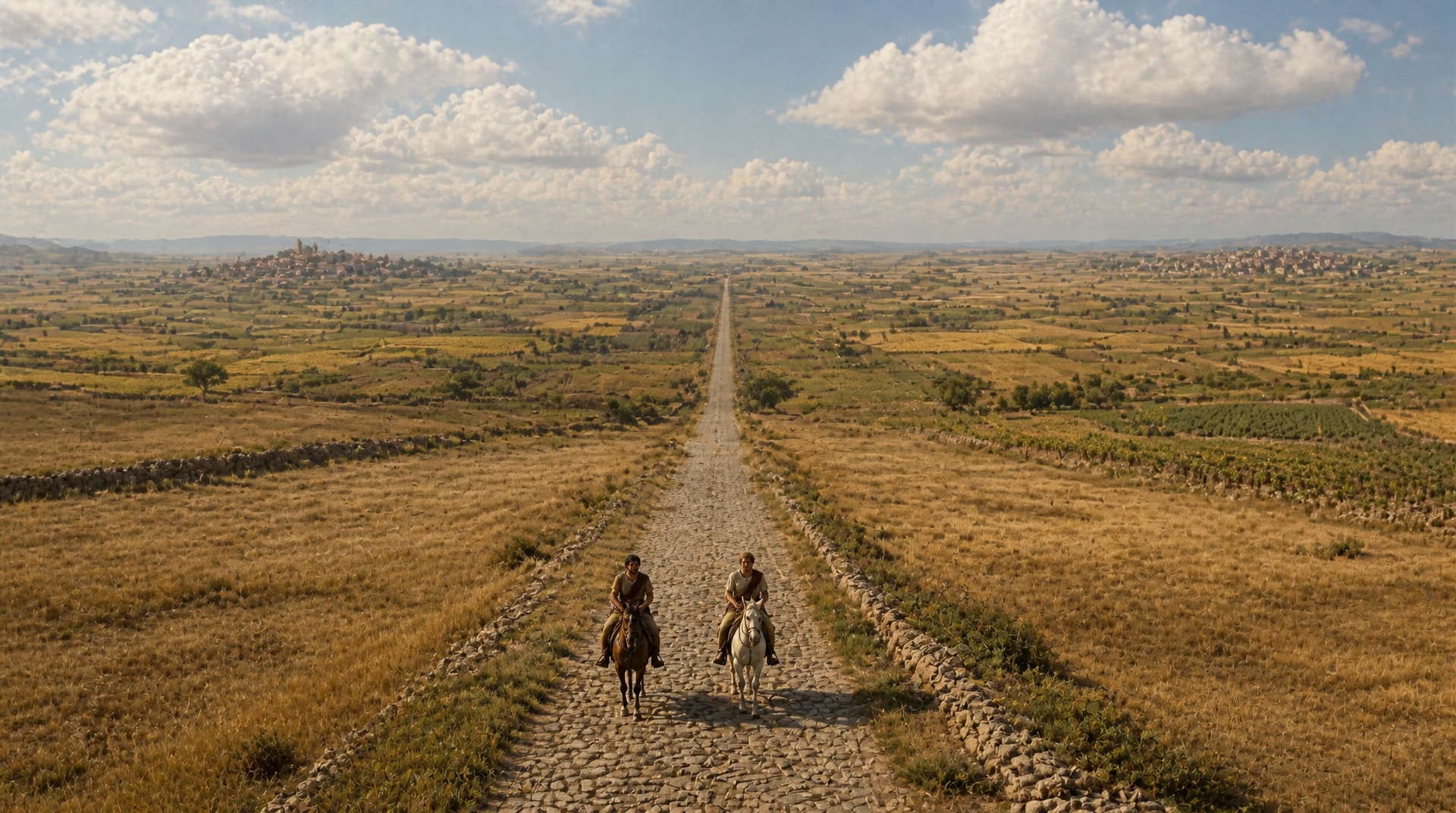
The road from Numantia led northwest across the Duero plateau. The landscape opened into endless
sky and rolling grassland, dotted with vineyards and wheat fields. This was agricultural land,
productive and settled. The plateau stretched on and on, an ocean of grass and grain under a
dome of blue so vast that it made the earth seem insignificant beneath it. Lucian had never seen
a landscape so empty of variation, so monotonous, so utterly indifferent to human concerns.
The towns came more frequently now: Uxama, with its hilltop forum and the sense of efficient
Roman administration; Clunia, a major Roman administrative center with a theater so vast it
seemed carved into the earth itself. The road here was bustling with traffic—merchants,
officials, soldiers, farmers bringing goods to market. This was the heart of Roman Hispania,
where the machinery of empire ran smoothly and without friction.
They arrived in Clunia in the late afternoon of the fourth day, the sun casting long shadows
across the streets. The theater rose above them like some massive stone monument to Roman
permanence. Lucian looked at it and understood suddenly that this was not a temporary thing.
Rome was not going anywhere.
Lucian made a decision. "We rest tomorrow," he said to Demetrios. "The horses need it.
And so do we."
They spent the next day in the baths, soaking the dust and ache from their muscles, the hot water
loosening the knots of tension that eight days of hard riding had woven into their bodies. In
the afternoon, they attended a performance in the theater—a comedy about mistaken
identities and lovers separated by fate. The enormous space amplified every laugh, every gasp.
Lucian laughed harder than he had laughed since Pompelo, laughed at the absurdity of love and
circumstance and the human capacity to get everything wrong.
That night, they sat in the mansio's courtyard under the stars and talked about the play, and
about the road still ahead, and about what lay beyond the Pillars of Heracles—beyond where
the Romans claimed civilization ended, beyond the maps they had studied. The world was a sphere,
any educated person knew that. But what was on the other side? What lay past the edge of the known world?
"Does it matter?" Demetrios asked. "Either way, we'll know when we get there."
Lucian chuckled and drew his friend in closer.
The Courier
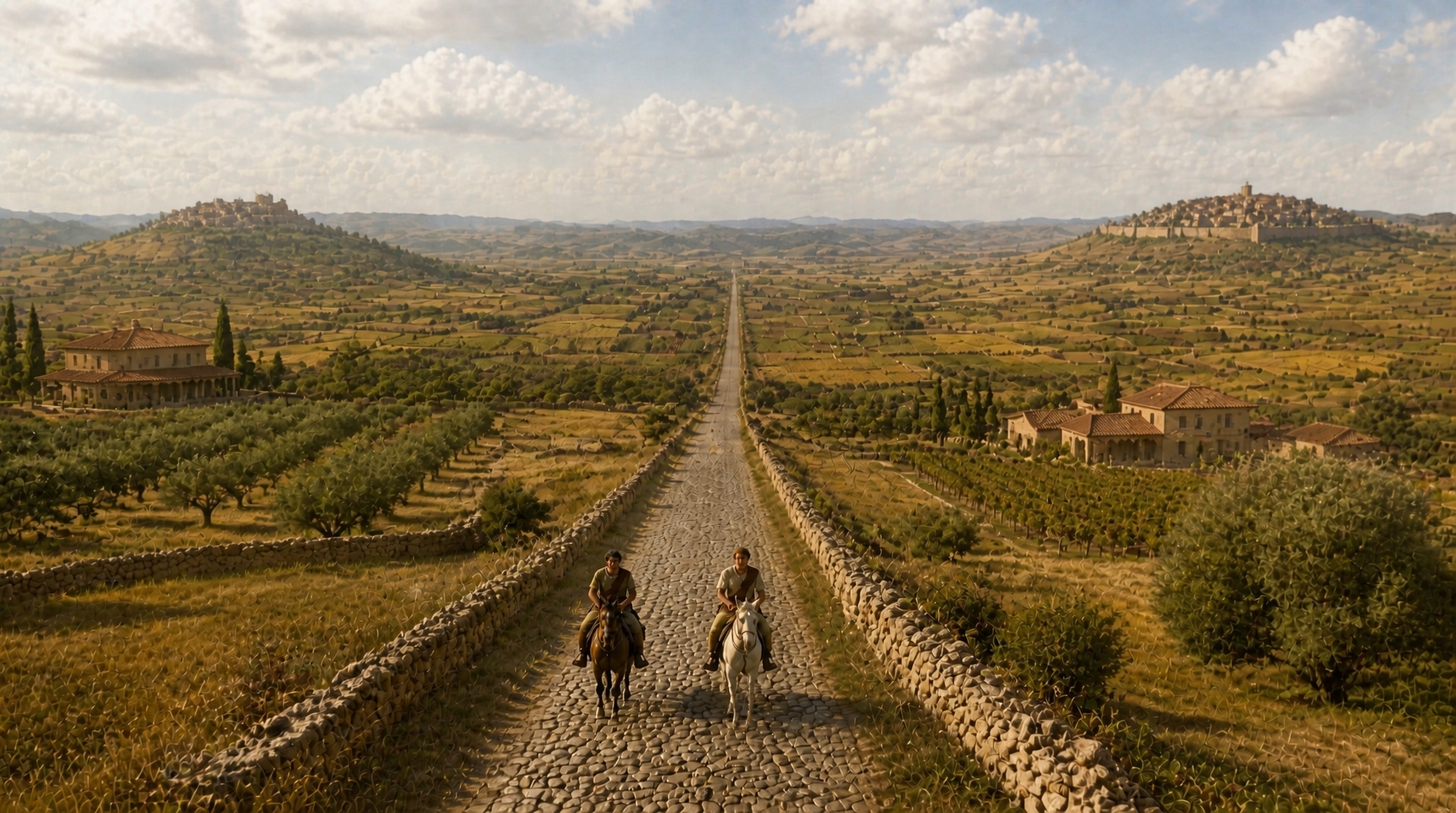
They left Clunia rested and refueled. The next days passed in a rhythm of riding and stopping,
dust and determination. Each day was slightly different, yet all the same. The landscape
progressed subtly: the plateau gave way to rolling hills, the hills to more fertile terrain.
Segontia was a fortified town perched on a ridge, all stone walls and military efficiency,
watching the roads like a hawk. Complutum was prosperous and bustling, a grid-planned Roman city
full of merchants and students and officials conducting the business of empire.
The land grew greener as they rode south. Villas appeared more frequently, estates with terraced
gardens and ponds for fish. The signs of wealth and Roman civilization became denser on the
landscape. This was the heart of Roman Hispania, orderly and productive, civilized according to the
Roman definition of the word.
On the night of the seventh day, as they were camped off the road somewhere in the darkness
between Complutum and Toletum, they heard it: the sound of pounding hooves approaching from
the north, a single rider moving at speed. Not a merchant with a small train, not soldiers on
patrol, but one man pushing his horse hard into the darkness.
"Courier," Demetrios muttered, rolling over. "Imperial business. That poor horse. Back
to sleep."
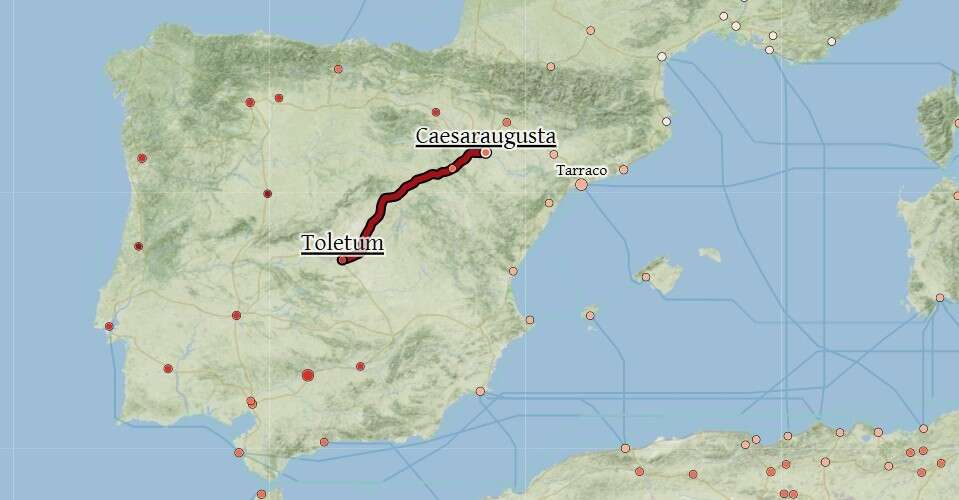
In the morning, they broke camp and continued riding south toward Toletum.
Holy Toletum!
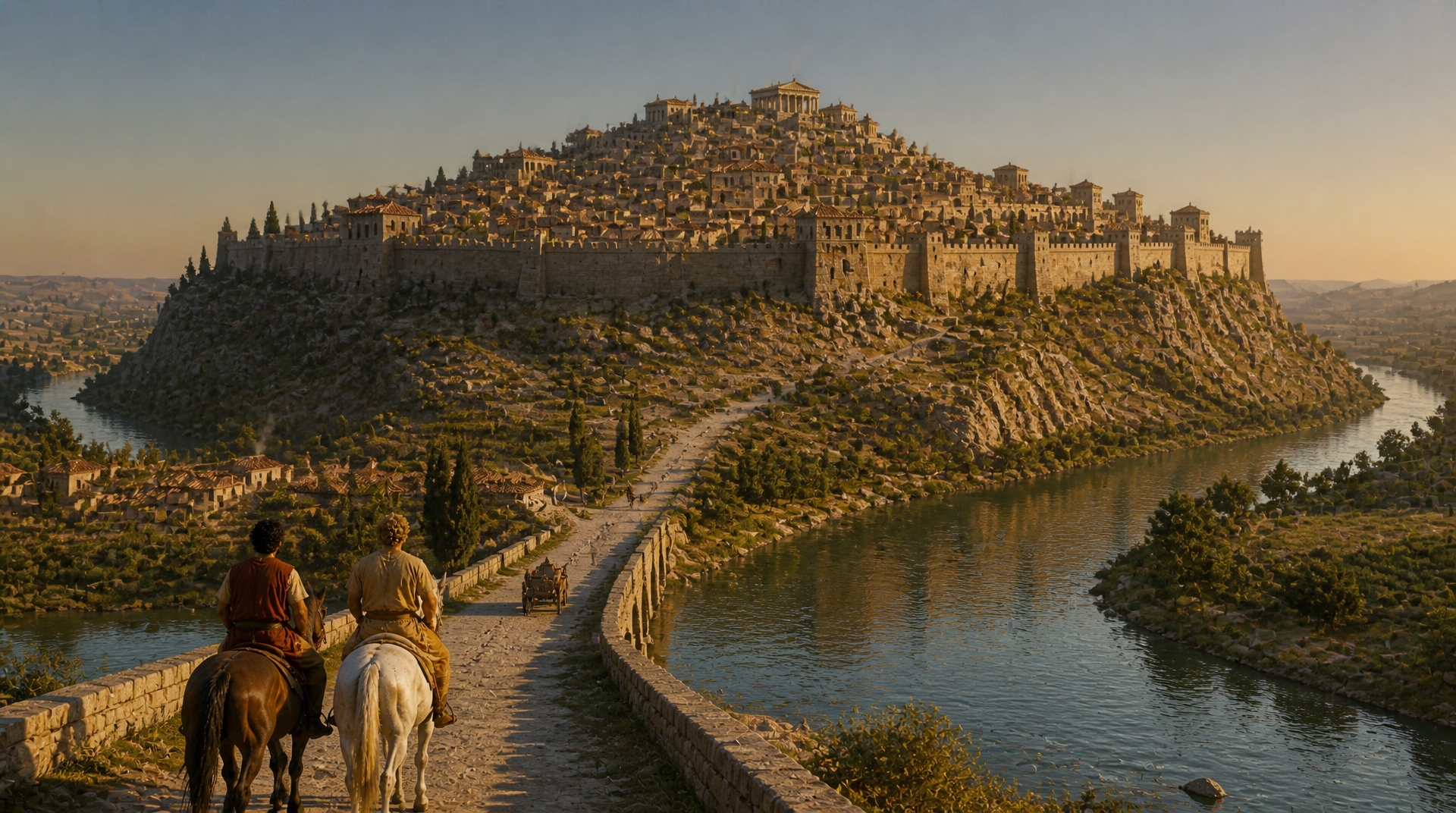
The Tagus River announced itself before the city did. The road descended from the Carpetanian
plain into a river valley, and suddenly there was water, green and alive, reflecting the
afternoon sky. They crossed a bridge of solid stone and climbed again on the other side, and
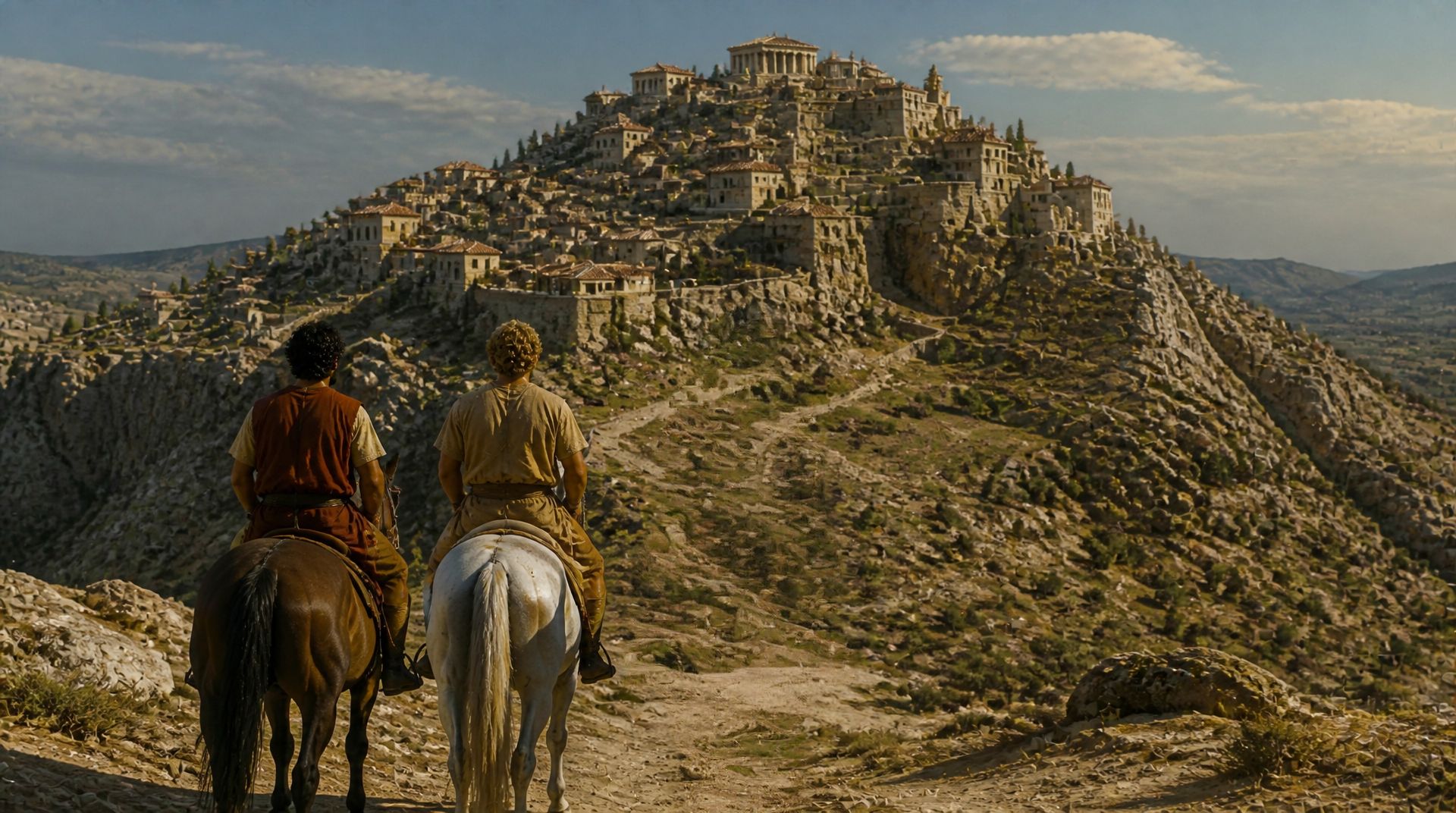
then Toletum appeared before them like something from a legend.
It rose from a granite hill like something ancient and powerful, the Tagus bending around it in
a near-complete circle, creating a fortress of stone and river. Roman walls ringed the city,
solid and authoritative, marked by gates and towers at the cardinal points. Even from a distance,
Lucian could see the signs of Roman engineering: roads spiraling up the hill, administrative
buildings of worked stone, the skeleton of an aqueduct system threading through the city.
They rode in through the southern gate as the sun was dropping toward the western hills, casting
everything in gold and long shadows. The city opened
before them: a forum with baths, workshops and mills along the river, streets laid out
in the efficient grid pattern that marked Roman control.
Oddly, or perhaps because of the geographic constraints of the city's location, Toletum
had a dearth of large temples. In fact, there was just one on the Forum, and it was
not at all impressive. Lucian had spent his life hearing about "Holy Toletum", but not
until he saw it for himself did he realize the epithet was meant to be ironic rather
than descriptive.
The mixed population of Toletum—Roman, Celtiberian, Carpetanian—moved through the
streets with the purposeful efficiency of people used to living in a place where empires ruled
and the business of empire kept everyone occupied. No one paid any attention to two dusty
merchants arriving at sunset, too tired to do anything but find a bed.
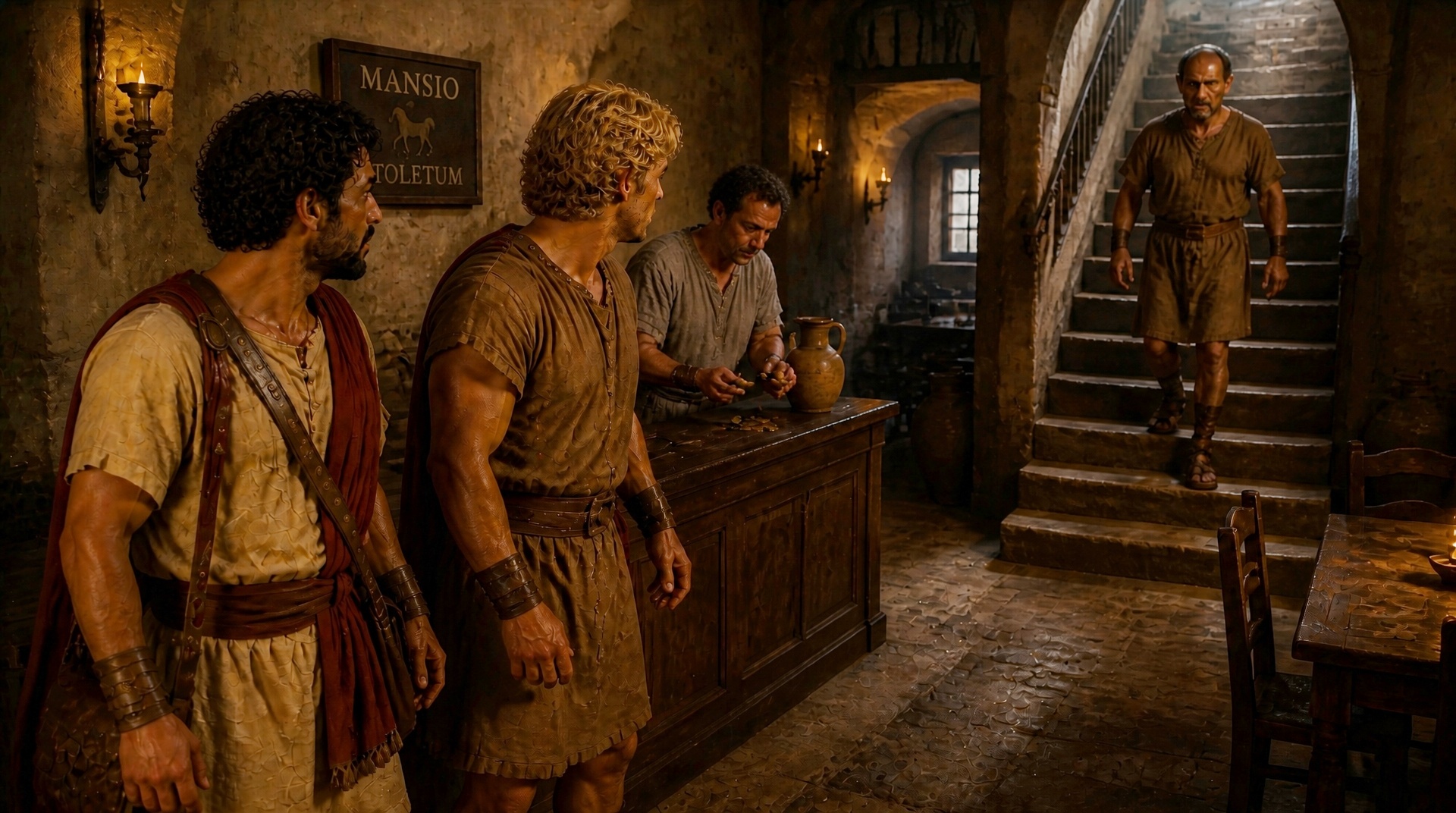
The mansio was a solid, respectable establishment near the river, the kind of place where
merchants and officials and traveling officials stayed. The proprietor was efficient and
uninterested in their business, which suited them perfectly. Demetrios doled out a few coins and
the man directed them to their room upstairs. They turned immediately, eager for rest, for
sleep, for an end to the endless rhythm of riding and stopping.
That was when Lucian suddenly gasped and froze.
Coming down the stairs from the upper floor was a man. Thin. Gaunt. Balding. About fifty years
old. The figure was moving with the casual purpose of someone accustomed to the luxury of the
mansio, someone who belonged here.
Time seemed to stop. The color drained from Lucian's face. It was impossible. It made no sense.
It was the mystery man from the boat.