|
By: Paul S. Cilwa |
Posted: 5/18/2026 |
|
Page Views: 15 |
| Hashtags: #HistoricalFiction #LucianOfSamosata #Caesaraugusta #Ebro |
| Lucian and Demetrios escape Pompelo and encounter a mysterious stranger. |
| Estimated reading time: 14 minute(s) (3307 words) |
"You cannot stay," Mari said frankly. "By tomorrow, perhaps the day after, they
will realize what you were actually saying. And then they will come for you."
"How long do we have?" Demetrios asked.
"A few days, perhaps. Maybe less. It depends on how quickly the soldiers put together what they heard,
and how quickly they decide to arrest you." Mari looked at Lucian. "You made a speech about
resistance. You wrapped it in history and philosophy, but the Vascons understood. And the Romans will
eventually understand, too."
Lucian nodded slowly. "Then we leave. Tonight, if necessary."
"Not tonight," Mari said. "Tonight would draw too much attention. Soldiers guard the city gates,
remember. You leave in the morning,as if you're simply continuing your journey. Heading south back to Tarraco,
to speak at their amphitheatre. Nothing unusual about that. But, in reality, you'll head to Caesaraugusta."
"And the route?" Demetrios asked, ever practical.
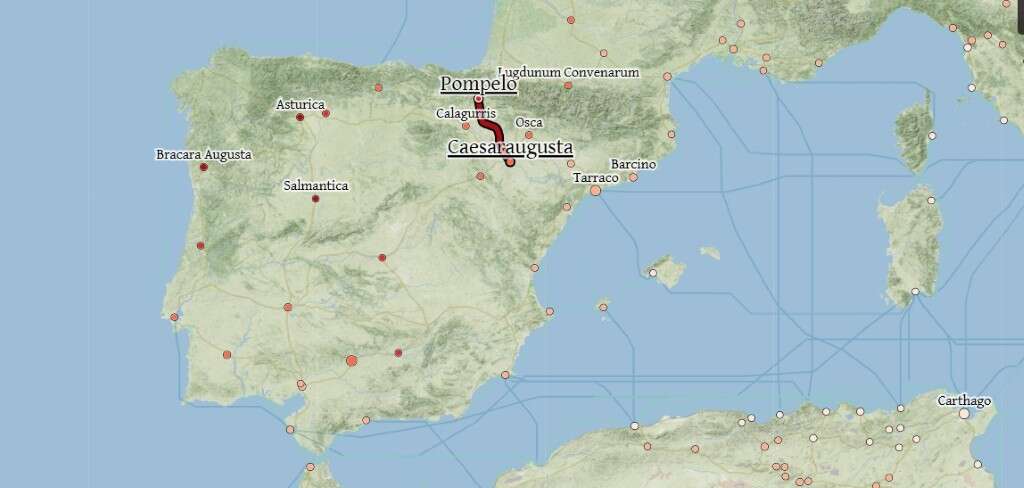
Mari moved to a table where a map was spread out—a merchant's map, showing the roads and rivers of
Hispania.
"You have three options," she said, pointing. "First: you ride. On horseback, you can cover
perhaps forty miles a day if you push. Caesaraugusta is about one hundred and twenty miles south.
That's three days of hard riding. But you would be visible—two men on good horses, traveling fast.
Someone might notice. They might wonder why you're in such a hurry."
"Not ideal," Lucian said.
"No," Mari agreed. "Second option: you join a caravan. There are merchant caravans that
leave Pompelo regularly, heading south. They move slower—perhaps twenty miles a day—but they're
inconspicuous. You're just part of a larger group. The journey takes about six days, but no one
would think twice about you if you simply pretend to be traders moving goods."
"Six days versus three," Demetrios mused. "That's a significant difference."
"It is," Mari said. "But there is a third option." She moved her finger to the river.
"The Ebro. If you travel southeast to reach the river—perhaps a day's journey—you can find a
riverboat heading south toward Caesaraugusta. Boats are common on the Ebro. There's merchant
traffic, military supplies, passengers. You would blend in perfectly. And most importantly—"
she looked at them both, "you can bring your horses."
Lucian looked up from the map. "We can bring the horses on the riverboat?"
"Yes," Mari said. "Merchant boats regularly transport livestock. Horses, cattle, sometimes
pack animals. The boats are built with pens and stalls. Your horses can travel with you, and when
you reach Caesaraugusta, you'll have them for the next leg of your journey. You're not abandoning
them, and you're not spending days riding when you could be resting."
Demetrios was already nodding. "The river is safer, faster than a caravan, and we keep our
horses," he said. "That sounds good to me."
"How long?" Lucian asked.
"The Ebro flows south and east toward the Middle Sea," Mari said. "From here, the journey
to Caesaraugusta is perhaps four days by water, depending on the current. Slower than riding alone,
but faster than a caravan. And you'll be fed on the boat. You'll have shelter. You can rest."
"Where do we meet the boat?" Demetrios asked.
Mari pointed to a location on the map. "There's a settlement called Iruña, about twenty miles
southeast. A day's ride. There are boats moored there regularly. I have a contact—a merchant
who's part of the Resistance. He owes me a favor. He'll make sure you have passage, and he'll make sure your
arrival goes unnoticed."
Lucian studied the map, mentally tracing the route. South and east, following the river. Toward
Caesaraugusta, toward the coast, toward the Pillars of Heracles that still called to him.
"And after Caesaraugusta?" he asked.
"After Caesaraugusta, you keep going south," Mari said. "The coast is your destination, yes?
The Pillars of Heracles?"
"Yes," Lucian confirmed. "I want to see what lies at the edge of the world."
"Then from Caesaraugusta, you travel to Baetica," Mari said. "The coast is your path. There
are cities all the way down—Corduba, Malaca, Gades. And beyond Gades—" she pointed to the edge
of the map, "—lies the strait. The Pillars of Heracles. Calpe and Abila, the gateway between
the Middle and Outer Seas. You'll get there."
Lucian felt something settle in his chest. Not quite peace, but direction. A path forward.
"We'll need supplies," Demetrios said, ever practical.
"I'll provide them," Mari said. "Food, water, clothing for both of you.
Consider it thanks for what you've done here. You came to
my people and gave them something they desperately needed: a path to resistance. Permission to
believe that Rome is not invincible, not all-knowing. You gave them hope.
We'll be forever grateful."
She rose from the table. "You leave at dawn. Have your horses ready. I'll arrange for a guide to
take you to Iruña. My contact there will see that you're treated well."
The Morning
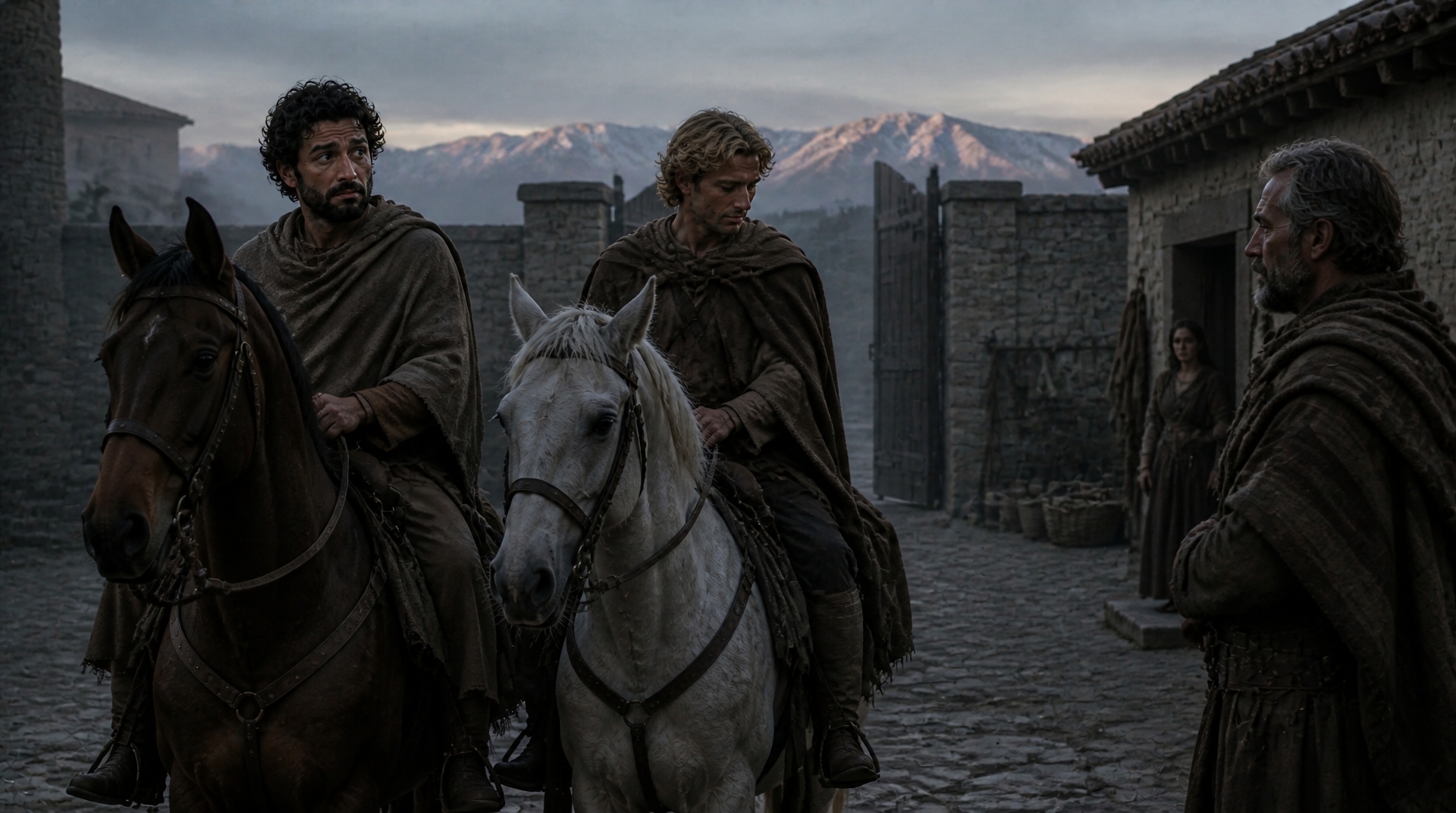
Dawn came gray and cool. Lucian and Demetrios stood in the courtyard of Mari's household,
wearing the non-descript merchant's cloaks that Mari had provided, their
horses saddled and ready. Mari's father Aitor stood watching, his weathered face unreadable. The
aunt and brother and his wife had already gone about their morning business—there was no point in
drawing attention with a large goodbye.
Mari emerged from the house carrying a pack, which she handed to Demetrios. "Everything you'll
need for the journey to Iruña," she said. "Food, water, a map marked with the route.
The caravan master's name is Gaston. He's expecting you. He'll know what to do."
She reached out and took Lucian's hand. "You'll make it to the Pillars of Heracles, Lucian. And when
you stand there and look out at the edge of the world, I hope you'll think of us. Of the small
people you taught to say no to the great empire."
Lucian squeezed her hand. "I will never forget you," he assured her intently. "I can promise that!"
He mounted his horse, and Demetrios did the same. They rode out of the courtyard without
looking back, but Lucian could feel Mari's gaze following them until they passed through the gate
and into the streets of Pompelo.
The city was already stirring. Soldiers patrolled the main streets, but they paid no attention to
three men on horseback heading out of the city. Just travelers, moving on to the next destination.
Just another day in a city that Rome occupied and that Rome did not quite control.
The Road to the River
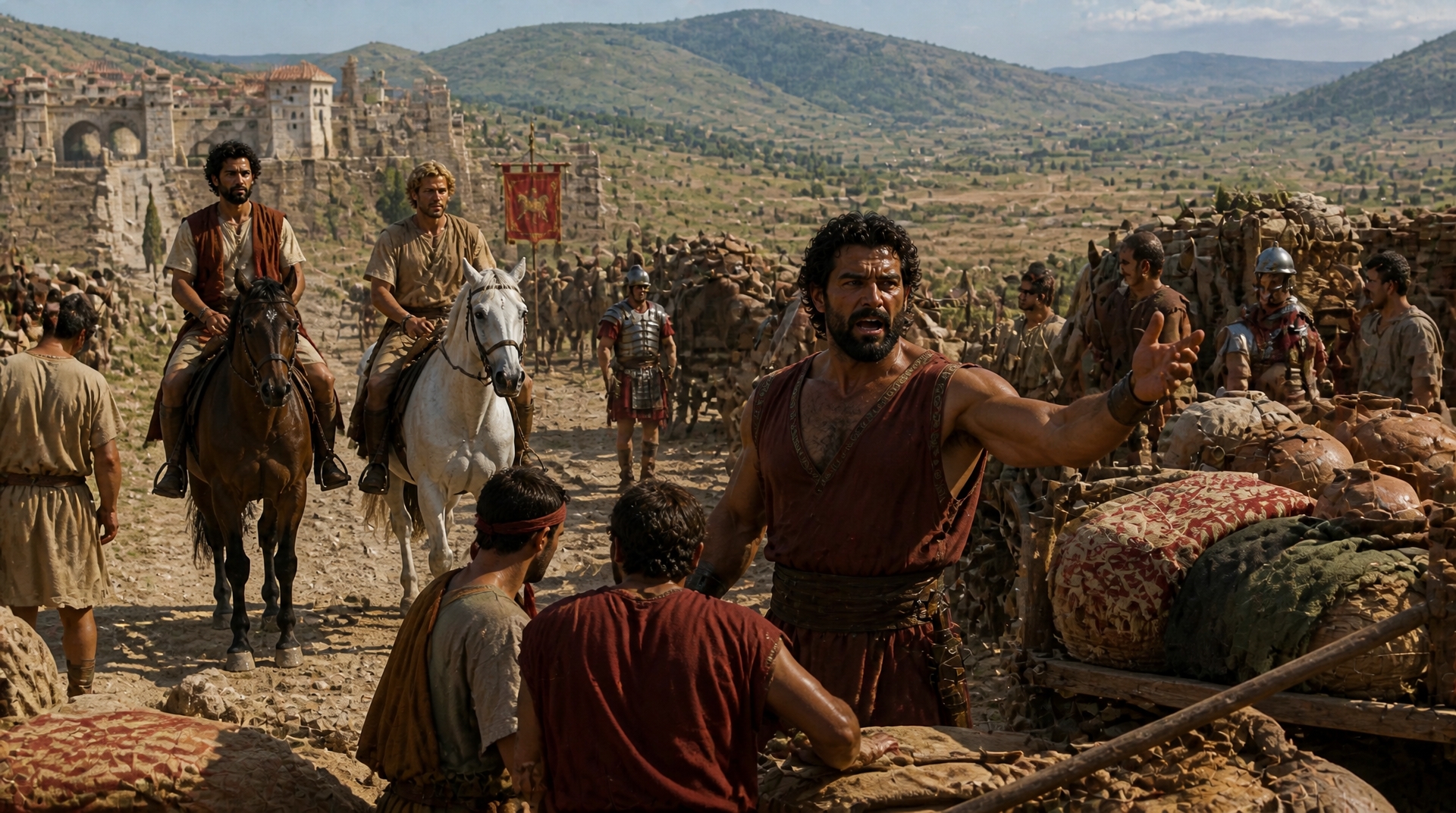
The caravan was gathering just outside the city gates. Gaston was easy to spot, as he was
a huge man with a booming voice, who was using it to direct the loading of goods onto his wagons.
He spotted them immediately and waved them over. "Ah, Mari's friends! Welcome! I have
a spot for you in the lead, so you won't get so much dust in your faces."
The journey to Iruña took a full day. Gaston led them through Vascon country—lands that Rome had
conquered but not quite tamed. They passed small villages where people watched them pass with
expressions that were carefully neutral. Lucian wondered how many of them knew who he was. How many, if any,
had heard about the speech? How many understood that a Syrian rhetor and a Greek businessman had
come to their mountains and helped light a fire that Rome would spend decades trying to extinguish?
By late afternoon, they reached Iruña. It was much smaller than Pompelo but prosperous, clearly a
trading hub where goods and people moved regularly. The river was visible even from the
outskirts—the Ebro, wide and brown and powerful, flowing southward with the weight of mountain water
behind it.
Gaston led them to a riverside inn, a modest place but clean, with a man standing outside who nodded
as soon as he saw them. "Yo, bro!" Gaston called, and the man grinned with recognition.
"Mari's friends," Gaston said to him, his accent Vasconi but his manner wholly that of a merchant
accustomed to international dealings. "Welcome. Your boat leaves at dawn. You'll have good
cabins, and the captain knows to ask no questions. Your horses are already being loaded into the
pens. You'll be comfortable."
He gestured them inside. "Rest tonight. Tomorrow, the river carries you south. And after
that—" he smiled, "—the world opens up before you."
That night, lying in a comfortable bed in the inn, Lucian listened to the rushing sound of the Ebro outside
the window. The river that would carry them south. The river that flowed toward Caesaraugusta,
toward Baetica, toward the coast and the Pillars of Heracles.
The Ebro Passage
The boat left at dawn. It was a merchant vessel, perhaps fifty feet long, with a wide, flat hull designed
to navigate the river's currents. The captain was a grizzled fellow named Rufus who had navigated the Ebro
for thirty years. He asked no questions about Lucian and Demetrios, other than their names. Gaston's
mention was enough.
The boat had room for fifteen passengers, three crew members, and a hold full of goods—wine, pottery,
fine linens meant for the markets in the south. The horse pens were on the upper deck, sheltered but
exposed to the air. Demetrios immediately went to check on their animals, speaking to them softly,
running his hands along their necks. He had grown fond of these horses during their time in Hispania.
As the boat pushed away from the dock and caught the current, Lucian watched Iruña recede behind them.
The town had been kind. Mari had been kind. But ahead lay the river,
and beyond it, the goal that had driven him this far: the Pillars of Heracles, the edge of the world.
The first day on the river was one of revelation. As they traveled south, the landscape transformed. The
mountains that had surrounded Pompelo and Iruña gave way to rolling hills, and the hills gave way to
flatter plains. The Ebro flowed through a land that had known irrigation and agriculture for centuries.
They passed olive groves, vineyards, fields where workers paused to watch the boat pass. The water became
warmer as they moved south, and the air smelled different—less of pine and stone, more of sun and earth.
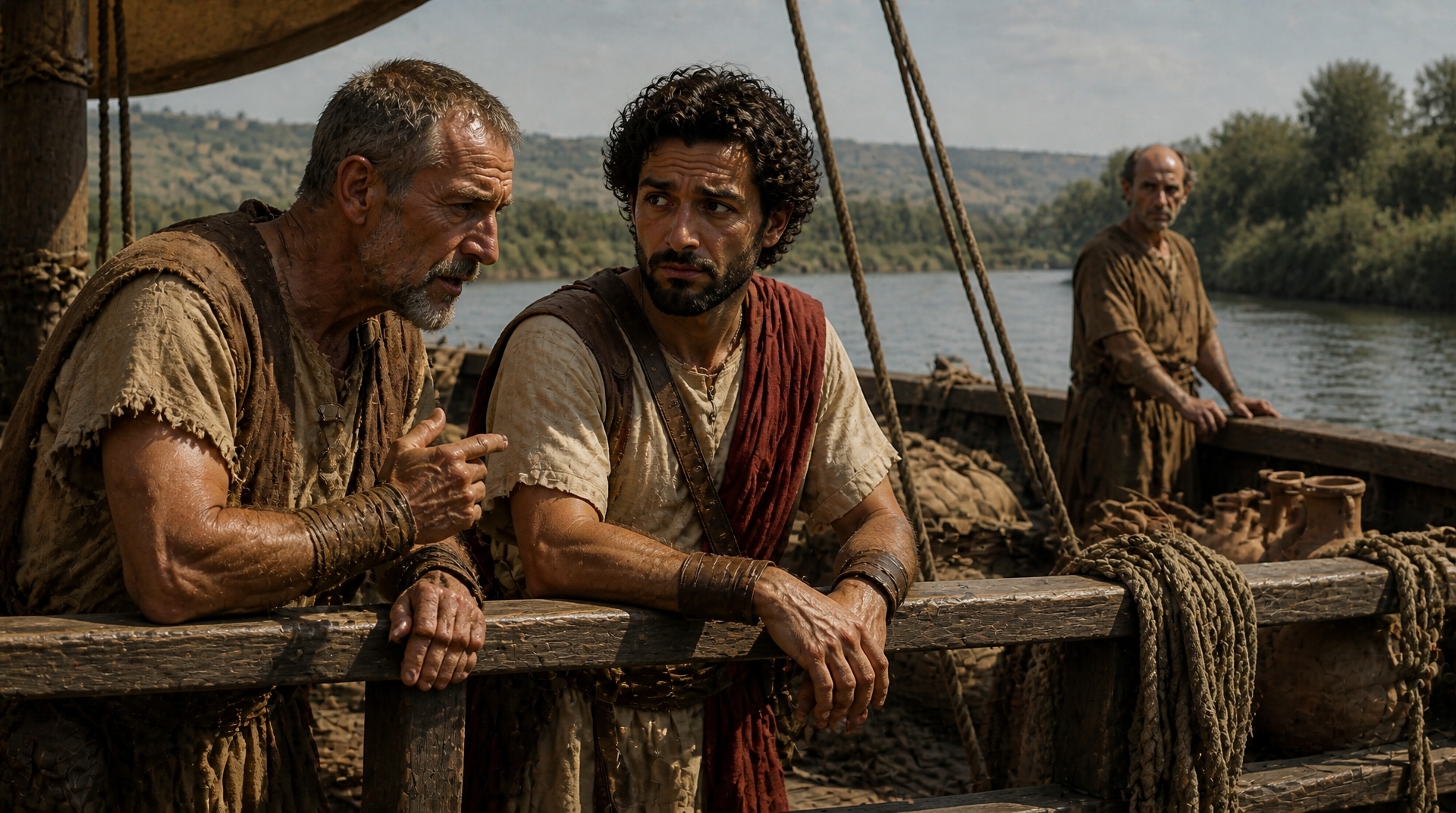
Late in the afternoon, Captain Rufus approached Lucian at the rail, where he stood watching the landscape
drift past. The captain looked troubled in a way he hadn't seemed that morning.
"I need to tell you something," Rufus said quietly. "In thirty years, I've navigated this river, and
I know everyone who travels with me. Everyone. I know their stories, their business, where they're going and
why. It's good business to know these things." He paused. "But there's a man aboard I don't know.
He may have been in your caravan from Pompelo, or he may have simply boarded here at Iruña. Either way, I can't
place him. I tried to talk to him, but he's evasive. Won't say exactly where he's from, or what his business is.
I'm only concerned because my friend, Mari, warned that someone might try and follow you."
"Where is he going?" Lucian asked, though he already sensed the answer.
"That's the strange part. When I asked him his destination, he was too vague."
The captain shook his head. "I don't like it. I don't like not knowing. So I'm telling
you: keep your eyes open. Don't be obvious about it, but watch him. If he makes a move toward you or your friend,
you let me know immediately."
Lucian nodded slowly, feeling the ease of the afternoon drain away. "We will," he said. "And thank you."
That evening, as the sun began its descent toward the western hills, Captain Rufus ordered the crew to make
for the bank. "We stop here for the night," he told Lucian when the Syrian questioned why they didn't continue
traveling. "There are passengers and cargo to be exchanged at the settlements along the way. We let people off,
take new ones on. Goods arrive at night that need to be loaded at dawn. That's how the trade works.
We'll be busy come morning. You can stay aboard in your cabin, or go into town to party.
It's up to you, but if you do leave, be back by dawn. We can't wait for stragglers."
They moored at a small settlement where a few houses clustered near the river. Captain Rufus was known here,
and the locals brought food—fresh bread, cheese, olives, wine. Lucian sat on the deck and watched the sun
set, casting the river into gold and shadow. Demetrios joined him, sitting in companionable silence.
"You want to go into town?" Lucian asked.
"No, I think I'll stay aboard," Demetrios replied.
Lucian nodded. "Me, too," he said. The men looked at each other, grinned,
and silently retired to their cabin.
Come dawn, the noise woke them before the sun had fully cleared the eastern hills. Vendors shouting, cargo being
loaded and unloaded; crew members calling out instructions; new passengers boarding, with their belongings and their
complaints. The men gave up any hope of sleeping and instead went to check on the horses. They stood
in their pens, patient, as the morning chaos swirled around them. Luckily these horses were travel
horses, accustomed to the noise and the movement from years of experience, earned long before Mari
had selected them.
Lucian and Demetrios fed them, and felt the boat leave the dock and return to the current
before they finished.
"We're going to make it," Demetrios said quietly. "Frankly, I wasn't sure we would, but we are!"
"We're not there yet," Lucian replied. "Caesaraugusta is still days away. And after that, everything south of
here is unknown to us."
"Yes," Demetrios said. "But we're on the river now. Moving. That's something."
On the second day, they passed through Logroño, a larger city where Roman authority was more visible. Soldiers
patrolled the riverbank, and there were Roman military structures visible on the hills above the city. But no
one stopped the boat. Captain Rufus had paid the necessary tributes, obtained the necessary permits. They were
simply merchants moving goods downriver. Lucian and Demetrios stayed below deck while the boat passed through
the city's main docks, and when they emerged, Logroño was already behind them.
That afternoon, as they drifted past a wide section of the riverbank, Lucian found Captain Rufus at the helm and
asked, "How does a boat travel back upriver? The current is too strong to fight with oars
alone, and you can't drift backward."
Captain Rufus smiled, as if he'd been asked this a hundred times. "Tracking," he said simply. "See those
paths along the shore? That's where horses or oxen walk, pulling us upstream with ropes. Takes three times as long to go up as
it does to come down. The profit is in going with the current, not against it. Most of my trade is downriver.
When I do go back up, I take passengers and light cargo, and I have to charge them enough to make it worth the effort."
Lucian nodded, understanding immediately. Downriver was easy. Downriver made money. Upriver was labor and time
and expense.
The landscape continued to dry as they traveled south. The green gave way to browns and golds. The Ebro
flowed more slowly here, broader and more placid, as if the urgency of the mountain snowmelt had drained away.
At night, they moored again, and again, always at places where Captain Rufus was known. The captain
seemed to have connections all along the river—friends, informants, people who owed him favors.
It was on the third day that Lucian caught the mysterious man watching them. He stood near the mast,
apparently studying the riverbank, but when Lucian glanced in his direction, their eyes met for just a moment.
Then the man's gaze slid quickly away, finding sudden interest in the horizon. Lucian said nothing to
Demetrios then, but that night, when they lay in their cabin, he described what he'd seen.
"He's definitely watching us," Demetrios said quietly. "But why?"
"I don't know," Lucian replied. "But we're almost there. A few more hours and we dock in Caesaraugusta."
They saw the man again the next morning, positioned on the deck in such a way that he could observe them
without appearing to. When Lucian looked directly at him this time, the man didn't look away immediately.
Instead, he held Lucian's gaze for a long moment, his expression unreadable. Then, slowly, he turned away.
By the fourth day, Lucian could smell the sea. It was faint, carried on the southern wind, but unmistakable.
Salt and distance and something older than Rome, older than Vascon and Greece and Syria. The water of the
river itself had changed, becoming brackish, influenced by the tidal movements of the Middle Sea as it
approached from the south.
And then, rounding a bend where the Ebro widened to embrace the larger landscape, Caesaraugusta appeared.
Caesaraugusta
It was larger than Lucian had expected. The city sprawled across both banks of the river, connected by a
bridge of stone that spoke of Roman engineering and Roman permanence. Walls surrounded the city, and beyond
the walls, Lucian could see the structures of Roman occupation: a forum, an amphitheatre, administrative
buildings. But there was also something else—a sense of life, of trade, of a place that existed for
reasons beyond the mere display of Roman power. Merchants' warehouses lined the docks. Ships from all around the
Middle Sea had left their marks on the city.
Captain Rufus guided the boat to a section of the riverbank reserved for merchant vessels. As they approached
the dock, he turned to Lucian and Demetrios.
"My brother runs an inn near the river," the captain said. "The Blue Anchor. Tell him Rufus sent you.
He'll give you good rooms and ask no questions. You can stay there as long as you need, and from there, you
can plan your next move."
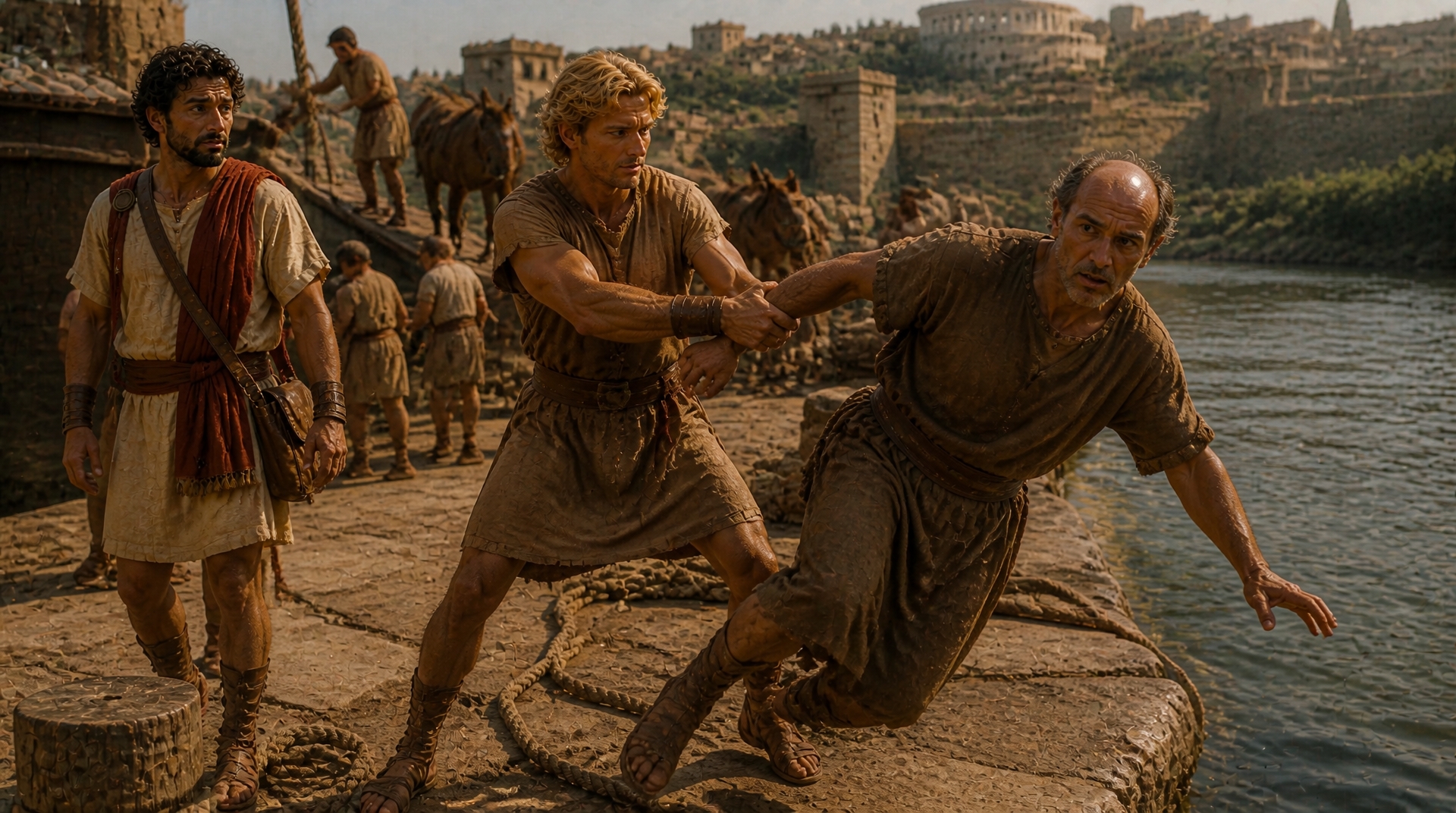
As the crew worked to secure the boat and unload cargo, Lucian climbed onto the dock with Demetrios.
Behind them, the crew was already beginning to lead the horses down the ramp, the animals restless
after four days on the water but none the worse for the journey. The mysterious passenger followed behind
them, moving toward the ramp where ropes and cargo lay scattered.
The man's foot caught on one of the mooring ropes. He stumbled, arms windmilling, teetering at the edge of
the dock with the river below. Without thinking, Demetrios reached out and grabbed him by the arm, yanking him
back from the edge. For a moment, they stood locked together, the stranger's weight heavy against Demetrios's grip.
"Careful," Demetrios said. The man looked at him, his expression unreadable, and nodded slowly. Then he
straightened, gathered himself, and continued toward the ramp without a word of thanks. Lucian and Demetrios
exchanged a glance. If the man was a threat, he was a strange one.
Lucian stood on the dock and looked south. Caesaraugusta was only a stop. Beyond it lay Baetica, the coastal
lands, and ultimately the Pillars of Heracles. He was closer now. Closer to the edge of the world, closer to
the answers he sought. The Ebro had carried him as far as it could. From here, he would have to ride.