|
By: Paul S. Cilwa |
Posted: 5/17/2026 |
|
Page Views: 51 |
| Hashtags: #HistoricalFiction #LucianOfSamosata #Pompelo #Vasconi |
| Lucian finds love and instructs the Vascones in passive resistance. |
| Estimated reading time: 12 minute(s) (2843 words) |
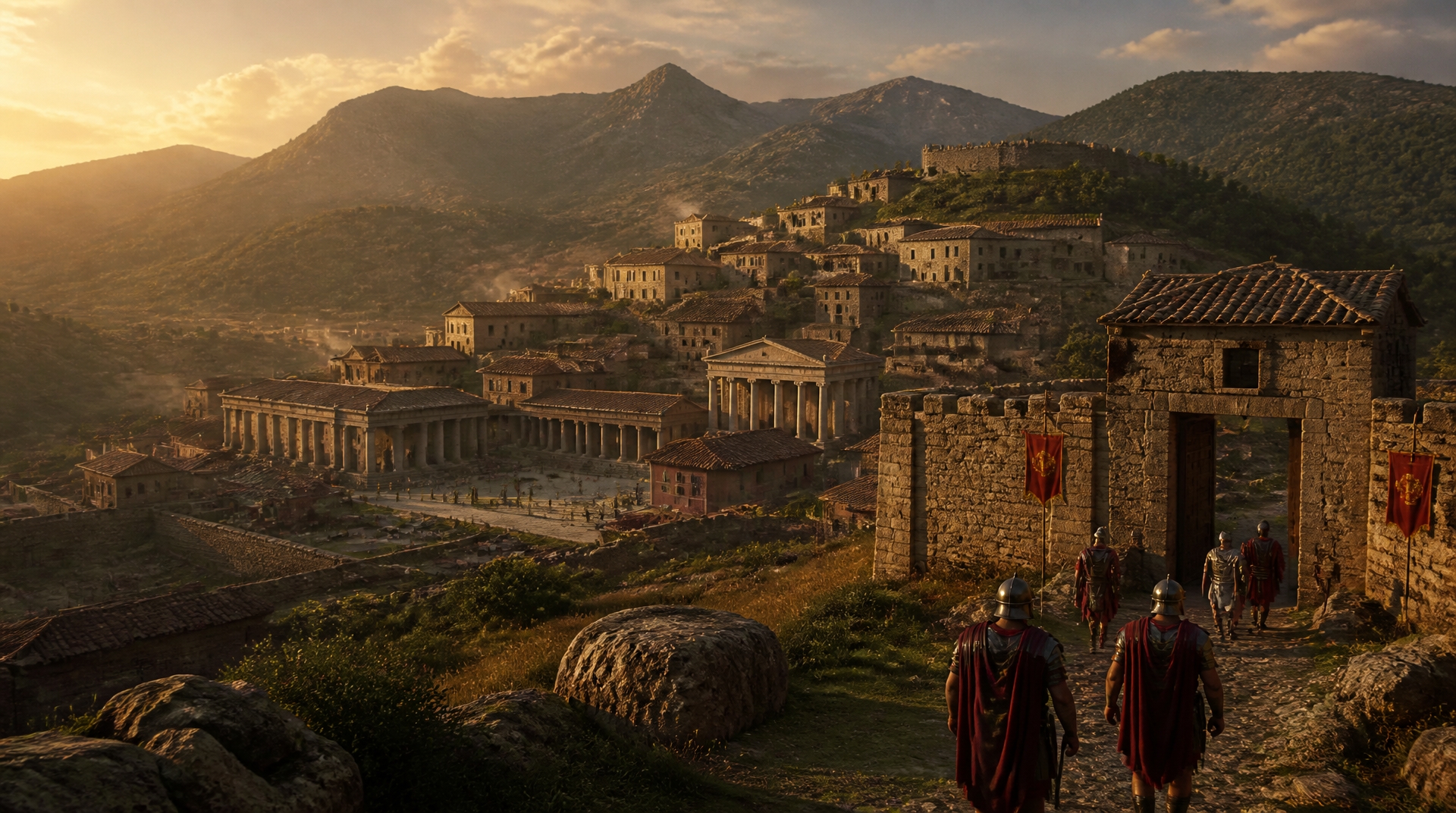
Mari's household lay on the outskirts of the city, in a compound that spoke of wealth and old
family. The main house was stone, two stories, with a courtyard large enough to hold animals and
servants. As they approached the gate, Mari paused.
"I should warn you about Zar," she said.
Both Lucian and Demetrios stared blankly. "What's a Zar?" Demetrios asked.
Mari laughed. "Zar is our dog. A large breed—Vascon herding
stock. He's very protective of the family. If he thinks a stranger is a threat, he can…" she paused,
choosing her words carefully, "…he can be quite dangerous. I'll introduce you to him first, before we
go inside. Let him smell your hands. Show him you're no threat."
When Mari led them through the gate, an elderly man stood at the doorway—her father,
lean and weathered, with the same sharp cheekbones and intense eyes as his daughter. But before he
could emerge fully, a massive dog bounded around the corner of the house.
The animal was enormous—easily chest-high on a man, with a thick coat the color of dark bronze and
intelligent eyes that fixed immediately on the strangers. His size alone was intimidating. His muscles
rippled under his fur as he approached, and Lucian instinctively caught his breath.
But then the dog smelled Lucian, and his entire demeanor changed. His mouth opened
in a big ol' doggie grin; his tail began to wag, and he trotted directly to Lucian and pressed his large head against Lucian's
hand. When Lucian, surprised and delighted, instinctively began to scratch him behind his ear,
the dog actually rolled over, exposing his belly with complete trust, his tail thumping against the
ground.
Mari stood frozen, her hand still raised to gesture a warning. Her father emerged fully now, equally
astonished. Zar, who Lucian had been warned would bark menacingly at merchants and soldiers alike, was
accepting belly rubs as if Lucian were his oldest and dearest friend.
"That," Mari said slowly, "has never happened before."
Her father studied Lucian with new interest, as if the dog's response had revealed something about him
that words could not.
"This is Lucian," Mari said, recovering herself. "The rhetor from Tarraco. And his companion
Demetrios."
Her father studied them both for a long moment. "You speak our languages?" he asked in Latin.
"Not your Euskara," Lucian admitted. "Yet. I'm trying to learn; Mari has been teaching me."
Her father nodded slowly, as if this was either acceptable or inevitable or both. He introduced
himself as Aitor, and gestured them inside. The household was larger than Lucian expected: an
elderly aunt who sat by the window with needlework; Mari's married brother Eneko and his wife
Beatriz and their two children; servants who moved quietly through the spaces. It was a
functioning, prosperous Vasconi household, nothing like the Roman villas Lucian had stayed in, but
comfortable and well-run. In fact, in a way it reminded him of his own parents' home in faraway
Syria.
The Baths
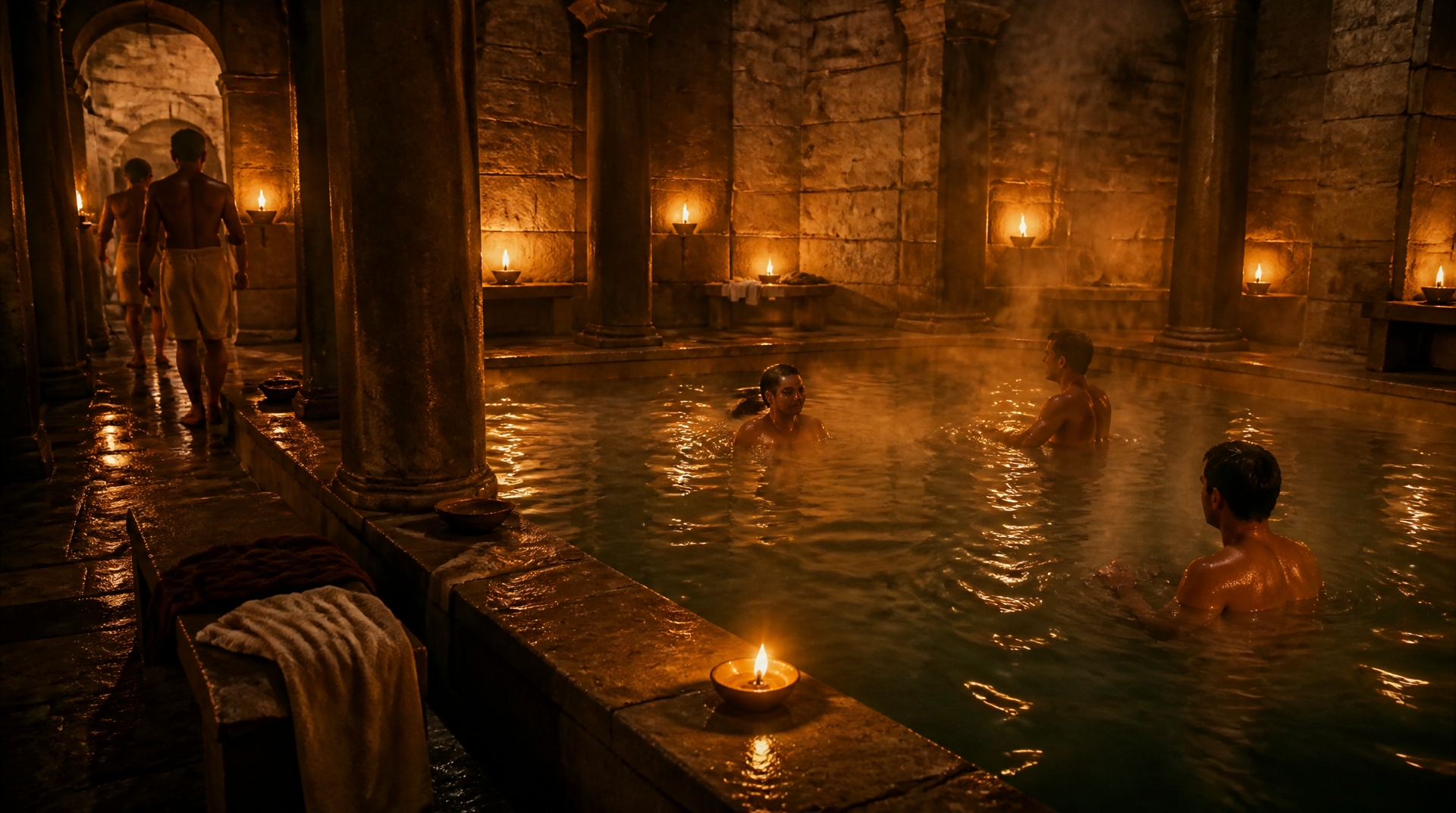
Pompelo had public baths, courtesy of Roman occupation. Not as elaborate as those in larger cities, but
serviceable—a heated pool, warm water, the luxury of soap and steam after days on the road. Aitor
directed Lucian and Demetrios to the men's bath in the early evening, and they went gratefully.
Lucian sank into the warm water with a groan of pure relief. The journey had left him stiff, dusty,
his muscles aching from days of travel. The heat began to unknot everything. He lay back in the
water, eyes closed, feeling civilization settle back onto him like a familiar garment.
Demetrios was already out, already dried, when Mari emerged from the bathing corridor, her damp hair
wrapped in a cloth, moving toward the massage rooms. Lucian caught only a glimpse of her as she passed
through the common area—the efficient grace of her stride, the ease with which she moved through
the public space as if she owned it. She wore only a thin shift, practical and unselfconscious, the
garment of someone who saw her body as simply a tool, no more remarkable than her hands or her voice.
He watched her disappear into the massage corridor, and then forced his attention back to the water.
Demetrios, standing by the entrance, had seen where Lucian's gaze had gone. When Lucian emerged and
toweled dry, Demetrios was waiting with a knowing smile.
They bathed together in comfortable silence, taking turns washing each others' backs.
"She's—magnificent," Demetrios said without preamble. "There's no other word."
"Yes," Lucian agreed, because it was true. "But, let's face it, you don't look at that many women."
"I can admire a woman without wanting to bed her. But you…she
gazes at you the way someone looks at a horizon," Demetrios continued. "I saw her
watching you. In the baths. She looked at you the way she probably looks at very few people."
Lucian's face was suddenly warm, and not from the bathwater.
"You need a wife, dear friend," Demetrios said, his voice gentle but firm. "You're famous
now. You're wealthy. You need an heir. It's respectable. It's what men do."
"Well, it won't be Mari," Lucian pointed out. "She's Vasconi. Haven't you noticed how much
alike they all look? They obviously don't marry outside their own people. Anyway, I don't really
want a wife. I…have you. I have my work. I have my freedom."
Demetrios studied his feet. "First of all, you may not want one, but you do need
a wife. No matter how fond of each other
we are, I can't give you an heir. Secondly, Mari is not just any Vascon. She's the daughter of
one of the most powerful families in Pompelo. She's wealthy, respected, and well-connected.
Marrying her would be a coup! It would give you a foothold in this city, in this culture.
It would show that you're not just some Greek who wandered in off the road, but someone who belongs here.
Someone who understands how things work in Vascon culture."
"And besides," Demetrios continued, "you know that wealthy Greeks and Romans maintain separate bedrooms
anyway. You don't have to be with her every night. Once she's pregnant, you don't even have to
talk to her if you don't want to. Come on, practically every Roman and Greek man is married."
He dug Lucian in the ribs. "They would probably all kill themselves if they actually
had to spend time with their wives. —You know it's true!"
"This is a Vascon household," Lucian said quietly. "Not Greece. Not Rome.
Besides, what makes you think I'd want to spend the rest of my life in Pompelo,
of all places? —Do you want to live here?"
"You're my home, Lucian. And okay, you don't have to marry her. But please don't think
I'll be jealous if you and she get together while we're here."
"Dear Demetrios, you are imagining things."
The Invitation
And yet, imagination or not, after the rest of the household had settled into sleep,
and Lucian lay next to lightly snoring Demetrios, Lucian became aware of a silhouette
in the door to the guest room. He was pretty sure it was Mari's, but she
said nothing. She simply stood in the doorway, silhouetted against the lamp light from the
hallway, and waited. Lucian swallowed hard, and rose; she took his hand and led him to her quarters.
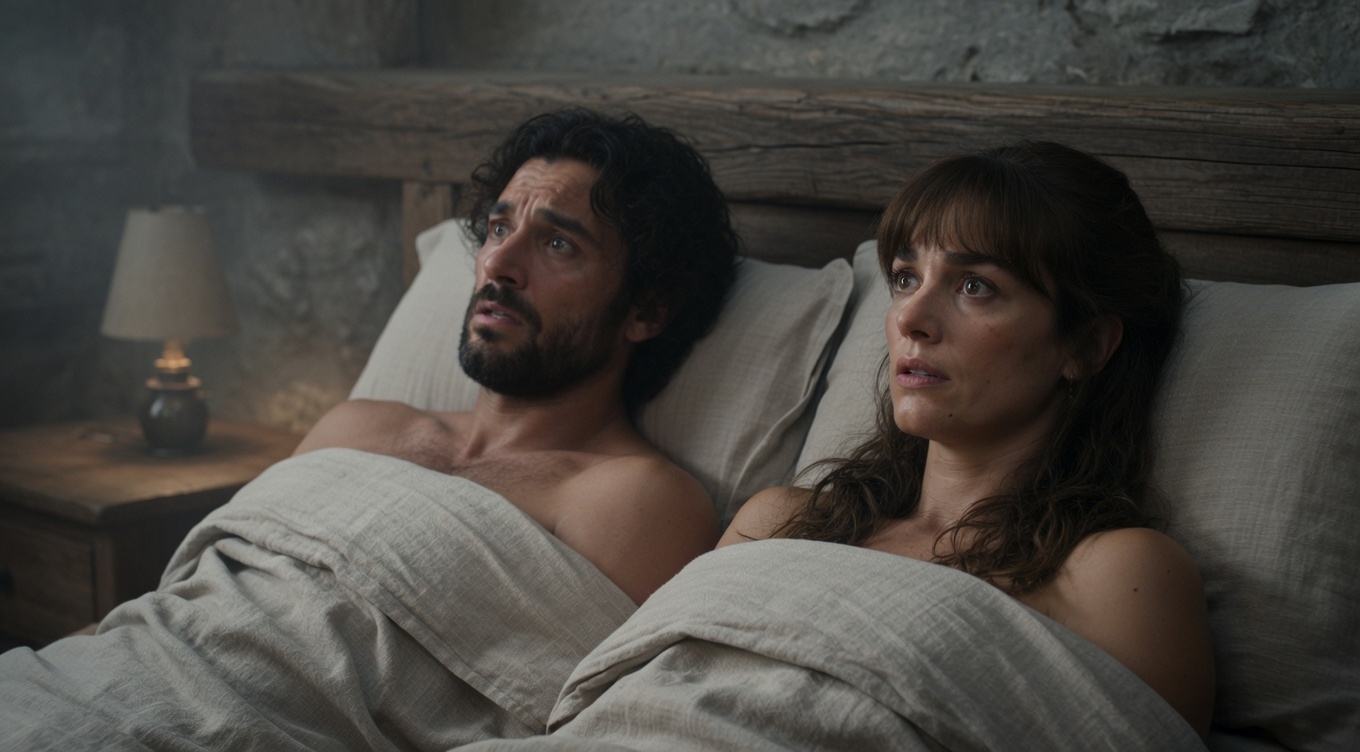
Her room was simple but not austere. A bed with a good mattress. One lit oil lamps giving off
a golden glow. A chest for clothes and
personal items. A window that overlooked the courtyard. It was the room of someone who had
authority in the household, who had chosen comfort without ostentation.
They came together without words. Mari moved with the same confidence and practicality she brought
to everything else. She undressed without self-consciousness, and then undressed Lucian,
who still stood numbly in disbelief. Then they laid together, and it was
warm and present and real in a way that surprised
him. She knew what she wanted and wasn't shy about showing him. He learned the shape of her, the
way she moved, the small sounds she made when something pleased her.
Afterward, they lay in the darkness, her head against his chest, his arm around her shoulders,
until he fell asleep, and dreamed.
In the dream, he was still with Mari, still lying in her bed. But as he watched her in the
darkness, her face began to shift. Her sharp cheekbones softened into the younger, rounder face of
a girl. Her red hair became the darker hair of his little sister,
Tabitha, in Samosata, the one who had cried when he left.
And Lucian realized, in that strange dream-logic, that he was holding his sister. That he loved the
person in his arms the way a man loves a sister—protective, fierce, loyal, but not the way a
husband loves a wife. The way brothers and sisters love each other across years and distance,
knowing they share blood and history and the particular way of seeing the world that comes from
growing up in the same house.
He woke.
His heart was racing. The dream clung to him like morning dew. He lay still, trying to make sense
of it, trying to understand what his sleeping mind had been trying to tell him. And slowly, as his
racing heart calmed, the understanding began to settle over him like snow.
He did love Mari. Genuinely and deeply, but not as a lover. Not as a husband. As a brother. As someone
he would protect with his life, yes. Someone whose happiness mattered, yes. But not someone to
marry. Not someone to claim as your own.
He had been so afraid of losing Demetrios that he had convinced himself he could want Mari. But the
truth was simpler and more complicated at once: he loved them both, but in entirely different
ways. Of course, he barely knew Mari at all; what he felt was most likely based
on his admiration of her. He had known Demetrios over a decade; what they had was based on
time and trust and, yes, also admiration.
He didn't know how to tell Mari this. He was terrified of hurting her, of making her feel rejected
or foolish. (Or, for that matter, of her hurting him, if she got angry!)
She had invited him into her bed with a clarity and honesty that deserved honesty in
return. But how do you tell someone you've just
been physically intimate with, that you love them like a brother?
He was still agonizing over this, staring at the ceiling in the pre-dawn darkness, when he realized
Mari was awake. He could tell by the change in her breathing, the way her body had shifted
slightly, becoming alert.
He turned his head to look at her, and she turned to look back at him.
"Well," Mari said, "that was fun. But you know what?"
"It was like having sex with my sister," Lucian blurted out.
Mari burst out laughing. "Exactly," she said. "I was going to say the same thing. Except
obviously not your sister. But that's what it felt like. Not right."
Lucian felt the tightness in his chest begin to release.
"So that's it," Mari said. "And now we know, and we can
both stop pretending. You go back to your Greek. I'll stay here and run my household. And we'll be
family, which is better than lovers anyway."
"Mari—" Lucian started.
"Please don't be offended," she said, and her voice was matter-of-fact. "You should know
that my people don't intermarry. It's not personal, Lucian. It's just how we are."
She rose from the bed and moved to the window, pulling on a robe. The first light of dawn was just
beginning to touch the edge of the sky.
Lucian rose and dressed, moving quietly so as not to wake the rest of the household. As he was
leaving, Mari turned from the window.
"Tell me you'll speak to the town this evening," she requested. "They're angry. Scared.
They need to hear from someone who understands what Rome is doing to us. Someone who can help them see
we're not alone."
The Fall of Athens
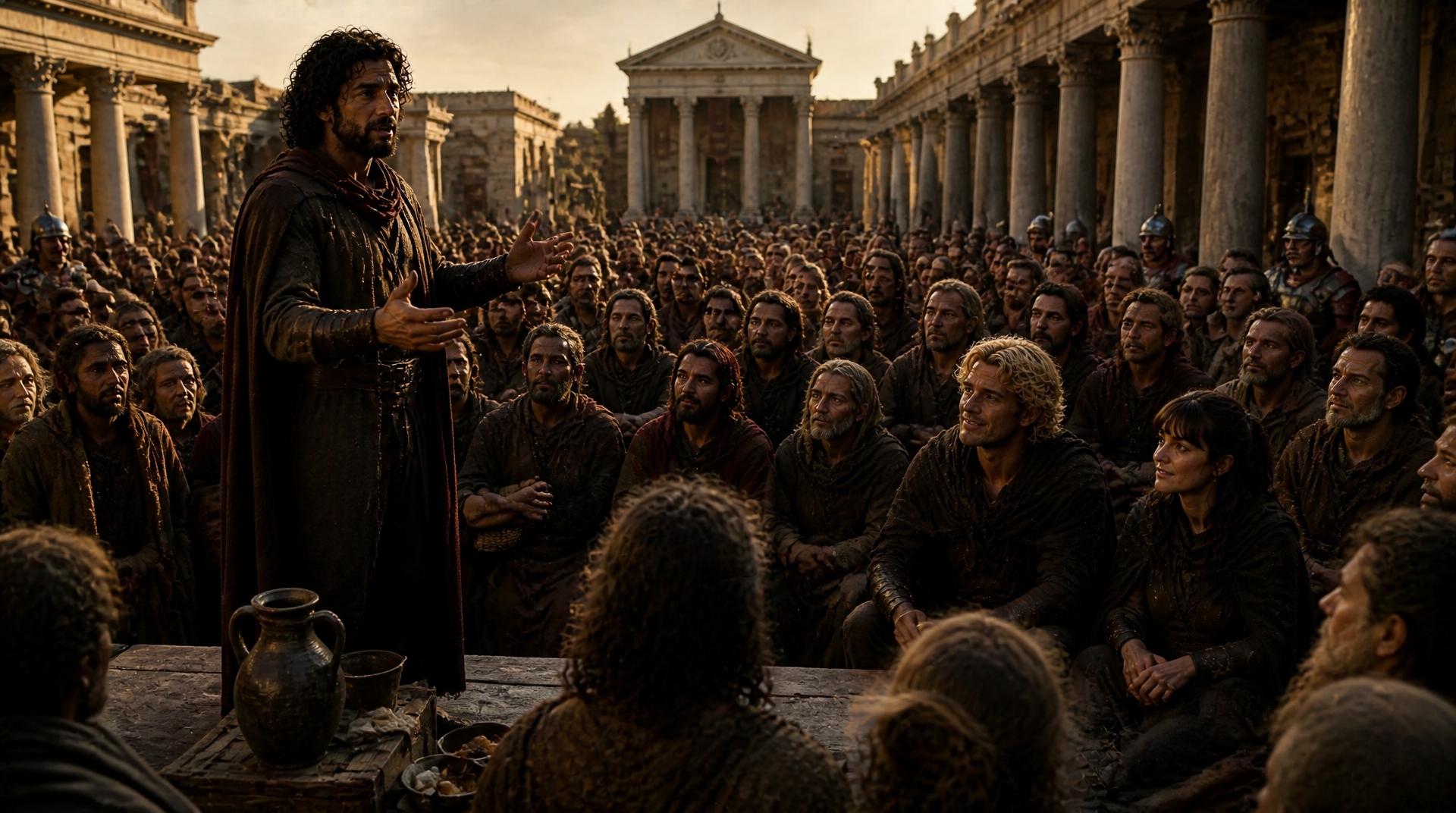
That evening, Lucian stood in the forum of Pompelo, in front of a carefully assembled crowd. Word
had spread quietly through the Vascon quarter—not an official performance, but a gathering. A man
who had something to say. They were wary, these people. There were soldiers present, watching from
the edges, but they seemed uncertain what to do. This was just a man talking. What law was being
broken?
Lucian began with a story.
"Once," he said, "there was a great empire that ruled much of the known world. Athens.
You've heard of Athens, perhaps? The birthplace of philosophy and democracy? The city that invented
the theater, the gymnasium, the pursuit of wisdom for its own sake? Well, for a well over a thousand years, Athens was
the light of the world. And then," he said, and he paused, letting the moment settle, "then
Athens began to fall. Not because of war. Not because of a rival power that was greater. But
because of a choice Athens made."
"There was an island called Melos. A small, neutral island, asking nothing of Athens except to be
left alone. The Athenians came and demanded submission. The Melians said no—not in anger, but in
reason. We have done nothing to you. We are no threat. We simply wish to remain free."
"And do you know what Athens said in response?" Lucian asked, shaking his head sadly.
"Athens said: 'The strong do what
they can and the weak suffer what they must.' Athens said that power was not a tool for
justice, but an end in itself. That might made right. That the only law that mattered was the law
of superior force."
He told them how Athens destroyed the island. Killed the men. Enslaved the women and children.
Not because Melos was a threat, but because they could. To make an example. To show the world
what happened to those who said no.
"And that," Lucian said, "was the beginning of the end of Athens. Because the moment an
empire decides it can do whatever it wants to the innocent, it has already begun to rot from
within. The world watches. The world remembers. And the world begins to resist.
As Melios resisted, with civil—if not civil disobedience, let's call it civil unpleasantness."
He let that settle. The soldiers were still standing at the edges, but they were listening now.
Lucian could feel the shift in the crowd—the recognition. This wasn't an attack on Rome, not
directly. It was a story about another empire, another time. But the mirror was clear.
"Now," Lucian said, and his voice took on a tone of bright, almost manic enthusiasm, "I'm
sure you would never do what the Melians did. You would never resist Rome, even if Rome treated you
unjustly. You would never hide from a tax collector who comes demanding what you don't have. You
would never raise your prices for a Roman soldier to make the occupation more costly. You would
never organize, never refuse to cooperate, never make it expensive or difficult for Rome to
maintain its control. You're far too civilized for that. Too wise. You understand that resistance
is futile and dangerous and foolish."
He was grinning now, the way he had learned to grin in Tarraco—that performance of enthusiasm that
was just barely excessive, just barely wrong. The way one grins when one is saying something
that contradicts itself.
"So you'll go about your business. You'll cooperate fully. You'll make no trouble. And Rome will
remain exactly as comfortable here as it wishes to be."
The soldiers didn't arrest him. How could they? He had told a story about Athens. He had warned the
crowd against resistance. If they didn't understand the subtext, that was hardly his fault.
But the Vascons understood. In the days that followed, the word spread. The price of goods rose
slightly for Roman soldiers. Tax collectors found homes suspiciously empty, families supposedly
fled to relatives in the countryside. Supplies for the garrison became harder to procure. Nothing
obvious. Nothing that could be pointed to and called rebellion. Just the quiet, patient resistance
of a people who had finally heard someone articulate why their anger was justified.
And Lucian, having set something in motion that he couldn't take back, waited to see what would
happen next.