|
By: Paul S. Cilwa |
Posted: 5/13/2026 |
|
Page Views: 27 |
| Hashtags: #HistoricalFiction #LucianOfSamosata #Gaul #Tanno #Language #Lugdunum |
| Lucian discovers the beauty of Gaulish, and the value of Tanno's voice. |
| Estimated reading time: 17 minute(s) (3897 words) |
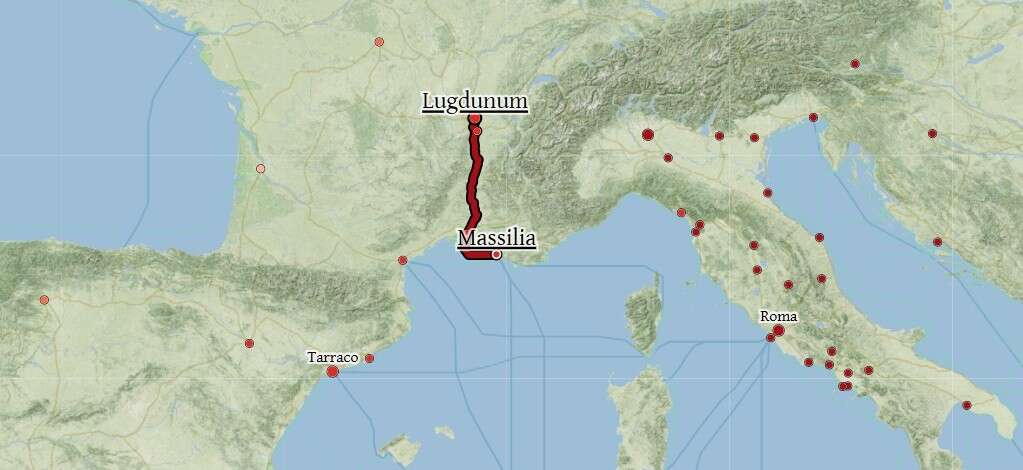
So when Demetrios began hearing rumors of a city further inland—Lugdunum,
at the confluence of two great rivers, a city where Greeks and Gauls mixed
more equally than in Massilia, where a traveling rhetor could command both
Greek and Gaulish audiences—Lucian was more than ready to listen.
"And," Demetrios said carefully, "it's in the direction Tanno came from.
Maybe it's time to move deeper into Gaul. Surely there will be theaters
there. There are theaters everywhere."
Lucian understood what Demetrios was not quite saying: that Tanno had proven
himself as a performer, that it might be time to give him something of his
own. That staying in Massilia indefinitely meant keeping Tanno as a curiosity
rather than recognizing him as what he was becoming.
So they packed. The landlord Philippos, who had become fond of them in their
weeks there, helped arrange a cart for the heavier belongings. They would
travel by ship up the coast, then overland toward Lugdunum—a journey of
perhaps two weeks, if the weather held.
Carry The Flame
The shipboard portion of the journey gave Lucian time, and by now he had
learned what to do with time at sea. On the voyage to Corsica he had taught
Tanno his letters; on this one, it would be Lucian who became the student,
though he did not yet know it. It began with a sound.
On the second day out, Lucian came upon Tanno near the bow, mending a tear
in one of Demetrios' tunics and muttering to himself as he worked. The words
were Gaulish—a low, half-spoken grumble at the thread, or the needle,
or the cold; Lucian could not tell which. But he stopped where he stood,
because he realized he had never truly listened to Gaulish before.
Something shifted in Lucian that day. He had always known, in an abstract
way, that Gaulish was the language of Gaul. But he had thought of it as
rough, unsophisticated, the tongue of people who had not yet learned to
build cities or write philosophy. He had heard it in the streets of
Massilia, in the voices of the interior Gauls who came to trade, and it had
sounded harsh to his ears, full of guttural sounds and strange emphases.
But hearing it now from Tanno's mouth—low, unguarded, shaped by that
deep voice—that was something else entirely. Gaulish was not rough.
Gaulish was beautiful. It was full of sharp edges and soft places,
harsh consonants that made you feel something in your chest, vowels that hung
in the air like a held breath.
So Lucian asked Tanno to teach him.
"I don't—" Tanno began, but Lucian cut him off.
"Please," Lucian said. "I want to understand. Not just the words. The way
it sounds. The way it means."
So Tanno began to teach him, there on the deck with the Gaulish coast sliding
past. Simple words at first: the Gaulish names for the sea, the sail, the
gulls, the colors of the water. Lucian had a good ear—he had learned
languages before—but Gaulish was different. It required different
muscles in his mouth, different intentions behind the sounds. Tanno would say
a word, and Lucian would repeat it, and Tanno would correct him gently,
showing him how to shape his mouth, where to put the emphasis.
It was intimate in a way Lucian had not expected. Teaching required trust.
Tanno was showing Lucian not just a language, but a piece of his own self,
the part he had been forced to bury when Rome renamed him Marcus.
And Lucian was learning to listen, not just to the sounds, but to what the
sounds carried.
By the time they had been a week at sea, Lucian could follow simple Gaulish,
and a handful of words had begun to feel like his own. It was then that he
asked for the thing he had wanted since the feast at Massilia.
"The song," he said one evening, as the sun bled red into the water. "I'm
not asking you to perform it. Sing it slowly, just for me—and tell me
what the words mean, line by line, as you go. I want to understand it."
Tanno's hands went still. Singing was not a small thing to ask of him; at the
feast it had broken out of him without his leave, and it had frightened him.
But this was a different kind of asking—quiet, private, with no crowd
to witness—and Tanno seemed to know it. He set down his work. And then,
so softly that Lucian had to lean close, he began to sing, stopping after
each line to render it into Greek. Translated, it ran something like this:
The salt is on the wound again,
The wind is high and cold,
I've watched the sea become a ghost,
As the story's left untold.
Oh, carry the flame to the water's edge,
(Carry the flame to the edge)
Let the shadows have their say,
(Let the shadows have their say)
For the tide has taken what it wants,
And the morning is far away. (Morning is far away)
I found your coat among the nets,
It smells of rain and brine,
A phantom touch that lingers on,
In this heavy heart of mine.
Oh, carry the flame to the water's edge,
(Carry the flame to the edge)
Let the shadows have their say,
(Let the shadows have their say)
For the tide has taken what it wants,
And the morning is far away.
(Morning is far away)
The light is gone.
The tide is out.
When he finished, neither of them spoke for a while. The Gaulish had a music
the Greek could not hold, but Lucian understood now what he had only felt
before, in the courtyard at Massilia: it was not a song about dying. It was a
song about refusing to let the dead be forgotten.
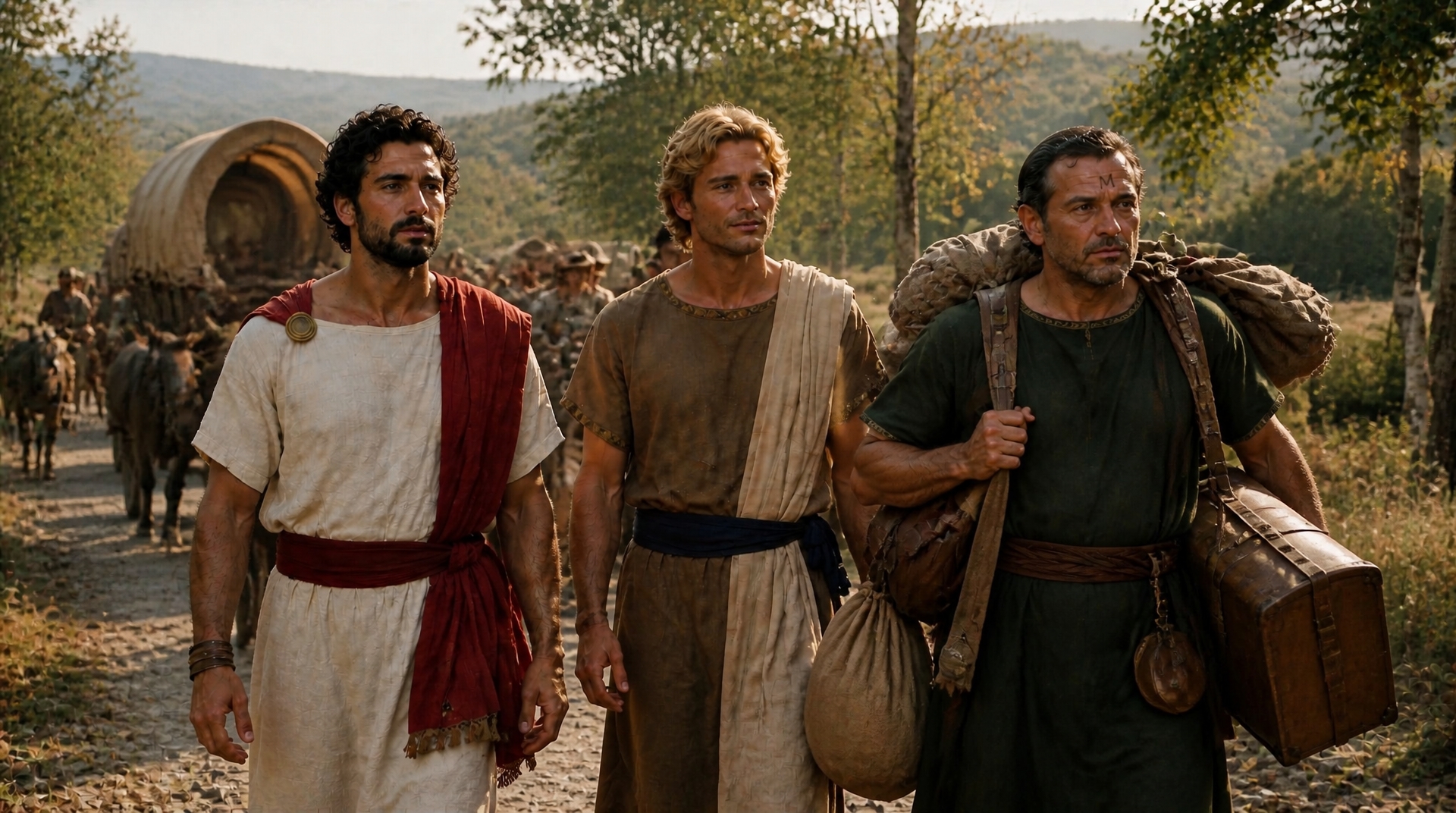
When they left the ship at last and transferred to the caravan for the
overland leg toward Lugdunum, Lucian noticed something in Tanno's face. A
tension. An attention. Tanno was watching the landscape as they traveled,
and with each mile, something in him seemed to shift.
It started small. A plant by the roadside—Tanno would recognize it,
would say the Gaulish name. A type of tree. A rock formation. The way the
hills rolled. None of these things were his home exactly, but they were
pieces of it. They were pieces of the person he had been before Rome.
"I remember this," Tanno said one afternoon, looking at a stand of
birch trees near the road. "We had trees like this. My father kept tools
under a tree like this. Hammers and anvils wrapped in cloth."
Lucian watched him. Tanno was not sad exactly. But he was—aware. As
if the landscape was slowly calling him back into himself.
Gaul's Got Talent
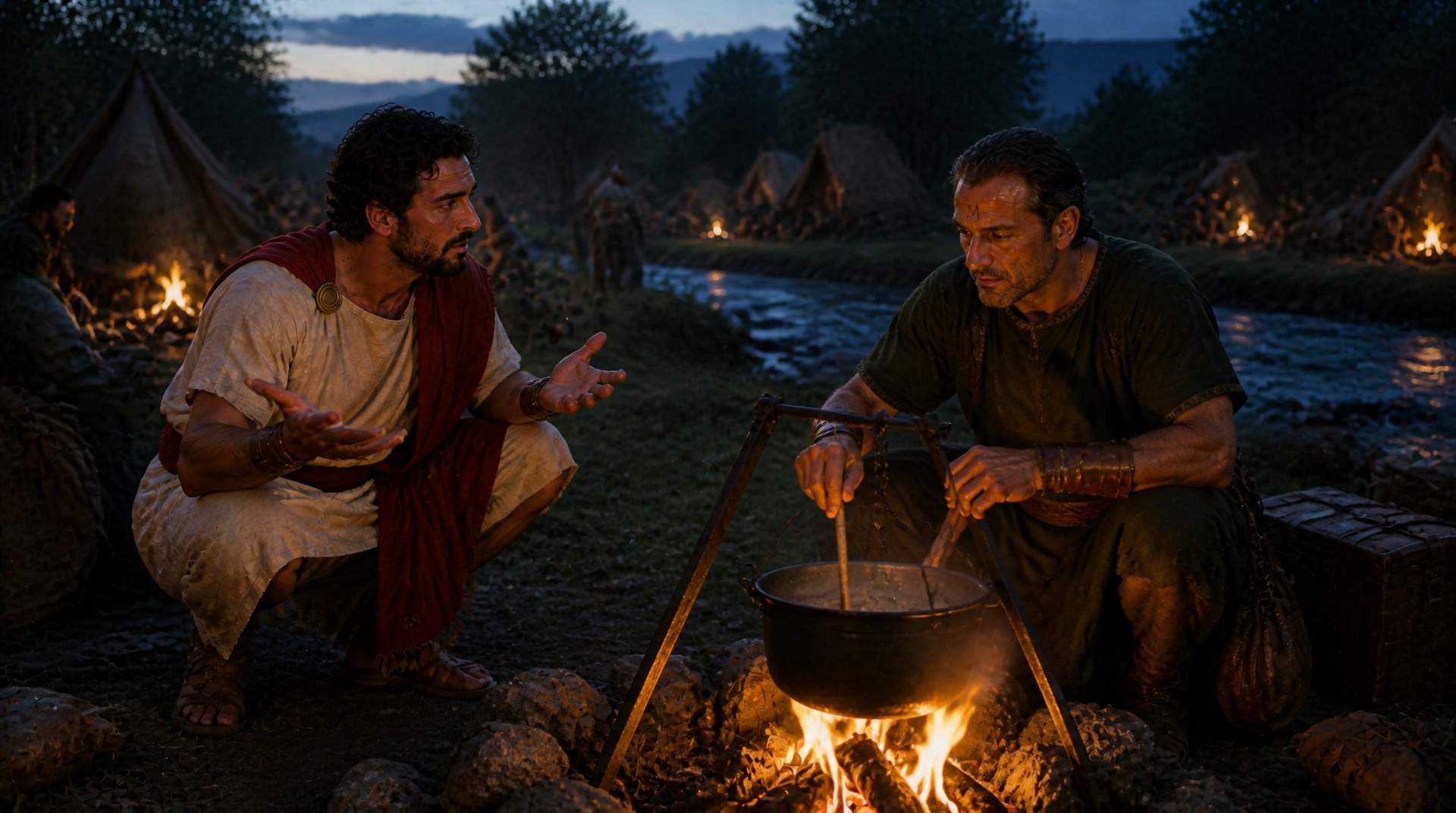
They were five days out from Massilia when Lucian broached the subject. It
was evening. They had made camp by a small stream. Demetrios was somewhere
in the darkness collecting firewood. Tanno was preparing food. Lucian sat
across the small fire from him.
"I need to talk to you about something," Lucian said.
Tanno's hands stilled. "What?"
"Your singing," Lucian said. "At the feast. You understand what it is we
actually do, yes? Kallias hosted it, but those people paid to be
entertained. That's the trade, in the end. A rhetor can teach, or
flatter, or provoke—but first he has to entertain, or no one stays to
hear the rest. It's the one door every audience leaves unlocked."
"Yes," Tanno said carefully.
"And your song," Lucian continued, "did all of it at once. It entertained
them, and then it did something I have never managed in my life: it broke
their hearts. People left talking about your voice, not about my words."
"That's not—" Tanno began.
"Yes, it is," Lucian said. "And I want to pay you for it."
The silence that followed was absolute.
"No," Tanno said finally.
"No?"
"I don't want money," Tanno said. "I'm your slave. You own me. What
would I do with money? Where would I go? What would I buy?"
Lucian had anticipated this. "Money," he said, "is not about
freedom. Or it's not only about freedom. Money is about choice. Small
choices. Do you want a better tunic? Money buys it. Do you want honey in
your bread instead of just bread? Money buys it. Do you want to learn a
skill—to buy tools, to take lessons—money lets you do it."
"I don't need—" Tanno started.
"It's not about need," Lucian interrupted. "It's about having
something that is yours. Something no one can take from you because
you earned it. Your voice earned it. Your gift earned it. You should have
something to show for that. Something that belongs to you and only you."
Tanno looked into the fire. The flames cast shadows across his face,
making him look older and younger at the same time. "If I took money from
you," he said slowly, "would I have to keep singing? Would you own my
voice?"
It was such a good question that Lucian had to think about it. "No,"
he said finally. "Your voice is yours. I can ask. You can choose to share
it or not. But if you do sing—in performances, for audiences, where
people have paid to see us—you should be paid. Not by me. By them. I
would arrange it. But the payment would be yours."
"And if I don't want to sing?" Tanno asked.
"Then you don't sing," Lucian said simply. "Your gift is not mine
to command. It was never mine to command. It's yours."
Tanno was quiet for a long time. When he finally spoke, his voice had gone
flat and hard. "I have never had anything that was mine," he said. "And I
don't want it now. Keep your money. Keep your kindness. Give it to someone
who has earned it."
"You earned it," Lucian said. "Your voice—"
"My voice is nothing!" Tanno snapped, and the heat of it startled them both.
He looked away, into the dark beyond the firelight, and said no more.
It was Demetrios who answered. He had come back from the trees with an
armload of wood, and how long he had been standing there, listening, Lucian
could not say. He set the wood down by the fire and looked at Tanno, not
unkindly.
"It isn't the money he's refusing," Demetrios said. "And it isn't the
kindness. He doesn't believe he's allowed to have either one."
"You don't know anything about me," Tanno said.
"I know the slavers don't take one man and leave the rest," Demetrios said.
"They took your family along with you. And you were there, marched through
your own country in chains, watching them sold off one by one—and you
could not lift a hand to stop it. You have spent twenty-two years deciding
that a man who could not save his own family has no right to anything good,
ever again."
The fire popped. Tanno did not move, but something in his face had come
apart.
"That is why you refuse the tunic, and the money, and the honey in your
bread," Demetrios went on, quietly now. "Not because you don't want them.
Because wanting them feels like theft. Like living well is something you
stole from the people you left behind."
For a long moment no one spoke. When Tanno finally answered, his voice was
barely a whisper. "I should have done something."
"You were a boy," Demetrios said. "There was nothing to be done."
Lucian leaned forward. He understood now what the argument had truly been
about, and he understood that money and choice had never been the heart of
it.
"Listen to me," Lucian said. "That song of yours—you showed me what
it meant, on the ship. A man who keeps walking, and keeps singing, because
the singing is the only way left to carry the names of the people he lost.
You said it yourself. It is not about dying. It is about refusing to let them
be forgotten."
Tanno looked at him.
"So sing," Lucian said. "Not for me. Not for coins. For them. Every time
you stand before a crowd and sing that song, you carry your family a little
further into the world. You make strangers in cities they never saw weep for
people they never knew. That is not a betrayal, Tanno. It is the opposite. It
is the only kind of faith you have left to keep with them."
Tanno was silent. The firelight moved across his face, making him look older
and younger at the same time. And then, slowly, he nodded.
"All right," he said. "I will sing. And I will take the money." He paused.
"Not because I want it. Because they would have wanted it for me."
And Tanno, for the first time since Corsica, looked like a man who might
believe he deserved something good.
Lugdunum
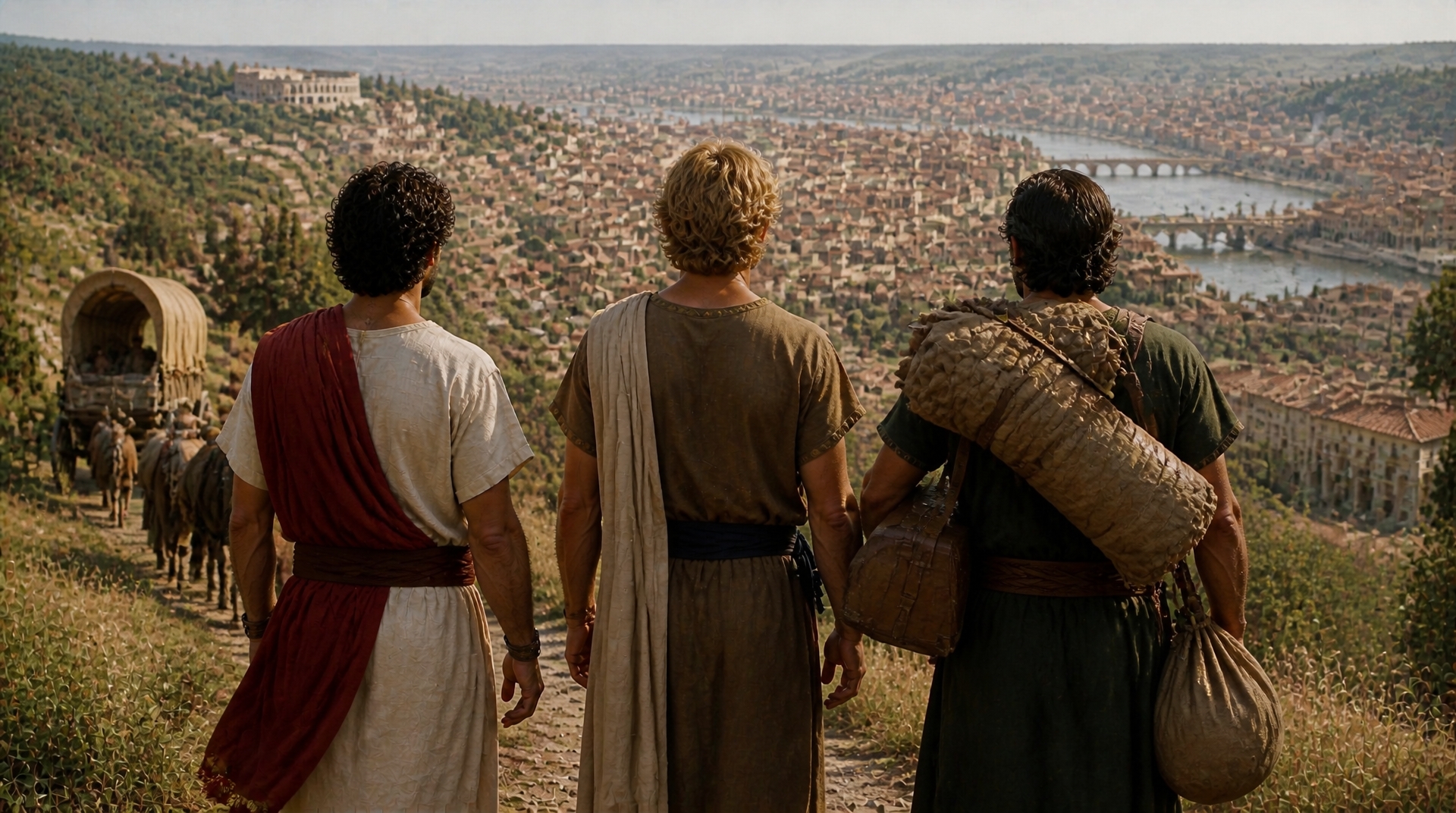
When Lugdunum appeared on the horizon, Tanno made a small sound. Not quite
a word. Not quite a cry. Lucian turned to look at him.
"What is it?" Lucian asked.
"It's close," Tanno said. "I can feel it. My home. It's close. I
don't know how far. I don't know exactly where. But it's—"
He trailed off, unable to finish.
Lucian understood. Tanno was returning to the geography of his own life.
He was moving back toward the place where he had been someone other than
Marcus. Back toward the possibility of becoming himself again.
Lugdunum was larger than Massilia in some ways, less refined in others.
It was a city of merchants and soldiers, of Romans and Gauls mixed together
in an uneasy coexistence. The great rivers that met here made it a crucial
trading center, and the population reflected that: Greek merchants,
Gaulish nobles, Roman administrators, all moving through the streets with
the wariness of people who knew they could not trust each other completely.
Demetrios found a venue within three days—a merchant's courtyard
near the forum, much like the one in Massilia but larger, with seating for
perhaps three hundred people. The merchant who owned it, a man named
Stephanos, was Greek but had lived in Gaul long enough to understand both
audiences. He wanted Lucian to perform, and he was willing to pay for the
privilege.
"The Gauls here," Stephanos said, "want to hear what the Romans
have to say. And the Romans want to hear what the Greeks think about them.
And the Greeks want to prove they still matter. It's a delicate dance. Can
you manage it?"
"I dance like Terpsichore!" Lucian laughed, referring to the Greek Muse of dancing.
For the first week in Lugdunum, Lucian did what he always did: he listened.
The forum merchants spoke of trade, yes, but also of something else: anxiety.
The Romans were pushing further into Gaul, establishing control, changing
things. The Gaulish nobles were being gradually displaced, their authority
undermined. The Greeks, balanced between the two powers, were trying to find
a way to profit from the tension without being destroyed by it.
In the bathhouse, he heard stories of resistance. There were tribes in the
interior who had not accepted Roman rule. There were Gaulish leaders who
were gathering followers, talking about pushing Rome back. The Romans, in
turn, were preparing for conflict, stationing more soldiers, tightening
control.
Lucian understood. Lugdunum was not a settled city like Massilia. It was a
city on the knife's edge, balanced between empires, between cultures,
between the old world and the new. These people needed rhetoric not about
civilization versus barbarism, but about the cost of choosing sides. About
what happens when you are caught between powers larger than yourself. About
whether compromise was wisdom or cowardice.
The Performance
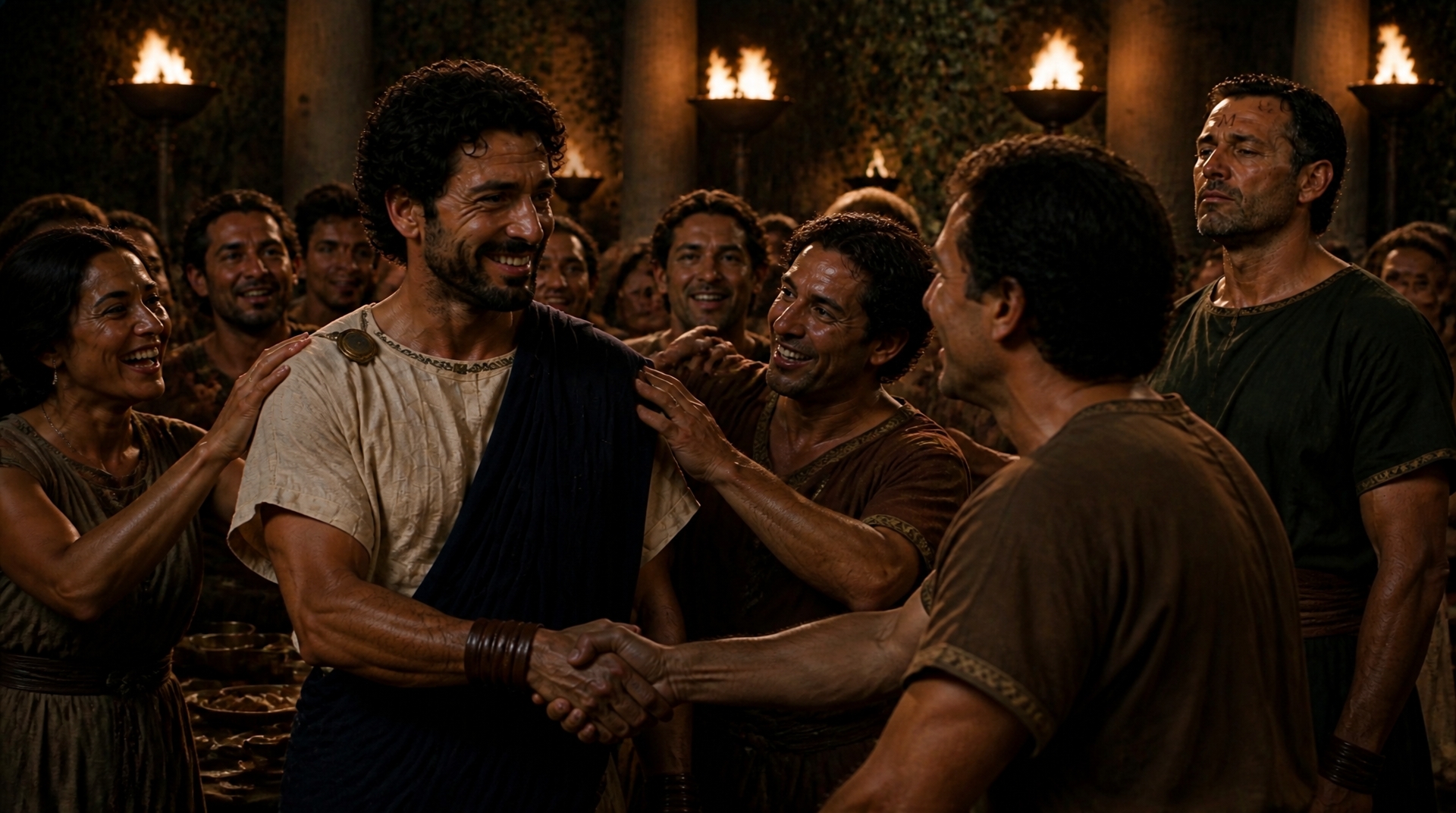
The night of the performance, the courtyard was packed. Three hundred
people, as promised, but also people standing in the doorways, sitting on
the walls, crowded in however they could fit. Lucian saw soldiers and
merchants, Gaulish nobles in their finery, Greek administrators trying to
look impartial, women and children scattered throughout.
Stephanos introduced him with the same careful neutrality he had brought
to arranging the venue. "A man of learning," he announced, "come to speak
to us about the world."
Lucian stepped forward. He had prepared carefully for this audience, and
he had decided to speak about something no one in Lugdunum wanted to think
about: the cost of living in a city that belonged to no one.
"I want to tell you about a merchant," he began. "A real man, from
a real city. This merchant was very successful. He had contacts in three
empires. He traded in goods from the north and the south. He was wealthy.
He had influence. He was respected."
"And one day, he was forced to choose. One of the empires demanded his
loyalty. They said: you must choose sides. You cannot trade with both of us
anymore. You must choose."
"And the merchant—" Lucian paused, "—the merchant
realized that there was no good choice. Either way, he lost something. Either
way, someone he had trusted would become his enemy. Either way, his city
would be diminished."
Lucian moved through the courtyard as he spoke, his voice carrying to
every corner.
"But here is what the merchant learned: sometimes there is no correct
choice. Sometimes there are only choices, and each one costs something. The
question is not whether you can avoid the cost. The question is: what are
you willing to lose? What matters enough that you will pay the price?"
"A man in such a city," Lucian said, "a man who has to choose
between masters, between empires, between identities—that man has to
know what matters to him. His city? His people? His conscience? His
family?"
"Because I will tell you something true: you cannot save everything. You
cannot please everyone. You cannot remain neutral when the world demands you
choose."
"But you can choose with intention. You can choose knowing the cost. And
you can live with your choice, knowing that it was yours, and that it
meant something."
He stood in silence. The courtyard held its breath.
"So the question for each of you," Lucian said, "is not: what will
the world force me to become? The question is: what am I willing to become?
What will I choose, and what will I accept as the price?"
When he finished, the silence was profound.
After Lucian's performance, there was a long pause. Then, as with Massilia,
the applause began. But this time, it was mixed with something else: the
sound of people arguing, debating, questioning. Lucian's words had not
settled them. They had disturbed them, made them uncomfortable.
Which was exactly what he wanted.
As the crowd began to disperse, Stephanos approached Lucian with something
between gratitude and exasperation. "You did not give them answers,"
he said.
"No," Lucian said. "I gave them questions. Answers are easy. But
questions make people think."
Recognition
And then, quietly, Tanno approached. He had been standing at the back of
the courtyard in his forest green tunic, silent and observant as always. But
something in his face had changed. A decision had been made.
"I want to sing," he said. Not asking. Stating.
Lucian looked at him. "You're sure?"
"Yes," Tanno said. "I choose to. Not because you asked. Not because
I'm forced. Because I want to. Because my voice—" He paused.
"Because it's mine."
So Lucian brought Tanno forward. The crowd, which had been dispersing, came
back. Word spread: the slave who sang. The man with the bass voice that had
moved the merchants of Massilia to tears.
Tanno stood in the center of the courtyard. And he began to sing.
It was the same song as in Massilia, the ancient Gaulish lament. But this
time, something was different. This time, Tanno was not singing because
emotion had broken through his control. This time, he was singing because he
had chosen to. Because he had decided, standing in a city near his home,
near the people he had lost, that his voice mattered. That what he had to
say mattered.
The song filled the courtyard. His deep voice carried the weight of loss,
of exile, of a man searching for family that had been scattered by the
whims of the powerful. Of walking through places he had known and finding
them empty. Of memory as the only thing left.
The Gaulish audience understood. Many of them had their own losses. Many
of them had their own families scattered by Rome's wars. The song was their
song. The grief was their grief.
And as the final notes of the song hung in the air, carried by Tanno's
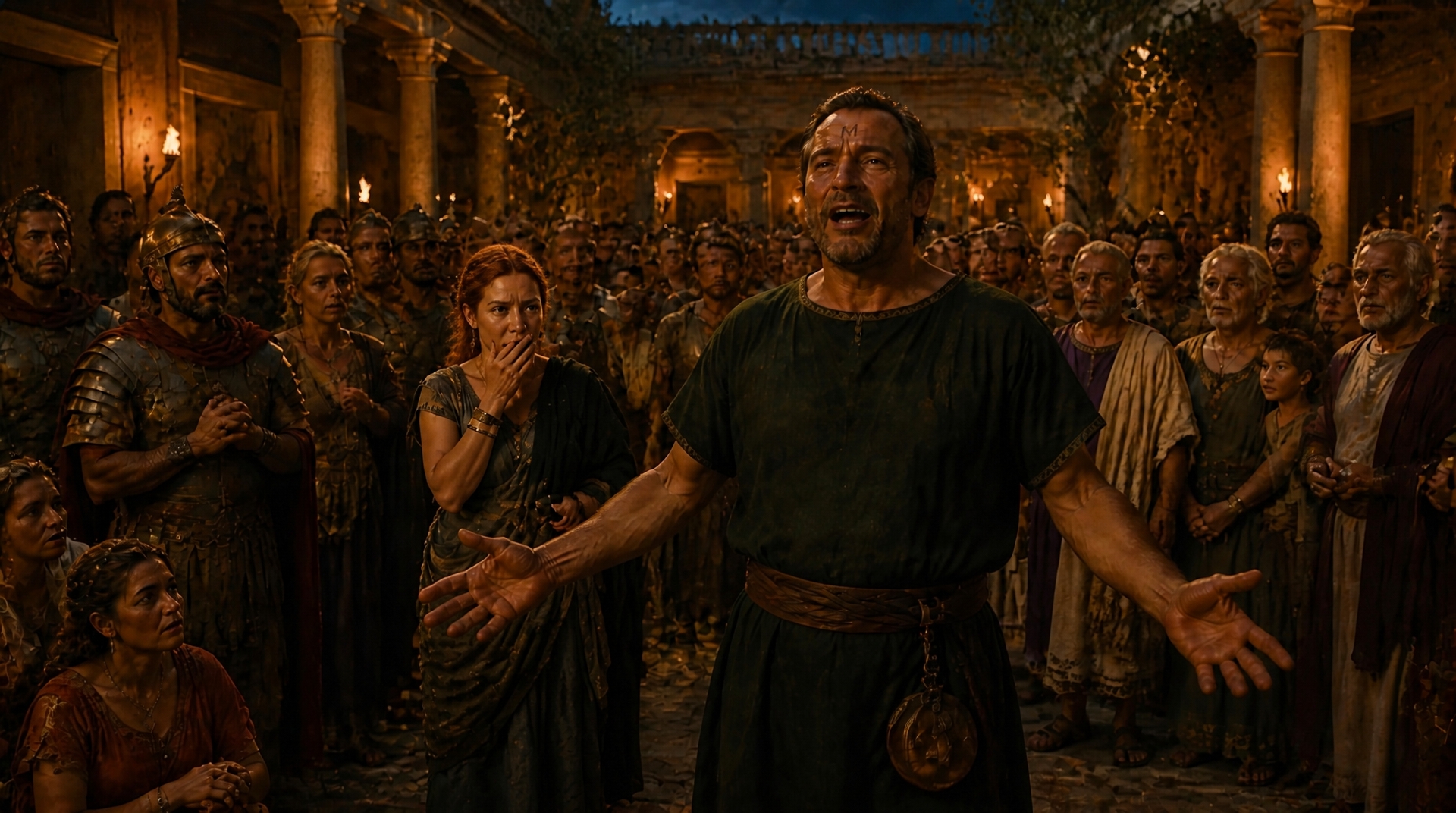
voice into the darkening evening, a woman in the crowd screamed.
It was not a scream of distress. It was something more primal. Something
that spoke of recognition, of shock, of a possibility so impossible that the
only response was to cry out.
The courtyard went silent. Everyone turned to look at the woman, who had
risen to her feet, her hand over her mouth, tears streaming down her face.
And in that moment, Lucian understood that the song had done more than
move an audience. It had reached back through twenty-two years. It had
reached across distance and time and the vast machinery of Rome itself.
And something that had been lost was, impossibly, being found.
It would be complicated. It would be painful. Tanno would never get back
what he had lost. His family scattered, probably dead or absorbed into the
chaos of conquest. His name taken. His freedom stolen. His past buried.
But as they stood in that courtyard, with a woman's recognition hanging in
the air like a second song, with Tanno's eyes wide and wondering, Lucian
understood something fundamental about his companion.
Tanno could not be unmade. Rome had tried. Slavery had tried. Twenty-two
years of trying to make him into something less than human had tried.
But Tanno had kept singing. Kept learning. Kept insisting, quietly and
persistently, that he was worth something. That his voice mattered. That
his choices mattered. That somewhere inside himself, underneath the 'M'
branded on his forehead and the chains that had bound him, there was still a
man. Still a self. Still a voice that deserved to be heard.
And now, impossibly, that voice had reached across the years and touched
someone who remembered him. Someone who may have known him. Someone who was still alive.
Tanno's Song (Carry The Flame)