|
By: Paul S. Cilwa |
Posted: 5/12/2026 |
|
Page Views: 45 |
| Hashtags: #HistoricalFiction #LucianOfSamosata #Massilia #Gaul |
| In Massilia, Lucian gives Tanno a makeover. |
| Estimated reading time: 17 minute(s) (3847 words) |
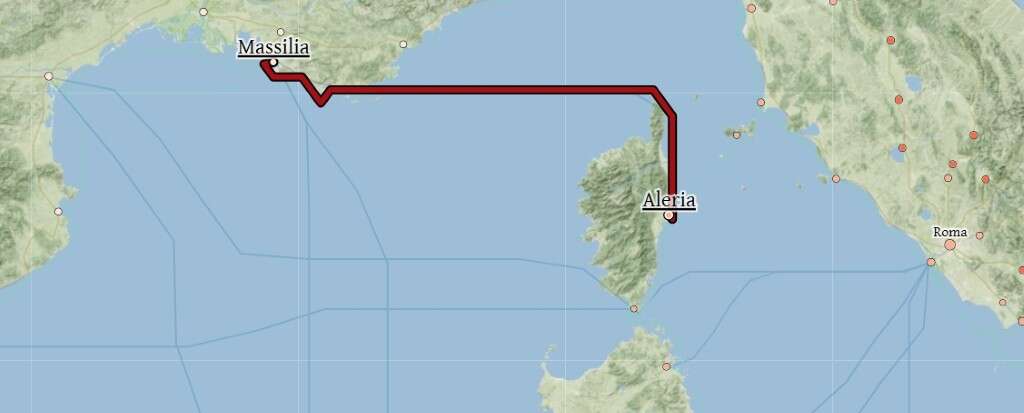
By late afternoon, the harbor of Massilia emerged like a painting slowly rendered visible by
a clearing mist. The water was crowded with vessels—merchant ships of every size, fishing boats,
a few naval vessels bearing Roman insignia. The city rose behind the harbor in terraces of pale
stone, with temples and columned buildings that could have been transplanted from Athens or
Corinth. The air smelled of salt and commerce, wine and olive oil, the dust of grain being
loaded onto ships. And underneath it all, something else: the particular smell of a place where
Greeks had lived for six hundred years, long enough to make it feel like home.
Lucian stood at the railing, watching the harbor expand before him, and felt something shift
in his chest. Not relief, exactly. Not yet. But something like recognition. After weeks of
small ports and cramped ships, after the trauma of Corsica and the long climb back to purpose,
Massilia felt like a destination. Like somewhere that mattered.
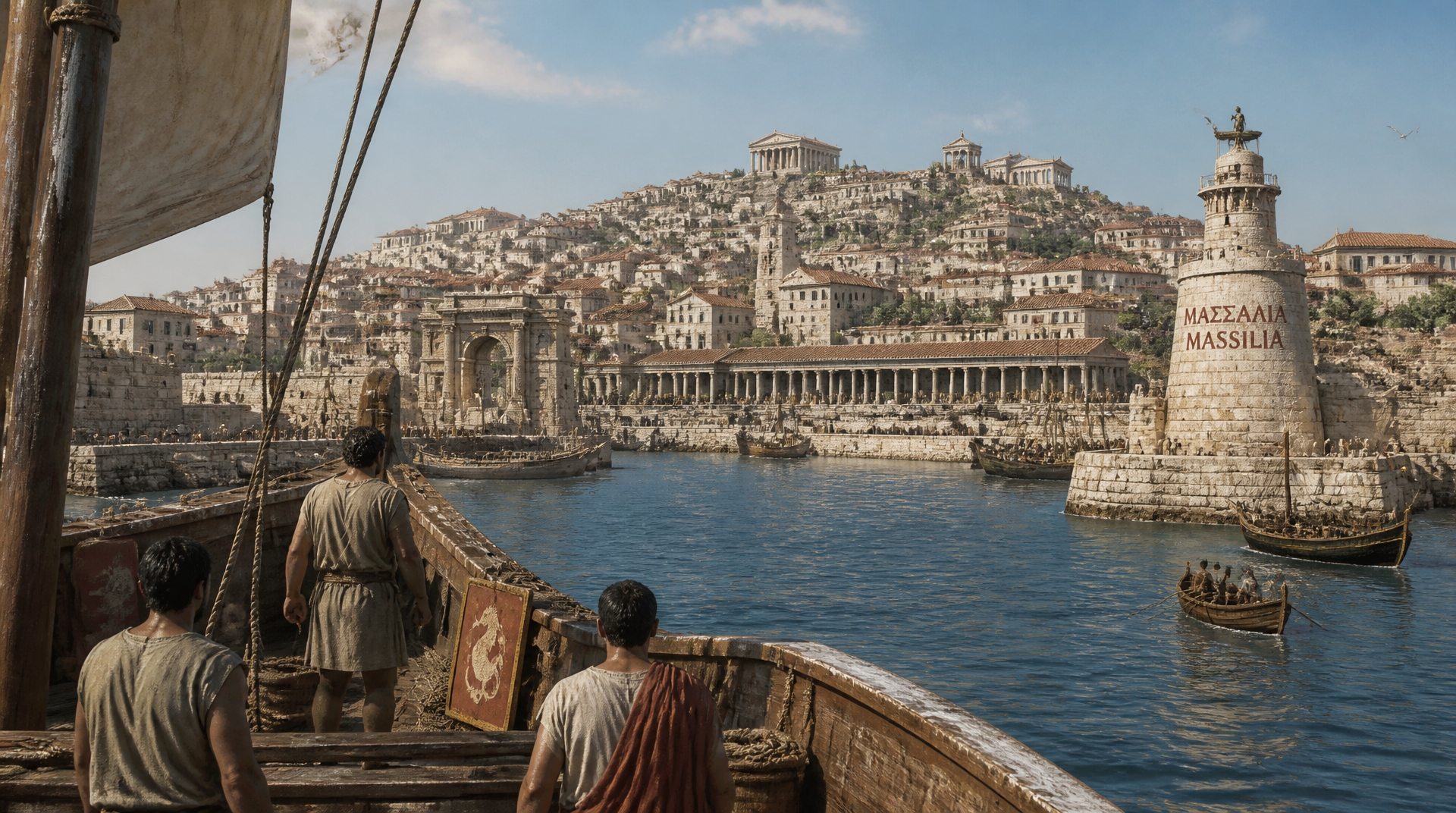
The Harbor
As their merchant vessel began the careful approach to the harbor, following a small pilot boat
that knew the channels and depths, Lucian could see the water teeming with activity. Longshoremen
moved cargo with practiced efficiency. Merchants haggled with ship captains. Sailors called to
each other in a hybrid language that seemed to mix Greek with the commerce-speak of a hundred
different ports. The sun was beginning its descent toward the western hills, turning the water
gold and the pale stone buildings a luminous amber.
Demetrios had come to stand beside him, and he was grinning. "Now," he said, his voice carrying
a note of deep satisfaction, "this is a proper city."
And Lucian understood what he meant. This was not just a Greek city masquerading on a Gaulish
coast. This was a city that had survived conquest and maintained its identity, that had grown
wealthy and powerful while remaining true to itself. The harbor was the proof of it—the
evidence that Greek merchant sense and Greek reason could flourish anywhere, could build
something lasting even in the face of barbarism.
Tanno, who had emerged from below when the crew began shouting, stood apart from them, watching
with the wariness that seemed to be his permanent state. But Lucian noticed something: his
wariness was not fear. It was the careful attention of a man assessing possibility. A man, perhaps,
beginning to believe that a future might exist beyond survival.
The ship slowed as it entered the harbor proper, maneuvering between anchored vessels toward an
open dock. The wind that had driven them for eight days died to nothing, and the crew moved to
tie off lines and lower the boarding plank. Above them, the city waited—Massilia, the Greek
jewel of Gaul, with its theaters and forums and streets crowded with the voices of commerce and
learning. And beyond that, if Lucian squinted and dreamed, the possibility of whatever came next.
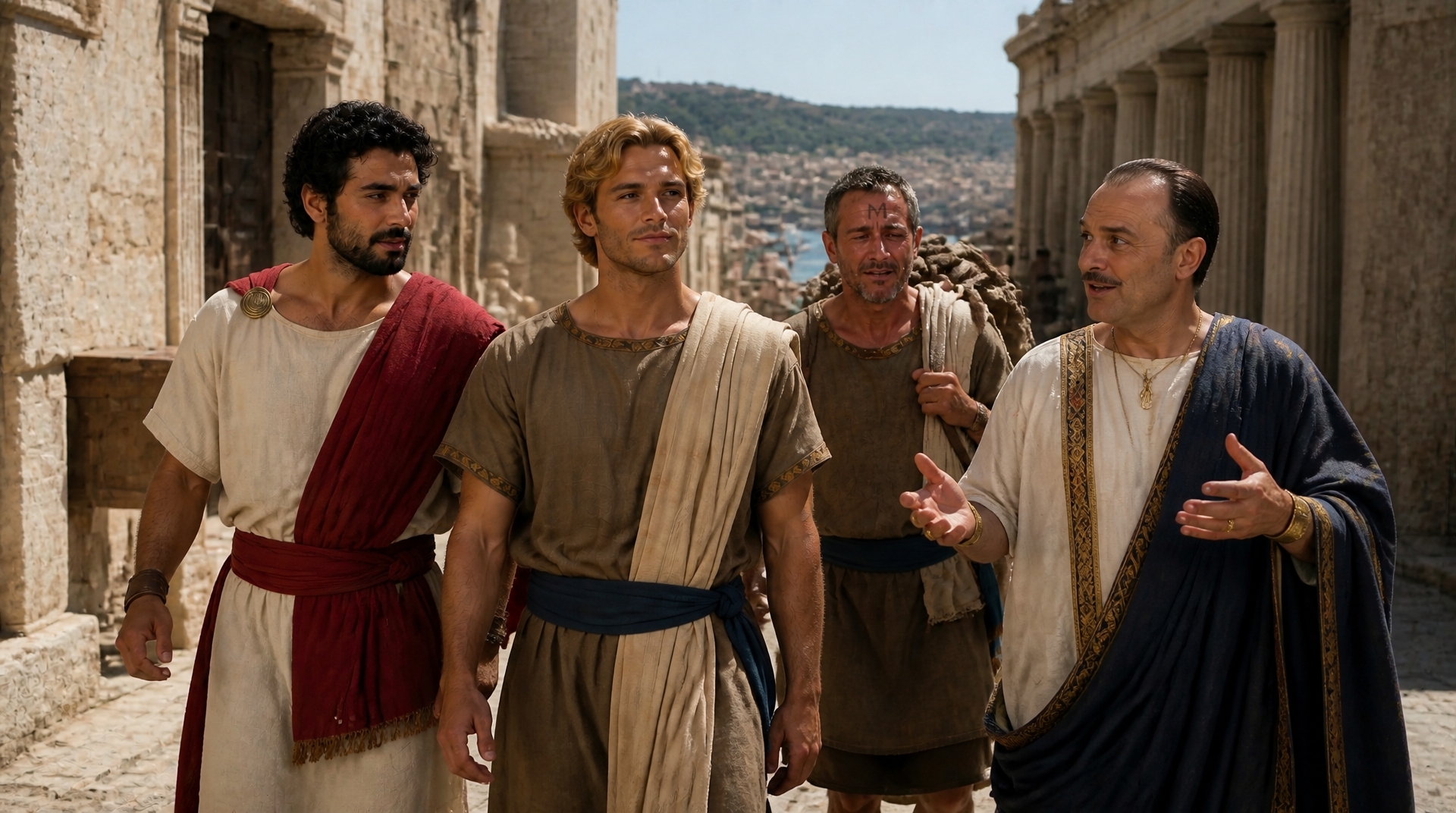
The Landlord's Tour
Finding lodging had been Demetrios' task, and he had done it well. A
month-long rental in a modest but respectable house near the harbor, not
so close as to smell the fish, but close enough that Lucian could feel the
pulse of the city. The landlord was a Greek named Philippos, a man of
perhaps fifty with the kind of obsequious cheerfulness that came from
decades of making strangers feel welcome.
As Philippos walked them from the rental agent's office to the house, he
talked, his voice melodious and yet somehow demeaning, as if he were royalty speaking to peasants.
He talked about the founding of Massilia by Greeks from Phocaea,
refugees who had fled the Persian conquest six centuries before. He talked
about how the city had remained Greek even as Rome conquered Gaul around
it, maintaining a kind of independence through trade and diplomacy. He
talked about the merchant families who had grown wealthy on wine and tin
and amber, the great fortunes built on knowing which ships to trust.
"This is not Rome!" Philippos bragged, gesturing at the
buildings around them. "Rome conquered us, yes, but we remain Greek.
We have our own magistrates, our own ways. The Romans understand: you do
not conquer Massilia. You make an arrangement with Massilia."
Tanno followed behind, taking in the city with eyes that seemed to see
everything and trust nothing. Lucian noticed he was watching the faces of
the people they passed, the way they moved, how they greeted each other.
Not with fear, exactly, but with the careful attention of a man who had
learned that safety came from wariness.
Philippos continued his monologue as they walked. The bathhouse he
recommended. The gymnasium preferred by educated men. The forum where
merchants haggled. The temples—here he became reverent, mentioning
Artemis and Athena as well as a few Gaulish gods whose names had been Hellenized.
The theaters, yes, there were two, and both had regular performances, and
yes, he knew the administrators, and yes, Lucian might have a chance, but
it would require the right introduction.
"I'll introduce you to Kallias," Philippos said, nodding to himself. "He's a merchant,
wine mostly, very wealthy, very cultured. And he does sponsor performances; if he
likes you, he can arrange anything. His courtyard is beautiful. Seats
maybe two hundred. Intimate, but prestigious."
Lucian was already calculating. Two hundred was not huge, but it was
respectable. And he'd long since learned that an intimate venue in the courtyard of a wealthy patron
was exactly the kind of thing that impressed other wealthy patrons.
Besides, he was discovering he preferred small, intimate audiences to
those filling an amphitheatre. It didn't pay nearly as well, of course; but as far
as satisfaction for himself, personally, modest venues like that of Kallias
were his preference.
Philippos waved a hand dismissively. "But you should understand: Massilia is
different from your Greekier cities. The people here, they want to hear
about this world. Not abstractions. Not philosophy, unless it's
practical philosophy. They want to hear about trade, about risk, about
what it means to be civilized people living on the edge of barbarism."
He paused meaningfully. "Or, if you're really clever, you make them see that
what they think is barbarism might be something else entirely."
Lucian's Week
For the first week, Lucian did what he always did when arriving in a new
city: he listened. He spent his mornings in the forum, watching how
merchants negotiated, what words they used, what made them laugh or
frown. He spent his afternoons in the bathhouse, soaking in the hot water
and eavesdropping on conversations about shipping routes and tariffs and
the reliability of various trading partners. He visited the gymnasium and
sat at the edge of the courtyard, listening to educated men debate
philosophy and politics.
What he discovered was that Massilia, despite its Greek veneer, was
fundamentally a merchant city. Not a city of philosophers or scholars,
but of men who wallowed in value, who measured worth in denarii and
amphoras and the reliability of a handshake. The rhetoric that would move
them was not the rhetoric of abstraction, but of money. Tell them about
risk. Tell them about the choices men make when the stakes are high. Tell
them about what it costs to be civilized, and what it costs not to be.
He also discovered beer.
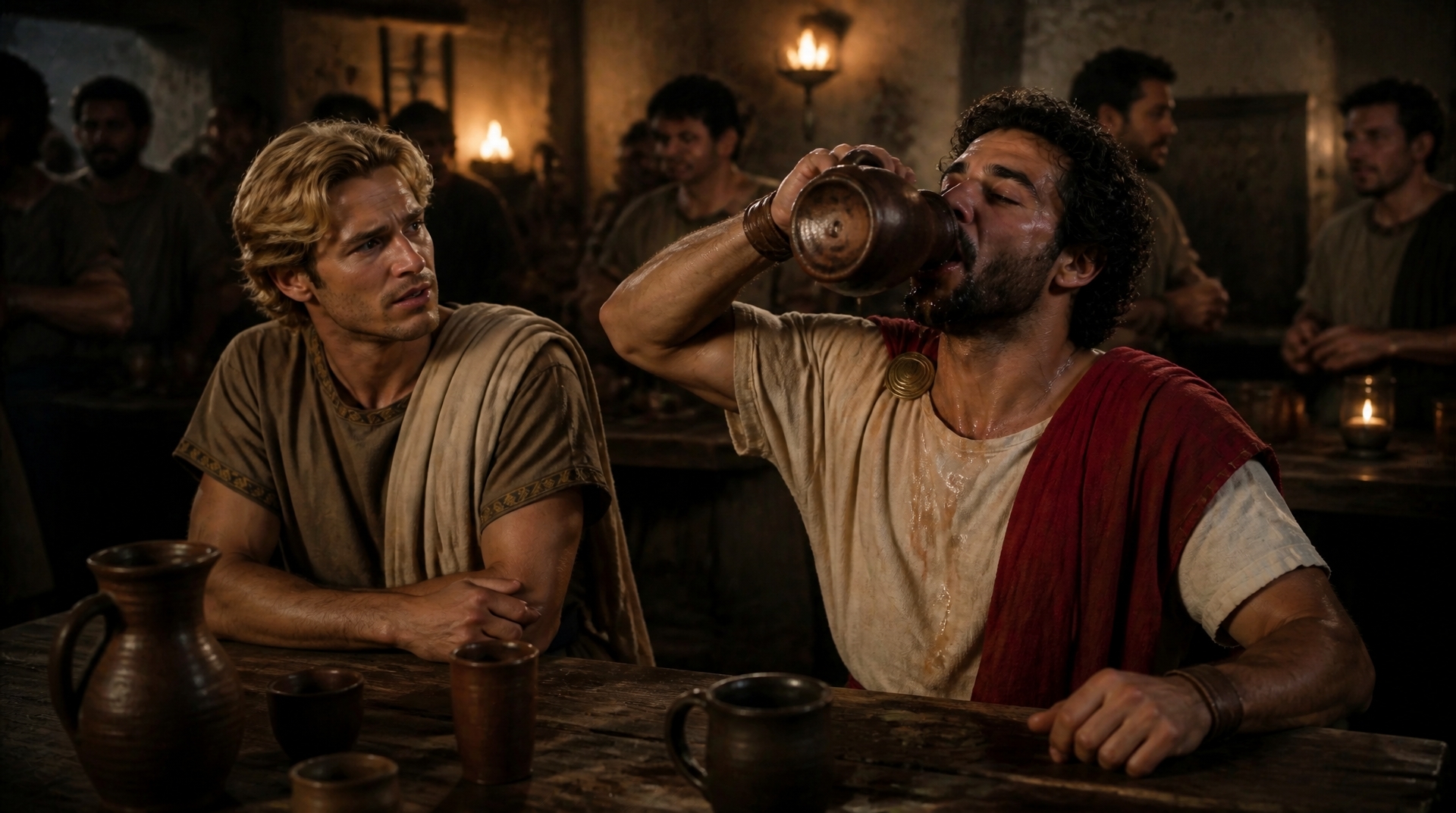
This happened on the fourth day, when a group of merchants invited him to
drink after the gymnasium. They were friendly, curious about the famous
Syrian rhetor who had conquered Asia Minor and Greece. They wanted to know
his stories, and Lucian, eager to be sociable, and eager to understand his
audience, accepted.
The beer came in a large wooden cup, dark and bitter. Lucian took a sip
and tried not to make a face. Bitter. Terribly bitter. Nothing like wine.
"You get used to it," one of the merchants said, laughing. "In a
few years you'll sneer at wine."
Lucian took another sip. And another. It was indeed bitter, but there was
something else underneath: a kind of earthiness, a substance. And as he
drank, the bitterness became less offensive. By the third cup, he was
beginning to understand what the merchants meant.
The problem was that there were still more cups.
Lucian, who was used to wine and whose tolerance for beer was therefore
nonexistent, found himself becoming progressively more relaxed. His tongue
loosened. The careful rhetor who measured every word began to speak from
the heart. And what emerged from his heart, after the fourth cup, was
Demetrios.
"I don't know what I would do without him," Lucian was saying,
gesturing expansively. "He's the steady one. He knows me. He knows what
I need before I know it myself. He's—" He paused, searching for
the word. "He's everything."
The merchants were charmed. In Gaulish culture, this kind of open
sentiment about friendship was not embarrassing; it was considered beautiful. A
man who could speak so freely about his affection for another man was a
man who understood what mattered. They bought him another beer and toasted
him.
Demetrios, who had come along to keep an eye on things and had
participated in exactly one beer before deciding he would never learn to tolerate the taste, was
turning an impressive shade of red.
"Lucian," he hissed, "perhaps we should leave, don't forget, we have
that thing we have to be at."
But Lucian was not finished. "No, no," he was saying, "they
understand. They understand that what we have is—" he gestured
vaguely, "is real. Is important. Not everyone understands that."
When they finally left, Lucian was leaning heavily on Demetrios, his
steps uncertain. Tanno followed behind, quietly amused. Demetrios
supported him with barely concealed exasperation.
"You're impossible," Demetrios muttered. "What am I supposed to
do with you?"
"You're doing it!" Lucian slurred.
Demetrios did not let Lucian fall, and the three
men made their way back to the rental house through the warm Massilian
night.
The Vestment Investment
The morning after, Lucian woke with a throbbing headache and an
incomplete memory of the evening's events. Tanno took one look at him, left,
and returned with a cup of whey with bits of herbs floating in it.
"Drink this," he said. "It will help."
It tasted worse than the beer, but to Lucian's surprise, it helped.
The idea of eating breakfast made him nauseated but by noon he was able
to get down a bit of bread and bland cheese, and then he did feel better.
By evening, Lucian had moved on to other things. He announced, with the
kind of casual confidence that comes from a performer who has convinced
himself of something, that Tanno needed new clothes.
"Proper clothes," Lucian told him. "Nothing expensive, but respectable. You
look like someone who just arrived from a mine, which, fair enough, you
did. But if you're going to move through this city with us, you need to
look like you belong."
Lucian understood that he could not simply be kind to
Tanno. Kindness felt like slavery to him. It felt like being indebted,
like owing something he could never repay. "It's not charity," Lucian assured Tanno.
"It's an investment. If you look prosperous, I look prosperous.
If I look prosperous, more people come
to hear me speak. If more people come, I make more money. Your appearance is
part of my business. So really, I'm spending this for myself, not for
you. It's practical."
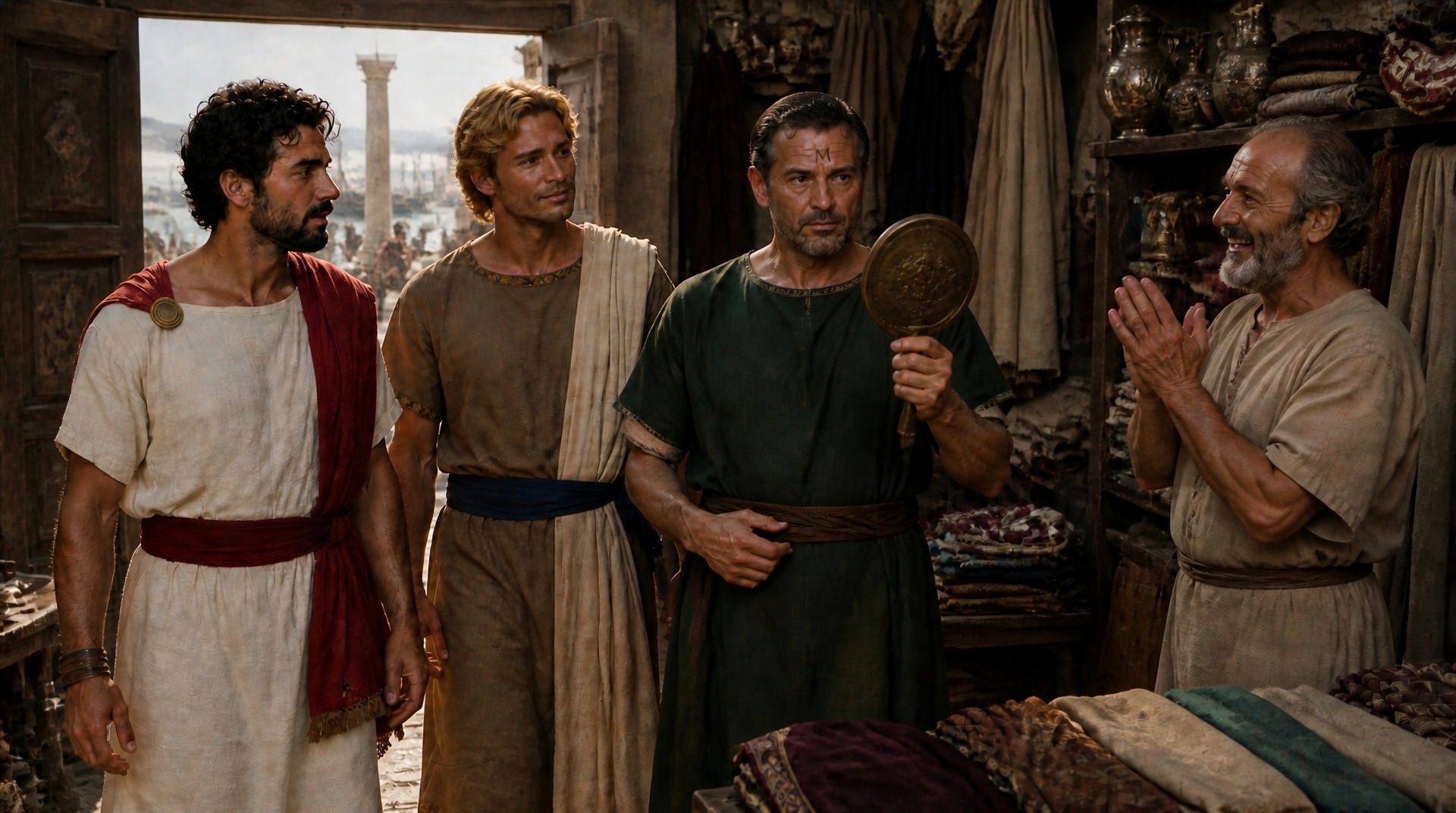
So they went to the cloth merchant in the Greek quarter, all three men,
and Lucian began pointing out fabrics. Good quality tunic cloth,
the kind that draped well and wouldn't wear out in a month. Lucian wanted
something impressive: perhaps a deep crimson, or a rich blue that would
catch the eye.
But Tanno kept gravitating toward the practical. He ran his fingers over
sturdy linen, fine wool, the kind of material a craftsman would wear.
Durable. Built for work. And again and again, he reached for earth tones:
browns, greys, the colors of stone and soil.
"That's too plain," Lucian objected. "I said you should look
prosperous. That makes you look like a laborer."
"I am a laborer," Tanno said quietly. "My father was a smith.
So was I, before—it all went to shit."
Demetrios, who had been watching this exchange, stepped forward. "What
if," he said, "we find something that is both? A craftsman's cut, but
in a finer material. And a color that matters to you, but in a tone that
reads as prosperous?"
They found it together. A deep forest green, the color of pine and shadow,
a color that spoke of ancient forests and things that endured.
The cut was simple, practical, a craftsman's tunic. But the material was
fine wool, well-made, the kind of thing that would last and would be
appreciated by anyone who knew the quality of cloth.
"What do you think?" Lucian asked.
Tanno looked at himself in the bronze mirror the merchant provided. For a
long moment, he did not speak. Then: "It's good."
It was not enthusiasm, but it was acceptance. More than that: it was
recognition. In the mirror, Tanno saw something he had not seen in
twenty-two years. A man who looked like he belonged to himself.
Well, except for the 'M' branded on his forehead, marking him as
a mining slave.
Demetrios Negotiates
While Lucian had been exploring and drinking beer,
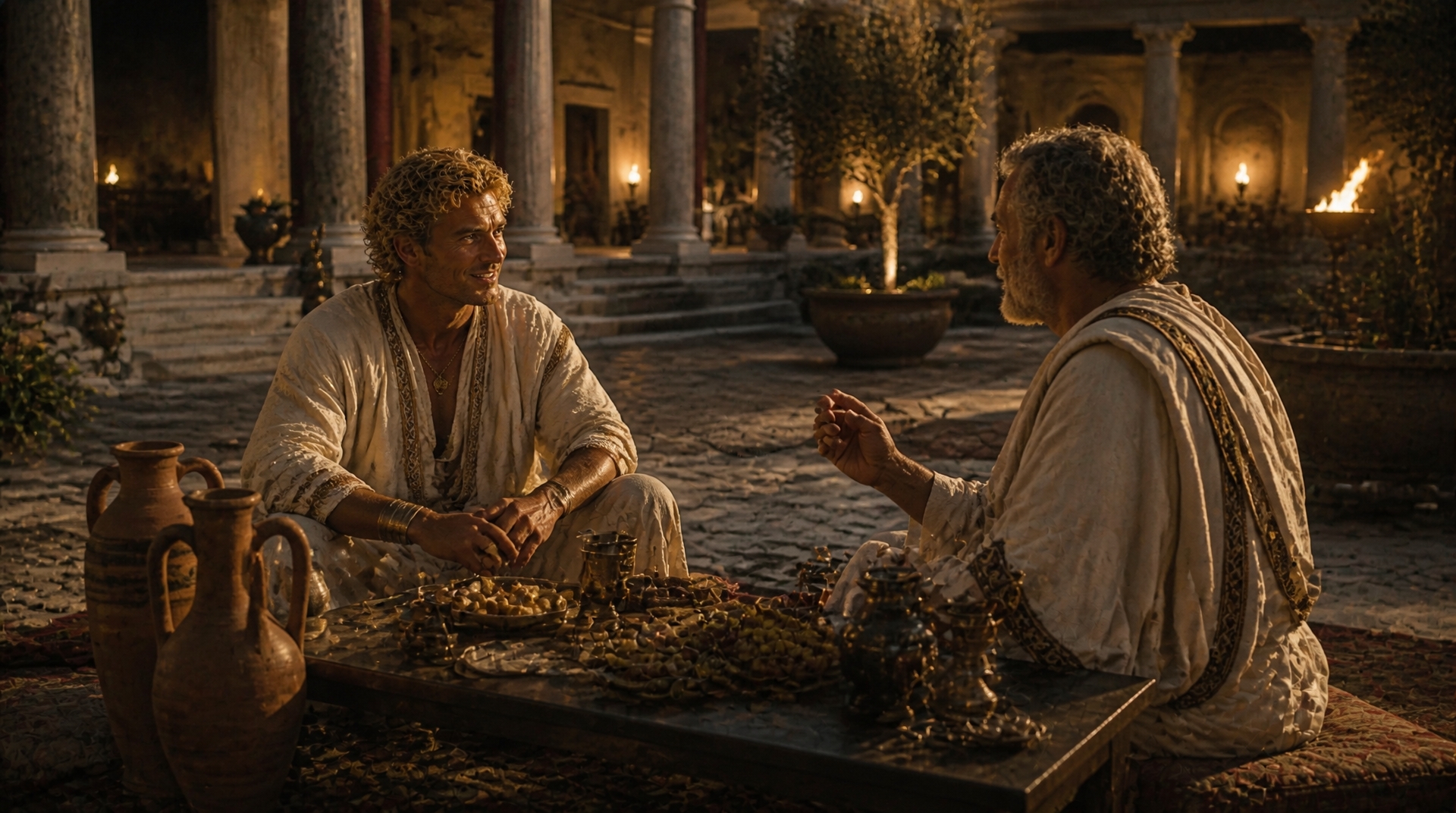
Demetrios had been doing his job. He had met with Kallias, the wine
merchant Philippos had mentioned. He had sat in the courtyard of Kallias'
house and listened as the man went on about his business, his philosophy,
his love of rhetoric and performance.
It had taken three meetings and two dinners, but Demetrios had managed to
secure the courtyard for a performance. Not immediately—Kallias did
not rush such things. But in two weeks' time, there would be a feast, and
after the feast, Lucian would perform. Kallias would invite his friends,
his business associates, the educated men of Massilia who understood the
value of good rhetoric. Two hundred people, perhaps more.
It was exactly what they needed. And Demetrios, when he reported this to
Lucian, smiled in satisfaction.
"Two weeks," he said. "That gives you time to prepare, to learn
more about your audience, to figure out what they need to hear."
Lucian nodded. Two more weeks. It was enough time and not enough time, all at
once. Enough to prepare something good. Lucian let himself be excited
by the prospect.
That night, he lay with Demetrios in their bed in the rental house and thought about what
Philippos had said. Make them see that what they think is barbarism
might be something else entirely.
He thought about Tanno in his new green tunic, looking at himself in a
mirror and finding, for the first time in decades, a man he could
recognize.
And he thought about beer, and about saying things he meant, and about
Demetrios' hand steady under his arm as he stumbled through the streets of
Massilia.
It was hard to imagine how his life could get any better.
The Feast
The night of Kallias' feast arrived with the weight of
expectation. Lucian had discovered what the merchants of Massilia feared: not
poverty, but irrelevance. Not failure in business, but failure to matter.
They were wealthy, yes, but wealth meant nothing, if the world around them
was crumbling into barbarism. They needed to believe that their
civilization meant something. That their choice to remain Greek in a world
of Gaulish tribes was not foolishness, but courage.
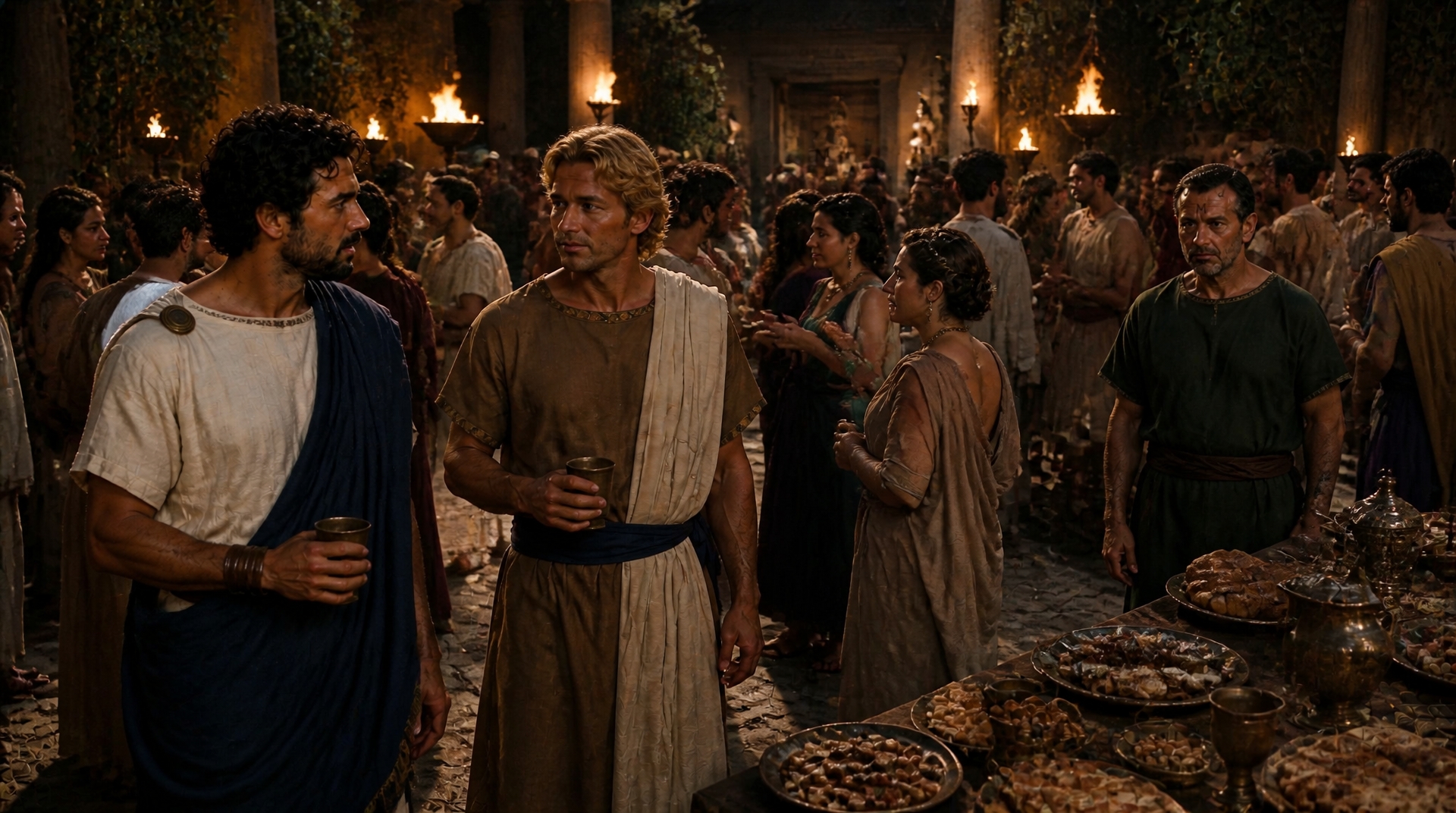
The courtyard of Kallias' house was lit with torches. Two hundred people
had gathered: merchants and their wives, local administrators, a few Roman
officials who had learned it was wise to respect Massilia's independence.
Tables were laden with food—fish from the harbor, wine from the merchant
houses, bread baked that morning. The air was warm and thick with
anticipation.
Lucian stood at one end of the courtyard, in a simple white tunic with a
deep blue himation draped over one shoulder. Demetrios was nearby, having
introduced him to Kallias an hour before. And Tanno stood at the back of
the crowd, in his forest green tunic, watching with the careful attention
he brought to everything.
When the feast ended and the tables were cleared, Kallias rose and
introduced Lucian with genuine warmth. "A man who has conquered
cities with words," he said. "I give you Lucian of Samosata."
Lucian stepped forward. He had decided not to do his usual extemporaneous
declamation. Instead, he had chosen his subject carefully, and prepared
every word. This audience needed more than cleverness. They needed truth.
"I want to tell you," he began, "about a city that does not exist.
A city that should exist, but does not. A city that was built by people who
believed in something."
He paused, letting the silence settle.
"Once, a long time ago, Greeks fled their home. The Persians had
conquered their city, burned their temples, enslaved their people. These
Greeks had nothing. No home. No wealth. No certainty that they would live
to see the next day. But they did have one thing: they had the memory of what a
city could be. A place where reason ruled over force. Where beauty mattered.
Where a man's words could matter more than his sword."
"So they sailed west, to an unfamiliar shore. To a land where the people
were not like them. Where the gods had different names. Where the very air
smelled wrong. And they built a city anyway. Not because it was easy. Not
because they were certain of success. But because they believed that some
things were worth building, even in the face of barbarism. Even in the face
of uncertainty."
Lucian moved across the courtyard as he spoke, commanding the space with
his presence.
"And here is the question that haunts every merchant in this city,"
he said. "Every man who has chosen to remain Greek instead of becoming
Gaulish. Every woman who speaks Greek instead of the rough tongue of the
interior. Here is what you all fear: that it was foolishness. That after six
hundred years, the barbarians will win. That your city will fall into the
swamps and the forests, and your memory of civilization will be buried with
it."
He let his words hang in the air as he took a few steps towards the audience.
The silence was palpable as they strained to hear his next words.
"But here is what I believe," he said, his voice quieter, yet intense
enough to carry to the furthest corners of the courtyard.
"Civilization is not a place. It is not stones and temples.
It's most definitely not walls."
"No," he continued, "civilization is a choice. A daily choice to believe that meaning
matters more than power. That beauty matters more than conquest. That a
human being has value beyond what they can produce or how much they can
conquer."
"And as long as there is one person who makes that choice—one person who
chooses to speak beautifully instead of strike brutally, to listen instead
of command, to see the humanity in someone different—that city still
exists. That city never falls. Because it was never built of stone. It was
built of the human heart."
He stood in silence. The courtyard was silent with him.
"The question is not whether barbarism will conquer you," Lucian said
finally. "The question is: what will you choose? Every day, what will you
choose?"
And then he stopped speaking. He stood in the center of that courtyard,
in his white tunic and blue himation, and let the weight of his words
settle into the silence.
For a moment, no one moved. No one spoke. Even the torch flames seemed to
hold their breath.
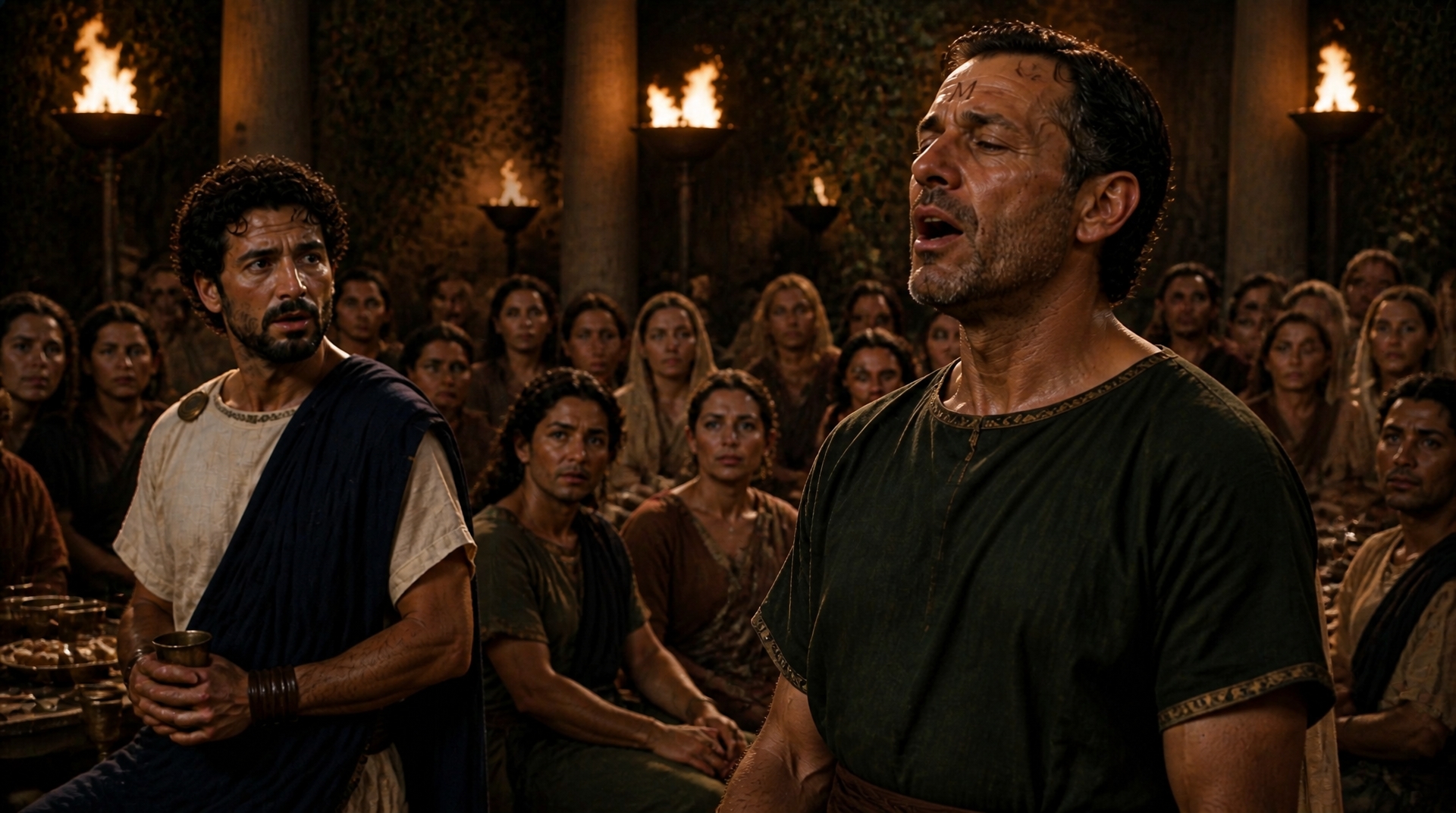
And then Tanno began to sing.
Tanno's Song
It was not planned. It was not discussed or rehearsed or agreed upon. Tanno
had simply been standing at the back of the courtyard, in his green tunic,
listening to words about civilization and choice, about building something
in the face of barbarism, about the value of a human heart. And something
in those words had broken open the careful walls he had constructed around
his own heart.
The song came out in Gaulish, in the rough beautiful language of his
childhood. It was an old song, the kind sung by soldiers and slaves and
mourners. The kind of song that lived in the bones of a people scattered by
conquest.
His voice was deep and rich, a bass that seemed to come from the earth
itself. The first notes were tentative, almost questioning. But as he sang,
something hardened in him. The song was about loss. About a land taken. A
family destroyed. A man scattered like ash on an unfamiliar wind.
The merchants of Massilia did not understand the words. But they
understood the meaning.
They understood loss. They understood the ache of exile, even though their
exile had happened six hundred years ago and was now woven into their very
identity. They understood the choice between holding onto what was lost or
building something new.
And the song held them. Two hundred educated, wealthy, careful people,
frozen in the torchlight while a slave sang about his shattered life
in a language they did not speak.
Lucian, whose jaw had dropped when Tanno first started singing, recovered himself
and then stood still, listening. He had never before heard Tanno sing, and he had
never heard anything like it. It was as if the song was not just coming from
him, but from the collective souls of every enslaved person ever.
When Tanno finished, the song hung in the air like smoke. No one applauded
at first. No one moved. The courtyard was utterly still.
Then Kallias stood. It was a small gesture, but it broke the spell. The
rest of the courtyard followed. The applause began slowly, then grew. Some
of the men had tears in their eyes. One woman was openly weeping.
Lucian walked to the back of the courtyard where Tanno stood, still in his
green tunic, still bearing the invisible weight of everything he had sung.
Lucian placed a hand on his shoulder, and in that gesture was everything he
could not say: I see you. I hear you. You are not what slavery made you. You
are what you chose to become.
And Tanno, for the first time since Corsica, looked like a man who might
believe it.