|
By: Paul S. Cilwa |
Posted: 5/11/2026 |
|
Page Views: 68 |
| Hashtags: #HistoricalFiction #LucianOfSamosata #Corsica #Trauma #Slavery |
| Lucian brings Tanno to an island haunted by his past. |
| Estimated reading time: 13 minute(s) (3077 words) |
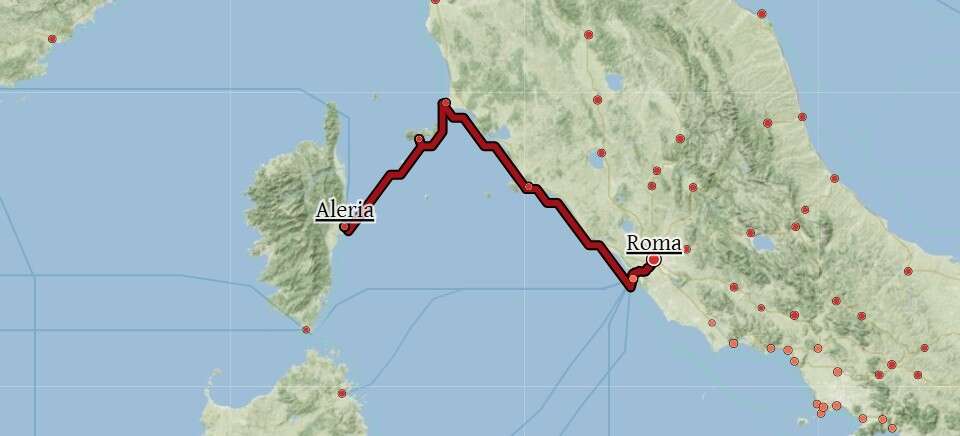
The captain of the merchant vessel had traded the direct route for a more profitable one: following
the spine of Italy northwestward, then cutting across toward Corsica before turning toward Massilia.
It added days to the journey, but it meant stopping at towns where there were people with coins and
appetite for entertainment. Ostia, Civitavecchia, smaller harbors whose names Lucian would forget as
soon as he left them. What mattered was that at each stop there was an audience, and at each audience
there was money.
Demetrios had mapped it all before they boarded, tracking which cities had theaters, which had
gymnasiums, which had patrons wealthy enough to pay for a performance. He had written letters ahead
to contacts in several ports, preparing the way. By the time Lucian and Tanno stepped aboard the
merchant vessel in the harbor at Ostia, their course was already set: a slow, profitable arc across
the Mediterranean, one performance at a time, toward Massilia and whatever lay beyond.
Conversations at the Railing
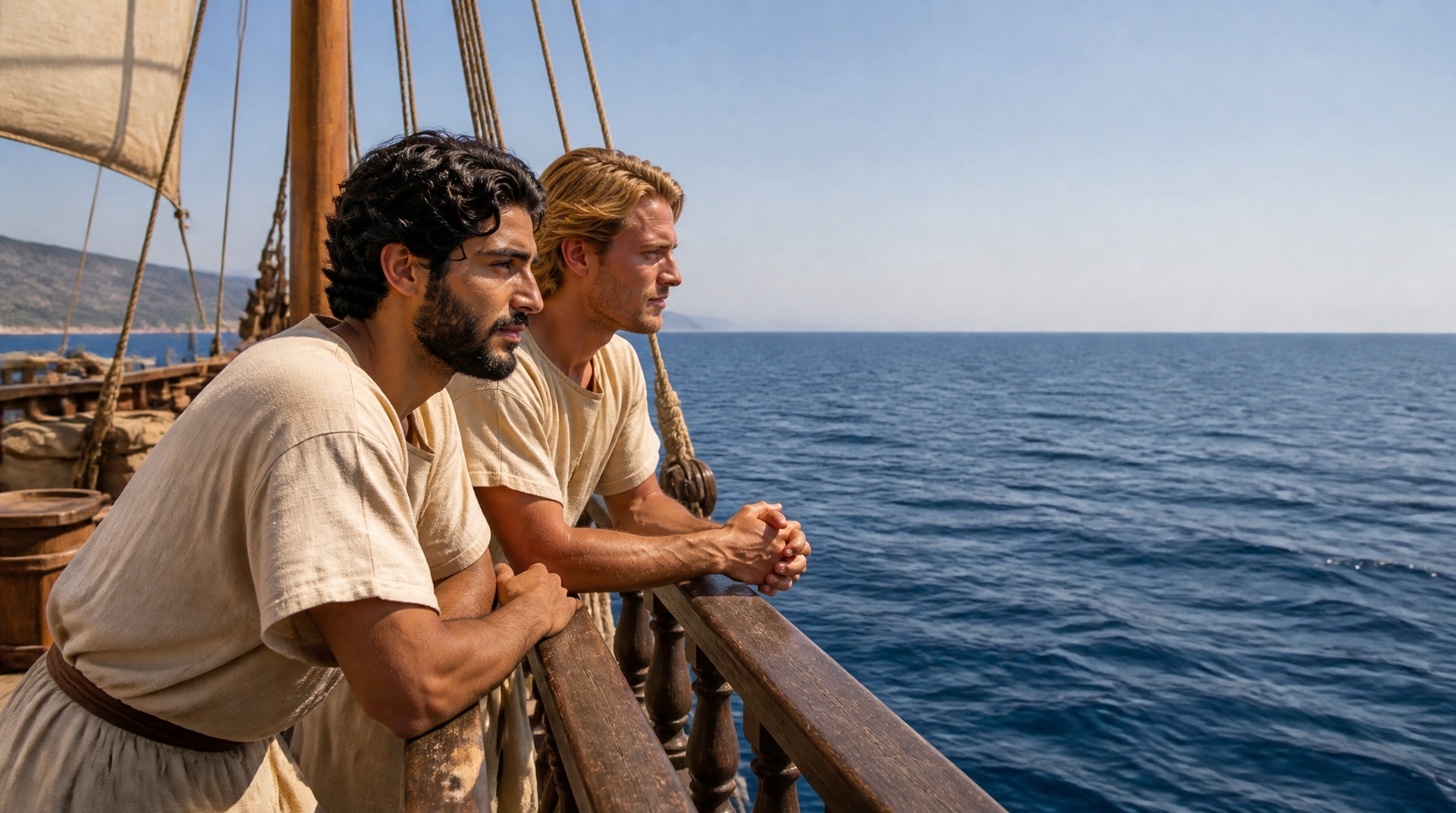
It was Demetrios who had arranged the slower passage, understanding before Lucian did that haste
served no one. They would stand together at the railing in the late afternoon, watching the coast
slip past, speaking of the cities ahead and the performance at the last one, of which merchants
they'd met and which ones might prove useful for future travels. Demetrios had a mind for such
calculations. He kept names and relationships in his head the way other men kept account books.
As on every previous ship, the voyage was not comfortable. The quarters belowdecks were close and foul, the food monotonous,
the water dubious. But Lucian found himself not minding as much as he might have expected. There
was a rhythm to it: the hours at sea where nothing was demanded of him, then the arrival at a
port, the scramble to arrange a venue, the performance itself. The money from his performances
covered their expenses and left a small surplus that Demetrios managed with an accountant's
precision.
"You've improved," Demetrios said one afternoon, as they watched a fishing village recede behind
them. "Even since we left Rome. Your delivery is more natural now; less like recitation, more like
conversation."
It was the kind of observation Demetrios often made, without hesitation and without flattery. He did not
offer praise lightly; so, when he did, the words carried weight.
"Well, you've been nothing short of amazing," Lucian replied. "The contacts you've made. The venues. You move
through these ports like you own them. I would never have been able to do what I do
without you, and I had no idea that would be the case."
Demetrios smiled. "I understand how cities work. How power flows. How favors
become opportunities." He paused, watching a bird dive toward the water. "The same way you
understand how how to guide the minds of your audiences."
And it was during these long days at sea, between the performances and the conversations at the
railing, that Lucian began, almost by accident, the education of Tanno.
The Alphabet at Sea
Tanno had insisted, from the moment they boarded, on carrying Lucian's and Demetrios' luggage. Not
because Lucian had asked. But because Tanno understood, in the way that enslaved men understand
such things, that he was valuable only insofar as he was useful. Lucian did not want to own a
slave. This much was obvious. But Lucian had bought a slave, which meant Lucian was now
responsible for him. And responsibility, Tanno had learned, was safer than indifference.
For Lucian's part, he was at a loss as to what to do with his new possession. He was accustomed to
doing things for himself; and he had no experience with slaves, no idea how to manage one, no idea
what to ask of him.
It was Demetrios who suggested literacy. They were on the fourth day at sea, the coast of Italy
still visible on the horizon, when Demetrios approached Lucian in the bow where he was watching the
water.
"He could help with cargo manifests," Demetrios said, nodding toward Tanno, who was below decks
arranging supplies. "If he could read. Most merchant captains mark their goods. It would make him
more valuable. And give him something to do. Plus, most rhetoricians seem to have at least one
secretary."
It was practical. Demetrios was not being kind; he was being practical. But it made Lucian admire
him all the more. Demetrios saw people as they were—as systems of utility and need—and worked
from there.
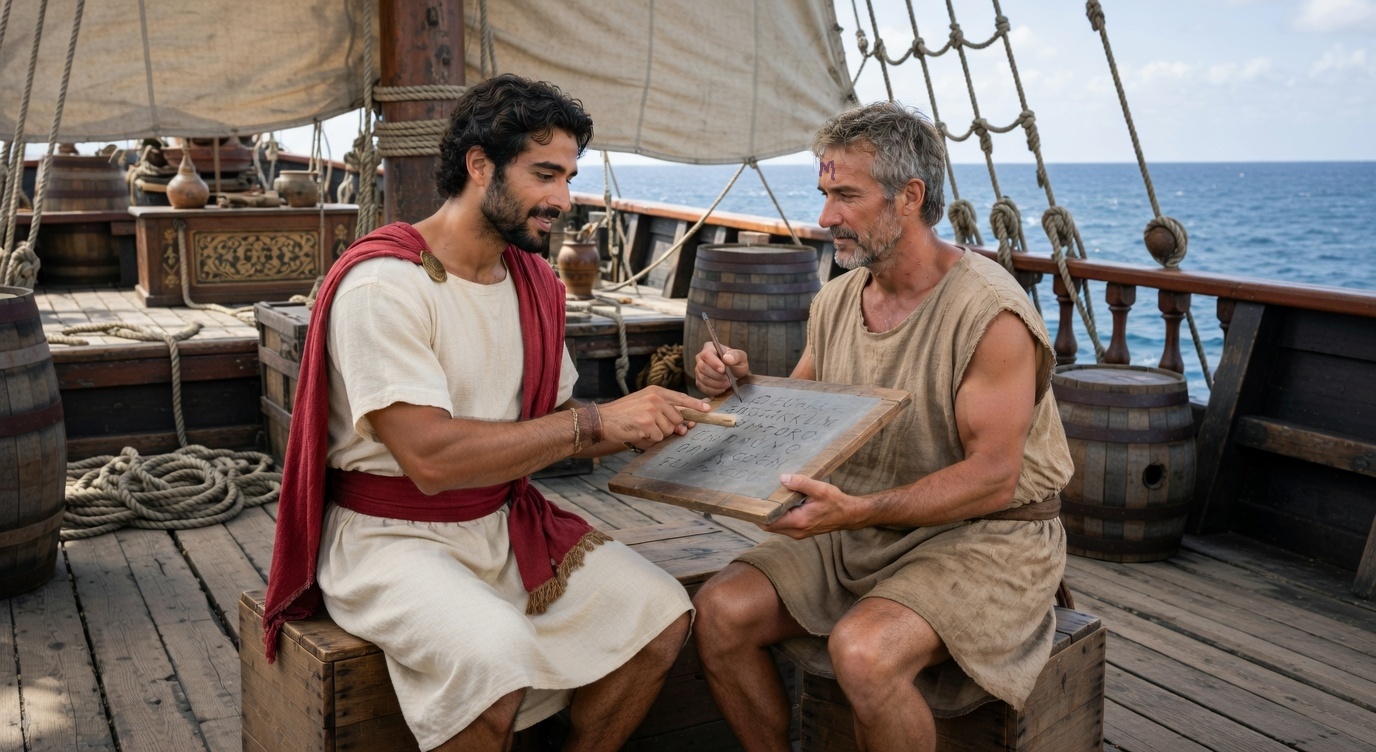
That afternoon, Lucian called Tanno to the deck where he had arranged writing materials.
"I'm going to teach you to read," Lucian said. "A man who can read is worth more. You'll be able to
help me. You'll be more useful to me. Do you want to learn?"
Tanno's expression did not change. "Yes," he said, muttering under his breath, "So, more
work." But Lucian knew by now that Tanno's complaints were more a habit than a reflection of his
feelings.
So they began. Lucian had learned his letters in Samosata from a thin Bithynian master who beat his
pupils. But that was how you taught children, not adults. Slave or not, he intended not to beat
Tanno. Instead, he drew the letters in wax on a tablet, speaking each sound, having Tanno repeat
it. Alpha. Beta. Gamma. The sounds were foreign to Tanno's Gaulish mouth, but his hands were steady
when he took the stylus and began to copy them.
For a man who had spent twenty-two years being told he was worthless, there was something profound
in holding a stylus. In making marks that meant something. In Lucian's patient voice saying: "No,
not quite. Try again. That's better."
By the time Corsica appeared on the horizon, Tanno could recognize most of the letters and write
his own name—or rather, the name that Rome had given him. Marcus. Three times he wrote it, slowly,
carefully, and each time Lucian nodded.
"Good!" Lucian enthused. "You're a quick learner!"
And for the first time in more than two decades, someone had told Tanno he was doing something
right.

The Warning
The captain was a weathered man named Achilles, which seemed to Lucian like a name given by a
hopeful mother to a boy with no future. Achilles had been sailing the Mediterranean for forty years
and had learned, in that time, to read the water, the sky, and the temperaments of his passengers.
When Lucian asked, at dinner on the evening they sighted Corsica, what there was to see on the
island, Achilles set down his wine cup and laughed "You want to visit Corsica? Well, there's
Aleria," he said. "Nearby. Good port. Roman garrison, Roman bathhouse, a market. You'll find an
audience there if you're looking to perform." He paused. "But I wouldn't go inland. The marshes are
bad this time of year."
"Bad, how?" Lucian asked.
"Bad air," Achilles said. "Rises off the swamps at dawn. Thick, poisonous air. Men who breathe it
get fevers. Sometimes they die. The Romans have a name for it: paludism, from paludis, the
swamp. Stay in the town. Stay on the coast. Stay away from the interior, especially after dark."
He took a drink of wine. "We'll anchor for the night. The tide comes in at dawn, and I want to
leave with it. One night. See your audience, spend your money, and we move on to Massilia. That's
more than enough time in Corsica!"
Lucian nodded. It was sensible. A night in port, a performance, and they would be gone.
He did not notice Tanno, sitting at the slaves' table, had gone very pale.
Recognition
They anchored in the harbor at Aleria as the sun was setting, painting the water gold and crimson.
The city rose from the coast in terraces of Roman stone. There was a theater visible from the
harbor, and Demetrios was already calculating how much time he would need to arrange a venue.
Tanno said he would stay with the ship.
"You should come," Lucian said. It was almost a question. He was learning that Tanno, left to
himself, would choose isolation.
"I'll watch the cargo," Tanno said, in a shaking voice. And then he all but ran to the hold.
Demetrios and Lucian exchanged a glance. It was Demetrios who nodded. "Let him stay," he said
quietly. "Some people need time with their thoughts."
So Lucian and Demetrios went ashore. The captain had been right about the bathhouse, and about the
market, and about the audience. But what Lucian noticed most was the smell. Under the Roman
cleanliness, the paved streets, the order of the port, there was something else. A dampness. A
faint sweetness that was not quite rotten but close. It was, he thought, what bad air smelled like
when it was still regular air and had not yet risen to poison anyone.
They arranged a venue in the theater for the evening. Demetrios went to find lodging. And Lucian,
as the light was failing, returned to the ship to tell Tanno that everything was arranged.
He found him in the hold.
Tanno was standing motionless in the shadows, one hand pressed flat against the wooden hull. When
Lucian spoke his name, Tanno did not turn. Did not move. His body was rigid, locked in place as if
he had turned to stone.
"Tanno," Lucian said again, moving closer. "Are you all right? What's wrong?"
Tanno's eyes were wide and unseeing. His jaw was clenched so tightly that the muscles stood out
like cords along his neck. He was breathing, but only barely—shallow, ragged gasps that came as if
his body had forgotten how to do it properly.
Lucian reached out to touch his shoulder, and under his hand he felt Tanno trembling. Not shaking
with small movements, but trembling as if a great force was pushing against him from the inside,
pressing to break through his skin.
"I was here," Tanno whispered, and the words came out strangled, barely audible. "I was
here. Before Rome. Before—" His voice broke. He could not finish.
Lucian felt something shift in his understanding. He had known Tanno had worked in the mines. But
he had thought of it as an abstract fact, a thing that had happened to someone else, in some other
life.
But now Tanno was here, in the place that had broken him. And twenty years of determined forgetting
had collapsed in a single moment.
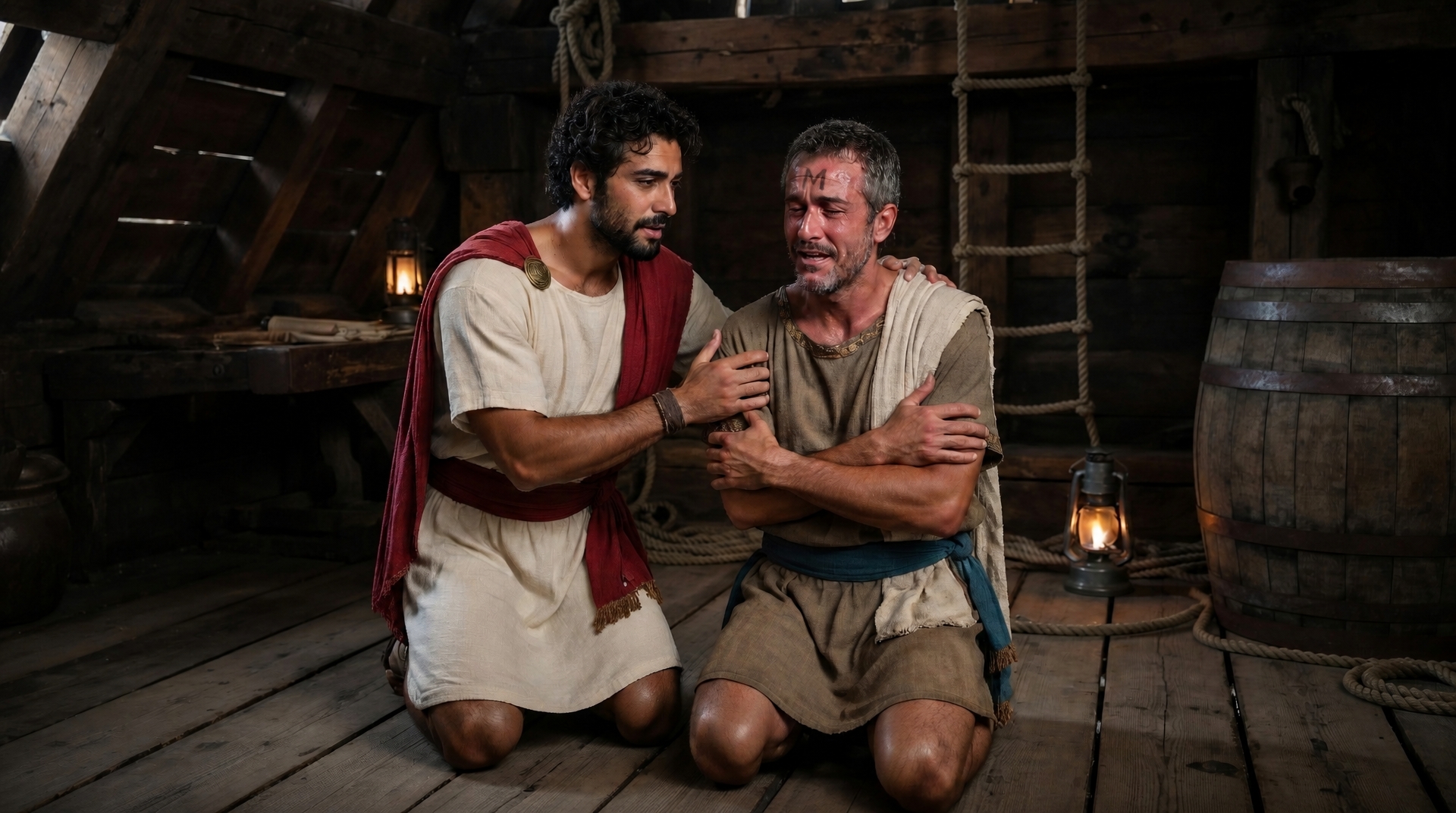
When the sob came, it was not a quiet thing. It tore from deep within Tanno's chest as if something
inside him was breaking apart. His body convulsed, and he dropped to his knees on the wooden floor
of the hold. The sound he made was raw, animal, a sound of such despair that Lucian could not look
away.
Tanno's entire body shook with the force of it. Tears streamed down his face, and his mouth opened
in soundless gasps between the sobs that came one after another, relentless, each one deeper and
more violent than the last. His hands clawed at the wooden planks as if he could dig through them,
could escape through the floor of the ship. Snot ran from his nose. His breath came in ragged,
choking heaves.
Lucian stood frozen. He had no idea what to do. He reached down again, trying to help Tanno up, but
Tanno shoved him away. Not in anger. In terror. In the blind, instinctive panic of a trapped
animal.
The sobs continued, unabated. Five minutes. Ten. Tanno was drowning in them, the grief and rage and
terror of twenty years finally breaking through the thin walls he had constructed to survive. There
was no comfort to offer. No words that would matter. Lucian simply sat down on the floor beside him
and stayed, bearing witness to the disaster of his recognition.
It took nearly half an hour before Tanno's sobs began to subside. Even then, his body continued to
heave, though the sounds grew quieter, more broken. His breathing was hoarse and ragged, each
inhalation a struggle. When he finally managed to speak, his voice was raw, stripped of all
control.
"I was here," he whispered. "This is where they left me after taking me from my home. Worked me in
the mines. For—for years. I thought—" His voice broke again. "I expected to die here. And now I'm
back, and still can."
Lucian sat in silence, listening. There was nothing else to do.
"You'll leave me," Tanno whispered finally, his eyes hollow. "You remember now. What I am. Where I
came from. You'll decide I'm not worth the trouble. You'll sell me to someone who will work me
until I break again."
"No," Lucian said, but even he could hear the uncertainty in his voice. Because he was young, and
he was uncertain about many things, and Tanno was reading that uncertainty the way a man reads the
weather.
Lucian sat down on the wooden floor of the hold, beside the man he owned and could not figure out
how to help. He thought of Philostratos, of the Stoic teachings about acceptance and judgment and
virtue. He thought of Epictetus explaining that external things did not matter, that virtue was the
only true good, that a man's spirit could remain free even when his body was enslaved.
He opened his mouth to say something about acceptance, about reframing the past, about the power of
judgment over circumstance.
And then he closed his mouth again.
Because philosophy, he realized, was cold comfort to a man who was quivering in the dark, afraid
that the person he had learned to trust would disappear.
"Listen to me," Lucian said fiercely. "I am making a vow. I will never sell you. Not
in Corsica, not in Massilia, not anywhere. And I will never free you without your permission. Your
choice. Your decision. Not mine. Do you understand?"
"Why would you promise that?" Tanno asked. "You don't owe me anything."
"Maybe not," Lucian said. "But I'm promising it anyway."
Tanno looked at him for a long time. And slowly, his breathing began to steady.
"As you wish," he said finally.
Lucian stood. "Come with me," he said. "To the performance. Stay close to me or Demetrios. We
aren't going anywhere near the mines. You can be with us at the theater. I don't think you should
be alone tonight."
Tanno rose, his movements still careful, as if the world might break beneath him. "As you wish," he
said again.
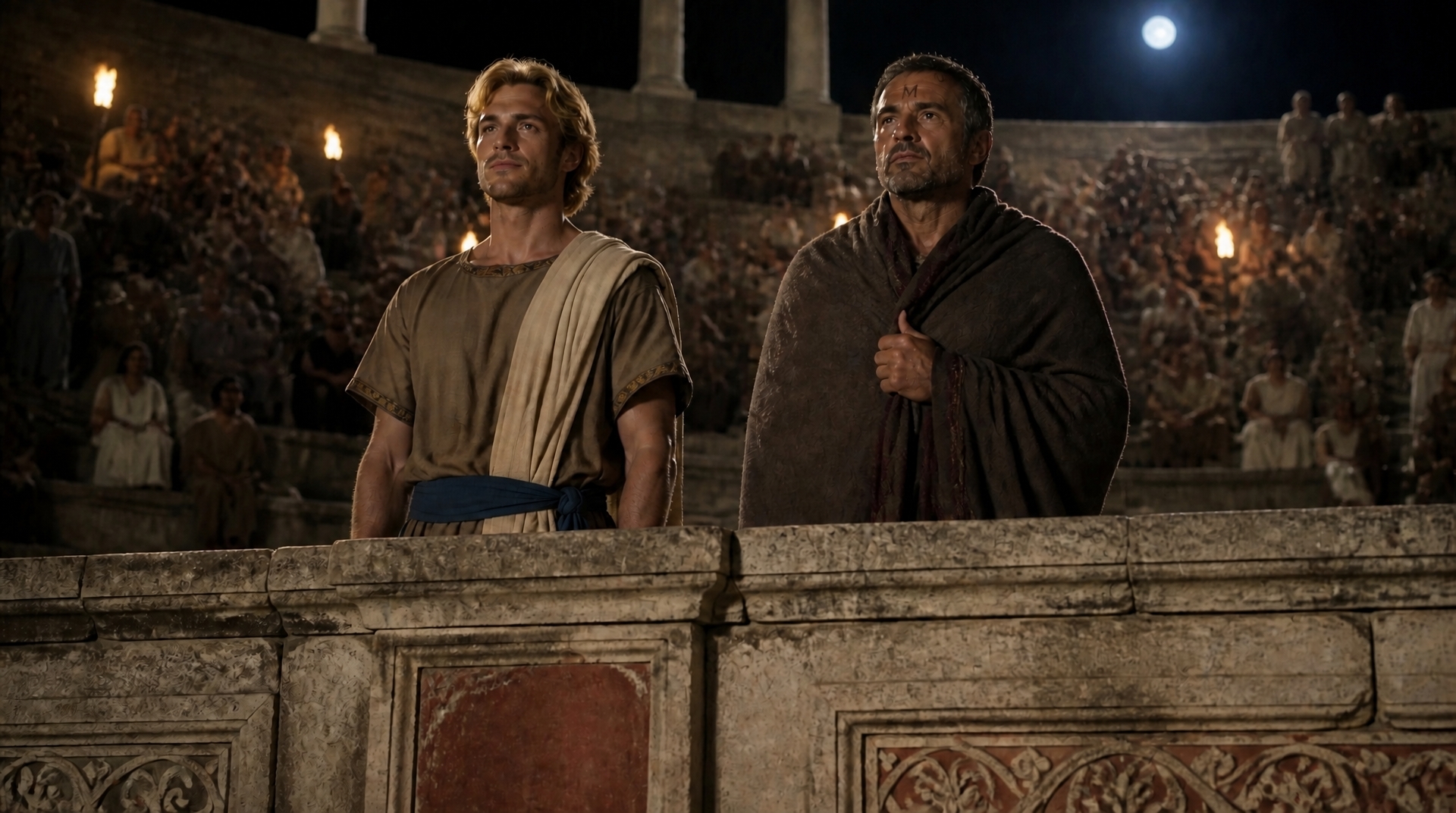
The Theater
The theater in Aleria was smaller than the ones in the major cities, but it was well-maintained.
Demetrios had arranged for Lucian to perform an extemporaneous declamation on a subject suggested
by the audience. It was a format Lucian had perfected in a hundred cities: he would stand on stage,
wait for a call-out, take a few minutes to gather his thoughts, and then speak as if he were
channeling the gods themselves.
The audience was a mixture: soldiers from the garrison, merchants from the port, a few local
administrators. Not the educated elite of Athens or Rome, but people who appreciated skill, who
knew the value of words, who understood that a good speaker could move the mind and the heart.
Tanno stood at the back of the theater with a garrison officer's cloak draped over his shoulders—a
courtesy from Demetrios, who had noted that a well-dressed man attracted less suspicion than a
frightened slave. He did not watch Lucian perform. He watched the audience, measuring them,
calculating. After twenty years of slavery, Tanno had learned to read people the way a sailor reads
the sea.
Lucian performed a declamation on the nature of exile—how a man could be exiled from his country
but never truly exiled from his own mind, how memory can be both prison and palace, how the places
that broke us are sometimes the only places that make us whole.
It was not the performance he had planned. It was not, perhaps, the performance the audience came
to hear. But when he finished, the applause that greeted him was that of men who had been moved.
And when Tanno glanced at him from the back of the theater, there was something in his face that
was not quite calm, but was something close to it. The look of a man who had survived a day he
thought would break him, and found, to his surprise, that he was still standing.
They slept on the ship and left with the dawn, as Achilles had promised. The ship caught the tide
and began its slow drift northwestward toward Massilia.
Tanno returned to the hold without being asked, but this time not to hide. He began to assist in
organizing the cargo, moving boxes and amphoras with purpose. And when the morning light caught the
wax tablet where he had written his name, he picked it up and looked at it for a long time.
Lucian, passing by on deck, glanced down into the hold and saw Tanno motionless, tablet in hand,
studying the letters of his Roman name as if they were a puzzle he might eventually solve. There
was no despair in his face. There was something closer to resolve.
Lucian understood, watching him, that Tanno was calculating. Learning to read was not submission to
his slavery. It was the first step toward becoming something more. Toward a day when he might
choose his own name, his own destiny—if such a thing was possible for a man without freedom.
In the distance, the coast of Corsica slipped away. And with it, the last echo of the place where
Tanno had been broken.