|
By: Paul S. Cilwa |
Posted: 5/8/2026 |
|
Page Views: 39 |
| Hashtags: #HistoricalFiction #LucianOfSamosata #Rome #Slavery #Bureaucracy #Freedom |
| Lucian attempts to buy a slave's freedom and discovers that bureaucracy is more complicated than generosity. |
| Estimated reading time: 12 minute(s) (2631 words) |

And it occurred to him, with the kind of crystalline clarity that only comes in the early morning,
that they were leaving Rome in a few weeks for Gaul. That Marcus, that is, Tanno, would stay behind, enslaved,
broken. That Lucian, who had just experienced what it meant to be
truly known by another person, could not bear to leave a man in chains.
The solution seemed obvious: he would buy Tanno. They would take him with them to Gaul. And
there, in a place where no one knew he had been enslaved, they would free him.
It seemed so simple!
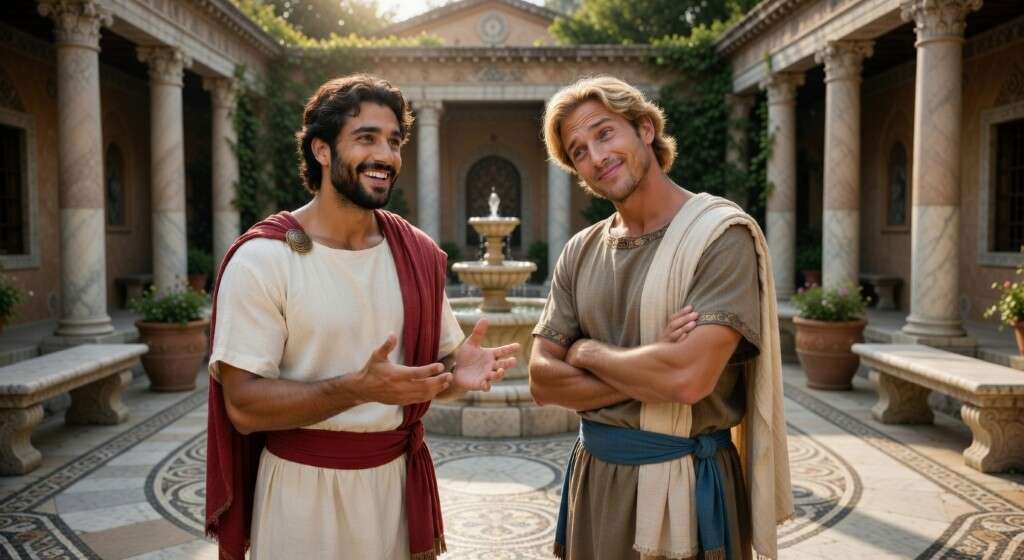
The Objection
After breakfast, Lucian found Demetrios in the courtyard, reviewing some notes about his next
performances. Lucian sat down beside him, took a breath, and explained the plan.
Demetrios set down his stylus and looked at him for a long moment without speaking.
"You want to buy one slave," he said finally, "out of the millions in this city. Out of the
tens of millions in the empire. And you want to free him."
"Yes," Lucian said. "Why not?"
"Because," Demetrios said, "it's absurd. Do you think Tanno's story is a worse tragedy than any
other slave's? Do you think he's special?"
"No," Lucian said. "But I know him. I've listened to him. And I can do something about his
situation. I can't do anything about the millions of others."
"So you're going to salve your conscience by freeing one man," Demetrios said, "while
stepping over thousands of others as you walk through the streets."
"Yes," Lucian said simply. "Because that's what I can do. That's what's in front of me. I
can't save the world, Demetrios. But if I can save one person, how can I not?"
Demetrios looked away. "You're going to waste your money," he said. "On a man who may not
even want this."
"Oh, please. Who wouldn't want to be free? But you can help me," Lucian said.
"You know Rome. You know how these things work. Help me figure
out what's possible."
And after a moment, Demetrios sighed. "I'll help you," he said. "But don't say I didn't warn
you. The first step will be to open a banking account at the Temple of Mercury. C'mon, boy,
we'll make a Roman of you, yet!"
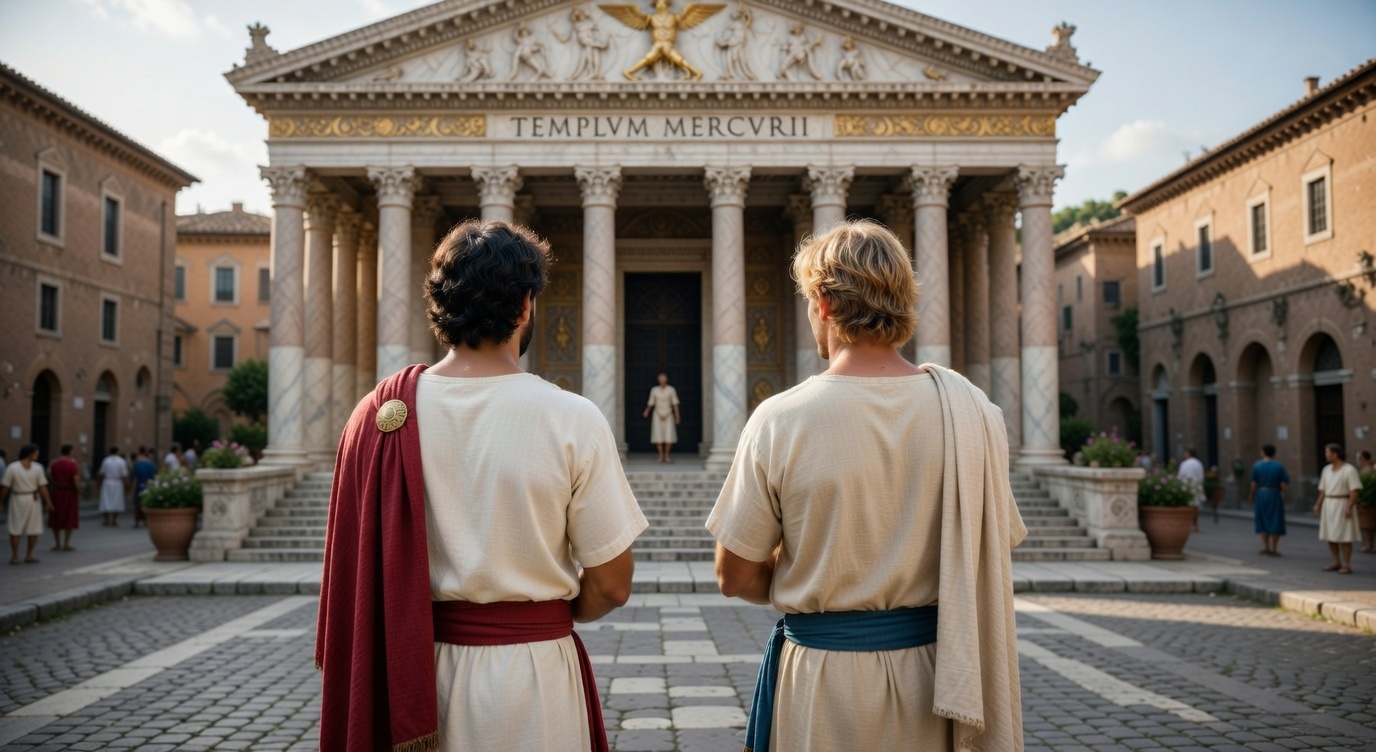
The Temple of Mercury
The Temple of Mercury stood in the Forum, a compact building with marble columns and the kind of
purposeful efficiency that suggested business rather than prayer. Inside, the air smelled of
incense and papyrus, and the sound of a stylus scratching on wax tablets echoed from the back
chamber.
The man who emerged to greet them was perhaps fifty, impeccably dressed in a himation so carefully
arranged it must have taken effort to achieve that particular fall of fabric. His hair was
precisely styled. Even his fingernails were clean. When he smiled, it was with the warmth of someone who
had learned that trustworthiness was his most valuable commodity.
"I am Marcus Aurelius Cordus," he said, "priest of Mercury and keeper of deposits. How may
the god of commerce assist you?"
Lucian explained that he had earnings from performances in Athens and Asia Minor, money he'd been
carrying or keeping in various deposits. He wanted to establish an account here in Rome, and he
wanted to understand how a traveling performer could safely maintain access to his funds across
multiple cities.
Cordus nodded with the satisfaction of a man being asked his favorite questions. "Come,"
he said, and led them deeper into the temple.
The back chamber was a marvel of organization. Wooden chests lined the walls, each one labeled with
a name. A ledger lay open on a desk, filled with Cordus's precise handwriting. And there, on a
small wooden stand, sat a lyre, which Cordus picked up on his way to his chair and literally plucked
as he spoke.
Cordus gestured for them to sit, then began explaining the system. For a modest fee, Lucian could
deposit his funds here at the Temple of Mercury. Cordus would maintain a detailed record. And most
importantly, Cordus could provide letters of credit—written authorizations that would allow Lucian
to withdraw funds from banking contacts in other cities.
"Naturally," Cordus said, adjusting a fold in his himation, "the system only works if one
maintains relationships with reputable bankers in the destinations one intends to
visit. If you are traveling to Gaul, I have
associates in Lugdunum, in Massilia, in Narbonne. In all the major cities of the empire, in fact."
He picked up his lyre and played a brief, minor-key phrase. "In twenty-three years," he
continued, "I have never lost a client's deposit. Not a single denarius. The god of commerce is
exacting, but he rewards precision."
As Cordus spoke, Lucian noticed something interesting. Cordus kept directing his words to Lucian,
maintaining eye contact, explaining the system with meticulous care. But his gaze kept drifting to
Demetrios. Not obviously—Cordus was too refined for that—but persistently. The way a man looks at
something beautiful he's trying not to look at.
Demetrios, for his part, sat with his arms crossed, radiating the kind of cold indifference that
Lucian recognized as active hostility. But he wasn't sure why.
"The letters of credit," Cordus continued, plucking another note on the lyre, "can be
written to specify exactly how much you can withdraw, and from whom. This protects both you and the
banker. No one can forge a letter too dramatically without being noticed."
Lucian asked practical questions: How long did deposits take? What happened if a city's banker
didn't know Cordus? What fees were involved?
Cordus answered everything with patient precision. And when Lucian agreed to deposit his earnings
and to arrange letters of credit for Gaul and Spain, Cordus began the process with the care of a
man handling sacred objects.
As they were leaving, Cordus turned to Lucian while somehow smiling at Demetrios.
"Your companion," he said delicately, "is he
joining you on your travels, or remaining in Rome?"
"He's traveling with me," Lucian said.
"Ah," Cordus said, with a trace of disappointment. "How fortunate for you. Safe travels."
They left the temple. Demetrios was silent until they reached the street.
"That man was insufferable," he said.
"That insufferable man just made it possible for me to travel the entire empire with access to my
money," Lucian pointed out.
"I know," Demetrios said. "Which is one reason why I didn't punch him."
"Seriously? You can't punch a priest in his own temple!"
Demetrios grinned. "That's the other reason."
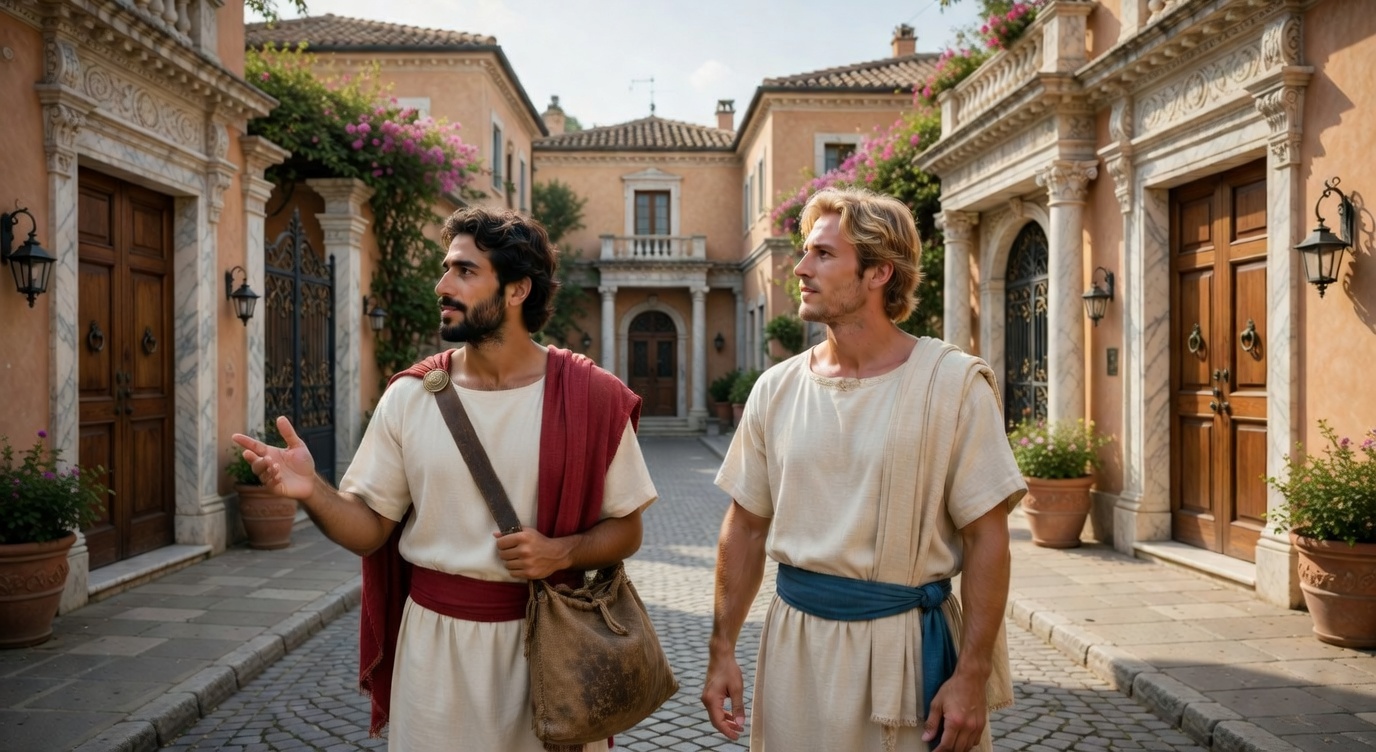
The Landlord
They left Mercury's temple with Lucian carrying a three-pound moneybag filled with 250 silver denarii.
He felt the weight of it as a physical reminder of the commitment he'd made.
"Too bad no one has ever invented lighter money!" he joked.
There were, in fact, letters of credit that Lucian could have gotten from the Temple of Mercury
(and indeed, did). But the owner of their property, unless he was also a moneychanger (unlikely),
would probably want to be paid in cash. Thus, the heavy moneybag.
Finding the property owner proved more complicated than Lucian anticipated. The house had been rented
through an agent, who gave them a direction to another agent, who finally provided them with a
name: Quintus Fabius Torquatus, a wealthy merchant who owned several rental properties across Rome.
His home was in one of the better neighborhoods, a substantial house with a small garden visible
through the open courtyard. A slave answered their knock and, when Demetrios gave his name as a
current renter, led them to a study where Torquatus was reviewing accounts.
Torquatus was a man in his sixties, with the smooth face of someone who had spent his life in
commerce. He greeted them and looked at Lucian with the mild curiosity of someone wondering why a young Syrian
performer would be calling on him at midday.
"I want to buy one of the house slaves," Lucian said without preamble. "Tanno.
I mean, Marcus. The one with the bad back."
Torquatus blinked. "You want to buy him?" he repeated blankly. "Not rent? Purchase him?
Permanently?"
"Yes," Lucian said.
Torquatus seemed to be at a loss for words. "Why?" he asked unbelievingly.
Lucian hesitated. The truth—that he wanted to free the man—would probably only make the negotiation harder.
"I've come to value his work," he said. "I'd like to take him with me when I travel."
Torquatus leaned back in his chair. "Those slaves came with the house rental," he said.
"They're part of the arrangement. If you take one away, it affects the other renters'
experience."
"You can replace him," Demetrios said. "We'll pay market rate."
"Market rate for a man with a bad back?" Torquatus smiled slightly. "That man is damaged
goods. He was useful in the mines for maybe another year before the injury made him worthless. I
bought him from the merchant who put him in domestic service because he's still capable of that,
but he's not getting any younger. I'm actually relieved someone wants to take him off my
hands. Surprised, but relieved."
"So you'll sell," Lucian said.
"I'll sell," Torquatus agreed. "For two hundred denarii."
Demetrios made a small noise in his throat. "For a damaged slave?" he said. "That's highway
robbery!"
"That's the price of inconvenience," Torquatus said mildly. "You want to deprive me of a
functioning house slave during a lease. I will need to replace him. The cost of finding and training a
replacement is going to be substantial. So, two hundred denarii."
Lucian had exactly two hundred and fifty denarii in his moneybag, which he set on the table.
Torquatus did not immediately open it. "I'll be right back, as soon as I get the paperwork," he said.
He rose and left the study, returning minutes later with
another man who Torquatus introduced as a notary. He was carrying a legal-looking parchment document.
"Here is the titulus for Marcus, whom I have owned these past five years. I warrant
that he is sound in body insofar as his previous injury in the mines permits. This defect I have disclosed.
He is honest and reliable in domestic service. I have no other defects to disclose."
It was, Lucian realized, the required legal disclosure. Roman law demanded that a seller acknowledge any
flaws in the merchandise. The bad back had been disclosed. Everything else was implied to be adequate.
Then Torquatus opened the money bag.
He poured the denarii onto the table in a small pile. The notary leaned forward to observe. Torquatus
began counting—one pile of ten, another, another—while the notary watched carefully.
As Torquatus counted, he examined each coin. He held some up to the light, checking the weight and thickness.
He scraped one gently with his fingernail, watching for the silver sheen that would indicate it wasn't
clipped. He was checking for counterfeit denarii, for coins that had been shaved down to half their value
while retaining their appearance.
"Counterfeit," he said once, setting aside a single coin. "You'll want to replace this one before
it causes problems."
"Of course," Lucian said, and did.
When Torquatus finished counting, he looked at the notary. "Two hundred denarii, in good coin,"
the man confirmed.
Torquatus nodded. "This slave is now yours," Torquatus said formally. "In the presence of witnesses, I transfer
ownership. He is your responsibility. His debts are your debts. His crimes are your liability."
Then Torquatus retrieved a tablet from a chest and wrote quickly on it, his stylus scratching across the wax.
"A record of the sale," he explained. "It's not required by law, but good practice.
Both of us sign it."
Lucian signed the tablet, making his mark. Torquatus signed. The notary signed.
It was done. Lucian now owned a human being.
But then it turned out there was another hoop to jump through.
Lucian had not anticipated needing to formally free Tanno. Buying him, yes. But freeing him? That
turned out to require a ceremony, a magistrate, and official documentation that proved the
manumission had been properly performed.
The magistrate who handled such matters was a busy man, and his schedule was booked for weeks.
"But I need to leave Rome soon," Lucian explained to the magistrate's assistant. "I'll need to
complete the manumission before I go."
"Then you should have started this earlier," the assistant said, matter-of-factly.
Demetrios looked at Lucian with the expression of someone whose every
pessimistic prediction was coming true. He shook his head, but then winked, and handed
the assistant the counterfeit denarius, who accepted it, hid it away, and said, "Oh, my!
look at this, there's been a cancellation! Three days from now! You're very fortunate!"
Lucian couldn't wait to tell Tanno.
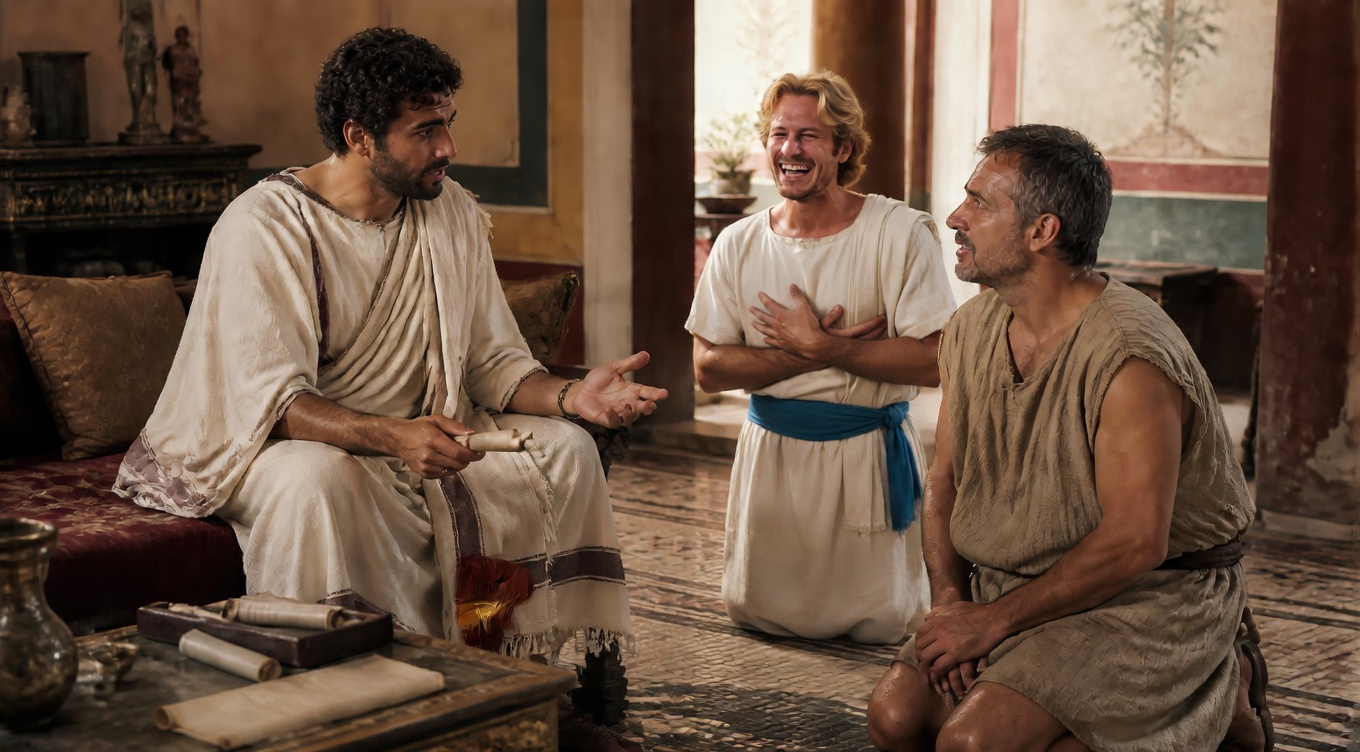
The Revelation
That evening, Lucian called Tanno into the study.
"I have some wonderful news for you," Lucian said.
Tanno turned, a slight wariness crossing his face. "Oh, no," he muttered.
"I've bought your freedom," Lucian said, grinning. "I purchased you from Torquatus.
The next step is to have the manumission ceremony with the magistrate, and then you'll be legally free."
He held out the certificate, expecting to see something shift in Tanno's expression. Joy,
perhaps. Relief. Gratitude.
Instead, Tanno simply looked at the paper, then back at Lucian.
"You bought me," he said flatly. "And now you want to free me. Without asking."
"I…wanted to surprise you," Lucian said. He ignored Demetrios, who was practically doubled
up in laughter.
"Well, you succeeded," Tanno said. He set down the cloth he'd been holding. "But what makes you think
I want to be freed?"
"Huh?"
"I don't want to be free," Tanno repeated. His voice was calm, matter-of-fact, the
way one might say "I don't like figs." "You bought me. I'll do as you order, of course.
And I can't stop you from freeing me. But if you do, it'll be because it's what you want, not
because it's what I want."
"Why not?" Lucian asked.
"Because I'm forty years old, and the person I was before is dead," Tanno said. "I don't
have family in Gaul anymore; they're either dead or have moved on. I don't have money.
I don't have the health or skills except housekeeping. And if I'm
free without resources, I'm just a poor man in a province where nobody knows me, trying to prove
I'm not enslaved. Plus. my forehead has this tattoo.
How long before someone decides I'm lying and just sells me again?"
"I'll help you," Lucian said. "We can—"
"You've already spent your money on me," Tanno said. "I appreciate it. I do. But freedom
without a way to live it is just a different kind of cage."
He picked up the cloth again. "I work for you now, because you bought me. That's
clear. You're leaving for Gaul in a few weeks. I'll go with you as you wish.
But please don't plan on turning me loose in what is now, to me, a foreign country."
"You're refusing freedom?!" Lucian said, unable to understand.
"I'm refusing to starve in a place where nobody knows me," Tanno said. "The idea was
kind, it was. It's just…impractical."
And he turned back to his work, leaving Lucian owning, and now responsible for, a slave he didn't want.