|
By: Paul S. Cilwa |
Posted: 5/7/2026 |
|
Page Views: 19 |
| Hashtags: #HistoricalFiction #LucianOfSamosata #Rome #Rhetoric #Slavery #CulturalUnderstanding |
| Lucian faces criticism in Rome, learns from an enslaved man's wisdom, and discovers the power of embracing difference. |
| Estimated reading time: 11 minute(s) (2563 words) |
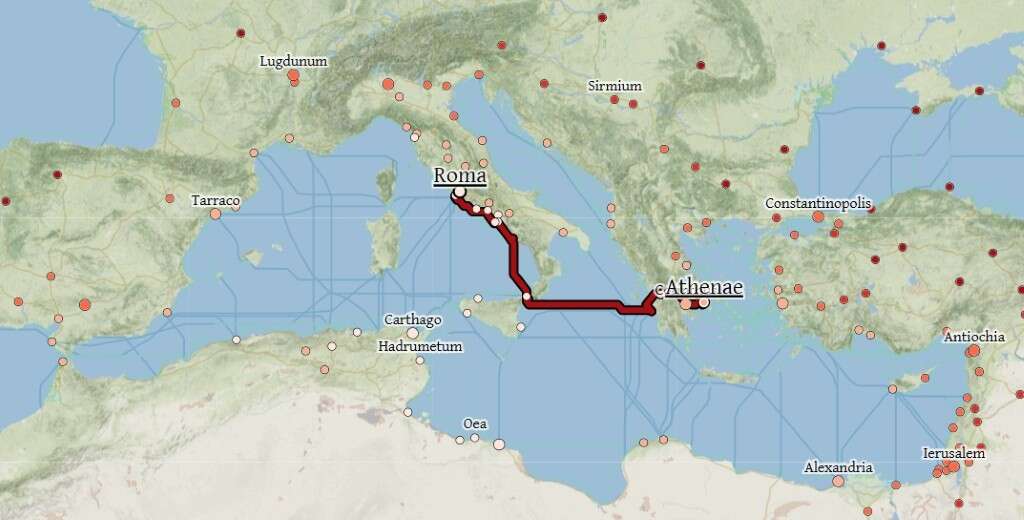
The sea voyage from Athens to Rome took twelve uneventful days, during which Lucian had time to
reflect on the journey and wonder what adventures awaited him in the Eternal City.
After so many years apart, it was strange having Demetrios traveling beside him again. He wondered
how much they had both changed. Lucian's own beard had grown in, and he had lost the boyish look
that had made him seem like a child prodigy.
He hoped Demetrios' eyes hadn't lost their openness, or the ability to see through the pretenses of
the world. Or of Lucian.
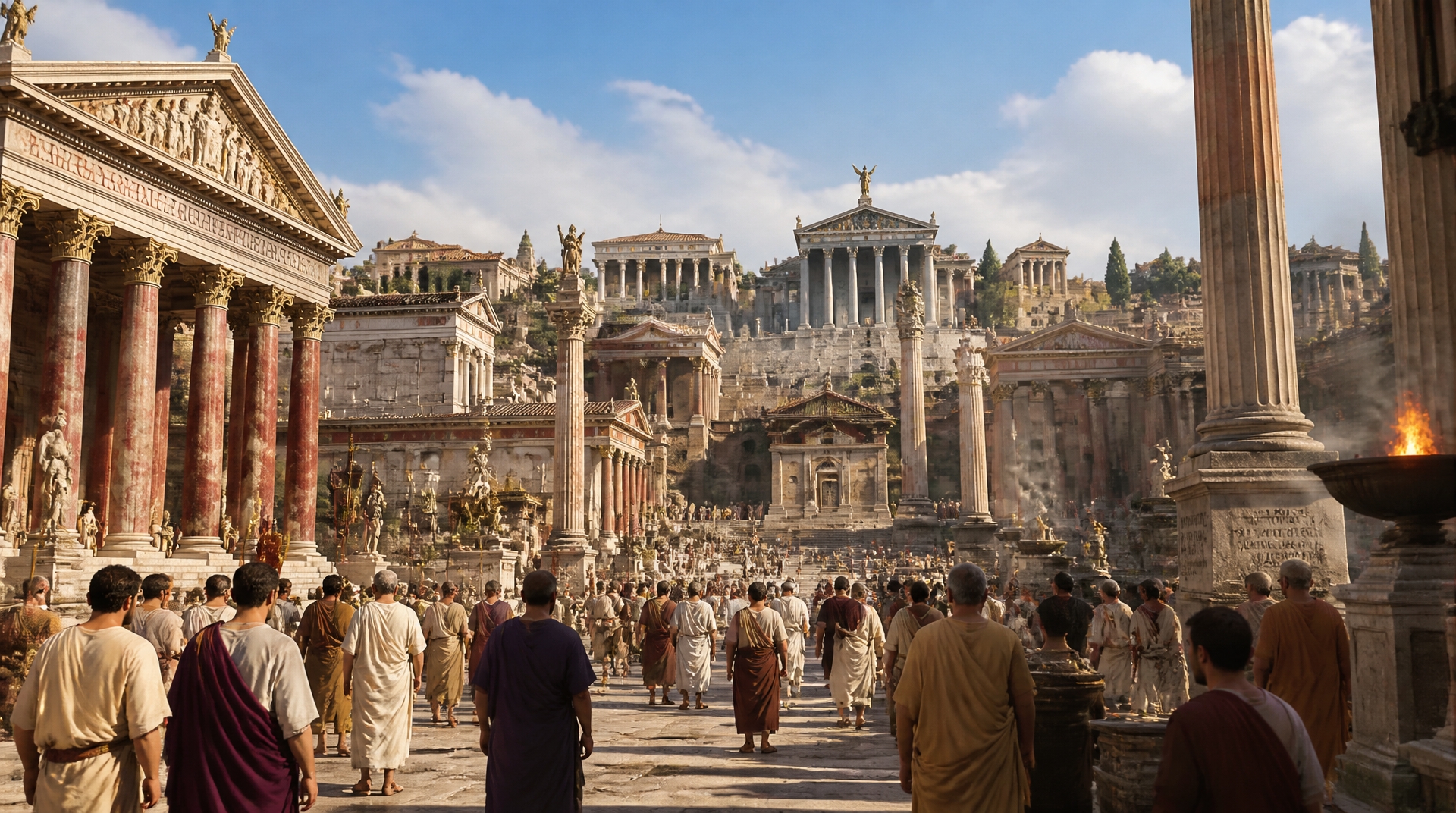
Lucian found it deeply unsettling. But he also found it impossible to ignore.
Accent On Accents
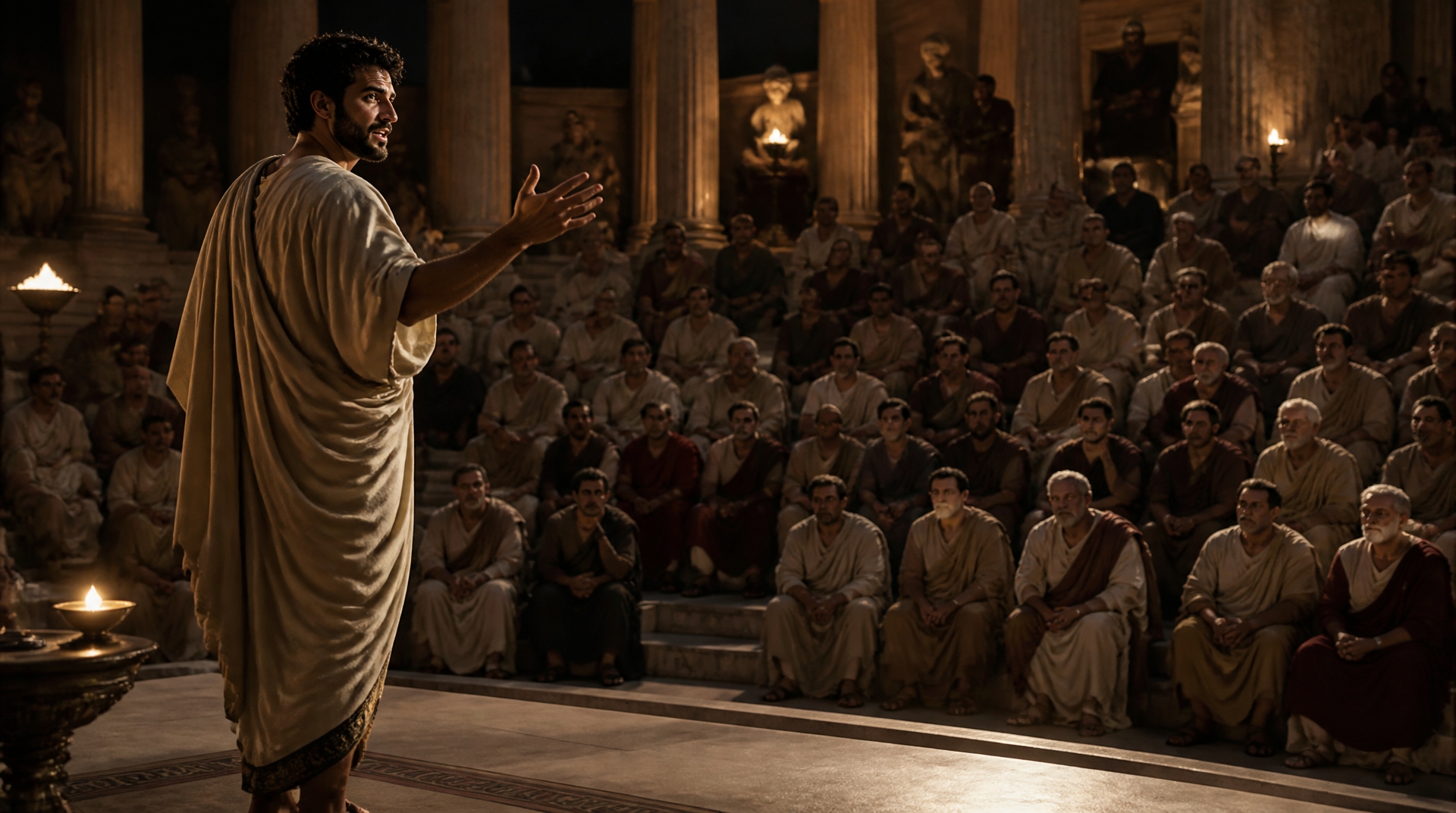
His first performance in Rome took place in a small theater attached to a private gymnasium.
Demetrios had arranged it carefully, just as he had in the Greek cities. The criers had announced
Lucian's coming. The stories had circulated about the famous Syrian rhetorician who had conquered
Asia Minor and Greece. The audience was curious, expectant, ready to be entertained.
Lucian gave them satire on the pretensions of Roman philosophers. He mocked their obsession with
order and law, their belief that the world could be systematized and controlled. He spoke in
correct Latin, with the grammatical precision of an educated man, but his accent was still
unmistakably foreign—touched with the cadences of his Syrian upbringing and his years in Greek
cities. It was the accent of a clever outsider, but it undermined everything he said.
The performance was, by any objective measure, quite good. Okay, not bad. The audience laughed in
the right places. But Lucian could see a few folks leaving early, which didn't usually happen in
the Greek cities. They applauded at the end. Several people approached him afterward with words of
praise.
But there was also criticism. One older Roman, a man of obvious education and status, approached
him with a kind smile and a devastating observation.
"You are very clever," the man said. "But you sound like a Greek girl who has been taught to read.
The rhythms of your speech, the way you shape your vowels—it is all wrong for Roman ears. You are
telling us about ourselves, but you are telling us from very far away."
It was not said unkindly. But it was accurate, and Lucian knew it immediately.
That night, he lay in his room and understood something that Philostratos had tried to teach him
years ago. The voice was not just the words. The voice was the entire package of sound, accent,
rhythm, the way breath shaped meaning. He had spent three years mastering Greek rhetoric in Greek
cities. But this was not a Greek city. And his mastery, suddenly, felt like a liability.
Immersion Learning
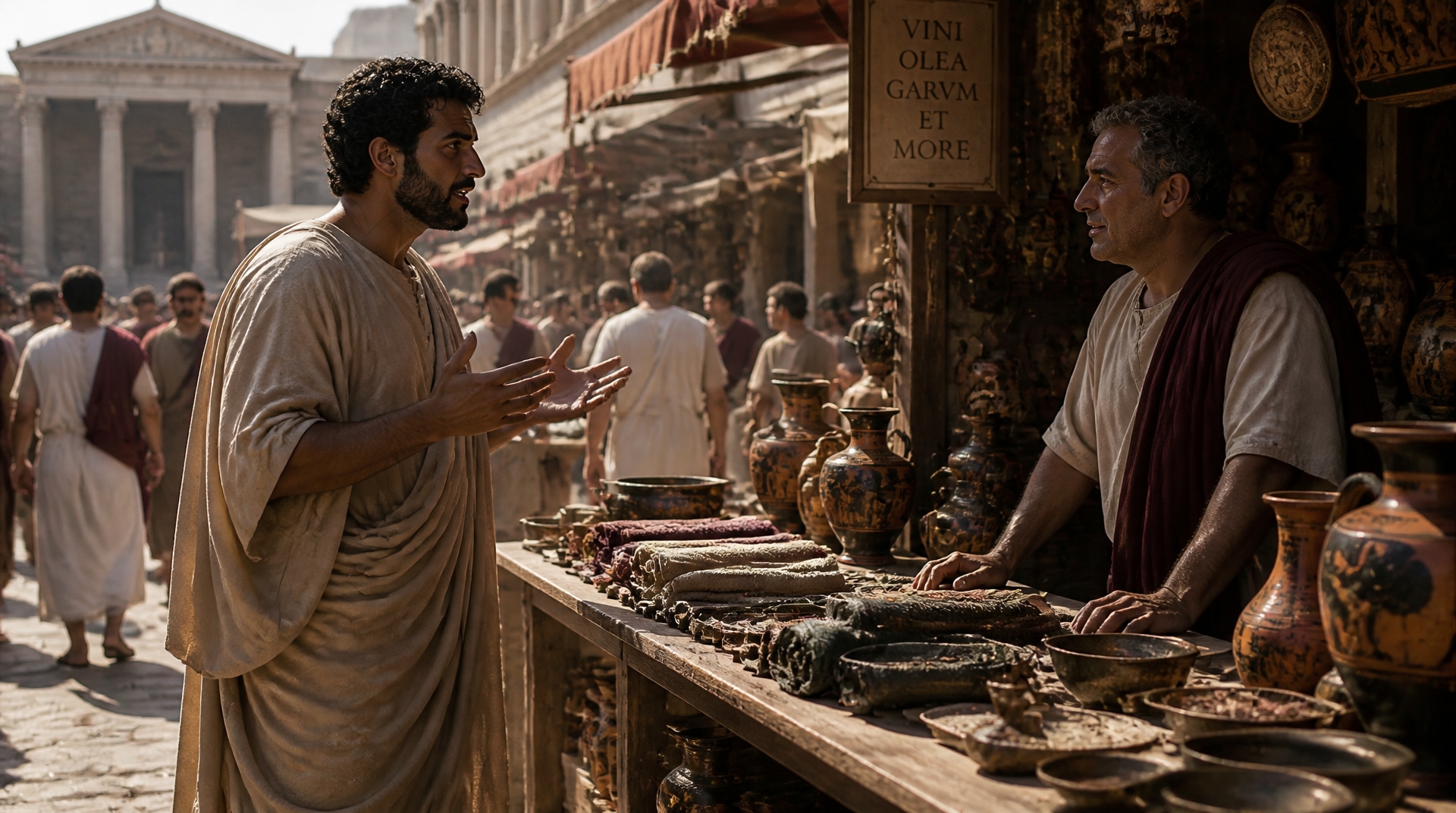
For the next three days, Lucian did something he had not done since his first days in Ephesus: he
listened. He went to the markets. He stood in the bathhouse and heard how Romans spoke to each
other. He found the barracks near the Forum and spent hours listening to soldiers, their Latin
rough and direct, full of slang and innuendo and abbreviations. He listened to shopkeepers
haggling, to slaves receiving instructions, to senators debating in the streets.
And he began to hear the patterns. Latin was a different language entirely from Greek, but
more than that, it was shaped by a different worldview. Greek was full of nuance and philosophy and
layers of meaning. Latin was stripped down, functional, direct. It was the language of a people who
wanted to command, not to convince.
But there was also music in it, if you listened carefully. There was a rhythm that was entirely its
own.
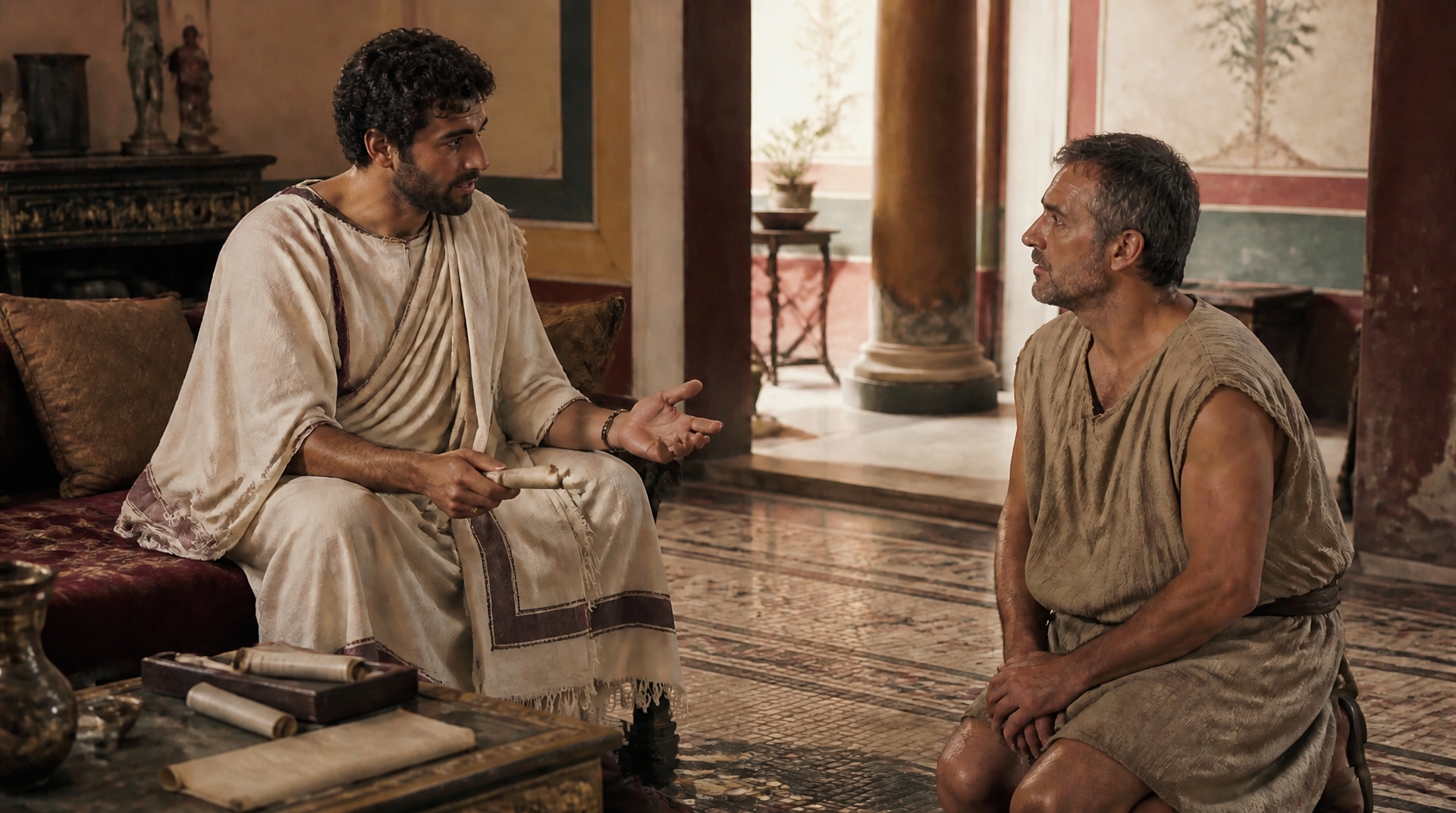
It was at home, on the third day of listening, that he found himself speaking with one of the house
slaves. The man's name was Marcus, and he was perhaps forty, with the careful posture of someone
who had learned long ago that his body was not entirely his own. On his forehead was the fading
brand of a slave, a letter 'M' that marked him as a slave bound for the mines. Lucian had been
asking questions about Latin pronunciation, about the way certain words were shaped, and Marcus had
been answering patiently, though, as he pointed out, he himself had an accent from his homeland in
Gaul.
"You listen well," Marcus said finally. "Most people like you don't bother to listen to people like
me."
"Why would I not want to listen?" Lucian asked. "You speak the language. You know it intimately."
Marcus smiled, but it was a tired smile. "You would be surprised how many educated men think that
knowledge only lives in other educated men. They think a slave is just a mouth that repeats
instructions."
Lucian was sitting on a bench, and he invited Marcus to sit as well. "'Marcus'
isn't a Gaulish name. What was your name before?" he asked suddenly. "Before you were Marcus?"
Marcus was quiet for a long moment. "Why would you want to know that?"
"Because," Lucian said, "I think, somewhere inside you, you still remember. I want to know what
brought you...here. But only if you're willing to share it. It's not a command."
Marcus looked away. And slowly, carefully, he began to talk.
The Slave's Tale
"My name was Tanno," Marcus said quietly, then sighed. "I hadn't said it aloud in so long, I almost
didn't remember how." He shrugged. "I had been born free, in a small town in Gaul, the son of a
smith. I learned my father's trade. I married, had children. And then the legions came during one
of the border wars, and my town was on the wrong side of the conflict. My family was scattered. I
was captured, sent to Rome, sold at market. When I arrived, my first owner said my name was too
foreign, too hard for Roman mouths. He called me Marcus instead. Everyone after that called me
Marcus. So, Tanno—I—died in Gaul."
"That was twenty-two years ago," Marcus said. "I have been Quintus Aemilius Varro's slave for the
last five. Before that, I belonged to a merchant, and before that to a man who worked me in the
mines until my back gave out. I was fortunate that he was able to sell me then. The mines kill most
men within a few years."
He did not tell the story with bitterness or self-pity. He told it the way a man tells a story
about the weather—as something that had happened, that was unchangeable, that one simply endured.
And that made it somehow more terrible.
"I have children," Marcus said. "Or I did. I don't know if they lived. My wife—she was sold to a
different owner. I haven't seen her since. That was a long time ago. You stop expecting to see
people after a while. You stop hoping. Hope hurts."
"Don't you want to escape?" Lucian asked. "To be free again?"
Marcus looked at him with an expression that was almost pitying. "To where? I am marked. Any free
man would know what I am. And there is no 'free again.' The person I was before is dead. He died in
Gaul, when the legions came. What's left is just this." He gestured to himself. "This body that
belongs to someone else. This mouth that speaks because it is told to speak. That's not freedom.
That's just being alive, and hoping it doesn't hurt too much."
But then Marcus paused, and something shifted in his expression. "But you—you listen like you
actually want to understand. That's rare. Most of your kind don't. They look but they don't see.
They listen but they don't hear. You're different."
Lucian found himself without words. What could he say? That he was sorry? That seemed obscene.
Marcus had not asked for sympathy. He had simply told his truth, and Lucian had listened.
"Thank you," Lucian said finally, "for trusting me with your story."
"Why not?" Marcus said, with a slight smile. "It's not like I can be hurt worse than I have already
been."
Winning The Crowd
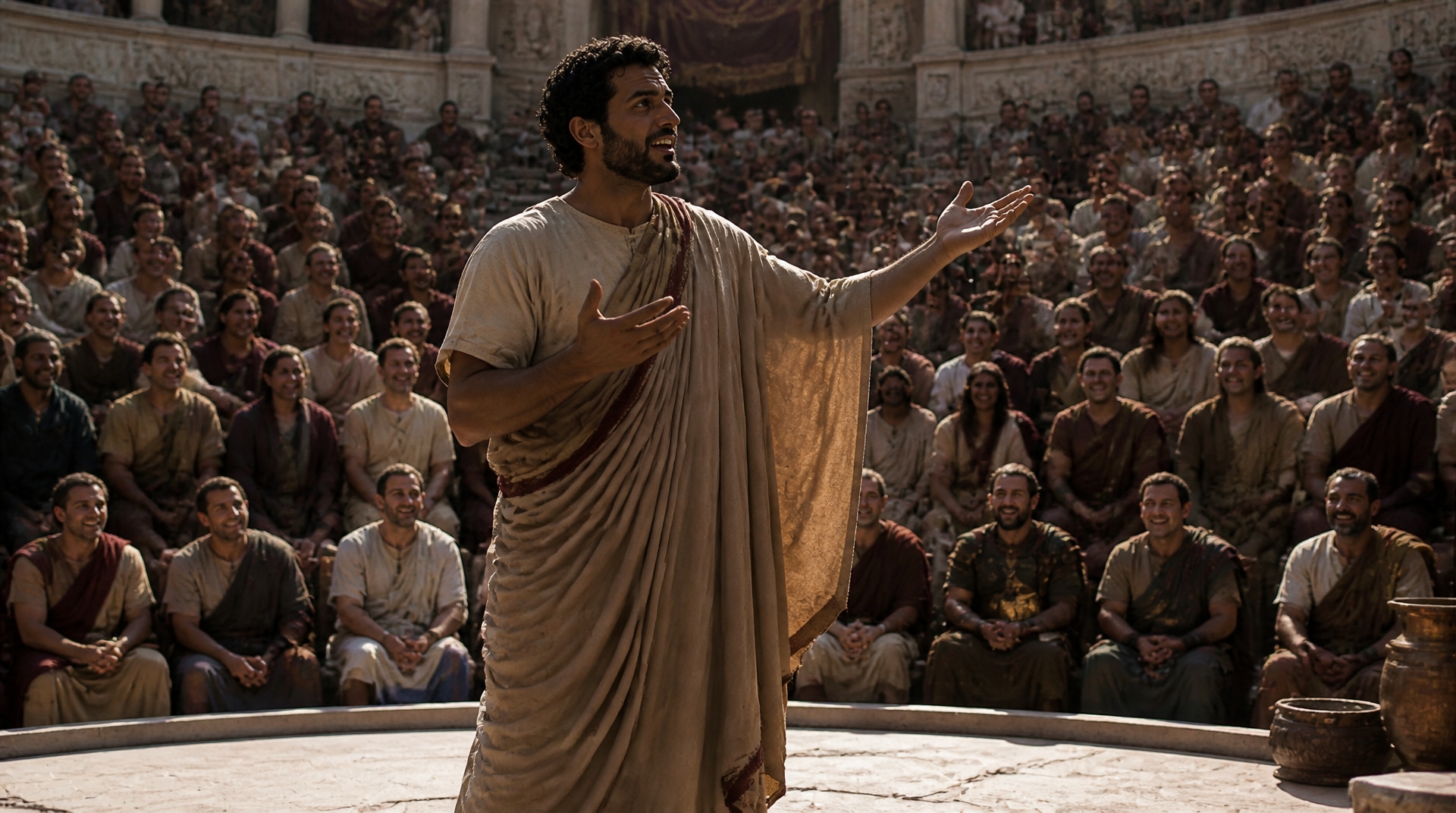
A week later, Lucian stood on the stage of a larger theater, in front of a larger audience. He
stared out at the crowd before going on. It was even larger than his first venue in Athens.
"Oh, my gods, Demetrios!" he exclaimed. "I've never been
in front of this big a crowd before! How did you even get this place?"
Demetrios grinned. "I paid for it, like all the others!" he said. "Don't worry, the crowd is here
to see you. They know who you are. And they've already paid, so we've already turned a profit!"
Lucian took a deep breath, and then he stepped out onto the stage. The crowd was huge, and it was
silent. This time, he had prepared something different. He began with his own voice—the
Syrian-Greek accent that the Roman had criticized. He exaggerated it, made it almost a parody of
itself. He performed the opening lines of a famous Latin philosophical text in that accent, and the
audience laughed, recognizing the outsider trying to speak their language.
Then he shifted. He performed the same passage in the accent of a Roman soldier—clipped, direct,
stripped of any pretense. The audience laughed again, but differently. He was mocking them now,
showing them how their own speech sounded when used to speak about abstract philosophy.
He did the accent of a slave, careful and precise, each word measured because there was never time
for waste. He did the accent of a merchant, quick and efficient. He did the accent of a senator,
grand and carefully controlled. Each accent brought out different meanings in the same words. Each
accent revealed something true about the person speaking it and the culture they belonged to.
And then he paused, and let the moment settle. The theater was absolutely quiet.
"Do you know what happened," Lucian said, "when Rome decided to conquer the world? Rome sent out
its legions. Rome sent out its governors. Rome sent out its tax collectors. And Rome imposed Roman
law, Roman gods, Roman language on every place it conquered." He paused. "And do you know what
happened? Some say the empire has grown fat and lazy and weak. Because Rome never learned to listen
to the peoples it conquered. Rome never asked: what do you know that I don't know? What have you
learned in your centuries that might teach me something?"
He gestured to the audience.
"I came to Rome as an outsider. My accent is wrong. My way of speaking is wrong. My perspective is
wrong. And Rome has two choices. Rome can dismiss me, dismiss everyone like me, as irrelevant
because we do not speak the way Romans speak. Or Rome can listen. Rome can ask: what does this
outsider see that we miss? What truth is this foreigner trying to tell us, underneath the awkward
accent?"
"The greatest conquest is not when you force people to become like you. The greatest conquest is
when you become larger by embracing what they are. When you say: I will learn your language, not so
that I can command you better, but so that I can understand you truly. When you say: 'Your truth
matters to me, even if it sounds strange coming from your mouth.'"
He looked out at the audience, and he saw the faces shift. He saw the moment when understanding
landed. He saw the moment when they recognized themselves in what he was saying—not as the
conquerors, but as the conquered. And he saw the moment when they began to wonder: what would Rome
look like if we actually listened?
"The world is not smaller when you embrace its diversity," Lucian said. "The world is larger. You
become larger. Your understanding becomes deeper. Your power becomes not the power of the sword,
but the power of recognition. To say to someone: I see you. I hear you. I understand you, not
because you have become like me, but because I have become wise enough to understand you as you
are."
He finished. The theater erupted.

The Triumph
It was not a quiet triumph. It was not a polite ovation. It was the kind of response that comes
when an audience realizes they have just been fundamentally changed. Men stood. Men shouted. Men
wept, some of them, though they tried to hide it. The guards had to hold back those who wanted to
crowd the stage.
For the next hour, men approached him with tears in their eyes and told him why his words had
mattered. A senator spoke of the provinces he governed, and wondered how many stories he had never
heard because he had not thought to listen. A merchant spoke of the slaves he owned, and for the
first time wondered what they might know that he did not. A soldier spoke of the villages he had
conquered, and admitted that he had never asked if there was something to conquer besides the land
itself.
And Lucian listened to all of them, and thanked them for their honesty, and understood that he had
done something rare: he had made powerful men uncomfortable in a way that did not make them
defensive, but instead opened them to change.
When he finally left the theater, Demetrios was waiting. They walked through the streets of Rome in
silence, and when they reached their house, Demetrios poured wine and they sat in the courtyard
under the stars.
"I have never admired you before as much as I do now," Demetrios said softly.
"Well, how about that," Lucian laughed. "Tonight, Syria conquered Rome!"
They drank, and the night deepened around them, and Lucian felt something settle in his chest. He
had come to Rome fearing failure. He had found instead the deeper truth that Philostratos had
been trying to teach him all those years: that the most powerful rhetoric is not the one that
dazzles, but the one that opens. That the most dangerous weapon is not the sharp blade but the
mirror held up to the world, showing it what it has forgotten to see.
Lucian and Demetrios had their own rooms, though they often spent so much time in one or the other
that they often wound up sleeping in the same bed. Tonight, heady with triumph, Demetrios simply
followed Lucian to his room. And in bed, in the darkness, Lucian kissed his friend goodnight, as he
had done so many times before.
But, this time, he didn't stop.