|
By: Paul S. Cilwa |
Posted: 5/6/2026 |
|
Page Views: 9 |
| Hashtags: #HistoricalFiction #LucianOfSamosata #Travel #Rhetoric #Mediterranean #MiddleSea |
| Lucian buries his mentor and embarks on his world tour as a famous rhetorician. |
| Estimated reading time: 13 minute(s) (3016 words) |
So it was with a shock that Lucian learned, on a cold morning in early winter, that Philostratos
had died. The old teacher had survived another spring, another summer, another autumn. But when the
first chill came, his worn body had simply stopped. He had gone to sleep and not woken.
Seventy-three years old, someone said. A good long life.
The family had delayed the funeral by a week to allow time for word to reach those who had mattered
to him. Which meant they were expecting Demetrios.
The Arrival
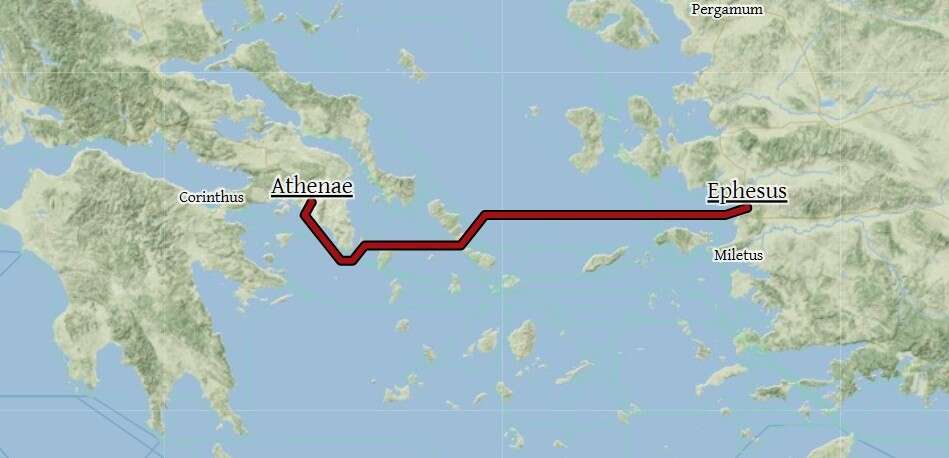
Four days later, Lucian received another message, this one in Demetrios's casual handwriting. He was about to
depart for Ephesus on the first available ship. It should take about three days, depending on
weather, of course. He couldn't promise a specific day—it depended
on the tides and the winds and the schedules of the merchant captains. But he would come as fast as
he could.
So Lucian raced to the harbor and scanned the faces of the
disembarking passengers. He had not seen Demetrios in person for nearly two years, though they had
exchanged letters regularly. He knew Demetrios would have left probably on the same ship
as the messenger, so he raced to the harbor. Lucian stood among the
crowd of dockworkers and merchants, scanning faces, his heart beating faster than
normal.
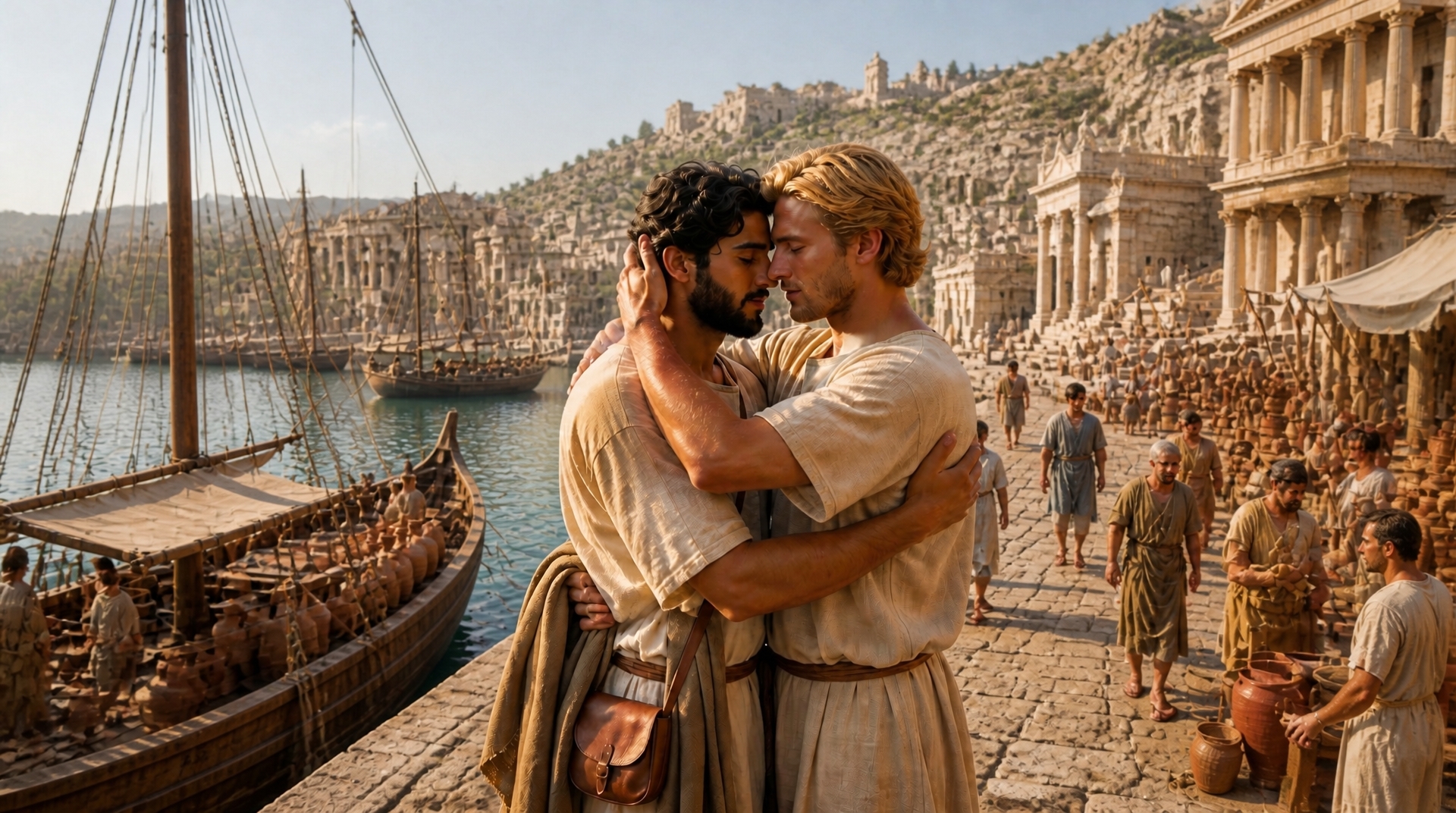
Then he spotted him. Demetrios emerged from the crowd of traders and sailors, older than Lucian
remembered, with the raggedness of someone who had been traveling hard and fast. His clothes were
salt-stained from the sea; his face was tear-stained. When he saw Lucian's face, grief
and joy collided in his expression. He moved toward Lucian like a man caught between currents.
"I can't believe he's really gone," Demetrios said. His voice cracked on the words.
"The family delayed the funeral," Lucian said quietly. "They wanted to give you
time to arrive."
Demetrios nodded, pulling Lucian into an embrace. "I should have been here. He had me doing—"
He stopped, holding Lucian tighter. "It doesn't matter now, does it?"
"No," Lucian said gently. "It doesn't. Come. The funeral procession is at his house. The family is
waiting for you."
They walked through the streets of Ephesus together, heading uphill toward Philostratos's house.
Lucian watched Demetrios's face, watched the grief settle onto him like a weight he couldn't put
down. And he understood that Demetrios had not just lost a teacher or a mentor. He had lost the
person who made sense of his life. As Lucian's father was to his mother, Philostratos had been
to Demetrios.
The Last Rites
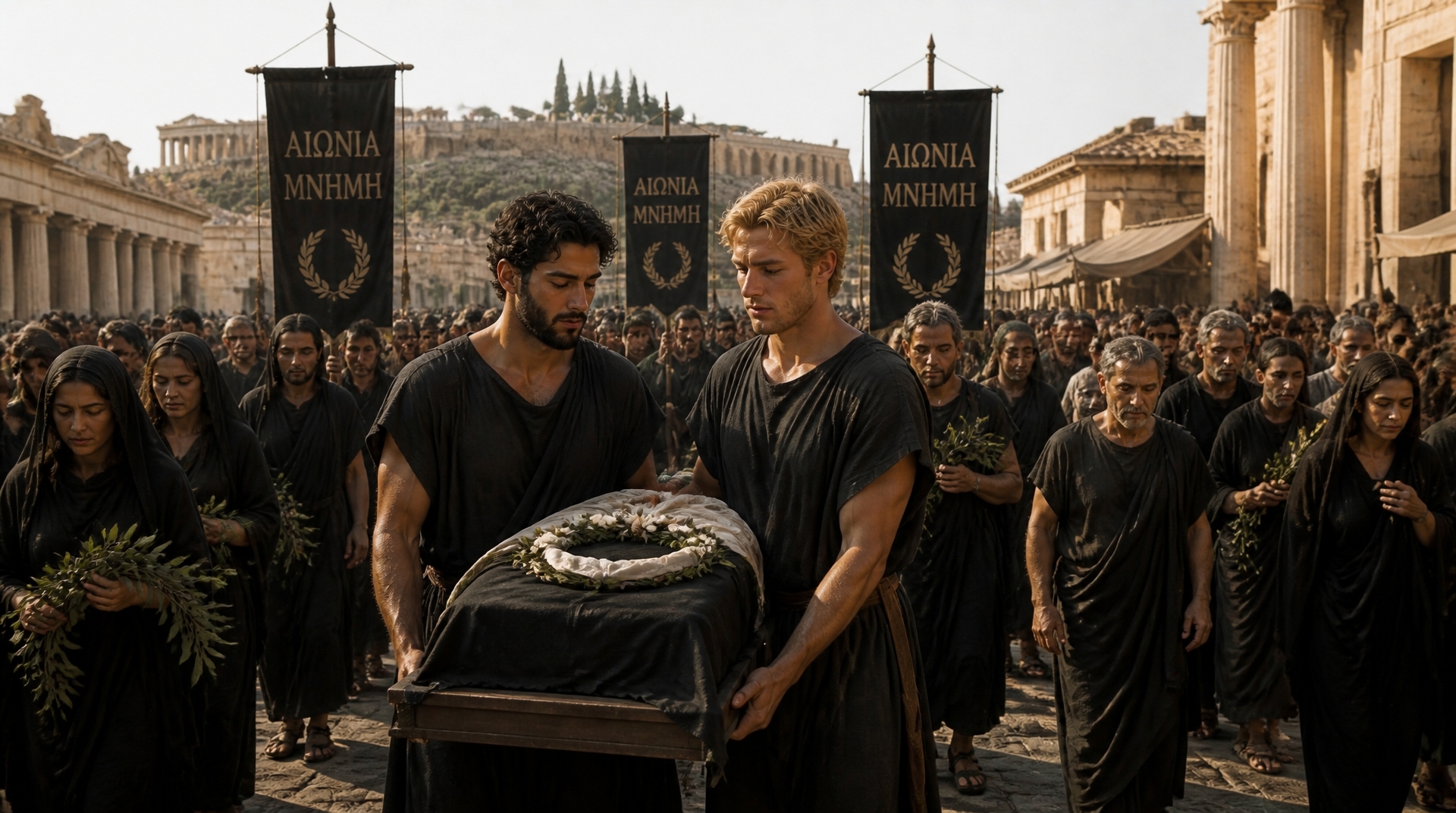
The funeral procession moved through Ephesus on a gray afternoon, winding from Philostratos's house
down to the harbor, where the body would be ritually washed and prepared for cremation. Lucian
walked behind the bier with the family members and Demetrios, trying to keep track of who was who.
There were a lot of them, and they all seemed to have opinions about how the funeral should
proceed.
"Philostratos!" a woman called out, and three men turned around at once. She sighed. "Philostratos
the younger. Not the elder, and definitely not the one from the harbor district."
The three men nodded, understanding perfectly. Apparently, this was a recurring problem in the
family.
"Where's Philostratos the merchant?" someone else asked.
"Which one?" replied an exasperated voice. "There are two of them now. We're going to have to start
using street names."
Even in their grief, the family could not help but joke about the name that had been passed down,
father to son to grandson, for so many generations that it had become almost meaningless. But
Lucian understood that the repetition of the name was itself a kind of love—a way of saying: this
man was important enough that we name our children after him. This wisdom was valuable enough that
we want to preserve it in the family.
The funeral rites themselves were simple. The body was washed, anointed with oils, wrapped in a
white cloth. A priest spoke words about Philostratos's life—his teaching, his wisdom, his
generosity to those who came seeking knowledge. And then the body, tightly wrapped in linen
to at least partially contain the stench, was placed on the pyre, and the fire was lit.
As the smoke rose, Lucian saw Demetrios standing at the edge of the crowd. He was dressed in
mourning clothes, his face hollow. He had clearly not been sleeping. When he saw Lucian, his eyes
filled with tears, and he turned away, unable to bear being seen in such a state.
Lucian waited until the funeral was over, until the family had dispersed back to the house for the
funeral meal. Then he found Demetrios alone near the harbor, looking out at the sea.
"He spoke of you often," Lucian said quietly. "The last time I saw him, he told me about your work.
He was so proud of you."
Demetrios did not turn around. "I should have been here," he said. "The last six months, I was
chasing some patron in Antioch who wanted to sponsor performances. I wasn't here when
he was dying."
"He didn't spend any time dying," Lucian said kindly. "The family told me it was very sudden.
You could have been here in Ephesus and still have missed it."
"My work," Demetrios said bitterly. "What good is the work when the man I've been doing it for is
dead?"
Lucian stepped closer. He reached out and took Demetrios's hand. "He's not the only reason you do
what you do. You do it because you're good at it. You do it because you understand what speakers need,
what audiences want, how to build the conditions for something meaningful to happen.
You still have those skills. True, you'll have to find someone to do it for. But you will."
The Proposal
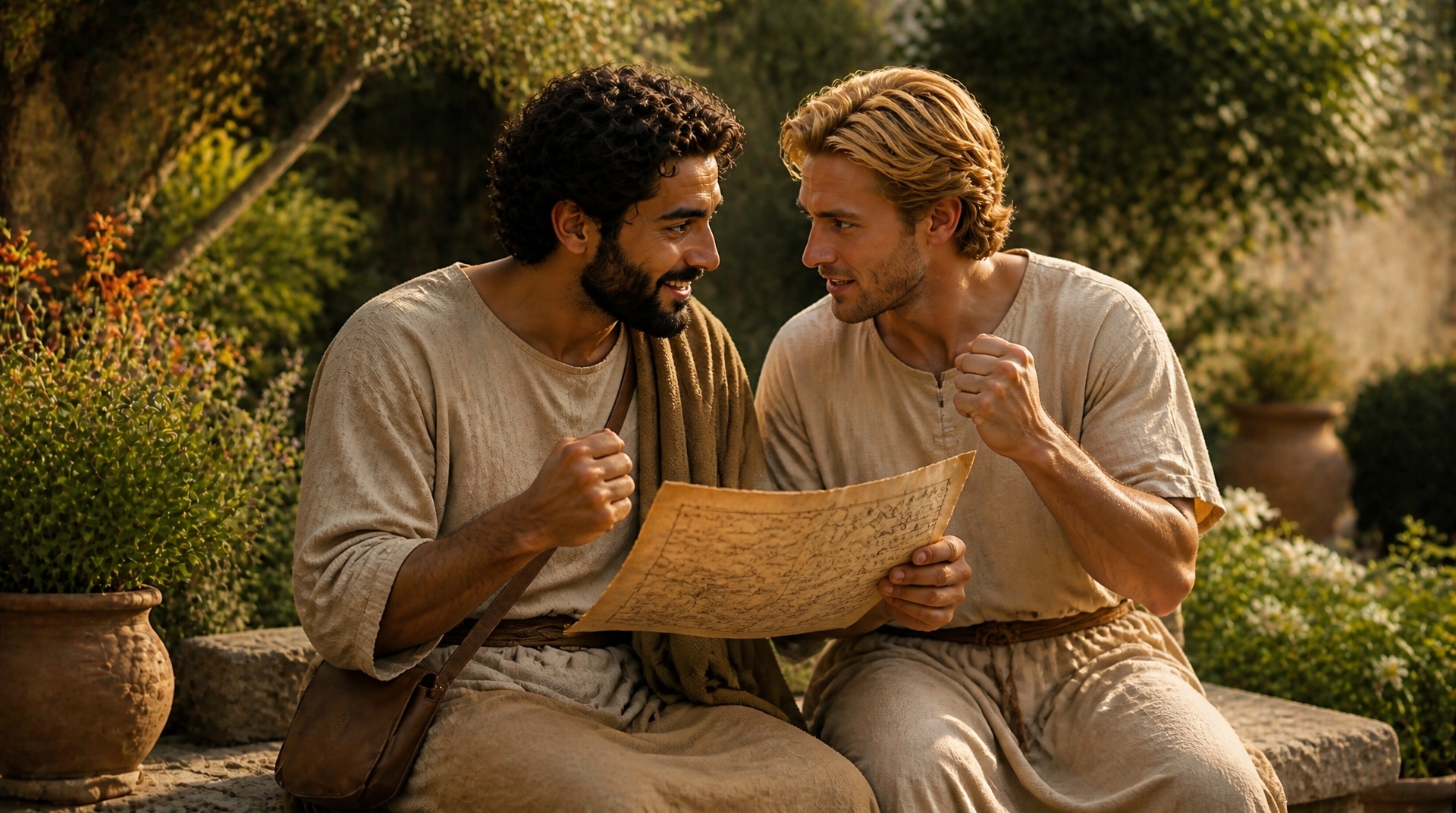
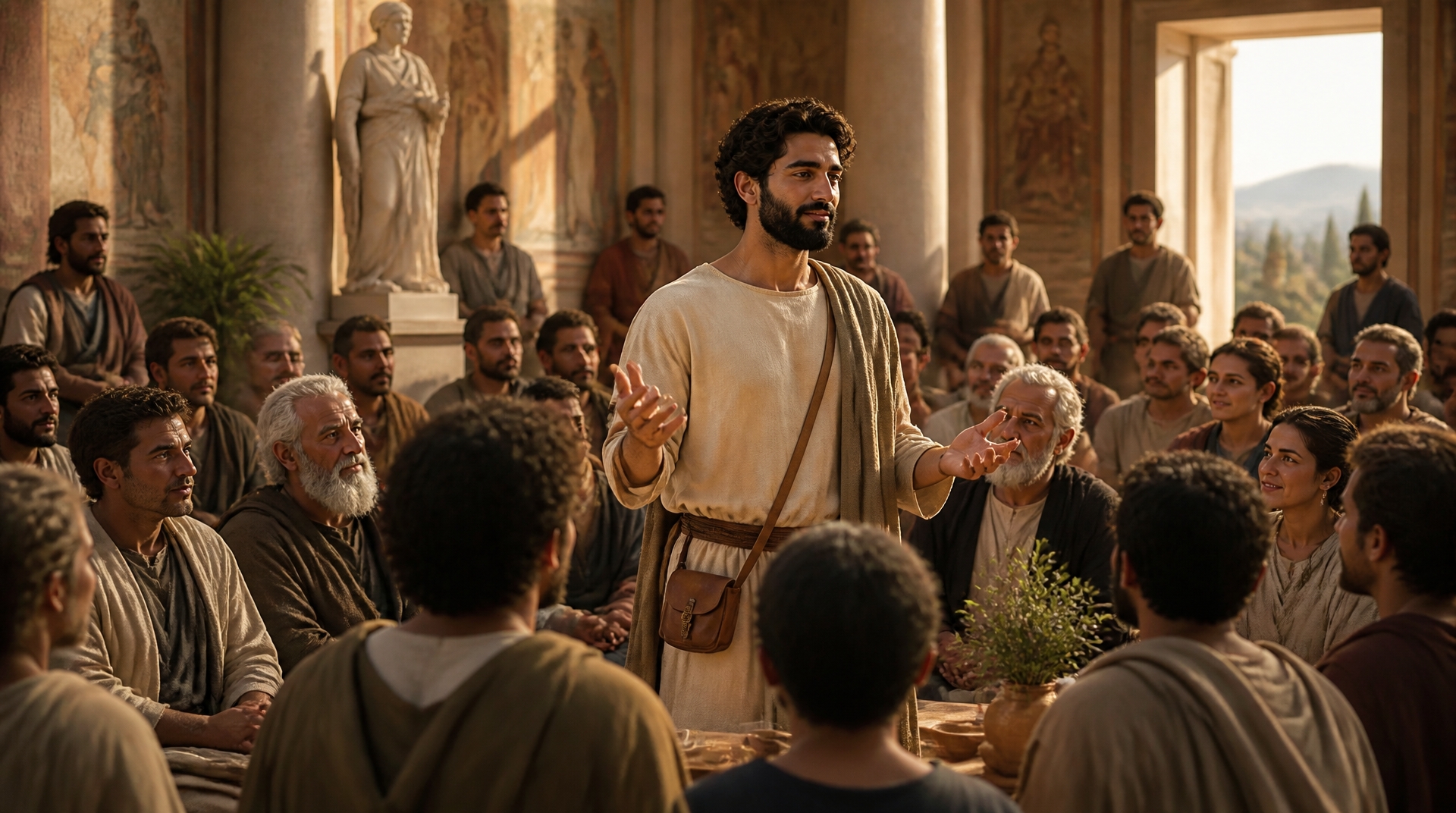
Later, they sat on the bench in Lucian's courtyard until Apollo's chariot was sinking into the west.
Demetrios talked, and Lucian listened. He
spoke about his years working for Philostratos, setting up venues for other speakers, learning the
business of making reputations. He spoke about the success he'd had, the cities he'd scouted, the
network he'd built. And he spoke about feeling lost now, about not knowing what the work was for
anymore if not to serve Philostratos's vision.
"But it wasn't just for him," Lucian said. "You built something real. A system that takes talented
speakers and gives them the platforms they deserve."
"Yes," Demetrios said slowly. "I guess so."
He was quiet for a long moment, watching the light change on the water. And then he turned to
Lucian with a look of sudden clarity.
"Come with me," he said. "Not as a student, but as my partner. I know you well enough
to see what you could become. I have the skill to make the world see it too. Together, we could do
something remarkable."
"What exactly are you proposing?" Lucian asked.
"I scout cities. I build relationships with theater masters, gymnasium directors, wealthy patrons.
I prepare the ground. And you arrive, and you perform. You take the platform I've built and you
transform it. Your gift and my work—between them, we could remake the entire known world circuit of
rhetoric and performance. You become the greatest speaker of your generation. And I become the man
who made that happen."
He paused. "And we travel together. We don't spend six years apart. We could build this together, as
business partners."
Lucian considered it. Six years ago, he would have hesitated. He would have worried about
obligation, about losing his independence. But six years had changed him. He had learned that being
attached to something—to a city, to a teacher, to a craft—did not diminish him. It deepened him.
"You know what," he said slowly, "That sounds like fun. And you know, Ephesus is going to feel very
barren without Philostratos in it. Our Philostratos, I mean!"
Demetrios reached over and took his hand. Neither of them said anything more. They sat together on
the harbor wall, watching the sun descend into the sea, honoring the man they had both loved by
moving forward with their lives.
The Farewell
The farewell party took place at Philostratos's house, on a warm evening two weeks after the
funeral. Two of his cousins, also named Philostratos, had moved in.
The family had wanted to honor both the loss and the new beginning. Word had spread
through Ephesus that Lucian was leaving, and the guest list grew to include not just Philostratos's
inner circle but many of the sophists, merchants, and philosophers who had supported Lucian's
career over the years. There was wine—good wine, not the leaded defrutum but honest Rhodian red.
There was music. And there were toasts.
One of Philostratos's nephews, himself named Philostratos (the one from the harbor district),
stood and raised his cup. "My uncle believed in this young man," he said, gesturing to
Lucian. "Not just as a student, but as someone capable of greatness. He would want to see you go
forth and prove him right. To Lucian—may you become exactly who my uncle thought you could be."
The crowd cheered and drank. But then Lucian stood, and raised his own cup.
"My friends," he said, "I came to Ephesus seeking education. I found it, and more besides. I found
people who believed in me when I didn't believe in myself. I found a calling. And now I'm leaving
to find something else entirely."
He paused, letting the moment settle.
"The ancient heroes, so the stories tell us, sailed forth in search of treasures such as the Golden
Fleece. They spent years fighting storms and monsters for a prize of pure gold. But let me tell you
what I'm looking for: I'm looking for Bacchus' river of wine! I'm looking for audiences who haven't
heard my jokes yet. I'm looking for cities where my name means nothing when I arrive, so that I can make it mean
something by the time I leave. And I'm looking for the chance to prove that a small town Syrian boy can become
someone that the whole world will remember."
The room erupted. Lucian had always had a gift for knowing what people wanted to hear, and this—
this was bold, it was audacious, it was the kind of declaration that made men either love you or
hate you. But in that room, on that night, they all loved him.
Later, as the party was winding down, Demetrios found Lucian on the terrace overlooking the
harbor. "You'll do well," Demetrios said. "Philostratos was right; you have the gift and
you have learned to use it wisely. And you
have something more valuable than either of those things: you have the confidence that comes from
knowing who you are."
"It's very scary," Lucian admitted. "Sending ourselves into the world where, at any time,
we could become marooned or enslaved or otherwise discombobulated without a safety net.
But you know what, Demetrios…I wouldn't even attempt this with anyone else.
But I trust you. You've never let me down."
He placed a hand on Lucian's shoulder. "And I never will."
Athens
They settled into a modest house near the Agora, with a small courtyard and room enough for both of
them to work. Demetrios had already begun the process of spreading rumors about Lucian's arrival.
The town criers had been hired for the week. Stories were circulating about the performances in
Ephesus, Smyrna, Perge. By the time Lucian gave his first performance in the great theater of
Athens, there were so many people wanting to attend that they had to turn people away.
Lucian couldn't believe it, and he was struck by his first experience with stage fright.
When Demetrios, standing behind him, sensed him freeze, he whispered, "You've got this, brother!"
and pushed him out.
And it worked. The partnership between them was effortless and productive. Demetrios would scout a
city, find the best venue, establish relationships with the local authorities. He would hire the
criers, spread the word, build the anticipation. And by the time Lucian arrived, the foundation was
already laid.
What Lucian had not anticipated was how much he would enjoy Demetrios's company again. They fell
back into old rhythms easily. They would wake together, take their breakfast together, discuss the
previous night's performance over wine in the afternoon. And at night, when Demetrios returned from
whatever advance work he had been doing, they would sit in the courtyard and talk about everything
and nothing, as if those years of separation were just a brief interruption in a conversation that
had never really ended.
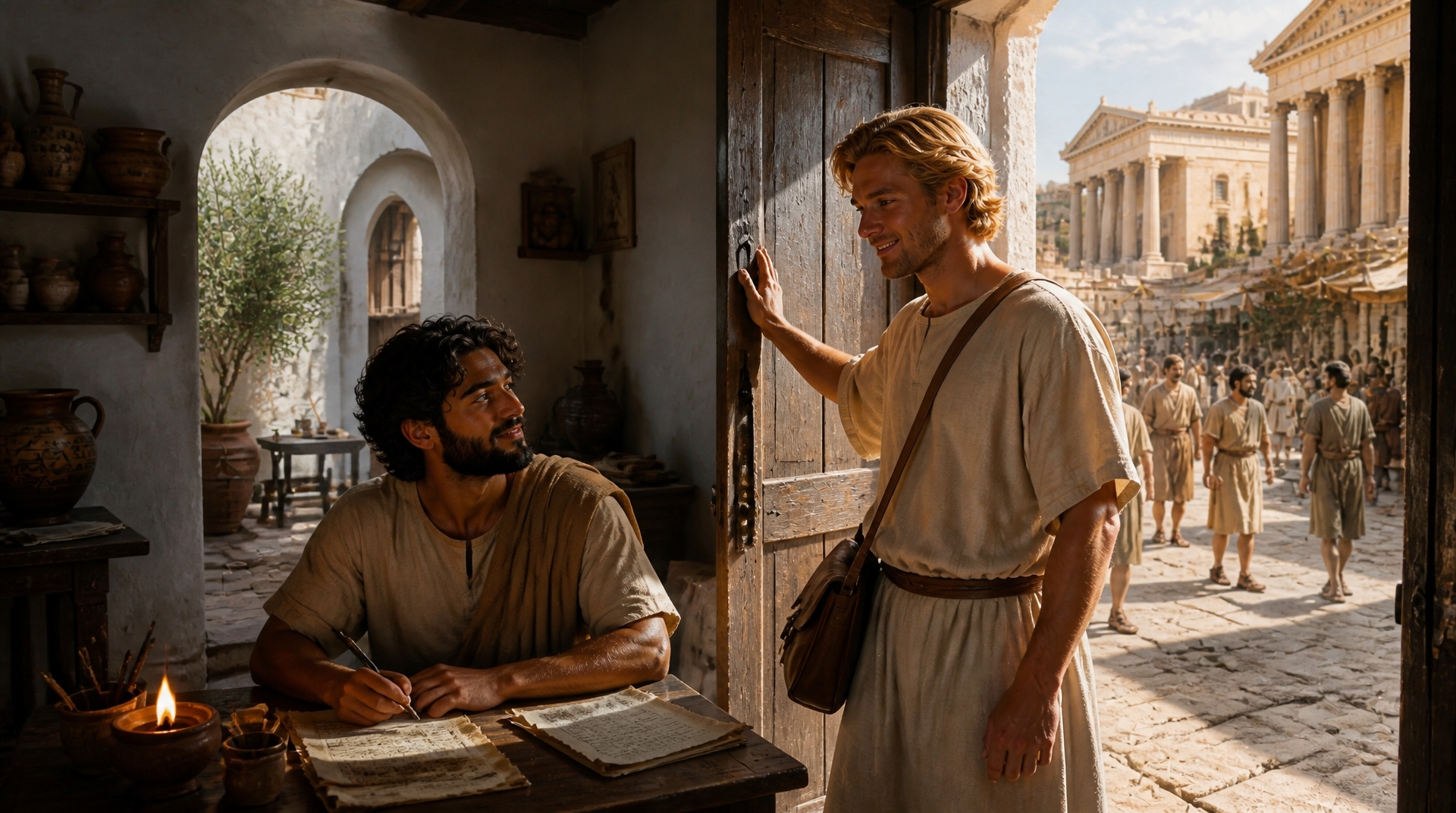
Lucian's mornings belonged to writing. He would sit at a small desk near the door that opened onto
the street, his parchment spread before him, composing new pieces, refining old ones. Passersby would
sometimes pause to watch him work, drawn by his concentration or his occasional bursts of laughter
when he struck upon a particularly good line. Demetrios would come and go—out into the city on
his endless rounds of preparation, then back again, and Lucian would look up from his writing with a
smile as his partner headed out the door, both of them understanding without words that the other was
building something real.
Neither of them spoke about what this was, or what it meant. They didn't need to. They had learned
enough in their travels to understand that some things do not need to be named to be real. What
mattered was that the work flourished, that the performances succeeded, and that every evening they
returned to each other with stories of the day, building a life together that honored the man they had
both lost.
Unplumbed Depths
After Athens, they turned their attention westward. Greece had been the homeland of rhetoric,
philosophy, and learning for a thousand years. But beyond Greece lay Rome, and Rome was where the
real power was. Rome was where an outsider could become famous, could make a fortune, could remake
himself entirely.
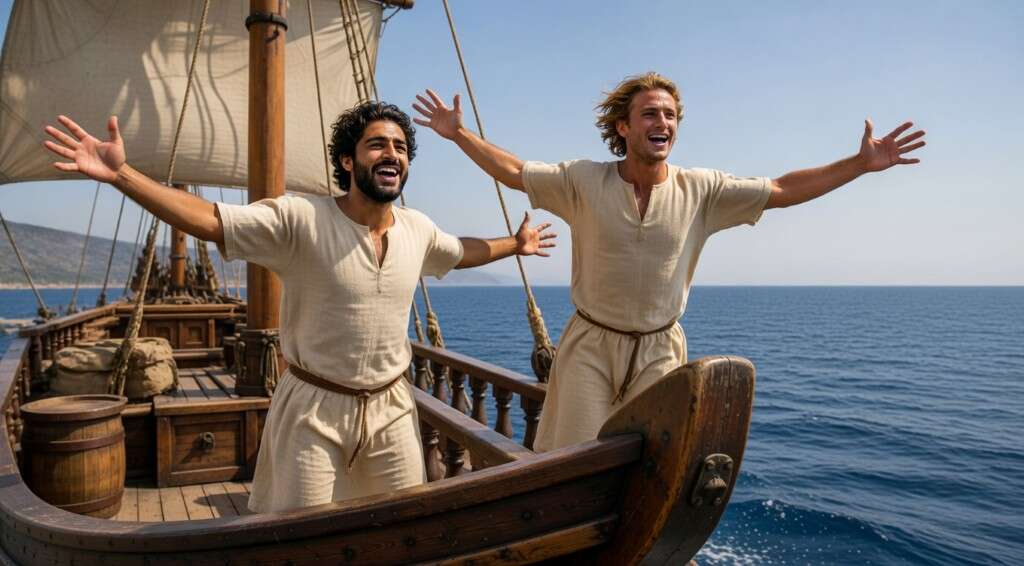
The crossing from Greece to Rome required a ship, and Lucian had not traveled by sea in many years.
He stood at the rail as the vessel pulled away from the harbor, and he felt again that strange
mixture of fear and exhilaration that the sea inspired.
The color of the Mediterranean was just as he had remembered. He had traveled it before, but now,
older and more observant, he realized that the sea was not one color but many. In the shallows,
near the shore, it was a bright turquoise, almost translucent. But as the water deepened, the color
changed. It became a blue so profound, so layered with depth, that it seemed almost impossible that
anything so blue could exist in the natural world. So blue that it almost, but not quite, reached
purple. It was not the color that painters captured in their frescoes—those always looked somehow
false, too flat, missing the dimension of the real thing. It was not a color that could be captured
in tile or in words. It was something that could only be experienced directly, by standing at the
edge of a ship and watching the water slide away beneath you, becoming darker and more mysterious
as it receded.
Demetrios stood beside him as they sailed.
"You're seeing it," Demetrios said.
"I've never really seen it before," Lucian said. "I was too busy being afraid."
"Fear makes one blind," Demetrios agreed. "But you're not afraid anymore."
It was true. Whatever Lucian had been afraid of in those early years—of being inadequate, of being
discovered as a provincial fool, of not being worthy of the world he wanted to inhabit—those fears
had burned away through repetition and success. He had performed in dozens of cities. He had made
thousands of people laugh and, he hoped, think. He had learned his craft and his gift. And
he was no longer the boy who needed to prove anything. He was a man who knew what he was.
The sea that stretched before them was infinite and ancient and utterly indifferent to human
ambitions. But Lucian found that comforting rather than threatening. If the sea did not care what
he did or did not do, then he was free to do anything he wished. He was free to be
himself—exactly, completely, unapologetically himself.
He turned to Demetrios. "How long until Rome?" he asked.
"Ten days if the winds hold," Demetrios said. "Rome is the greatest city in the world. Greater than
Athens, greater than Alexandria, greater than Antioch. It is where empires come to die and be
reborn."
"Is that meant to be encouraging?" Lucian asked.
"I mean," Demetrios said, "that Rome is a place where anything is possible. You will do well
there."
But Lucian was not so certain. Rome was different from the Greek cities. Rome had its own
aesthetic, its own values, its own expectations. The Romans had learned rhetoric from the Greeks,
but they had transformed it into something else entirely. They valued power and control. They
valued dominance and victory. Whether they would value the kind of gentle satire that Lucian had
been perfecting—the kind that exposed contradiction without crushing the contradicted—he could
not predict.
He would find out soon enough.