|
By: Paul S. Cilwa |
Posted: 5/5/2026 |
|
Page Views: 17 |
| Hashtags: #HistoricalFiction #LucianOfSamosata #Ephesus #Sophistry #Satire #Comedy |
| Lucian discovers his voice as a satirist and learns the power of gentle critique. |
| Estimated reading time: 10 minute(s) (2374 words) |
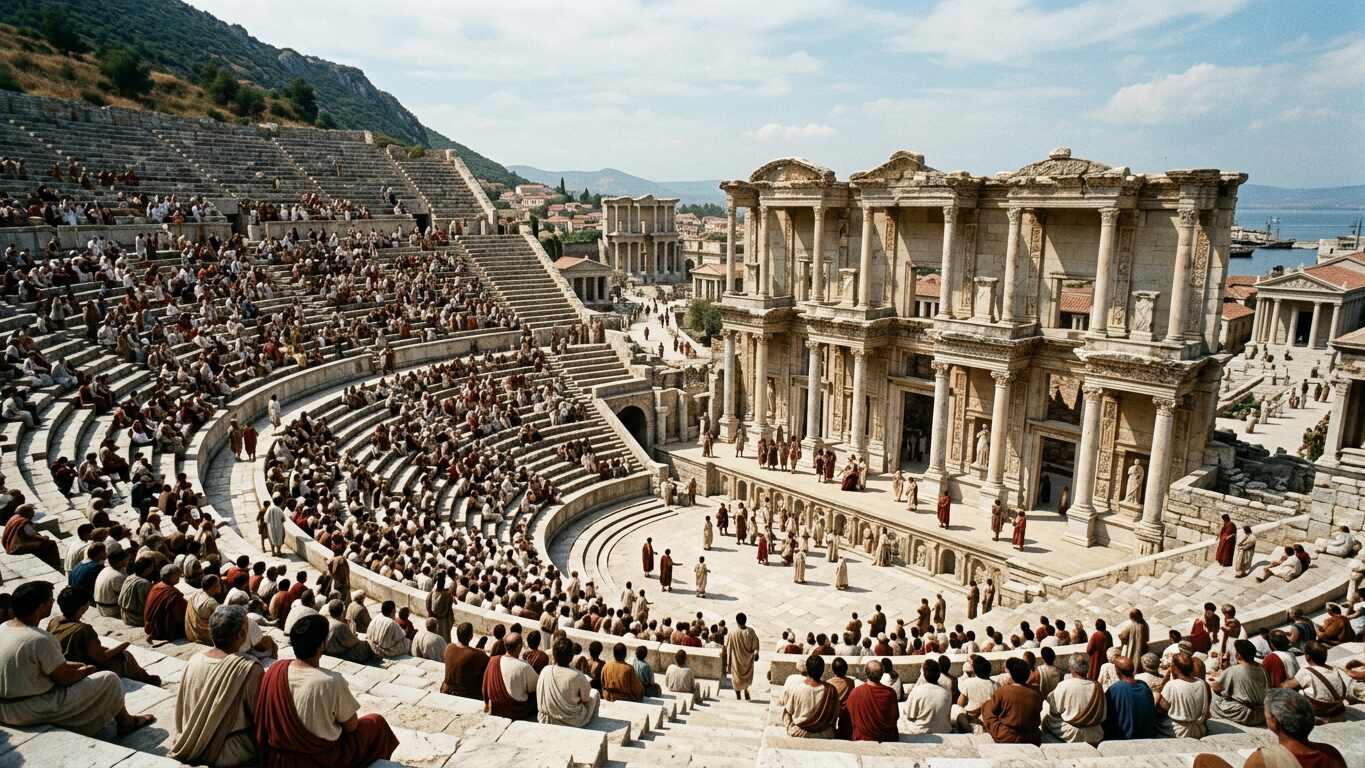
He was no longer the provincial boy who had fled Samosata. The accent had been trained out of him,
replaced with the flawless Attic Greek of the educated elite. His clothes fit better now, chosen
with the subtle attention to status that Demetrios seemed to understand so well. He moved through the
world with a confidence that came from understanding its codes, its languages, its hidden rules.
He belonged here, or so it seemed.
Partings
It was Demetrios who left first. On a morning in early spring, three years after they had arrived
in Ephesus together, Demetrios came to Lucian with the news that he was departing.
"Philostratos is sending me ahead to prepare things in Alexandria," he said. The words were
simple, but Lucian understood what lay beneath them. This was the end of their traveling together,
the end of sleeping in the same bed, the end of the friendship that had been the center of Lucian's
life for so long.
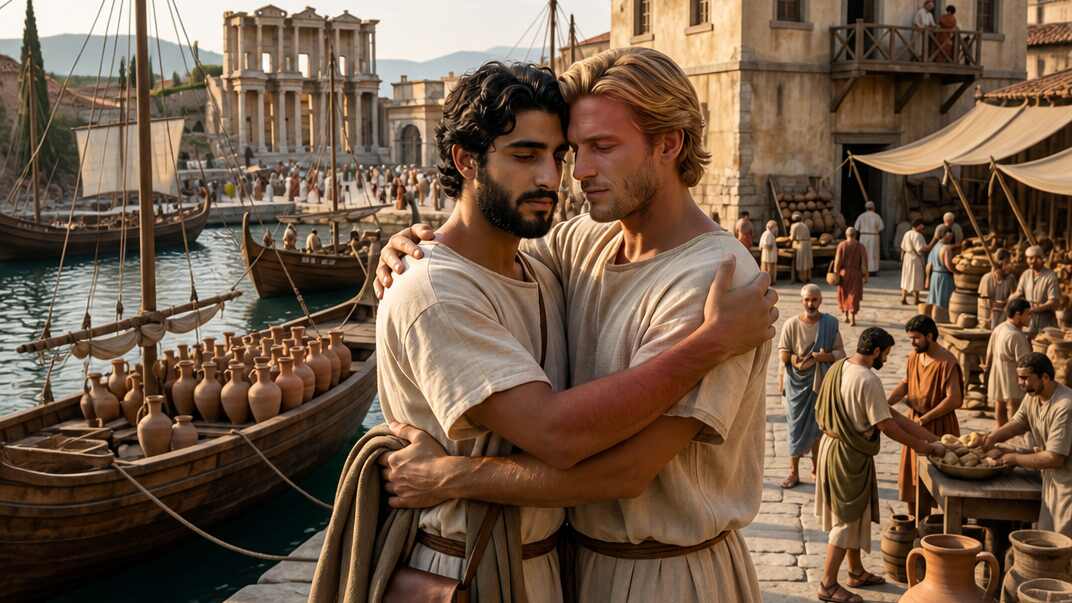
They stood on the harbor wall, watching the ships. Demetrios's hand found Lucian's, and they stood
that way for a long time without speaking.
"Thank you," Lucian said finally.
"For what?" Demetrios asked.
"For showing me that the world was larger than I thought it was. For being kind when I didn't
understand. For staying when you could have gone."
Demetrios squeezed his hand, then released it. "Don't make me into something I wasn't," he
said gently. "I stayed because I wanted to. Because being with you made me happy. That's not
kindness. That's just…being alive!"
They embraced on the dock, and when Demetrios boarded the ship heading south, Lucian did not watch
him leave. Instead, he turned away, back toward the city, back toward whatever he was becoming.
He saw Hermione three more times over those three years. The first time was a chance encounter in
the marketplace; her community had expanded from Miletus to Ephesus, and she with it. She was buying olives, and her hand trembled when she recognized him.
"Lucian," she said, and there was a question in her voice, a hoping.
They walked together to a quiet corner of the agora. He told her about his studies, about the
sophists, about how he was beginning to understand the power of words. She told him about her
community, about how it had grown, about the joy she had found in service to others.
At the end of the day, they stood at the harbor's edge, and Hermione took his hand.
"Could you believe?" she asked. "If you tried? If you opened your heart?"
"I don't know how to believe something I don't believe," Lucian said. "And I won't lie to
you, pretending I do. You deserve someone who is already what you want, not someone you'll
spend the rest of your life trying to change."
Hermione nodded, and there were tears in her eyes, but they were quiet tears, the kind that came
from acceptance rather than despair.
The second and third encounters were briefer. Once she was with other Christians, at a public
gathering, and she gave him a smile that held no expectation. The last time, they passed on the
street, and she was accompanied by a man Lucian did not know—a Christian, presumably, who
looked at her the way Lucian had looked at her. He turned away before they made eye contact, and
he never saw her again.
The Temple of Aphrodite
It was his fellow students who convinced him, one evening when they had been drinking wine in a
tavern near the gymnasium. They spoke of it the way men spoke of crossing a threshold—as
something that marked the passage from youth to manhood.
"You can't spend your whole life being a mind," one of them said. "A man has a body too.
You should use it while it still works."
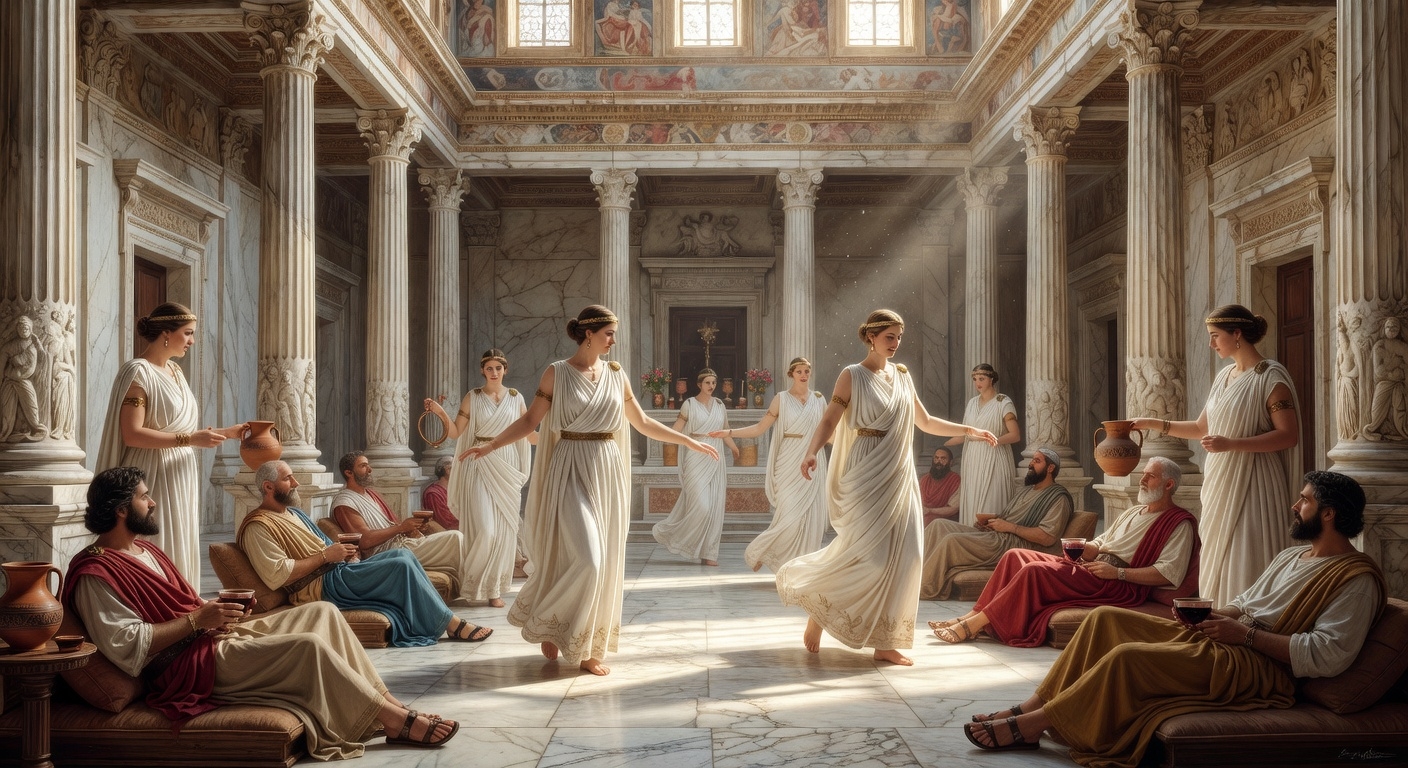
So one night, slightly drunk and slightly ashamed and mostly curious, Lucian found his way to the
temple of Aphrodite, where women were available for hire. The woman was perhaps thirty, with the
weary competence of someone who did this work without passion or revulsion. She knew what to do,
and he followed her lead, and when it was finished, he felt neither transformed nor diminished. He
felt, mostly, like he had crossed off an item on a list.
He left money on the table, more than he owed, as if the extra could purchase forgiveness for
something he wasn't sure he had done wrong.
It happened two more times over the following months. The women were different, but the experience
was essentially the same: competent, efficient, solitary even in the presence of another body. He
began to understand what Epicureanism actually meant—that the absence of pain was not the
same as the presence of joy. That relief and pleasure were not synonymous. That a body alone, no
matter how skillfully used, could not fill the emptiness that came from being unknown.
The Comedian's Gift
It was during this time that he began spending his evenings at the theater, and more importantly,
in the taverns where sophists gathered to perform. These were not the grand rhetoricians who spoke
in the formal gymnasia, polished and precise. These were the comedians, the cynics, the men who
made their living by saying the things that respectable philosophers would not say.
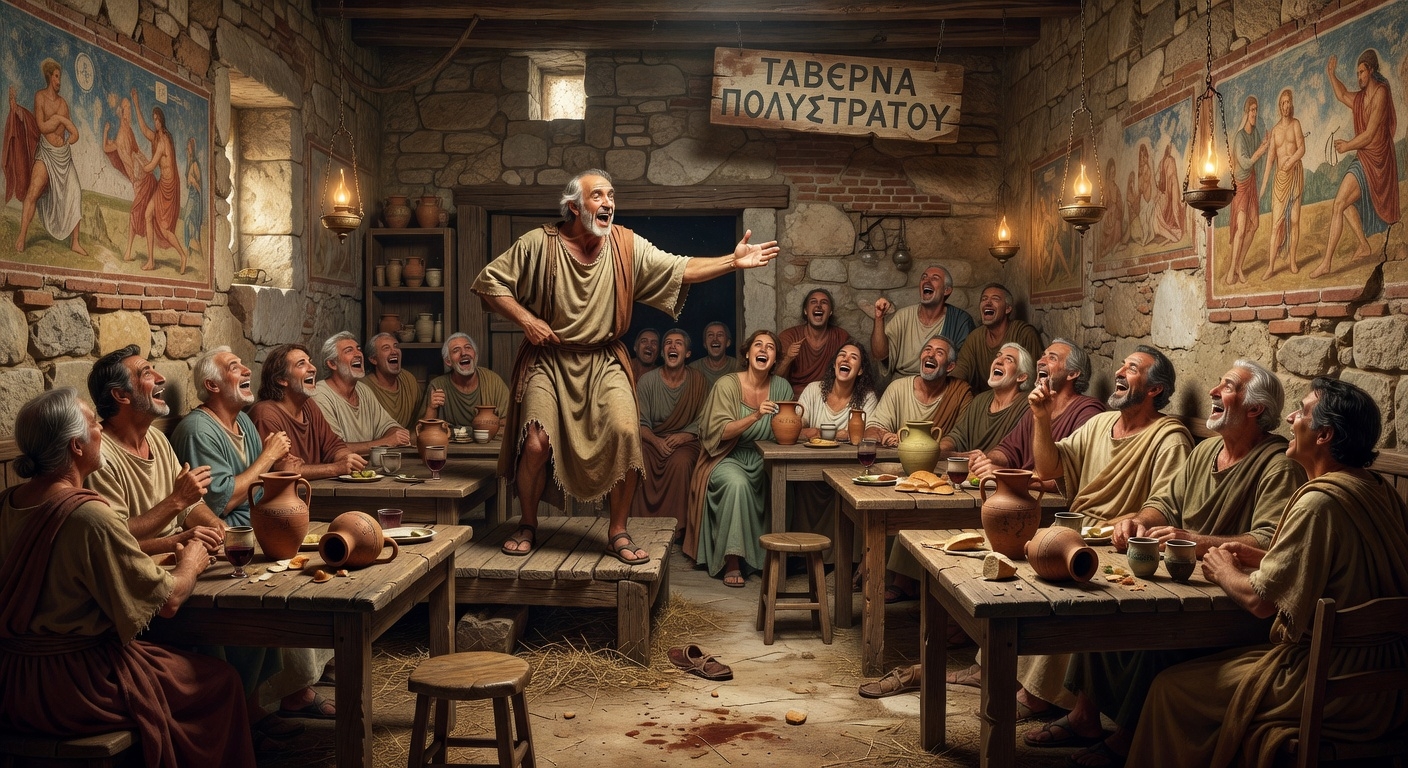
There was one in particular, a man named Polystratus, who performed in a tavern near the harbor.
He was perhaps fifty, with the look of someone who had lived hard and seen much, and he had no
interest in flattering anyone. His routine was simple: he took the pretensions of the educated classes
and turned them inside out. He would mimic a Platonist philosopher, speaking of the Forms while
simultaneously eating and drinking and visibly enjoying sensual pleasure. He would do a Stoic who
preached that external things did not matter while constantly checking to see if his expensive
himation was clean. He would perform a sophist who was so concerned with the beauty of his language
that he had forgotten to say anything meaningful.
Lucian would sit in the corner and laugh, and he would feel something shift in his chest. This was
power! Not the power of elevated language or polished argument, but the power of recognition. The
power of standing up and saying: I see what you are pretending not to be, and I'm going to hold a
mirror up to it so everyone else can see it too.
One night, Lucian found himself at the same tavern as Philostratos. His old teacher was sitting at
a table near the back, nursing a cup of wine and watching Polystratus with an expression of amused
tolerance. When Polystratus finished and the crowd dispersed, Lucian approached him.
"You still come to listen to this?" Lucian asked.
"Of course," Philostratos said. "Why wouldn't I? He's excellent. He sees the gaps between
what we claim to believe and what we actually do. That's the beginning of wisdom."
"It's a little cruel," Lucian said.
"It is," Philostratos agreed. "And sometimes cruelty is necessary. But I wonder if you might
be better at this than he is."
Lucian blinked. "At cruelty?"
"At comedy," Philostratos said. "He's good at making people feel small. But you—I think
you could make them laugh at themselves in a way that's almost affectionate. That's a rarer gift."
Open Mikon Night
The public gatherings where young performers could test their material happened monthly, in a small
theater attached to the gymnasium. The proprietor's name was Mikon, and the events were known
as "Open Mikon Night". Lucian had gone many times as an audience member, watching
students deliver speeches, perform scenes, tell jokes. On the night that mattered, he signed up to
perform, and his hands shook as he wrote his name on the roster.
He had prepared a monologue on Stoicism—or rather, on the logical contradictions in Stoic
teaching. It was drawn from arguments he had read, sharpened
and dramatized. The core was this: the Stoic claims that nothing external matters, that all virtue
lies in the judgment of the mind. But then the Stoic goes to great lengths to maintain his virtue,
to live correctly, to avoid vice. But if external things don't matter, why does it matter whether
he acts virtuously or viciously? The whole edifice collapses under its own contradiction.
He performed it as a character—a pompous Stoic sage, pausing frequently to admire his own
logic, only to accidentally say something that undermined his entire previous argument. He had the
man arguing passionately that pain didn't matter, then immediately complaining that the bench he
was sitting on was uncomfortable. He had the sage declare that reputation was irrelevant, then
spend minutes adjusting his clothing to look impressive.
For the first five minutes, the audience laughed. It was exactly what they wanted: a sharp,
intelligent critique of one of the city's dominant philosophies, delivered with enough humor to
make it palatable.
And then something shifted.
There were perhaps two dozen Stoics in the audience. Lucian had not realized this when he was
preparing; after all, Stoics looked like anyone else. He had thought only about the logic, the contradiction, the humor. But as he watched
their faces shift from amusement to offense, he realized his mistake. He had made them look foolish.
And foolish people, when embarrassed in public, do not laugh at themselves. They get angry.
The Cynics, on the other hand, loved it. The Cynic school was Stoicism's bitter enemy, and they
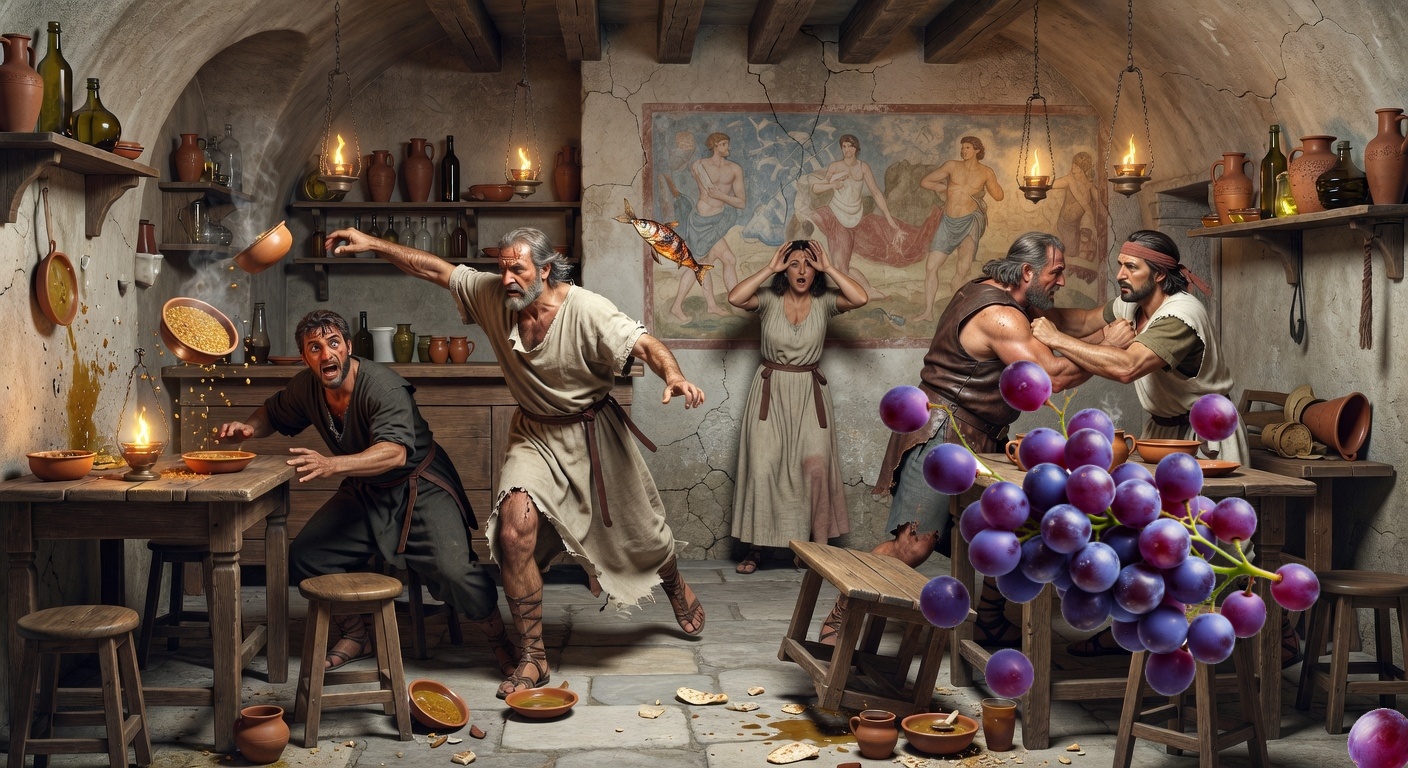
roared their approval, shouting encouragement as Lucian pressed on. And then, as if on signal, the
two groups began to argue. Voices were raised. A bench was overturned. Someone threw a piece of
fruit.
Philostratos appeared at Lucian's elbow. "Go," he said quietly. "Now. Through the back."
They slipped out while the theater dissolved into chaos, the Stoics and Cynics now engaged in what
looked like it might become a genuine brawl, with Lucian's monologue forgotten in the larger
satisfactions of settling philosophical scores.
They walked in silence through the darkening streets. Lucian's heart was still pounding. It had been
exhilarating and terrifying in equal measure. He had done it! He had stood in front of an audience
and spoken his truth, and it had been powerful. And it had been dangerous.
When they reached Philostratos's house, his teacher turned to him.
"You were excellent," Philostratos said. "Your logic was sound. Your performance was sharp.
You have found your gift, Lucian. That is rare."
"Then why do I feel like I made a mistake?" Lucian asked.
"Because you did," Philostratos said gently. "But not the kind you think. Your error was not
in being too harsh. It was in being too harsh with people who did not ask to be criticized. You
took men who were simply sitting in an audience, minding their own business, and you held them up
to ridicule."
Philostratos gestured toward a bench in his courtyard, and they sat. "There is a difference,"
he said, "between satire that exposes hypocrisy and cruelty that merely mocks. Do you know what
happens when you attack someone directly, when you make them feel foolish in front of others?"
"They get angry," Lucian said.
"Yes. And when they get angry, they put up armor. They stop listening. Your words bounce off the
shield of their wounded pride. But if you mock the idea rather than the man—if
you show the absurdity of the doctrine without requiring the believer to feel personally attacked—then
something different happens. They might laugh. They might think. And most importantly, they might
change their minds without feeling like they have to defend themselves."
Lucian thought about Polystratus, about the way the comedian had mocked the Platonist without quite
making it personal, had made fun of the sophists without making any single sophist feel destroyed by
the joke.
"So I should be kinder," Lucian said.
"No," Philostratos said. "You should be smarter. Kindness is for people who don't know how
to hurt. You clearly do. Your weapon is too sharp. What you need to learn is not to put it down,
but to use it with precision. To cut away the pretense without damaging the pretender. That is an
art form in itself."
Lucian nodded slowly. It was not the lesson he had expected. He had thought perhaps that Philostratos
would tell him to give up on satire, to return to straightforward philosophy. Instead, his teacher
was telling him that satire was his calling—but that he had to learn to wield it with care.
"Will I get better at it?" he asked.
"Yes," Philostratos said. "If you're willing to learn. And I think you are. I've watched you
these three years, Lucian. You came here as a boy who wanted to be an orator. You became a student
of philosophy. But what you really are is a writer. A satirist. Someone who can see through pretense
and speak the truth. That is a dangerous gift. Handle it carefully."
As Lucian walked home that night, his mind was already beginning to work on his next piece. Not an
attack. But something more subtle. Something that would make people laugh at their conceits without
quite realizing that they were laughing. That was the kind of power he wanted. Not the brutal power
of the knife, but the surgical power of the blade that cuts so cleanly that the wound barely bleeds.