|
By: Paul S. Cilwa |
Posted: 5/4/2026 |
|
Page Views: 18 |
| Hashtags: #HistoricalFiction #LucianOfSamosata #Mithraism #MysteryReligions #Christianity #Pergamum |
| Lucian encounters the mysteries of Mithras and recognizes Christianity's debts to older faiths. |
| Estimated reading time: 10 minute(s) (2186 words) |
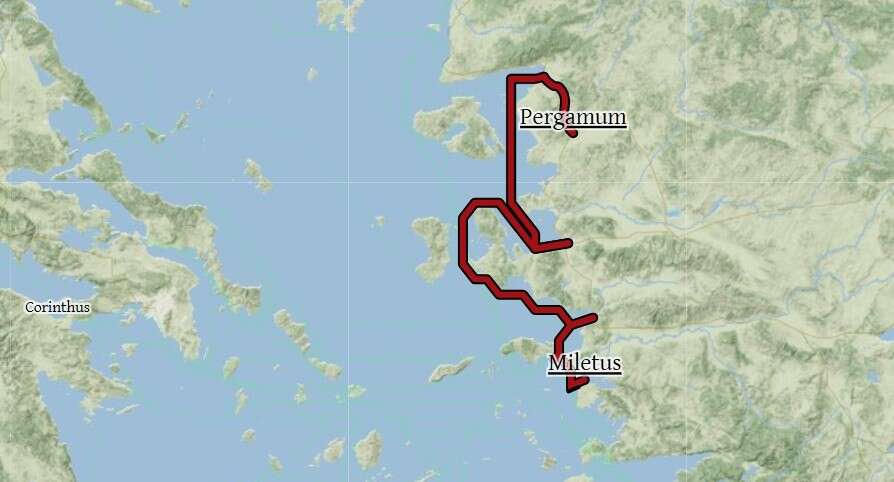
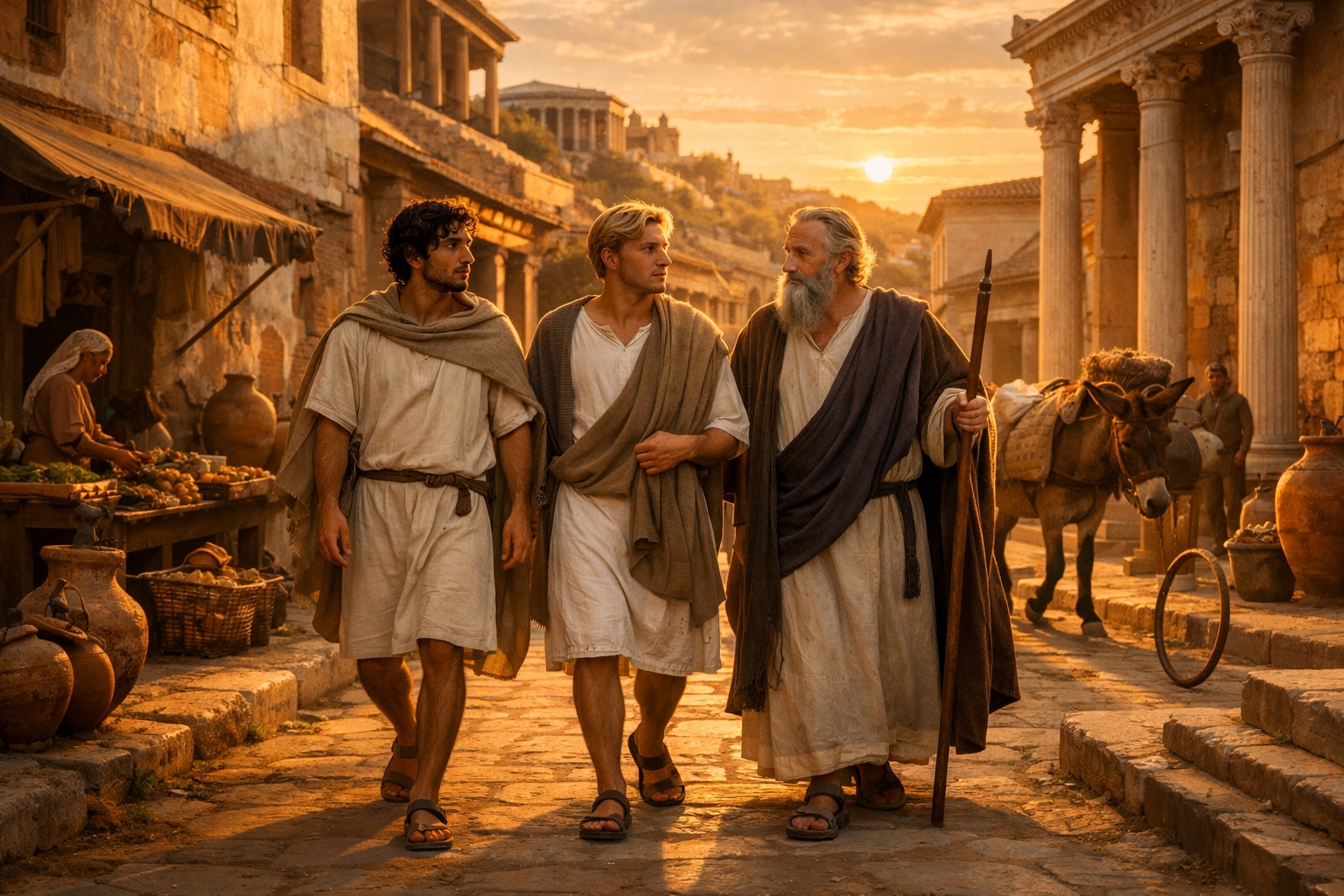
Arriving by ship from Miletus, Lucian was struck by how Pergamum seemed to cling to its hillside
like something alive. The harbor was a forest of masts, merchant vessels from across the
Mediterranean, their crews unloading cargo into warehouses that reeked of fish and olive oil and
foreign spice. The streets rose steeply from the waterfront, paved in stone that had been worn
smooth by centuries of feet, and the houses pressed shoulder-to-shoulder, their balconies nearly
touching across narrow alleys where slaves hauled water and women haggled over vegetables. At the
top of the city, visible from every street, stood the great white Temple of Athena, its columns
luminous against the afternoon sky. Between the harbor and the temple, the city seemed to contain
multitudes—soldiers in uniform, merchant traders with the accents of half a dozen nations, priests
of a dozen gods, slaves and freedmen and the ubiquitous class of minor officials who served the
Roman administration.
The inn where they stayed was respectable enough—a two-story structure built around a central
courtyard, with a kitchen on one side and a small shrine to Hermes in the corner. The innkeeper, a
portly Syrian named Alexandros, knew Philostratos from a previous visit and gave them three
adjoining rooms on the second floor, overlooking the street. There were proper beds, a servant to
bring water, and most importantly, the rooms opened onto a shared balcony where one could sit in
the evening and watch the city settle into dusk. Demetrios unpacked his things methodically,
checking the hinges on the shutters and testing the lock on the door. Lucian stood at the railing,
watching the light drain from the sky and noticing how the soldiers' armor caught the last rays of
sun as they marched in formation toward what must be the garrison.
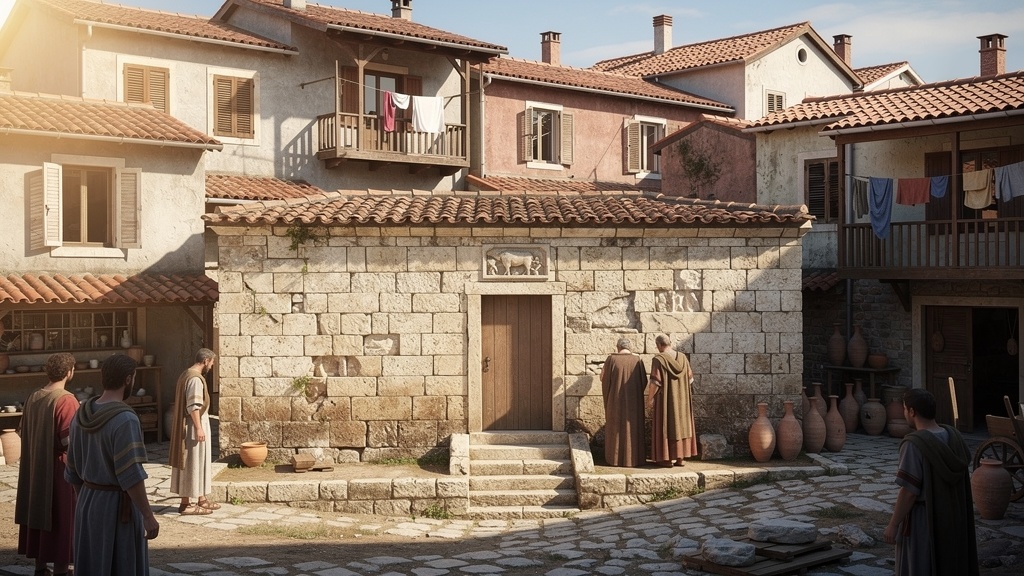
Philostratos led them to an underground temple. "I have heard," he said as
they walked through the marketplace, "that the Mithraic mysteries are the most closely guarded
secret cult in the empire. No one knows what they teach except those who have been initiated. I
have a contact—a man who served with me in Egypt many years ago. He is now a 'father,' a priest in
this temple. I sent word ahead that we were coming."
Demetrios looked skeptical. "Another mystery religion? I thought we were past all this. You're a
Platonist, Philostratos, not a believer in secret initiation rites!"
"I am a believer in understanding," Philostratos corrected. "If Mithraism numbers millions among
the legions and the merchant class, then it needs to be understood. Besides, after what Lucian
has told us of the Christians, I am curious about how these mystery religions compare. Are they
competitors? Influences on each other? Different expressions of the same human hunger for
certainty?"
He glanced at Lucian. "And I suspect you, too, will find this illuminating."
The Descent
The entrance to the mithraeum was not impressive. A narrow door in a plain stone wall, with no
marking to indicate what lay behind it. A young priest answered their knock, a soldier in his day
job, probably, given the military bearing. He led them down a stone staircase that spiraled beneath
the earth. The air grew cool and damp, and the smell changed—earth and incense and something else,
something animal, perhaps sacrificial.
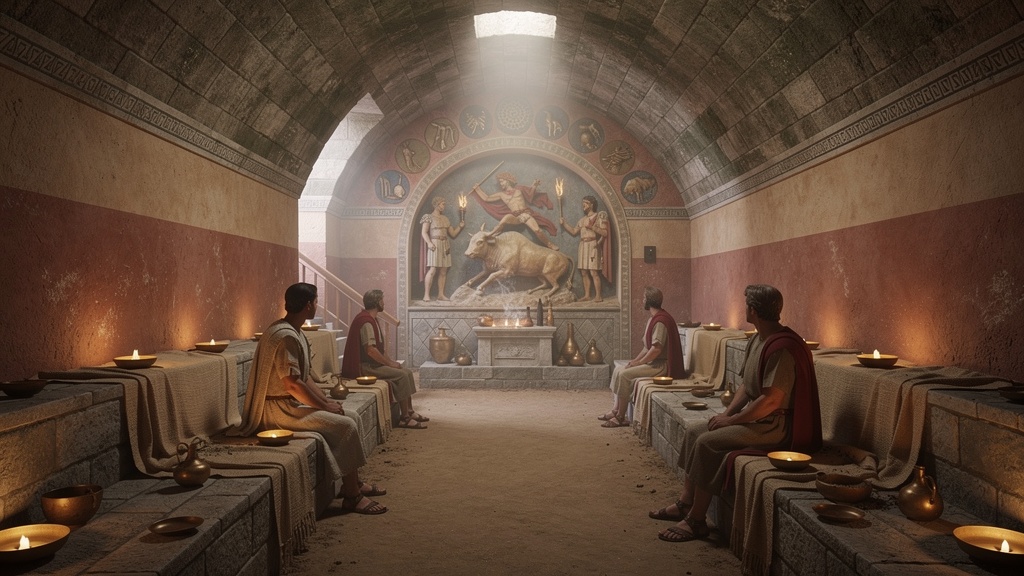
The temple chamber itself was small, much smaller than Lucian had expected. It was carved from
living rock, and the ceiling was low enough that a tall man would have to stoop slightly. Along the
walls on either side were stone benches, arranged as if for a meal. At the far end of the chamber,
carved in relief on the stone wall, was a figure on horseback, dressed as a Persian, driving a
dagger downward into the body of a great bull. Above and below the scene, astrological symbols had
been carved: the zodiac, the planets, the constellations.
At the sight of them, a man stepped forward from the shadows. He was ancient, perhaps seventy, with
a scarred face and the bearing of someone accustomed to command. This was Lucius Corvus, though his
title here was Father. He embraced Philostratos warmly, called him "old friend," and studied Lucian
and Demetrios with appraising eyes.
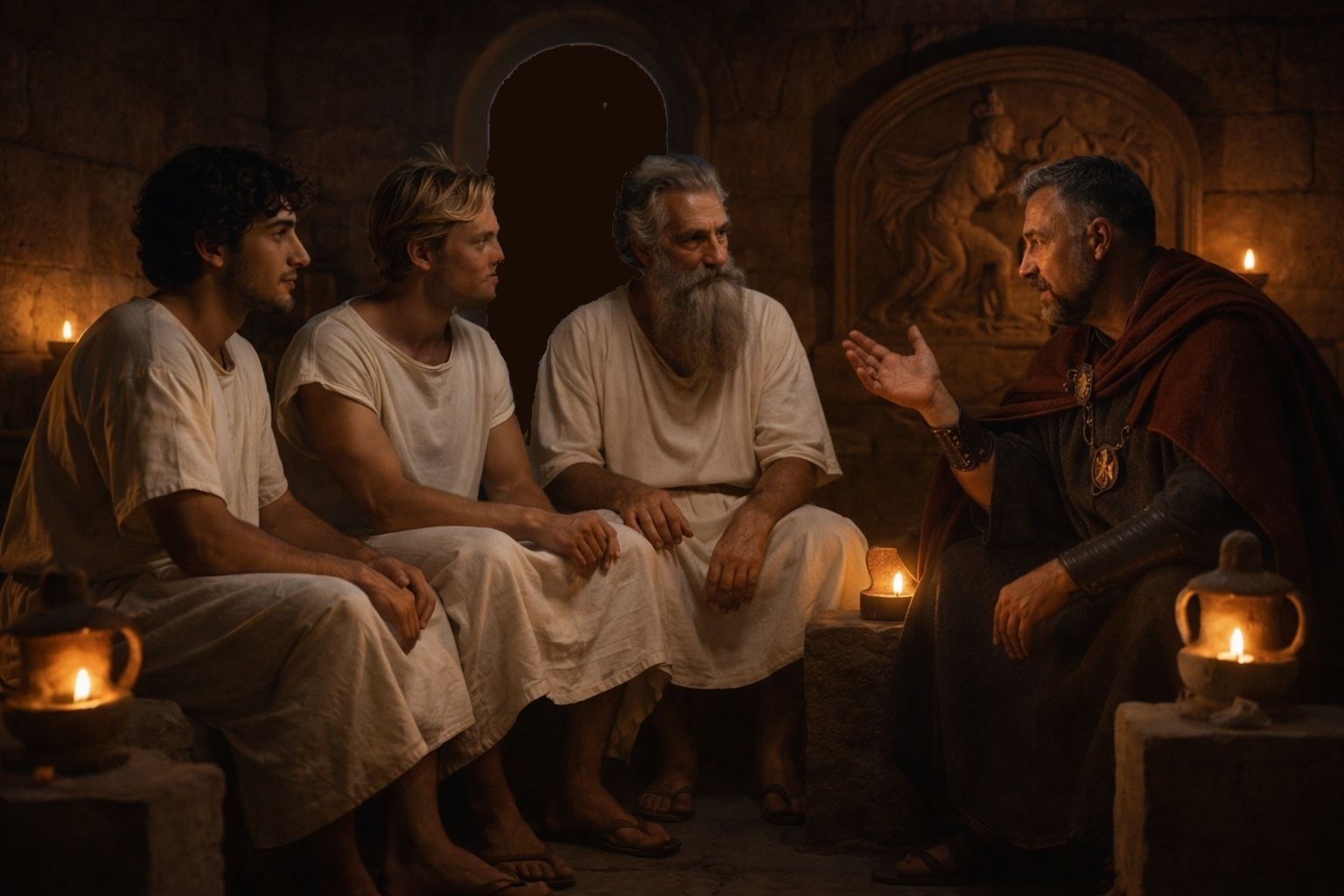
"You want to know the mysteries," Corvus said. "Or rather, you want to understand them as much as
an uninitiated person can. Come. Sit." He gestured to the stone benches.
The Teaching
"In the beginning," Corvus said, his voice dropping as if this were a precious secret entrusted to
them, "there was chaos. And from the chaos arose the cosmic God, whom we call Ahura Mazda, the Lord
of Wisdom. And Ahura Mazda created the world as a battleground between good and evil, between light
and darkness."
He pointed to the relief carving. "From the cosmic God came Mithras, the god of light, the god of
truth, the god of contracts and law. Mithras was born of a virgin on the twenty-fifth of December,
born under a star that shone in the eastern sky. He was attended at his birth by shepherds who
brought him gifts."
Lucian felt something shift in his chest. He sat very still.
"Mithras was a god of the soldiers," Corvus continued. "He taught the virtues that soldiers live
by: courage, loyalty, honesty, the willingness to sacrifice oneself for the good of the community.
And his teaching was simple: the light will ultimately triumph over darkness. But only if each man
chooses to align himself with the light."
"The great act," Corvus said, pointing again to the carving, "was the slaying of the bull. Here you
see Mithras subduing the cosmic bull—the universe itself, created with a dual nature, capable of
producing life but also representing the wild, unbounded forces of chaos. When Mithras drives the
dagger into the bull's heart, he performs the cosmic sacrifice. From that act comes salvation for
those who believe in him. The world is redeemed through his deed."
A young soldier, passing through the temple on some errand, happened to overhear. He slowed, and
called out, "No, Father Corvus. Mithras was crucified. Everyone knows that."
Corvus smiled with the patience of a man accustomed to such corrections. "Many soldiers believe
this," he said, turning to face the young man. "And I do not blame them. The story has spread among
the legions, passed from mouth to mouth. But you mistake a popular belief for the true teaching.
Mithras was not crucified. He is eternal, immortal, divine. What he does is slay
the bull. The bull is what dies. The bull is what is sacrificed. And from that sacrifice comes
redemption!"
The soldier nodded, as if this were a familiar correction, and continued on his way. Corvus turned
back to Lucian.
"You see how easily the true teaching becomes distorted," he said. "But the foundation remains:
Mithras is the god of light and order. Through his great deed—the slaying of chaos itself,
represented by the bull—he brings salvation to the world. And then he descends into the
underworld, into the realm of death itself."
Lucian found his voice. "And let me guess...he rises from the dead?"
"Yes," Corvus nodded with obvious pleasure at the question. "He cannot be held there. His nature is
divine, eternal. He rises. And he ascends to the right hand of God, where he sits as judge and
advocate for those who have followed him."
"This is what the initiate learns," Corvus continued. "That there is a war being fought in the
heavens and on the earth, between the forces of order and chaos, light and darkness, good and evil.
And we are soldiers in that war. Our bodies may be mortal, but our spirits can be eternal, if we
understand the truth that Mithras has shown us, if we align ourselves with the light, if we commit
ourselves to virtue."
"How long has this been taught?" Philostratos asked.
"Centuries," Corvus said. "Mithras was worshipped in Persia long before Rome existed. When the
legions encountered the worship in Egypt and Syria, they brought it back to Rome. Now soldiers from
the Rhine to the Euphrates gather in these temples to remember that they serve not merely Rome, but
a cosmic principle. The triumph of light over darkness. The victory of order over chaos."
Corvus led them to a private chamber, where a simple meal had been prepared: bread, wine, and fish.
As they ate, he explained the structure of initiation. There were seven levels, each corresponding
to a planet, each granting deeper understanding of the mysteries.
"At each level," Corvus said, "the initiate learns more. At the highest level—that of the
Father—one comes to understand that the boundary between the mortal and the divine is not so great
as most men think. That to eat the sacred meal together, to share bread and wine that have been
blessed in the name of Mithras, is to commune with the divine itself. We are not merely followers
of a god. We are participants in the cosmic struggle. We are, in a real sense, part of Mithras
himself."
Demetrios leaned forward. "And this is practiced throughout the empire?"
"In every garrison. In every city where soldiers are stationed," Corvus said. "And among merchants,
too. Trade follows the flag, and so does religion. The worship of Mithras is not bound to any
nation, but speaks to something universal in the human heart: the desire to belong to something
larger than ourselves, to participate in a cosmic drama, to know that our choices matter."
The Recognition
Later, as they climbed back up the stone stairs toward the entrance, Lucian's mind was churning.
And when they emerged into the fading afternoon light of Pergamum, he turned to Philostratos.
"It's almost exactly what the Christians teach," Lucian said quietly. "A god born of a virgin. A
star at his birth. Shepherds bringing gifts. Sacrifice, suffering, resurrection, ascension. A
sacred meal of bread and wine. A promise that those who believe will share in the god's
immortality."
He stopped walking. "Except Mithras was worshipped for centuries before Jesus was born."
Philostratos nodded slowly. "Yes. You are beginning to see something important."
"Did the Christians copy Mithraism?" Lucian asked. "Did they take an older story and apply it to a
man who actually lived?"
"Or," Demetrios suggested carefully, "did they both express something that humans deeply need to
believe? The pattern of death and resurrection, of sacrifice and salvation, of a divine being
willing to suffer for humanity—perhaps this is not a lie told by one religion and stolen by
another. Perhaps it is a fundamental story that the human spirit keeps telling itself."
Philostratos led them to a bench overlooking the harbor. "Consider," he said. "Mithraism speaks to
soldiers. It tells them that their suffering, their discipline, their willingness to die for Rome,
is part of a cosmic drama. It gives meaning to military life."
"Christianity," he continued, "speaks to the poor, the outcast, the enslaved. It tells them that
their suffering matters, that they are loved by God, that the last shall be first, that a god was
willing to be tortured and executed rather than abandon them. It gives meaning to suffering
itself."
"So they're both true?" Lucian asked.
"No," Philostratos said. "But they're both powerful. And perhaps that is the real lesson here. The
truth of a belief system lies not in whether it accurately describes objective reality, but in
whether it transforms the people who hold it. Both Mithras and Jesus transform their followers.
Both create communities, virtue, and purpose. Both promise that this world is not all there is,
that justice and meaning exist beyond the material."
Lucian was quiet for a long moment. "But the Christians claim exclusive access to Truth. They say
that all other gods are demons, all other religions are false. Mithraism doesn't make that claim. A
man can worship Mithras and still honor the old gods, still worship Jupiter or Apollo."
"Yes," Philostratos said. "And that may be their weakness—or their strength. It remains to be
seen."
As the sun descended toward the Aegean, painting the harbor gold and crimson, Lucian found himself
thinking about Hermione, about her absolute conviction that Jesus was the only way, the only truth.
And he thought about Corvus, about soldiers gathering in an underground temple to worship a god who
had died and risen centuries before Rome was founded. And he realized that the question he needed
to ask was not which story was true, but what made a story compelling enough to rewrite human
civilization.