|
By: Paul S. Cilwa |
Posted: 5/14/2026 |
|
Page Views: 13 |
| Hashtags: #HistoricalFiction #LucianOfSamosata #Gaul #Tanno #Brigid #Reunion #Freedom |
| Tanno meets his long-lost daughter after twenty-two years. |
| Estimated reading time: 12 minute(s) (2696 words) |
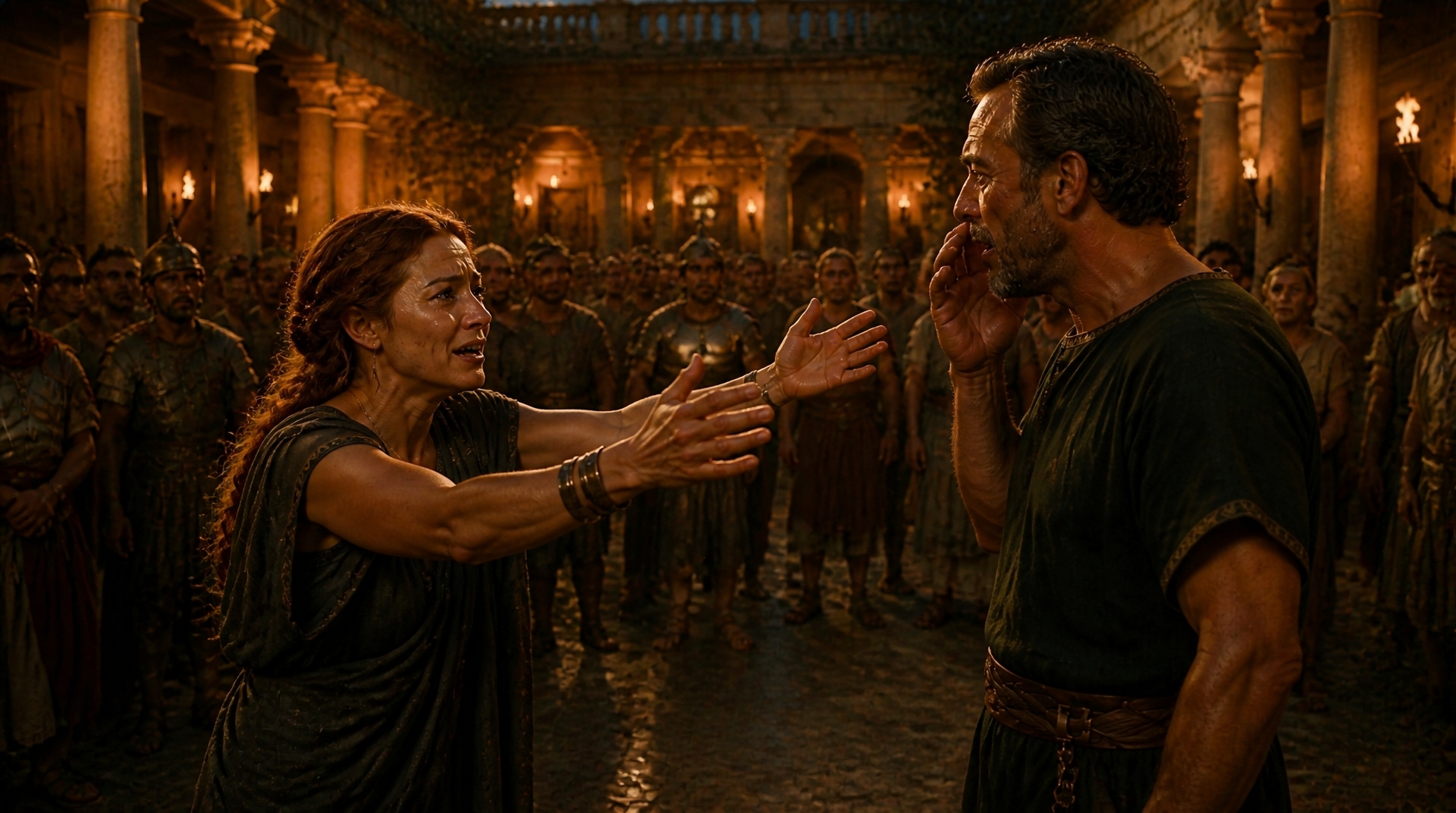
Instead, she stood motionless for a long moment. As if frozen by the
impossibility of what she had just experienced. As if the scream itself had
been the only movement left to her.
And then she moved. She rose slowly to her feet, and her arms came up, held
out before her like a child reaching toward something precious and fragile.
She began to walk, and Lucian, watching her approach through the crowd with
outstretched arms, found himself stepping forward to meet her.
But she walked past him. Walked past him as if he did not exist. Her eyes
were fixed on Tanno, who stood motionless in the center of the courtyard, his
voice still echoing in the evening air.
She reached him, reached out and touched his face with trembling fingers. And
when she spoke, her voice was barely a whisper, cracked with hope and
disbelief:
"Father…?"
For a moment, Tanno did not move. And when he spoke, his voice was hard,
shuttered, a man closing a door.
"No," he said. "No. Your father is dead. He died in the mines. That man
is gone. I'm Marcus. I've been Marcus for twenty-two years."
The woman's hand fell away from his face. But she did not step back.
"You sang that song," she said, her voice steady now, sure. "Only my
father sang it that way. I remember. I was small, and he would sing it while he
worked at the forge. The hammer striking the anvil, and his voice over it,
telling the story of a man searching for what he'd lost. I remember every note.
Every word. I've heard it in my dreams for those same twenty-two years."
Tanno's face twisted. "That was a different life," he said. "A
different man. That man doesn't exist anymore."
"He does," the woman said. "He exists in that song. He exists in your
voice. And he exists in me, because I'm your daughter, and I've carried him
with me all these years."
Something broke in Tanno's face. The hard shell cracked and crumbled. He made
a small sound, something between a sob and a gasp, and his knees nearly buckled.
His hand reached out, grasping for something to hold onto, and found her
shoulder.
"Yes," he said, his voice barely audible. "Yes. I'm your father. I
was…I am…" He stopped, unable to finish.
"Brigid," Tanno whispered, and then he blinked, as if seeing something
far away, as if the word was reaching him from across an impossible distance.
"Brigid. I haven't heard that name in twenty-two years."
Lucian stepped back, understanding. And when he looked at Tanno's face, at
the way his hand came up to hold hers, at the way tears began to flow, Lucian
understood that some moments do not belong to rhetoric, do not belong to
performance. Some moments belong only to the people who have been waiting
over two decades to find each other again.
Lucian moved toward them both. "Come," he said quietly. "Not here.
Not like this. This is not the place for what you're feeling."
She let him guide her, still silent, still staring at Tanno as if he might
dissolve into smoke if she looked away. Stephanos appeared with practical
efficiency and led them through a side passage into the private quarters behind
the courtyard. It was a merchant's house, not richly appointed but comfortable,
smelling of oil and spiced wine.
Lucian settled the woman in a chair near a brazier. She was perhaps thirty
years old, with brilliant red hair the color of autumn leaves, but
Tanno's same sharp cheekbones and the same
intensity in her eyes. But where Tanno's intensity came from suffering, hers
came from something else. From intelligence. From having survived and learned.
Tanno had followed them silently through the passage, and now he stood in
the doorway, afraid to enter, as if crossing the threshold might shatter
whatever strange magic had brought him to this moment.
"Brigid," the woman said finally, her voice shaking. "My name is
Brigid." She looked at Lucian. "Please. Leave us. Whatever happens next,
this is…this needs to be private."
Lucian nodded and withdrew, though not before seeing the way Tanno's eyes
filled with tears at the sound of her name. A name he had never
expected to hear again.
Twenty-Two Years
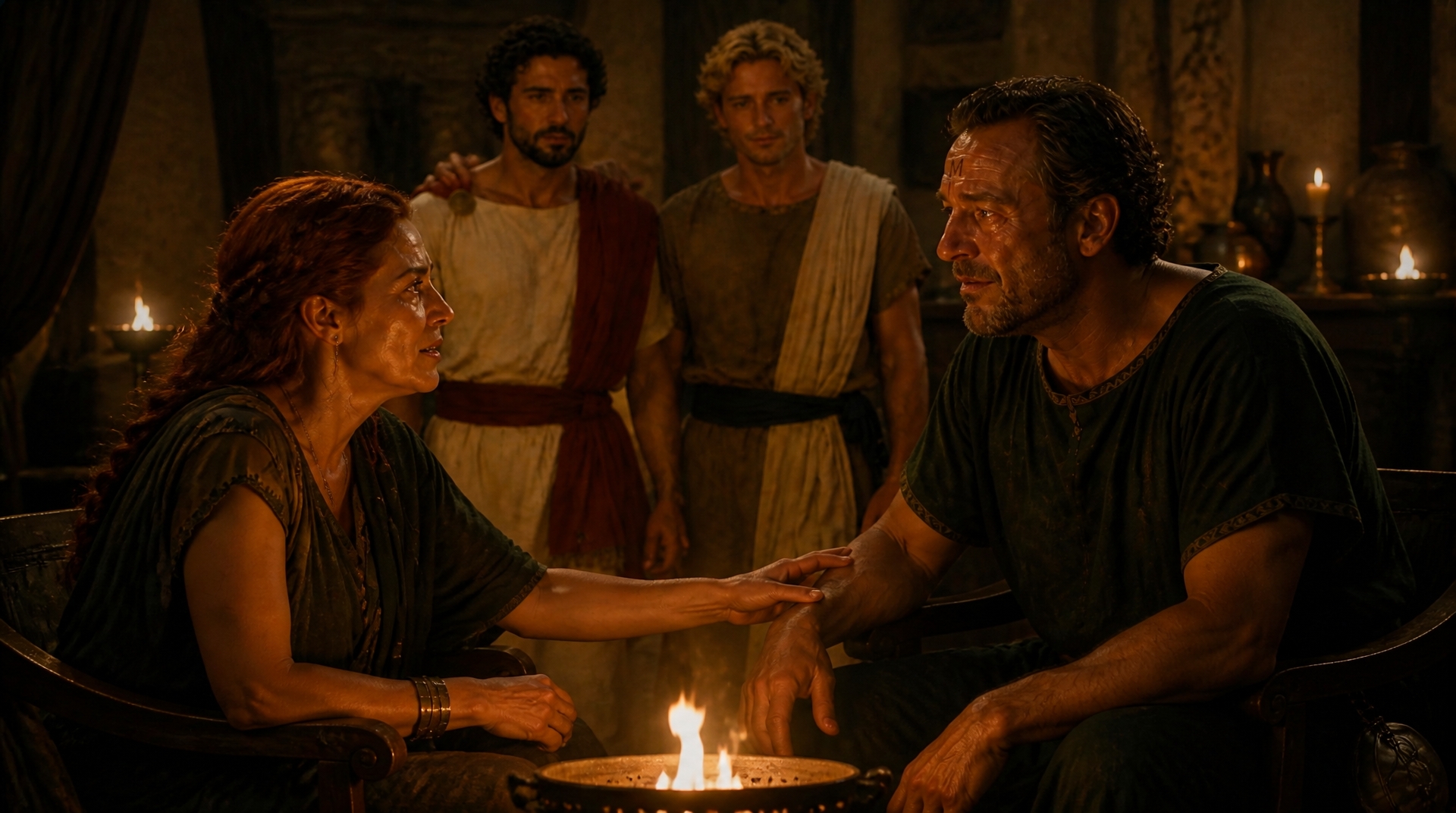
When Lucian returned an hour later, they were sitting by the brazier, their
chairs close together but not touching. Tanno's face was wet. Brigid's was very
still, the way a person's face becomes still when they are barely holding
themselves together.
Brigid looked at Lucian. "My father," Brigid said quietly, measuring her words,
"was a smith. A good one. We lived on the outskirts of our village, far enough
away that Father could work without the noise disturbing others. We had a good
life. A respected life. The Romans changed that. Not all at once. But they kept
coming. Taking more. Demanding more."
She paused. Tanno reached over and took her hand.
"Months passed. Then one day…cavalry. A lot of them. They came from
the far end of the village, moving fast, burning as they went. We all could hear the
screams. Mother grabbed me and Dubnos and told us to run for the forest. Run for the
old oak tree we had played under. She said she would follow. She said to hide
and not come out until it was quiet."
"Father…my father stayed. I remember him. He tried to slow them down.
Some of the other men did too. The only weapons they had were Father's smithy tools. But they
fought so we could get away."
Brigid took a deep breath and blew it out, as if she was exhausted from having
had to carry this weight for so long.
"Mother ran with us at first. Carrying Dubnos, helping me along. But then she
put the baby in my arms and told me to keep going. She said she had to go back.
She said she had to help Father fight. I
didn't understand. I was eight. I just knew she was leaving."
Tanno made a sound like he had been struck.
"I found the tree," Brigid continued, her voice quavering. "The hollow
we used to play in. I put Dubnos inside and I climbed up into the branches. And
I waited. For hours. For a very long time. When the smoke finally stopped coming,
and everything was quiet…I climbed down. Dubnos was crying, but he was
alive."
"The village was gone. Everything was ash. There were bodies…" She
stopped, unable to continue for a moment. "I found Mother among the ruins. She
was…she had tried to protect the house. Or maybe they found her trying to
run. I was eight. I didn't understand what I was seeing. I just knew she wouldn't
wake up. That Father wasn't coming home. That everything was burning."
"I wasn't alone," Brigid said. "There were others. Some older children.
A few women who had hidden or escaped. We banded together. We decided to walk
toward Lugdunum. It was the only city we knew was still standing. It took weeks.
We had almost no food. Dubnos got sick several times. But he lived. We both
lived."
The Merchant's House
"When we got to Lugdunum," Brigid said, "we had nothing. The band
split up. Some people tried to find work as laborers. Some…some disappeared
into the worst parts of the city. I knew I couldn't let that happen to Dubnos.
I was still a child, but I looked older than I was. I looked desperate. I
looked like work."
"I went to the merchants' quarter. I found a house that looked large
enough to need help, and I knocked on the door. An older woman answered. I
told her I would do anything, that I had a little brother, that we needed
shelter and food. I didn't ask for pay. I just asked for shelter."
"She was named Philippa," Brigid said, and there was warmth in her
voice when she said the name. "She asked me where I was from. I told her the
truth. She told me that many people had come to Lugdunum in the last years,
displaced, scattered, looking for something they couldn't name. And she took
me in."
Lucian found himself leaning forward, caught in the story.
"Philippa's husband was a grain merchant," Brigid continued. "Not the
richest merchant in Lugdunum, but comfortable. Respected. They had two children
of their own, both older than me. And they had room for one more. Dubnos and I
were given a small room in the servants' quarters. I was given work. Light work
at first, since I was still small. Cooking. Cleaning. Caring for the house."
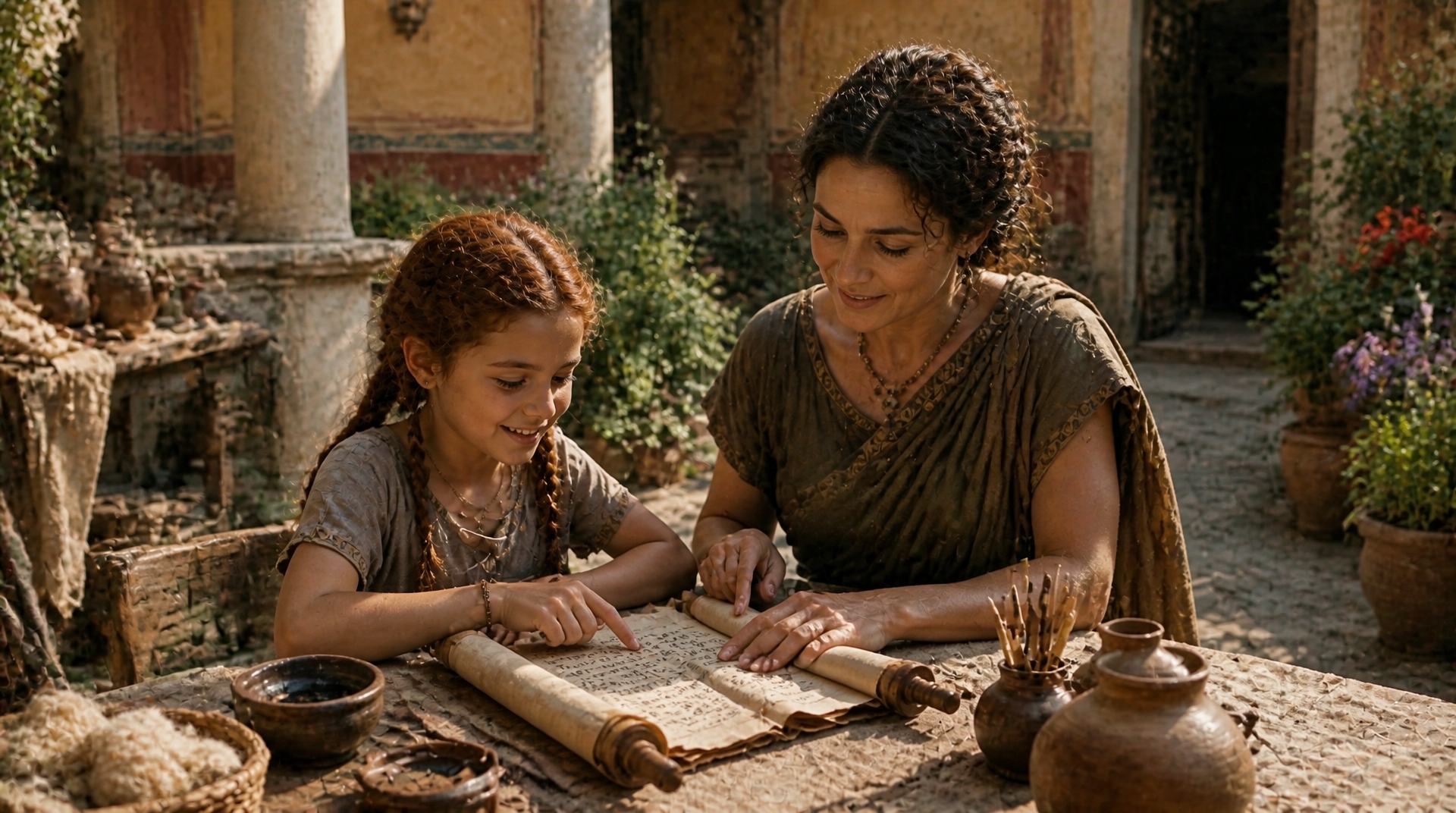
"But Philippa did something unexpected," Brigid said. "She taught me.
Not how to be a better servant. She taught me to read. To count. To understand
commerce. She said that every person, no matter their origin, deserved to have
choices. That if I was going to survive in this world, I needed more than a
strong back. I needed a mind."
"Dubnos grew up in the household. Philippa's husband, Marcus, treated him
like another son. He taught him the merchant trade. We were never officially
adopted. Never formally freed from being stateless refugees. But we were never
treated as slaves or servants. We were…family. In every way that mattered."
"And you?" Lucian asked. "What did you become?"
Brigid smiled, and it transformed her face. "I became a partner in the
business," she said. "My mind was good for commerce. I had a gift for
understanding what people needed and what they were willing to pay for it. And
I had something else: I understood both sides. The Roman side and the Gaulish
side. Many merchants here are purely one or the other. I could move between
them. I could see opportunities they couldn't see."
"Philippa's children didn't mind sharing the business with me. The oldest
married and moved away. The younger—Alexios—and I became close
collaborators. And then we married."
Tanno made a small noise, and Brigid squeezed his hand. "He's a good man,
Father. He knows where I come from. He knows what survival cost me. And he
respects it. We have built something together. A business. A life."
The Price of Freedom
Lucian cleared his throat. "And your brother?" he asked.
"Dubnos manages the southern trading routes," Brigid said. "And Alexios,
my husband, was supposed to attend the rhetor's performance at Stephanos'
courtyard. He had business with Stephanos—grain contracts, pricing
negotiations. He wasn't feeling well the day of the performance, so I went in
his stead.…"
She stopped. Her hands trembled.
"I hadn't thought about my father in over ten years," Brigid said quietly.
"I mean, I thought about him sometimes, of course. But not…not in any
real way. He was a memory from childhood. A ghost. Someone who had died
before I was old enough to truly remember him. I mourned him when I
was eight, and then I had let him go. There'd been so many bodies, all burnt
beyond recognition, that I couldn't even be sure which one was him.
But one of them had to be him. How could it not?"
"And then you sang," she said to Tanno, her voice cracking. "And I…I
didn't recognize you. Not at first. But the voice…the way the words came
out, the Gaulish lyrics, the emotion…it all came back. Not
as a memory. As a feeling. And I screamed because suddenly I was eight
years old again, and I was hearing my father sing while he worked at the forge,
and I couldn't breathe."
She began to cry, finally, the tears flowing freely. "That voice. I had
buried it so deep I didn't even know I was carrying it. But when I heard it
again, it was like you reached back across twenty-two years and pulled me
underwater. Like you made it real again. Made you real again."
Tanno pulled her toward him, and she rested her head on his shoulder, just as
she might have when she was eight years old and the world had fallen apart.
Lucian gave them a long moment before speaking again. "What do you want to
happen?" he asked quietly.
Brigid lifted her head. "I want to buy my father's freedom," she said
simply. "I understand that he is your slave. I understand that you own him.
I have money. Considerable money. What is your price?"
Lucian hadn't dared hope for this. He had grown to love Tanno, but he had
never wanted to own a slave. It was all he could manage to be responsible for
himself, let alone another person. But the
law said Lucian owned Tanno. The law said Tanno's body, his labor, his voice all
belonged to Lucian.
"I bought Tanno with the intention of freeing him," Lucian said.
"But he didn't want that, and I vowed to honor his choice and not free him."
Lucian grinned. "Unless he changed his mind. What do you say, Tanno?
Will you release me from my vow?"
"No," Tanno said.
Both Brigid and Lucian looked at him.
"You paid money for me," Tanno said. "You should at least be reimbursed for that."
Lucian burst out laughing. "Are you joking?" he asked. "You taught me better
Latin, and Gaulish. Tanno, money isn't everything. It's not even the most important thing.
You have given me so much more than I could have ever paid for. You have given me your
voice, your story, your friendship. No, Tanno; you don't owe me anything.
It is I who am in your debt. Please let me free you.
Let's not have one of those dramatic scenes where I pretend to hate you and throw you
out."
There was a pause. A long pause. Finally, Tanno spoke.
"I thought my family was dead. I thought I was dead. But I was wrong
about the first, and I was wrong about the second. So, yes…I release you from
your vow."
Demetrios, Lucian and Brigid all exhaled as one, none of them having been aware
they'd been holding their breath.
"There will be documents," Lucian remarked after a moment. "Demetrios can arrange
them. It will cost money to make it legal, to make it official, so that no one
can dispute it. That cost will be minimal, and if you wish to cover it
from your earnings, I won't argue."
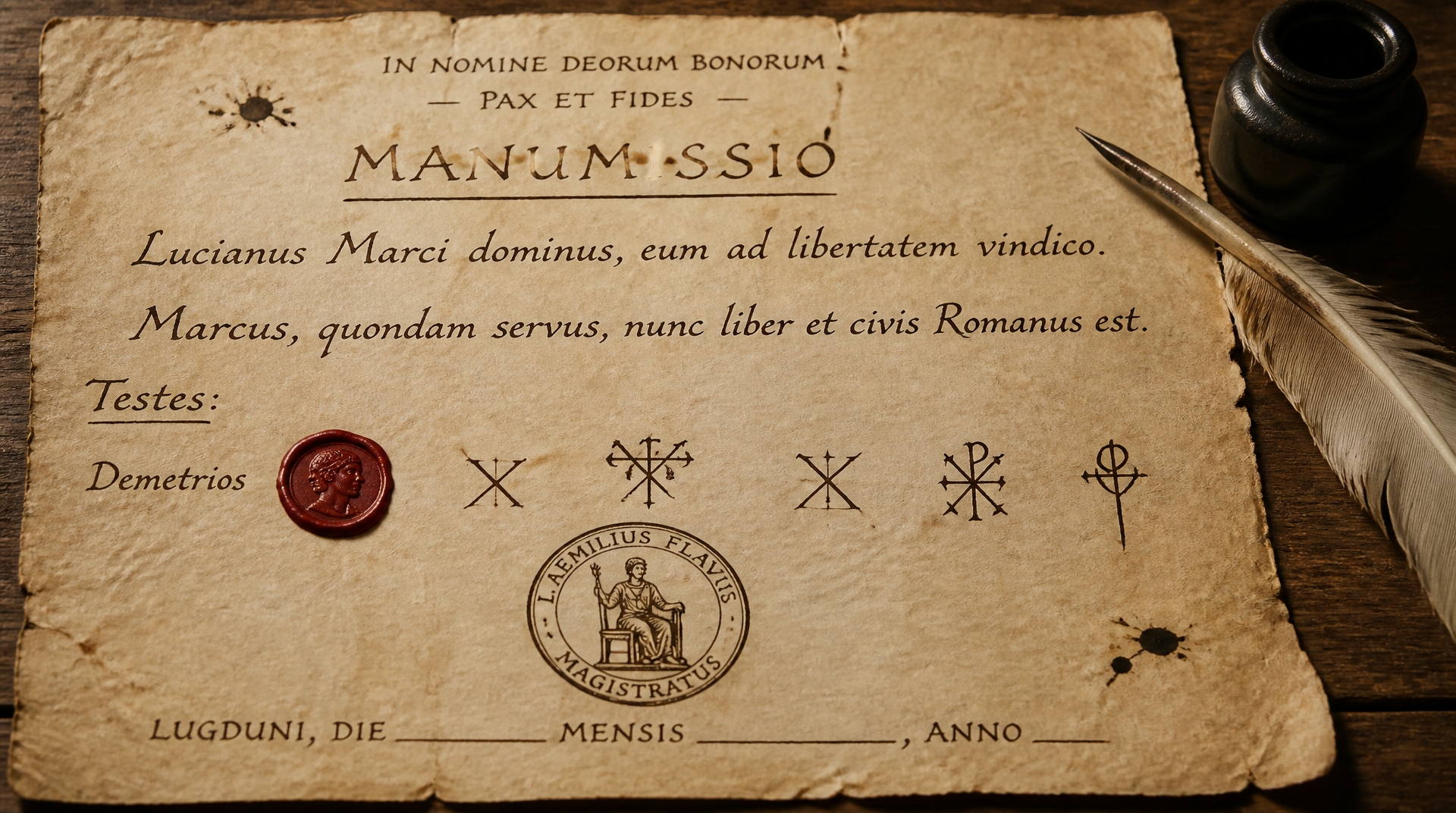
The next morning, Lucian, Demetrios, Tanno, and Brigid made their way to the
magistrate's office in Lugdunum. For a smaller city than Rome, the paperwork
moved with surprising efficiency. The magistrate, a practical man accustomed to
dealing with merchants and business affairs, required the following:
Demetrios and Brigid both stood as witnesses. A scribe recorded the
transaction. A fee was paid (modest, as Lucian had promised). And then, with
a few words in Latin, "Marcus" ceased to be a slave and became a free man. A
libertinus, bearing the name Marcus but now with the rights and status that
freedom carried.
When it was done, Tanno looked down at the document as if it might vanish if
he looked away. Brigid reached over and squeezed his hand.
"Brigid has offered me work," Tanno said. "With the business. With her
husband. They need someone who understands both the Roman and Gaulish sides of
trade. Someone who can navigate between them." He paused. "I think I can
do that."
"I think you can too," Lucian said. "Which makes this goodbye. Tanno,
when you think of me, if you ever do, I hope you think of me as a friend,
not a master. Because I never thought of you as a slave."
In response, Tanno hugged Lucian and kissed his cheek—something no slave
would have dared to do.