|
By: Paul S Cilwa |
Posted: 3/28/2026 |
|
Page Views: 170 |
| Hashtags: #Science #ScientificMethod #Neanderthals #Evolution #CriticalThinking #Epistemology #Vaccines #Supplements |
| From bathtub experiments to birch tar distillation, a look at how science became science—and why some brains handle it better than others. |
| Estimated reading time: 13 minute(s) (3010 words) |
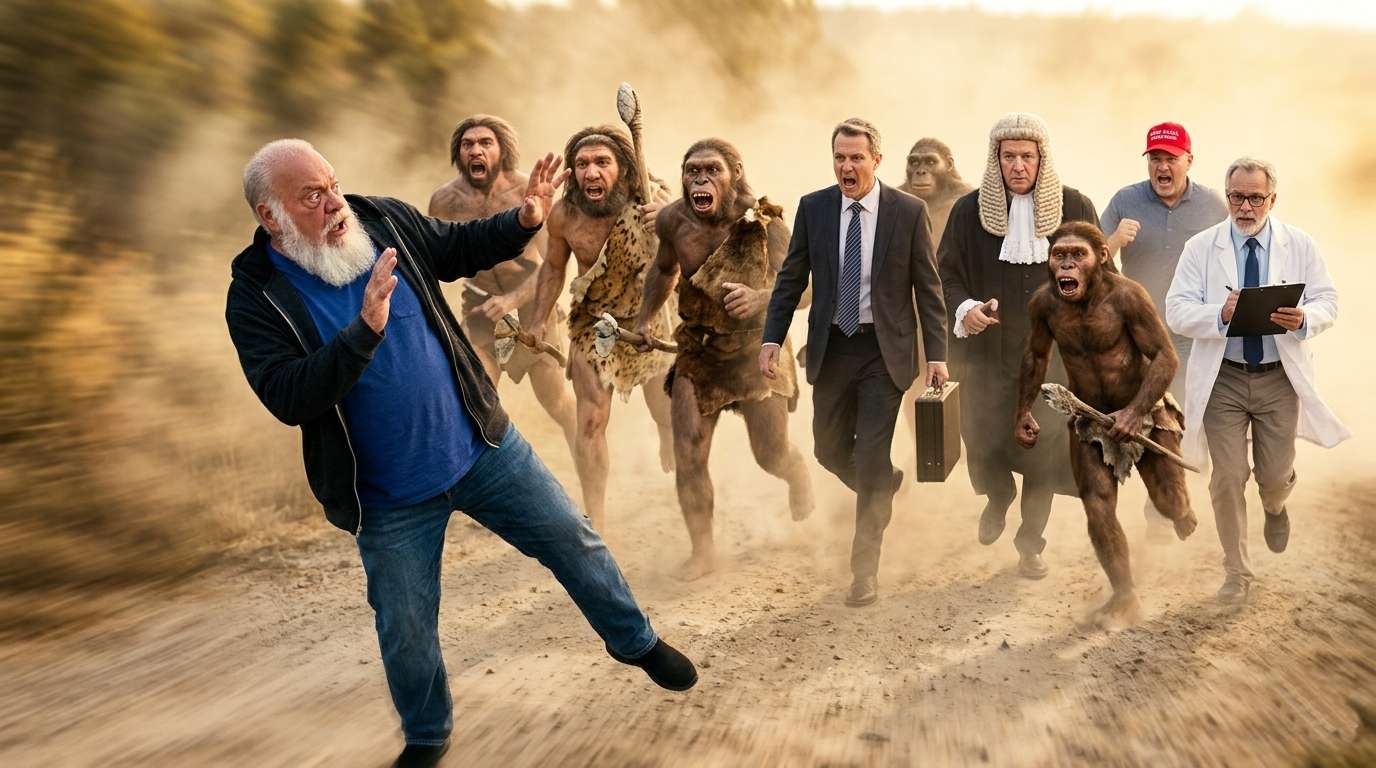
Humans are curious. It's our defining trait—more
than language, more than tool use, more than our questionable
taste in headwear. Long before anyone thought to name it, we
were doing science: poking things, tasting things, dropping
things off cliffs to see what would happen. The formalization
came later. The curiosity was always there.
Science is the approach favored by the branch of humanity that prefers evidence over
wishful thinking. And it's gotten us as far as we've come,
no thanks to any other method. We wouldn't have electricity, or
smart watches, or vaccines, or antibiotics, or the internet, or the…
well, you get the point.
But curiosity alone isn't science. A cat is curious. A
toddler is curious. What makes science science is
what you do after you poke the thing: you write down what
happened, you poke it again to see if it happens the same
way, and—this is the hard part—you accept the
result even when it isn't what you wanted.
The Long Crawl Toward Method
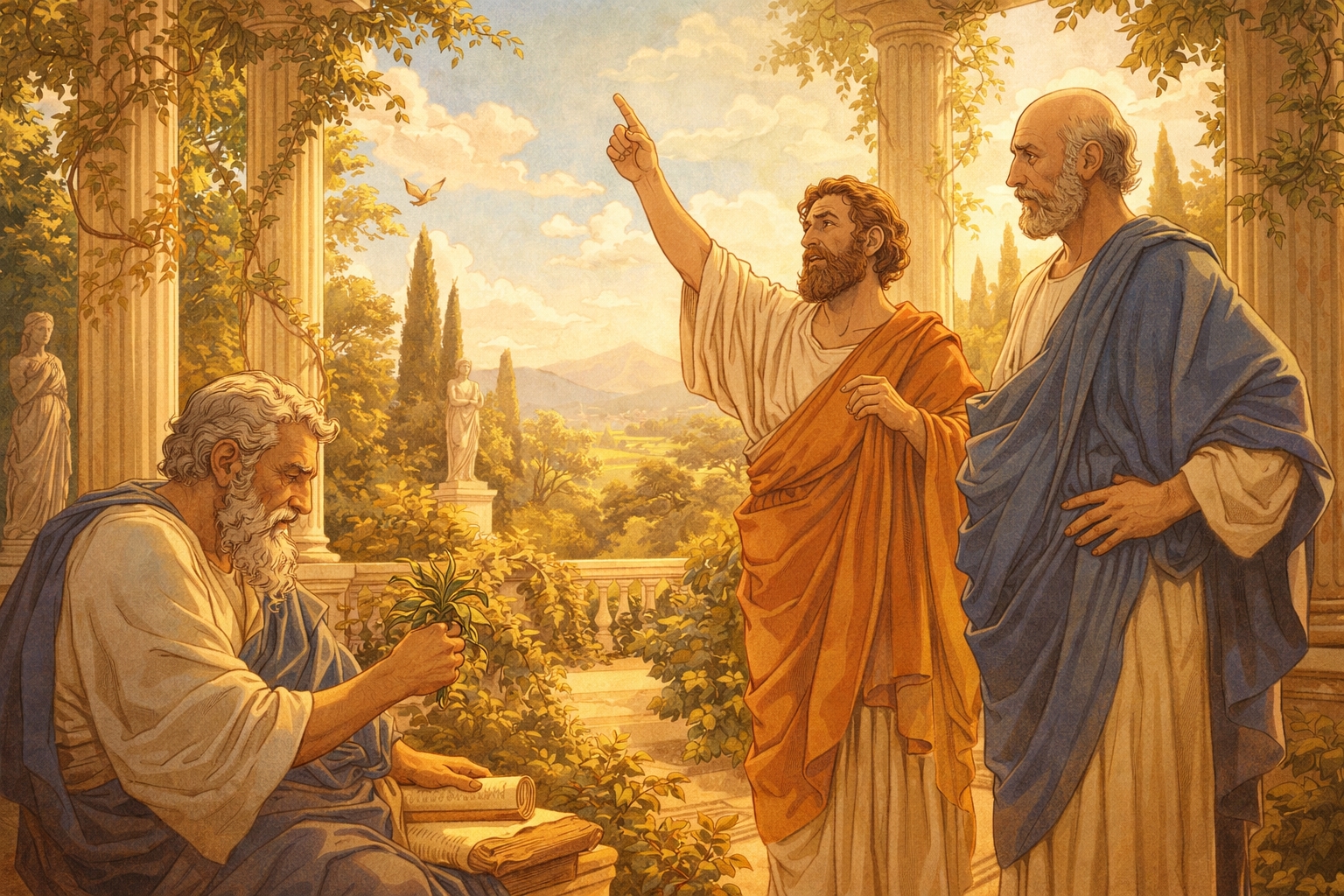
For most of human history, the answer to "why does that
happen?" was some version of "because a god wanted it to."
Thunder was Zeus being irritable. Disease was divine
punishment. The Nile flooded because Isis wept. These weren't
stupid explanations—they were the best available ones in
a world where nobody had yet thought to ask whether
explanations should be testable.
The ancient Greeks were the first to seriously propose
that natural phenomena might have natural causes. Thales
suggested that water was the fundamental substance of the
universe. He was wrong, but he was wrong in the right
way—he was looking for a physical explanation
rather than a mythological one.
Aristotle took it further, championing systematic observation
and classification. He catalogued animals, studied embryology,
and developed formal logic. He also decided that heavier
objects fall faster than light ones, which anyone with a
rock and a pebble and two seconds of spare time could have
disproved—but nobody did for almost two thousand years,
because Aristotle Said So.
And then there was Archimedes, who noticed that water
rose when he got into his bath and realized he could use
displacement to measure volume. He allegedly ran through
Syracuse naked shouting "Eureka!" (Well,
who among us hasn't?) which raises questions
about ancient Greek bathing customs, but never mind.
The point is, the Greeks had the raw materials: observation,
logic, experimentation. What they lacked was a system.
They had brilliant individuals doing brilliant things, but
no framework for building on each other's work or, critically,
for correcting each other's mistakes. Which is how Aristotle's
error about falling objects survived unchallenged for
nineteen centuries.
The Part Everyone Forgets

Ask most people when the scientific method was invented
and they'll say "the Renaissance" or, if they paid attention
in school, "Francis Bacon." They're wrong by about six
hundred years.
In 1011 CE, an Arab scholar named Ibn al-Haytham—known
in Europe as Alhazen—published his Book of Optics,
in which he did something revolutionary: he described a
systematic method of inquiry based on controlled experiments,
reproducible results, and hypothesis testing. He didn't just
do science. He wrote down how to do science,
so that others could do it too.
The Islamic Golden Age produced an extraordinary run of
scientists, mathematicians, and physicians who built on each
other's work in exactly the way the Greeks hadn't quite
managed. Avicenna systematized medicine. Al-Khwarizmi
invented algebra (the word itself is Arabic). They preserved
and extended Greek knowledge while Europe was busy with the
Dark Ages.
When the Renaissance finally arrived, Francis Bacon (1620)
and Galileo picked up where the Islamic scholars left off,
adding mathematical rigor and institutional frameworks. But
they were refining a method, not inventing one. Credit where
it's due.
The Neanderthals Were Doing It First

Here's where it gets interesting. We tend to think of
science as a modern human invention. But recent archaeology
suggests that our Neanderthal cousins were proto-scientists
tens of thousands of years before Archimedes' bath.
The evidence is birch tar. Neanderthals were making this
adhesive at least 190,000 years ago, using it to attach
stone points to wooden shafts. That alone is impressive.
But chemical analysis of actual Neanderthal tar samples
from Konigssaue, Germany (over 43,000 years old) revealed
something remarkable: they weren't using the simplest
method. They were distilling tar in an underground
environment that restricted oxygen flow—a process
they couldn't even see while it was happening.
This level of technique doesn't get invented in one
afternoon. It requires starting with a simpler method,
observing the results, making adjustments, observing
again, and iterating over generations. That's not instinct.
That's experimental method. That's cumulative cultural
evolution. That's science, minus the lab coats.
And it doesn't stop there. Dental plaque from Neanderthals
at El Sidron cave in Spain contained traces of chamomile
and yarrow—bitter, nutritionally worthless plants
that are medicinal. One individual's plaque showed both
a gastrointestinal pathogen and traces of
Penicillium fungus and poplar bark (natural sources of
antibiotic and aspirin). That Neanderthal appears to have
been self-medicating with targeted remedies for a specific
illness. Fifty thousand years ago.
The Thing That Got Overturned

Here's the part that separates science from everything
else: science is allowed to be wrong.
For decades, every doctor in the world knew that
peptic ulcers were caused by stress. It was in the textbooks.
It was established consensus. Patients were told to relax,
reduce their anxiety, change their diets, and come back
when the ulcer got worse (which it always did, because
stress doesn't cause ulcers).
In the early 1980s, two Australian researchers named
Barry Marshall and Robin Warren proposed that ulcers were
actually caused by a bacterium: Helicobacter pylori.
The medical establishment laughed. Literally. At conferences.
To their faces. Everyone knew bacteria couldn't
survive in stomach acid. Everyone knew ulcers were
a lifestyle disease.
Marshall, unable to get anyone to take him seriously,
did the most scientist thing imaginable: he drank a petri
dish full of H. pylori culture, gave himself an
ulcer, and then cured it with antibiotics.
He and Warren won the Nobel Prize in 2005. The textbooks
were rewritten. The old consensus was replaced by the
new evidence. And that's the point: science isn't a
collection of facts. It's a process for replacing
wrong facts with less-wrong facts. The willingness to be
overturned is the feature, not the bug.
Three Kinds of Brains
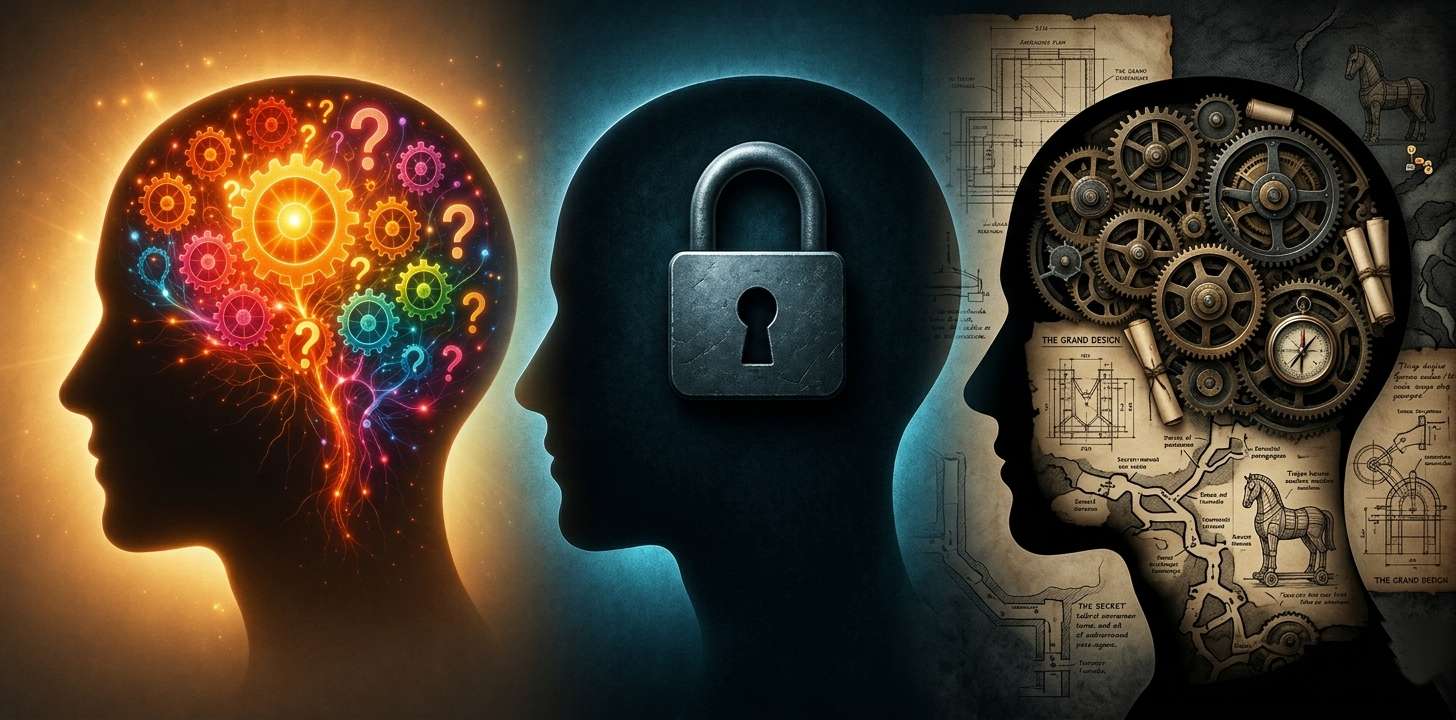
And this is where I'm going to make some people
uncomfortable. Because in my observation, there are three
fundamentally different kinds of human minds when it comes
to knowledge.
The first kind wants to know. Knowers understand
that knowing is an ongoing process—that each new
discovery opens new questions, and the answers to those
may invalidate what you thought you knew, and sometimes
you have to start from scratch. Knowers find this
exhilarating. The shifting ground isn't frightening;
it's the whole point. The universe is more interesting
than any fixed story about it.
The second kind needs to believe. Believers can only handle
unchanging truths. That no such thing exists is beside the
point. Their brains are simply not built to handle the
complexity of a shifting backdrop of sometimes-conflicting
observations. They need the answer to stay the same once
they've learned it. New information doesn't update their
model; it threatens it. And threatened brains don't
reason. They dig in.
This isn't stupidity. I want to be very clear about that.
It's inflexibility. A Believer can be brilliant at
math, fluent in three languages, and an accomplished
surgeon. No one could love their families more.
But show them evidence that contradicts something
they've already filed under "settled," and the drawbridge
goes up.
The third type is extremely flexible and so is like the Knowers
in that regard. But they utterly lack empathy, and so make perfect Rulers.
They can send people to war, destroy the environment, and cause suffering on a massive scale without a second thought,
because they don't care about the people or the planet. They just care about power and control.
The Trap Everyone Falls Into
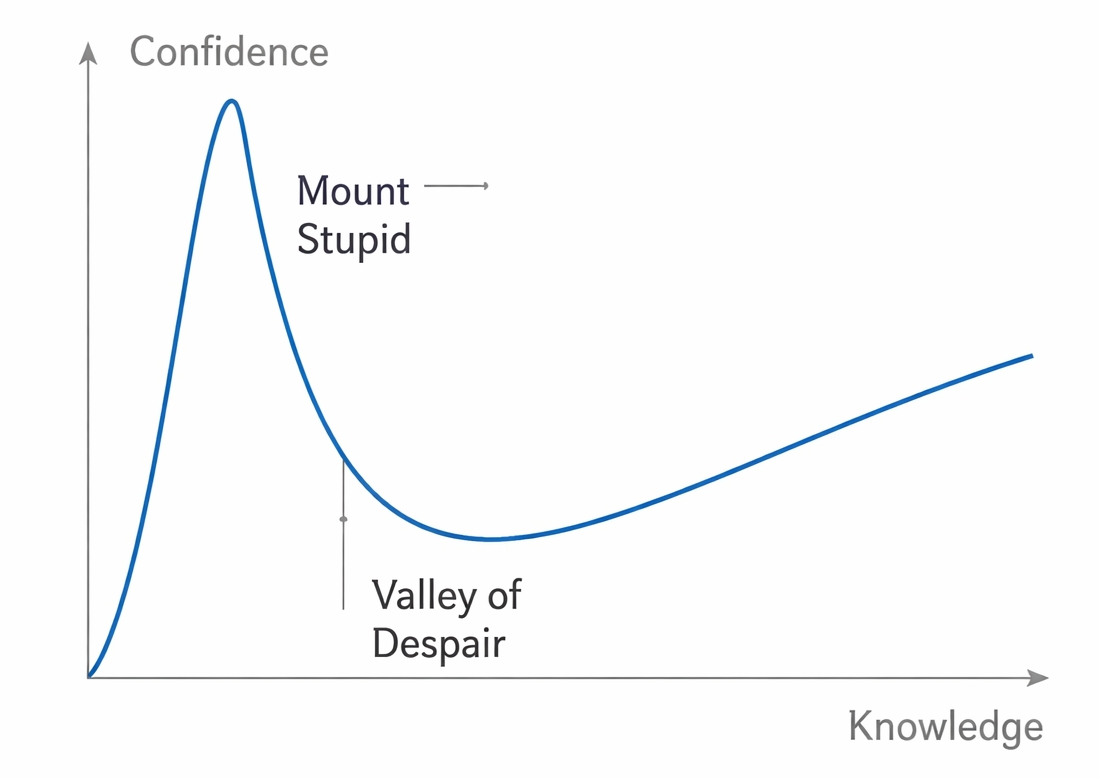
In 1999, psychologists David Dunning and Justin Kruger
documented something that experienced teachers had always
known: the less you know about a subject, the more confident
you are that you understand it. They called it the
Dunning-Kruger effect, and it is devastatingly universal.
Then, if you keep learning, something horrible happens:
you realize how much you don't know. Your confidence
crashes into the Valley of Despair. This is where most
people quit, because feeling ignorant is uncomfortable.
But if you push through—keep reading, keep questioning,
keep finding out how wrong you were—your confidence
slowly rebuilds on an actual foundation of knowledge. It
never gets as high as it was on Mount Stupid, because now
you know enough to know what you don't know.
I saw this firsthand at the EPA in 1978. My first
assignment as a co-op student was to rewrite a monthly
COBOL report in PL/I. I did, tested it, and handed the
printout to my boss's boss—let's call him Dork, since
I've mercifully forgotten his real name. He didn't open it.
Didn't glance at a single page. He just hefted it and said,
"That's not right. It has to be twice that thick,"
pointing at a shelf of previous months' reports with dusty
tabs separating them.
I went back and rechecked my code. Got a co-worker to
recheck it. Ran it again. Same output. Finally, my
co-worker, who'd been there for years, whispered: "You
know, he never actually reads that report. No one
does. We run it, and no one ever even opens it."
There was, I noticed, a lot of dust on those tabs.
So, feeling very guilty, I added one instruction to the
batch job submission card: COPIES=2. Submitted
my unchanged program. The printout was now twice as thick.
I handed it to Dork, who beamed. "That's right!" he said,
and added it to the shelf. Without opening it.
That man was confident. He had no doubt whatsoever that
he knew what a correct report looked like. He was standing
on the summit of Mount Stupid, and the view was
magnificent.
Everyone is susceptible to this. Everyone. Knowers
aren't immune; they just know the trap exists, so they
compensate by continuing to research after they
think they've found the answer. That second round of
digging—the one you do when you already feel
confident—is where the real learning happens. It's
also where you discover that the first three sources you
read were oversimplified, or biased, or funded by someone
with a financial interest in the conclusion.
An AI, in theory, should be immune to the Dunning-Kruger
effect. It doesn't have an ego invested in being right.
But it relies on information created by humans, who do.
So the bias comes in through the back door: not in the
AI's confidence, but in the training data's blind spots.
Garbage in, confidently presented garbage out.
How This Plays Out

A Knower gets vaccinated after studying the evidence.
If a particular vaccine later turns out to be ineffective,
defective, or dangerous, the Knower stops taking that
vaccine. They don't then dismiss all vaccines as
dangerous, because that would be insane. Each vaccine is
its own evidence set.
A Believer, upon learning that one vaccine had problems,
concludes that all vaccines are a scam and always were.
The specific failure doesn't update a data point; it
confirms a narrative. "See? I knew they were
lying to us."
A Knower takes supplements after studying them—not
one second after watching a YouTube video extolling their
virtues, but after reading the actual research, checking
for conflicts of interest in the studies, and starting
with conservative doses. Should a supplement be disproven
by additional studies, the Knower stops taking that
supplement. They don't stop taking all supplements,
because again: each one is its own evidence set.
A Believer either takes everything a charismatic guru
recommends or takes nothing at all, because the entire
category has been filed under "trust" or "don't trust,"
and individual evaluation isn't how their filing system
works.
A Taxonomy Nobody Asked For
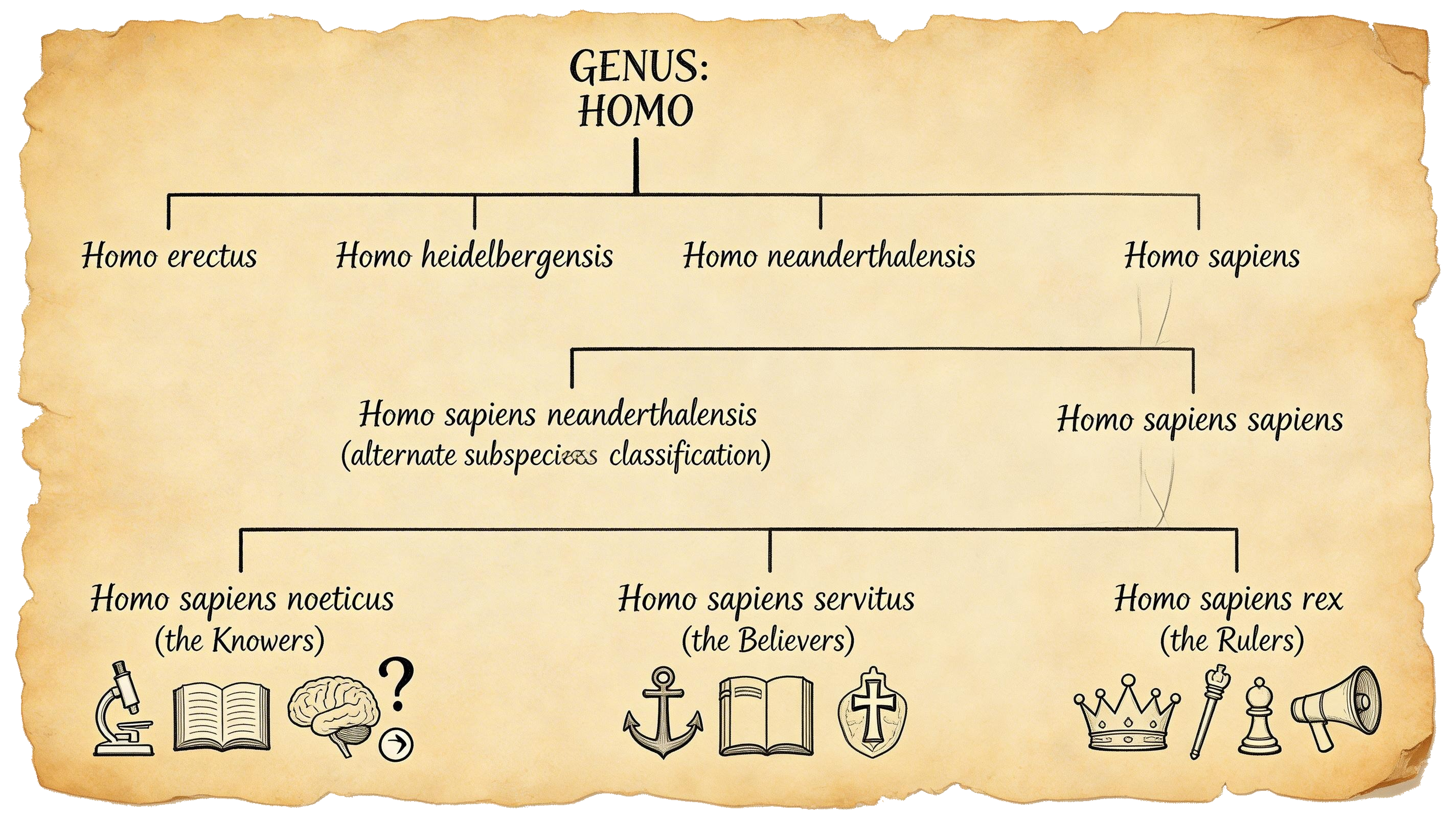
In my entirely unofficial, will-never-be-peer-reviewed
personal taxonomy, I've come to think of humanity as having
three subspecies. Not races—these cut across every
ethnicity, nationality, and income bracket.
Homo sapiens Noeticus: the Knowers. Named from
the Greek noetikos, meaning "of or relating to the
mind." These are the people who update their models when
new evidence arrives. They're not always right, but they're
always willing to be wrong. They find uncertainty
energizing rather than terrifying, a challenge rather than
a roadblock. They are the scientists,
the inventors, the people who read the actual study instead
of the headline.
Homo sapiens servitus: the Believers. Named from
the Latin for "servitude," because their minds are in
service to whatever fixed belief system they adopted first.
As I said before, they aren't stupid. They are usually kind,
generous, loyal, hardworking, and loving. But their cognitive architecture
needs the ground to stay where it was when they last
checked.
They have always been the majority. But that may be changing.
After all, going to church or temple doesn't make one a genetic
Believer, especially if one's culture has no other options.
The thing is, while we have always had wars, the last century's worth
have exceeded all previous wars in terms of weeding out thousands and
thousands of young, virile men from the population. And who are those
men? The ones who believe every word the Ruler sending them to war believes,
or aren't smart enough to stay out of it.
In this week's war (known globally as "Operation Epstein Fury"), a cross-section
of guys were in the military, minding their own business, when they
suddenly found themselves in the middle of a war zone. That was last week,
But now, MAGAts from all over the country are signing up to go fight
in Iran, and thus a disproportionate number of Believers are going
die young and childless.
And, as I said, this has been happening a long time. It's generally
conceded by people who still care, that World War I was a scam war no one should
have fought. So was Vietnam; I was too young to have figured it out,
but I was smart enough to join the Navy before I was drafted—a
decision I have never regretted, and which may well have saved my life.
But the point is, the wars have been thinning out the population of Believers
for awhile now, and we're seeing the results: the percentage of the population built
to handle complexity, uncertainty, and change.
Consider that only about two-thirds of eligible Americans cast a ballot in 2024,
and of those who did, roughly half voted for Trump—which means that in the
end, only about a third of all eligible voters supported him.
Those would be the Believers. —Especially those who still,
still, support a senile, drooling, lying, narcissistic, power-hungry,
war-mongering, tax-evading, science-denying, conspiracy-theorizing, misogynistic,
racist, authoritarian buffoon who promised to lower gas prices and keep us out of war,
and then raised gas prices and started what's looking increasingly like World War III.
Believers simply can't update
the model. The belief was filed. The drawer is locked.
New information gets routed to the shredder. It's not
malice. It's not stubborness. It's architecture.
Ahem. In any case, we finally come toHomo sapiens rex:
the Rulers. These are the ones
who figured out, probably very early in our history, that
Servitus will follow whoever promises certainty. Rex doesn't
think like either of the other two. Rex thinks in terms of
power, leverage, and narrative control. Rex doesn't care
whether the story is true. Rex cares whether the story
works.
The Neanderthal Connection
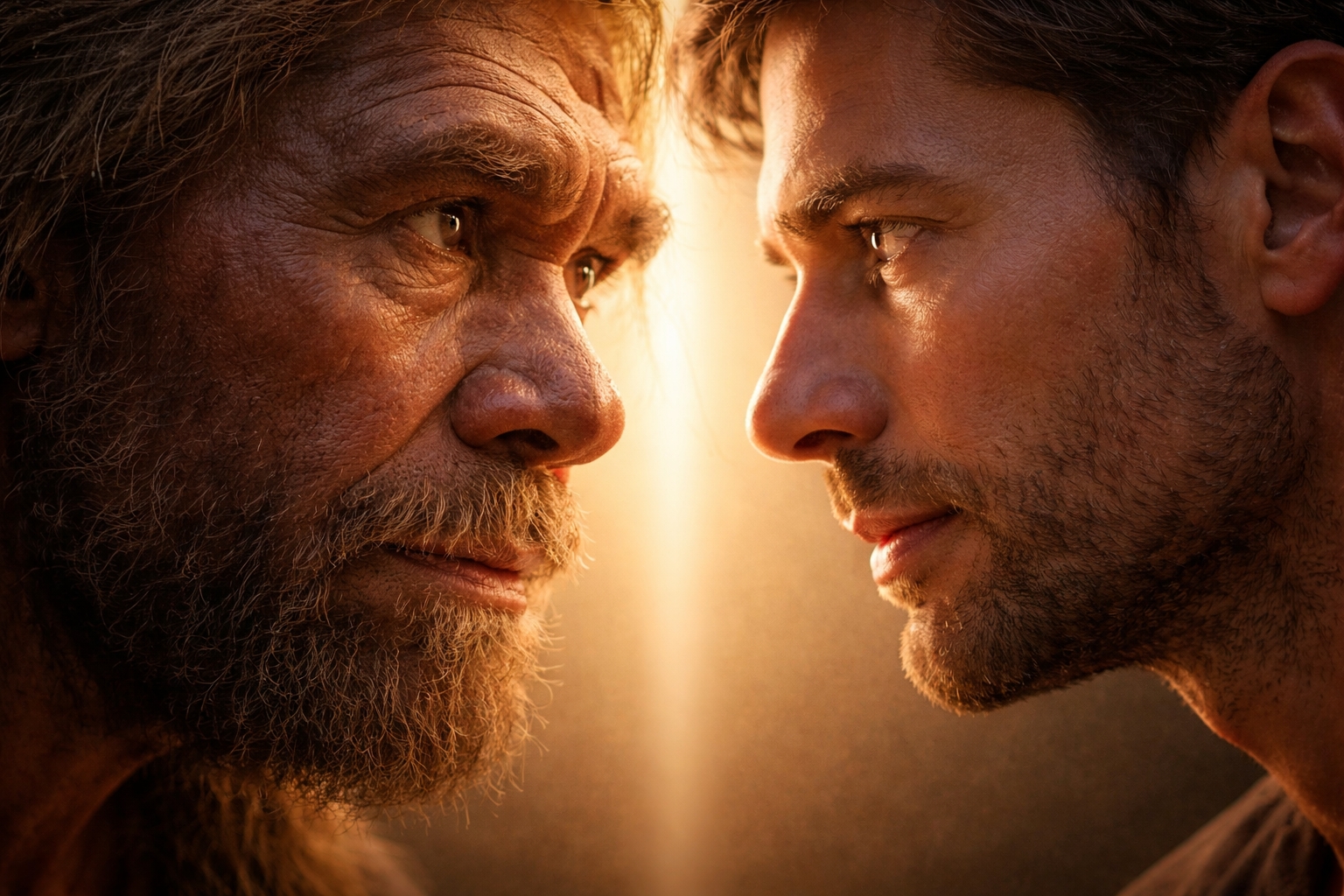
Here's my most provocative thought, and I offer it as
speculation rather than established science. (See? Noeticus.)
We know that Neanderthals weren't that different from us.
We interbred freely. Modern humans of non-African descent
carry roughly 2-4% Neanderthal DNA, and recent studies
suggest it could be as high as 8% in some populations. We
inherited immune system variants, skin adaptations, sleep
patterns, nose shape, red hair and pain sensitivity from them.
We consider Neanderthals "extinct" because the most
visible physical differences—the heavy brow ridges,
the stocky build—have been diluted below recognition
over 40,000 years of interbreeding. But they aren't extinct.
Their DNA is in us. Their traits are expressed in us. They
live on.
And I can't help wondering: did the cognitive architecture
of Servitus come from the same deep past? Neanderthals were
clearly capable of learning—the birch tar proves
iterative improvement over generations. But their tool
traditions also show a remarkable conservatism. The
same basic toolkit, refined but not revolutionized, for
hundreds of thousands of years. They got very good at what
they knew. They didn't leap to what they didn't.
Homo sapiens, by contrast, couldn't stop leaping. New
tools, new art, new trade networks, new ways of doing
everything, all the time, accelerating. The Noeticus
brain. The brain that treats the unknown as an invitation
rather than a threat.
Maybe the tension between Knowers and Believers isn't a
cultural accident. Maybe it's the echo of two species,
merged but not blended, still negotiating the terms of
the merger 40,000 years later.
I can't prove it. But I can poke it, observe the results,
and write them down. Which, come to think of it, is the
whole point.