|
By: Paul S Cilwa |
Posted: 4/23/2026 |
|
Page Views: 274 |
| Hashtags: #Science #ScientificMethod #PlateTectonics #AlfredWegener #HarryHess #WilliamSmith |
| An exploration of the forces that shape our planet and the geological processes that drive change. |
| Estimated reading time: 7 minute(s) (1537 words) |
Mrs. Howe was being kind. The truth was harsher. In 1958, suggesting
that continents had moved—that they were still moving—was
professional suicide for a geologist. The theory had a name: continental
drift. It also had a champion, a German meteorologist and geophysicist
named Alfred Wegener, who'd proposed it fifty years earlier. But in 1912,
when Wegener published his ideas, the geological establishment had
all but laughed him out of the room.
And even before Wegener, as early as the mid-1800s, figures like
William Smith—a surveyor mapping the geology of England—recognized
that rock strata (layers) weren?t deposited uniformly. They were folded and
faulted, suggesting a dynamic past. He famously said,
When you find a particular set of rocks, you can know where you are, no matter how far you travel.
That was a crucial first step: recognizing the Earth wasn't static.
What made the idea so hard to swallow wasn't that it was impossible.
It was that nobody could explain how continents could move. The
crust of the Earth, everyone knew, was solid rock. Rock didn't slide
around like ice floes. The physics didn't work. Or so it seemed.
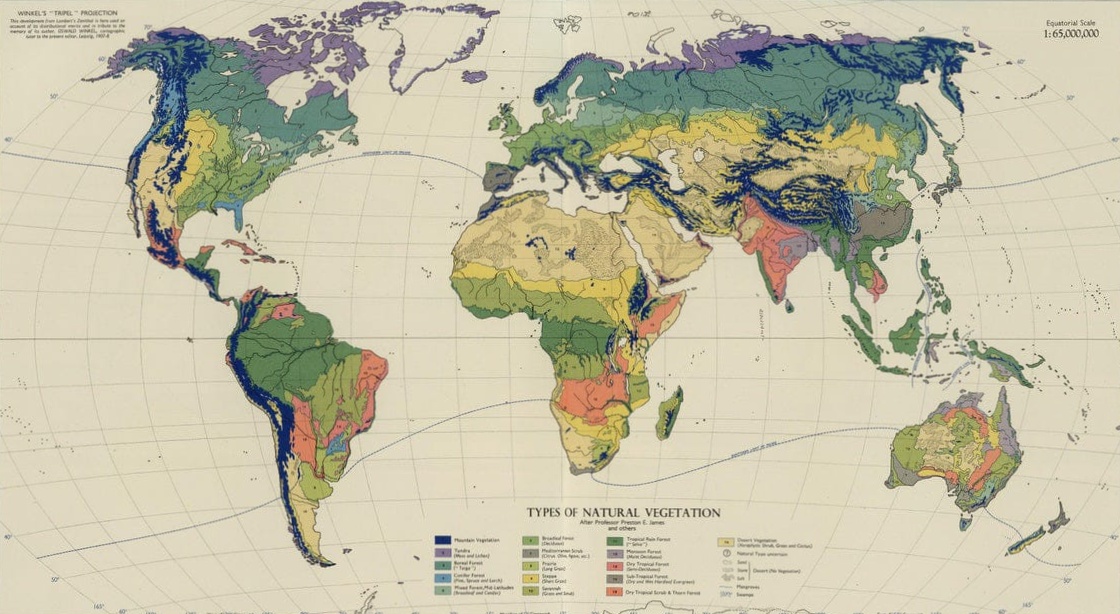
But Wegener had noticed something that geographers couldn't ignore,
something any student with a world map could see: the continents fit
together like puzzle pieces. South America's eastern bulge nestled
against Africa's western curve. The coastlines matched. More than that,
fossils on opposite sides of the Atlantic Ocean were identical. Rocks in
Africa matched rocks in Brazil. It wasn't that Wegener had invented the
idea—he was reviving it. But he was the first to gather enough
evidence to make it impossible to dismiss as fantasy.
How an Idea Became a Heresy
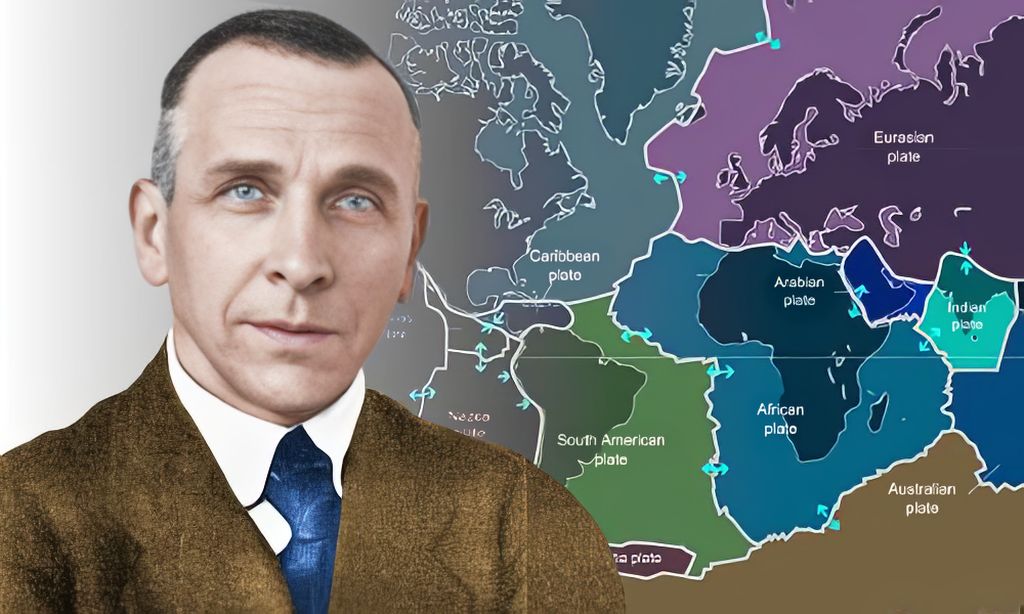
Wegener died in Greenland in 1930, during an expedition, still trying
to prove his theory. By then, the geology establishment had made up its
mind: continental drift was wrong. The problem wasn't the evidence.
The problem was the mechanism. Without a force powerful enough to move
a continent, the whole theory was just a story. A good story, sure, but
not science.
For thirty years, continental drift languished. Textbooks mentioned it
as a historical curiosity, something a German scientist had believed in,
the way people used to believe in phrenology. Geologists who took the
idea seriously found it hard to get funding or respect. The weight of
institutional opinion was against them. And institutional opinion, in
science, is a heavy thing.
Then, in the 1950s, something changed. A young geophysicist named Harry
Hess began mapping the ocean floor. What he found was astonishing. The
seafloor wasn't flat. It was broken, fractured, alive. Running down the
middle of the Atlantic Ocean was a ridge—a mountain chain,
underwater, where the Earth was literally cracking open. Hotter material
was rising from below, pushing the seafloor apart. If that was true, then
the continents on either side would be moving apart too.
Hess called his idea "seafloor spreading." He wasn't claiming it was
proven. He called it an essay in geopoetry. But he was describing
a mechanism, and that was what geology had been waiting for. Not just
"continents move," but "here's how they move."
The Proof, and Who Delivered It
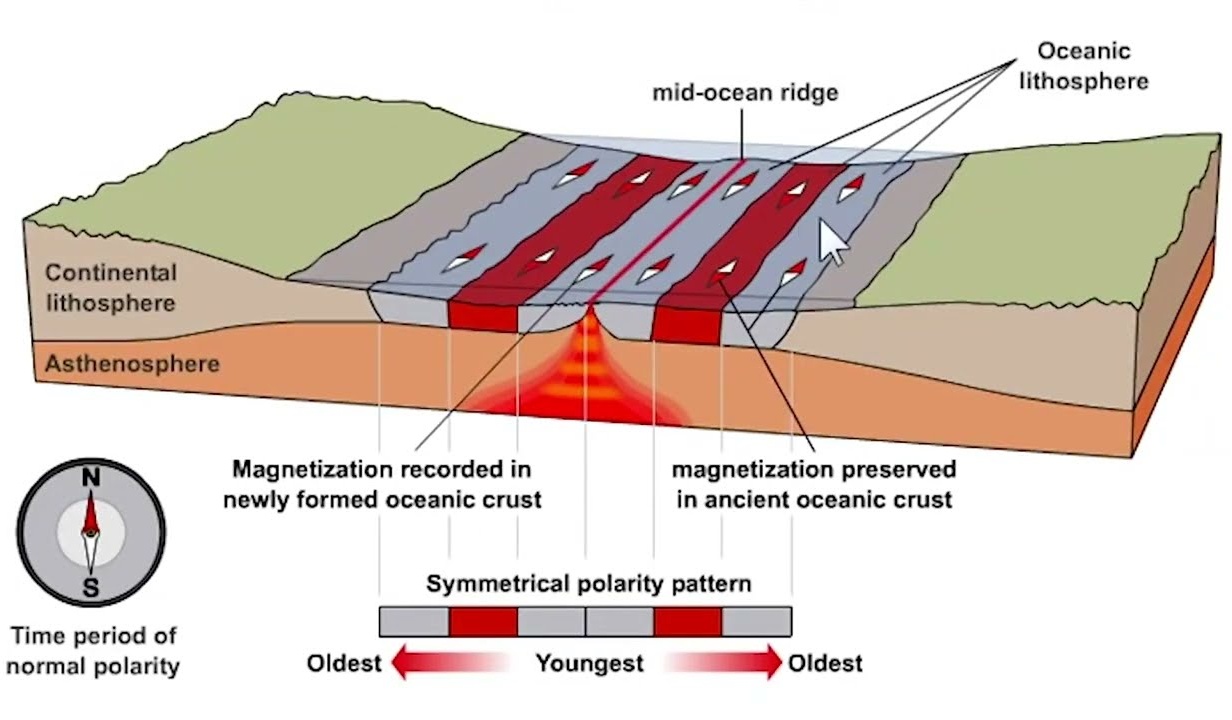
The proof came from an unexpected direction: magnetism. The Earth's
magnetic field reverses every few hundred thousand years or so. When
molten rock at the seafloor ridge cools and solidifies, it locks in
the direction of the Earth's magnetic field at that moment. As you move
away from the ridge, the rock gets older. The magnetic direction changes
in a striped pattern, back and forth, like a magnetic bar code.
In 1963, two British scientists, Fred Vine and Drummond Matthews,
realized what those magnetic stripes meant. If you measured the stripes
on either side of a seafloor ridge, they were mirror images of each
other. The rock on one side matched the rock on the other side, but
reversed, like a photographic negative. That pattern could only mean one
thing: the seafloor was spreading symmetrically outward from the ridge,
creating new crust as it went. The older rocks got pushed aside. The
newest rocks sat at the ridge itself.
This was the smoking gun. By the mid-1960s, the evidence was
overwhelming. Seafloor spreading was real. Continental drift was real.
The continents were still moving. What had seemed like heresy in 1912
had become orthodox science by 1968, within the space of a decade.
But there was a catch. The theory had to be reframed. It wasn't just
about drifting continents anymore. It was about plates—vast,
rigid sections of the Earth's crust and upper mantle that moved as single
units. Wegener had described the symptom. The new theory explained the
system. The continents didn't drift through the ocean floor; they rode on
plates that were slowly spreading from the ridges and sinking back into
the Earth at the trenches.
Why Nobody Believed It (At First)
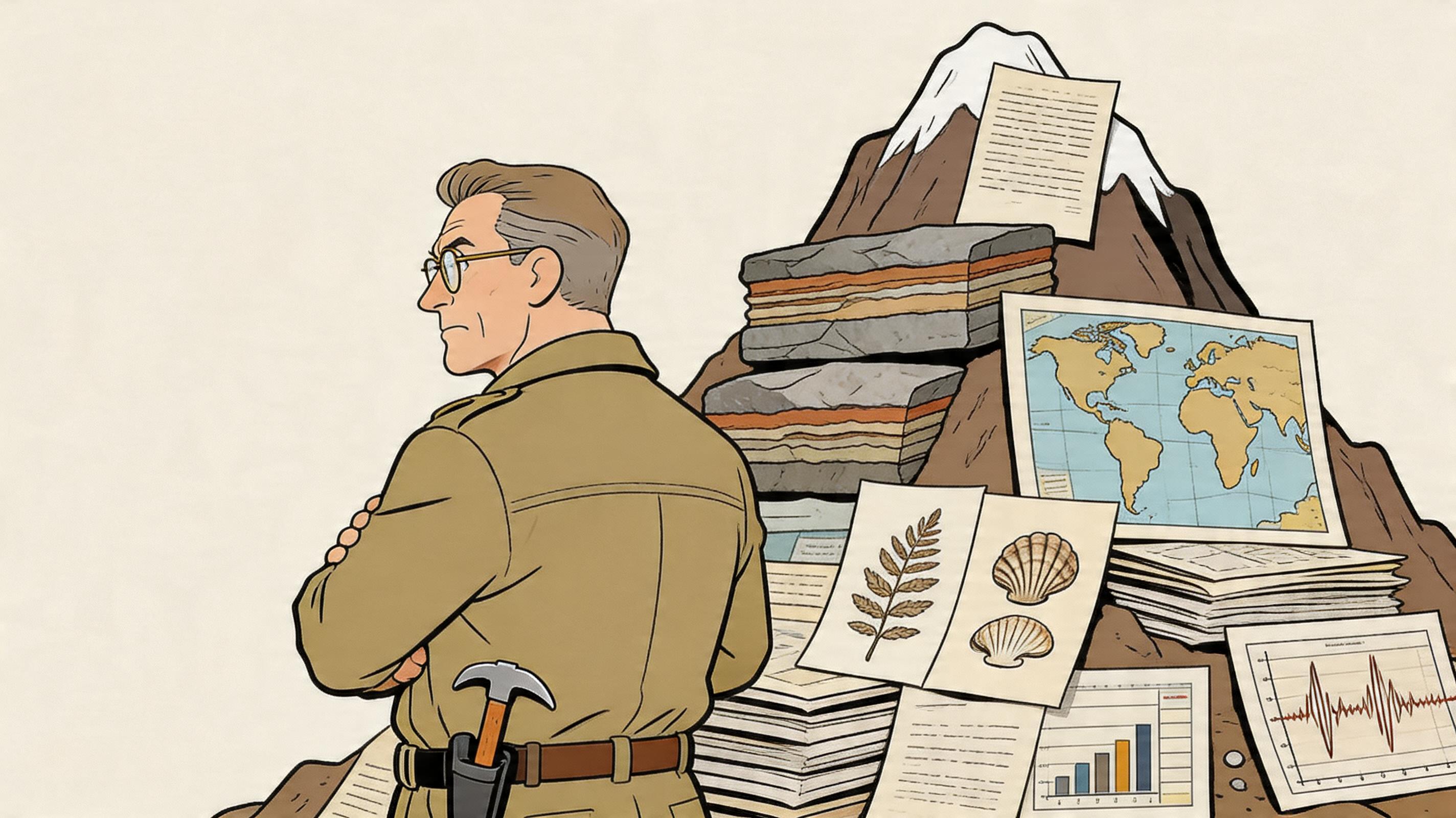
The resistance Wegener faced wasn't irrational, though it looked that way
from a distance. The geology of the 1920s was built on solid ground, or
so it seemed. The continents were fixed. The ocean basins were ancient,
unchanging. Mountains were pushed up by horizontal compression, folding
the rocks like an accordion. Everything fit together in a neat, static
picture.
Then Wegener came along saying everything we knew, was wrong. The continents were
moving. The ocean basins were young. The seafloor was spreading.
Not only was this contradicting everything geology had built, but Wegener
couldn't explain the mechanism. Geologists asked the reasonable question:
What force could possibly move a continent? The crust was solid rock,
for Pete's sake. You didn't move rock with a magic wand.
There was also, to be honest, a personality factor. Wegener was a German
meteorologist, not a geologist. He was publishing in German. He was an
outsider. In geology, outsiders with radical ideas don't tend to get a
warm welcome. The men who built the field had built it on foundations of
fixed continents and ancient ocean basins. You don't lightly abandon that
kind of foundation.
By the 1930s and 1940s, continental drift had become a punchline in
geology departments. Well-meaning geologists would say something kind
about Wegener's evidence, but everyone knew he was wrong because the
physics didn't work. It was a catch-22: the evidence was real, but the
mechanism was impossible, so the evidence must not mean what it seemed to
mean. It was like a magician showing you a card trick and insisting it's
impossible, so what you saw must have been something else.
How Science Changes Its Mind
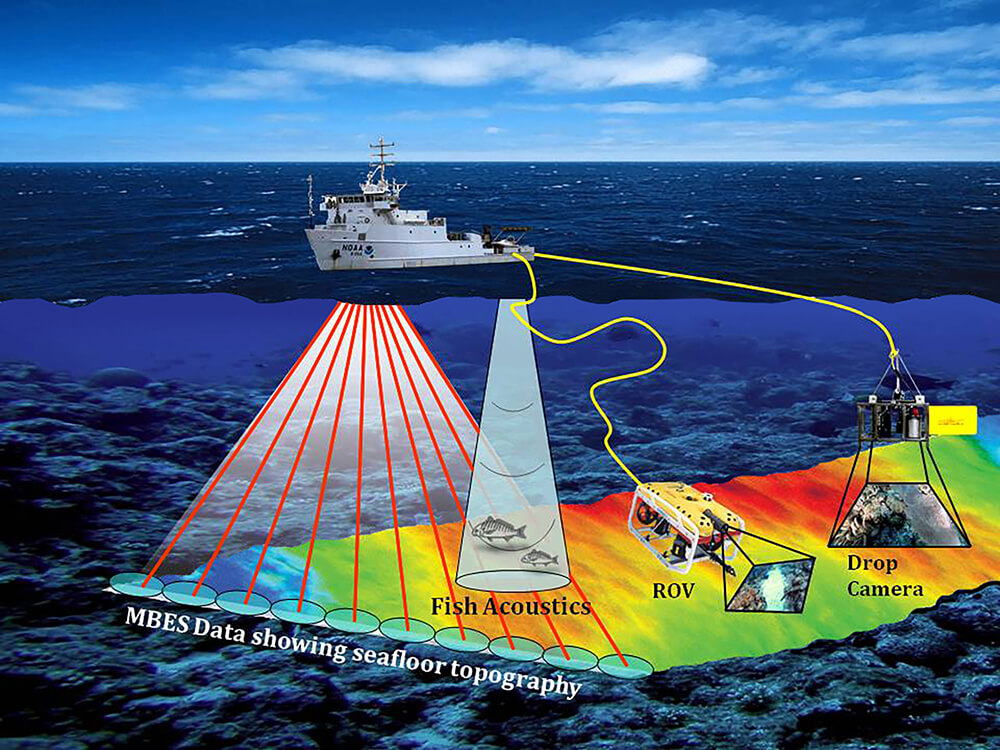
The revolution, when it came, arrived on the back of new technology.
Sonar mapping of the ocean floor revealed what was actually down there.
Satellite data became available. New instruments for measuring gravity and
magnetism provided evidence that older methods couldn't. You can't ignore
the ocean floor when you can actually see it.
But there was more to it than just better instruments. There was also a
generational shift. The geologists who'd built their careers on fixed
continents weren't the ones doing the seafloor research. Younger
scientists, unburdened by decades of commitment to the old framework,
could look at the new evidence with fresh eyes.
By 1965 or so, geology had undergone what the science historian Thomas
Kuhn would call a paradigm shift. Not everyone shifted at the same time.
Some old guard geologists never accepted it. But the consensus had
changed. What had been heretical was now doctrine. The mechanism was
understood. The evidence was overwhelming. And the world—quite
literally—was seen as a different place.
To her credit, a few days later, Mrs. Howe told us she'd looked further
into the question and found that there was some evidence for continental
drift, but that it was still a controversial idea, not accepted by
the scientific community.
By 1969, when I was finishing high school, plate tectonics had become
the unifying framework for all of geology. The Earth had become seen as a dynamic, living system. The
continents were still moving, carried along by currents in the mantle
below, spreading at the ridges, colliding at the edges, recycled back into
the planet at the deep trenches.
And my 4th-grade observation—that North and South America looked
like they'd been pulled away from Europe and Africa—turned out to be
exactly right. Sometimes the obvious answer is just ahead of its time.
Just think of the time they'd have saved, if they'd only listened to me then!