|
By: Paul S Cilwa |
Posted: 3/20/2026 |
|
Page Views: 143 |
| Hashtags: #Science #Astronomy #History #Mythology #Pleiades |
| Cultures worldwide call the Pleiades the 'Seven Sisters,' but most people can only see six. The answer may lie in stellar motion and the oldest story ever told. |
| Estimated reading time: 12 minute(s) (2849 words) |

I took the case.
The Pleiades—that tight little knot of blue-white stars in the
constellation Taurus—are one of the most recognizable objects in the
night sky. Every culture on Earth has a name for them. Nearly every culture
calls them seven. And nearly every person who looks up and tries to count
them comes up one short. With sharp eyes and a dark sky, you can actually
make out nine. Point a cheap pair of binoculars at them and dozens of stars
emerge, still nestled in the wispy remnants of the nebula from which they
were born. So what is the story? Why do the myths say seven when the eyes
say six?
A Boy and a Belt

When I was a kid in Florida, I used to walk to my friend Timmy Miller's house
after dark to watch TV. Timmy's family had a color television, which in
those days was like having a private IMAX theater. My family had a
black-and-white set, so walking half a mile through the darkness to see
Lost in Space in color was not even a decision. It was a
pilgrimage.
I was not worried about the walk. There was nothing to worry about in those
days, or at least nothing that occurred to a kid to worry about. No
streetlights, either, once you got past the first couple of houses. Just the
road, the warm Florida air, the sound of frogs, and the sky.
And what a sky. Not the washed-out orange dome that hangs over most of
America today, but the real thing—thousands of stars, so many that the
Milky Way looked like someone had spilled a glass of luminous milk across
the whole vault of heaven. There was one pattern that always grabbed me: three
stars in a perfect row, close together, unmistakable. I did not know they
were called Orion's Belt. I did not know they were named after a Greek
hunter. I just knew they were there, every night, reliable as
furniture. I would wonder what kind of people lived on the planets around
those stars, and whether they had invented soap yet.
And if I followed the line of the Belt upward, it pointed to a little
cluster of stars—a tiny, shimmering smudge unlike anything else in the
sky. Not a pattern of bright stars like the constellations, but a huddle of
faint ones, packed so close together that they seemed to be whispering. They
jumped out at you. You could not miss them once you knew where to look, and
you could not forget them afterward.
I was not particularly interested in the names of stars back then. I figured
their inhabitants just used their word for "sun" anyway, the way
everyone calls their own planet "Earth" or "the ground" or
"the place where we keep all our stuff." But I loved the way those
stars looked. And I knew that if I ever found myself lost in the woods, at
that time of year at least, I could look up and know which direction to walk
to get back to the road. I did not know which direction it was by name. I
just knew it was the way to go.
What the Pleiades Actually Are
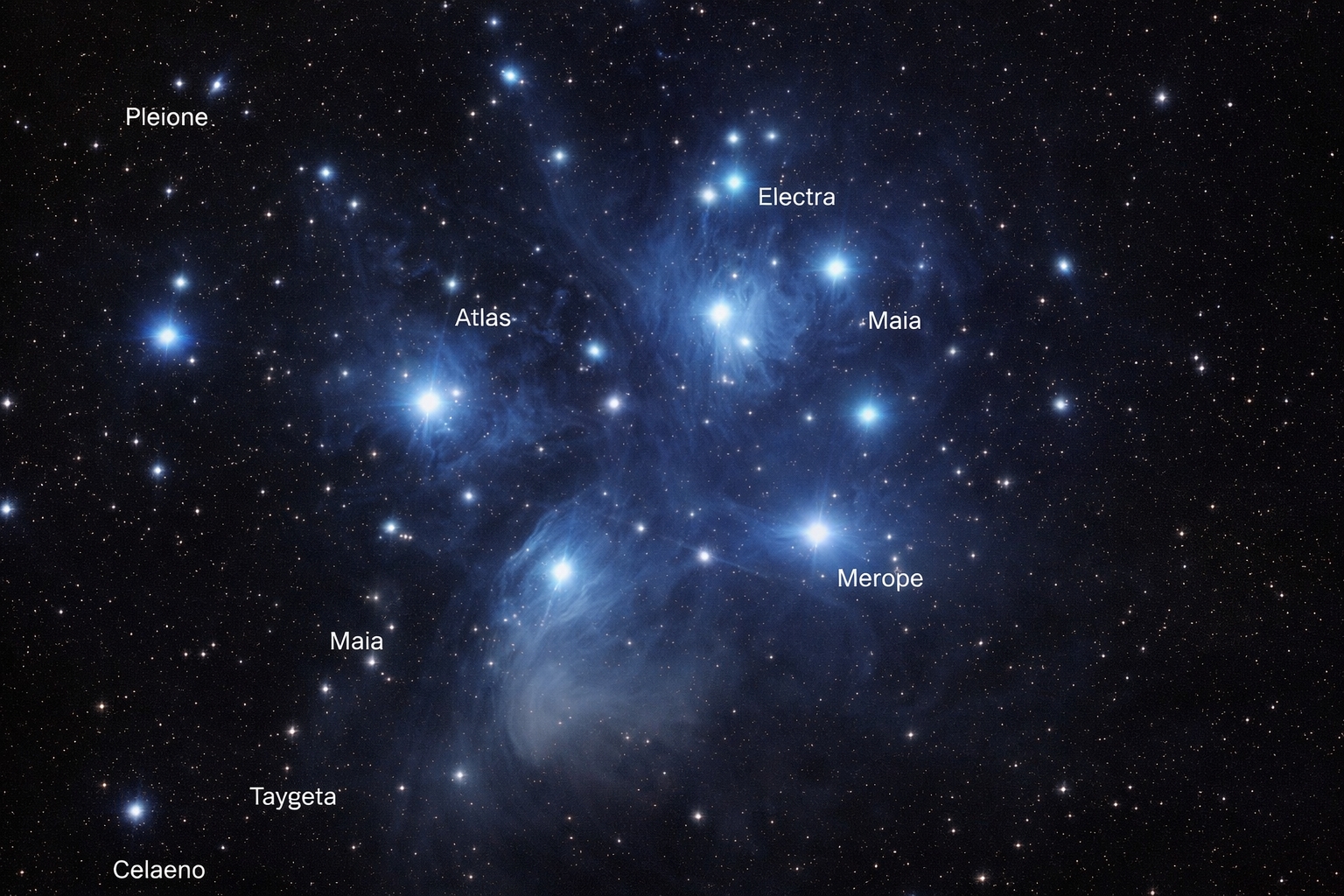
Before we get to the myths, let me introduce the suspects properly.
The Pleiades are not a constellation. They are an open star
cluster—a family of over a thousand stars, all born from the
same enormous cloud of gas and dust roughly 100 million years ago. In
stellar terms, they are infants. The wispy blue nebulosity you can see
in long-exposure photographs is not the remnant of their birth cloud
but interstellar dust they happen to be passing through, lit up by the
hot young stars like headlights in fog.
They sit about 444 light-years from Earth—though for decades,
that number was the subject of a surprisingly heated astronomical
argument. In the late 1990s, the European Space Agency's Hipparcos
satellite measured the distance at roughly 390 light-years, which was
about 10% shorter than every other method had suggested. Astronomers
scratched their heads, rechecked their instruments, and argued about
it for nearly twenty years. It was not until later missions, including
Hubble and the Gaia spacecraft, confirmed the original ~440
light-year estimate that the Hipparcos measurement was chalked up to a
systematic error. For a while, though, nobody could agree on how far
away these stars actually were, which is a little embarrassing when
you consider that humans have been staring at them for a hundred
thousand years.
And about that pointer: Orion's Belt seems to aim right at the
Pleiades, which is how most people find them. But that alignment is
purely a trick of our vantage point. Orion's Belt stars—Alnitak,
Alnilam, and Mintaka—are
between 800 and 2,000 light-years away
from us, and the Pleiades are at 444. They are not related, not
connected, and not even in the same neighborhood. It is like driving
down a highway and noticing that a road sign seems to point at the
moon. From your car, the alignment is perfect. Move to the next lane
and it is gone. From a planet orbiting any star in Orion's Belt, the
Pleiades would be in a completely different part of the sky, and no
one there would dream of associating the two.
The Oldest Story Ever Told
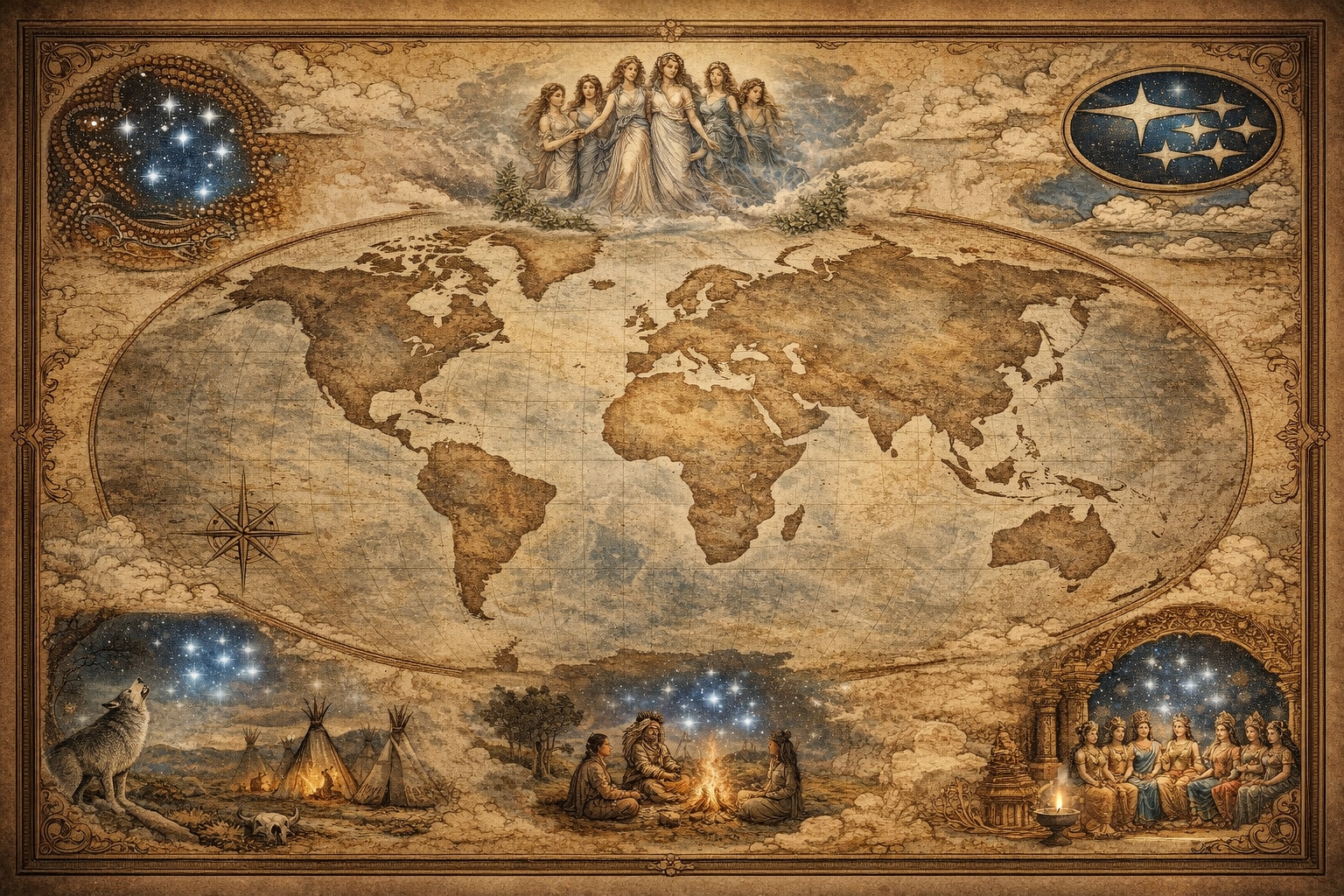
Here is where the case gets strange. Cultures separated by oceans, by
millennia, by every conceivable barrier that humans can put between
themselves and other humans, all tell essentially the same story about this
little cluster of stars: there are seven of them, and one is missing. The
details vary. The reasons vary. But the number and the mystery are
constant.
The Greeks: Merope's Shame
The Greeks called them the Pleiades, the seven daughters of the Titan Atlas
and the sea-nymph Pleione. Their names have come down to us across the
centuries: Maia, Electra, Taygete, Alcyone, Celaeno, Sterope, and Merope.
Six of them married gods. Merope, the seventh, married a mortal—Sisyphus,
king of Corinth, the same fellow who was later condemned to roll a boulder
uphill for eternity. According to the myth, Merope was so ashamed of having
married a mere human that she hid her face, which is why her star shines
the faintest of the seven. She is there, but she will not look at you.
The Cherokee: The Boys Who Danced into the Sky
The Cherokee tell of seven boys who would not stop playing their gatayusti
game—a hoop-and-pole sport—no matter how many times their
mothers called them in for dinner. Finally, their exasperated mothers served
them stones instead of cornbread. The boys, furious, began to dance. And
they danced harder and faster until they began to rise into the air. Their
mothers ran out and tried to pull them back, and one mother succeeded in
grabbing her son, who struck the ground so hard he sank into the earth and
became a pine tree. The other six rose into the sky and became Anitsutsa, the
Pleiades. The number, again, is seven. And again, one is missing—pulled
back to Earth.
The Kiowa: Seven Sisters and the Great Bear

The Kiowa people of the Great Plains tell of seven sisters who were playing
in the forest when a great bear attacked them. They ran to a tree stump and
prayed for rescue. The stump began to grow, rising higher and higher into the
sky, carrying the girls beyond the bear's reach. The bear clawed at the
rising tower of rock, gouging deep vertical scratches into its sides. The
girls rose all the way into the heavens and became the Pleiades. The
rock—scarred by the bear's claws—is what we now call Devils
Tower in Wyoming, and the claw marks are the columnar basalt formations that
give it its distinctive fluted appearance. In this version all seven sisters
arrive safely, but the story still begins with seven, as if the number were
embedded in the DNA of the myth.
The Aztecs: Tianquiztli and the New Fire
The Aztecs called the Pleiades Tianquiztli—the Marketplace—and
they were not merely decorative. Every 52 years, when the Aztec calendar
cycle reset, priests climbed the Hill of the Star (Huixachtlan) outside
Tenochtitlan and watched for the Pleiades to cross the meridian at midnight.
If the stars passed overhead, the world would continue. If they did not—well,
no one had ever had to find out, but the implication was catastrophic. A
human sacrifice was performed, a new fire was kindled in the victim's opened
chest, and runners carried the flame to every hearth in the empire. The
Pleiades were not just a story. They were a countdown clock for the
continuation of existence.
The Japanese: Subaru and the Missing Star
In Japan, the Pleiades are called Subaru—yes, like the car, whose
logo is a stylized depiction of the cluster. But here is what makes the
Japanese tradition interesting for our case: they traditionally count
six stars, not seven. The name Subaru itself means "to gather
together" or "united," and the cluster has been depicted with six
stars in Japanese art and astronomy for centuries. If anything, this
strengthens the mystery. The Japanese looked at the same sky and counted
honestly: six. Which means the cultures that insist on seven are not
just rounding up. They are remembering something.
The Kungkarangkalpa: The Seven Sisters Songline
Among Aboriginal Australian peoples of the Western Desert, the Pleiades are
the Kungkarangkalpa—the Seven Sisters—and their story is not
merely a tale but a songline: a navigational and spiritual path stretching
thousands of kilometers across the continent. The Sisters are pursued across
the land and sky by a lustful man, Wati Nyiru (associated with Orion), and
they flee from waterhole to waterhole, their journey mapping real geographic
features and water sources. One of the Sisters is sometimes caught or hidden,
explaining the missing star. This songline is one of the most widespread
and ancient oral traditions on Earth, connecting communities who might never
meet in person through a shared story written in the stars and walked into
the land itself.
The Berber: The Daughters of the Night
Among the Berber peoples of North Africa, the Pleiades were crucial
agricultural markers. Their appearance in the autumn sky signaled the
beginning of the plowing season, and their disappearance marked the start
of the hot months when fieldwork was futile. The cluster was associated with
a group of sisters—again, seven—and the faintest among them was
said to be a sister who had wept so much that her light had dimmed. The
specifics vary from the Kabyle to the Tuareg to the Amazigh of the Atlas
Mountains, but the number seven and the weeping sister persist.
The Universal Mystery
So here is the puzzle that keeps this case file open. Cultures from every
inhabited continent, cultures that had no contact with one another, cultures
separated by tens of thousands of years of independent development, all
landed on the same story: seven stars, one missing. How?
There are really only two explanations. Either the event that inspired the
myth was so dramatic that every culture on Earth independently noticed it
and wove it into their own stories—which is possible, since everyone
shares the same sky. Or the myth predates the separation of those cultures.
It goes back to a time when there was only one very small population of
humans, a single band of ancestors huddled somewhere in Africa,
and they looked up and counted seven stars and one went
missing and they told their children about it. And those children's
children's children scattered across the globe and carried the story with
them, and it evolved like a game of generational telephone—the details
shifting, the names changing, the morals bending to fit new landscapes and
new gods—but the essence remaining the same. Seven sisters. One
missing. Why?
If the second explanation is true, it means this myth is not merely old. It
is among the oldest stories humanity has ever told. Older than agriculture.
Older than pottery. Older, perhaps, than language as we know it. A story
that has survived not centuries but millennia, carried forward by
every generation that ever bothered to look up.
A Novelist's Theory
In my novel,
The Lady
From Heaven, I explained the conundrum thus:

The Pleiades were not named the Seven Sisters because there were seven
stars. There were never seven visible stars—there were six, or nine,
depending on your eyes, but never seven. They were called the Seven Sisters
because seven ships sailed toward them on the last night of Atlantis, seven
great vessels heading for the stars as the continent sank beneath the waves.
The people who watched them go remembered the number. Seven ships. Seven
sisters. The stars were just the direction they were heading.
Of course, for the myth to have spread so widely, the ships would have
sailed long before Atlantis is thought by anyone to have existed. But a
novelist is allowed to play with time, and a good myth does not need to be
true to be useful.
Stellar Motion: The Real Answer
But this is a science essay, not a novel, so let me give you the answer
that does not require lost continents or starships.
The stars are not still. They look still—the Pleiades appear tonight
exactly as they appeared to you last week, last year, last decade. But they
are moving. Every star in the cluster is drifting through space at its own
speed and in its own direction, like a flock of birds that happens to be
heading roughly the same way but is slowly, imperceptibly spreading out.
More importantly, the Pleiades are not a flat arrangement, despite how
they appear projected on the dome of the sky. They are a three-dimensional
structure—more like a mobile hanging in a nursery than a pattern
painted on a ceiling. Some stars are closer to us; others are farther away.
And this is where the mystery resolves.
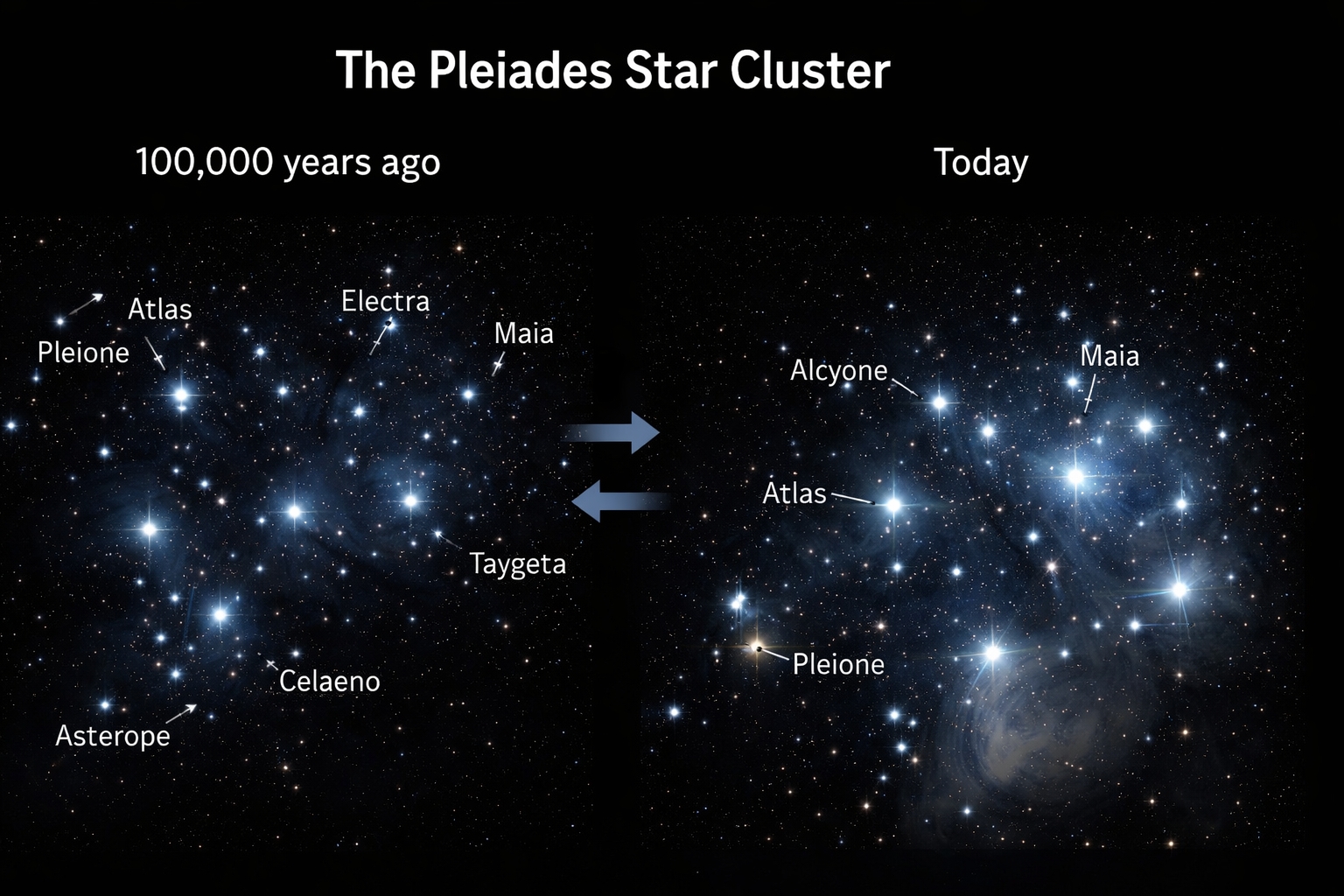
Two of the stars in the cluster—Atlas and Pleione—are
currently so close together in our line of sight that they are difficult to
distinguish even with a good telescope. Pleione is partially hidden behind
Atlas from our vantage point, and her light bleeds into his. To the naked
eye, they merge into what appears to be a single star. That is your missing
sister. She is not gone. She is standing behind her sibling.
But rewind the clock. Stellar proper motion studies suggest that the
relative positions of these stars were significantly different in the distant
past. Researchers have calculated that roughly 100,000 years ago, Atlas and
Pleione were far enough apart to be clearly distinguishable as separate
stars to the naked eye. A person standing on the African savanna on a clear
night, 100,000 years ago, would have counted seven stars in that little
cluster without any difficulty.
One hundred thousand years. That is deep time. That is before the
migration out of Africa. Before the invention of writing, of agriculture, of
everything we think of as civilization. And yet someone was counting. Someone
noticed there were seven. And someone, generations later, noticed there were
only six and wondered what had happened to the seventh.
And they told a story about it. And that story survived.
Case Closed
I found the missing sister. She was never really missing—she was just
hiding in plain sight, tucked behind her brother Atlas like a kid ducking
behind an older sibling in a family photograph. She had been there the whole
time. A hundred thousand years of mythology, a hundred cultures pointing at
the sky and asking the same question, and the answer was right there in the
math: stars move, sight lines shift, and a dame who used to stand alone gets
lost in the glare.
I closed the file and poured myself a drink. The case was solved, but the
story—the oldest story, the one that every human being who ever lived
has a share in—that story is still being told. It is being told right
now, by anyone who steps outside on a clear winter night and looks up and
tries to count to seven.
Case closed. For now.
Further Viewing
This excellent video from SciShow explores much the same mystery: