|
By: Paul S Cilwa |
Posted: 2/21/2026 |
|
Page Views: 233 |
| Hashtags: #ArchaeologicalDating #Carbon14 #RadiocarbonCalibration #LuminescenceDating #Thermoluminescence #UraniumSeriesDating #Stratigraphy #RadiometricDating #GeologicTimeScale |
| How scientists date the past, using archaeology, geology, and modern technology working together to decode Earth's timeline. |
| Estimated reading time: 10 minute(s) (2209 words) |
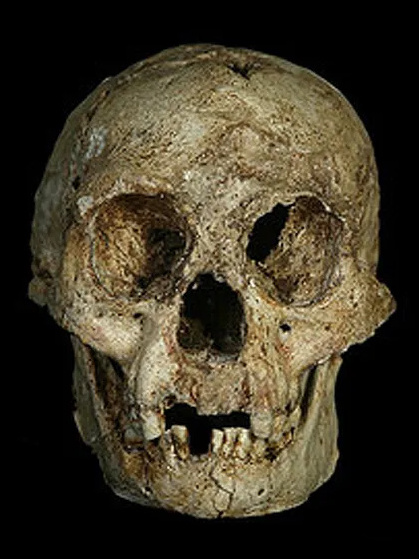
But the guy in the book wasn't grossed out at all. In fact,
he showed it around, watched smart people disagree about what it was,
and then went back to living his life while the
rest of the science freaks spiraled into a polite existential crisis. The
Swanscombe quarry in Kent coughed up those pieces in the 1930s, and for
a while nobody could agree whether it belonged to a not-that-old weirdo,
a prehistoric neighbor, or something that made Victorian family trees
feel…optimistic.
The funny part is that the question wasn't even What is it?
so much as
When is it?
Because once you admit the skull might be hundreds of
thousands of years old, you've also admitted that the world has been
doing its own thing for an uncomfortably long time—without asking our
permission.
Remember that, in 1835, most people didn't question what they were told
the Bible said: That Earth was about 6000 years old. Now, to be sure,
the Bible actually says no such thing. However, one James Ussher, the
17th-century Archbishop of Armagh and Primate of All Ireland, who
was one of the most respected scholars of his age, fluent in multiple
ancient languages and deeply versed in biblical history, classical sources, and Near Eastern
chronologies, published in 1654 a massive chronological work in which he attempted to
synchronize biblical events with known dates from Greek, Roman, and Persian history. By carefully
adding up the genealogies in the Old Testament—X begat Y at age Z
—and aligning
them with external historical anchors, he calculated that the Creation occurred in 4004 BC,
specifically in late October, with some later editions famously specifying October 23 at nightfall.
The precision wasn't mystical; it came from his belief that biblical festivals and the rhythms of
the Jewish calendar could be used to pinpoint the season. Ussher's date became widely known not
because everyone agreed with it, but because 18th-century English printers began placing it in the
margins of King James Bibles, giving it an air of officialdom it never actually had.
But if the Bible couldn't be relied upon to help date ancient objects, what could?
How do archaeologists and geologists put dates on bones, tools, charcoal, ash layers, dinosaur
beds, and the occasional trilobite that looks like it got flattened by a
cosmic ironing board? Carbon dating gets top billing, but that's basically
the opening act. After that, the dating methods get weird in a good way.
How do you date something that doesn't come with a receipt?
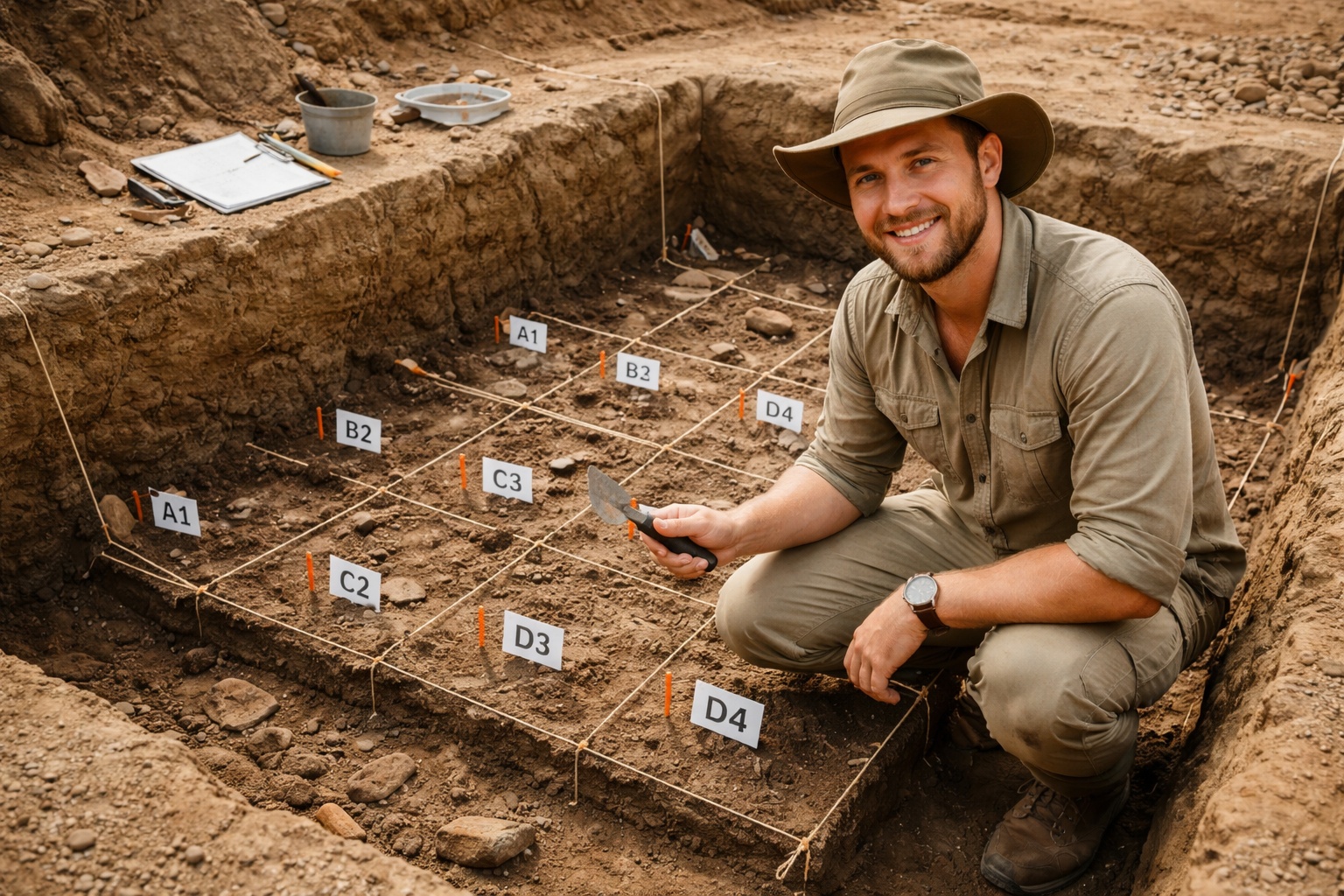
The first thing to understand is, we don't date objects
as much as we date
events. A stone knife was made, used, dropped, buried, and then messed with by worms,
roots, floods, and whichever graduate student sneezed near it in 2007.
When we say the knife is 8,000 years old, we usually mean the layer of dirt
where it ended up was formed around then.
That's why context is king. If you find a spear point in a well-
documented layer below a volcanic ash bed you can date, you're able to say with some certainty,
not when the spear point was made, but when it was dropped.
If you find the same spear point in a box labeled misc
pointy things,
it's lost that context and can't be dated (at least in the same way).
Archaeologists start with relative dating: what's above is generally
younger than what's below (the law of superposition), and styles tend to
change over time. Pottery shapes, tool types, and even how people build
houses can be arranged into sequences. That doesn't give you a year, but
it gives you an order: this came before that.
Absolute dating is where you attach numbers—calendar years, or at least
years before present. And the trick is that absolute methods work best
when you stack them with the relative story. A single date is a data
point. A date that matches the stratigraphy is evidence you can take to
court. (Science court. With better snacks.)
So what's the deal with carbon dating, anyway?
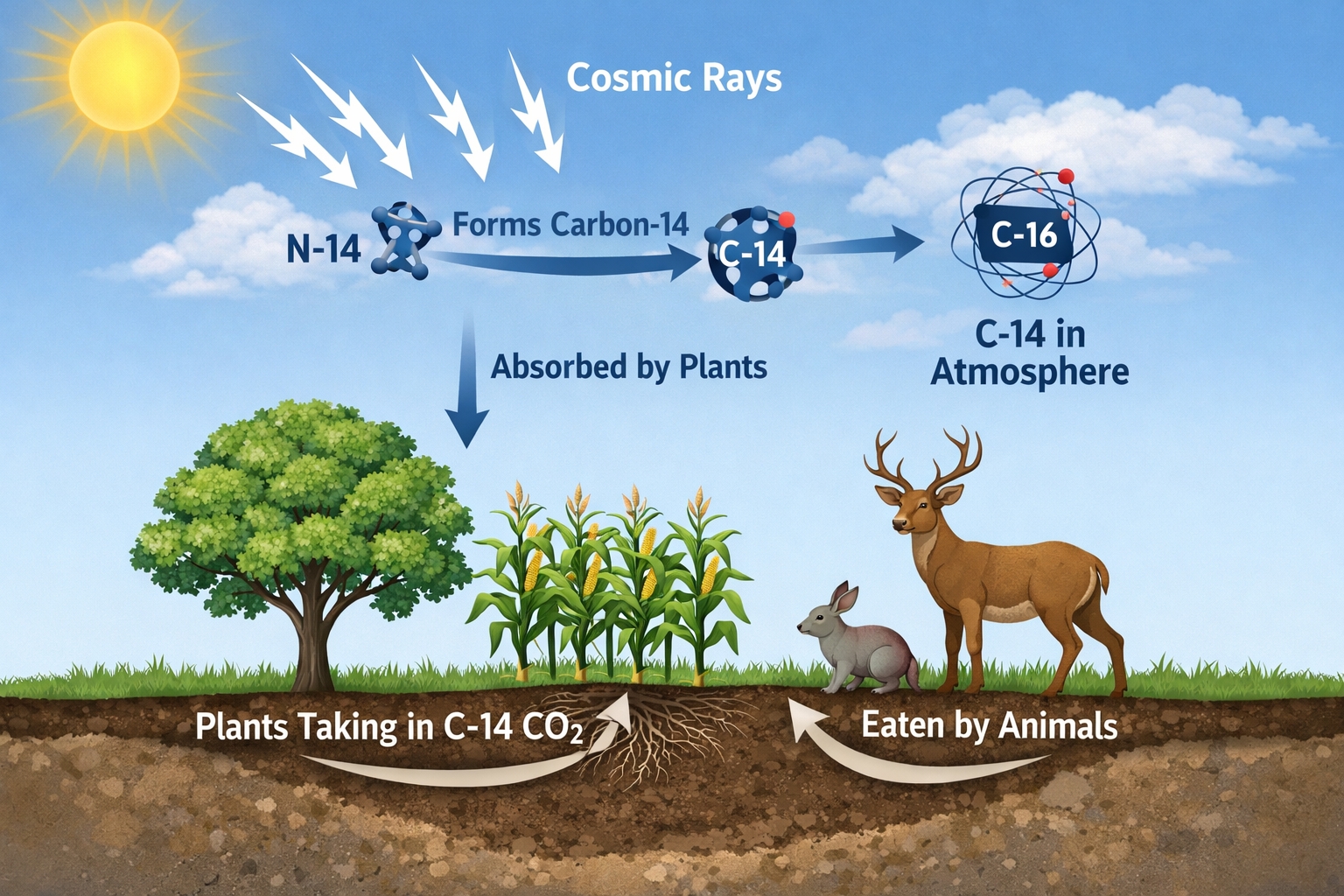
Radiocarbon dating works because the
atmosphere is constantly making a slightly radioactive version of
carbon: carbon-14. Cosmic rays help convert nitrogen into carbon-14, and
that carbon becomes CO2, which plants inhale, which animals eat, which
you then turn into bad decisions at a barbecue.
While something is alive, it keeps swapping carbon with the
world, with its breathing, eating, and photosynthesizing. So its ratio of carbon-14 to
normal carbon stays roughly in sync with the atmosphere. When it dies,
the swapping stops. Carbon-14 decays away with a half-life of about
5,730 years, and the "missing" carbon-14 becomes a clock.
In practice, labs measure how much carbon-14 is left and compute an age.
This works best for things that were once living: charcoal, wood, seeds,
bone collagen, textiles, even a forgotten sandwich (if you really want
to know how long it's been in the fridge).
There are limits. After around 50,000-ish years, there's so little
carbon-14 left that the signal starts fighting with background noise and
contamination. If your sample is older than that, carbon dating doesn't
fail with a dramatic explosion—it fails quietly, with a false sense of
confidence if you're not careful.
Why did carbon dating get a reputation for being "unreliable"?
Early on, people treated radiocarbon dates like a direct conversion:
measure carbon-14, do the math, receive Truth™. The problem is that the
atmosphere isn't a stable factory line. The amount of carbon-14 being
produced (and the amount of ordinary carbon being added) has changed
over time.
Production changes because cosmic rays don't hit Earth at a constant
rate. The Sun's activity matters. Earth's magnetic field matters. Even
big climate and circulation shifts matter because carbon moves between
the atmosphere, oceans, and biosphere on different schedules.
Then humans showed up and made it worse—in both directions. Burning
fossil fuels adds old
carbon with almost no carbon-14, diluting the
atmosphere (the Suess effect). Nuclear weapons testing injected extra
carbon-14 and created a very obvious mid-20th-century bomb peak,
which
is great for dating modern things and terrible for pretending the world
is simple.
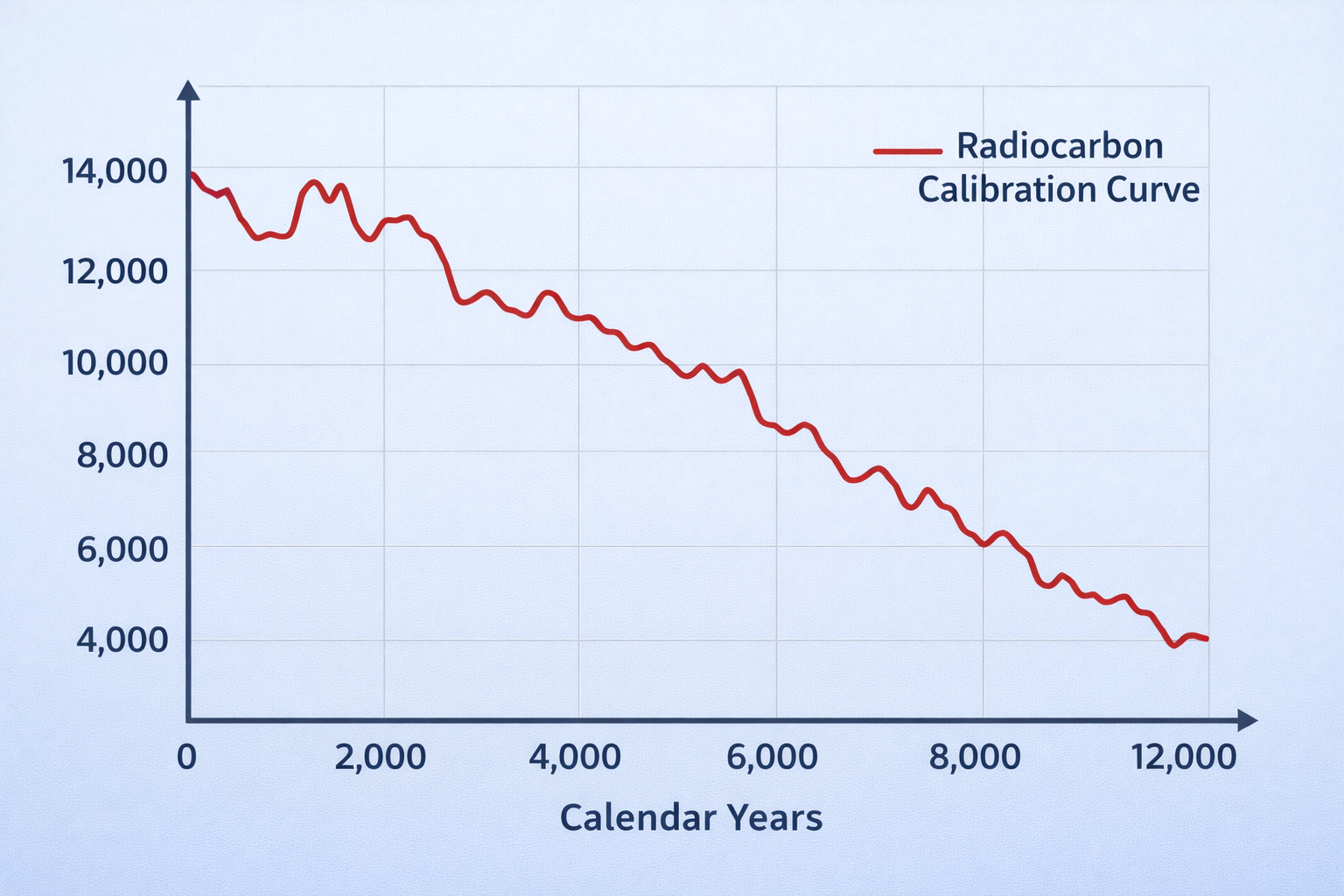
The fix is calibration. We compare radiocarbon ages to independent
records that have real calendar years: tree rings (dendrochronology),
lake sediments, corals, speleothems, ice cores. Those comparisons
produce calibration curves (like IntCal) that translate radiocarbon
years into calendar years—wiggles and all.
Dendrochronology deserves special mention because it's
beautifully simple. A tree adds one growth ring per year. Thick rings
mean good growing seasons; thin rings mean drought or cold. Because
these patterns are regional, you can match overlapping sequences from
living trees, old buildings, and buried logs to build continuous
records stretching back thousands of years. The longest unbroken
European oak chronology reaches back over 12,000 years. Each ring is
a known calendar year, making dendrochronology one of the few dating
methods that gives exact dates rather than ranges—and it's the
backbone against which radiocarbon dates are calibrated.
If carbon dating isn't feasible, what can we use instead?
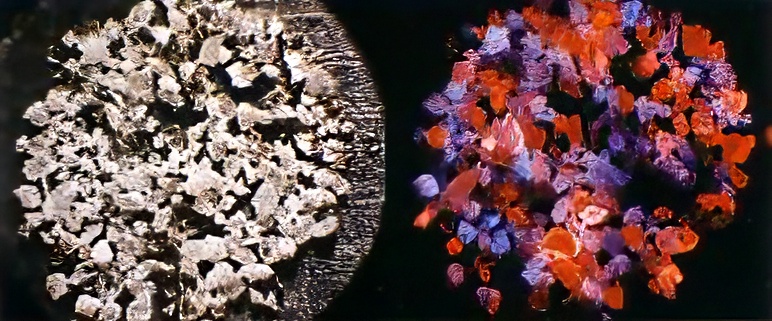
This is where the toolkit gets fun. If you can't date the organic
material (or there isn't any), you can often date the last time
something was heated or saw sunlight. That's the idea
behind thermoluminescence (TL) and optically stimulated luminescence (OSL).
Mineral grains trap energy from natural radiation over time, and when
you heat them or hit them with light in a lab, they release that stored
energy as a glow. Bright glow, long burial.
Optically Stimulated Luminescence is particularly good for dating sediments:
when quartz or feldspar
grains were last exposed to sunlight before being buried. That makes it
useful for dunes, river deposits, and the kinds of layers that love to
hide human activity. Thermoluminescence is often used for ceramics and heated stone,
because firing resets the clock.
For cave sites and some fossils, uranium-series dating is a workhorse.
Uranium dissolves in water and gets locked into cave minerals like
calcite; it then decays into other isotopes at known rates.
Date the flowstone above or below an artifact and you can bracket the age,
sometimes far beyond radiocarbon's range.
There are more niche options too: electron spin resonance (ESR) for
tooth enamel, obsidian hydration for volcanic glass, archaeomagnetic
dating when fired materials record Earth's magnetic field direction, and
tephrochronology when distinctive volcanic ash layers serve as time-
stamped breadcrumbs
across landscapes.
Every method has its diva behavior. Luminescence hates being exposed to
light. Uranium-series hates open-system chemistry. Archaeomagnetism
hates sloppy heating. Dating is less press button, receive year
and
more manage a temperamental orchestra.
How do we date dinosaurs, trilobites, and other deep-time fossils?
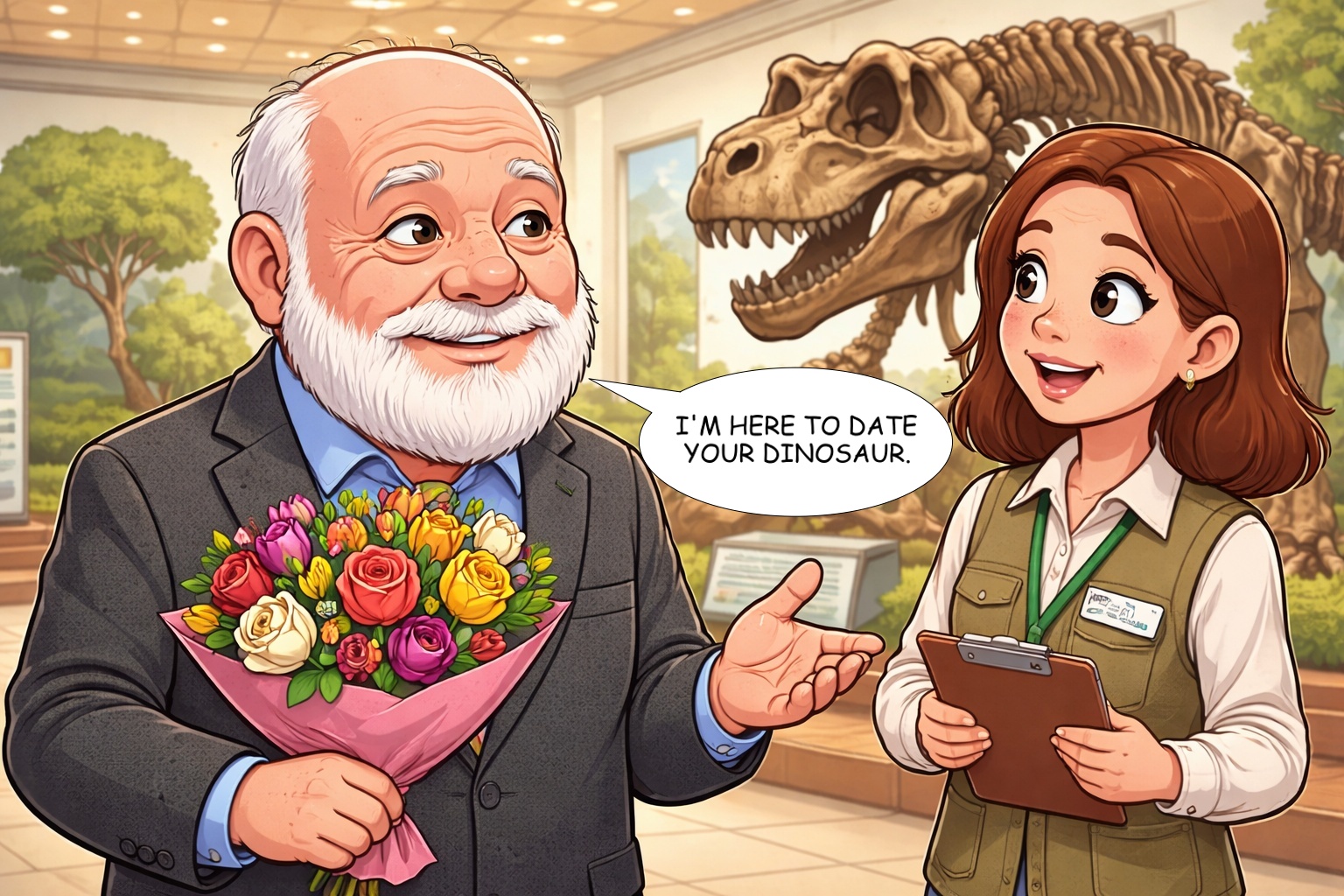
Now we're in the age ranges where radiocarbon doesn't even pretend.
Dinosaurs lived tens of millions of years ago; trilobites go back
hundreds of millions. The trick is to date the rocks that bracket the
fossils, and to use Earth's layered history like a filing system.
Relative dating becomes incredibly powerful here. Stratigraphy tells you
the order of layers, and index fossils tell you the era. Certain species
existed for relatively short windows but spread widely. If you find the
same index fossil in two places, you can correlate the layers—even
if the continents are being dramatic about drifting apart.
Absolute dates usually come from radiometric dating of igneous
rocks—especially volcanic ash beds. Ash contains minerals that lock in
radioactive isotopes when they crystallize. Methods like potassium-argon
(K-Ar), argon-argon (40Ar/39Ar), and uranium-lead (U-Pb) dating can give
ages from millions to billions of years, depending on the system.
That's why a dinosaur bone is often dated by the ash above and below it:
the bone itself isn't easy to radiometrically date, but the geologic
sandwich around it is. For trilobites, the combination of
biostratigraphy and radiometric dates across the same sequence builds
the geologic time scale—our planet's shared calendar, assembled the hard
way.
What new tech is helping us solve the "when" problem now?
A lot of the progress is less about inventing brand-new clocks and more
about reading old clocks better. Accelerator mass spectrometry (AMS)
revolutionized radiocarbon dating by counting carbon-14 atoms directly,
which means you can date much smaller samples with better precision.
That opens the door to minimally destructive sampling and to dating tiny
scraps that would have been impossible decades ago.
On the analysis side, Bayesian modeling lets researchers combine
multiple dates with stratigraphic information and other constraints.
Instead of treating each date as an island, you model an entire site as
a system: Layer A is older than Layer B; Event X happened between two
phases; this burial must be after that hearth. The result is usually
tighter, more honest ranges—less wizardry, more bookkeeping.
Then there's the non-date
tech that still helps: high-resolution CT
scanning, micro-sampling tools, better contamination control, ancient
DNA and proteomics that can confirm what species a sample really belongs
to, and improved calibration datasets that keep getting extended and
refined. In other words: we're not just asking the past what day it is.
We're verifying its ID.
The endgame is convergence. The best chronologies are built when
different methods agree for different reasons—radiocarbon plus
dendrochronology, luminescence plus stratigraphy, U-Pb ash dates plus
index fossils, and so on. New tech doesn't magically remove uncertainty,
but it does make it harder for uncertainty to hide.
We still don't get perfect dates. But we do get better at saying what we
don't know, which is the most underrated superpower in science. As
well as in the other kind of dating, the romantic kind.