|
By: Mark Twain |
Posted: 2/21/2007 |
|
Page Views: 5,765 |
| Hashtags: #Spirituality #Metaphysics #MarkTwain #Synchronicity #Telepathy |
| Famous writer Mark Twain noted the existence of what we now call 'telepathy', and how to make it happen intentionally. |
| Estimated reading time: 15 minute(s) (3511 words) |
One of my very favorite writers is Mark Twain—real name, Samuel Clemens,
of course. Among his voluminous writings, are several serious pieces he wrote
about what he called "mental telegraphy" (and we now call telepathy).
The pieces were serious, but because Twain's reputation was that of a
humorist, he didn't want them published under his famous nom de plume; and as he
wrote to a publisher,
I tried to creep in under shelter of an authority grave enough to
protect the article from ridicule—The
North American Review. But Mr. Metcalf was too wary for me. He
said that to treat these mere "coincidences" seriously was a thing which the
Review couldn't dare to do; that I must put either my name or my
nom de plume to the article, and thus save the Review
from harm. But I couldn't consent to that; it would be the surest possible way
to defeat my desire that the public should receive the thing seriously, and be
willing to stop and give it some fair degree of attention. So I pigeonholed
the manuscript, because I could not get it published anonymously.
These are the pieces referenced by Robert A. Heinlein in
Lost Legacy, when he stated that Twain had written about
telepathy and even told how to do it, but that people only laughed.
I intend to reprint these essays here over the next few days, for
it's been far too long since they were seen in the light of day. But
please, as you read these words that are over a hundred years old,
consider: Since they were, indeed, published—how is it that, even
now, the mainstream media makes light of the very kind of incidences
Twain describes?
—Oh, by the way—in editing these pieces, I have modernized the spelling
and, in one or two peculiar cases, the grammar; but otherwise these are Sam
Clemens' exact words, just as he wrote them.

May 1878
Another of those apparently trifling things has happened to me which puzzle
and perplex all men every now and then, keep them thinking an hour or two, and
leave their minds barren of explanation or solution at last. Here it is—and it
looks inconsequential enough, I am obliged to say.
True enough; but why should it? That is the puzzling part of it. We are
always talking about letters "crossing" each other, for that is one of the very
commonest accidents of this life. We call it "accident," but perhaps we misname
it. We have the instinct a dozen times a year that the letter we are writing is
going to "cross" the other person's letter; and if the reader will rack his
memory a little he will recall the fact that this presentiment had strength
enough to it to make him cut his letter down to a decided briefness, because it
would be a waste of time to write a letter which was going to "cross," and hence
be a useless letter. I think that in my experience this instinct has generally
come to me in cases where I had put off my letter a good while in the hope that
the other person would write.
Yes, as I was saying, I had waited five or six weeks; then I wrote but three
lines, because I felt and seemed to know that a letter from Millet would
cross mine. And so it did. He wrote the same day that I wrote. The letters
crossed each other. His letter went to Berlin, care of the American minister,
who sent it to me. In this letter Millet said he had been trying for six weeks
to stumble upon somebody who knew my German address, and at last the idea had
occurred to him that a letter sent to the care of the embassy at Berlin might
possibly find me. Maybe it was an "accident" that he finally determined to write
me at the same moment that I finally determined to write him, but I think not.
With me the most irritating thing has been to wait a tedious time in a purely
business matter, hoping that the other party will do the writing, and then sit
down and do it myself, perfectly satisfied that that other man is sitting down
at the same moment to write a letter which will "cross" mine. And yet one
must go on writing, just the same; because if you get up from your table and
postpone, that other man will do the same thing, exactly as if you two were
harnessed together like the Siamese twins, and must duplicate each other's
movements.
Several months before I left home a New York firm did some work about the
house for me, and did not make a success of it, as it seemed to me. When the
bill came, I wrote and said I wanted the work perfected before I paid. They
replied that they were very busy, but that as soon as they could spare the
proper man the thing should be done. I waited more than two months, enduring as
patiently as possible the companionship of doorbells which would fire away of
their own accord sometimes when nobody was touching them, and at other times
wouldn't ring though you struck the button with a sledge-hammer. Many a time I
got ready to write and then postponed it; but at last I sat down one evening and
poured out my grief to the extent of a page or so, and then cut my letter
suddenly short, because a strong instinct told me that the firm had begun to
move in the matter. When I came down to breakfast next morning the postman had
not yet taken my letter away, but the electrical man had been there, done his
work, and was gone again! He had received his orders the previous evening from
his employers, and had come up by the night train.
If that was an "accident," it took about three months to get it up in good
shape.
One evening last summer I arrived in Washington, registered at the Arlington
Hotel, and went to my room. I read and smoked until ten o'clock; then, finding I
was not yet sleepy, I thought I would take a breath of fresh air. So I went
forth in the rain, and tramped through one street after another in an aimless
and enjoyable way. I knew that Mr. O______—, a friend of mine, was in town, and
I wished I might run across him; but I did not propose to hunt for him at
midnight, especially as I did not know where he was stopping. Toward twelve
o'clock the streets had become so deserted that I felt lonesome; so I stepped
into a cigar shop far up the avenue, and remained there fifteen minutes,
listening to some bummers discussing national politics. Suddenly the spirit of
prophecy came upon me, and I said to myself, "Now I will go out at this door,
turn to the left, walk ten steps, and meet Mr. O______ face to face." I did it,
too! All right, I could not see his face, because he had an umbrella
before it, and it was pretty dark anyhow; but he interrupted the man he was
walking and talking with, and I recognized his voice and stopped him.
That I should step out there and stumble upon Mr. O______ was nothing, but
that I should know beforehand that I was going to do it was a good deal.
It is a very curious thing when you come to look at it. I stood far within the
cigar shop when I delivered my prophecy; I walked about five steps to the door,
opened it, closed it after me, walked down a flight of three steps to the
sidewalk, then turned to the left and walked four or five more, and found my
man. I repeat that in itself the thing was nothing; but to know it would happen
so beforehand, wasn't that really curious?
I have criticized absent people so often, and then discovered, to my
humiliation, that I was talking with their relatives, that I have grown
superstitious about that sort of thing and dropped it. How like an idiot one
feels after a blunder like that!
We are always mentioning people, and in that very instant they appear before us.
We laugh, and say, "Speak of the devil," and so forth, and there we
drop it, considering it an "accident." It is a cheap and
convenient way of disposing of a grave and very puzzling mystery.
The fact is, it does seem to happen too often to be an accident.
Now I come to the oddest thing that ever happened to me. Two or three years
ago I was lying in bed, idly musing, one morning—it was the 2nd of March—when
suddenly a red-hot new idea came whistling down into my camp, and exploded with
such comprehensive effectiveness as to sweep the vicinity clean of rubbishy
reflections and fill the air with their dust and flying fragments. This idea,
stated in simple phrase, was that the time was ripe and the market ready for a
certain book; a book which ought to be written at once; a book which must
command attention and be of peculiar interest—to wit, a book about the Nevada
silver-mines. The "Great Bonanza" was a new wonder then, and everybody was
talking about it. It seemed to me that the person best qualified to write this
book was Mr. William H. Wright, a journalist of Virginia, Nevada, by whose side
I had scribbled many months when I was a reporter there ten or twelve years
before. He might be alive still; he might be dead; I could not tell; but I would
write him, anyway. I began by merely and modestly suggesting that he make such a
book; but my interest grew as I went on, and I ventured to map out what I
thought ought to be the plan of the work, he being an old friend, and not given
to taking good intentions for ill. I even dealt with details, and suggested the
order and sequence which they should follow. I was about to put the manuscript
in an envelope, when the thought occurred to me that if this book should be
written at my suggestion, and then no publisher happened to want it, I should
feel uncomfortable; so I concluded to keep my letter back until I should have
secured a publisher. I pigeonholed my document, and dropped a note to my own
publisher, asking him to name a day for a business consultation. He was out of
town on a far journey.
My note remained unanswered, and at the end of three or four days the whole
matter had passed out of my mind. On the 9th of March the postman brought three
or four letters, and among them a thick one whose superscription was in a hand
which seemed dimly familiar to me. I could not "place" it at first, but
presently I succeeded. Then I said to a visiting relative who was present:
"Now I will do a miracle. I will tell you everything this letter
contains—date, signature, and all—without breaking the seal. It is from a Mr.
Wright, of Virginia, Nevada, and is dated the 2nd of March—seven days ago. Mr.
Wright proposes to make a book about the silver-mines and the Great Bonanza, and
asks what I, as a friend, think of the idea. He says his subjects are to be so
and so, their order and sequence so and so, and he will close with a history of
the chief feature of the book, the Great Bonanza."
I opened the letter, and showed that I had stated the date and the contents
correctly. Mr. Wright's letter simply contained what my own letter, written
on the same date, contained, and mine still lay in its pigeonhole, where it
had been lying during the seven days since it was written.
There was no clairvoyance about this, if I rightly comprehend what
clairvoyance is.
I think the clairvoyant professes to actually see concealed
writing, and read it off word for word. This was not my case. I only seemed to
know, and to know absolutely, the contents of the letter in detail and due
order, but I had to word them myself. I translated them, so to speak, out of
Wright's language into my own.
Wright's letter and the one which I had written to him but never sent were in
substance the same.
Necessarily this could not come by accident; such elaborate accidents
cannot happen. Chance might have duplicated one or two of the details, but she
would have broken down on the rest. I could not doubt—there was no tenable
reason for doubting—that Mr. Wright's mind and mine had been in close and
crystal-clear communication with each other across three thousand miles of
mountain and desert on the morning of the 2d of March. I did not consider that
both minds originated that succession of ideas, but that one mind originated it,
and simply telegraphed it to the other. I was curious to know which brain was
the telegrapher and which the receiver, so I wrote and asked for particulars.
Mr. Wright's reply showed that his mind had done the originating and
telegraphing, and mine the receiving. Mark that significant thing now; consider
for a moment how many a splendid "original" idea has been unconsciously stolen
from a man three thousand miles away! If one should question that this is so,
let him look into the encyclopedia and note once more that curious thing in the
history of inventions which has puzzled everyone so much—that is, the frequency
with which the same machine or other contrivance has been invented at the same
time by several persons in different quarters of the globe.
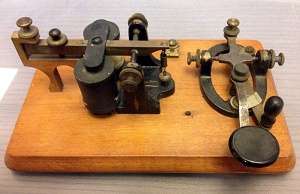 The world was without an electric telegraph
for several thousand years; then Professor Henry, the American, Wheatstone in
England, Morse on the sea, and a German in Munich, all invented it at the same
time. The discovery of certain ways of applying steam was made in two or three
countries in the same year. Is it not possible that inventors are constantly and
unwittingly stealing each other's ideas whilst they stand thousands of miles
asunder?
The world was without an electric telegraph
for several thousand years; then Professor Henry, the American, Wheatstone in
England, Morse on the sea, and a German in Munich, all invented it at the same
time. The discovery of certain ways of applying steam was made in two or three
countries in the same year. Is it not possible that inventors are constantly and
unwittingly stealing each other's ideas whilst they stand thousands of miles
asunder?
Last spring a literary friend of mine, W. D. Howells, who lived a hundred
miles away, paid me a visit; and in the course of our talk he said he had made
discovery—conceived an entirely new idea—one which certainly had never been used
in literature. He told me what it was. I handed him a manuscript, and said he
would find substantially the same idea in that—a manuscript which I had written
a week before. The idea had been in my mind since the previous November; it had
only entered his while I was putting it on paper, a week gone by. He had not yet
written his; so he left it unwritten, and gracefully made over all his right and
title in the idea to me.
The following statement, which I have clipped from a newspaper, is true. I
had the facts from Mr. Howells' lips when the episode was new:
A remarkable story of a literary coincidence is told of Mr.
Howells' Atlantic Monthly serial, "Dr. Breen's Practice." A lady of
Rochester, New York, contributed to the magazine after "Dr. Breen's
Practice" was in type, a short story which so much resembled Mr. Howells'
that he felt it necessary to call upon her and explain the situation of
affairs in order that no charge of plagiarism might be preferred against him.
He showed her the proof-sheets of his story, and satisfied her that the
similarity between her work and his was one of those strange coincidences
which have from time to time occurred in the literary world.
I, personally, had read portions of Mr. Howells' story, both in
manuscript and in proof, before the lady offered her contribution to
the magazine.
Here is another case. I clip it from a newspaper:
The republication of Miss Alcott's novel Moods recalls to
a writer in the Boston Post a singular coincidence which was brought to
light before the book was first published: "Miss Anna M. Crane, of Baltimore,
published Emily Chester, a novel which was pronounced a very striking
and strong story. A comparison of this book with Moods showed that the
two writers, though entire strangers to each other, and living hundreds of
miles apart, had both chosen the same subject for their novels, had followed
almost the same line of treatment up to a certain point, where the parallel
ceased, and the denouements were entirely opposite. And even more curious, the
leading characters in both books had identically the same names, so that the
names in Miss Alcott's novel had to be changed. Then the book was published by
Loring."
Four or five times within my recollection there has been a
lively newspaper war in this country over poems whose authorship was
claimed by two or three different people at the same time. There was
a war of this kind over "Nothing to Wear," "Beautiful Snow," "Rock
me to Sleep, Mother," and also over one of Mr.
Will Carleton's early ballads, I think. These were all blameless
cases of unintentional and unwitting mental telegraphy, I judge.
A word more as to Mr. Wright. He had had his book in mind some time;
consequently he, and not I, had originated the idea of it. The subject was
entirely foreign to my thoughts; I was wholly absorbed in other things. Yet this
friend, whom I had not seen and had hardly thought of for eleven years, was able
to shoot his thoughts at me across three thousand miles of country, and fill my
head with them, to the exclusion of every other interest, in a single moment. He
had begun his letter after finishing his work on the morning paper—a little
after three o'clock, he said. When it was three in the morning in Nevada it was
about six in Hartford, where I lay awake thinking about nothing in particular;
and just about that time his ideas came pouring into my head from across the
continent, and I got up and put them on paper, under the impression that they
were my own original thoughts.
I have never seen any mesmeric or clairvoyant performances or spiritual
manifestations which were in the least degree convincing—a fact which is not of
consequence, since my opportunities have been meager; but I am forced to believe
that one human mind (still inhabiting the flesh) can communicate with another,
over any sort of a distance, and without any artificial preparation of
"sympathetic conditions" to act as a transmitting agent. I suppose that when the
sympathetic conditions happen to exist the two minds communicate with each
other, and that otherwise they don't; and I suppose that if the sympathetic
conditions could be kept up right along, the two minds would continue to
correspond without limit as to time.
Now there is that curious thing which happens to everybody: suddenly a
succession of thoughts or sensations flocks in upon you, which startles you with
the weird idea that you have ages ago experienced just this succession of
thoughts or sensations in a previous existence. (The phenomenon we now call "Déj?
vu".—Paul) The previous existence is possible, no doubt; but I am
persuaded that the solution of this hoary mystery lies not there, but in the
fact that some far-off stranger has been telegraphing his thoughts and
sensations into your consciousness, and that he stopped because some
counter-current or other obstruction intruded and broke the line of
communication. Perhaps they seem repetitions to you because they are
repetitions, got at second hand from the other man. Possibly Mr. Brown,
the "mind-reader," reads other people's minds, possibly he does not; but I know
of a surety that I have read another man's mind, and therefore I do not see why
Mr. Brown shouldn't do the like also.
Mental Telegraphy Part 2
|
By: Mark Twain |
Posted: 2/22/2007 |
|
Page Views: 2 |
| Hashtags: #Spirituality #Science #Metaphysics #MarkTwain #Synchronicity #Telepathy |
| The continuation of Mark Twain's writings on 'Mental Telegraphy'. |
| Estimated reading time: 19 minute(s) (4488 words) |

Clemens talks about
"accidents"—what we, today, call coincidences or synchronicity. The science of
statistics wasn't well-established in Clemens' day, but today's statisticians
try to tell us that "coincidences" are meaningless; that they are the result of
the patterning human mind imposing seeming order on what is actually random
chance.
Mental Telegraphy Part 3
|
By: Mark Twain |
Posted: 2/23/2007 |
|
Page Views: 2 |
| Hashtags: #Spirituality #Metaphysics #MarkTwain #Synchronicity #Telepathy |
| The conclusion of Mark Twain's essays on telepathy. |
| Estimated reading time: 19 minute(s) (4521 words) |

At the end of yesterday's guest blog, Sam Clemens described an odd
circumstance which, while not exactly an example of his "mental telegraphy,"
nevertheless qualified as what we, today, would call "high strangeness." As he
watched a stranger approach his house, the stranger seemed to disappear. When
Clemens found the stranger had, in fact, rung and been admitted through the
front door, he concluded that he must have unknowingly fallen asleep, or
unconscious, for the sixty seconds (minimum) that it took the visitor to walk
past him, ring the doorbell and be admitted.