|
By: Mark Twain |
Posted: 2/23/2007 |
|
Page Views: 3 |
| Hashtags: #Spirituality #Metaphysics #MarkTwain #Synchronicity #Telepathy |
| The conclusion of Mark Twain's essays on telepathy. |
| Estimated reading time: 19 minute(s) (4521 words) |
Now, let's examine this a little further. From Clemens' point of view, the
man simply "disappeared." As he puts it, "It was as astounding as if a church
should vanish from before your face and leave nothing behind it but a vacant
lot."
Normally, when a person falls asleep or unexpectedly loses consciousness,
there is a break in perception—a sense of discontinuity. Yet Clemens reports
none of that. He didn't say, "I blinked and he was gone." Instead, he says the
man disappeared. In fact, his first impulse was that he had witnessed a
ghost or phantasm vanish.
When he questioned the stranger, Clemens doesn't report asking the question
I was dying to know: "Did you notice me on the porch? What was I doing, how
did I appear to you?" But with over a hundred years between Clemens' experience
and my second-guessing, there's no way for me to find out the answer. However,
Clemens gives us a clue. He says,
He was a stranger, and I hoped he would ring and carry his
business into the house without stopping to argue with me; he would have to
pass the front door to get to me, and I hoped he wouldn't take the trouble; to
help, I tried to look like a stranger myself—it often works.
In other words, Clemens wished to be invisible to the visitor.
In 1972, my wife and I lived in a garage apartment in Palatka, Florida. My
best buddy at the time was a guy named John, who was very good-looking and very
popular among the ladies. In fact, he lived with three of them and had made the
mistake of bedding all of them at one time or another. Well, he was young—we
were in junior college together—and it apparently came as a surprise to him that
the girls compared notes and proceeded to fight over him. The turmoil became so
extravagant that he fled, intending to come to my house for some peace.
Unknown to him, Mary and I and our friends Mike and Johanna, were on our way
to the St. Augustine Beach. As John was walking up our front stairs, we were
exiting out the back way to where my car was parked. We didn't bother to lock
our doors in those days, so John simply let himself in and, finding no one home,
stretched out on our sofa and, wished himself invisible.
Meanwhile, in the car, I discovered I had left the apartment without my keys.
So I ran back upstairs, checking the various surfaces where I may have put them
down—the dinette table, the counter next to the stove, then the end tables on
either side of the sofa, the coffee table, and finally in the bedroom where I
found them on the floor. At no time during this search did I perceive John, or
anyone else, on the sofa. In fact, I found nothing amiss, and hurried out the
back door, letting it slam shut in my rush.
When I got into the car and started the engine, and put it into reverse, I
happened to look up at one of our apartment windows and was astounded to see
John's face in it, grinning, accompanied by his waving hand. Of course I stopped
the car, apologized (again) to our passengers, and ran upstairs. I thought John
had just arrived, having no idea that he'd been there for several minutes. But
as we hammered out the details, it became apparent that, somehow, John had made
himself invisible to me.
Or had he? He was completely unaware that I had come into the apartment at
all, and he didn't feel that he had had time to go to sleep. Yet he hadn't seen
me, and I hadn't seen him, even though—in theory—we had been in the same room at
the same time.
I have another, earlier story—like the incident with John, among the few that
I cannot connect to UFOs or alien abductions. In 1961, my family moved from St.
Augustine to a home on Anastasia Island, across the Matanzas River from St.
Augustine. We only stayed there a couple of months while our custom home was
being built a few miles away, so we never really unpacked. The garage was
therefore filled almost to the ceiling with boxes, neatly stacked and arranged
in a spiral so that it was possible to get to any of them should the need arise.
This house was part of a small development that consisted of a single street,
horseshoe-shaped; and the house was at the end of the horseshoe furthest from
the main road. There were no developments on either side of ours, and the
Florida jungle rose up at the terminus of our back yard. If we'd walked another
half mile through the woods, we'd have come to the bank of the Matanzas. But we
never did that, because Mom explained that the woods were full of snakes.
One day, Mom and my grandparents and my sister Mary Joan rode off in the car
to check on the new house, leaving me and my other sister, Louise, to fend for
ourselves. I was busy writing a radio script (for fun) and decided I needed
to write it on a special type of paper that was still boxed in the garage. I
thought I knew where that box was, and decided the need warranted the search. So
I went into the garage, following the spiral path around and around to its end,
where I had last seen the box I wanted. Sure enough it was there; I opened it
and extracted a sheaf of the paper I wanted, and made to return to the kitchen
door, which opened into the garage.
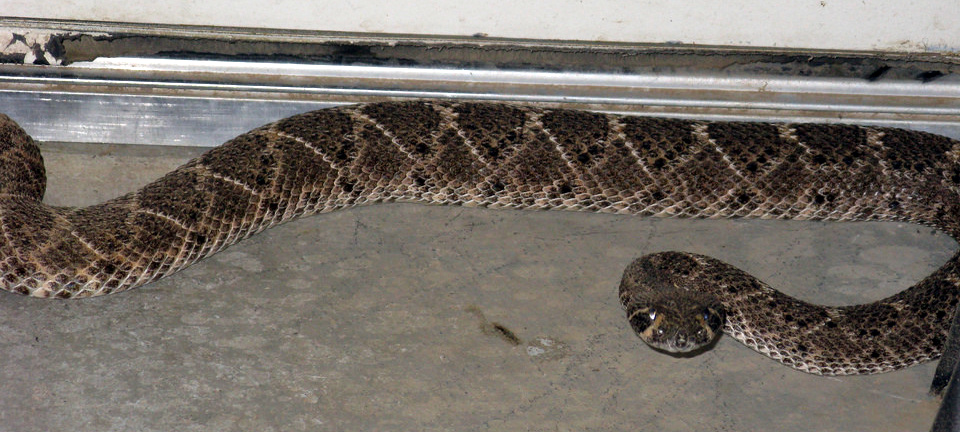
I was almost all the way there, when a staccato rattling caught my attention.
There, not three feet in front of me, was a rattlesnake, coiled into striking
position, rattling its rather large tail off.
As Sam Clemens once said, "My lungs collapsed and my heart stopped." There
was no way I could move in time to avoid being struck, and even if I could back
up fast enough I would then be trapped in the garage, with no way to get back
inside the house or out of the garage. All this went through my mind without my
making the slightest motion. And then, something happened which should have
struck me odd at the time, but in fact didn't appear so to me until days later
as I re-ran the terrifying memory for the umpteenth time. Without my moving, and
with my eyes locked on the snake, I found myself standing in the kitchen door,
still staring at the snake, which was still coiled to strike, still rattling,
but now maybe a safe twenty feet away. As I watched, the snake, having nothing
to strike at, stopped rattling and relaxed, stretching out on the floor of the
garage.
I was still gasping when Louise, two years younger than me—I was ostensibly
babysitting—came into the house through the front door and headed straight for
me, as if to enter the garage. I held out my arm to prevent her, yelling, "Lou!
There's a snake in the garage!" And I pointed the creature out.
Thing is, a stretched-out snake isn't nearly as identifiable as one that is
coiled. Louise looked where I was pointing, and snarled, "That's no snake. It's
a rope. I was going to play with it yesterday." She had decided instead to "run
the water," which meant playing with the garden hose and getting wet, a favorite
pastime of ours. But now she was intent on proving that the snake was a "rope"
and for a moment I was afraid I would have to deck my little sister to save her
life. Fortunately, the snake took that moment to shift position; Louise screamed
when the "rope" came to life, and we slammed the door shut and ran into the
yard…
…And to our neighbors, one by one, yelling, "There's a snake in our garage!
There's a snake in our garage!" One of them called the sheriff, and soon there
was a police car, complete with flashing light, in our driveway and a gathering
crowd as the officer made his way into our garage with his "snake catcher", a
pole with a metal loop at the end.
Which is what my Mom and grandparents and other sister found when they came
home. Unable to park in the driveway, they edged into the crowd of neighbors
who, of course, didn't know them since we had just moved in. "He's in the
garage," Mom heard, and "Almost killed two children!" Finally, the officer
emerged from the side door of the garage with the six-foot-long snake dangling
from his snake catcher. The crowd applauded and Mom nearly fainted. The snake
was taken to the nearby Alligator Farm on what was presumably the most thrilling
automobile ride of its life; the crowd dispersed, and we brought Mom into the
house where she collapsed into a chair and had to be ministered to.
But, as I said, days later, as I ran the memory over and over—I realized
that, somehow, I had instantaneously shifted position from directly in front of
the snake, to the kitchen door. The snake didn't change position. It was still
coiled, staring at where I'd been, from my position in the door. What's more,
even if I had somehow traveled from in front of the snake to the kitchen
without remembering it—well, I couldn't have. I'd have had to climb over
precariously stacked boxes, some of which would certainly have fallen in the
attempt; and there was no evidence of that. Besides, how to explain the snake
waiting patiently in strike position while I got out of the way?
We humans (and all other animals) are constructed of cells, which are made of
molecules, which are collections of atoms. The atoms are composed of quantum
particles. Now, the interesting thing about quantum particles, is that they
don't obey the same rules as (relatively) big things like atoms and cells. Where
a cell lasts a long time and most atoms are forever, quantum particles come and
go like last week's reality show contestants. They arise out of what is called
the "quantum foam" only to vanish back into it as quickly. Normally, the
"reality" that is the atom remains in one place, its components constantly
changing even though the form remains. This is reflected in the fact that the
atoms that make up you also come and go (being completely replaced every
seven years), while the identity of you remains.
But—what if—it's possible, under some certain circumstances, for you
to stick with the quantum particles as they flutter out of this Universe and
back into it at another space-time coordinate? From your point of view, you
would remain constant and conscious with no discontinuity; but to the outer
world you might appear to have jumped ahead in time, moved instantaneously in
space, or both. (Remember, to the physicist, time is a dimension just
like width, and exactly as easy to manipulate.) It might
even be possible, to an outside observer, to seem to be in two places at
once.
Consider this, as we read Sam Clemens' final entry on the subject…
1885
I have three or four curious incidents to tell about. They seem to come under
the head of what I named "Mental Telegraphy" in a paper written seventeen years
ago, and published long afterward.
Several years ago I made a campaign on the platform with Mr. George W. Cable.
In Montreal we were honored with a reception. It began at two in the afternoon
in a long drawing-room in the Windsor Hotel. Mr. Cable and I stood at one end of
this room, and the ladies and gentlemen entered it at the other end, crossed it
at that end, then came up the long left-hand side, shook hands with us, said a
word or two, and passed on, in the usual way. My sight is of the telescopic
sort, and I presently recognized a familiar face among the throng of strangers
drifting in at the distant door, and I said to myself, with surprise and high
gratification, "That is Mrs. R.; I had forgotten that she was a Canadian." She
had been a great friend of mine in Carson City, Nevada, in the early days. I had
not seen her or heard of her for twenty years; I had not been thinking about
her; there was nothing to suggest her to me, nothing to bring her to my mind; in
fact, to me she had long ago ceased to exist, and had disappeared from my
consciousness. But I knew her instantly. I was impatient for her to come. In the
midst of the hand shakings I snatched glimpses of her and noted her progress
with the slow-moving file across the end of the room; then I saw her start up
the side, and this gave me a full front view of her face. I saw her last when
she was within twenty-five feet of me. For an hour I kept thinking she must
still be in the room somewhere and would come at last, but I was disappointed.
When I arrived in the lecture-hall that evening someone said: "Come into the
waiting-room; there's a friend of yours there who wants to see you. You'll not
be introduced—you are to do the recognizing without help if you can."
I said to myself: "It is Mrs. R.; I sha'n't have any trouble."
There were perhaps ten ladies present, all seated. In the midst of them was
Mrs. R., as I had expected. She was dressed exactly as she was when I had seen
her in the afternoon. I went forward and shook hands with her and called her by
name, and said:
"I knew you the moment you appeared at the reception this afternoon."
She looked surprised, and said: "But I was not at the reception. I have just
arrived from Quebec, and have not been in town an hour."
It was my turn to be surprised now. I said: "I can't help it. I give you my
word of honor that it is as I say. I saw you at the reception, and you were
dressed precisely as you are now. When they told me a moment ago that I should
find a friend in this room, your image rose before me, dress and all, just as I
had seen you at the reception."
Those are the facts. She was not at the reception at all, or anywhere near
it; but I saw her there nevertheless, and most clearly and unmistakably. To that
I could make oath. How is one to explain this? I was not thinking of her at the
time; had not thought of her for years. But she had been thinking of me, no
doubt; did her thoughts flit through leagues of air to me, and bring with it
that clear and pleasant vision of herself? I think so. That was and remains my
sole experience in the matter of apparitions—I mean apparitions that come when
one is (ostensibly) awake. I could have been asleep for a moment; the apparition
could have been the creature of a dream. Still, that is nothing to the point;
the feature of interest is the happening of the thing just at that time, instead
of at an earlier or later time, which is argument that its origin lay in
thought-transference.
My next incident will be set aside by most persons as being merely a
"coincidence," I suppose. Years ago I used to think sometimes of making a
lecturing trip through the antipodes and the borders of the Orient, but always
gave up the idea, partly because of the great length of the journey and partly
because my wife could not well manage to go with me. Toward the end of last
January that idea, after an interval of years, came suddenly into my head
again—forcefully, too, and without any apparent reason. Whence came it? What
suggested it? I will touch upon that presently.
I was at that time where I am now—in Paris. I wrote at once to Henry M.
Stanley (London), and asked him some questions about his Australian lecture
tour, and inquired who had conducted him and what were the terms. After a day or
two his answer came. It began:
The lecture agent for Australia and New Zealand is par
excellence Mr. R. S. Smythe, of Melbourne.
He added his itinerary, terms, sea expenses, and some other
matters, and advised me to write Mr. Smythe, which I did—February
3rd. I began my letter by saying in substance that, while he did not
know me personally, we had a mutual friend in Stanley, and that
would answer for an introduction. Then I proposed my trip, and asked
if he would give me the same terms which he had given Stanley.
I mailed my letter to Mr. Smythe (who, remember, was in Australia) February
6th, and three days later I got a letter from the selfsame Smythe, dated
Melbourne, December 17th. I would as soon have expected to get a letter from the
late George Washington. The letter began somewhat as mine to him had begun—with
a self-introduction:
Dear Mr. Clemens.
It is so long since Archibald Forbes and I spent that pleasant afternoon in
your comfortable house at Hartford that you have probably quite forgotten the
occasion.
In the course of his letter this occurs:
I am willing to give you [here he named the terms which he had
given Stanley] for an antipodean tour to last, say, three months.
Here was the single essential detail of my letter answered three
days after I had mailed my inquiry. I might have saved myself the
trouble and the postage—and a few years ago I would have done that
very thing, for I would have argued that my sudden and strong
impulse to write and ask some questions of a stranger on the under
side of the globe meant that the impulse came from that stranger,
and that he would answer my questions of his own motion if I would
let him alone.
Mr. Smythe's letter probably passed under my nose on its way to lose three
weeks traveling to America and back, and gave me a whiff of its contents as it
went along. Letters often act like that. Instead of the thought coming to you in
an instant from Australia, the (apparently) insentient letter imparts it to you
as it glides invisibly past your elbow in the mail-bag.
Next incident. In the following month—March—I was in America. I spent a
Sunday at Irvington-on-the-Hudson with Mr. John Brisben Walker, of the
Cosmopolitan magazine. We came into New York next morning, and went to the
Century Club for luncheon. He said some praiseful things about the character of
the club and the orderly serenity and pleasantness of its quarters, and asked if
I had never tried to acquire membership in it. I said I had not, and that New
York clubs were a continuous expense to the country members without being of
frequent use or benefit to them.
"And now I've got an idea!" said I. "There's the Lotos—the first New York
club I was ever a member of—my very earliest love in that line. I have been a
member of it for considerably more than twenty years, yet have seldom had a
chance to look in and see the boys. They turn gray and grow old while I am not
watching. And my dues go on. I am going to Hartford this afternoon for a day or
two, but as soon as I get back I will go to John Elderkin very privately and
say: 'Remember the veteran and confer distinction upon him, for the sake of old
times. Make me an honorary member and abolish the tax. If you haven't any such
thing as honorary membership, all the better—create it for my honor and glory.'
That would be a great thing; I will go to John Elderkin as soon as I get back
from Hartford."
I took the last express that afternoon, first telegraphing Mr. F. G. Whitmore
to come and see me next day. When he came he asked:
"Did you get a letter from Mr. John Elderkin, secretary of the Lotos Club,
before you left New York?"
"No."
"Then it just missed you. If I had known you were coming I would have kept
it. It is beautiful, and will make you proud. The Board of Directors, by
unanimous vote, have made you a life member, and squelched those dues; and you
are to be on hand and receive your distinction on the night of the 30th, which
is the twenty-fifth anniversary of the founding of the club, and it will not
surprise me if they have some great times there."
What put the honorary membership in my head that day in the Century Club? For
I had never thought of it before. I don't know what brought the thought to me at
that particular time instead of earlier, but I am well satisfied that it
originated with the Board of Directors, and had been on its way to my brain
through the air ever since the moment that saw their vote recorded.
Another incident. I was in Hartford two or three days as a guest of the Rev.
Joseph H. Twichell. I have held the rank of Honorary Uncle to his children for a
quarter of a century, and I went out with him in the trolley-car to visit one of
my nieces, who is at Miss Porter's famous school in Farmington. The distance is
eight or nine miles. On the way, talking, I illustrated something with an
anecdote. This is the anecdote:
Two years and a half ago I and the family arrived at Milan on our
way to Rome, and stopped at the Continental. After dinner I went below and
took a seat in the stone-paved court, where the customary lemon trees stand in
the customary tubs, and said to myself, "Now this is comfort, comfort and
repose, and nobody to disturb it; I do not know anybody in Milan."
Then a young gentleman stepped up and shook hands, which damaged my theory.
He said, in substance:
"You won't remember me, Mr. Clemens, but I remember you very well. I was a
cadet at West Point when you and Rev. Joseph H. Twichell came there some years
ago and talked to us on a Hundredth Night. I am a lieutenant in the regular army
now, and my name is H______. I am in Europe, all alone, for a modest little
tour; my regiment is in Arizona."
We became friendly and sociable, and in the course of the talk he told me of
an adventure which had befallen him—about to this effect:
"I was at Bellagio, stopping at the big hotel there, and ten days ago I lost
my letter of credit. I did not know what in the world to do. I was a stranger; I
knew no one in Europe; I hadn't a penny in my pocket; I couldn't even send a
telegram to London to get my lost letter replaced; my hotel bill was a week old,
and the presentation of it imminent—so imminent that it could happen at any
moment now. I was so frightened that my wits seemed to leave me. I tramped and
tramped, back and forth, like a crazy person. If anybody approached me I hurried
away, for no matter what a person looked like, I took him for the head waiter
with the bill.
"I was at last in such a desperate state that I was ready to do any wild
thing that promised even the shadow of help, and so this is the insane thing
that I did. I saw a family lunching at a small table on the veranda, and
recognized their nationality—Americans—father, mother, and several young
daughters—young, tastefully dressed, and pretty—the rule with our people. I went
straight there in my civilian costume, named my name, said I was a lieutenant in
the army, and told my story and asked for help.
"What do you suppose the gentleman did? But you would not guess in twenty
years. He took out a handful of gold coin and told me to help myself—freely.
That is what he did."
The next morning the lieutenant told me his new letter of credit had arrived
in the night, so we strolled to Cook's to draw money to pay back the benefactor
with. We got it, and then went strolling through the great arcade. Presently he
said, "Yonder they are; come and be introduced." I was introduced to the parents
and the young ladies; then we separated, and I never saw him or them any m—
"Here we are at Farmington," said Twichell, interrupting.
We left the trolley-car and tramped through the mud a hundred yards or so to
the school, talking about the time we and Warner walked out there years ago, and
the pleasant time we had.
We had a visit with my niece in the parlor, then started for the trolley
again. Outside the house we encountered a double rank of twenty or thirty of
Miss Porter's young ladies arriving from a walk, and we stood aside, ostensibly
to let them have room to file past, but really to look at them. Presently one of
them stepped out of the rank and said:
"You don't know me, Mr. Twichell, but I know your daughter and that gives me
the privilege of shaking hands with you."
Then she put out her hand to me, and said:
"And I wish to shake hands with you too, Mr. Clemens. You don't remember me,
but you were introduced to me in the arcade in Milan two years and a half ago by
Lieutenant H______."
What had put that story into my head after all that stretch of time? Was it
just the proximity of that young girl, or was it merely an odd accident?