|
By: Paul S Cilwa |
Posted: 3/1/2026 |
|
Page Views: 55 |
| Hashtags: #ElectricalAge #Science #HistoryOfLighting #ElectricLightEvolution #KeroseneLamps #VoltaicPile #ArcLamps #IncandescentBulbs #EdisonLightingSystem #GeisslerTubes #FluorescentLights #LEDHistory #HomeLightingTechnology #ScienceOfLight #GlobalElectrification #ThomasAlvaEdison #AlessandroVolta |
| How our entry into the Electrical Age went past lighting to global communication. |
| Estimated reading time: 14 minute(s) (3235 words) |

We had previously lived in New Jersey, on the grid; so I knew what electricity and
electric lights were. But just a century earlier, practically no one did.
Electric lights, as well as telegraphs, telephones, and radio,
would not have been possible without a stable source of electric current,
something we lacked until Alessandro Volta invented his voltaic pile.
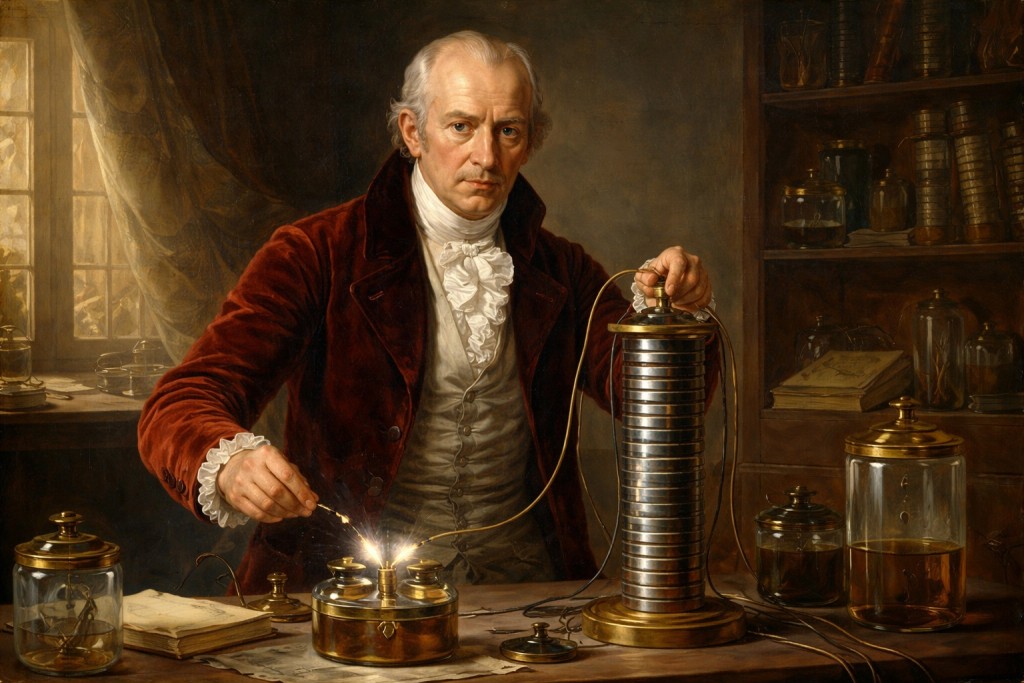
Alessandro Volta was an Italian physicist whose curiosity about electricity pushed him far beyond
the static sparks and Leyden jars of the 18th century. Born in Como in 1745, he spent his life
experimenting with electrical phenomena at a time when no one fully understood what electricity
even was, let alone how to harness it. His rivalry with Luigi Galvani—who believed electricity was
a biological force—drove Volta to prove that electricity could be generated chemically, not
just stored or discharged. That determination led him to one of the most important breakthroughs in
the history of science, and the basis of all of today's technology.
The voltaic pile, which Volta unveiled in 1800, was the world's first true battery: a device
capable of producing a continuous, steady electric current. It was built from alternating discs of
zinc and copper, separated by pieces of cloth or cardboard soaked in saltwater or acid. Each
zinc-copper pair formed a tiny electrochemical cell, and stacking many of them increased the
voltage. Unlike earlier devices that produced only brief sparks, the voltaic pile delivered a
sustained flow of electricity—something no one had ever seen before.
The way it worked was elegantly simple. The two metals had different tendencies to give up
electrons. Zinc, being more reactive, released electrons more readily, while copper accepted them.
When the electrolyte (the cloth or cardboard) allowed ions to move between the metals, electrons flowed through an external
wire from zinc to copper, creating a usable electric current. This continuous current was the
essential ingredient that made later inventions possible: telegraphs, electrolysis, early motors,
and eventually electric lighting. Without Volta's pile, there would have been no reliable power
source for the experiments that led to arc lamps, incandescent bulbs, and the electrified world
that followed.
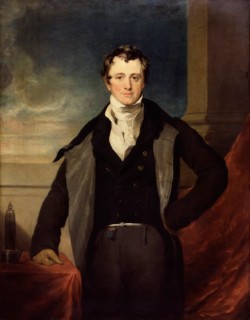
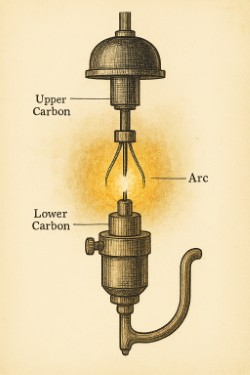
Humphry Davy's arc lamp was one of those inventions that feels almost mythic in
hindsight—brilliant, dangerous, and far ahead of its time. Davy first demonstrated it in
1806, using the newly invented voltaic pile to push an enormous electric current through two carbon
rods. When the rod tips were brought close together, the current leapt the gap as a blinding
electric arc. This was the first time anyone had produced a sustained, intensely bright artificial
light, and it instantly became clear that electricity could outshine any flame humans had ever
made.
The lamp worked through a simple but dramatic mechanism. As the carbon electrodes were brought near
each other, the electric current heated their tips to incandescence and ionized the air between
them. The ionized air became a conductive plasma, allowing electrons to jump the gap and creating a
brilliant, white-blue arc. The carbon tips burned away as the lamp operated, so early arc lamps
required constant adjustment to maintain the gap. Later designs added mechanical
regulators—clockwork, solenoids, or electromagnets—to keep the electrodes at the
correct distance automatically.
Arc lamps found their first real home outdoors and in large public spaces, where their intensity
was an advantage rather than a hazard. By the 1870s and 1880s, they illuminated city streets,
railway stations, factories, and theaters. Their harsh glare made them unsuitable for homes, but
they were indispensable for early electric lighting infrastructure. In a sense, arc lamps were the
bridge between the age of gaslight and the age of incandescent bulbs: too bright and unwieldy for
everyday life, but powerful enough to prove that electric lighting could transform the modern
world.
When I was a teen in the late 1960s, the local drive-in theatre's movie projectors still used arc
lamps. Once when I was visiting the projectionist, who I had somehow managed to befriend, he
showed me how the projectors worked, and how the carbon rods had to be monitored and manually
cranked together when the light began to dim. By then, carbon-arc projectors were
already living on borrowed time, but drive-ins and older theaters kept them running because
they produced a gorgeous, steady beam that early xenon lamps couldn't quite match.
In a carbon-arc projector, the two carbon electrodes burn down at different rates, and the arc gap
widens as the show goes on. If the gap gets too wide, the arc sputters and the light dims.
Projectionists had to watch the brightness constantly and turn a small handwheel to nudge the rods
closer together, keeping the arc at just the right length. Some projectors had automatic feed
mechanisms, but even those needed babysitting; the carbon rods could warp, burn unevenly, or jam,
and the projectionist had to correct it on the fly.
There was a kind of craft to it—almost
like tending a fire. The projectionist wasn't just running machines; he was managing a living,
hissing, white-hot column of plasma that powered the entire movie experience. The smell of ozone,
the faint grit of carbon dust, the hum of the rectifier, the glow leaking from the lamphouse
vents…it was a whole sensory world that vanished when theaters switched to sealed xenon
lamps in the 1970s.
Obviously, arc lamps couldn't fill the place of trusty old kerosene lamps. So inventors kept at it.
What made kerosene lamps safe? Well, they weren't that safe; knocking one over started
many a housefire. But the flame was mostly surrounded by glass, which at least provided some
level of protection to, say, a kid doing their homework at the kitchen table.
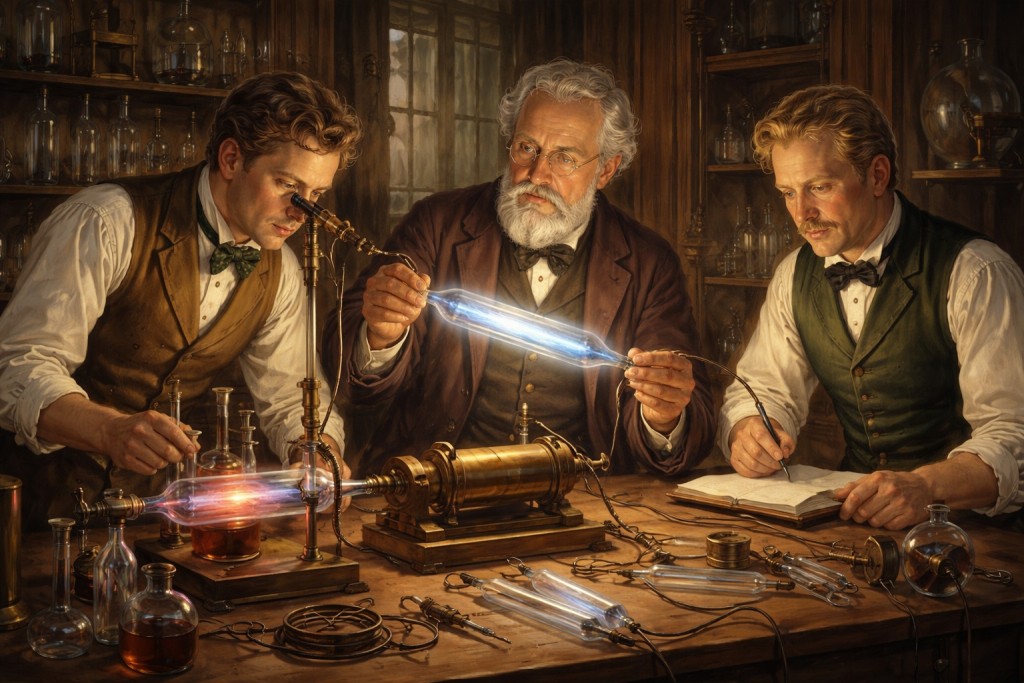
Heinrich Geissler was a German glassblower and instrument maker whose skill with delicate vacuum
tubes helped launch an entirely new branch of physics. In the 1850s, he began experimenting with
sealed glass tubes containing very low-pressure gases and fitted with metal electrodes at each end.
When connected to an induction coil, these tubes produced vivid, colorful glows that fascinated
scientists across Europe. Geissler wasn't a theorist—he was a craftsman—but his tubes
gave researchers a new window into the behavior of electricity in rarefied gases, something no one
had been able to (or thought to) study before.
A Geissler tube worked by applying a high voltage across the electrodes, which accelerated
electrons through the nearly evacuated interior. As these electrons collided with the gas atoms
inside, they excited them to higher energy states. When the atoms relaxed back to their normal
state, they emitted light—often in striking colors depending on the gas used. Neon glowed
red, mercury vapor blue, nitrogen purple. The tubes were beautiful, but they were also
scientifically important: they revealed that electricity could travel through gases in ways that
hinted at deeper structures within atoms.
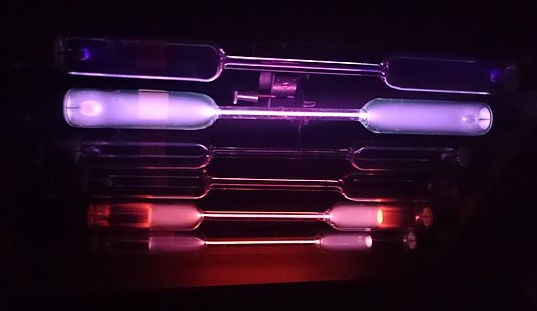
Their uses ranged from scientific demonstration to early entertainment. Physicists used Geissler
tubes to study electrical conduction, spectral lines, and the nature of cathode rays—work
that eventually led to the discovery of the electron and the development of vacuum tubes, X-ray
tubes, and even television. At the same time, the public was captivated by their eerie glow, and
they became popular in parlor demonstrations and traveling science shows. In many ways, Geissler
tubes were the ancestors of neon signs, fluorescent lamps, and plasma displays.
But, of course, no one wanted bright green, red or blue lamps in their homes. Kerosene lamps
burn with a yellow-white flame. Anything more chromatic just wouldn't have been acceptable.
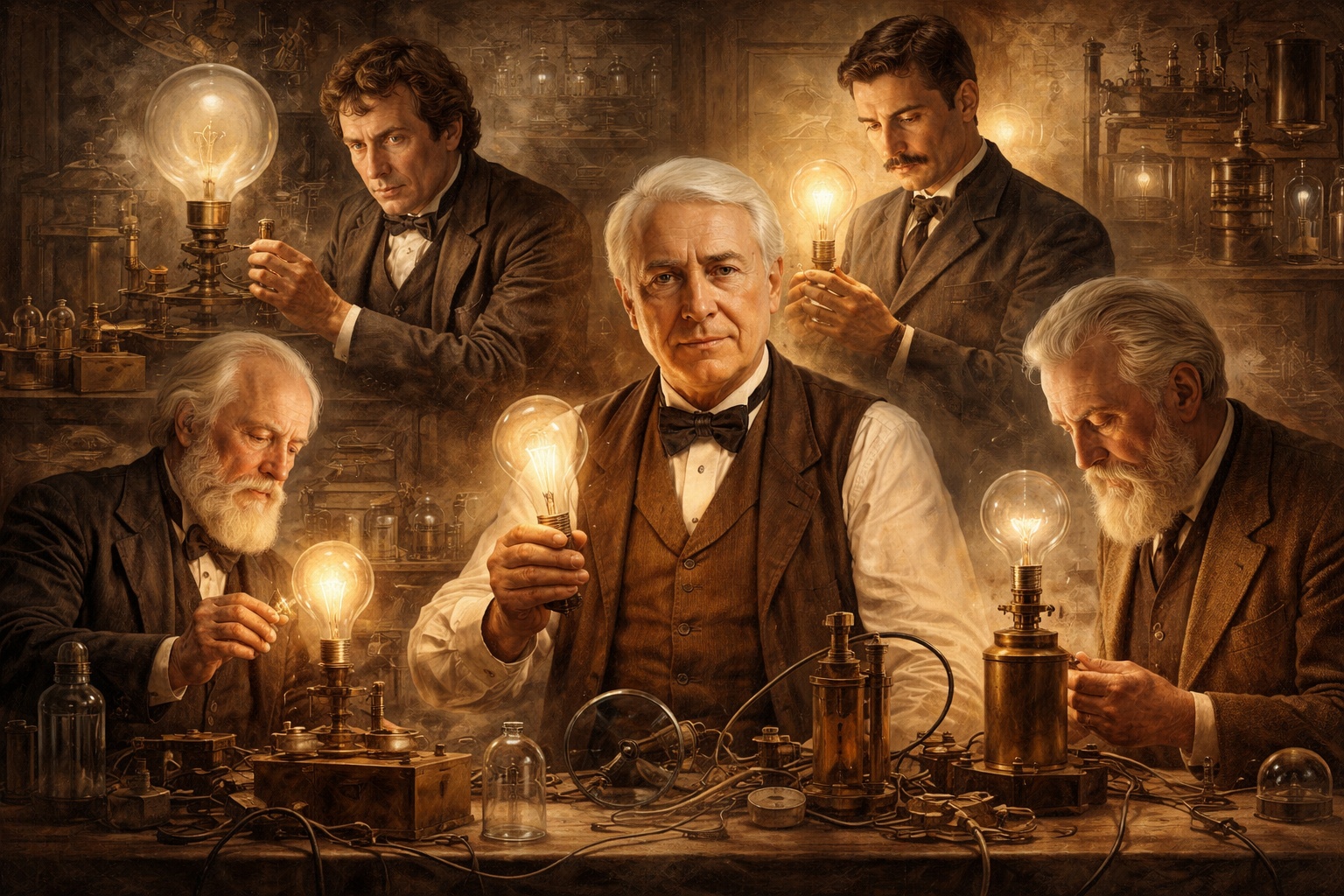
Early attempts at incandescent lighting were bold but fragile steps toward a workable idea. Humphry
Davy (our arc lamp friend) heated thin platinum strips to incandescence in 1802, but the metal couldn't survive the heat
for long. James Bowman Lindsay demonstrated a steady incandescent light in 1835, yet he lacked the
means to commercialize it. Dozens of inventors tried carbonized paper, metal filaments, and various
vacuum techniques throughout the mid-19th century, but every design failed for the same reasons:
filaments burned out quickly, vacuums weren't strong enough to prevent oxidation, and no one had a
reliable electrical system to power the lamps. The concept was sound, but the materials and
infrastructure simply weren't ready.
Meanwhile, other uses for this new source of power popped up in unlikely places.
The electric telegraph emerged in the 1830s-1840s, with Samuel Morse (you may have heard of
his eponymous Code) and Alfred Vail credited for
creating the first practical system. By 1838, they had a working model, and in 1844 they sent the
famous first message What hath God wrought
between Washington, D.C. and Baltimore.
This system built on earlier experiments by figures like Sir Francis Ronalds and William Fothergill
Cooke, but Morse and Vail produced the version that became commercially and globally dominant.
Thomas Alva Edison entered the telegraph world as a teenager in the early 1860s. He learned Morse code, worked
night shifts, and moved from city to city taking operator jobs. This period shaped his technical
imagination: he saw firsthand the bottlenecks, the fatigue, the errors, and the mechanical
limitations of hand-sent messages.
He tinkered constantly with equipment at the office, sometimes to the annoyance of
his supervisors. His first patents—including the vote recorder and early telegraph
improvements—came directly from this operator background.
Meanwhile, Alexander Graham Bell was also playing with electricity, in his case, how to
modulate its flow by the pressure waves made by a human voice, and then to recreate them
at another location. In other words, he invented the telephone, filing his patent on
February 14, 1876, and sending the first intelligible sentence to another room,
on March 10th. Lily Tomlin reported the fateful quote as, "Mr.Watson…(heavy sigh)…come
here…(licks lips and exhales lustily)…I want you."
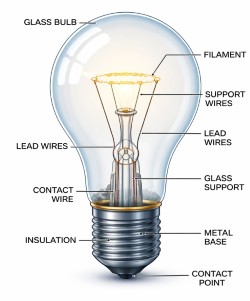
Shortly after, in 1880, Tom Edison patented his lightbulb.
What Edison did was not to invent the incandescent lamp from scratch, but to turn a promising idea
into a complete, functioning industry. He approached the problem systematically: a durable
filament, a high-quality vacuum, a standardized bulb, and—crucially—a power
distribution network to feed it. Edison's Menlo Park laboratory tested thousands of filament
materials before settling on carbonized bamboo, which offered both longevity and high resistance.
But the real breakthrough was organizational. Edison built generators, wiring standards, sockets,
switches, meters, and even the business model for selling electricity. He didn't just make a lamp;
he made a system.
The Edison electric light that emerged in 1879 was the first incandescent lamp practical enough for
everyday use. Its high-resistance filament allowed it to run on a centralized power grid, and its
vacuum-sealed glass envelope kept the filament from burning away. Early bulbs lasted only a few
hundred hours, but that was enough to prove the concept. Within a few years, Edison's Pearl Street
Station in New York was supplying electricity to homes, offices, and factories. The incandescent
bulb became the symbol of modernity—quiet, steady, safe, and far more pleasant than the harsh
glare of arc lamps or the soot and odor of gaslight.
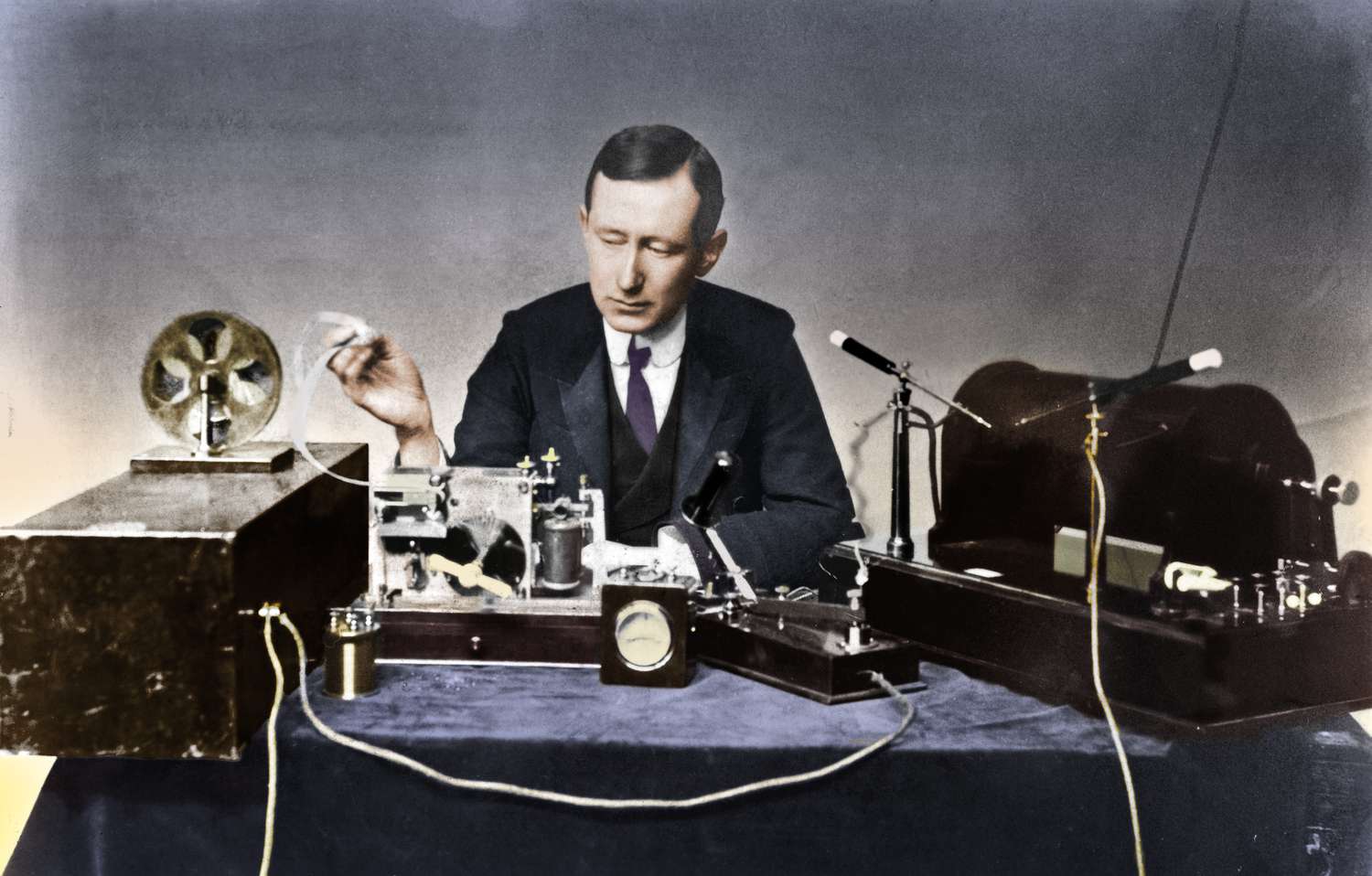
Guglielmo Marconi's contribution lay in turning already-known electromagnetic waves—first predicted
mathematically by James Clerk Maxwell in 1873 and demonstrated experimentally by Heinrich Hertz in
1886-1888—into a practical system of wireless telegraphy. Beginning his experiments in 1894,
Marconi adapted Hertz's laboratory apparatus into a workable communication tool by adding elevated
antennas, grounding systems, and sensitive coherer detectors, which allowed Morse-code signals to
be transmitted over increasing distances. By 1896, he filed the first patent for a wireless
telegraphy system, and by 1897-1901 he had extended transmission ranges from a few miles to nearly
2,000 miles, culminating in the 1901 transatlantic signal. His work established
wireless telegraphy as a commercial, naval, and global communication medium, transforming radio
from a scientific curiosity into an operational technology.
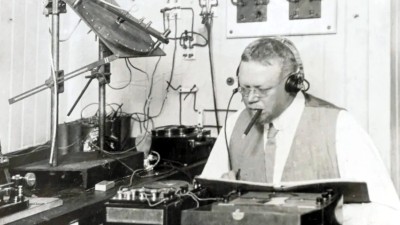
Then, armed with the newly invented telephone microphone, Reginald Fessenden made the first,
non-experimental, public broadcast: Reginald Fessenden's Christmas Eve broadcast of 1906,
transmitted from Brant Rock, Massachusetts. That program included spoken voice and music,
marking the shift from wireless telegraphy's dots-and-dashes to true audio transmission.
Fessenden's 1906 Christmas Eve broadcast was directed primarily at the radio operators aboard
United Fruit Company ships along the Atlantic coast, the vessels that had recently been
equipped with his wireless sets and were already accustomed to receiving Morse code traffic.
Although he aimed the demonstration at this specific maritime audience, the signal carried far more
widely, and operators on other ships at sea also reported hearing the unexpected mix of spoken
voice, violin music, and phonograph recordings. Because ships were the only widespread users of
wireless receivers in 1906, they formed the natural listening public for his experiment, and their
astonished reactions marked the moment when radio shifted from a point-to-point telegraphy tool
into a medium capable of carrying real audio.
By the early 1930s, the majority of U.S. households owned a radio.
In 1923, only about 1% of American homes had a radio, but by
1931 a majority did, and by 1937 roughly 75% of households owned at least one set. This rapid rise
reflected radio's shift from a hobbyist technology of the early 1920s into the first true
electronic mass medium, reshaping entertainment, news, and daily life.
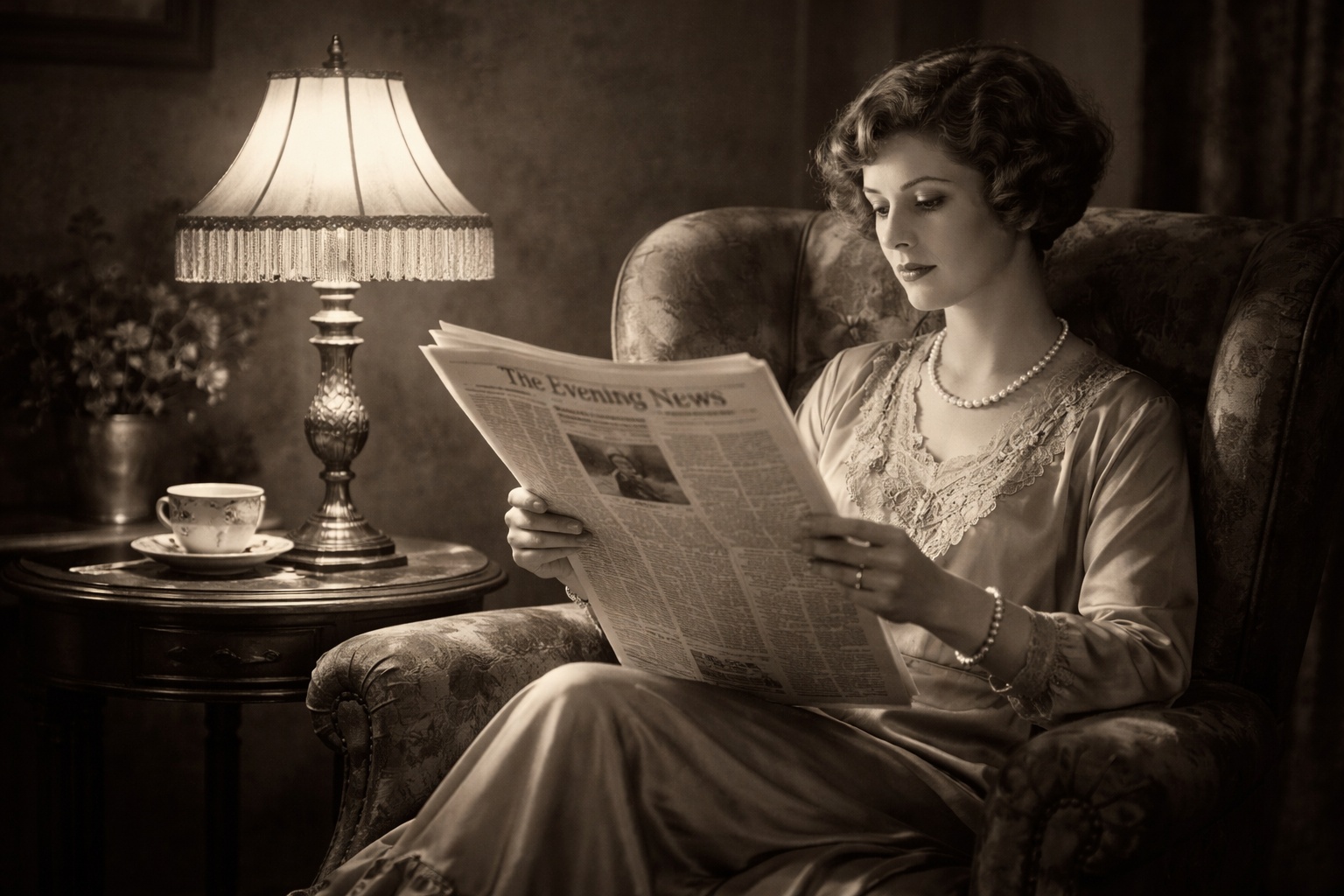
Urban America embraced electric lighting with astonishing speed. By the 1910s and 1920s, most city
homes were wired, and electric lights became a standard feature of new construction. Rural America,
however, lagged far behind. Private utilities refused to build long, unprofitable lines to sparsely
populated areas, leaving most farms in the dark well into the 1930s. The New Deal's Rural
Electrification Administration changed everything. By offering low-interest loans to cooperatives,
it enabled rural communities to build their own power lines. Within a generation, the
electrification gap closed, and electric lighting became a universal expectation across the United
States.
Fluorescent lighting is one of those technologies that sits right in the middle of the story of
electric light—newer than incandescent bulbs, older than LEDs, and still surprisingly
relevant. The idea dates back to the early 20th century, but the breakthrough came from Edmund
Germer, a German engineer who, in the 1920s, proposed using high-pressure mercury vapor and a
phosphor coating to create a bright, efficient white light. General Electric licensed his patents,
refined the design, and introduced the first commercially successful fluorescent lamps in the late
1930s. They arrived just in time for wartime factories, postwar offices, and the mid-century boom
in commercial architecture.
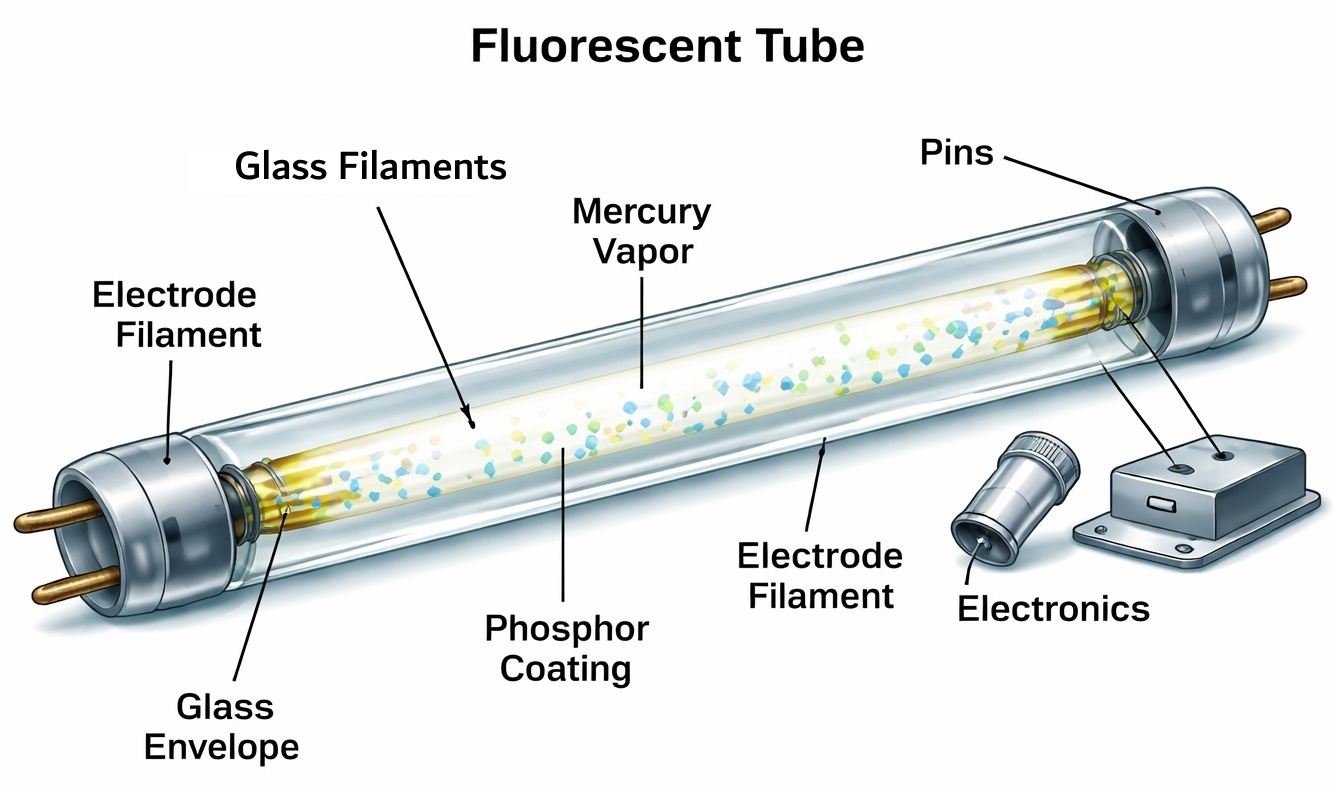
A fluorescent lamp works by exciting mercury vapor inside a sealed glass tube.
(Why is it excited? Well, it's never been in a glass tube before!) When a high voltage
is applied, electrons flow through the low-pressure gas, causing the mercury atoms to emit
ultraviolet light. That UV light isn't visible to the human eye, so the inside of the tube is
coated with a phosphor—a material that absorbs ultraviolet radiation and re-emits it as
visible light. The color of the light depends on the phosphor blend, which is why older
fluorescents often looked greenish while modern ones can be quite natural. Ballasts—first
magnetic, later electronic—regulate the current and keep the lamp operating smoothly.
(By the way, a fluorescent tube without phosphors—is a black (ultraviolet) light!)
As for their future, fluorescent lights are definitely being phased out, but not because they're
ineffective. They're still reasonably efficient and inexpensive, and in some industrial settings
they remain cost-effective. The problem is mercury: even the tiny amount inside each tube has
pushed governments and manufacturers toward safer alternatives. LED technology has now overtaken
fluorescents in efficiency, lifespan, and color quality, and LED "tube replacements" (T8 and
T12-shaped LED lamps) are designed to drop into existing fixtures with minimal rewiring. So
fluorescents aren't gone yet, but they're clearly on the downward slope, with LEDs taking over
nearly every application they once dominated.
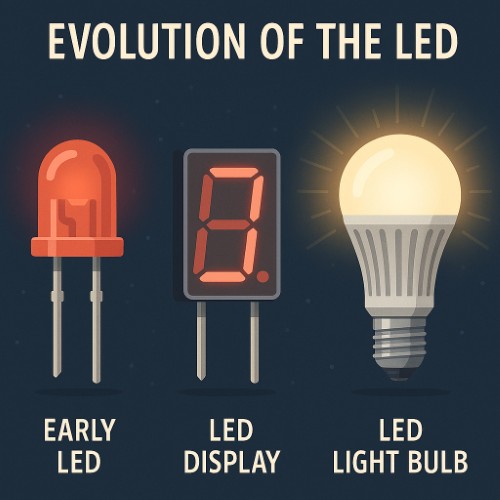
The story of LEDs begins much earlier than most people realize. The first light-emitting diode was
demonstrated in 1907 by British experimenter H. J. Round, who noticed that certain crystals glowed
when current passed through them. It wasn't understood, and it certainly wasn't practical. The
first modern LED arrived in 1962, when Nick Holonyak Jr., working at General Electric, created a
red light-emitting diode using gallium arsenide phosphide. Holonyak envisioned it as a replacement
for incandescent lamps, but early LEDs were dim, expensive, and available only in red. Through the
1960s and 1970s, engineers refined the materials—gallium phosphide, gallium nitride, and
other semiconductors—slowly expanding the palette to green, yellow, and orange.
An LED works through electroluminescence, a process in which electrons crossing a semiconductor
junction fall into "holes" and release energy as photons. The color of the light depends on
the semiconductor's bandgap—the energy difference between electron states. Early materials
produced only low-energy red or infrared light, which is why LEDs first appeared in calculator
displays, digital watches, and indicator lamps. They were efficient and long-lived, but nowhere
near bright enough to illuminate a room. The breakthrough came in the 1990s with high-brightness
blue LEDs, pioneered by Shuji Nakamura and others working with gallium nitride. Once blue existed,
engineers could combine red, green, and blue—or use blue LEDs with phosphor coatings—to
create bright, high-quality white light.
That leap transformed LEDs from tiny indicator dots into a full-scale lighting technology. By the
early 2000s, white LEDs were efficient enough to compete with compact fluorescents, and by the
2010s they surpassed every other light source in efficiency, longevity, and color quality.
Heat-sinking, driver electronics, and improved phosphors allowed LEDs to scale from flashlight
bulbs to streetlights and household lamps. Today, LEDs dominate everything from smartphone screens
to stadium lighting, and those "fluorescent-tube-shaped" LED replacements are part
of the same evolution—solid-state light packaged in familiar forms so buildings can upgrade
without rewiring. (For that matter, that's why LEDs are now packaged as "light bulbs", even
though they don't need to be that big.)

Yet even today, electricity has not reached every corner of the world. Remote villages in
sub-Saharan Africa, parts of South Asia, and isolated regions of Oceania still lack reliable
electrical infrastructure. In some places, geography makes grid extension prohibitively expensive;
in others, political instability or poverty prevents sustained development. Millions of people
still rely on kerosene lamps, candles, or small solar lanterns. The story of electricity is
therefore not finished—it's a global project still unfolding, with the same mix of ingenuity,
infrastructure, and social will that shaped its earliest chapters.
And yet, in 1945, a new force appeared to be reckoned with, one so powerful that,
with a devastating one-two punch, life on Earth would never be the same.