|
By: Paul S Cilwa |
Posted: 2/27/2026 |
|
Page Views: 47 |
| Hashtags: #Science #History #Technology #Gunpowder #Dynamite #TNT #Nitroglycerine #AlfredNobel |
| How we entered the Gunpowder Age |
| Estimated reading time: 7 minute(s) (1614 words) |
 Last known photo of Daoist alchemist Sun Simiao, taken just before he accidentally discovered gunpowder.
The earliest references to gunpowder
appear in Chinese Daoist texts of the ninth century, written by alchemists who were less interested
in destruction than in transcendence. They worked with sulfur, charcoal, and saltpetre because
these substances were already part of the pharmacological and ritual toolkit of the time. Saltpetre
in particular had a reputation for vitality and purification. When mixed in the right proportions,
however, these ingredients produced not longevity but violent combustion. The discovery was
alarming enough that some texts warned practitioners to avoid certain mixtures because they
burned the hands and face.
Yet the discovery stuck. Fire had always been a companion of
human ingenuity, but this was fire with agency—fire that could leap, burst, and propel.
By the tenth century, Chinese artisans had begun to harness this new energy in practical ways. The
first uses were not guns but fireworks, signal flares, and incendiary devices. Fire
arrows—ordinary arrows tipped with small gunpowder packets—extended the reach of flame
in battle. Ceramic or bamboo shells filled with powder became early bombs. These inventions still
treated gunpowder as a burning agent rather than a propellant, but they marked the beginning of a
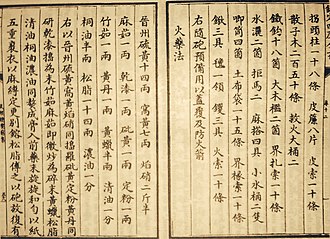
new relationship between chemistry and warfare. The Wujing Zongyao,
a military compendium from
1044, contains the earliest known formula for gunpowder, evidence that the mixture had become
stable and reproducible enough to codify.
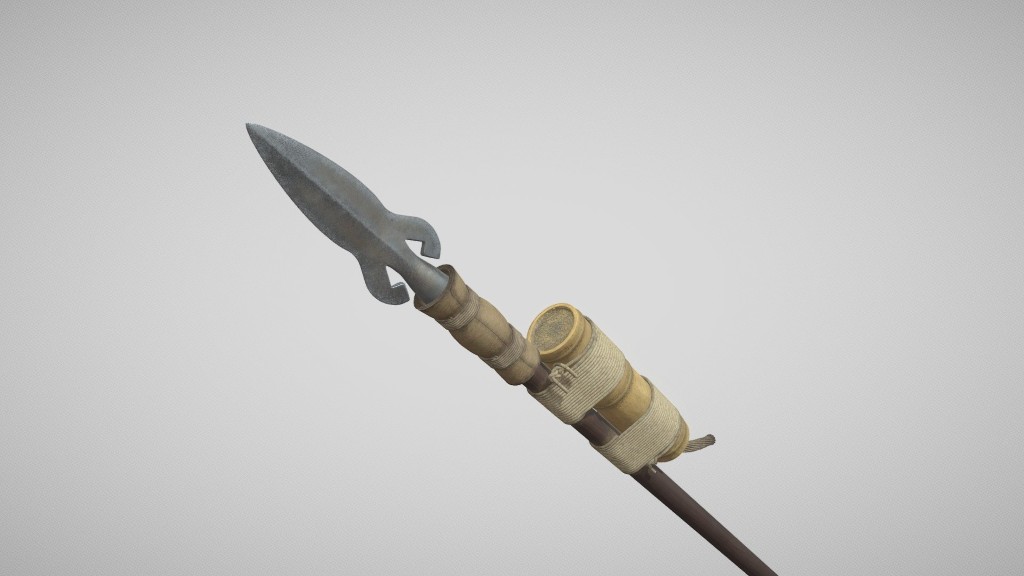
The decisive transformation came with the fire lance in
the twelfth century. At first it was simply a spear with a tube attached, ejecting a burst of flame
to startle or burn an opponent. But as artisans experimented with stronger tubes and more refined
mixtures, the fire lance began to expel not just flame but projectiles—pellets, metal scraps,
or arrows. This was the moment when gunpowder shifted from incendiary to ballistic. The tube became
a barrel; the burst became propulsion. By the late thirteenth century, China had produced the first
recognizable guns: cast metal tubes designed to fire solid projectiles with explosive force. The
logic of artillery was born.
Gunpowder knowledge did not remain confined to East Asia. The Mongol
Empire, with its vast networks of conquest and communication, acted as an accelerant. By the
mid-1200s, Middle Eastern scholars were writing about gunpowder mixtures, and European thinkers
such as Roger Bacon were describing its effects. Within a few decades, European
metallurgists—already skilled in casting bells and cannon-like vessels—began producing
bombards and early hand cannons. Each region adapted the technology to its own strengths: the
Islamic world integrated gunpowder into cavalry and siege warfare; Europe pushed the development of
heavy artillery; India and the Ottoman Empire built gunpowder-based military states.
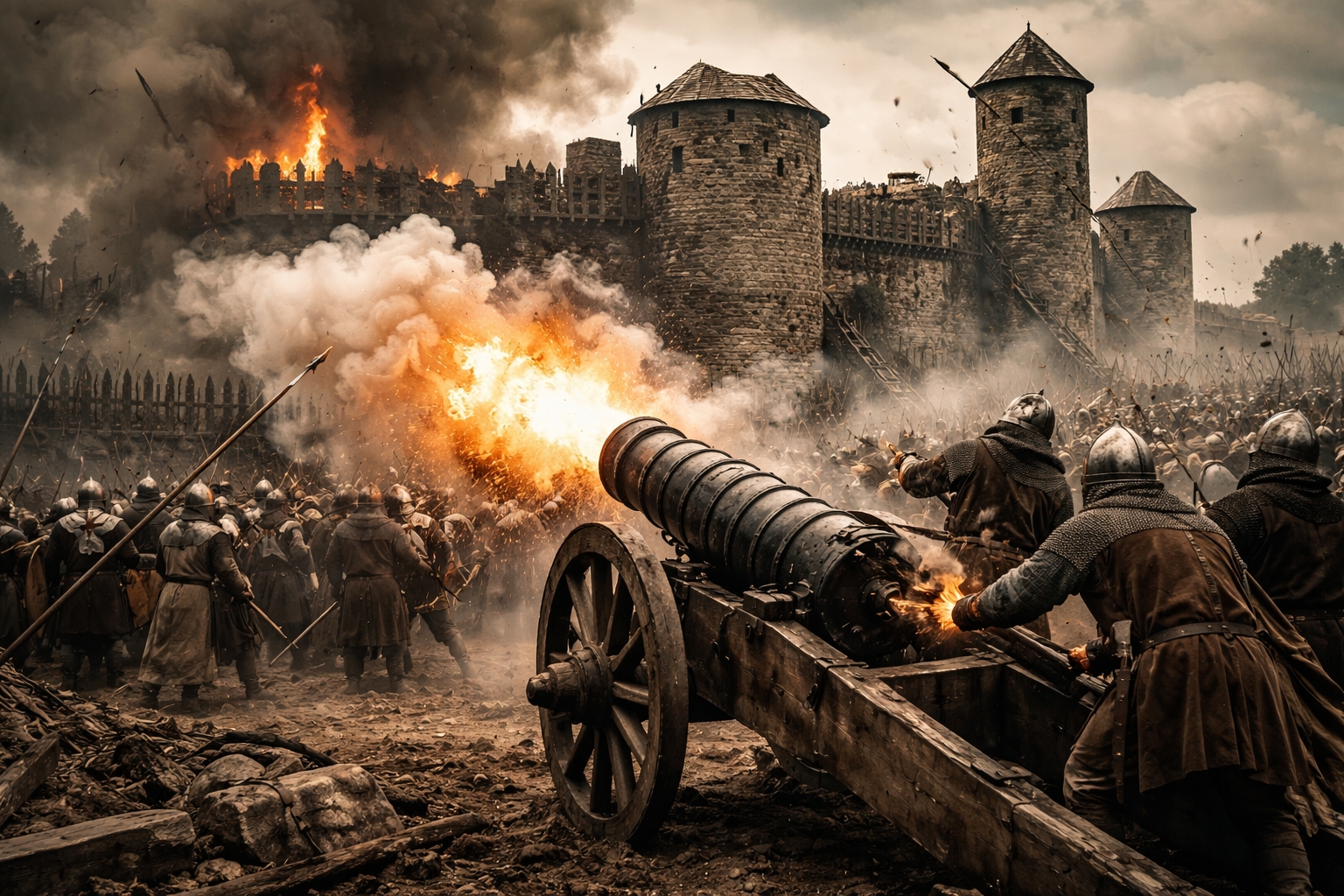
The consequences were profound. Medieval fortifications, designed to withstand arrows and catapults,
crumbled under cannon fire. Architects responded with star
forts—low, angled, earth-backed
structures that absorbed and deflected artillery. The new geometry of defense reshaped entire
cities. States that mastered gunpowder logistics—securing saltpetre supplies, standardizing
production, training specialized artillery units—gained enormous military and political
leverage. The Ottomans, Safavids, and Mughals became known as the "Gunpowder Empires," their
rise inseparable from their command of this volatile mixture.
Gunpowder also escaped the
battlefield. By the seventeenth century, miners were using it to blast tunnels and clear rock,
accelerating infrastructure projects and altering landscapes. It powered fireworks that became
cultural symbols from China to Europe. Even after smokeless powder replaced it in modern firearms,
black powder remained essential for fuses, pyrotechnics, and ceremonial uses. Its legacy is not
just military but industrial, artistic, and symbolic.
Seen in the broader arc of technological
evolution, gunpowder is part of a long lineage of fire-based innovations. Pottery required
controlled heat; metallurgy required hotter, more sustained heat; gunpowder introduced heat that
moved—heat that pushed, shattered, and propelled. Each step expanded what humans could do
with energy. And like many transformative technologies, gunpowder emerged not from a linear
progression but from a collision of curiosity, craft, and accident. Alchemists sought immortality
and found explosion. Engineers turned that explosion into propulsion. States turned propulsion into
power.
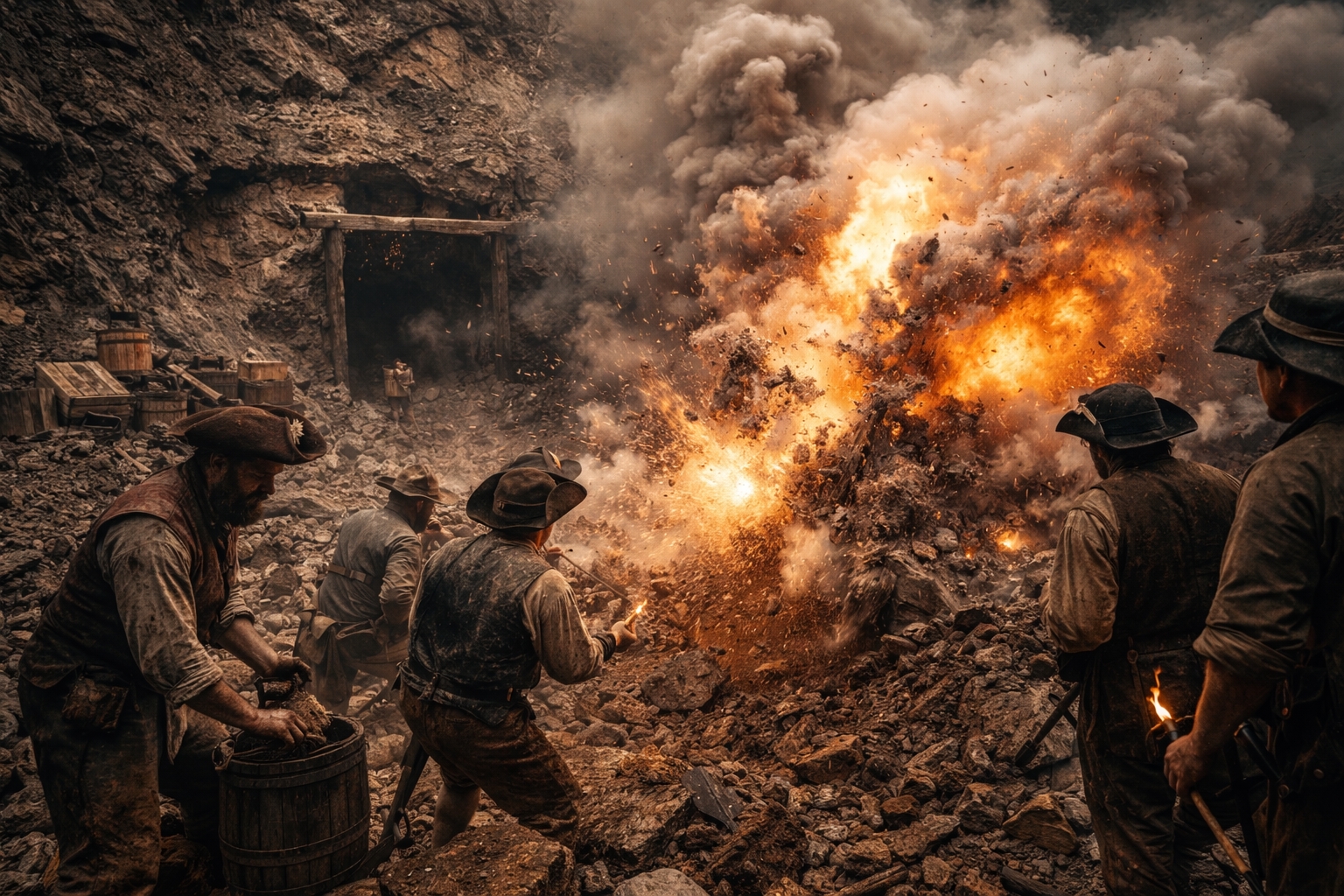
The first major shift came when gunpowder left the battlefield and entered the mines. By the
seventeenth century, black powder was being used to fracture rock, open tunnels, and clear ground
for roads and canals. This was a conceptual leap: explosives were no longer just destructive but
constructive. Yet black powder had inherent limitations.
It burned rather than detonated, producing
a slow pressure wave that was adequate for breaking rock but inefficient and unpredictable. It was
sensitive to moisture, produced heavy smoke, and varied widely in quality. Engineers wanted
something cleaner, faster, and more reliable—something that behaved like a tool rather than a
temperamental force of nature.
The nineteenth century provided the chemistry needed to make that
leap. As scientists began to understand molecular structures and reaction mechanisms, they
discovered compounds that released energy far more rapidly than black powder. Nitroglycerin,
synthesized in 1847, was the first true high explosive. It detonated rather than burned, producing
a shockwave capable of pulverizing rock. But it was dangerously unstable, prone to exploding from
heat, friction, or even spontaneous decomposition. Early attempts to use it in mining were marked
by catastrophic accidents. The material had enormous potential, but it needed discipline.

Alfred Nobel's contribution was to give nitroglycerin
that discipline. By absorbing it into diatomaceous
earth, he created dynamite—a stable, portable explosive that could be shaped, transported,
and detonated with relative safety. Dynamite revolutionized mining and construction. It allowed
engineers to drive railroads through mountain ranges, carve canals across continents, and excavate
foundations for the growing cities of the industrial age. For the first time, explosives were not
just powerful—they were manageable. They could be integrated into systematic workflows,
measured in predictable quantities, and deployed with confidence.
The next major step came with
TNT in the late nineteenth century. Unlike nitroglycerin, TNT
(trinitrotoluene) was stable to handle, resistant to
shock, and melted at a low temperature, allowing it to be cast into shells or shaped charges. It
became the backbone of both military and industrial blasting in the twentieth century. TNT's
stability made it ideal for large-scale engineering projects, where reliability mattered as much as
raw power. It also enabled more sophisticated detonation systems, where timing and sequencing could
be controlled with increasing precision.
By the mid-twentieth century, explosives had become a
fully engineered technology. Mining operations used ammonium nitrate-fuel oil mixtures (ANFO),
which were cheap, stable, and powerful enough for most rock-breaking tasks. Plastic explosives
offered moldability and consistent detonation velocities. Emulsion and slurry explosives improved
water resistance and safety, allowing blasting in wet or unstable environments. The emphasis
shifted from simply breaking rock to breaking it correctly: minimizing flyrock, controlling
fragmentation size, and shaping blast patterns to reduce waste. Explosives became part of a larger
system of geotechnical planning, timing circuits, and safety protocols. The blast engineer replaced
the alchemist and the artilleryman.
This progression—from black powder to nitroglycerin,
from dynamite to TNT, from ANFO to precision emulsions—reflects a broader arc in
technological history. Each stage increased not only the energy available but the human ability to
direct that energy with intention. What began as a mystical search for immortality became a tool
for sculpting mountains and building cities. The descendants of gunpowder are not simply more
powerful; they are more purposeful. They embody the shift from fire as a natural force to fire as a
programmable instrument.
What makes the idea of gunpowder compelling is not just its impact but its origin story: a metaphysical
experiment that became a geopolitical revolution. It reminds us that the boundary between mystical
inquiry and practical innovation is often porous, and that the most world-changing technologies
sometimes begin as side effects of entirely different quests.
And yet, for all the thunder of cannons and the smoke of battlefields, gunpowder was only the
overture. The same chemistry that shattered castle walls also hinted at a deeper transformation: a
world where power would no longer depend on muscle, wind, or flame, but on machines that could
outwork armies and outproduce empires. As furnaces replaced forges and engines replaced horses,
humanity stood at the edge of a new revolution—one that would not merely change how wars were
fought, but how civilization itself was built. In the next chapter, we'll step into the roar of steam
and steel: the dawn of the Industrial Age.