|
By: Paul S Cilwa |
Posted: 3/21/2026 |
|
Page Views: 152 |
| Hashtags: #AI #Programming #VBNET #Claude #Coding #Opinion |
| AI hasn't replaced programming. It's replaced the keypunch machine. And my joy has increased twentyfold. |
| Estimated reading time: 11 minute(s) (2417 words) |

What Programming Actually Is

Programming, called coding by programmers (who call
themselves coders, because every subculture requires
its own jargon or what is even the point), is simply the act
of getting your computer, phone, tablet, or smart refrigerator
to do exactly what you want. It does not matter if you do it
in machine code, Assembler, FORTRAN, COBOL, VB.NET, Python,
English, Jive, or Mandarin. What matters is that you have a
clear picture in your head of what should happen, and you
find a way to make the machine understand and manifest it.
If that sounds familiar, it should. It is exactly the same
process I described in But Is It Art?:
you have a vision, and
you labor to drag it into shared reality. The medium
happens to be logic instead of pigment, but the itch is
identical. You see something that does not exist yet. You
need it to exist. You will not sleep well until it does.
Only a computer programmer would understand this, but
programming is one of my passions. The joy of crafting a
piece of elegant code that fits seamlessly and efficiently
into a project—a project that will help someone be
more creative, or at least accomplish a boring goal quickly
and in a fun way—is what I live for.
Also, pistachios.
A Brief and Ludicrously Incomplete History
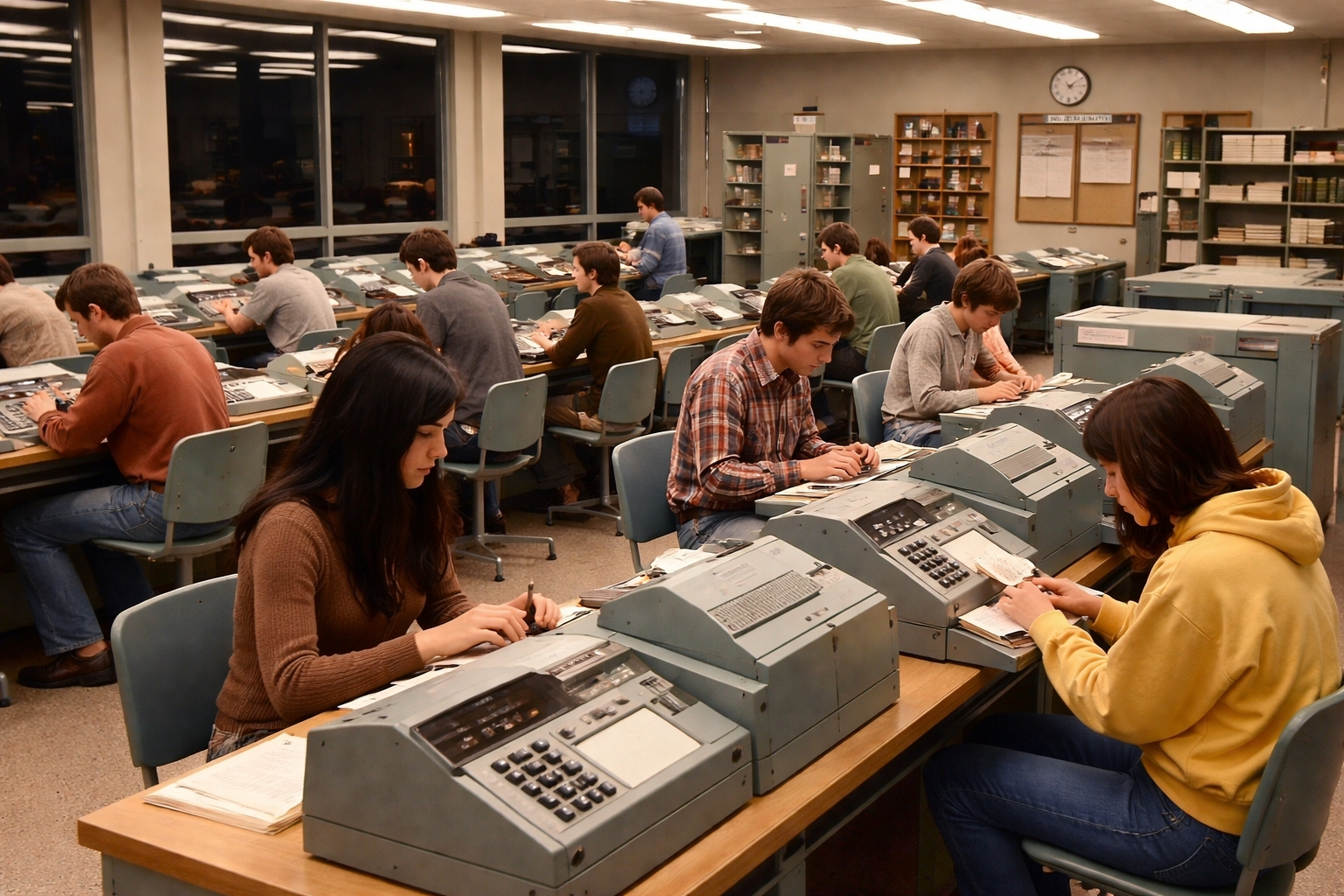
I started programming in 1972, which means I have been at
this for fifty-four years. In that time, I have watched the
tools change so dramatically that describing them to a
younger programmer is like describing radio to a ten-year-old who
only knows streaming. Allow me to describe programming to you.
In the beginning—my beginning, anyway—you wrote
your program on paper, on a special form called a coding
sheet. Then you handed the coding sheet to a person called
a keypunch operator, who typed it onto a stack of
punched cards. Then you handed the cards to a person behind
a window, who fed them into a machine, which ran your
program and printed the results. Then you picked up the
printout, discovered you had misspelled DIMENSION on line
four, wrote a correction on the coding sheet, handed it
back to the keypunch operator, and waited another four hours.
This was called a fast turnaround.
Eventually we got terminals, and then personal computers,
and then the ability to type our own code directly into the
machine. This was an astonishing improvement. Instead of
waiting four hours to discover a misspelling, you could
discover it in four minutes. The misspellings did not
decrease, but the lag did.
Then came integrated development environments—Visual
Studio, Eclipse, IntelliJ—that could catch some of
your errors as you typed, which was like having a
very patient, very literal-minded copy editor sitting on
your shoulder, tapping it every time you forgot a semicolon.
Programmers complained about this, naturally. Programmers
complain about everything. It is our second-favorite
activity, right after arguing about which text editor is
best. (The answer is Visual Studio, and I will fight you.)
Enter the Amanuensis

And now we have AI. And the question that everyone keeps
asking—the question that is the title of this
essay—is whether the code that an AI helps you write
is really your code.
I find this question hilarious, and I find it hilarious for
a very specific historical reason: nobody ever asked this
question about the programmer who used a keypunch operator.
Think about what a keypunch operator did. You handed her
(it was almost always a her in the 1970s) a sheet of paper
listing each individual thing you wanted the computer to do.
And we're talking about a single line that might say,
"Add hours-worked to total-hours." And there could be 5000 or more lines
just as detailed. The keypunch operator would then create
punch cards, one for each line. If she made a mistake, she would have
to throw away the card and make a new one. She was fast. She was
accurate. She sometimes caught your errors and fixed them
silently, because she had been doing this longer than you
and she knew that DIMENISON was not a COBOL keyword. And
nobody, not once, suggested that the resulting program was
hers.
An AI coding assistant is a keypunch operator. A very, very
fast keypunch operator who has read every programming manual
ever published and never takes a coffee break. I describe
what I want—sometimes in precise technical language,
sometimes in a vague wave of the hand like "make the
dialog box not look terrible"—and the AI
translates my intent into syntactically correct code that I
then review, test, adjust, and integrate into the larger
design. The design is mine. The architecture is mine. The
decision about what the software should do and
why is mine. The AI is just typing it up for me,
like a really smart keypuncher.
It is, if you want to get fancy about it, my amanuensis.
A word that means "secretary," but in Latin, so
it sounds more dignified. (If you want to understand what an amanuensis actually does in a dramatic,
lived‑in way, Cloud Atlas is a surprisingly rich place to start. Its 1930s
storyline follows a gifted young composer who becomes the amanuensis to an aging
maestro—copying scores, refining themes, and quietly shaping a masterpiece
while navigating the power dynamics of genius and dependency. The film's
reincarnation structure adds an extra layer, showing how creative influence and
mentorship echo across lifetimes. It's an ambitious, rewarding watch, and you can
find it on IMDb here: Cloud Atlas.
What Has Actually Changed
Here is what AI has not changed about programming:
the thinking. The hard part of building software has never
been the typing. (Well, it used to be; but that's the point
of improvements!)
The hard part is figuring out what the
software should do in the first place, how the pieces fit
together, what happens when the user does something
unexpected (they will), and how to make the whole thing
maintainable by your future self, who will have forgotten
why you did it that way and will curse you for not leaving
a comment. The hard part is design, and no AI I
have encountered does design. Not yet. Maybe never.
Design requires wanting something, and wanting is not yet
in the AI skill set.
Here is what AI has changed: the ratio of thinking
to typing. It used to be that I would spend twenty minutes
thinking about how a control should work, and then ninety
minutes typing the implementation, discovering mistakes in
my logic while typing, retyping, testing, finding more
mistakes, and gradually converging on the thing I had
envisioned. Now I spend the same twenty minutes
thinking—sometimes more, because the thinking is the
fun part and I am freed to indulge it—and then five
minutes describing what I want. The AI produces a first
draft. I try running it, find the things it got wrong
(there are almost always a few, though Claude's top-tier Opus LLM
is really good), describe the corrections,
and we converge on the final version in a fraction of the
time.
The result is not that I produce more code. The result is
that I produce better code, because I have more time
to think about whether the code I am producing is the
right code. The bottleneck was never my typing speed.
The bottleneck was the cognitive overhead of translating
design into syntax, which consumed attention I would rather
have spent on the design itself. The AI has removed the
bottleneck, and what has rushed in to fill the space is
joy.
The Joy, Specifically

I need to be specific about this, because people who do
not program will not otherwise understand it, while people
who do program will nod so vigorously they will
hurt their necks.
There is a particular pleasure in a piece of code that is
exactly right. Not just functional—any code
can be functional if you beat on it long enough—but
elegant. Code where every line earns its place.
Code where the names of things tell you what they do. Code
where the structure mirrors the logic so precisely that
reading it feels less like decoding and more like
agreeing. You look at it and think, Yes. That
is how that should work. That is the only way that could
work!
This is the programmer's equivalent of the artist
stepping back from the canvas and realizing, with a small
shock, that the painting is finished. Not because there is
nothing left to add, but because there is nothing left to
remove. Saint-Exupéry said that about
airplanes, and he was right about airplanes, and he was
right about code, and he was right about sentences, and he
was probably right about most things, which is why he is
still quotable eighty years later despite having crashed
into the Mediterranean.
Before AI, I spent most of my programming time on the
mechanical parts—the syntax, the boilerplate, the
tedious plumbing that every application needs but nobody
finds interesting. The elegant parts, the parts that
sparked joy, were islands in a sea of drudgery. I still
loved programming, but I loved it the way you love a
garden: the flowers are glorious, but most of the time
you are pulling weeds.
Now the AI pulls the weeds. And I spend my time among the
flowers. My joy in perfecting the already-perfect
application, or polishing a library of reusable controls
until each one is a small gem of purpose and clarity, far
from being diminished, has increased twentyfold.
(Corrected from 20.119-fold, because Claude asked if
I really wanted to be that precise.)
The Craft Remains
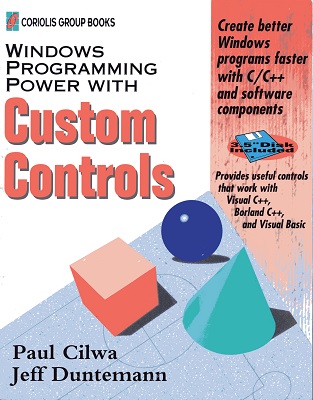
I wrote my first book on
Windows
Programming Power with Custom Controls in 1994. The book
was about building reusable software components—small,
focused pieces of code, each one designed to do one thing
thoroughly and well, that you could drop into any project
and trust to behave. I believed then, and I believe now,
that this is the highest form of programming: not building
applications, but building the pieces from which
applications are built. Tools. Libraries. Frameworks. Components
that are so well-designed they feel inevitable, as if they
had always existed and you merely discovered them.
AI does not change this. If anything, it sharpens it. When
the mechanical cost of writing code drops, the
design cost becomes the dominant factor, and
suddenly the questions I have always cared about—Should
this be a property or a method? Does this control have the
right public API? Is this abstraction earning its
complexity?—are the only questions left. The
AI cannot answer them. The AI does not even understand why
they matter. But I do, and now I have more time to sit
with them, turn them over, get them right.
Yesterday I spent forty minutes deciding whether a
UserControl should expose its chosen items as a
List(Of String) or as an
IEnumerable(Of String). The AI would have
happily given me either. Both would have worked. But one
was right, and finding the right one was the
work—my work, the human work, the work that no
amount of machine learning will automate because it
requires caring about the answer.
That is what programming is. Not typing. Caring.
The Part Where I Get Sentimental

I am seventy-four years old. I will be seventy-five in
April. I have been writing code for longer than most of
my colleagues have been alive, and I have watched every
major shift in the industry from punched cards to cloud
computing. I have written in twelve computer languages.
(I think. Truthfully I have lost count. Does anyone remember SNOBOL?) I have
shipped software that people used. I have written four
technical books, including one that was considered in the
technical area as being a bestseller. I have earned my opinions.
And my opinion is this: AI is the best thing that has
happened to programming since the development of
object-oriented programming (another thing I
"wrote
the book" on).
It has not replaced me. It has freed me. It has
taken the parts of my craft that were labor and left me
with the parts that are love. At an age when I might
reasonably be expected to slow down, I am instead building
more, building better, and having more fun than I have
had since the 1990s, when Visual Basic first made it
possible to design a user interface by dragging things
around with a mouse and I thought, Well, it's
not going to get better than this!
It got better than that.
The vision is still mine. The architecture is still mine.
The obsessive, borderline-compulsive need to make every
pixel, every property name, every public API feel
inevitable—that is still mine, and it will
be mine until they scatter me over the Sonoran Desert or
wherever I end up. (I have left instructions for my ashes to be
scattered over Chris Evans, but I have a feeling that is not going to happen.)
The AI is my keypunch operator, my
amanuensis, my absurdly well-read typing pool. And like
my radio station boss said in that studio fifty-four years ago: the
measure of a craftsman is not the tools he uses, but how
well he uses them.
I intend to use this one until they pry it from my cold,
dead, impeccably manicured fingers.
Now if you'll excuse me, I have a library to polish.
I think one of the controls might be off by a pixel.