|
By: Paul S. Cilwa |
Posted: 5/26/2026 |
|
Page Views: 17 |
| Hashtags: #HistoricalFiction #LucianOfSamosata #Corduba #Castulo #Saturnalia #AntoninePlague #Hispania #Spain |
| Lucian receives devastating news from home. |
| Estimated reading time: 20 minute(s) (4541 words) |
They had bathed every day. They had drunk wine that did not taste of dust. Lucian
had given three performances in the town's small theater and had been paid generously and
had managed to not offend any of the local schools. Demetrios had slept until the
fourth hour every morning, which for him was practically dissipation. By the time
they rode out of the western gate at the beginning of December, with their saddlebags heavier
than they had been when they came in, both of them looked at each other and laughed at how
little they resembled the men who had ridden south from the cinnabar.
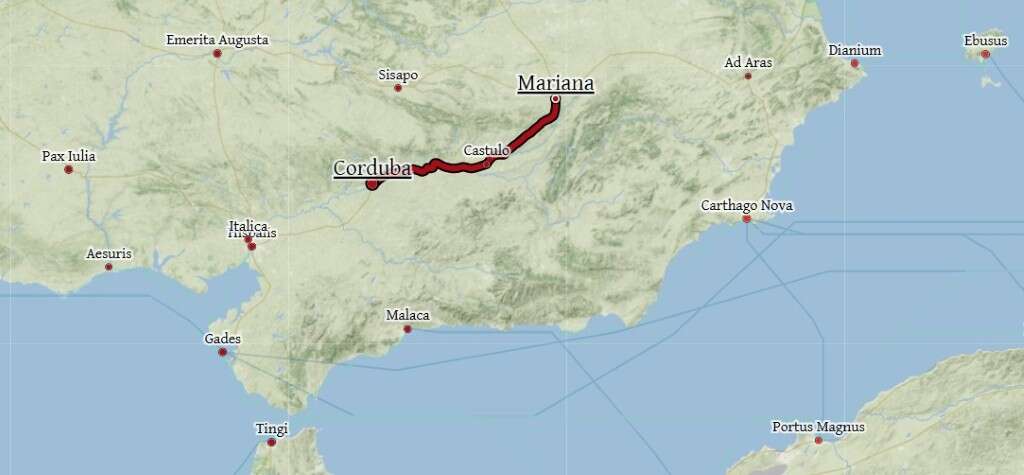
The road to Corduba ran southwest down the long valley of the upper Baetis, through villages
where the olive harvest was just ending, past oil presses that still ran day and night, under
a December sky that in this part of Hispania was not the gray slab of an Italian winter but
a high, clean blue that surprised them afresh, every morning. The mornings were cold. By midday a
man on a horse could ride in his tunic if the sun was on him. By evening he wanted his cloak
again. It was the gentlest weather either of them had known in months.
And they could feel the festival coming. Every village they passed had its pine boughs out.
Every doorway had its sprig of green. Every shop selling candles—and in Hispania, that
December, every other shop seemed to be selling candles—had its trays of cerei
set out in the front window, the small wax cylinders dyed in the colors that the rich could
afford and the poor could only admire: saffron yellow, madder red, the deep ocean blue that
came from woad, and the occasional extravagant green that nobody could quite agree on the
source of but that everyone wanted. The poor bought the brown ones, which did the
same job. But the trays of color in every window told you, more clearly than any calendar,
what week of the year you were in.
A Saturnalia To Remember
Riding side by side on a stretch of road boring enough that the horses could walk
themselves, Lucian and Demetrios chatted about Saturnalias gone by.
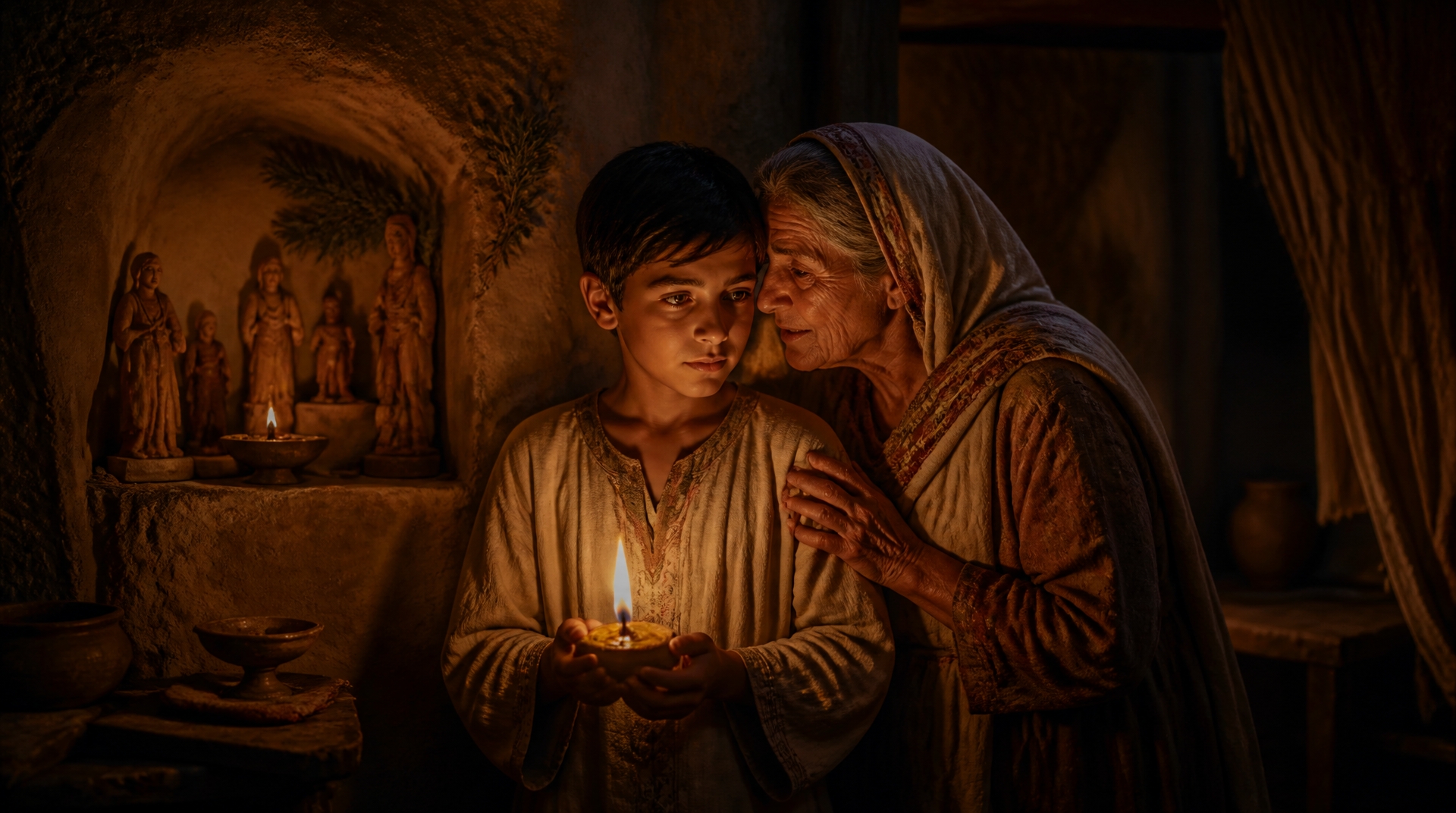
"The one I remember best," Lucian said, "was the year I was ten. My grandmother
was still alive—she died the next summer—and she had decided, that
December, that I was old enough to be taught what she called the proper way. The
proper way was a thing she had brought with her from her mother and her mother's mother,
and it was older than Rome, and as far as my grandmother was concerned, it was older than
Greece, and probably older than Babylon. Which I'd often suspected was also true of her."
He smiled into the road.
"So on the first night of Saturnalia, after my father had brought the household together
and lit the big lamp by the door, and after my mother had set out the cakes—they were
not honey cakes the way you Greeks make them, they were date cakes, a soft, sticky cake with
dates pounded into the dough and sesame on top, and my grandmother said no other cake counted
as a cake—after all that, she took me into the back room
where the household gods sat in their little niche, and she made me hold a small clay lamp
in my hand, and she taught me, in Aramaic, a blessing for the longest night. I didn't
understand the words. She did not translate them. She said I was not meant to understand
them. She said the words knew their own work, and my work was just to say them, and that
the lamp would do the rest. I remember the smell of the oil and the sound of her voice and
the way her hands shook a little when she put the lamp in mine." He shook his head sadly.
"I have forgotten the words."
They rode on for a while in silence.
"When I was very young, we had a slave," Lucian said. "His name was Sosthenes. He
was older than my father, and he had been in the household since before I was born, and on
Saturnalia night my mother would dress him in my father's second-best tunic and sit him at
the table in my father's place, and she would serve him. The first year I was old enough
to notice, I asked her why. She said: Because once a year we admit that the order of the
world is not the order of the gods. It is the order of luck. It could have been him in your
father's chair from the beginning. It is only luck that it is not. Luck does not earn
us anything. Luck only obliges us. The cakes are part of how we pay the luck back.
She would not have called this philosophy. She would have called it good manners. But it
was the first piece of philosophy I ever heard, and I have yet to hear a better one."
Demetrios was quiet for a long time. "You seemed so uncomfortable with owning Tanno, I'm
surprised you ever had a slave. Or your family."
"Sosthenese was more a member of the family. He was never mistreated, and in fact until
that Saturnalia I hadn't even given it a thought. He was just a grown-up in the house,
almost a third parent, except I addressed him by his name." Lucian considered. "I kind of think
Sosthenes had saved my father's life, once, or he had saved his, something like that.
Anyway, he died when I was 12, and was not replaced."
"The cakes," Demetrios said finally. "The dates and sesame ones. Are they hard to make?"
"For my mother they were not."
"I shall try, then," Demetrios said, "in your honor, when we reach the inn."
They rode in silence for a few minutes. Then Demetrios continued, "I had a lot of great Saturnalias.
Athens is not as foreign as Samosata. The Saturnalia we keep is the Saturnalia you would
know. But we have a little of our own in it. The Kronia is the old name, you understand;
the festival is older than the Romans, we had it for Kronos before the Romans rebranded him Saturn,
and there are some old families in Athens who still call it that even now,
if for no other reason that to annoy the procurator."
Lucian laughed.
"The one I remember best," Demetrios continued soberly, "was the year I was eight.
My grandfather died, inappropriately, on the first day of the festival."
"Oh, no!" Lucian cried. "You couldn't mourn."
"He had been sick a long time. We had all been waiting,
without saying we were waiting. And then on the morning of the seventeenth, when the slaves
had already begun to put up the pine boughs over the door, he…went. The household did not know
what to do. When you take the woolen bands off Kronos's feet (or Saturn's),
you take the woolen bands off your sorrow, you eat
and drink and gamble and shout Io Saturnalia in the street like an idiot. But my
grandfather had just died on the floor in the front room. My father did not know whether to
pull down the pine."
"And your mother?" Lucian prompted.
"My mother sat down on the floor beside my grandfather—he was her father, you
understand, not my father's—and she closed his eyes, and she whispered something to him,
and then she stood up and said to my father, and I'll always remember this: she said, 'Leave the pine
over the door. He would have wanted the pine over the door. The gods know how to put the
light and the dark together. That is their job. Ours is not to argue with them about how
they do it.'"
Lucian rode for a while without speaking.
"That is a wise mother," he said at last.
"She is. She is sixty now. I haven't been home in eleven years.
I miss them," he said. "I don't say so often. But I miss them. My father is not
a clever man, but he is a kind one. Phaidra, my sister, has three children I have never met. Andron, my
brother, runs the shop now."
"I haven't heard from home in a long time," Lucian said. "I do think about them.
Sometimes. My childhood may have been a bit more…bristly than yours."
The horses continued their steady pace.
"The candles," Demetrios said after a moment. "I guess that's the one thing I miss most. My
father had a thing he did, every year on the 23rd, the longest night of the year. He would line up six candles on
the windowsill of the upper room—one for each of us, the four children plus him and
my mother—and he would light them at sunset, and he would say: 'The night is long.
The dark is patient. But there are six of us and only one of it, and we will outlast it
together.' Then we would sit around the brazier and we would not let any of the candles
go out until morning. We took turns. The youngest started; that was Andron when I was small.
Then me. Then Phaidra. Then the oldest, who is dead now. Then my father. Then my mother.
Six watches of the night."
He turned to Lucian, and there was a small, rueful smile on his face.
"I have not sat that watch in eleven years. I sometimes wonder, on the longest night,
whether my father still lines them up. Whether he leaves a gap for me on the sill. Whether
he says the words to three candles instead of six and then sits up to watch them by
himself." Demetrios caught himself. "Good gods, listen to me waxing maudlin!"
Corduba
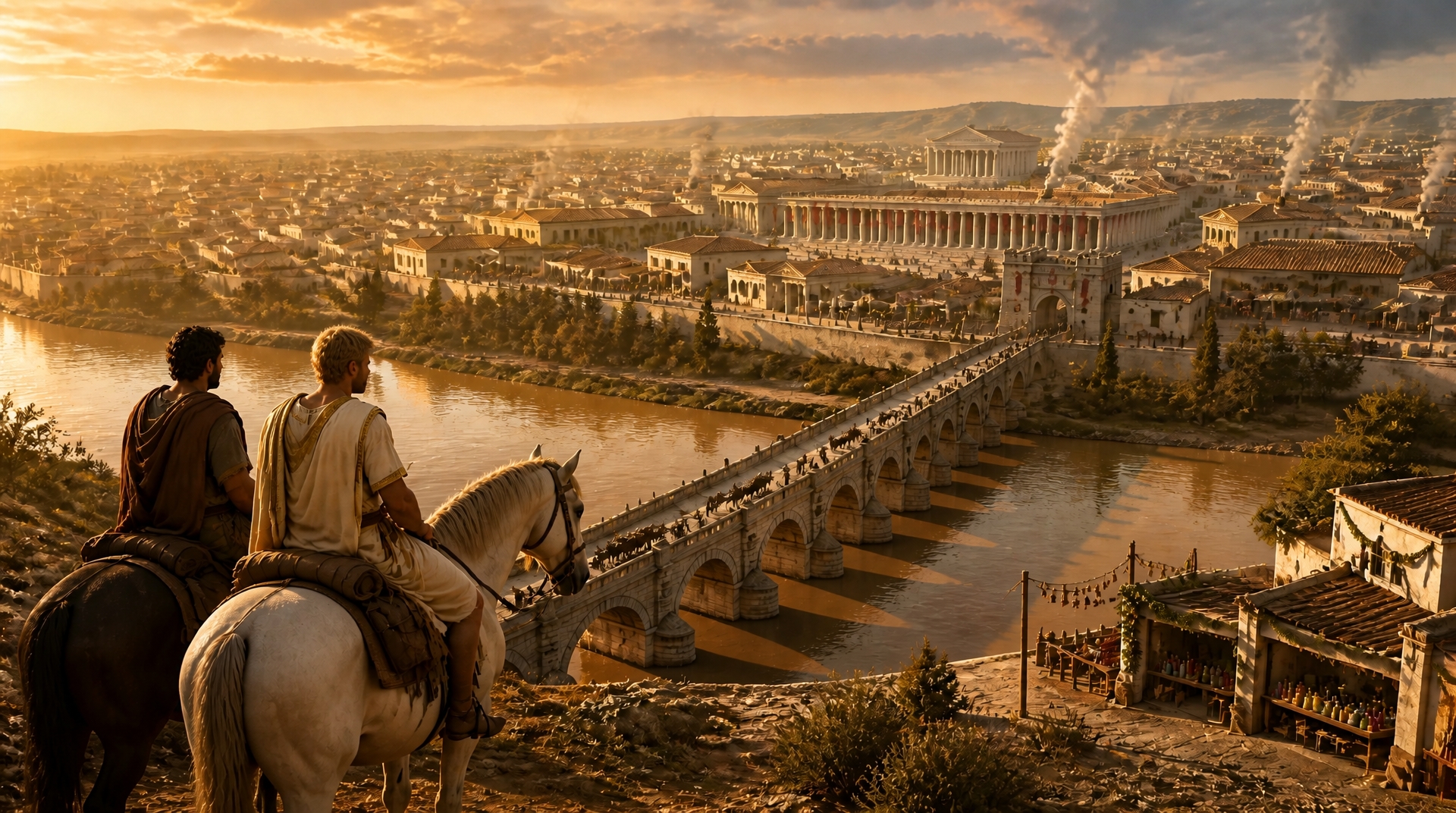
They came over the last low rise above the Baetis in the late afternoon of the fifth day, and
the city opened beneath them like a thing arranged for their pleasure. The Roman bridge
stretched across the slow brown water in sixteen great arches. The colonnaded streets ran
away from the bridge into the body of the city, straight as ruled lines. The forum, with the
new temple of Janus that the proconsul had built only the year before, glittered in the
west-falling sun. Smoke rose from a hundred bathhouses. Smoke rose from the bakers' shops.
Smoke rose, in particular, from the small temple of Saturn at the south end of the forum,
where the priests had begun, three days early, the slow ritual of preparing the god for the
untying of his bonds.
Even from the rise, they could see the pine boughs. Every doorway in the city had its sprig of
green. Long red cloths hung from the basilica's eaves. Strings of small clay figurines
hung in front of the potters' quarter like the laundry of a city of dolls. The candle-makers'
windows blazed with color. It was the only week of the year when a city looked, from a
distance, as if it had been designed by fauns and satyrs.
Demetrios let out a long breath.
"I have decided," he said, "that I love Corduba already, and I don't even know what
the wine is like yet."
They rode down into the city by the eastern road. The streets were crowded for the
holidays: people carrying things, other people
looking for yet other people they had agreed to meet, slaves dispatched on
three errands at once and
failing at all of them with great dignity. Children ran past in small bands shouting Merry
Saturnalia at any adult who would respond, which most adults did.
Lucian's tendency was to be a bit reserved, which made his rhetorical performances
all the more impressive when he let himself go. But he could not help feeling his
spirits rise in the festive atmosphere.
The inn that Demetrios chose, after his customary quarter hour of intricate questioning in
the cattle market, was a Greek house run by a Greek family two streets from the forum. The
proprietor was named Diodoros and his wife was named Larissa, and when they heard
Demetrios's Athenian Greek, they fell upon him with the particular delight of provincial
Greeks discovering a real one in the door. They were given the upper room, with a brazier
and a window that looked down into a courtyard where a fig tree had been pruned to the
shape of a praying old man, and a bed wide enough for two, and a small table by the window
on which Larissa had set, in welcome, a jar of olive oil, a dish of dates, a sprig of pine,
and three unlit candles in three different colors—saffron, red, and the woad blue.
Demetrios looked at the table and laughed.
"She has read us," he said. "She has read us in five minutes through a closed door.
How does she do that?"
"Innkeepers," Lucian agreed.
They were unpacking, slowly, in the unhurried way of men who knew they would not be packing
again for at least a week, when there came a small, careful knock at the door.
The Letter
The man at the door was perhaps fifty, in a traveler's cloak that had clearly been worn for
a long road, with the brown skin of a Hispano-Roman who had spent his life on ships and
piers. He carried a leather satchel under one arm. He bowed, not deeply but with care, the
way men of business bowed to other men of business when they were not yet sure of each
other's rank.
"Forgive the intrusion," he said in serviceable Greek. "My name is Titus Annaeus
Bassus. I am a garum merchant of this city, returning home from Rome. I have been carrying
a letter for these last five months that was given to me on the chance that our paths might
cross. The chance has happened. Diodoros tells me you are the man."
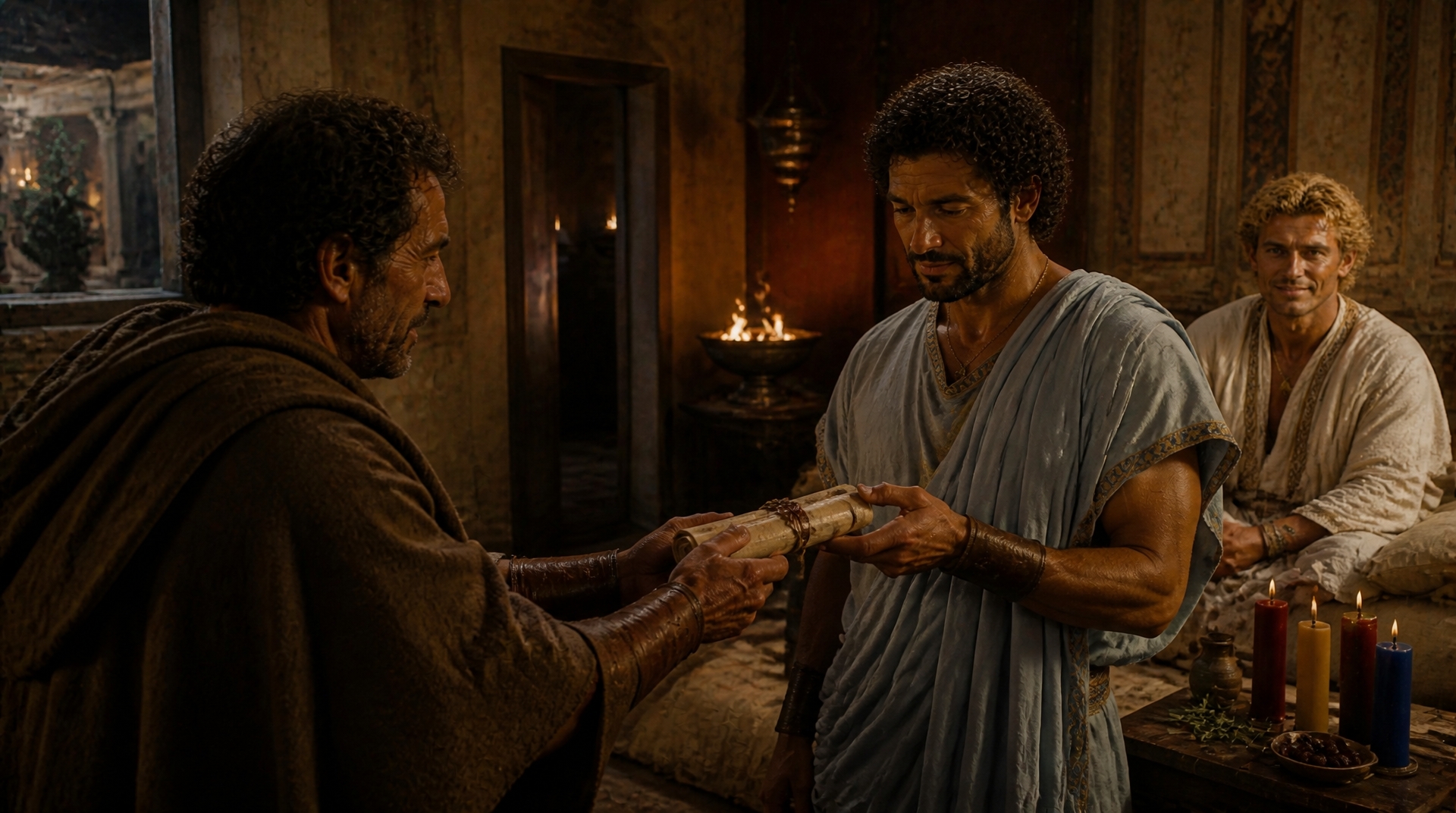
He turned the satchel and produced a thick folded packet of papyrus, stained and resealed
and addressed in three different hands.
Lucian took it and looked at the outside.
The original seal—underneath all the other seals—was a clay impression of a chisel
and mallet crossed. He had seen that seal once a year, on his own birthday, throughout his
boyhood, on the small gifts his uncle Zenodoros had sent down from the workshop by the
south gate of Samosata.
Bassus, who had clearly carried a great many letters in his life and had become a connoisseur
of the faces people made on receiving them, watched Lucian carefully and then said, in the
tone of a man delivering information rather than asking for thanks,
"It was given by your uncle to a caravan leaving Samosata for Antioch last spring. In
Antioch a ship captain bound for Italy took it on. In Rome it sat for some weeks in the
warehouse of a man called Septimius, who is a friend of your friend Demetrios' father,
until I came through on business in the autumn and Septimius asked me, since I was
coming home to Baetica anyway, would I carry it on. I said I would. It only took me three
inns to find you!"
He inclined his head once more, and went down the stairs before Lucian could offer him
a gratuity. Lucian stood with the packet in his hand for what felt like a long time.
"Sit down," Demetrios said quietly. He had not moved from his place by the bed. "You
don't have to read it standing up."
"This can't be good news," Lucian said, his voice barely above a whisper. He sat down.
He carried the packet to the table by the window, where the light was
best, and broke the seals one by one. The hand inside was his uncle's, and it had aged. The
letters were larger than he remembered. The lines wandered. The last paragraph was in a
scribe's hand and dated separately, because the old man had given out by the end.
Lucian, my sister's son, the letter began.
If this finds you, it has traveled farther than I ever have. I hope you are well. I hope you
are something of a name, as I have heard from a man who heard it from another man. I hope
you have forgiven an old man who once put his hand too hard upon a boy and lost him for it. I
have thought about that day, Lucian, more times than you would believe.
I am writing because there is no one else who can. The sickness that the soldiers
brought back from Parthia came up the river last autumn. It came to Samosata in the month
of Hyperberetaios. By the new year it had taken a third of the lower town.
The blood began to drain from Lucian's face.
Your mother went first. She would not let your father into the room when she realized. She
made him sit in the courtyard and call to her through the door. The priest of Apollo had
said that holding a sponge soaked in vinegar over the mouth would keep the breath off. She
held one, but it made no difference.
Your sister Tabitha—you would not know her now, she was tall as her mother with the
same laugh and a wicked temper—she nursed your mother to the end, and
then she fell sick herself on the day of the burning. Three days. She asked for you on the
second day. I am sorry to write that. I would not write it if I were not afraid I would die
before you were told and you would never know.
Your father went on for two weeks after. He did not catch the sickness. He simply stopped.
I don't know how else to say it. He sat in the kitchen where she had cooked and after a
while he was gone too.
The house has been burned, by order of the magistrate, with all that was in it. I saved
what I could of your mother's. There is a small wooden box with her combs and a pair of her
bracelets and the little carved bird she carried in her sleeve when she was a girl. Your
grandmother gave it to her. I have the box for you. If you ever come back, it is yours.
I had the sickness too. I did not die of it, though there were three nights when the
physician thought I would. I am old, Lucian. The mallet is heavier than it was.
Here the hand changed.
My master Zenodoros instructs me to add that he loves you, and that he is sorry, and that
if the gods are kind he will live to see you again, but that if they are not, you should
know that the last of us thinks of you with pride and not with anger. He instructs me to
add further that you are not to write back to Samosata. There is no one here to read it.
The letter ended there, with a date eleven months old.
Lucian sat very still. He set the papyrus down on the table. He folded his hands on his lap.
He looked at the brazier, and then at the candles on the table, and then at his hands.
Demetrios came and knelt beside the chair and put a hand on his arm.
"Lucian."
Lucian did not answer at once. When he spoke, the words came out in a small, flat voice that
did not seem to belong to him.
"The plague," he said. "All of them. Mother. Father. Tabitha. The house has been
burned. Even the house."
He looked up at Demetrios, and his face was twisted almost beyond recognition.
"I have no home," he said.
All I Want for Saturnalia Is You
Lucian was in shock. He couldn't speak. He couldn't move. After awhile, Demetrios left
him to himself.
It wasn't like he'd spent a lot of time pining for home. He had written the occasional letter to his family,
but other than one reply from his father, who proactively told him he had no money to send (though
Lucian hadn't asked for any), he hadn't heard from them in years. And, to be honest, he hadn't
really ever experienced a desire to go back. So why should it shake him this much
to discover he had no home to go back to?
When Lucian came back to himself, it was almost dark, and the brazier had been built up, and
Demetrios was sitting on the edge of the bed beside him with a flat parcel in his lap.
"Can you sit up?" Demetrios asked.
Lucian sat up. He felt as if he had been beaten. His eyes were swollen. His throat hurt.
The world had the slightly unfocused, slightly tilted quality of a place one has been
violently shaken inside of and then set down again.
"I have something for you," Demetrios said. "I had thought to keep it for the
Sigillaria. But the Sigillaria is six days off and I don't think we are going to wait six
days for anything tonight."
He set the parcel on Lucian's lap. It was wrapped in linen and tied with a piece of red
wool, in the way of Saturnalia gifts. Lucian's hands were too unsteady to undo the knot.
Demetrios undid it for him.
Inside were five candles.
They were the small wax cylinders called cerei, the traditional Saturnalia gift. But
they were not the plain brown wax of the poor man's window. They had been dyed by some
craftsman in the candle quarter Demetrios had walked through that afternoon, before any of
the news had come. There was a yellow one, the saffron yellow of midmorning. There was a
red one, madder red, the color of the cloths that were hung from the basilica eaves. There
was a green one, soft and strange. There was a blue one, the deep woad blue of the sea off
Rhodes. And there was a white one, plain wax, unadorned, the color of new bone.
Lucian counted them, in the way one counts a thing one cannot yet take in.
"Five," he said.
"Five," said Demetrios. "The yellow is for your mother, the color of sunshine. The red
is for your father, because red is the color you put on a clerk's stylus when he reaches a
total and you have decided to trust him with the books. The green is for your sister
Tabitha, because she was young, and green is the color of young things, and I did not know
what else to do for a girl I never met. The blue is for your uncle Zenodoros, because the
sea brought you this letter."
Lucian's eyes had filled again. He could barely see the candles.
"And the white one?"
Demetrios picked up the white candle and turned it in his fingers.
"The white one," he said, "is the one I want you to listen to me about. Because you
said something an hour ago that was not true, and I have been sitting here trying to find
the right way to tell you so."
He set the white candle down on Lucian's lap, very carefully, in the center, between the
other four.
"The white candle is me. It is not a person you have lost. It is a person you
will never lose. It will burn through the night with the other four, and in the morning four of
them will be wax on the sill, and the fifth one will still be here, beside you."
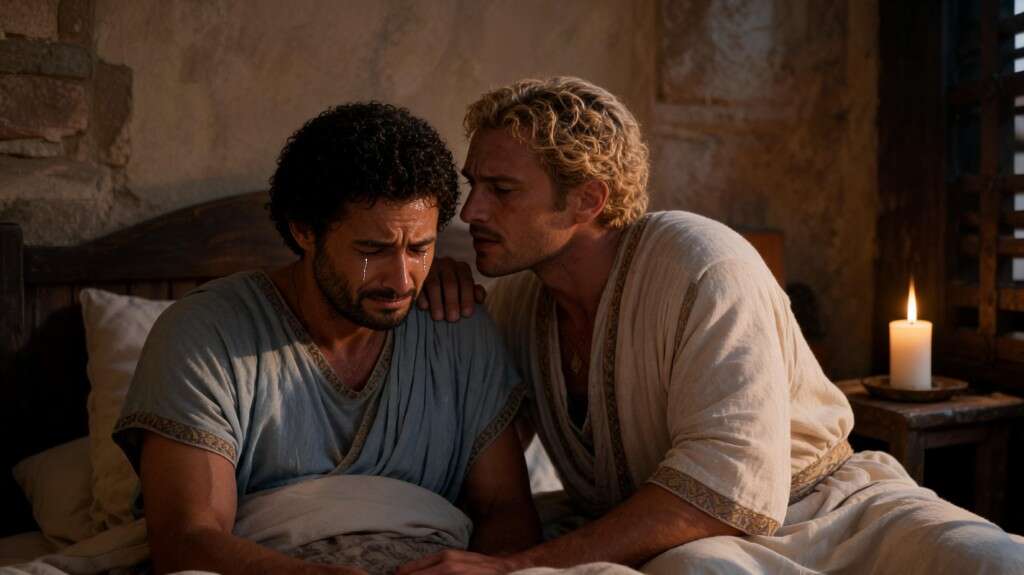
Demetrios kissed Lucian gently on each tear-filled eye, then on his lips. He held him close,
and whispered into his ear, "I am your home."
They blew out four of the candles before they went to bed, because four of them were for
people who could not hold a light through the night, and Lucian wanted to do their watch
for them, and Demetrios understood this without having to be told. The white candle they
left burning on the sill.
They lay down on the wide bed. Demetrios pulled the blanket up over both of them. Lucian
turned in to him, the way he had turned in to him on the deck of the Aphrodite's
Favor the first night out of Seleucia, when he had been seventeen years old and had
never been at sea in his life and had not yet known what it was to be afraid of something
you could not fight.
He cried for hours. He couldn't stop. He thought there might be something wrong with him,
because he had never cried like this before, and because it was not just tears, but sobs.
He tried to apologize for it, twice, and twice Demetrios said, "Don't," and held
him tighter. Demetrios understood, in a way that Lucian would only
fully understand much later, that the only useful response to grief on this scale is to
refuse to leave. Words come and go. Reasons come and go. Comforts come and go. The body
beside you does not, if it is the right body, and it has decided.
At some point past the middle of the night, Lucian's crying slowed. It did not stop. It
simply found a lower register, and went on more quietly, and Demetrios, who had not slept,
kept on holding him. At some point after that, Lucian slept, in the small, broken way that
grief permits the first night. He woke and cried again. Demetrios held him. He slept again.
He woke again. The candle on the sill burned down through its first hour, and its second,
and its third.
And just before dawn, with the small pre-light of the southern winter beginning to gray the
window glass, Lucian woke for the last time before morning, and lay very still in the warm
bend of Demetrios's arm, and watched the white candle on the sill, which had burned all
night and was burning still, and understood, with the slow surprise of a man learning
something he should have known years ago, that the candle had been right.
He did have a home. It, he, was breathing, quietly, against the back of his neck.
Demetrios' arm was around him. Lucian pulled Demetrios' hand tight against his chest and shut
his eyes, and slept the last hour before dawn the way a man sleeps who has decided,
without quite knowing he has decided, that life might just go on another day.