|
By: Paul S. Cilwa |
Posted: 5/24/2026 |
|
Page Views: 16 |
| Hashtags: #HistoricalFiction #LucianOfSamosata #Mariana #Sisapo #Hispania |
| Lucian defends Demetrios and unmasks the murderer. |
| Estimated reading time: 26 minute(s) (6061 words) |
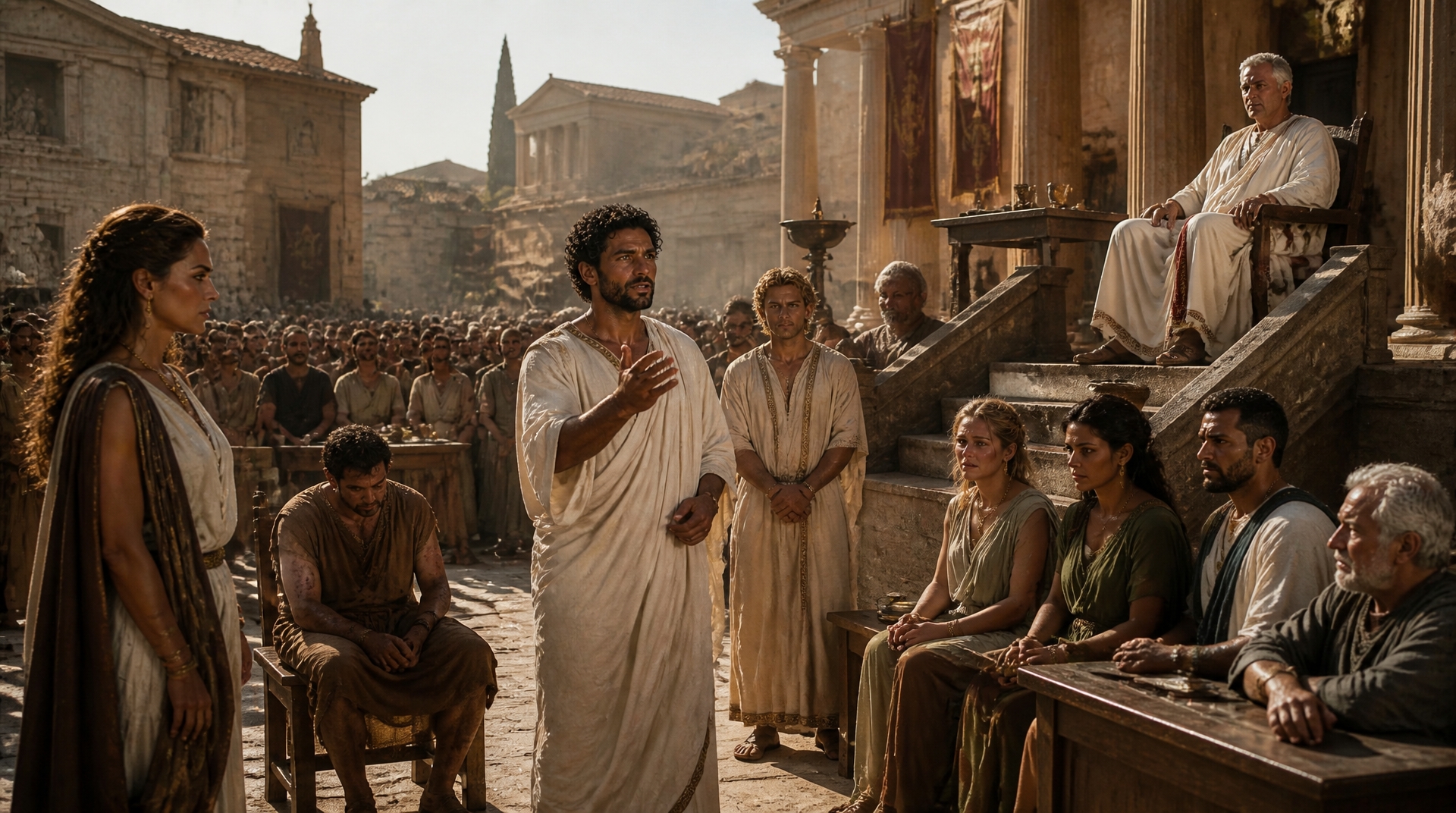
The trial sat in the forum at the second hour. The magistrate, Lucian gathered, had refused to
convene under the basilica's leaking roof; he would not be seen judging a capital case beneath
a drip. The tribunal had been set up in the open air instead, the curule chair on a low dais
beside the speaker's platform, benches for the household witnesses arranged to one side. The
crowd packed the open square.
It was not a kindly crowd. The town was a mining town, the dead man had been the man who ran the
mining town, the dead man had been a brute, and the crowd had not yet decided whether they were
here to see a foreigner crucified for killing one of their tormentors or to see a foreigner crucified for
the principle of the thing. Either way they were here to see a foreigner crucified.
Priscus took his seat. He arranged his toga with the small
unconscious gesture of a man who had done this thousands of times. He raised one hand.
"The court will hear the accuser."
Quintus Porcius Carbo rose.
He was, as advertised, loud. Perhaps forty-five, with the high color of a man who took wine before
noon as a matter of professional necessity, and the trained voice of a man who had been making the
back of a room hear him since he was sixteen. He had ridden from Corduba in the night, by the look
of his cloak, and put on a fresh toga before crossing the forum. He looked like a man who enjoyed
his work.
"Magistrate." Carbo bowed. "Citizens of Mariana. The case
before this court is plain, and I will not insult the court's intelligence by dressing it in
rhetoric. A Roman official, an imperial procurator of equestrian rank, was struck in his own
house, in his own chamber, by the hand of a foreign Greek to whom he had offered hospitality.
Within a quarter of an hour of that blow, the Roman official was dead. The Greek had quarreled
with him. The Greek had left the chamber in a rage. Only the Greek had been in the chamber. The
Greek's fist bore the marks of the Roman's face, and the Roman's face bore the marks of the
Greek's fist. I shall call three witnesses. I shall ask, at the end, for the sentence the law
provides."
He sat.
"The defense," said Priscus.
Lucian rose.
"Magistrate. The accuser is admirably brief. I will be briefer still. My friend Demetrios did,
in fact, strike Gaius Vibius Crispinus once across the face
in defense of his person, when the Overseer assaulted him with an intent this court will hear
about presently. He broke the Overseer's nose. He did not kill him. The Overseer was killed by a
second blow, with a bronze object, struck by another hand, after my friend had left the chamber.
I shall demonstrate this. I shall demonstrate, also, by whom. With the court's indulgence I will
ask each of the accuser's witnesses my own questions, and I will call certain witnesses of my own.
I thank the court."
He sat.
The crowd had not expected this. There was a small disturbance, which
Priscus quelled with a glance.
"The accuser will call his first witness."
The Word of a Slave
Carbo rose. "I call Dora,
slave of the household, who entered the chamber and discovered the body."
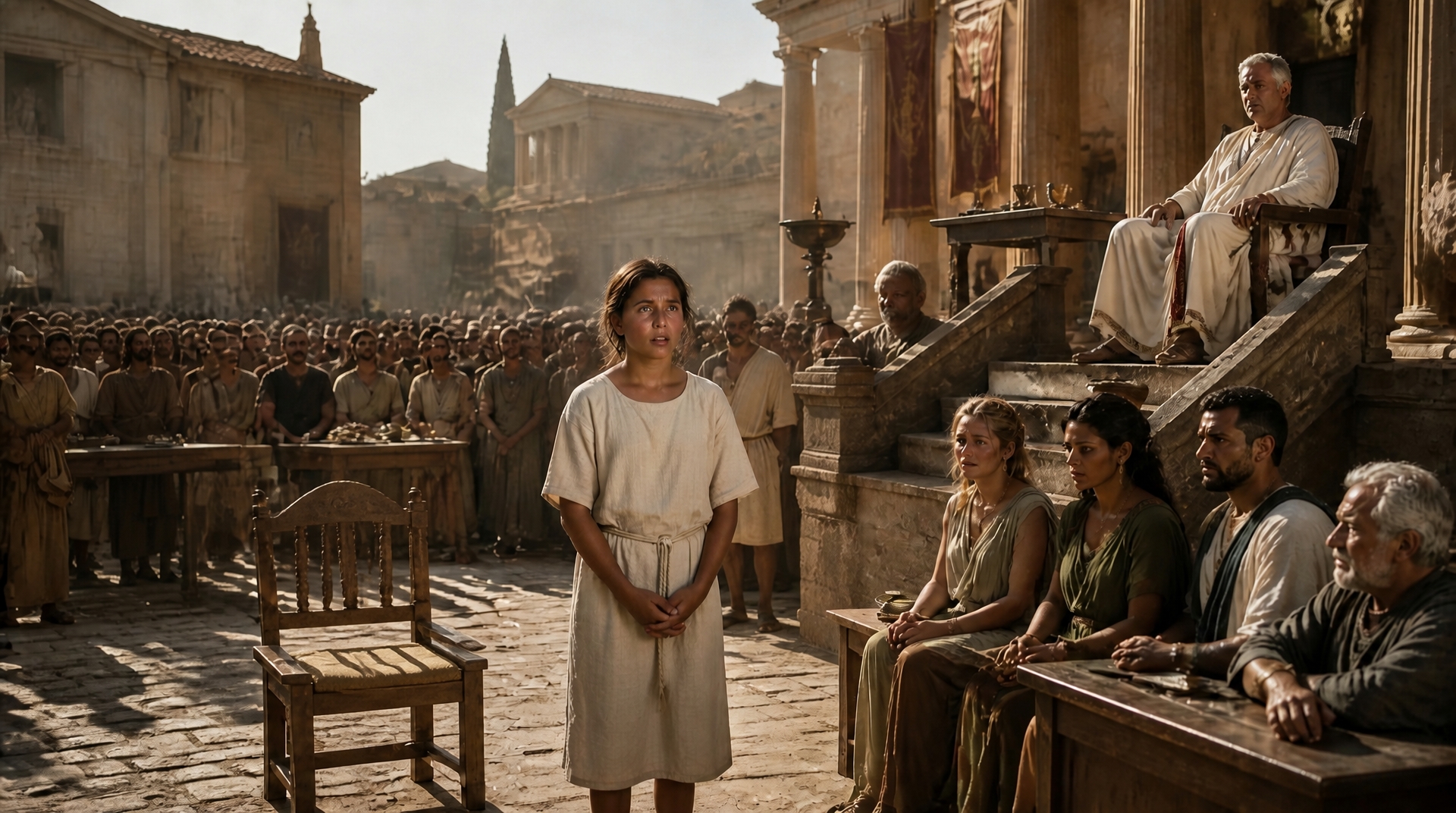
The girl was brought forward by a steward. She had been bathed and her hair combed, but she was still
shaking. She was the same age Lucian's own sister in Samosata had been when he left
seven years previously, and whose grown-up face he couldn't imagine.
"Magistrate." Carbo turned to
Priscus with the air of a man performing a sad duty. "Before
I examine the witness, I must remind the court of the rule. The testimony of a slave is admissible
in a Roman court only after quaestio. I would not press the point if the defense were
content to dispense with the girl's word, but the defense having indicated it intends to test the
witness, I see no remedy. The law is the law. The girl must be put to the question."
A silence in the square.
Lucian rose.
"Magistrate. The defense offers the witness for free examination without dispute. We waive the
requirement. The girl may speak as a free man speaks, and her testimony shall be received as such.
We so offer."
"The defense may waive," said Carbo. "The prosecution does
not. The law requires the question. I will not have my case built on testimony that the rules of
evidence do not recognize."
"The rules of evidence," Lucian said mildly, "under cognitio extraordinaria, are what
the magistrate determines them to be. The defense's waiver is offered. The court rules."
Priscus looked from one to the other. He looked, for a brief
moment, at the girl. He looked, longer, at the crowd.
"The defense having waived the requirement of quaestio, and the witness being available
to both parties for free examination, the requirement is dispensed with. The girl will be examined
as a free witness. Her testimony shall be weighed as the court sees fit. Accuser."
Carbo inclined his head. At the corner of his mouth, the smallest
possible tightening—a man who had expected to be allowed to make his point and had not.
Carbo's examination of the girl was brisk. She had been sent
with a tray of wine and cheese. She had pushed the door open with her elbow. She had seen the master
on the floor. She had dropped the tray. She had screamed. She had seen, just before she entered, the
master's Greek guest walking away down the colonnade, bruised at the knuckles and red in the face.
Yes, she was sure of the man. Yes, she was sure of the hour. And no, she had seen no one else.
Carbo sat.
Lucian rose. He did not move toward the girl. He stayed beside Demetrios, where he could see
Dora's face plainly.
"Dora. You said you didn't see anyone else enter the master's chambers."
"Y-yes, master."
"How long did you watch before you entered?"
"Not at all, master. I came up from the kitchen."
"You testified that you saw the accused coming from the direction of the master's chambers.
How long was that before you entered and found the body?"
Carbo leapt to his feet. "Objection, Magistrate! The witness testified she saw the accused
coming from the chambers! That is not the same as saying she saw him coming from
the direction of the chambers! The rhetor is confusing the issue!"
"I will rephrase the question, Magistrate." Lucian said. When the magistrate nodded, he continued.
"When you saw the defendant in the colonnade, could you also see the door to the master's chambers?"
"Well, no, master."
Lucian looked puzzled. "Then how did you know he was coming from the master's chambers?"
Dora looked embarrassed. "I—I don't know, master. I knew the master had called for him,
so I assumed…"
Lucian nodded sympathetically. "That is understandable. But the fact is, you don't actually
know how much time elapsed between the defendant leaving the chamber and you entering it,
do you?"
Dora shook her head.
"Now I want to ask you something else. You have served this chamber. You have wiped the dust
from the master's shelves. You know the bronze weights he kept on the western wall."
"Y-yes, master. But I didn't dust them, they're too high for me to reach."
"When you entered the chamber and saw the master on the floor, did you see any object beside him
that ought not to have been there?"
"I—no, master."
"No weapon on the floor."
"No, master."
"No tool of any sort."
"No, master."
"And the bronze weights on the shelf. Were they in their places, or were any missing?"
A hesitation. "I—I did not look at the shelf, master. I can't see that high."
"Of course. That is all, Dora. Thank you."
The girl was led away. Still shaking, but no longer afraid. A small thing. But a thing.
Carbo rose. "I call Festus,
centurion of the local garrison, who attended at the body."
The centurion was brisk, professional, and certain. He had arrived within the hour of the alarm.
He had viewed the body. He had taken the Greek into custody on the strength of the slave's
identification and the visible bruising of the Greek's knuckles. The chamber had been sealed.
Lucian rose.
"Centurion. When you entered the chamber, was there any weapon on the floor beside the body?"
"There was not."
"Did you, or any of your men, search the chamber for one?"
"We did. We found none."
"And the body bore a head wound."
"It did."
"A wound consistent, in your judgment, with the deceased having fallen against the marble floor
after being struck in the face."
"That was my judgment at the time."
"Centurion, in your years of service in Hispania, have you examined many bodies that died of head
injuries?"
Festus's mouth tightened. "Some."
"Bar-room brawls, drunken falls, blows from above, blows from the side?"
"Some of each."
"Did you, when you formed your judgment that this man had fallen against the floor, summon the
physician of the household to confirm it?"
"I did not."
"Why not?"
A silence. Then: "The case appeared clear."
"The case appeared clear. So that is the explanation for an incomplete investigation?
Thank you, Centurion. That is all."
Festus glared at Lucian. The crowd had begun, very slightly, to shift. Carbo rose for his
third witness. "I call Hermogenes, physician of the household, who
examined the body of the deceased."
Two Wounds
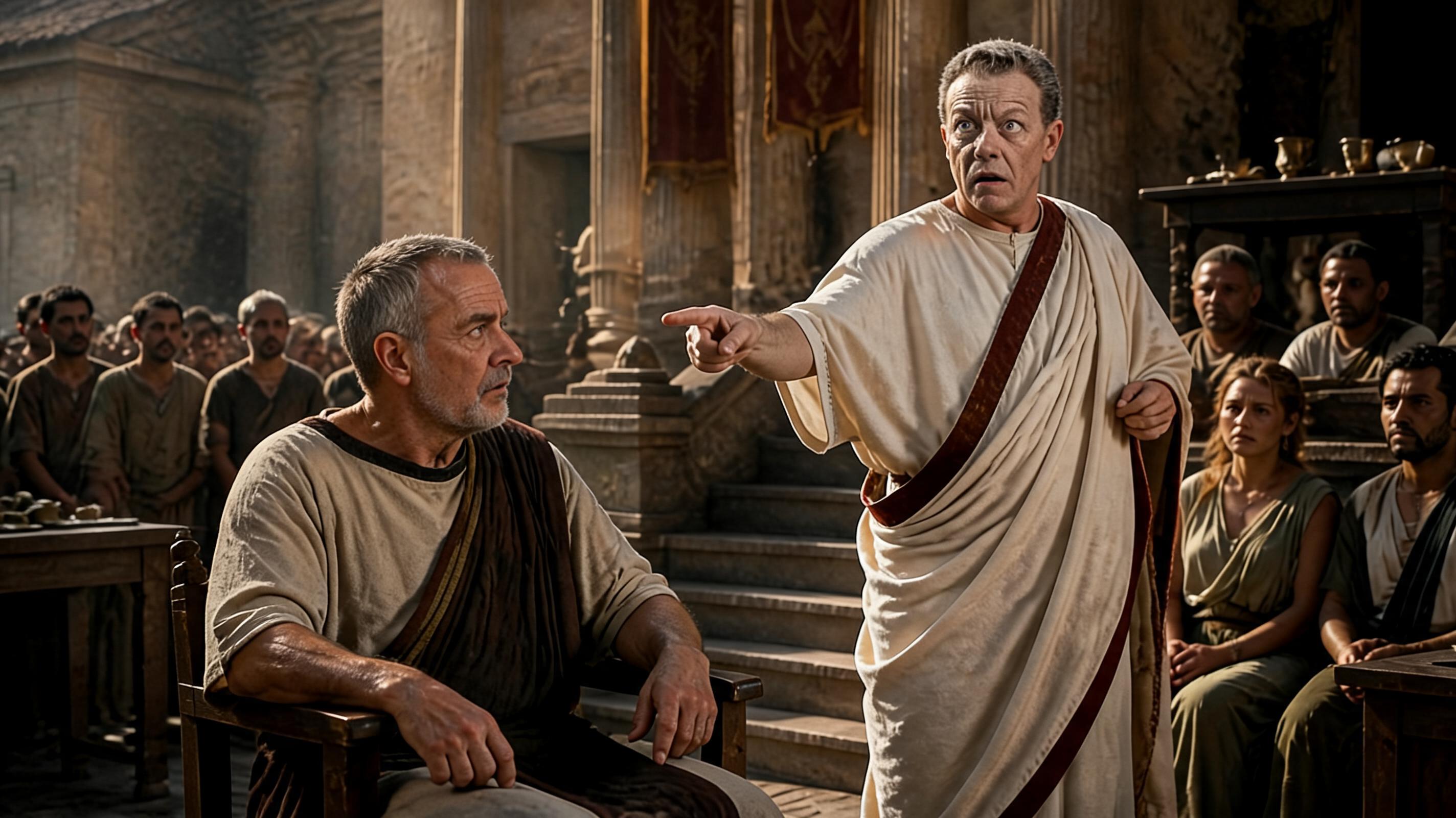
Hermogenes walked to the place before the tribunal with
the same patient calm he carried into a sickroom. He bowed to the magistrate. He waited.
"You examined the body of Gaius Vibius
Crispinus," Carbo said.
"You have, I understand, prepared him for the rites."
"I have."
"He died of a head wound."
"He did."
"A wound consistent with falling against marble after being struck in the face."
The physician looked steadily at Carbo.
"It is not, master."
Carbo looked surprised. "Explain yourself, physician."
"The deceased was struck twice. The first blow was a fist, to the nose. The bruise and the angle
are consistent with the act. The first blow did not kill him. The second blow did. It was
dealt to the left side of the head, above the ear, with a heavy, smooth, rounded object of bronze.
The skull is depressed beneath the wound. The angle of the striking blow is descending, but barely.
The man who struck the second blow was the same height as the deceased or shorter. The Greek who
struck the first blow is a hand taller than the deceased. He could not have struck the second."
The crowd, collectively, gasped.
Carbo said: "You did not report this to the centurion at the
time of the arrest."
"I was not asked. The centurion was satisfied. I was sent for after the arrest was made and the
body was brought to me to prepare. I gave my opinion to the man who asked me for it. The man who
asked me for it was the rhetor for the defense. He asked the right question."
Carbo sat down rather more abruptly than he had risen.
Lucian rose.
"Physician. The bronze object that struck the second blow. Could it have been a household
weight?"
"It could."
"Such weights are kept in the chamber where the body was found?"
"Several. On the shelf along the western wall. The Overseer used them in his daily work. I have
seen them often."
"Magistrate." Lucian turned. "I would request that the row of bronze ore-weights presently
on the shelf in the deceased's chamber be brought before this court, that the physician may
examine them, and that the court may see what he sees."
Priscus looked at Carbo.
Carbo rose, slowly, with the look of a man computing whether the
gesture of objecting would do him more harm than the substance of the evidence. He sat back down
without speaking.
"Bring them," said Priscus.
A soldier was dispatched. The court waited. The crowd, denied the spectacle of an instant crucifixion, was
discovering an unexpected appetite for courtroom drama.
The soldier returned with the weights, carried on a wooden tray with an indentation for each
one. He set them on the prosecutor's
bench in their proper order, from the half-ounce at the left to the pound at the right.
Hermogenes went forward.
He took up each weight in turn. He examined each. He set each down. The crowd watched as if he
were performing a rite. When he came to the pound, the heaviest, he held it longer. He turned it
to the light. He looked at the bottom; he looked at the rim. He brought it briefly to his nose,
in the small private movement of the physician confirming what he had already suspected.
"Magistrate," the physician said, "the row of weights was, until very recently, undisturbed.
Cinnabar dust still lies upon every weight in this row but one. The pound has been wiped. The cloth that
wiped it has missed a thread of dark matter caught at the seam of the casting. The matter is
consistent with blood and with hair. The shape of the weight is consistent with the wound. This
is the object that killed Gaius Vibius Crispinus."
He set the pound weight on the bench beside the others. He bowed to the magistrate, and stepped
back to his place among the witnesses.
The square, for perhaps the space of three breaths, was perfectly silent.
"Accuser," said Priscus. "Have you further witnesses?"
Carbo rose. He had recovered some of his color. "Magistrate, the
physician's testimony establishes only that a second blow was dealt. It does not establish that
the Greek did not deal it. The chamber was not searched immediately; the weight could have been
wiped by the Greek before he left it; the height calculation depends on assumptions about how the
deceased was standing. I shall ask the court to weigh these matters."
"And so I shall," said Priscus. "Defense. Your witnesses."
"I call Onesimus, freedman, steward of the household."
The Household on the Stand
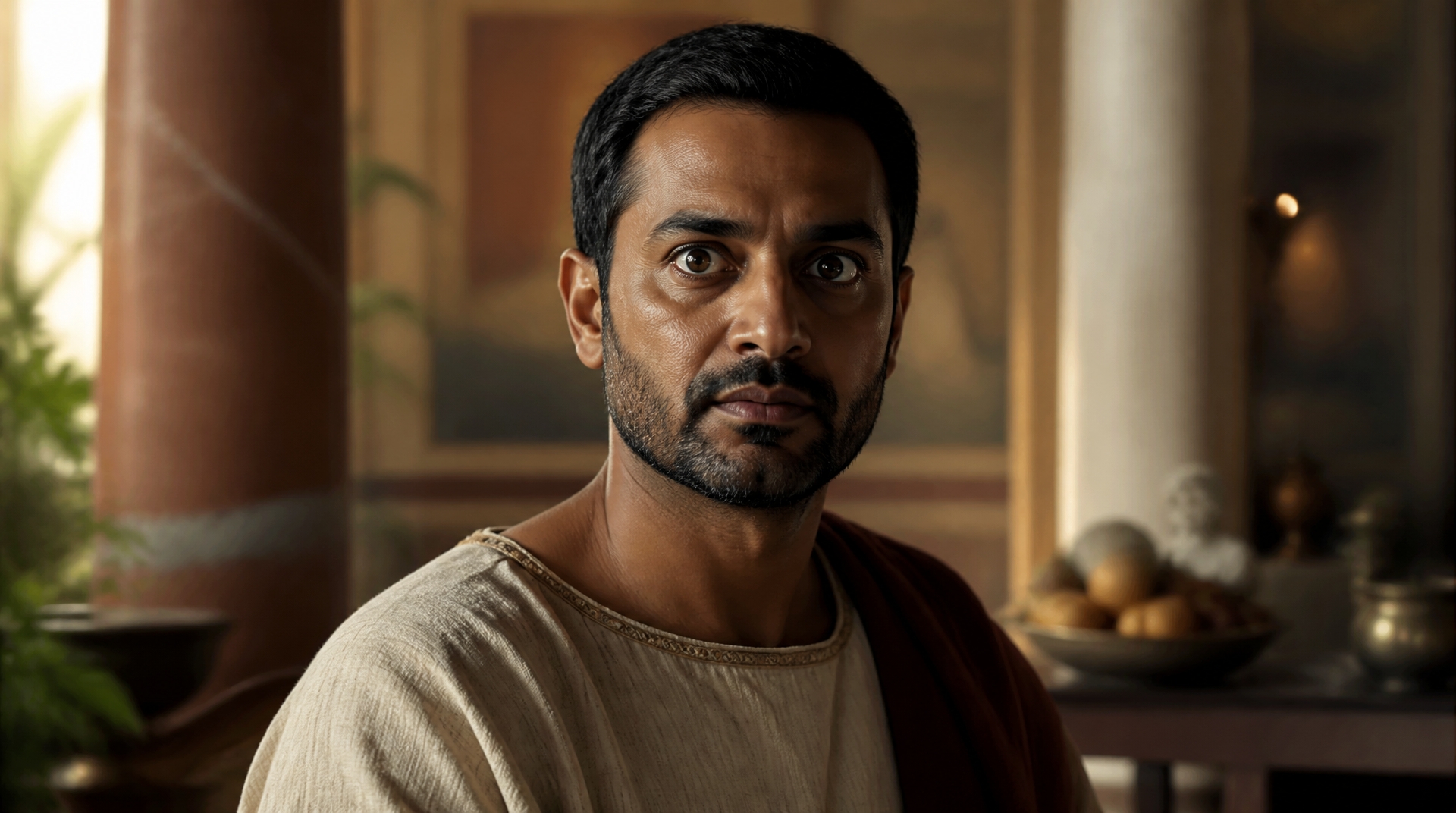
Onesimus walked to the place before the tribunal with the
tidy economy of a man who had spent a lifetime making things appear easier than they were. He
bowed. He waited.
"Onesimus. You served as steward to Gaius Vibius
Crispinus for how many years?"
"Eight, master, since he freed me. Three before that, as his slave."
"You managed his household accounts."
"I did."
"In those eleven years, did you ever wish him dead?"
A startled noise from the crowd. Onesimus did not flinch. He considered the question
with the same care he might have given a difficult column of accounts.
"I did, master. Many times. He was not, shall we say, a kind master, and a steward sees more
unkindness than most. I did not weep when I heard the news. I will not pretend
otherwise before this court. But I wouldn't kill him, or anyone else."
He winced and shivered. "Murder would be so…messy."
A small movement passed through the square. Honesty, in a witness, was always a
surprise.
"Where were you at the hour of his death?"
"In the kitchen passage, master, speaking with Thalia. The
cook will swear to it. He was eavesdropping, though he didn't think we knew."
"While you were in the kitchen passage, did you see anyone else moving about the house?"
Onesimus paused, recollecting.
"I saw Hermogenes leaving the latrine and heading for his room. And I saw
Severus, master, the clerk. He came down the colonnade from the master's quarter,
and went on past."
"That is all."
Carbo rose. He had recovered enough to be theatrical again. "You
stand here, freedman, and admit before this magistrate that you wished the man dead?"
"In a Roman minute."
"And you ask the court to believe you did not act on that wish."
"By your expression, master, I'd be surprised if you didn't wish the rhetor dead right now!
But I only ask the court to believe the cook."
The crowd liked that. Carbo sat down.
"I call Thalia, companion of the lady of the house."

Thalia
Thalia walked to the tribunal as if she had been walking to
tribunals all her life. She was perhaps the most composed person in the square, with the exception
of Priscus and Lucian himself.
"Thalia. What was your relationship to the deceased?" Lucian queried.
"I was his concubine. He purchased my contract from a house in Corduba seven years ago. He freed
me three years ago at his wife's request, on the understanding that I would remain."
"You had been told you were to be replaced, weren't you?"
Thalia looked surprised that Lucian would know. "He told me the day before yesterday.
He had a new girl from Corduba. The contract was
drawn. He told me as if he were doing me a kindness. He told me that under Roman law I
had no remedy, which was true, and that I should be grateful, which was not."
"You had reason to want him dead."
For the first time, the composure cracked. Thalia's voice rose, sudden and hot.
"If he was drowing I would sit on a coil of rope and watch.
Do you know what he was going to do to my lady?
He was going to divorce her. Under the Lex Julia. On a paid charge of
adultery. He bought witnesses. He had the documents drawn.
By the gods, he had already written to
her family in Italica! By the Kalends she would have been exiled, her dowry forfeit,
her name a thing one did not say at table. Her family would not have received her
back. Twenty-two years of marriage and he was going to throw her on a rock in the sea
for sport, because he was tired of her, because—"
She stopped. The square was suddenly very quiet.
"You had, then, more than ordinary reason to want the master dead."
"I had reason. So did everyone in that house. And everyone in the mines, as far as I know.
But I have never killed anyone, master. I am not in the habit.
I am of the belief that evil is its own punishment, in the long run.
And look; I was right! The monster is dead!"
"Where were you at the hour of the death?"
"In my own chamber. I came up from the kitchen some quarter of an hour before.
Rhodia was with me. She was brushing my hair."
"That is all."
Carbo did not rise. He had begun, over the last several minutes,
to write very small notes on a wax tablet, in the gesture of a man who had stopped believing in
his own case and was preparing for something else.
"I call Marcus Vibius, son of the deceased."
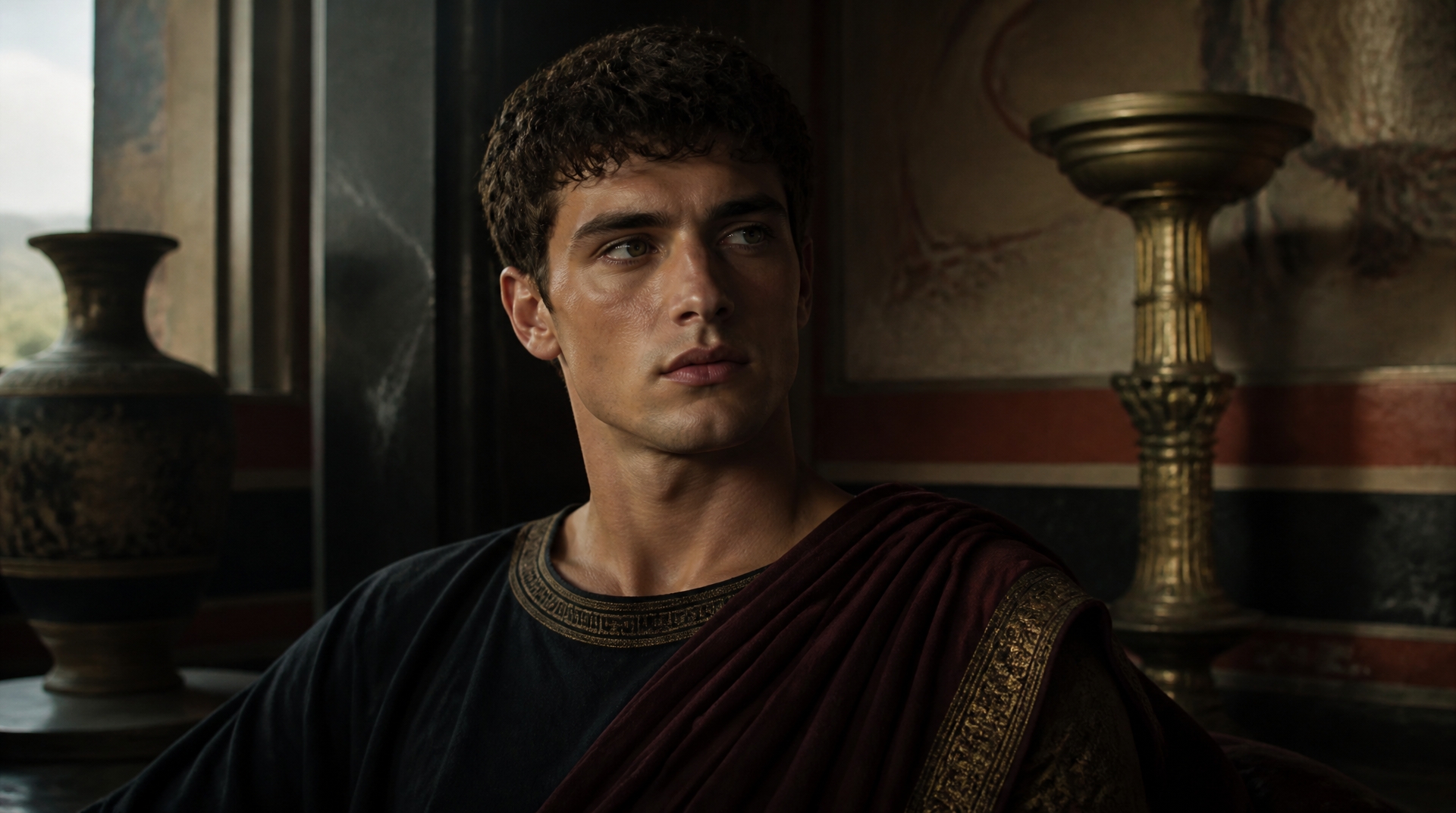
Marcus
Marcus walked to the tribunal with the easy swagger of a man who had inherited every
cubit of his father's brazenness and none of his caution. He was hungover. He was not,
however, embarrassed.
"Marcus. Where were you at the hour of your father's death?"
He grinned. The grin had no apology in it.
"At the brothel by the forum, master. I went in at the hour after dinner with two
amphorae of decent wine, and emerged the next morning by way of being shaken awake.
There are six women and a doorman who will swear to it, and a seventh girl who is, as
we speak, sleeping it off; she may or may not be coherent by the afternoon."
The crowd laughed outright. Marcus inclined his head in acknowledgment. His father
had taught him many lessons, most of them ugly, but one of them durable: brazenness,
properly applied, was a kind of armor.
"Did you wish your father dead?"
"Master, I have wished him dead since I was old enough to wish. I am perfectly
willing to admit it under oath. But the women will tell you I was not, last night,
in any condition to swat a fly, let alone bash a man's skull. Ask them. They keep
a list."
The magistrate, despite himself, almost smiled. Almost.
"That is all."
Carbo did not rise.
Lucian rose. He did not move from his place. He looked at the magistrate, and then at the
witnesses' bench, and back.
"Magistrate. The court has now heard, from every member of this household called before
it, the same admission. Every one of them wished the master dead. The steward, who had
served him through unkindness without number. The concubine, whom he had cast off for
another. The son, whom he had despised since the day the boy could lift a sword. Every
one of them had motive. Every one of them had means: the bronze weights stood on the
shelf in the master's own chamber, in plain sight, the heaviest of them within reach of
any hand in this house."
A pause.
"What remains, Magistrate, is opportunity. Who could have entered the master's chamber after
my friend Demetrios left it, and before Dora entered with her tray? Onesimus was in the
kitchen passage, seen by the cook. Thalia was in her chamber, the maid brushing her hair.
Marcus, by his own admission, was at the brothel by the forum, in the company of a
number of witnesses I will not require this court to enumerate. The hour of the murder
is small. The window is smaller. Only one person in this household has not yet accounted
for that hour. Only one was seen, by another member of this household, walking toward
the master's chamber while the master was still alive."
Lucian turned, slowly, toward the bench where the household sat. He let the crowd see
what he intended.
"I call Severus, clerk of the household."
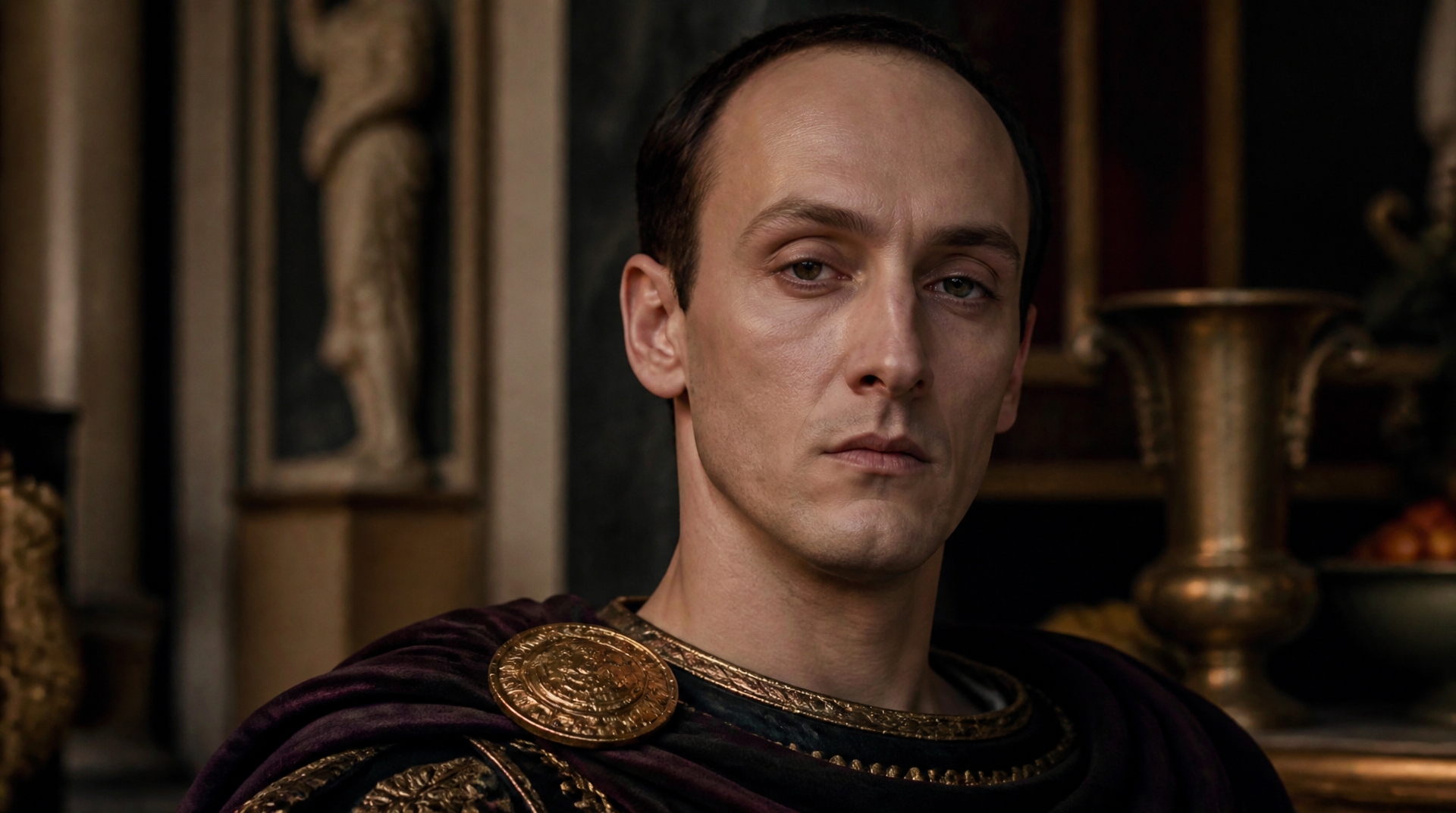
Severus
The clerk walked to the tribunal as a man walks to the edge of something he has been walking toward
for a very long time. He bowed to the magistrate. His hands were not shaking. Whether that was a
good sign or a terrible one was not, at this point, the question that mattered.
"Severus. You served as clerk to the deceased for how many
years?"
"Eleven, master."
Lucian looked the clerk over with pity. "You were in love with him, weren't you?"
The crowd, which had been gathering momentum toward another small laugh, did not laugh. The clerk
caught his breath, his face suddenly a furious red. Finally, in a small voice,
he looked pleadingly at the magistrate. "Do I have to answer that?"
The magistrate gave him the side eye and intoned, "I think you just did."
"For how long?" Lucian pressed.
"Nine years. Nine…years."
"Did he know?"
Severus emitted a sound that was a cross between a laugh and a sob.
"That man never knew the meaning of the word. Love? The only thing he ever loved was himself.
Himself, and power."
"When were you told that you were to be replaced?"
"Cornelia told me—" and then suddenly stopped. The clerk's eyes widened,
and he added, "the day you arrived."
"Did she tell you that you were to be replaced by the defendant?"
Severus glared. "That's right"
Lucian spread his hands in mock surprise. "By Demetrios? Whom your master had not yet
propositioned, but would proposition that night."
"Yes."
"Long ago, Crispinus loved me. Once. And then he set me
aside, the way he sets everyone aside. We were all playthings to him. The cook. The girl
from the laundry. Thalia. Myself. And he was going to replace me completely
with that Greek! Not only would the Greek get Crispinus, he would take my job,
and then blacklist me so I couldn't get another. See, it wasn't enough for
Crispinus to use and abuse, he also had to destroy."
Priscus did not move. Carbo's stylus, which had been moving, stopped. The crowd, which
had not yet caught the shape of it, began to.
"And so you went to his chamber after Demetrios had left."
"Yes. I hid behind a column when the Greek went to his chambers, and didn't go in
until I saw him leave. I never saw the master so angry! His nose was
bloodied. He saw me, and he laughed, and said not to worry, there
would be no shortage of pretty boys in the next caravan. He said it as though I were
not there. As though I had never meant anything."
Severus sighed. "I…I had the weight in my hand. I
do not remember choosing it. I remember the sound. I remember he fell."
"And you wiped the blood off the weight, and replaced it."
A long pause, drawn out for the crowd's benefit and for one other person's.
Then Lucian addressed the magistrate.
"Magistrate. The clerk has confessed the act. The court has heard it. The court will,
I trust, weigh it. But before it does, the court should hear something else."
"A person of high station may move a person of low station as a player moves a piece
upon a board. The piece does the work. The hand that moved it bears the guilt no less.
Severus held the weight;
Severus dealt the blow. He did so because a woman
to whom he could not say no, told him he must do it, and must do it that night, before
he could question, before he could verify, before he could find any voice in himself that
was not hers. She did not need to hold the weight. She held him. The Greeks have a word
for the one who arms the assassin. The Romans, I am told, have one too. Neither word is
innocent."
Priscus inclined his head, very slightly.
Then, slowly, everyone turned toward the witness bench, where Cornelia
sat in the gray of mourning, hands folded in her lap, chin lifted just so. The perfected composure of
a Roman matron performing her duty in public.

Cornelia
Her eyes met his. They did not flinch.
"Magistrate. I beg the court's leave to address the lady directly."
Priscus, with a look of curiosity, nodded. "Granted."
Lucian stepped down from the place before the tribunal and crossed to the witness bench. He did not
raise his voice. He did not have to. The square was perfectly silent, in the way a square is silent
only when a great many people are listening at once and holding their breath.
"Lady Cornelia. You have heard from your
companion what your husband intended. You knew it before she did. You had perhaps two
weeks before the matter would have been filed with the magistrate, and after that,
you'd have been destitute and exiled."
She did not answer. She did not need to. The household, on the bench behind her, was
answering for her in the small ways the household had been answering for the master
for years: a flicker of Onesimus's mouth, a
long breath from Hermogenes. Every one of
them had known.
"You had no remedy in law. You had, however, a clerk who loved your husband and was
the only person in this house who could be made to
do what you yourself dared not do. You needed only to whisper to him what he most
feared, that he was being discarded, and to give him a deadline for something he could not
verify. You knew your husband. You knew his appetites. You knew there was a Greek
under your roof who would, by morning, have made the lie true. The lie did not even
need to last the night."
A pause. Long enough for her to look at him.
"The clerk did the deed. But you did the planning. Then all you had to do was
go to bed and wait for the alarm when someone found the body.
You composed your face. You came down in mourning gray, and you played the widow with the
dignity that, as your husband once observed at table, was the one thing you had ever truly
possessed."
For the first time, her composure faltered. A small thing—a single breath drawn slightly too
sharply. The magistrate saw it. The centurion saw it. Lucian saw it.
Thalia, very faintly, smiled.
"He has confessed," Cornelia said. The musical quality
was gone from her voice. What remained was flat and very cold. "He has said this was his own act.
You have no proof of anything else."
"Is it not true that you told Severus in the cubiculum off the colonnade, after dinner on
the night of the murder, that there would not be another night?"
Cornelia adjusted herself. "Certainly not."
"I heard you myself," Lucian said, his tone regretful. I was three
columns away. I heard you very clearly.
Lady Cornelia sniffed. "That's your word against mine," she said. "You would obviously
say anything to protect your friend."
Lucian paused. She had a point.
But then, unasked, Hermogenes rose to his feet. "I also heard you! Lady Cornelia,
it breaks my heart to say so, but I overheard you from the latrine, where I happened to be.
It is as the rhetor says. You told Severus he was to be replaced. I didn't understand
the significance of the conversation—after all, Crispinus went through people
like he went through togas—but you did say it."
Cornelia looked, then, at
Severus, who would not look back. She looked at
Priscus.
She lifted her chin one degree higher.
"My husband," she said, "was a brute. I did not weep for him. I will not weep for him.
I am of equestrian rank, magistrate. I claim my right to be tried at Rome."
Priscus did not answer at once. He looked at her a moment, then at the household on the
bench, then at the crowd.
"The court will recess for a quarter of an hour. The accused, the lady, and the clerk
are to be held under separate guard. The witnesses will remain in the square. The court
will return to pronounce sentence."
He rose from the curule chair and walked, with the deliberation of a man weighing
something heavy, into the basilica behind the tribunal. The people in the square did not disperse.
Even people who needed to use the latrine returned immediately.
No one wanted to miss a moment. This was, after all, free entertainment.
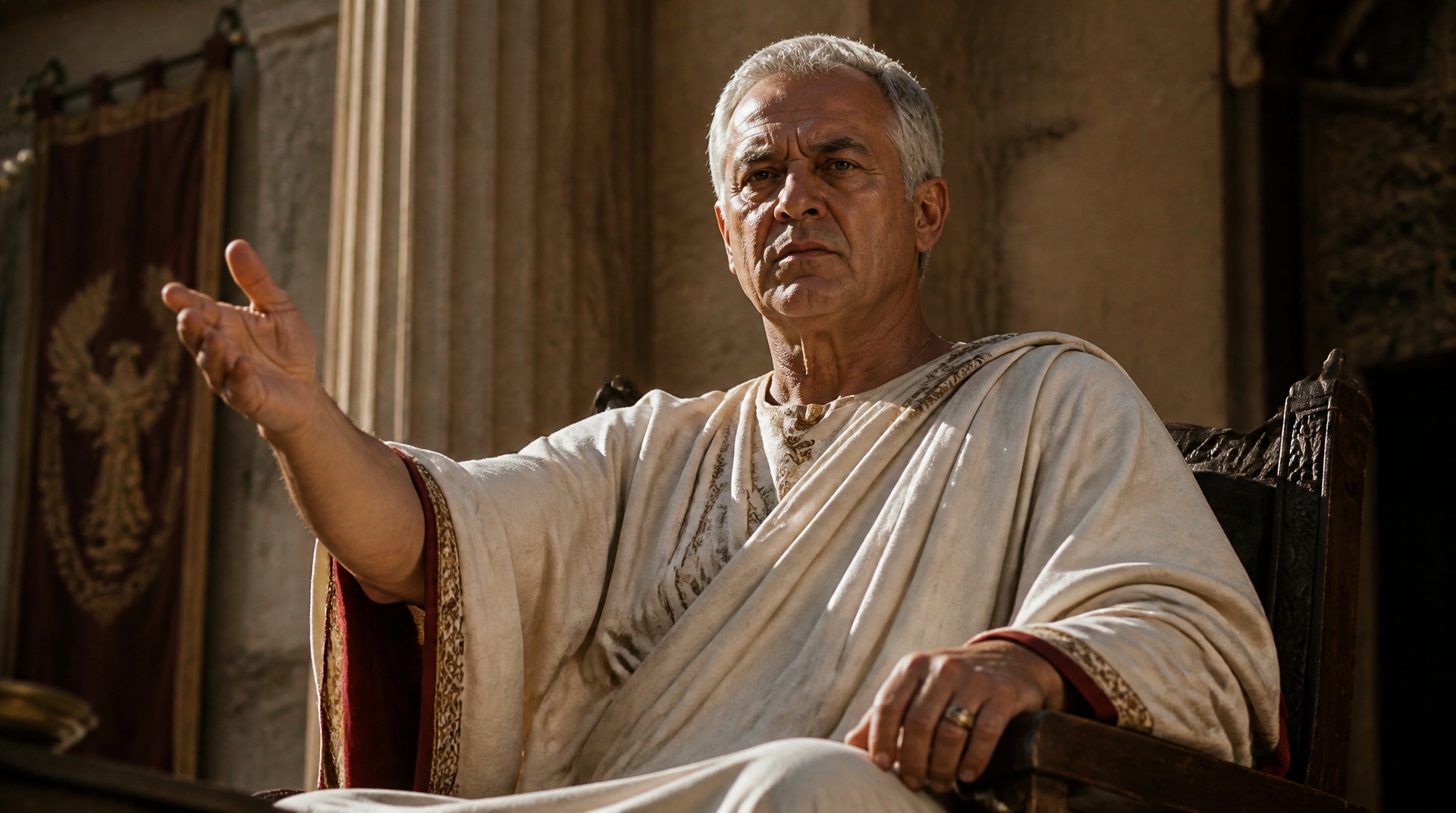
The Sentence
A quarter of an hour later by the sundial, Priscus returned. He resumed his place in the curule
chair. He raised one hand. The square fell silent.
"The court has heard the accuser. The court has heard the defense. The court has
heard the witnesses. The court now rules."
"To Demetrios, of the Greek east: the court finds you bore your hand against Gaius
Vibius Crispinus in defense of your person, and
that the second blow, which was the killing blow, was not by your hand. You are
acquitted. The cords on your wrists shall be cut. You are free to go. The court
suggests that you do so without delay."
A small sound from the crowd. Whether it was approval or disappointment, Lucian could
not tell. Probably both.
"To Severus, clerk of the household: the court
finds, on your own confession before this tribunal, that you struck the killing blow.
The court further finds that your act was induced, which does not absolve. Under
cognitio extraordinaria you are consigned to the conventus at Corduba for
execution. You will be conveyed under guard at the next sunrise."
Severus whimpered without raising his head. It had been slumped against his chest
since he had spoken her name.
"To the Lady Cornelia, of equestrian rank,
widow of the deceased: the court finds
that you planned and directed the murder of your husband and conveyed your instrument
to the act by misrepresentation. Your rank entitles you to be tried in Rome. The court
so directs. You will be conveyed under guard to Tarraco, and from Tarraco to Ostia.
Until that time you will be held at the magistrate's villa under separate guard."
A pause.
"The court hopes, lady, that Rome will weigh your circumstances with more discernment
than your husband did."
Cornelia inclined her head, very slightly. It
was as much as she would permit herself, and very nearly as much as the magistrate
would permit her.
"This court is adjourned."
The square exhaled all at once, as if it had been holding the same breath for an hour.
One soldier moved to Demetrios and cut the cords on his wrists. Another took custody of the clerk,
who did not resist. A third escorted Cornelia, who walked
between them with her dignity intact, because dignity, as her husband had once observed, was one
of the few things she had ever truly possessed. She had killed to keep it. She would take it with
her to the island on which she would be exiled.
From the witnesses' bench, Thalia cried out; her shoulders fell,
her hands leapt to her face, and she wept—the kind of weeping that is past
words and past help. Cornelia, walking between
her two soldiers, turned her head once. She did not stop. She did not slow. But her
eyes found Thalia's, and held them, for the space of perhaps two paces. Then she faced
forward again, and went out of the square, and was gone.
The dead man's second-in-command, Lucius Vibius Sabinus,
who had stood at the back of the square
throughout the trial with his arms crossed and his burned face unreadable, turned without speaking
and walked away toward the mines. He now had a district to run. He had also, by the look of him, a
quiet new respect for a magistrate who would not be hurried.
The magistrate rose from the curule chair. He came down from the dais. He approached Lucian, and
stopped, and inclined his head in the small private gesture of one professional to another.
"You did not waste my day, rhetor."
Lucian smiled. "The magistrate did not waste mine."
He inclined his head once more, and went.
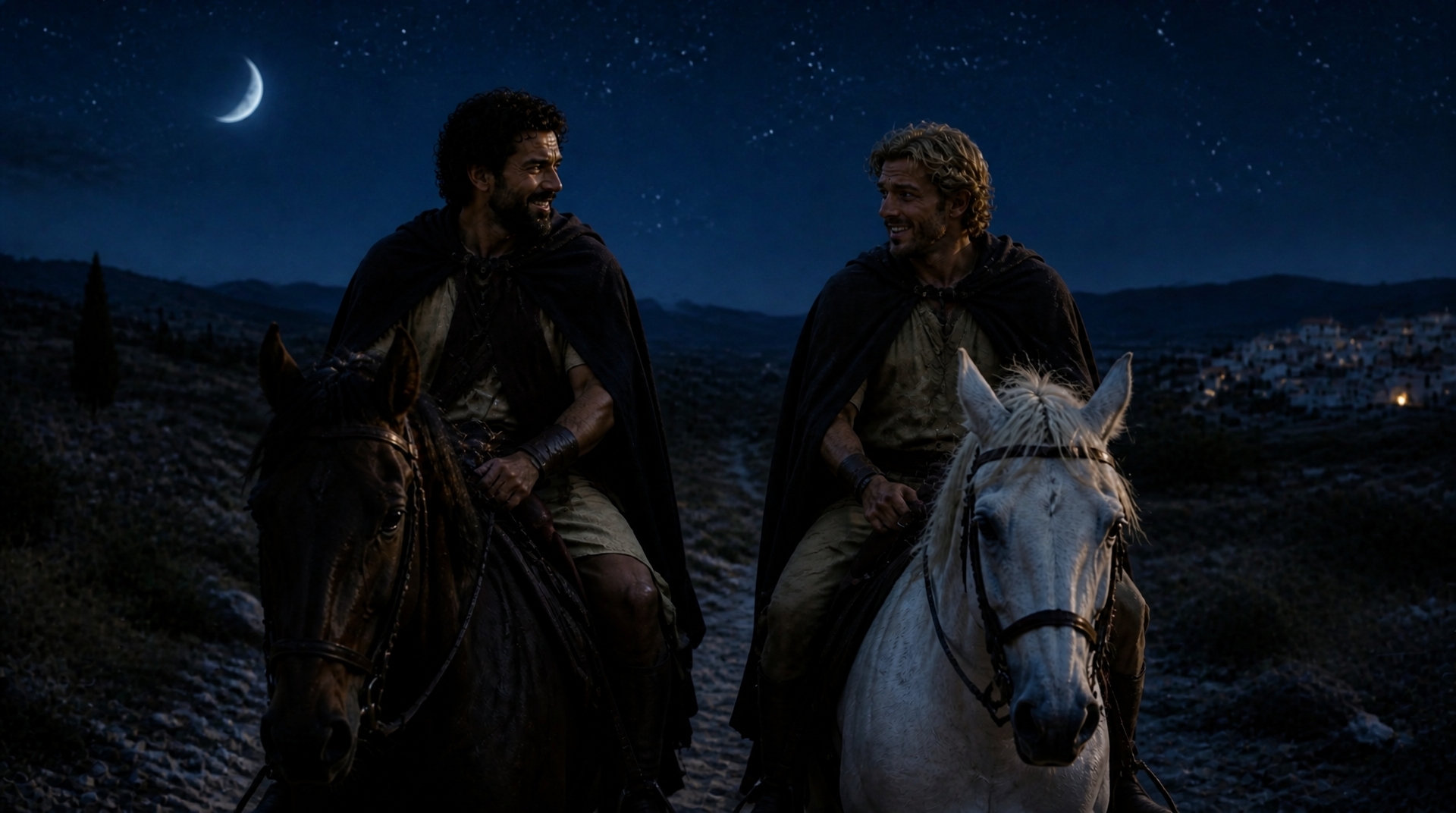
The Road South
Lucian and Demetrios did not stay an hour more in Mariana. They
retrieved their satchels from the house where they had been guests; they paid the
stableman, who took the coin with both hands and asked no questions; and they were on
the south road before the sun had touched the cinnabar dust on the western hills.
They rode in silence for the first miles. Demetrios's wrists still bore the dark rings
of the cords. Neither of them spoke of it. Neither of them needed to.
They rode past sundown. They rode past the hour at which any sensible traveler would
have stopped for the night. The moon was thin, and the road ran on under it pale as
bone, and the mules complained, and they did not stop. They would sooner sleep in their
saddles than spend another hour in the district of Mariana.
As their horses trudged down the road side-by-side, Demetrios said, hesitantly,
"Lucian…I don't have words. You literally saved my life. And from the
most horrible death anyone could imagine."
"You would do the same," Lucian assured him.
"What I'm trying to say is…I have always had the highest regard for you.
I have loved you as you know. My love for you is noble and pure enough for
even Plato himself to offer it as an example. But now it has grown by tenfold.
A hundredfold. I am not only yours to command, I am also in awe. Like I was
in the presence of a god."
Lucian laughed gently. "I'm no god," he assured his partner. "If I'd known
he was going to try to take you from me, I'd have killed him myself."
They looked at each other in the starlight. "We should probably stop soon and
camp," Lucian suggested.
Demetrios nodded. "Off the road, so we don't get awakened by early-morning
traffic," he added.
They pulled off the road, dismounted, and embraced before even unbridling their horses.
Then they kissed. And the world fell away.