|
By: Paul S. Cilwa |
Posted: 4/27/2026 |
|
Page Views: 19 |
| Hashtags: #History #LucianofSamosata #Zeugma #Antioch #Beroea |
| Lucian heads out to see the world. |
| Estimated reading time: 14 minute(s) (3243 words) |
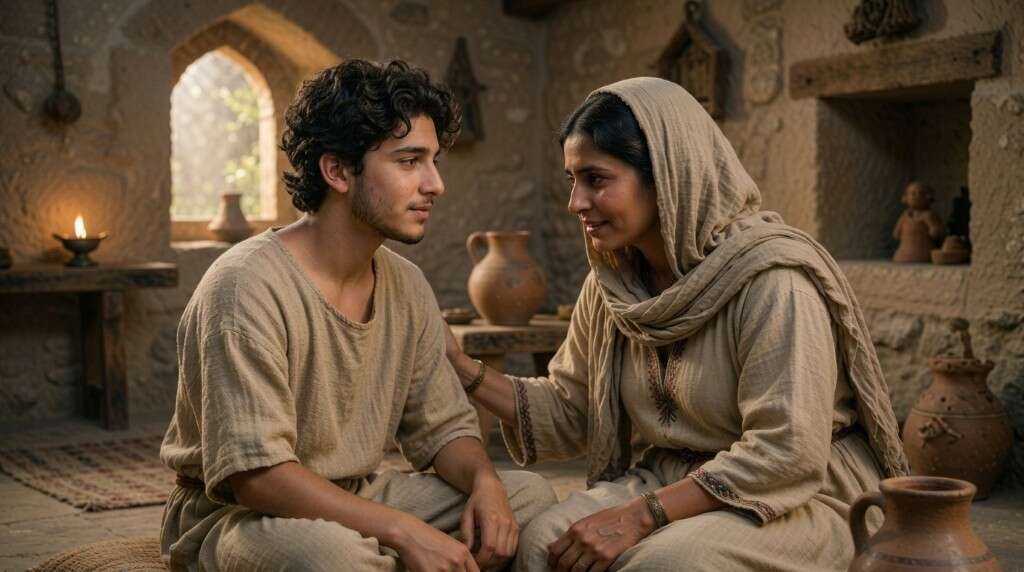
"What am I going to do?" Lucian asked his mother, who
looked him in the eyes. "It's your life," she said, "and you are at the balancing
point where you can make of it what you will. The gods may throw obstacles and
opportunities to us, but what we make of them is up to us. So: What do
you want to do? What sort of things bring you joy, make time fly
while you do them?"
Lucian looked out the window. There had only been one event in his life that
had fired him up, had made him want to be the guy holding his
audience's rapt attention like a puppet master with a hundred strings.
"I liked that sophist who came to speak when I was a kid. But I don't know
how to be one. I can't afford a rhetor, as Father pointed out."
"That's not the only way to learn from a rhetor," his mother said.
"A caravan leaves every day for Antioch. From there,
you could make your way to Ionia, where the temples of learning are located.
And I understand that, if you find a master you like, and who likes you,
you can 'attach' yourself to him by doing odd jobs, in exchange for the
education." She slipped him a small sack of coins. "I've been
saving pennies here and there since you were born.
I saved it for you. It's not much, but
it should get you a few nights' lodging and something to eat until you
can get work, or kill a rabbit."
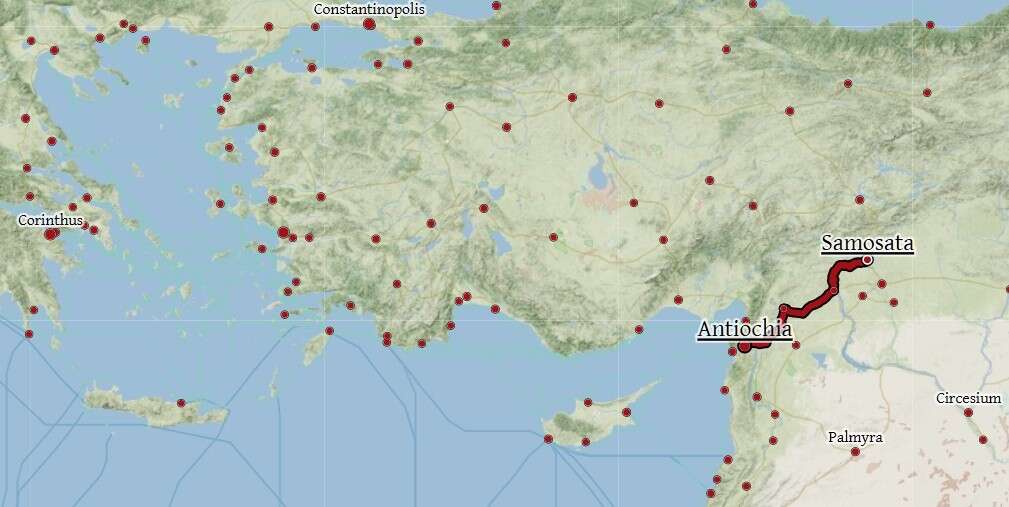
Lucian's heart skipped a beat. "Leave home? Leave Samosata?" He looked into her eyes.
"Leave you?"
She laughed kindly. "Baby bird, it's time to leave the nest! You've always
been too big for Samosata. There's a whole world out there! Make your mark on
it. That's what I've always seen for you."
He spent that night curled up in the household's courtyard. He'd never slept on
the ground before; but if he were going to become a world traveler, he'd better
get used to it! —And he discovered it wasn't so bad, once he stopped
feeling sorry for himself for having to endure such an indignity.
That night he dreamed two women came to him:
one in a workman's apron, with strong arms and stone-dust in her hair, and one in a
clean himation, with a scroll in her hand and of that particular saffron color
of that sophist's robe he'd seen as a child. They quarreled over him. He did not remember, when he woke,
which of them he had chosen in the dream. But he knew which of them he would
choose when he opened his eyes.
The Caravan
In the morning, he bade goodbye to his mother, who fed him breakfast and
gave him a bag lunch. He grabbed his backpack, loaded with just a few essentials,
and headed to the edge of town. As a child, he had often gone to watch a
caravan form, and wonder where they were going. Now, at last! —he
was going to join one, himself, for real.
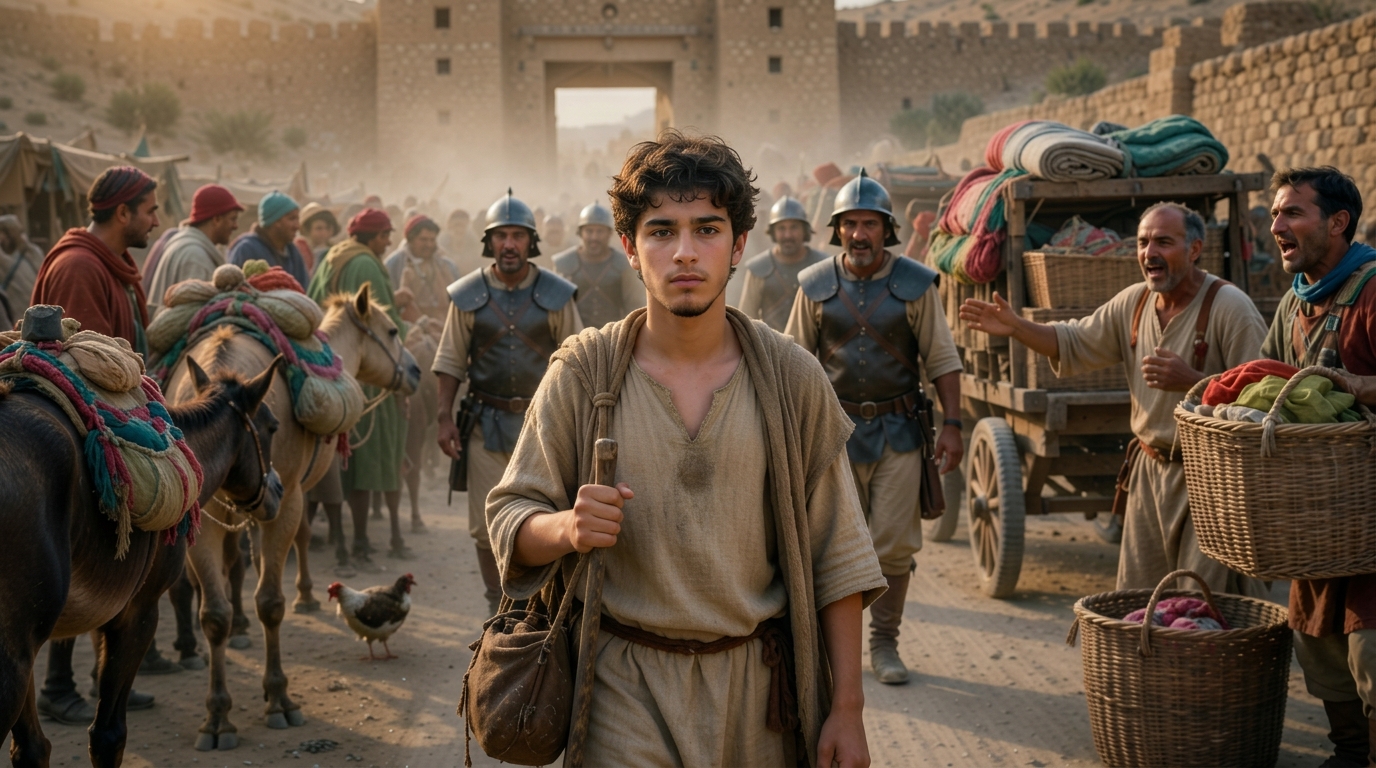
There was no office, no ticket window, no manifest. Caravans formed organically at the
edge of the city: merchants gathering their pack animals, muleteers shouting to one another,
families loading baskets and bedding, soldiers drifting in and out as they moved between posts.
Lucian simply walked down to the southern gate of Samosata at dawn, carrying his
small pack, and looked for a group heading toward Zeugma or Antioch.
There were a lot of people still milling around. He asked around:
"Are you bound for the river crossing?"—and someone would point him toward
a mule train or merchant family taking the same road. If he wanted the protection of a
caravan, he didn't pay a fee; he just joined the group, helped where he could,
and became part of the moving community.
The smells hit hard. Fresh-cut hay for the animals; leather tack warmed by the sun.
Olive oil, dried figs, and flatbread packed for the journey. The sharp, dusty scent
of limestone from the city walls. and always the animals: mules stamping, oxen snorting,
goats bleating as they were herded into position. The air was full of voices: merchants
arguing over prices, women calling to children, muleteers cursing affectionately at
stubborn animals, and the rhythmic clatter of wooden wheels on stone. Lucian,
nervous but excited, found an older man in a likely clump of travelers. "Antioch?"
"That'd be us!" the man laughed. "I'm Theodoros."
The boy smiled. "I'm Lucian." He had made his first friend; and his new friend was
a real Greek, which to Lucian meant he was probably very well-traveled, and
was probably very wise.
As the caravan began to move, the city's sounds faded behind him and the open road took over.
Sandals scuffing dust, hooves thudding, the creak of wagon axles, the occasional jingle
of harness bells. Lucian felt the strange mix of fear and freedom that comes with leaving home
for the first time. He glanced around at the people he'd be spending the next ten to fourteen
days with—families, traders, a couple of soldiers on leave, a few other young men—and
realized that these strangers were now his temporary world. And because he was bright,
curious, and quick with a joke, it didn't take long before someone laughed at something he
said, or asked him about Samosata, or invited him to share a bit of bread at the first rest stop.
That's how travel worked then: you didn't "buy a ticket"; you earned your place with good
manners, a strong stride, and a little charm.
They reached their first caravanserai just as the sun was lowering itself into the dust-gold
haze of late afternoon, and the place felt like a small, temporary city. Animals were tied to posts;
pots were simmering over low fires, children chased each other between bundles of cargo. The
air was thick with smells he'd never encountered all at once: sweat and leather, cooking lentils,
olive oil warming in clay bowls, dust kicked up by hooves, all mixed with the faint sweetness of wildflowers
growing along the outer wall.
Caravanserais were public spaces, funded by cities or wealthy patrons, and no one asked for a
fee unless you wanted a private room—which he certainly couldn't afford. So he found a
patch of ground near a low wall, spread his cloak, and tried to look like he belonged.
He hadn't been sitting long when a merchant with a kindly face and a wife bustling at his side
waved him over. They had a daughter—Claudia—about his age, with dark eyes and a
curious expression; and she kept glancing at him with the polite boldness of someone used to
meeting travelers. The family insisted he join them for dinner, pressing bread and olives into
his hands before he could protest. When they asked what had brought him onto the road alone,
he launched into a humorous retelling of his disastrous apprenticeship: the marble slab that
chipped wrong, the uncle who flailed like a man drowning, the moment he realized he was better
at making people laugh than making stone behave. By the time he finished, Claudia was covering
her mouth to hide her laughter, her father was wiping tears from his eyes, and even her
mother—wary at first—had been charmed.
Later, when the fires had burned low and the caravan settled into the soft murmur of night,
he returned to his cloak. The ground was hard, but he barely noticed. A warm breeze carried the
scent of night-blooming flowers from beyond the walls, mingling with the faint trace of
Claudia's perfumed hair from where she had leaned close during his story. He lay there wondering
which one he was smelling, and whether it mattered, before sleep pulled him under.
The Bridge of Zeugma
The second day was much like the first: Lots and lots of walking,
but not so strenuous as to make conversation
difficult. There was no other way to pass the time than
by talking. Which is how Lucian met Demetrios, another Greek lad of nineteen or so.
"It's easy to keep yourself fed in Antioch as long as you don't mind being nice
to the gentlemen."
Lucian had no idea what Demetrios was talking about.
"Money?" Demetrios tried to explain. When Lucian still looked blank, Demetrios
switched to orator mode, to explain it as a teacher would. "It's called 'prostitution'.
It's where you let a man have his way with you, in exchange for which he pays you."
Lucian still looked confused. "I just figured I would do odd jobs, like clerking or scribing
or cleaning."
Demetrios shrugged. "That, too." he nodded. "It doesn't pay as well, though. And prostitution is also
a really good way to get a patron, which will help if you are looking to get a good education."
There's nothing quite like travel to open one's horizons.
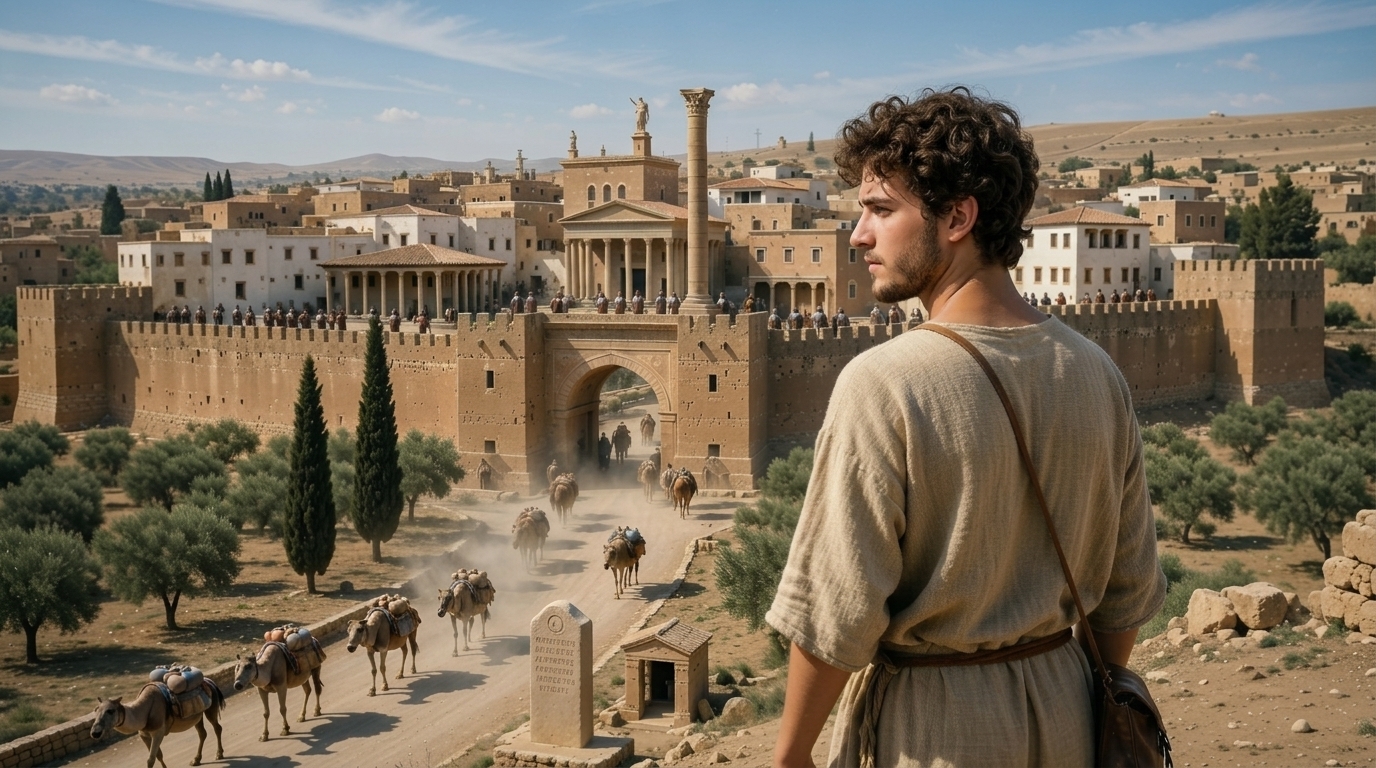
Approaching the city of Zeugma felt like stepping into a different world:
Bigger, louder, richer, and more chaotic than anything Lucian had ever seen in Samosata.
Samosata was a fortified hilltop city, proud but compact, with narrow streets and a provincial rhythm.
Zeugma, by contrast, was a river metropolis, a hinge between worlds, and the first place on Lucian's
journey that truly felt Roman in scale.
They were still miles away from Zeugma when Lucian could see the Euphrates glittering like a sheet
of hammered bronze, and beyond it the dense cluster of buildings climbing the slope. The air changed
as they neared the city. It was cooler, wetter, carrying the smell of river mud, fish, and wet rope
from the docks. The road widened, and traffic thickened: mule trains, ox carts, soldiers,
merchants shouting prices, and porters carrying amphorae of wine or baskets of dates.
The noise was constant. The creak of wagons, the slap of sandals, the calls of ferrymen,
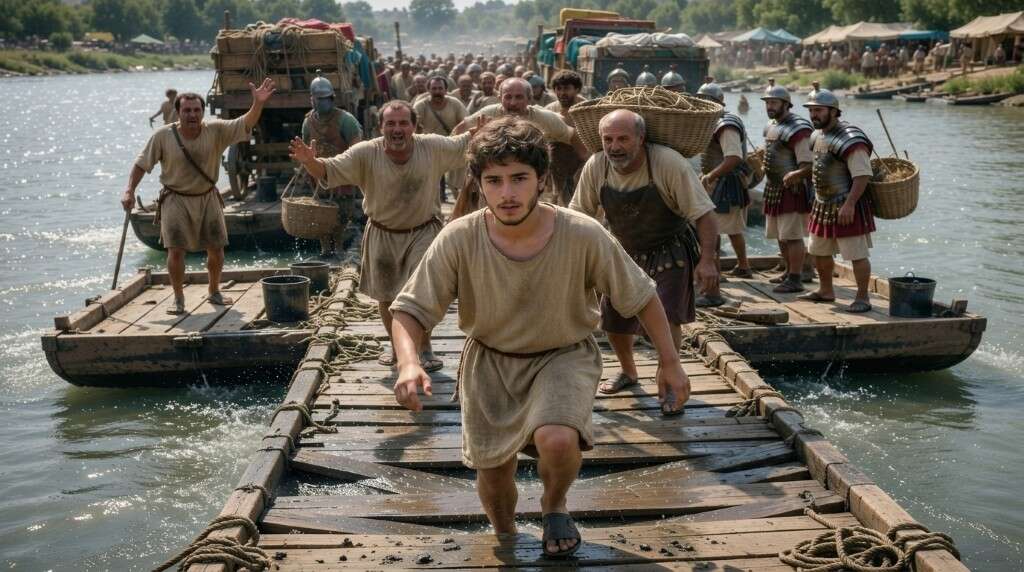
and the deep, rhythmic thud of water against the pontoons of the great bridge. The bridge
itself—Zeugma's pride—was a marvel: a long, floating chain of boats lashed
together, planked over to allow carts and animals to cross. It was one of the few reliable
Euphrates crossings in the entire region, and it made Zeugma wealthy.
Lucian and the caravan reached the Euphrates just after midday, when the sun turned the whole
river into a sheet of hammered silver. The crossing at Zeugma was louder and more alive than
anything he had imagined—ferrymen shouting orders, soldiers checking cargo,
porters weaving between wagons with baskets balanced on their backs. The air smelled of
wet rope, pitch, and river mud; a sharp contrast to the dry dust of the road behind them.
When the caravan was waved forward, he stepped onto the pontoon bridge with the others,
feeling the planks shift under his feet as the current pressed against the boats beneath.
It was like walking across something alive, like the spine of a giant serpent.
They had made it only a third of the way across when a soldier ahead raised his arm and barked
for everyone to halt. The line of travelers bunched up, murmuring. Lucian craned his neck
and saw what was happening: a barge loaded with amphorae (big storage pots) was waiting upstream,
its crew holding long poles to keep it steady against the current. Two pontoons near the center
of the bridge were being untied, the thick ropes hauled in by sweating soldiers. Slowly,
the boats making up the bridge drifted apart, opening a dark, swirling gap in the middle of
the river. The barge angled itself toward the opening, the ferrymen shouting to one another
as they fought the current. Lucian felt the bridge shift again—more sharply this time—and
grabbed the side rail, pretending he wasn't startled.
The barge slid through the gap with surprising grace, its hull cutting the water in a smooth arc.
As it passed alongside him, Lucian caught the smell of grain dust and river reeds, and heard the
crew laughing at some private joke. Then the soldiers began pulling the pontoons back together,
tightening the ropes until the planks aligned once more. The caravan lurched forward again, and
Lucian followed, his heartbeat settling as the far bank rose ahead in a jumble of warehouses and
tiled roofs. When he finally stepped off the bridge and onto solid ground, he felt a quiet thrill.
He had crossed not just a river, but a threshold. Behind him lay the world he knew; ahead lay a
world he was only about to discover.
Reaching Beroea
The road from Zeugma to Beroea felt different yet again from everything that had come before.
It was wider, drier, more open to the sky. Once Lucian left the river behind, the air lost
its cool dampness and returned to the familiar heat of inland Syria, carrying the smells of
sun-baked earth, goat herds, and the faint resin of scrub pines scattered along the hills.
The caravan stretched out into a long, uneven line, each traveler falling into their own rhythm.
Lucian walked near the middle, where the dust wasn't quite as thick, listening to the blend of
languages around him: Greek from merchants, Syriac from farmers, Latin from a pair of soldiers,
and something he didn't recognize at all from a man with a red-dyed headscarf and a camel-driver's
staff.
That man introduced himself as a Nabatean, a trader from the caravan routes farther south.
His name was Hanan, and he spoke a rough but serviceable Greek, the common bridge
language of the eastern empire. They talked as they walked—Hanan about the long desert
roads near Petra, Lucian about Samosata and his failed apprenticeship. Hanan had a deep,
musical accent, and Lucian found himself unconsciously imitating it as they spoke, matching
the cadence and vowel shapes until Hanan burst out laughing and declared that the boy must
have Nabatean blood somewhere.
Lucian grinned, then tried mimicking the Latin of the soldiers ahead of them, then the Syriac
of a muleteer, and finally a string of nonsense syllables that sounded like a language
but meant nothing at all. The caravan erupted in laughter. Someone shouted for him to do the
accent of a Parthian next, and though he had never met one, he invented a voice on the
spot—half growl, half chant—and the travelers loved it.
Word spread quickly. By the time they reached the mansio that evening—a low, square
building of mudbrick and stone with a courtyard for animals—Lucian had become the
unofficial entertainer of the caravan. The keeper of the place, a stout man with a balding head
and a sharp eye for opportunity, pulled him aside and asked if he'd be willing to
"give the guests a bit of amusement" after supper. In return, Lucian could sleep inside
the courtyard wall instead of out on the open ground, and he'd get a bowl of stew without charge.
Lucian agreed, and after the meal he stood near the fire and launched into a dramatized retelling
of his disastrous sculpting career: the marble that cracked, the uncle who wailed like a wounded ox,
the moment he realized the gods had given him a tongue for stories instead of hands for chisels.
The guests roared with laughter, even the tired muleteers who rarely smiled at anything.
Later, when the fire had burned low and the others drifted off to sleep, Lucian lay on his cloak
beneath the stars, the warm stone of the mansio wall at his back. He could still hear
faint chuckles from those who had enjoyed his performance, and he felt something new settle over
him—a sense that his voice, his humor, his ability to mimic and charm, might carry him farther
than any trade or craft ever could. The road to Antioch stretched on, but for the first time he felt
he was not merely traveling it. He was belonging to it, and it to him.
Antioch, At Last!
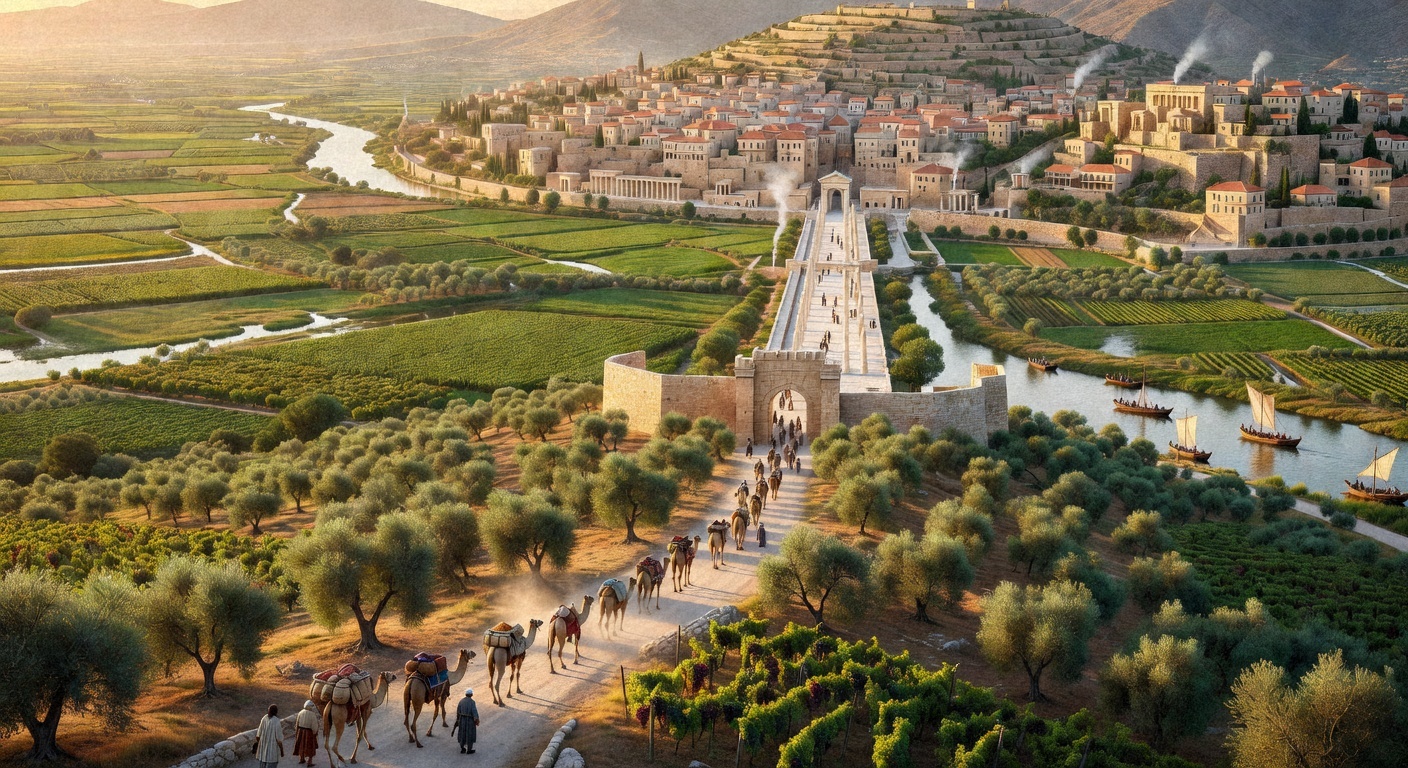
Lucian saw Antioch long before the caravan reached its gates. The road dipped and rose through orchards
and vineyards, and then—suddenly—the world opened. The Orontes valley spread out
below him, green and glittering, and beyond it the city rose in terraces of stone and tile, its
colonnaded main street catching the late afternoon sun like a white ribbon laid across the earth.
Smoke curled from bathhouses, barges moved along the river, and the noise—distant but
unmistakable—rolled up the hillside in a soft, continuous hum.
After two weeks of dust, inns, and open sky, Antioch looked impossibly vast, almost unreal, yet utterly welcome.
At the final rest stop before the gate, he said goodbye to Marcus, Claudia, and their family.
Marcus clasped his shoulder and told him to "keep talking, boy—your tongue
will take you farther than your feet." Claudia gave him a shy smile, wishing him luck in Ionia.
Lucian felt a surprising pang as they walked away toward the merchants' quarter; two weeks
on the road had made them feel like kin. But caravans were temporary worlds. People drifted in,
drifted out, and the road kept moving.
Inside the city, he found Demetrios, the young Greek he'd befriended earlier on the journey,
haggling with a porter over the price of carrying his crates. Demetrios waved him over
immediately. "You're bound for Ionia, aren't you? Then you'll want the port at Seleucia Pieria.
I'm heading there, too." Lucian felt relief wash over him. The idea of navigating Antioch
alone—this sprawling, multilingual metropolis—had been quietly terrifying.
Over the next day, Demetrios explained the realities of sea travel. Ships did not leave constantly;
they departed when cargo, weather, and opportunity aligned. Some weeks saw several departures,
others perhaps only one. Passage cost money, though not an impossible amount—especially if
one was willing to sleep on deck and eat whatever the crew ate. Lucian had enough, but only just.
Demetrios, more experienced, suggested they go together to the port and ask around.
"A ship bound for Ephesus or Smyrna will come," he said. "But you may wait a few days.
Maybe longer."
Lucian weighed his options. He could stay in Antioch for a week or two—find cheap lodging,
explore the city, maybe even earn a few coins telling stories in taverns. But the longer he
lingered, the more his money would drain away. And the road had given him momentum; he felt
it in his bones. Better to push on while his courage was high.
So he and Demetrios agreed to leave for Seleucia Pieria at dawn. Lucian spent the evening walking
Antioch's colonnaded street, watching the crowds, listening to the swirl of Greek, Syriac, Latin,
and Arabic around him. The city dazzled him, but it also reminded him why he had left home in
the first place. He wasn't meant to stay here. Not yet. He knew, someday, he'd be back.
But first, tomorrow: the sea.