|
By: Paul S. Cilwa |
Posted: 4/26/2026 |
|
Page Views: 25 |
| Hashtags: #HistoricalFiction #LucianOfSamosata #Samosata #Syria #EasternRomanEmpire |
| Life in the Eastern Roman Empire in the 2nd Century. |
| Estimated reading time: 11 minute(s) (2502 words) |
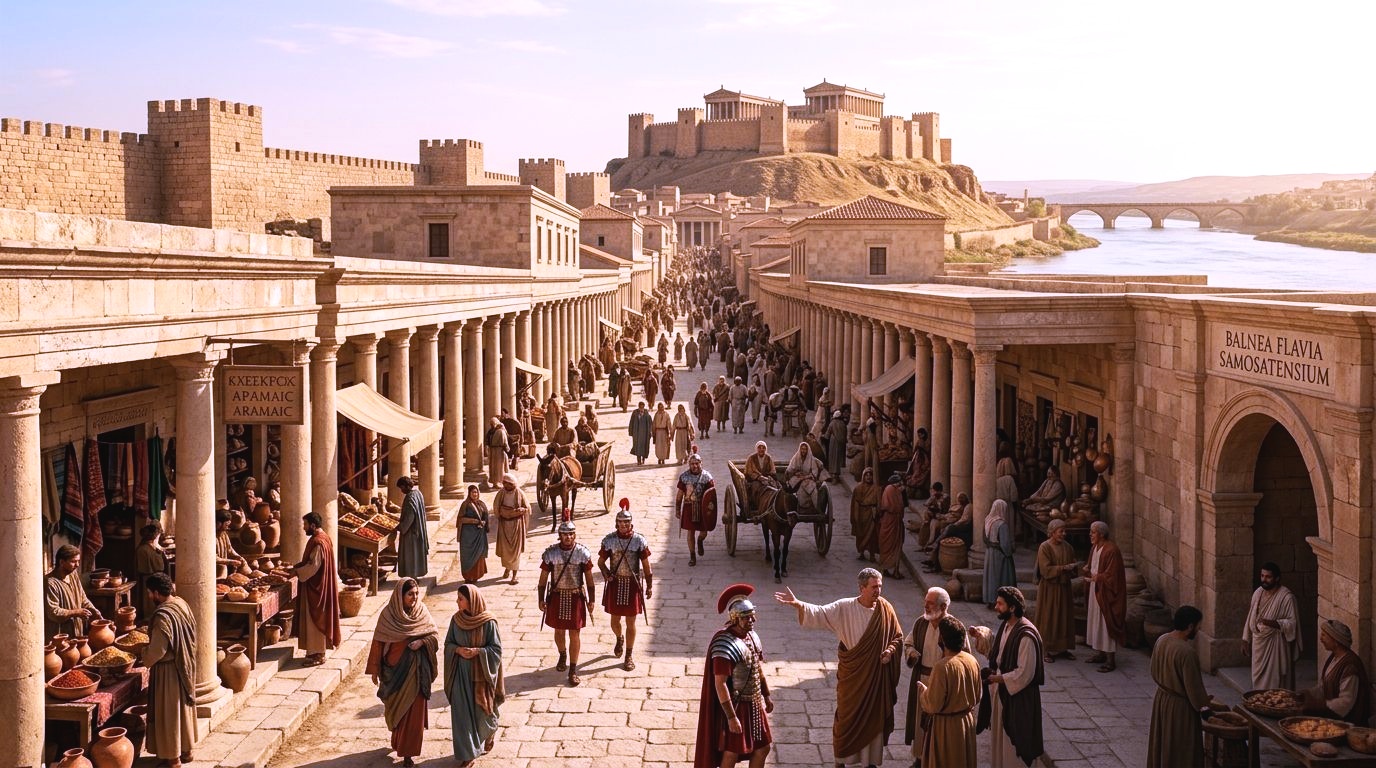
Lucian was born in Samosata, sometime around the Roman Year 878,
on the western bank of the Euphrates, where the river
bends green and slow before it turns south toward the great plain. His father
called the place a polis, because under Vespasian it had been folded
into the Roman province of Syria and
given the dignity of its old Hellenic name; his grandmother called it Shamishat,
in her mother's tongue, and crossed herself with the sign of the Sun
whenever she said it. They were Syrian by blood and Greek by speech, and Roman by
the coin in the purse—three skins one wore and shed without thinking,
depending on whether one was haggling for figs in the market, reading Homer to a
tutor, or saluting the standards when the Sixteenth Legion passed through on its
way to the Parthian frontier.
His family was lower middle class. His father did some kind of small clerking—copying
letters and tallies, the sort of literate labor that earns a household a roof of fired tile
rather than thatch and, in most such households, a slave to haul the water and mind the
younger children. His parents never bought one, probably because his grandmother didn't
approve. Whether that was for economy or something
else, Lucian never knew; his mother carried her own jars up from the fountain, while the
neighbors mostly did not.
They lived in the lower town, below the citadel,
in a quarter where the houses pressed shoulder-to-shoulder and an overheard quarrel three
doors down could be repeated word for word at supper. From the flat roof, on summer evenings,
one could see the river silvered by the moon, the pontoon bridge torchlit, the white stone
of the Commagenian kings' old palace on the height, and beyond all that, the dark hills where,
his grandmother said, lions still walked at night.
Water of the City
The first thing a stranger noticed in Samosata, if he came up from the desert routes,
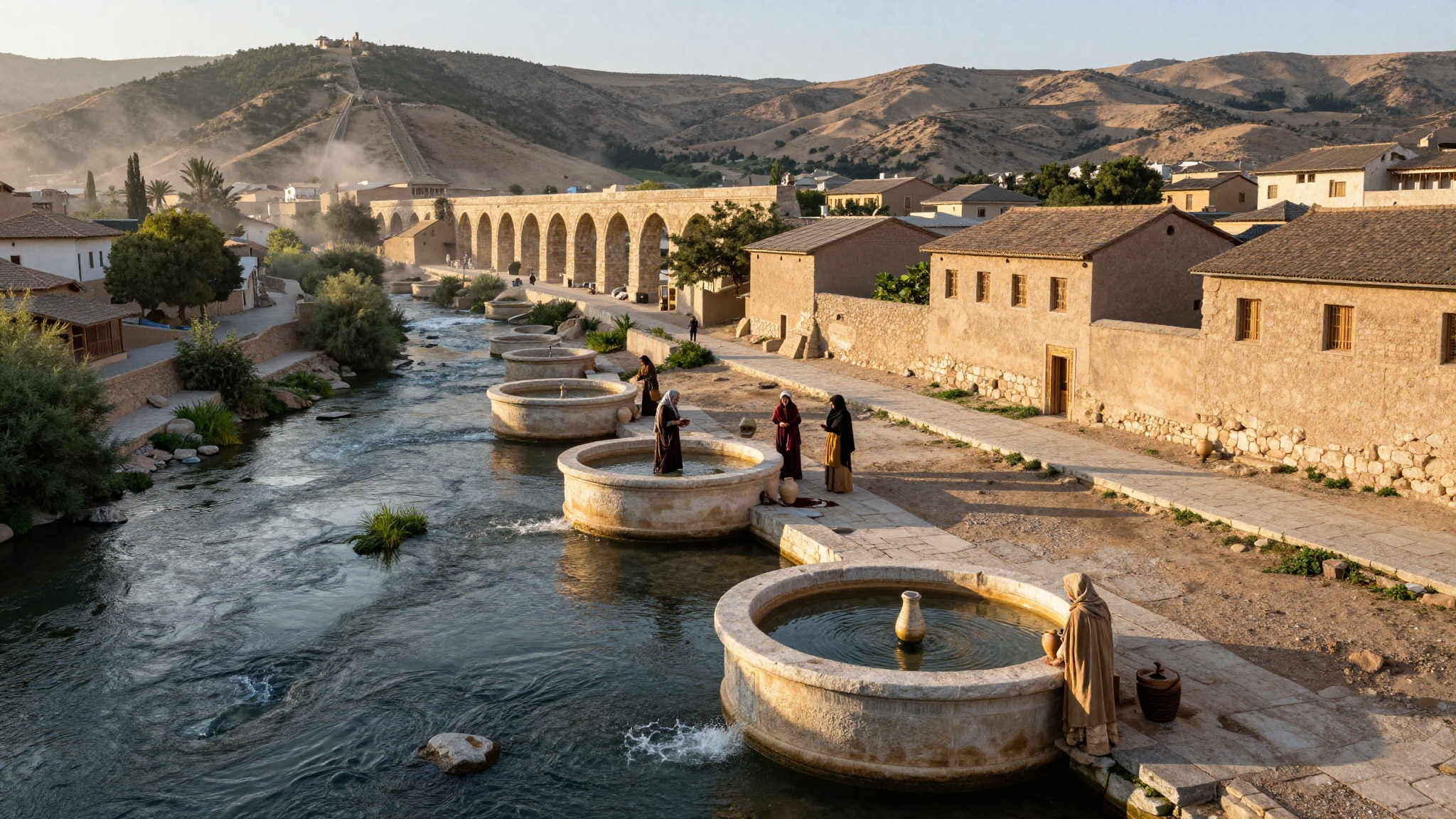
was the water. It ran everywhere. The Euphrates fed cisterns through clay pipes
glazed inside with bitumen; an aqueduct on stone arches stepped down from the springs in
the hills above the town and emptied into a covered tank near the shopping mall;
from the tank, lead and terracotta lines branched out under the streets, hissing softly
when a fountain was opened. Public fountains stood at every quarter—heavy basins of
local limestone, the lip rubbed concave by two centuries of jars. The women went there at
dawn and again at dusk, and the gossip of the fountains was the unofficial newspaper of
the town: who had a fever, who had quarreled, whose son had been seen on the wrong side
of the river with a girl from a tanner's family.
Latrines were less inviting. The public restrooms near the market stood in a long,
vaulted room, with stone benches running the
walls, each pierced by a row of keyhole-shaped holes; below them ran a constant
trickle of water, drawn off from the baths' overflow, that carried everything down
toward the river. There were perhaps twenty seats to a side, and no partitions.
Men sat shoulder to shoulder, eating chickpeas, debating the price of wool,
settling petty disputes; in front of each seat was a narrower channel, a small
running gutter for the sponge on a stick that one rinsed and
passed, by custom, to one's neighbor. As a small boy Lucian was afraid of the
place. The cold of the stone, the echo of voices, the sense that the floor was not
solid but a thin lid over the rushing dark—he would hold what he had to hold
until he could run home and use the chamber pot in the courtyard, where his
grandmother emptied the household's nightsoil onto the kitchen garden every
morning.
The baths were the consolation. There were three. The oldest had been built,
his father said, when Antiochus IV of Commagene still ruled, before the Romans came;
it was small, smoke-stained, and reserved by long habit for the poorer trades. The
newer bath, paid for by some legate whose name was carved over the door, had a
proper heated floor system—brick pillars beneath the
steam room, with hot air
from the furnace running under the soles of one's feet so that the marble paving
stung and one danced from one tile to the next. Lucian and his father went, on the
eighth day of every Roman week, after his work was finished. One stripped in the
dressing room, leaving one's tunic in a niche under the eye of an attendant slave;
one oiled in the warm room; one sweated in the steam room, where the air was thick
enough to chew; one was scraped with a bronze scraper until the dirt came off in
long gray curls; and at last one plunged into the cold pool and
came up gasping and laughing, with all the dust of Samosata floating away. For an
obol, a man with strong thumbs would knead one's shoulders. For two, he would pull
the small bones of the back until they cracked like green sticks. Lucian thought,
even then, that the whole world must be like this—that every village from
the Pillars of Heracles to the Indus had baths and aqueducts and sponge-sticks,
and that to be a proper man was to be a man who bathed.
School of Letters
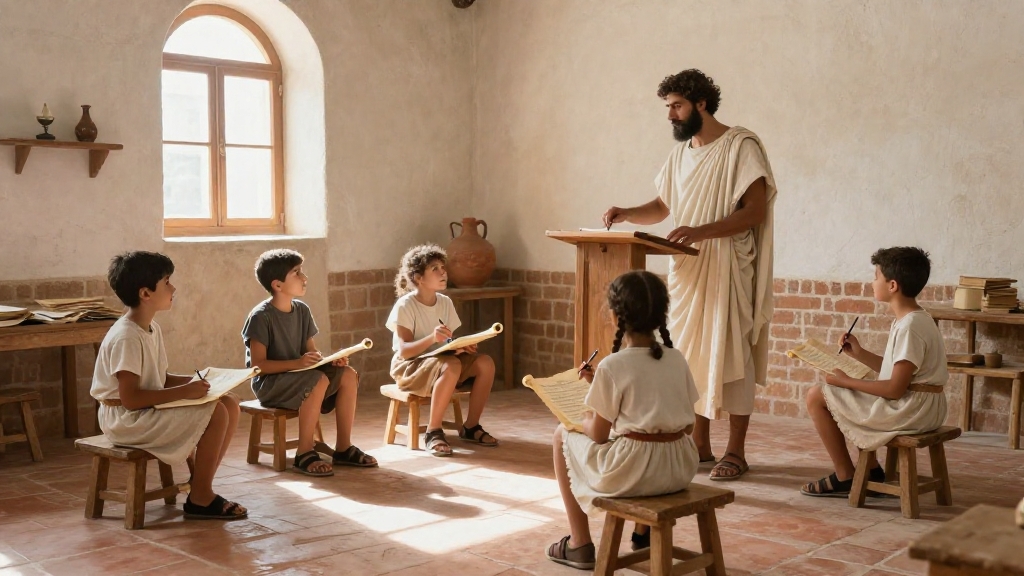
Lucian went to his elementary school at the age of six. The schoolroom was a rented
colonnade behind a wineshop, and the
master was a thin Bithynian named Sostratos who beat his pupils with a flat reed
when they miswrote a letter and with the round end of a stick when they miswrote a
word. The boys sat on the floor on rush mats. They had wax tablets in wooden
frames, and styluses of bone—pointed at one end for writing, flat at the
other for smoothing the wax to begin again. They learned the alphabet first as a
song, then as a forward-and-backward chant—alpha-omega, beta-psi,
gamma-chi—and then syllables, and then the names of the gods and heroes.
Their first connected reading was Homer. By the age of eight, Lucian
knew the Iliad by heart, and the Catalogue of Ships shortly after, and
could be made to recite either at a dinner party on cue.
When he was ten, he went up to the next level of schooling, the grammar school.
This teacher was a freedman from Antioch, a man who had once heard Polemon
speak in Smyrna and would remind his pupils so once a week. With him they read more
Homer, then Hesiod, then the tragedies, then some of the orators. They learned
to parse, to scan, to identify the clever figures of speech, such as
transferred epithets, syntactic blends, and coordination ellipses. They were
taught that the Greek of the great Athenians was the only Greek that mattered, and
that their own speech, soft with Aramaic vowels, was a thing to be scrubbed off as
one scrubbed the dust off in the bath. Lucian learned to be embarrassed by his
mother's accent. It was one of the small cruelties of an education in a provincial
town that a child learned to wince at the sound of their own household.
Sophist's Choice
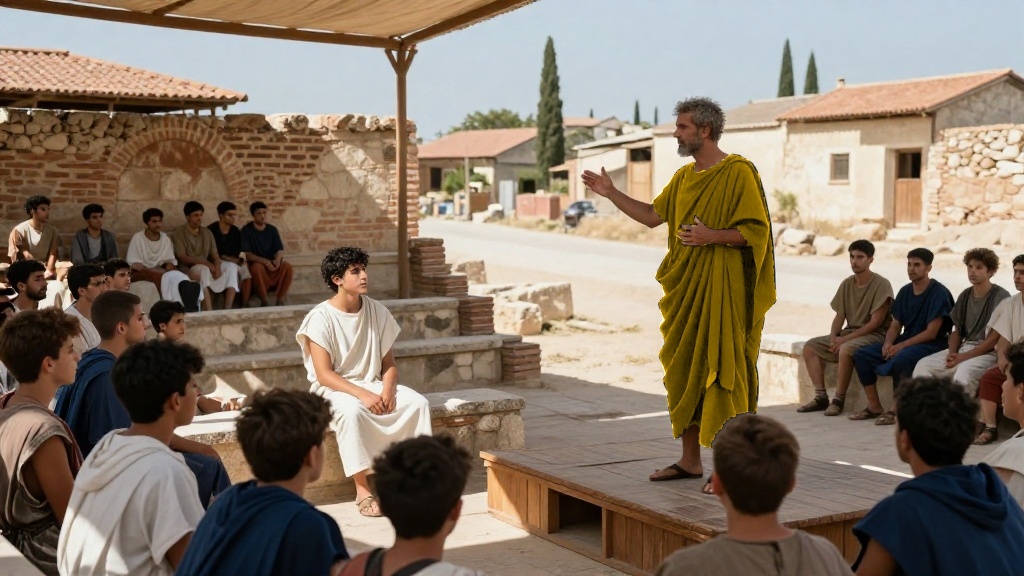
When Lucian was about fourteen a Sophist came to Samosata. The boy did not remember his
name afterward—there were so many in those years, and the Second Sophistic period
provided a thick rain of them—but he remembered that the man came up from Antioch
with a retinue of three slaves and a pupil who carried his books, and that the council
voted him the use of the small hall for two evenings, and that the whole town went
(Netflix not having been invented yet).
He was perhaps forty, with a salt-and-pepper clipped beard, a himation of fine Milesian wool
dyed a particular saffron that Lucian had never seen on a person of his acquaintance,
and a voice—gods of his fathers, what a voice! The sophist proposed, on the first
night, to declaim extemporaneously on a subject given to him by the audience. A
councilman called out: The tyrant who, having put out the eyes of his enemy,
is now blind himself and begs to be killed. The sophist closed his eyes for the space
of perhaps thirty heartbeats. Then he opened them and began.
Lucian could not reproduce what he heard. He was fourteen, and he had read perhaps two of
Demosthenes' speeches in school, and he understood maybe one phrase in three. But he understood
the structure of it. He understood that the sophist was building, sentence by sentence, an
architecture in the air—a portico of antitheses, a colonnade of parallel
clauses, a pediment of perfectly placed quotations from the Iliad and from a
tragedy he had not yet read. He understood that the audience was leaning forward
as one body, and that when the sophist reached a particularly fine turn
—when the blind tyrant, in his mouth, cried out I see now what I would not
see when I had eyes—there was a sound from the benches like a sigh of wind
through wheat, and grown men whom Lucian knew to be hard, men who beat their
slaves and cheated at dice, were openly weeping.
The boy walked home behind his father in silence, and when they passed under the lamp
at the corner of their street he looked at his own shadow on the wall and tried, in a
whisper, to say one of the sophist's sentences. It came out flat and Syrian and ridiculous.
But something had been planted that night that would not stop growing.
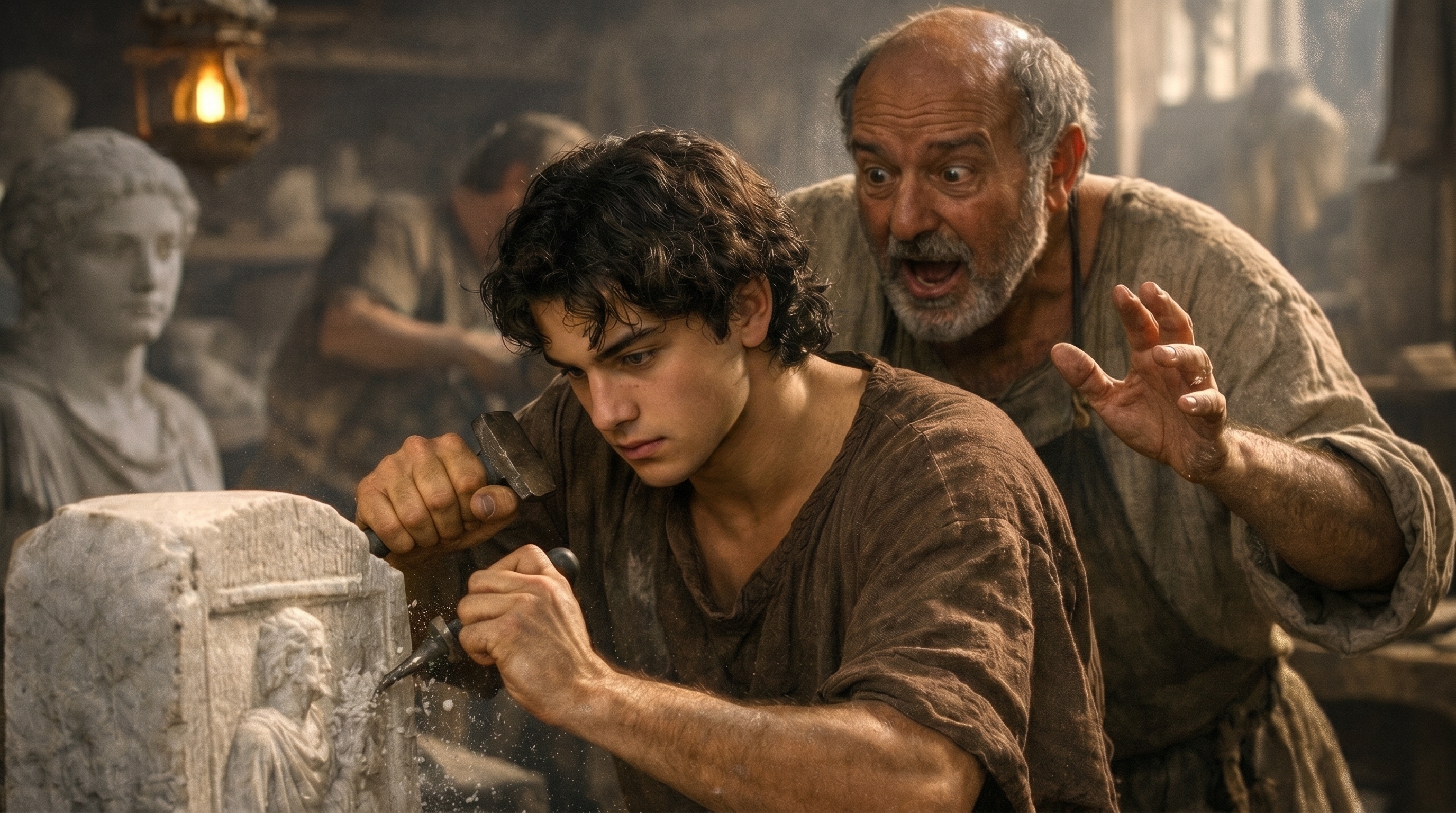
Chip Off the Wrong Block
When he turned 17, Lucian's father sat him down to talk about his future.
"It's time for you to learn a trade," he said. "It's your parents' job to pay for your
elementary and grammar school, even after you legally become an adult at 14.
But now you get to take on actual adulthood, which means finding a
trade, making a living, establishing yourself, and getting married."
"I want to become a rhetor," Lucian responded. His father shook his head with
regret.
"I know you do, and the way you like to talk, you're bound to be good at it.
But, son…we just can't afford the fees of a rhetor, which would be
the next stage of a literary education. They charge in gold, you know!"
Lucian's shoulder's drooped. "Now, I'm a clerk; I've taught you enough of that
through the years that I think you have the skills for it. But I also know that
sitting inside all day writing and copying and cyphering would kill you."
His father took a deep breath. "Now, as you know, your mother's brother
has a sculpture shop. And he's offered to take you on as an apprentice. I hope
you appreciate what an opportunity this is."
Lucian's uncle was a carver of the stone marker pillars topped with bearded heads that stood at every
crossroads and at every gate. His shop was always busy; not only were the pillars
popular locally, but they were in demand across the empire.
Lucian would be fed, clothed, and taught a trade that, as his father pointed out,
never wanted for work. The dead will always need gravestones; the living always
needed statuary and votive reliefs; the magistrates always needed busts of the
emperor for the basilica.
Lucian went, but without enthusiasm.
To be a sculptor in the second century CE was to belong to one of the manual trades. The Greeks (and the
Syrians like Lucian's family who were wannabe Greeks) had inherited from Athens an old contempt for
working with one's hands, even for crafts that produced representations of the gods. As folks said,
"Pheidias made the Athena of the Parthenon, and Pheidias died in prison."
The work was honored; the worker was not.
A sculptor was a man with cracked hands and a permanent dust in his hair and
lungs, who stood all day among heaps of marble and limestone flour, who breathed it in, and then blew it
from his nose at evening in long gray ropes. He worked from a clay model,
working with a wooden caliper from the model to the
block; he roughed out with an iron punch, drove the stone away in coarse chunks;
then with the toothed chisel he combed the surface; then with the
flat chisel; then with the running drill, whose bow he pulled back and forth to
bore the deep shadows of curls and nostrils; then with rasps; then with pumice and
emery and water, hour upon hour, until the limestone or marble began to seem less like stone
and more like skin held very still.
His uncle's shop stood by the south gate. It smelled of stone and of the linseed oil that was
rubbed into finished pieces. There was always a half-carved emperor leaning in a
corner—Antoninus Pius, in those years, with his broad calm brow—and always
a row of unfinished herms, distinctive Greek boundary markers
consisting of a rectangular stone pillar topped with a carved head, usually of the god Hermes,
and bearing stylized male genitals on the front. Herms stood at crossroads, doorways, gymnasia,
marketplaces, and property lines, serving as protective talismans, good-luck markers, and public signposts.
In Lucian's time, they were a familiar part of the urban landscape: simple, blocky, slightly humorous,
and instantly recognizable as guardians of thresholds and travelers.
On his first morning, his uncle gave Lucian a small chisel and a flat slab
of practice limestone, and told him to smooth one face of it.
Lucian struck too hard. The slab cracked clean across. His uncle struck him harder
than he had struck the slab, with the back of his hand, and the boy ran out of the
shop into the street with his nose bleeding and the dust still in his hair and did
not stop running until he was home.
He was seventeen. He did not go back to the shop.