|
By: Paul S Cilwa |
Posted: 5/11/2006 |
|
Page Views: 5,105 |
| Hashtags: #Politics #CivilRights #Wiretapping |
| Information like this is a weapon, and weapons are made to be fired. |
| Estimated reading time: 9 minute(s) (1923 words) |
It seems like only yesterday that my friend John showed me, with pride, his
brand-new AT&T 6300 Plus computer with a 10 megabyte drive. The manual that came
with it said,
You may think that you'll never be able to fill up a
hard drive that holds 10 mb, and you may be right! However, it's
a good idea to delete files you no longer need, just to be safe.
Here's how…
…followed by a description of the DOS DEL (delete) command.
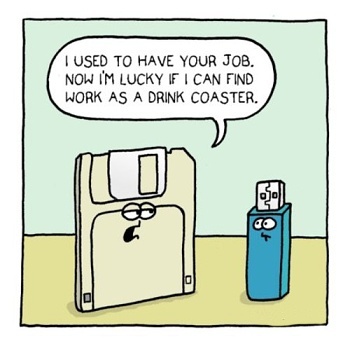
Earlier computers had used 5.25" floppy drives, which held about 360
kilobytes of data. John's hard disk held forty times that; so AT&T's pride was
understandable. After all, these were the days of command-based, text-based
applications. There were no sounds (other than the occasional "beep!"), no
pictures, no icons. All you could store was words, with one character taking up
one byte in the hard disk. Ten million letters and spaces is a lot of letters
and spaces. Jane Austen's novel Pride and Prejudice, to give an example,
is made up of roughly 650,000 letters and spaces. John's hard disk could have
stored more than 15 complete novels the size of that one.
But, of course, in less than a year John and I had managed to fill his hard
disk up, anyway, with the names and addresses he used in his bulk mail business.
We had to purchase another hard disk, and another. Older disk drives failed, but
two 10 mb drives could be replaced by one 40 mb that provided room for future
growth…which too soon was not enough, either.
It wasn't just words anymore. Graphics were introduced. Microsoft
Windows not only included built-in icons, it allowed users to draw their own
pictures. The first graphics were crude and didn't take up too much space, as
they only allowed four different colors. But then new versions of Windows
supported 16 colors, then 256, and finally the millions of distinct shades that
make computer storage of photographs possible.
The human eye can perceive about 16,000,000 different shades. To represent
24,000,000 distinct colors, each pixel must be four bytes wide. Our
wallpaper photo takes up 1,228,800 bytes…and that's for one picture.
That's right: A single photo of the Grand Canyon or your kid blowing out the candles on his
birthday cake or of Janet Jackson's "wardrobe malfunction" takes up about twice
as much space as an e-copy of Pride and Prejudice.
Obviously, people's photo collections were expanding faster than the
capacities of their hard disks. Compression techniques evolved that made it
possible to store a wallpaper-size photo as a "jpg" (pronounced jay-peg) that
might be somewhere around 100,000 bytes or even less, depending on how complex
the photo was. But the photo problem was no sooner solved than computer audio
was introduced. And then there came video, which combines audio with a series of
millions of photos, for which storage is in the range of billions
of bytes.
Now, even though text by itself doesn't take up much space, relatively
speaking, when you get into the concept of a "database" you can require a
surprising amount. For example, John's name-and-address lists typically looked
like this:
- Name, 32 characters
- Address 1, 32 characters
- Address 2, 32 characters
- City, 20 characters
- State, 2 characters
- ZIP, 9 characters
That's 127 bytes to store one person's
name and address…but John's mailing lists often held as many as
20,000 addresses or more. Still, that "only" required 2,540,000
bytes, or about four times the size of Pride and Prejudice.
The IRS is much more impressive when it comes to databases. Each year, it
adds 1.7 terabytes
to its massive collection of information on you and me and every job we've ever
held, not to mention our list of deductions. (A terabyte is approximately one
trillion bytes.) Considering that they must be storing at least seven
years' back data, that's a heck of a lot of storage.
Now, as Dan Aykroyd said to Albert Brooks in The Twilight Zone, do you
want to see something really scary? Then keep reading.
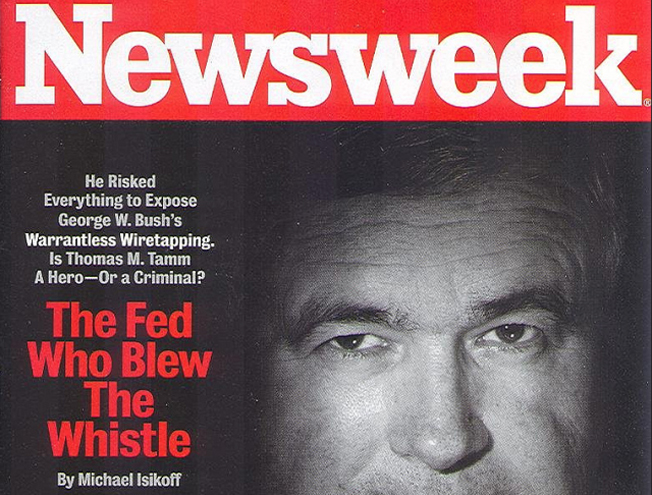
Yesterday's USA Today included an interesting story about the NSA
wiretaps. These have been in the news recently, with President Bush assuring us
that the NSA was only monitoring calls of US citizens who telephone
members of al Qaeda in foreign countries—never domestic calls. Well,
according to the story,
The National Security Agency has been secretly collecting the
phone call records of tens of millions of Americans, using data provided by
AT&T, Verizon and BellSouth, people with direct knowledge of the arrangement
told USA TODAY.
Later on, the story reports,
Appearing on live TV today, President Bush, who in just a couple
of paragraphs managed to work in the phrase "After September 11" and
to reiterate that the NSA was "only listening in to international
calls with known Al Qaeda agents" and "the government does not
listen to domestic phone calls without court approval," ignored the
allegation that all calls were being noted.
The USA Today article described this spying as
involving the numbers of the telephone making the call, and the telephone
receiving the call. Common sense says they'd also need to store the date and
time the call began, and probably its duration. That's all text information that
should take up far less than the name-and-address information in my friend's
bulk mailing lists. I could do it in 16 bytes. So let's make some assumptions:
| Size of record: |
16 |
| Number of phones: |
300,000,000 |
| Calls per phone per day: |
20 |
| Size of one day's data: |
4,800,000,000 |
| Size of one year's data: |
1,752,000,000,000 |
That's a lot of data. But it matches the IRS's 1.7
terabytes stored each year. And the IRS's data storage needs are
minor compared to some other databases, like Google's with their
photos of every square mile of Earth, or Wal-Mart which tracks the
purchase of every single item sold by them anywhere. So how can this
be the "largest database ever assembled in the world"?
By adding to the phone number and time information…the call itself, as an
audio file.
The cat's out of the bag. The USA Today's informant may have
intended to reveal just part of the story—the idea that the government is
engaged in a relatively benign cataloging of who calls who—but that's not what's
happening. They are keeping recordings of every word you speak on the phone.
Now, before you blush at the thought that your wife will find out about that
phone sex line you called last month, or your boss will fire you because of what
you told your brother about him after a particularly trying day at the office,
relax. Even if it's possible to store all those calls, even the most
powerful computer in the world could not, in the foreseeable future,
interpret all those calls. If you've ever tried voice command software on
your computer, you know such technology is a long way from perfection. And if a
computer cannot understand the content of all those calls, the recording is
safely inaccessible. Right?
And yet, we've been told the purpose of all this is to root out terrorists.
So if a computer can't analyze all these six million conversations a day—every
day!—what's the point? How can we ever catch someone planning the next hijacking
with this database?
As a tool for catching terrorists, this database is useful only if we start
out with the phone number of the suspected terrorist. It's then a simple matter
to look up calls from that phone, and humans can listen to the
recordings. However, if we knew the phone number, a standard wiretap would do
the trick. Of course, a wiretap normally requires a court order, which President
Bush has refused to request. Why?
What if the conversations to be overheard are not those of
terrorists—but are, instead, of Congressmen and Senators and reporters and
newspaper editors and TV anchormen?
What if, armed with those phone numbers, someone with access to this
information could blackmail congressmen into, oh, say, voting for the
Patriot Act without reading it, or permitting the invasion of Iraq or any of the
other hundred-and-one bits of insanity that we've seen in Congress over the past
five years? Broadcasters could be blackmailed into refusing to report the voting
irregularities of the last elections. Occasional slips of information—like this
story itself—would simply be the result of someone at one newspaper who didn't
use the phone much.
And this scheme doesn't require an entire agency—just some trusted individual
who can run the computer program that locates the target conversations and
listens to them over headphones plugged into the computer at his desk.
And this information, stored for years, could be used to blackmail anyone
who comes into public prominence, even decades later! Given enough time,
what future senator or head of CBS might never have talked with his best friend
about the underage girl he screwed, or the one-time sexual experimentation with
the football jock, or the time he tried pot or heroin or cocaine? Even if the
man himself is as pure as the driven snow, could he guarantee he'd never
had a heart-to-heart discussion over the phone with a relative or friend that
would prove embarrassing to the other person if it became public?
Every single person in government or the media would be a potential tool of
the person wielding this weapon.
And, okay—suppose you like George W. Bush and don't believe he would
ever misuse information of this sort. Maybe you're right. I hope you are.
But can you guarantee the next president will be as noble? Or the one
after that? Information like this is a weapon, and weapons are made to be fired.
It's only a matter of time before some president gives into temptation
and uses this, the most comprehensive blackmail database of all time.
And that's not all—go back to that quote from USA Today. The
specification was every call ever made. There used to be rumors that all
our phone calls were being tape recorded. If the guy from the NSA wasn't just
bragging, his statement implies this was true. Millions of reels of old tape
would be pretty useless, but if they can be read into computer form, then the
ability to blackmail includes people who are currently prominent, but may have
made indiscreet phone calls decades ago.
Just yesterday, George W. Bush remarked to the press that his brother, Jeb,
would make a "great President". With enough influence over the manufacturers of
voting machines, and heads of county boards of election, and newscasters, Jeb
could be President in 2008 no matter how low his brother's approval polls
go or how few people actually vote for him.
I'm sorry. I'm not one to resist progress. But any database that can change
America from a democracy into a dictatorship—even if that's
not the intention—is too big.