|
By: Paul S Cilwa |
Posted: 3/19/2010 |
|
Page Views: 1,091 |
| Hashtags: #CastillodeSanMarcus #StAugustine #Florida #Photography |
| Let's take a time trip back to 1975 and open the photo album to look at my kids cavorting in St. Augustine's 'Old Fort'. |
| Estimated reading time: 3 minute(s) (618 words) |
The first of these photo ops was a trip to St. Augustine's
historic "old fort", more formally known as the Castillo de San
Marcus, or Fort of St. Mark.
Please note that the negatives from which these scans were made
are over 30 years old. I've digitally restored them as best I could,
but there still a few color-shifting artifacts which leaves them
less than perfect.
The Old Fort, which is now a National Monument, was in 1975 just
a local attraction and, like most attractions in St. Augustine at
the time, was free to city residents. It was, and is, surrounded by
generous, park-like grounds; and the first pictures I took were on
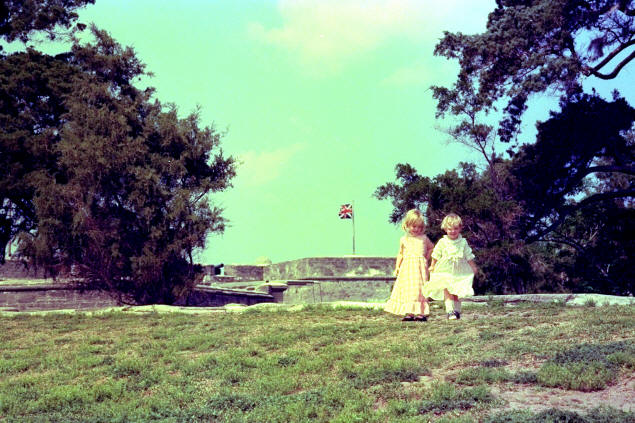
those grounds, with the fort in the background. In the first photo
below, you can see the British flag. St. Augustine has flown under
six different flags, and all are flown at the fort. (The native
Americans who lived here first, the Timucuans, didn't use flags and
so are not represented.)
St. Augustine was founded by Spaniard Don Pedro Menendez in 1565.
He wasn't a very statesmanlike sort, and managed to alienate the
friendly natives almost right away. In addition, the seaside town
was subject to pirate attacks. The Queen Regent of Spain, Mariana,
decreed that a stone fort be built to replace the series of nine
wooden forts that had preceded it; construction began in 1672 and
was completed in 1695.
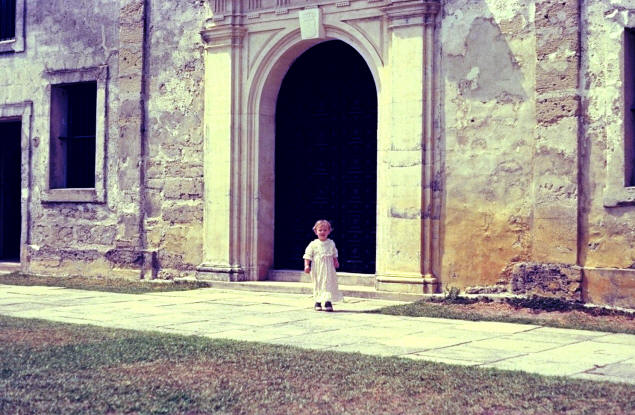
Once across the drawbridge and inside the structure, one finds a
huge, enclosed area surrounded by stone rooms. The entire population
of St. Augustine could, and did, take shelter here during more than
one attack.
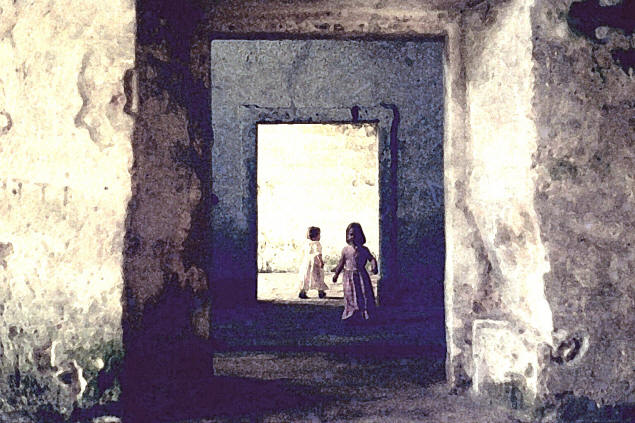
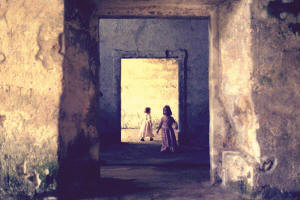 In
1975, the interior rooms were open to the public. There had
originally been wooden doors which had not survived the centuries as
well as the stone and had not been replaced. The resulting light
pouring into the stone rooms and reflecting into various passages
created a very artistic ambience, which in the following photo I
could not resist enhancing with a painterly digital filter. (The
original version, in reduced size, is at right.)
In
1975, the interior rooms were open to the public. There had
originally been wooden doors which had not survived the centuries as
well as the stone and had not been replaced. The resulting light
pouring into the stone rooms and reflecting into various passages
created a very artistic ambience, which in the following photo I
could not resist enhancing with a painterly digital filter. (The
original version, in reduced size, is at right.)
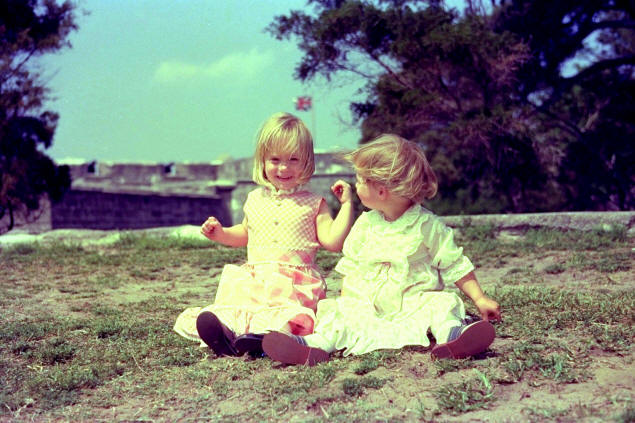
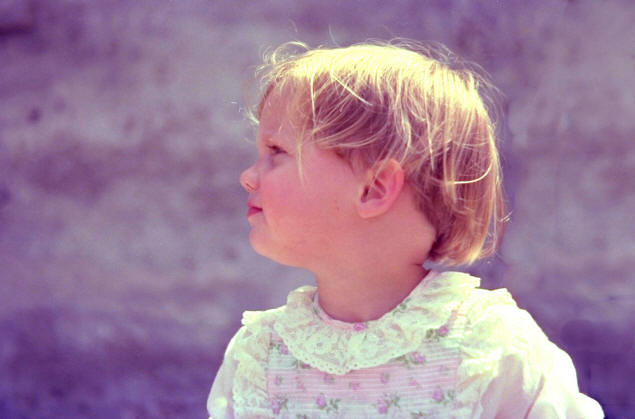
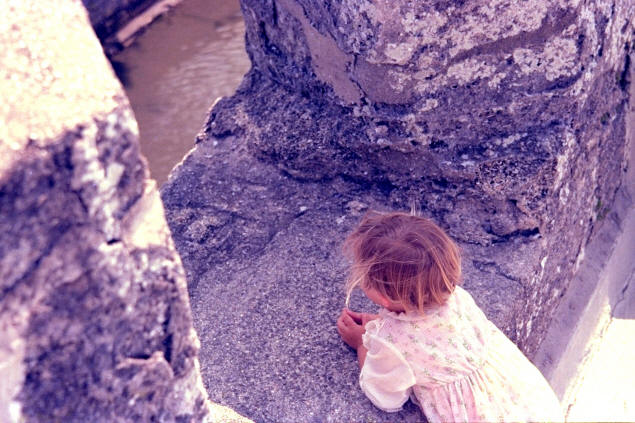
One of the most charming things about toddlers is that they're
always adorable, from every angle.

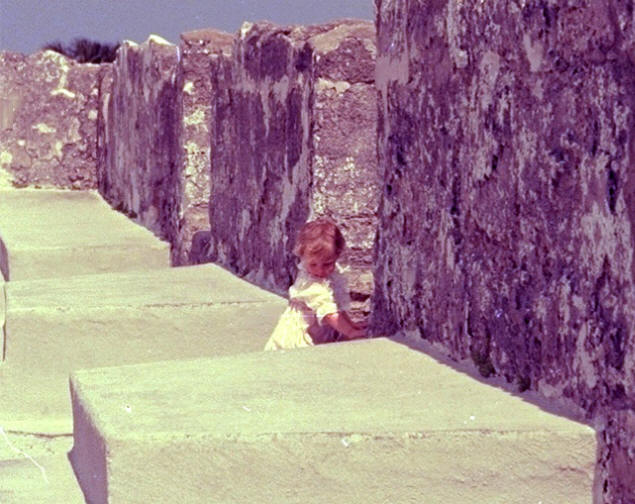
The Castillo is a masonry star fort made of a stone called
coquina, literally "little shells", made of ancient shells that have
bonded together to form a type of stone similar to limestone. This
stone is unique to the area. Workers were brought in from Havana,
Cuba, which had been settled before St. Augustine and was a thriving
colony in its own right, to construct the fort. The coquina was
quarried from Anastasia Island across the bay from the Castillo, and
ferried across to the construction site.
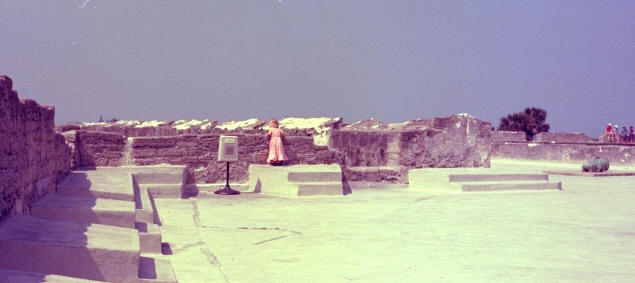
Here and there, electronic playback devices would, at the push of
a button, recite a portion of the fort's history. The kids, of
course, loved to press the button.
The fort is surrounded by a good, old-fashioned moat. It is
likely that, in the old days, it was stocked with alligators.
Before leaving, we did sneak in one photo each of Mom and Dad as
well.