|
By: Paul S Cilwa |
Posted: 2/22/2026 |
|
Page Views: 39 |
| Hashtags: #Science #History #Technology #HomoHabilis #StoneAge |
| It's making tools, not just using them, that makes us human. |
| Estimated reading time: 11 minute(s) (2452 words) |
Their days were simple but busy. The women gathered roots and tubers, dug with sticks, and carried
infants on their hips. The men ranged farther, watching vultures for signs of a carcass. Fire
wasn't part of their world yet; meat was eaten raw, torn with hands and teeth, softened by
pounding. Evenings were quiet—huddled bodies, grooming, the soft grunts of reassurance.
Wilma was one of the steady ones in the group, always good at finding food. That afternoon she had dragged back a
strip of meat scavenged from a zebra carcass. She set it on a flat boulder and lifted her favorite
pounding stone. She swung, aiming to tenderize the tough fibers, but the stone slipped in her grip.
It struck the edge of the boulder instead, cracking with a sharp snap. A thin flake sheared off and
skittered across the rock.
She reached for the broken piece, curious. Its edge was thin and
bright. When she brushed it with her thumb, it sliced her skin. She hissed, shook her hand, then
looked again. She pressed the edge to the meat and drew it across. The flesh parted cleanly. She
tried again. It worked every time.
A new idea stirred—rare, electric. She picked up another
round stone and struck it against the boulder on purpose. It broke again, leaving another sharp
edge, which could also cut the meat. She held both pieces, turning them in her hands, feeling
the promise in them.
Her heart pounded in her chest. Having a new idea was, itself, a new idea!
Every day, the world had held exactly the same things in it as the day before. But now,
something new had come into existence. The usefulness of it was instantly obvious.
But she was blown away by the idea that, not only had something new come into
the world—she was the one who had birthed it.
"Fred!" she called in the way Homo Habilines understood. Fred wandered
over, drawn by her excitement. She showed him the cut meat, the broken stones, the way the edge
sliced. He understood immediately. He took one of the flakes and ran to the water hole
to show his buddies. He demonstrated the cutting motion, and soon they were all hammering
stones against the boulder, laughing in their rough way as sharp flakes flew.

By nightfall, everyone had a stone knife. And by morning, and all the guys agreed that
Fred had invented something remarkable. Wilma didn't care, as she was busy showing the women
the rock trick. And besides, everyone knew how full of themselves men can be.
The next morning the group gathered near the riverbank as they always did. The adults checked each
other for ticks, brushed dirt from shoulders, and exchanged short bursts of sound paired with hand
movements—simple conversations about where food had been found yesterday, who was ranging out
today, who was staying with the young ones. Their communication wasn't symbolic, but it was rich:
posture, gaze, and rhythm carried as much meaning as the sounds themselves. Every social species
has its own grammar, and theirs worked well enough to keep the group fed and safe.
Fred arrived
with the new stone tool in his hand. He held it out so the others could see the bright edge. A few
of the males leaned closer, sniffing, touching the flake with cautious fingers. Fred made a slicing
gesture through the air, then pointed toward the meat Wilma had cut the night before. The others
understood the demonstration, not because they had words for it, but because the motions were clear
and the result was obvious. They crowded around the boulder, each choosing a stone and striking it
against the edge. The sharp crack of breaking rock echoed across the water.
Soon flakes littered
the ground. Some were useless, but others had edges as clean as the one Wilma had found. The group
tested them on roots, on strips of hide, on the tough tendons of an old carcass. Their sounds
shifted—short, excited bursts, the habilis version of enthusiastic chatter. A few of the
females joined in. Wilma had already shown the gals how to strike a rock, but some of them
pretended to have not mastered the technique, encouraging their favorite guys to "show" them
how to "do it properly."
Wilma stayed a little apart, watching the scene unfold. She wasn't annoyed
that Fred had taken the lead; this was how their world worked. Ideas didn't belong to individuals.
What mattered was whether something helped the group survive. Still, she kept her original flake
tucked into a small hollow in the boulder, where she could find it later. It felt like hers in a
way she couldn't name.
By midday, the group had settled into a new rhythm. Some continued
practicing the stone-breaking technique. Others used the new flakes to strip bark or slice meat
more efficiently than ever before. The young ones watched with wide eyes, absorbing the motions the
way all young primates do—by imitation long before understanding.
As the sun dropped toward
the horizon, the group gathered again in the shade. Their communication was calm now, the earlier
excitement fading into the familiar patterns of grooming and rest. But something had shifted. A new
behavior had entered their world, and it would stay. They didn't know it, but they had crossed a
threshold. The first true stone tools lay scattered around them, sharp and purposeful.
And somewhere in the quiet, Wilma touched the edge of her flake again, feeling the smooth curve where
the stone had broken. She didn't have a word for the idea that had sparked in her mind the day
before, but she remembered the moment clearly. In her own way, she carried the knowledge that she
had started something new.
The dry season tightened its grip on the land, and food grew scarce. Fred and Wilma's group stayed
close to the river, guarding the best foraging spots and the shade trees that kept the heat
bearable. One morning, as the sun climbed, a line of figures appeared on the far side of the
clearing. Another habilis band—larger, hungrier, and unfamiliar. Their sounds carried across
the grass: sharp, insistent bursts paired with stiff postures. To them, it was a clear message.
They wanted the territory.
Fred's group gathered quickly. Their own calls rose in
answer—warning tones, arms lifted, bodies angled forward. The newcomers kept advancing.
Several picked up rounded stones, the kind used for throwing. This was a common threat display
among groups that didn't share space. A thrown stone could break a bone or drive a rival away. The
intruders clearly expected the usual outcome: the smaller group would scatter.
But this time,
things were different. Fred stepped forward with one of the new flakes in his hand. He held it low,
edge outward, making a slow, deliberate sweep through the air. The others in his group mirrored
him, each raising a sharp-edged stone. The gesture was unmistakable. The intruders paused,
confused. They had seen stones used as hammers, as missiles, as pounding tools—but never
held up as something that needed no help to be deadly.
The rival group tried to rush Fred's group. But cutting stones could be thrown, too; and when
these hit someone, they didn't just make a bruise—they drew blood.
A few stepped closer, stones raised to throw. Fred's
group responded with a coordinated rush, not striking bodies but sweeping the air in front of them
with the bright edges. The newcomers flinched back. They understood the message instantly. These
stones were different. These stones were dangerous in a new way. The intruders backed away, their
sounds shifting from challenge to frustration, then to resignation. Within minutes, they retreated
across the clearing and disappeared into the brush.
When the tension eased, Fred's group gathered
in a loose circle. Their communication was low and steady—relief, pride, reassurance. They
had defended their home without injury. They had done it with something no other group had. Wilma
watched the flakes glint in the sun and felt a quiet certainty settle in her chest. The world had
changed, and not just for them. Their children would learn this new trick and thrive. Any group that
didn't would be pushed aside, driven off, or slowly starved.
The truth was simple, even if they
had no words for it. Move forward, or go extinct. And on that day, with sharp stones scattered at
their feet, Fred and Wilma's band had taken the first step into a new age.

The above is my suggestion as to how we entered the Stone Age. It may not have happened precisely
like this, and it's highly unlikely that the primary contributors were named "Fred" or "Wilma".
But the basic premise, that there is a boundary between being a tool-user and a tool-maker
is profound. And it was that day (which was probably independently repeated for a million years)
that took us from being animals (not that there's anything wrong with that!) to being human.
Yes, even when it was a hominid, rather than a true member of our own species.
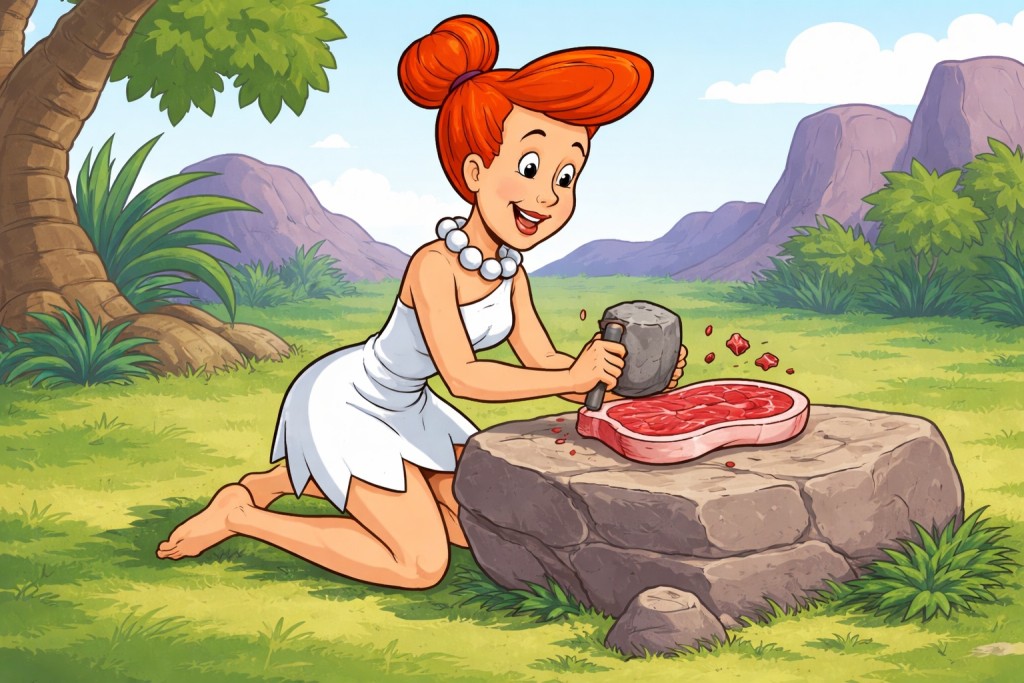
So, to bring in a little more reality here, here's an actual photo of the original Wilma
pounding meat with a stone. 😉

Now, obviously, the technology didn't end with sharp rocks. Here are the four main
levels of stone tools, when and where they first appeared, and their characteristics.
Oldowan (Mode 1)
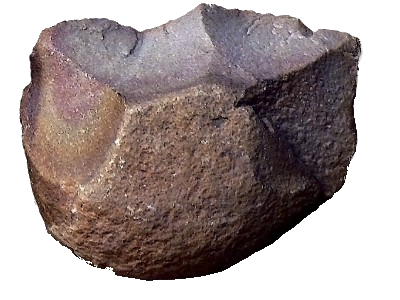
The Oldowan tradition marks the beginning of deliberate stone tool manufacture,
appearing around 2.6 million years ago. Early humans—likely Homo habilis and some late
australopiths—learned to strike one stone against another to produce sharp flakes. These
flakes were the real tools, used for cutting meat, scraping hides, and breaking open bones, while
the leftover cores and hammerstones were simply by-products of the process. Oldowan tools show no
symmetry or standard shapes; the innovation wasn't craftsmanship but the realization that stone
could be transformed into something sharper and more effective than anything found in nature. This
is the level Fred and Wilma stumbled into in our story.
The earliest stone tools—Oldowan flakes around 2.6 million years ago—predate any solid
evidence of controlled fire. Early Homo habilis almost certainly did not tame fire. They may have
scavenged from natural wildfires, but there's no sign they could maintain or transport flames.
Acheulean (Mode 2)
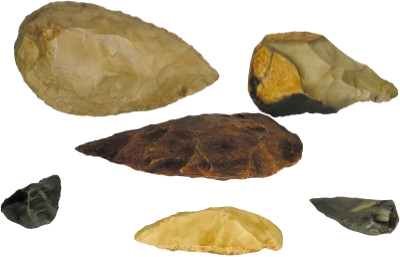
The Acheulean tradition begins about 1.7 million years ago with Homo erectus, who took toolmaking far
beyond simple flakes. Acheulean handaxes—teardrop or oval in shape—required planning,
skill, and a mental template. These tools were shaped on both sides, producing symmetrical,
standardized forms that could be used for butchering, digging, and woodworking. The leap here is
cognitive: Acheulean tools show that humans were no longer just reacting to materials but
envisioning a finished shape and working toward it through multiple steps. This is the first time
tools show true craftsmanship and long-term planning.
This is also where fire becomes part of the archaeological record. By the time Homo
erectus is making Acheulean handaxes—around 1.7 million years ago—we start seeing
the first convincing traces of controlled fire use. These include burned bones in habitation
sites; reddened, heat-altered sediments; and charcoal in places where natural fires
are unlikely. The earliest widely accepted hearths appear around 1 million years ago, and
by 700,000 to 500,000 years ago, fire use becomes common across Africa, Europe, and Asia.
Mousterian / Middle Stone Age (Mode 3)
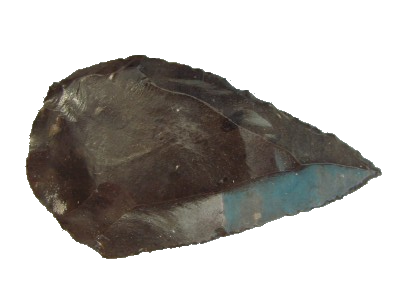
By about 300,000 years ago, Neanderthals and early Homo sapiens developed the Mousterian or Middle
Stone Age toolkit, which introduced prepared-core techniques such as the Levallois method. Instead
of striking flakes at random, toolmakers shaped a core in advance so that a single, controlled blow
would detach a flake of a specific size and shape. These flakes became spear points, scrapers, and
other specialized tools. This period also saw the rise of composite tools—stone edges hafted
onto wooden handles using adhesives like pitch—showing a deeper understanding of materials
and the ability to combine them into more effective instruments.
By this stage, fire was fully integrated into daily life.
Upper Paleolithic / Later Stone Age (Mode 4-5)
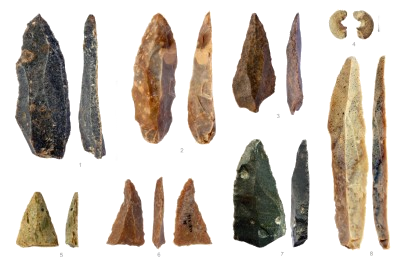
Beginning around 50,000 years ago, Homo sapiens entered a period of rapid
innovation that produced long blades, microliths, bone and antler tools, sewing needles, harpoons,
and eventually symbolic objects like beads and carved figures. Toolkits became highly specialized,
with different tools for hunting, hide processing, woodworking, and ornamentation. This era
reflects not just technological skill but cultural complexity: traditions, teaching, long-distance
trade, and artistic expression all appear alongside the tools. By this point, toolmaking is no
longer just survival—it's identity, culture, and communication
During the Upper Paleolithic, fire became more than a source of heat and light—it evolved
into a versatile cultural tool woven into nearly every aspect of human life. People learned to use
fire to heat-treat stone, making it easier to flake into long, thin blades, and they used
controlled flames to harden wooden spear points or shape bone and antler tools. Hearths became
stable features of campsites, serving as centers for cooking, social gathering, and teaching. Fire
also made new forms of creativity possible: small stone lamps lit the deep chambers of caves where
early artists painted, and in some regions people began firing simple ceramics long before
agriculture. By this stage, fire was no longer something humans merely tended; it was something
they mastered, shaping materials, landscapes, and the rhythms of daily life.
And then, one day, somebody fooling around with rocks and fire noticed something odd: a shimmering,
molten glob of something that, when it cooled, was completely different from any rock
he'd ever seen. And a new Age of technology was poised to begin.