|
By: Agnes Steinberg |
|
|
Page Views: 39 |
| Hashtags: #AgnesSteinberg #Yonkers #NewYork |
| Chapter 7 of my dead ex-mother-in-law's memoirs. |
| Estimated reading time: 9 minute(s) (2031 words) |
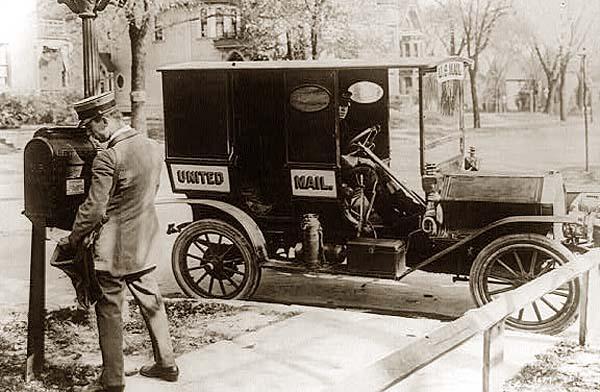
The train had just rumbled across the upper fields, setting the house
a-tremble and starting the glasses tinkling on the shelves. It was
time to go for the evening mail.
Mail sacks from the train were being carried into the interior,
now dimly lighted by two oil lamps burning in reflector brackets on
the wall. A glass-covered counter offered a selection of candy, gum,
shoelaces, pencils and fancy crackers. On the shelves bread, soap,
writing paper, lamp chimneys, wicks and other sundry items waited to
replenish the housewife's stock. Barrels held flour and sugar. A tin
container with handle and spout bore the label "kerosene". Pounds
and ounces were most exactly measured out upon the counter scale. A
coal stove that was not used in summer completed the equipment.
The Post Office occupied one side of the store. A wall formed by
numbered glass letter boxes rose some five or six feet from the
floor. Behind it, the postmaster and his helper sorted out the mail,
slipping it into the correct boxes. The owner unlocked the box from
the front. Those without boxes claimed their mail by name when all
was ready and the window had been raised for the sale of stamps.
While the sorting was in progress, people gathered from all
directions. From up the hill and down the road, through fields,
along by-paths and out of garden gates they came. Everyone was
heading for the spot where the harp strings of emotion are plucked
by little paper packets stamped and sealed. Two anxious girls with
braided hair jumped up and down, stretching their necks to see what
was arriving. A dozen boys stood on the porch aiming sling shots at
trees or carving initials on the posts. Old men in blue shirts
chewed tobacco, leaning up against the door jamb to comment on crops
or weather. They squinted down their wrinkled noses at the latest
bulletin tacked up on the wall. A farm hand wearily climbed the
hill, a lunch pail in his hand, a scythe across his shoulder. The
wit made sure all would hear his sallies, as empty as the barrel on
which he sat. Neglecting his ruddy forge across the way, the
blacksmith strolled, grimy with soot, a leather apron hanging down
his front. Bicycles and carriages stood all around as though they,
too, expected mail. The village dandy hurried up the steps, hair
slicked and smelling of some flowery ointment, a loud tie flying
from his open jacket, shoes shining like the sun. Of course, he
could not wait; he must be off again at once, as though he had some
place to go other than the cow path that led straight by his lowly
door. There was, however, time enough for ogling at the girls who
stood about in summery dresses starched and dainty. They looked away
in scorn and would have none of him, for they, in turn, had primped
for others. They giggled and whispered coyly before the local swains
who lolled, oblivious to their presence and their charms, with legs
sprawled out on barrels or across the railing of the porch.
That sudden crowding toward the door told us the sorting had been
finished. A young girl hurried out, her cheeks aflame, a love note
hidden in her dress. The housewife clutched the catalogue for which
she had been waiting many weeks. The little girls were thrilled!
Their packages contained birthday presents promised by their aunt. A
white-haired woman crumpled the letter in her hand and shouted for
all the world to hear, "A grandson! Born three days ago to Jim and
Anna!" The old man put his shaking hand before his eyes. The notice
could not read, "Foreclosure!" After all his struggles he must let
the homestead go.
Our mail was unimportant. We took it with letters for two
neighbors and started home. While we had waited, night had come.
Other paths soon parted from our own. Our footsteps were the only
sound of human life that could be heard. The way was lonely. Beyond
the dam, bushes took on unfamiliar shapes. The moon, swathed in
misty veils of cloud, was drifting, drifting behind the lacy pattern
of the trees. Eerie shadows fell across the road and whippoorwills
were clearly calling. How welcome was the lamplight in our window!
How safe we felt from troubles and from darkness when we reached the
kitchen door!
Haying Time
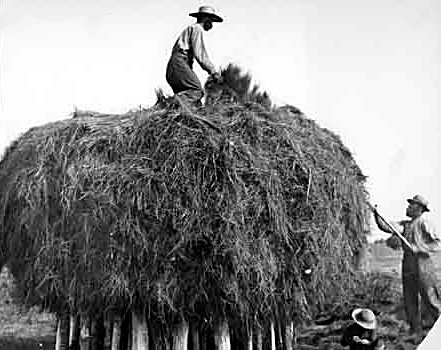
The summer moved along. August nights were cold. Katydids began to call
and answer. Six weeks later, we were told, the first frost would
brush the leaves with red and yellow. Guinea hens were roosting
nightly high up in the oak and sending forth their weird, peculiar
note of warning if, in the darkness, stealthy fox or weasel prowled
on padded feet.
At noon, the days were scorching. Haying time had come. Whenever
the hayrack set out in the morning for the marshy fields along the
shore, we children might ride along if we were "a-minded". Of course
we went wherever there was the chance to wander in these meadows
where large pink marshflowers grew, tipped by every little breeze in
all directions, like temple bells set ringing.
Such a day and place were brimming with excitement. Scattered all
around among the marshflowers grew stiff, low bayberry bushes. Along
their stubborn little branches clustered tight bunches of small
berries covered with a fine white powdery coating. A mold was
hanging waiting in our pantry at the farm. If filled with wicks and
hot wax from the melted berries the finest tangy, gray-green candles
would be fashioned. To gather all the berries that we could was the
first project of this most exciting day.
Not far away, a wobbly little dock jutted out into the waters of
the Great South Bay. Here lay adventure number two. A piece of salt
pork weighted down with stones and lowered to the shallow bottom
proved to be exactly what the most fastidious crabs had long been
awaiting. The faintest nibble told us that it had been noticed. We
raised the line, ever so gently, a few inches. The interested party
down below kept up its nibbling. Higher rose the line. Now one could
see, in faintest outline, half way up from the bottom, a huge brown
crab whose two front claws, pale blue and white, embraced the piece
of pork. More slow and gentle pulling on the line—we dared not speak
or move—a skillful slipping under of the scoop, and lo, the prize
was ours! It tangled with the net and fought but was finally
deposited in the burlap bag. An hour or two spent thus and we might
have some forty giant crabs. The bags were closed and knotted, tied
securely to the post, and dropped into the water so that their
contents might keep fresh until we picked them up on our way home.
Beyond the shore road rose the dunes, with houses scattered here
and there. If nights had been extremely cold, the beach plums
growing all about would by now be turning royal reddish purple.
Along the crest of dunes, one might lie down to rest, completely
hidden by the tall marsh grasses. Or one might run along the
endless, empty stretches of wet sand. Strange shells, sand fleas and
driftwood strewn about were more conspicuous than the signs of human
habitation.
The hay-making crew had been about its business all day long,
pitching till the wagon groaned. Soon they would come looking for us
on the road that ran between the ocean and the bay and help us climb
on top. Until then the untamed sea was ours, gray or green or blue,
tempestuous or peaceful as its fickle mood dictated. Winds blew
inland, scattering spray, flattening grasses in its path.
The little wave or breeze, with faintest mockery, touched us
gently; and, in a moment, tore away defiant, wild and free,
unconcerned and still uncaptured.
Summer's End
September came, and, with its coming, I grew lonesome. Children
in the clearing went to school. My school was eighty miles away.
Neither flesh nor fish nor fowl, I idly walked the roads, enjoying
with mixed feelings the sight of other children plodding off with
sullen looks and heavily-laden book bags.
What was there for a solitary child to do? Daily I helped Aunt
Ida carry down some produce from the larger garden "up lots" across
the railroad tracks. As usual her blanched sun bonnet slanted at a
foolish angle. Gold-rimmed spectacles sat far down upon her nose.
Her wide-checked apron gathered to one side, held lettuce, carrots,
greens. We made a most unusual pair—the city child, the country
grandma: she, looking backward; I, seeing but the future. Yet, we
shared much together. The years between us did not seem to matter.
Each of us loved fields and woods and things just as they grew,
without much cultivation. Each for the other pulled the well-rope
and lowered the bars at the entrance to the pasture. Down in the
tiny circular cellar built beneath the house, we tapped the barrel
of salt pork for the choicest pieces and selected jars of homemade
pickles. In the parlor, she told me over and over again where each
shell on the corner what-not had been gathered and how the great
glass lobster balls for nets were used. Across the room, the organ
with its fascinating rows of stops and keys posed in solemn dignity.
In its carved music rack, someone long ago had left a set of ancient
hymn books. Aunt Ida stood beside the organ and I picked out the
simple notes and pumped the carpet-covered pedals with my feet. "Vox
Humana" set the notes to quivering; "Dulcet" made the music whisper.
With her voice high and cracking but persistent, and mine very, very
young, we sang together, bringing back to life the songs of many
generations, half-forgotten even then.
"…The sweet little church in the wildwood,
The dear
little church in the vale…"
October was approaching. We were leaving. There was the little matter of an
appointment with the train that must be kept. The bags were in the
carriage standing in the yard. We wore our city clothes. A hurried
pat for Tommy Cat sitting on his barrel; one last friendly brush of
Roddie's tail; Aunt Ida's hug and huge bouquet of zinnias—and we
were moving. All the neighbors of the clearing stood at their doors
to wave "Good-bye". At the station, there was just time for the
hearty handshake and brusque "Godspeed" from our farmer. The saucy
train was coming round the bend whistling shrilly that we must be
ready, for it would not wait. I lingered but a moment to rub Jerry's
star and touch my head against his hairy cheek.
I looked out of the window at our woods and farmhouse as the
train sped across the upper fields. For our departure, trees had
donned their party robes of red and gold. Winds were singing, little
leaves were dancing all along our way. No matter who would ever come
to live there or own it, I would always be a part of them, and they,
of me.