|
By: Agnes Steinberg |
|
|
Page Views: 29 |
| Hashtags: #AgnesSteinberg #Yonkers #NewYork |
| Chapter 2 of my dead ex-mother-in-law's memoirs. |
| Estimated reading time: 19 minute(s) (4372 words) |
To Each His Own
Within the home lived three very different persons.
Sometimes of an evening, having had more than my fair share
during the day, I would help myself to more of the chocolate
peppermints which some thoughtful guest had brought and which were
kept in Grandmother's neatly arranged bureau drawer.
If the pilferage were soon discovered, I dropped to my knees at
the bedside as if for evening prayer, peeking out from behind
clasped fingers at the progress of the chase and secure in the
knowledge that my devout grandmother wouldn't disturb the child
while she was "talking to God". In this way the moment of
retribution was postponed and the incident always purposely
forgotten by the time my "prayers" were finished.
Rain drops drumming on the window never failed to summon her to
cross the sea in spirit and to stand again, a gray-eyed lass beside
the Shannon or to walk the Limerick road. The present slipped away.
In song and verse she had learned long ago and now repeated
letter-perfect and always fraught with longing, I met her fisher
folk, I listened to the winds that moved the boats or watched the
mounting clouds, the flight of birds that tell of the storm. In dark
and misty bogs, the Faerie lights of Ireland would begin to twinkle
while eerie leprechauns were busy at their pranks…
But should a sudden rainbow flood the sky with green and red, we
would hurry back again, my grandmother and I, the visit still
unfinished, to await the story-telling hour of another rainy day.
The business aspects of the home were precisely managed by Aunt
Mary. Taller than the rest of us, thin and always delicate of
constitution, she never spared herself. The fingers of her hands
were knotted with unceasing toil. Spare of word and keen of
judgment, in her nature early hardships had left their mark, and
much of Puritan severity remained. All things were measured by the
yardstick of their eternal values.
No time was wasted in idle gossip or in visiting. Yet she was
hospitality itself when company came. She made things pleasant,
often giving up her own bed that they might stop overnight and
doing, herself, much of the "fancy" cooking for the guests. Aunt
Mary might tell you bluntly that the question to which you sought an
answer was not your affair, but there would be no dealing in evasion
or "white lies". Her word was her bond. With the landlord, her
spoken agreement held more weight than the signed lease of our
neighbor. A shipment of fine-quality yard goods might arrive solely
in response to a verbal request. Mrs. T's dress promised for
Tuesday, would be delivered on that day, through its completion
required an all-night sewing session.
As I grew, great admiration developed within me for my aunt. I
found the strict adherence to the letter of the law was chiefly for
herself. An overwhelming kindliness for others evened up score.
To me, no word of praise was ever given, lest I grow conceited.
Yet, she would shield me from all things that were a hardship to
her, as a child. An unexpected bag of candy appeared when funds were
low. A new school coat was bought, when season after season she had
been wearing down the cuffs and elbows of her own. Here was a gift,
hand-made while orders waited, if one could not be bought, that I
might be present at someone's birthday party. A bunch of pink sweet
peas might blossom on a winter morning for a little girl in bed with
tonsillitis. So many different things revealed the deep devotion of
which, like any true New England daughter, no one ever heard her
speak.
A whiff of drifting perfume, gay laughter, brown eyes beneath a
veil, a feminine gesture, violets and fur waiting on the table—my
Mother had passed by; and, trailing her, a cluster of admiring
glances. All things frivolous and social came her way. She loved
them. Visits to relatives, plays at school, friends in to supper on
a Sunday night—these were no small part of my mother's life. And
beaus came, too, to play cribbage or to take us for a carriage ride.
They came, but just so far—no further. The gay exterior was but the
armor of a promised heart.
Have you ever seen a woman walking through a dark and empty
hallway, carrying a candle, its sputtering flame protected by her
hand? Just so I've seen my Mother walking down the years—the
stealthy years that slowly make so many subtle changes. In time, her
quick light step grows slow and falters. Brown hair turns to gray
and then to white. Shoulders straight and strong grow frail and
rounded. The gay, high voice is low and very seldom heard.
Yet there are things that never, never change. For to me it
always seems as though she carries the candle high, the shining
symbol of unwavering love. The lips are ever uncomplaining. The mind
knows what it seeks. The eyes are steady, looking forward into
darkness, but darkness broken by the rays her candle sheds.
Beyond, my mother feels, a heart is waiting, and a hand she lost to
clasp her own once more. The steadfast flame, so carefully guarded
through a lifetime, reveals the lovers to each other at life's end.
Romance
A broadening and interesting factor was contact with the
"customers"—those ladies of upper middle class gentility who came,
sometimes by trolley or "el", sometimes in their own small carriages
seeking the skill of Aunt Mary in making or remodeling dresses.
The fittings took place in the parlor. Thither my aunt would
hasten, bearing pinned to her bosom a pincushion studded with pins
and needles, and carrying over her arm lovely rustling taffetas or
organdies, rich broadcloths, or velvets.
The fitting over, and the important lady standing before the
mirror puncturing her feathered hat with hat pins of great length,
an invitation was often forthcoming for the child of the family to
"come in". As in all circles of life, the clientele was composed of
very different personalities. With some, I was shy; with others,
friendly. Some could not entice me into the room upon the second
visit or thereafter.
Among the most faithful of customers were the wife of a prominent
surgeon, her two grown daughters and her mother. Mrs. D. requested
that a long pocket be put into the folds of all her skirts, as a
convenient place for carrying small change, etc. Into this
mysterious hiding place I was always invited to thrust my hand.
Sometimes it would contain a pretty carved figurine from China (the
two daughters had been missionary workers in the Orient); sometimes,
a pair of silver buttons, a tiny doll, or a fancy pencil. The
uncertain nature of the gift held fascination. Could it be this same
expectant urge which pilots me today to auctions and antique shops?
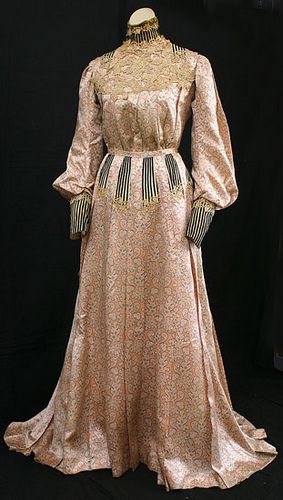
The greatest thrill of the dressmaking business, however, was provided
by the brides. Oh, the beautiful, beautiful brides! Every once in a
while the daughter of one of the patronesses would promise her hand
to a suitor. Or perhaps it would be the lady herself, a widow
striving to replace in a second marriage a lost love, or a spinster
coming perilously close to the brink of abandoned expectations who
would present herself to be arrayed as the chosen one.
On the occasion of such a fitting, white sheets were spread over
the parlor carpet in advance; the shades outside the curtains drawn
down to the windowsills, the latticed blinds closed on the shades,
thus excluding all possible daylight. Then at the touch of the gas
lighter equipped with a sliding wax taper, each of the four frosted
glass globes branching off from the center pipe burst into a mellow
glow, giving somewhat the effect of candlelight.
The stage was now set; the ring of the doorbell awaited. Farther
back in the dining room, I crouched in hopeful suspense. Would I be
asked to "come in" today? Oh, voluminous folds of lush satin! Oh,
crispness of net and lace! Oh, delicate scent of sachet, as the
white-sheeted bridal outfit was whisked away through the door and
disappeared into the parlor.
Pinning and snipping and fitting completed to satisfaction, I was
summoned into the presence, invited to view the vision.
And a vision indeed she always was, with a flush on her cheeks, a
light in her eyes, as she turned and swayed, looking over her
shoulder to see the great mirror, a long swirling train, graceful
narrow sleeves, the soft glow of seed pearls, the shimmer of satin.
The bride-to-be was pleased! She was joyful! Then, glancing at
me, she sought confirmation. What greater proof could she ask than
the speechless adoration seen in a child's wide eyes? Truly her hour
of fulfillment was at hand. The white glory of the bride without,
but faintly echoed the radiance within.
Business of the Day
On those delightful occasions when school was not in session, the
day officially began when, breakfast over, and dressed in suitable
seasonal attire, the younger generation arrived upon the street.
"Equipment" which varied from day to day was carried—usually an old
thread or candy box. Today, it might contain a set of jacks and
ball; tomorrow, a small china doll with bits of lace, material and
thread for making costumes. another day might call for a stamped
table doily and strands of different-colored embroidery floss. One
good look up and down the street sufficed to settle the question of
who was out, who still had to be called for, what was going on and
the best means of getting the situation in hand. If ever a street
was played upon from dawn till dark, it was that one long block
between Lexington and Third.
Besides the five families who possessed offspring and whom we
descended upon in droves from time to time, we children had a
speaking acquaintance with not one household. In fact, I do not
remember ever having seen a single person go into or out of any
other house. Did their owners stand behind the long lace curtains of
the parlors and watch our antics with amusement or perhaps
resignation? Or were they so preoccupied as to be unconscious of our
existence? Whatever the answer, to their credit be it said that
very, very seldom was a butler or maid dispatched to curb our
activities. And they endured much.
In groups we sat upon their lower steps for hours. When the
summer sun burned, we retreated up the stoop and entrenched
ourselves beneath their front door awnings. Area gates were mounted
and swung upon. Across their sidewalks in winter were formed sliding
ponds of thinly-fallen slow. Icy igloos and forts were built before
their coal holes. Heavy solid marbles, the size of a plum, were
bounced hundreds of times without a miss upon the flagstones—often
glancing off up into the air and teetering dangerously near the area
windows. The center of the street and sidewalks were covered with
great chalk "potsie" circles in which we jumped through the spider
web from "start" to "home". Lines formed to wait a turn at jump
rope. When hide-and-seek was in vogue we hid behind their outer
opened doors. Yet the greatest trial of all must have been to watch
and listen as whole armies of shouting roller skaters flew up and
down the sidewalks or skated clockwise on the wide spots.
Whatever their destination in another world, may tranquility
descend upon them as, in bygone days these long-suffering
proprietors granted us our unmolested freedom.
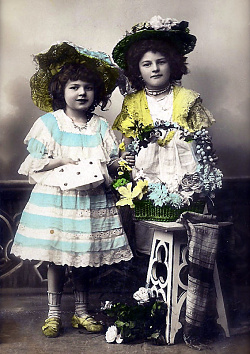
We played with gusto and a directness that would have confounded
the theories of many a philosopher. If a game was good, we repeated
it again and again till we were exhausted; if we didn't like it, it
was taboo. All, without exception, turned their attention to the
same recreation at the same time, as though a gong had been sounded
for the ending of one sport and the beginning of another.
With the exception of a few rousing games of "Cops and Robbers"
or a few good snowball fights, the boys kept pretty much to
themselves. A girl was considered a tom-boy if she had much to do
with them.
A most peculiar feature of those years was being "best friends". The
basis upon which the selection was made is hidden in history. If you
decided to be "best friends" with Mary, from that moment forward,
you were her partner in all games, her second in arguments; you
shared her secrets, candy, and skate key. In other words you became
each other's shadow. The system had many advantages, not the least
of which was moral support in a crisis. The alliance might last for
ten minutes, for a day, or for years. Either party could terminate
it at will with the brief and blunt statement that she no longer
wanted to be the other's best friend. Yet, while it existed, no
documented and signed contract between individuals or nations was
ever maintained with greater fidelity.
Like No Other
When weather cleared the street of the noisy flock, novel local
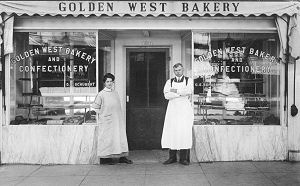
spots were to be visited. The bakery around the corner, owned by
Helen's father, claimed first attention. There behind windows
frosted with steam, Mr. G. presided over shelves of tempting
pastries. Small, ruddy-cheeked, dark-eyed and sound as an apple, his
good business management always succeeded in making a very fine
living. Mrs. G., blond and gentle, arrayed in a long white apron
like her husband, assisted behind the counter as did the older
sister and brother—although the latter could most often be found
rising from the basement stairs to the sidewalk like a white
apparition, carrying high above his head immense tin trays laden
with cakes fresh from the oven.
As Helen's "best friend", I was granted carte blanche to
the premises. We roamed through the family's apartment above, looked
in on the goodies cooking in the kitchen pots, had kaffee klatch
or supper at the back tables of the store and, occasionally, were
even permitted a trip through that mysterious region: the basement.
Here, beneath the sidewalk, squads of bakers working day and night
took care of all those amazing processes which resulted in the
masterpieces displayed on counters above. It was a privilege allowed
to no others, to roam below unsupervised and tantalized by the odors
of fresh dough, of dried apples, cherries, citron, raisins and nuts,
and snatching a morsel here and there as we passed.
No more generous family ever lived. A dozen rolls always numbered
thirteen. One day a pair of fine ball-bearing skates arrived for
Helen, and a second pair for me. Weekly, the square, black carriage
of the Little Sisters of the Poor pulled up before the entrance. A
huge empty clothes basket entered the store and in a few minutes
emerged creaking under its weight of food donated. The blessings of
the departing Sisters must have lingered for this family prospered.
"Bread cast upon the waters" seemed to return with the success of
every new store opened.
Not far away, the pungent odors of tobacco circled. Two of our
playmates, noses pressed flat against the rain-spattered door of
their father's cigar store, gazed out past the painted wooden Indian
posing erect and virile in the torrents. Entering, we stopped to
chat, unimpressed by case after case of gold-banded cigars. In the
rear behind a curtain, a half-dozen workers stooped over tables
laden with brown, dry leaves. The rolling, shaping, clipping, and
boxing of cigars went on hour after hour with monotonous precision.
No color, no prettiness, no pleasing flavor arose to greet our
appraising senses. A visit here might help to kill time on a dull
day, but one or two such would suffice for the year.
Wind and rain tearing around the corner assisted our flight
halfway up the block. A white stone building boasting of two
entrances gave greater promise and here a halt was called.
Hopefully we rang the bell. Perhaps the horses would be out! "The
horses?" a stranger, startled, might have enquired. "Out?" Yes. This
was the carriage house where dwelt others of our tribe.

Mr. F., thin and wiry, Mrs. F., plump and patient in spite of the brood
clinging to her skirts and the baby carriage always standing in
anticipation of the next arrival, lived on the top floor. The second
floor housed the animals. On the street level were numerous
carriages opened and closed, awaiting the summons of the owners to
banquet, ball or burial.
A Gothic arch spread high and wide across three-quarters of the
front; a small ordinary door was squeezed in at one side. Through
the first impressive portals pranced the chestnut darlings of the
rich, coats brushed to a luster, hoofs blackened and polished.
Liveried coachmen perched upon the seat of the delicate carriage
might well have been made of wood. Through the narrow side gate
flowed the life of the family, their bundles and friends.
Should the stalls be occupied, there would be no fun today. If
the horses were elsewhere earning their oats, we might jump in the
hayloft, play hide-and-seek in the dark corners of the harness
closet, race up and down the ramps and prance between the carriage
shafts like the best-trained of quadrupeds. Our liking for our
playmates who dwelt there was not lessened by the privilege which
knowing them entailed.
I wonder. Did Queenie and Prince, Jerry and Beauty, upon our
return, resent our intrusion, much as the Three Bears when they
discovered the use of their chairs and bowls by Goldilocks?
The Sea
Each year when vacation securely locked the doors of schools an
excursion was in order. A sizzling July morning found a group of
neighbors burdened with blankets, bathing suits and boxes of lunch
climbing the narrow stairway to the "el".
Via this means of transit the first half of the trip took us to
City Hall. As we were transported through the lower sections of the
metropolis, children with arms outspread on car windowsills watched
the houses whirling by and received an introduction to some of
life's less pleasant phases seen without.
At Brooklyn Bridge, mothers clutched the sticky hands of children
and transferred the group from train to train. Barely had the last
empty seat been filled when several discoveries were made. A doll
and pocketbook were missing and little Tommy was not with us
anymore. With one accord we rose to search. Tommy, discovered
standing on the platform, his finger in his mouth and weeping
copious tears, assumed a new importance, since his absence had the
power to stay the whole excursion. The other errors were beyond
correction. Again we took our seats. The snake-like string of cars
pulled out and meandered through the various parts of Brooklyn and
Flatbush, as though uncertain of their destination, finally pulling
to a standstill not far from Luna Park.
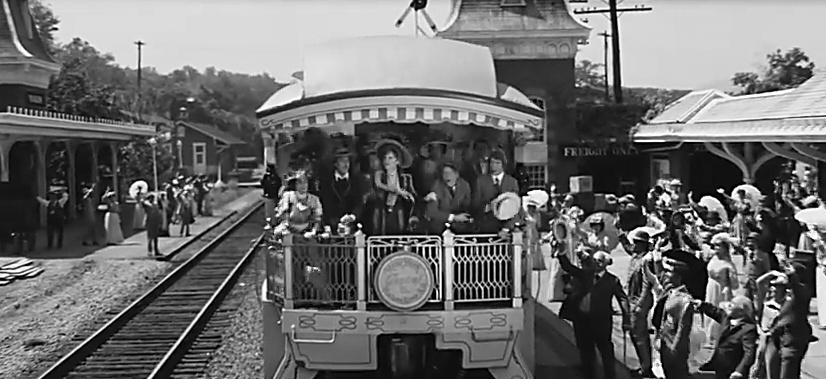
Car sickness and excitement were by this time accounting for many
throbbing heads. Grown-ups, too, were beginning to question the
wisdom of the trip and to wonder who had first suggested it. The
mingled scents of roasted peanuts, sawdust, corn cooking, monkeys,
and the sea came to meet us. Vendors' shrill whistles, hecklers
calling, carousel music, the splashing of the waves bade us hurry.
Through the hot streets of Coney Island to the still hotter sands
the party wound its way. At last, the first sight of the water! An
unoccupied tent was soon captured and filled with our possessions.
Blankets, stretched from center pole to sides, formed individual
compartments in which each child disrobed and dressed for bathing.
We raced each other to the shore as if the ocean were about to
pull away. A few hesitant footsteps with soapy foam licking our
ankles. Cold. Cold. Icy cold! A few shivering dips and we were
really wet all over.
As though from earth's distant inlets, strange herbs had been
gathered and brewed beneath the sun into a healing infusion, the
ocean now drenched our bodies with its life-giving waters. Who can
explain this mysterious gift of the sea?
With luncheon spread out upon a checkered cloth, the last
sandwich unwrapped, the last ripe tomato peeled, a summons was sent
out for all hungry members to report. No sooner had we gathered
round the fringes of the cloth, our appetites whetted to a razor's
sharpness, than some passerby would cast a pail of sand close enough
to cover exposed morsel with grit.
Sand castles were built, holes dug, shells gathered to take home,
numerous dips made into the waves, a constant bronzing took place
beneath the sun. So the day passed. At sunset we were no longer the
wan creatures who had set out that morning, but instead a tribe of
husky, reddened warriors.
When evening came, against the darkening sky, Steeplechase and
Dreamland flung their strings of lighted pearls, competing with the
crescent moon hung low above the sea.
How grand had been the day! How lovely was the night! But, oh,
the price we paid was high. Most of us were restored to normal by a
rest of several days in bed: sunburns, upset stomachs, swollen tired
feet our memoirs. And yet, we'd like to go again.
Temptation

Who, living in that era, could remain long unaware of that institution
known as the corner saloon? Here it squatted, two-sided, with the
eye of one window looking west on East 70th Street and the other
watching South on the Avenue as if fearful lest the housewives of
the section descend upon it in wrath.
Its swinging doors were indeed functional. Deep scroll carvings
shortened them at top and bottom, allowing plenty of air and light
to enter the dark and questionable cavern beyond. Yet the opaque
quality of the wood so concealed the customers within that nothing
was visible except legs, in their usual inoffensive activity of
standing. The absence of locks or handles made egress a simple
matter, too, for one whose brain might not at the moment be
functioning to full capacity. Swinging freely back into position of
themselves, the wooden panels allowed the departing guest to leave
in haste, wiping his moustache with the back of his hand, his mind
innocent of any plan for closing the doors behind him. (With what
welcome, indeed, would he be received back into the bosom of his
family?)
This front entrance, all but reeking of brimstone and sulfur, was
considered the first step in the downward descent which would
eventually lead to an uncomfortable and fiery hereafter. Mrs. X.,
whose husband was known throughout the neighborhood as a regular
patron, was looked upon coldly and with lifted eyebrows. Children
passing by walked with averted eyes and kept close to the curb, thus
putting all possible distance between themselves and contamination.
Yet, illogical though it was, Mrs. Z. might with impunity stand
upon the threshold of the side, or "Ladies", entrance, ringing the
bell and holding a black cotton bag tightly by its drawstrings and
partially hidden in the folds of her full skirt. A portly bartender
with white towel draped crosswise over his broad stomach answered
the summons. Admitted into the small vestibule, the lady slipped the
cotton casing from a tin beer can. A few words were softly murmured;
several coins changed hands. The can disappeared into the inner
region and returned shortly, its sides beaded with sweat, its
character forever sullied. It was again encased in the black bag.
The gentleman bowed, thus concluding the transaction. Mrs. Z.
departed, flaunting the perky little feather of her hat in a most
righteous manner and smoothing the pleats of her skirt with a
nicely-gloved hand. Nor did she forget, in passing the swinging
doors, to cast a look of withering scorn at the standing legs whose
owners were, no doubt, engaged in the dastardly act of quaffing a
glass or two of beer beyond the range of vision.
Enchanted Evening
Leaden skies brought swift ending to a gray afternoon. A sudden
chill penetrated deep into one's bones. The scent of snow was in the
air.
By the time supper was over, the first spitting flakes of the
season were tapping at the windowpane. This was the signal! By
long-standing agreement, Helen and I, each in her own house,
prepared for "The Great Adventure".
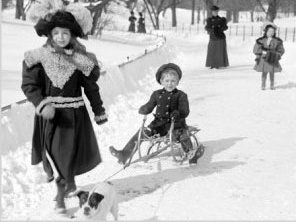
Long, inner drawers, always worn to the ankles in winter and
covered by thick black stockings, were now encased in padded
leggings, the latter buttoned up the sides and slipped over shoes
and rubbers. Wooly hat, scarf, mittens, sweater, a blue chinchilla
coat lined with red flannel were added and the squirming creature
within was ready to play with whatever breath and movement might be
possible beneath such armor. Out we went, like two bullets released
from opposing batteries, out into the cold darkness, with the
tingling touch of snowflakes on our cheeks—to meet beneath the great
iron clock which stood towering high above the jeweler's shop,
halfway between our two houses.
The street was deserted. Together, we ran around the block,
skidding, sliding, kicking up the soft fluff. In a few hours, the
new-fallen snow would lie like whipped cream, thickly covering
sidewalk and door post, stairway and tree trunk, in the rich
darkness of a winter's night.
Silence and softness and whiteness were still untouched by
footprint or shovel. Diamond-dust sparkled in the blue and orange
flame of lamp posts! Diamond-dust, strewn freely for rich and poor
alike, the beautiful gift of Jack Frost.