|
By: Agnes Steinberg |
|
|
Page Views: 27 |
| Hashtags: #AgnesSteinberg #Yonkers #NewYork |
| Chapter 1 of my dead ex-mother-in-law's memoirs. |
| Estimated reading time: 11 minute(s) (2445 words) |
I was not a child prodigy, lived in no remote or exotic place,
shared no amazing experiences. Why, then, bother to record the
following?
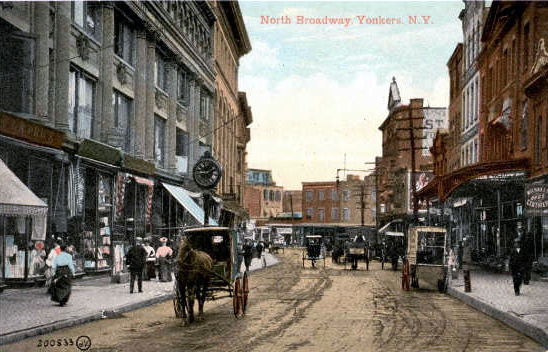
It happened this way. The other day, business took me to the old
neighborhood where I had lived. I explored the few blocks, standing
stock still now and then, half hoping that out of the familiar
haunts would emerge the forms of loved long-departed or childhood
playmates who would remember, too. I noted what remained the same,
recalled what had gone, sensed the past activities as truly as the
walls of a house absorb the daily atmosphere of the life being lived
within it. I walked on.
That night, unable to sleep, my mind kept adding a detail here, a
scene there until the whole, like a play being enacted upon a stage
before me, was vivid, complete, again alive. With a shock, I
realized that, although not many years had slowly turned since we
had moved away, time had worked so relentlessly that the
environment, the interests, even most of the physical setting were
now as much a part of by-gone days as the flowers of the Bouwerie or
horse-car travel.
On three of the corners were red brick apartment houses with
brown trim, four stories high—each entire floor being an apartment.
In one of the latter on the Northeast corner of Third Avenue, I
spent eight or ten years of that blissful period of life in which
there is no yesterday and no tomorrow.
No consciousness of the problems or trials which await, shadow
the brightness of the current day. Like believing in Santa Claus,
the fragile, fairy tale state is as real as earth or sky (though the
scientist in us can lay no finger upon its fragile existence) and,
like Humpty-Dumpty, once it has passed and been broken, "not all the
King's horses and all the King's men" can put it together again.
The Exterior
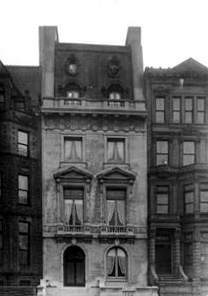
Three windows of the long, second-floor apartment faced east; seven faced
south, and the last room, the kitchen, faced south on East 34th
Street, west towards the Park and north over a flagstoned back yard
almost as large as the house itself. This yard was entered from
the street by a huge, solid black door in a curving brick wall.
Entering it always involved some risk or uncertainty as one never
knew what was to be found on the other side.
Sometimes, it was a clothes-line man, climbing the high, thick
pole to put up a line for an arriving tenant or to remove one for a
family going away. Or a band of German musicians might stand playing
precise, martial music or Viennese waltzes upon highly polished
brass instruments. Sometimes a blind man gently fingered an old
violin, or a couple sang a duet. On rare occasions, a voice of
unusual beauty would rise quivering above the clothes-lines and pass
searching through the open windows to tug at the heart strings of
the housewife while she peeled her potatoes. Then, up on the shelf,
the pewter mug would be opened, a penny or two taken out, wrapped in
a scrap of paper, and flung to the entertainer below.
Occasionally, a suspicious-looking stranger loitered aimlessly
there or in the next yard, separated from ours by another wall and
entered by a small door. No! Back yards were definitely not regions
to be explored when alone. Even when in groups, we entered timidly.
Access to the house itself was through a wrought-iron fencing
about three feet high which guarded each side of the doorway. A pair
of solid, high wooden doors opened wide in the daytime, and closed
and locked after 10 p.m., led into a small vestibule at street
level. Halfway up on the left wall were three letter boxes, each one
surmounted by a mouthpiece sunken into the wall and having beneath
it a lever. When pulled down, this lever started a bell jangling in
the kitchen in an apartment above. Also in the kitchen was a
corresponding lever which, when operated, wreaked havoc with a chain
on the inside of the inner, frosted-glass doors of the vestibule.
This clanking procedure wrestled with the door lock and finally
admitted the entering presence.
Mischief
In moments of idleness, we used to lie in wait inside for an
unsuspecting visitor. When one came along and rang the bell, we
stealthily disconnected one of the links of the opening chain so
that admission was impossible. On the second and third attempt the
bell was rung more emphatically by the impatient guest. Always the
answering but futile jangling of the chain followed. By this time
the infuriated visitor would dash out into the street and look up at
the windows of the apartment to be visited, seeking an explanation.
The expectant host, hanging halfway out the window, would wrathfully
inquire what under the sun was the matter with him, that he didn't
open the door and walk up. At that precise moment, we quickly
connected the chain again and innocently sauntered into the street,
whereupon the visitor, seeing the slowly closing door, made a dash
to get through it and up the stairs. Needless to say, it was unwise
to attempt a repeat performance with the same guest upon any of his
future visits.
Two long flights of carpeted stairs brought him to the second
floor. Here a choice of four entrances, all leading to the same
apartment, presented itself. The first door belonged to a hall
bedroom; the second led to the parlor; the third, to a sitting room;
and the fourth, to another hall bedroom. Before heading for any of
these, he usually waited until the unbolting of a lock and a ray of
light indicated by which one he was to enter. The selection of the
door to be opened marked his status as irrevocably as the caste
system of the East.
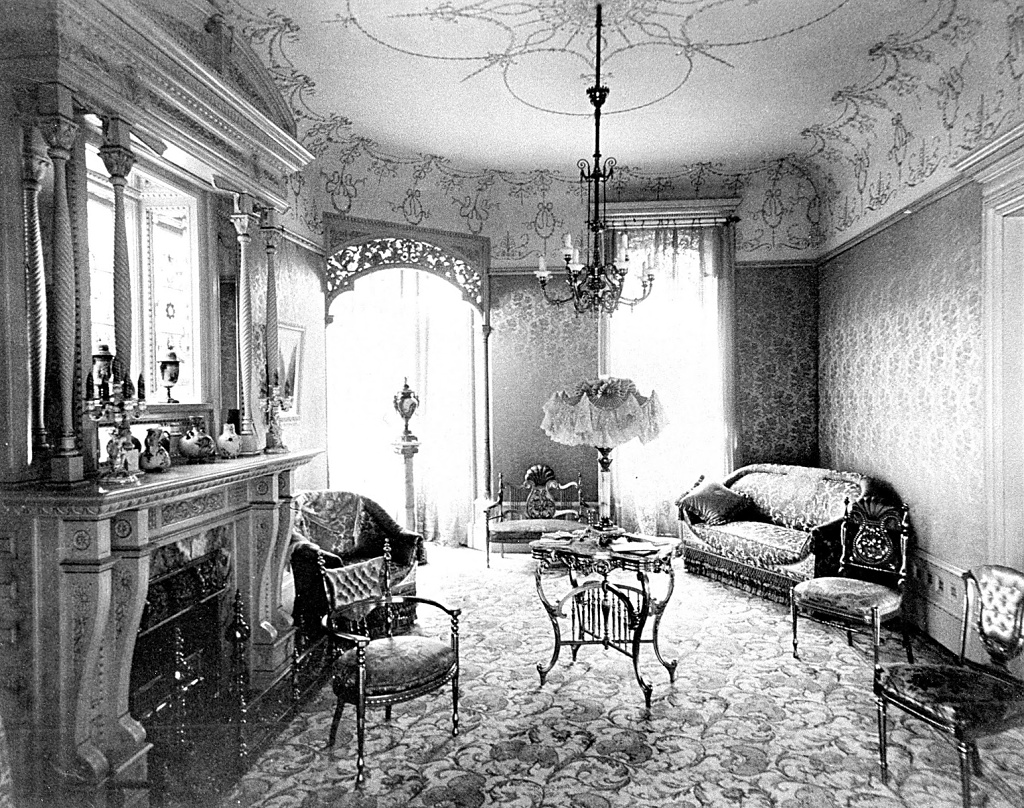
Important persons, business connections, little-known guests and
those upon whom an impression was to be made were ushered into the
parlor and left to sit in cool silence while the proper member of
the household was summoned. Doctors, clergymen and others on
official sick calls were conducted personally through the hall
bedroom portals with softly murmured pleasantries. Members of the
family, relatives and close friends were greeted by a kiss and a hug
or a wave of the hand, and allowed to follow at will through the
dining room door left wide for their convenience. Well, indeed,
might they smile with satisfaction who had been assigned to the
last-mentioned entrance, secure in the knowledge that they bore the
stamp of approval and really "belonged."
The Interior
On the inside, the rooms and furnishings were probably typical of
any similar home of that time—with two exceptions. I know the dining
room was unique; I like to think the kitchen was, too.
Here I shall have to inject a brief explanation as to why the
dining room was used for dining on Sundays only. My father having
died when I was eighteen months old, my mother, heartbroken and
scarcely caring whether or not she lived from day to day, returned
with me to her mother's home. There we were welcomed with open arms
by my grandmother and two maiden aunts. When I was six, one of the
aunts entered a cloistered convent and vanished forever from our
family circle, but never from our hearts, thus leaving a family
consisting of Grandma, Mother and Aunt Mary. The latter was the real
businessman and breadwinner, Mother assisting with shopping and
Grandma keeping house and cooking.
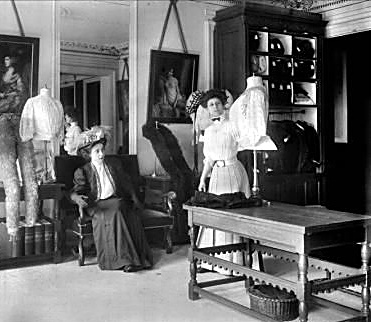
Our means were limited, indeed. Aunt Mary was an excellent
dressmaker and had a number of good, steady, well-to-do customers
most of whom were driven up to our door in their own coaches. But
the orders were spasmodic; now plentiful, now scarce. The dining
room was, of necessity, the work room. No carpet could be spread
upon the floor. Two long, bare tables, with drawers for scissors,
pincushions and tape measures were the chief pieces of furniture. A
dressmaker's form, adjustable to the size of thin or stout ladies,
 decorated one corner and an old Wilcox and Gibbs sewing machine
stood by the window. A fireplace with black marble mantel between
the two windows and a curtained dish closet reaching from ceiling to
floor completed the decor. Here the breadwinning took place from
daylight till six or later at night. Around the tables sat the girls
who were employed, their number indicating the prosperity or
slackness of the season. In the evening the instruments of trade
were put away, the floor swept clean of pins, scraps and threads. A
white sheet was thrown over a line strung catty-corner from wall to
wall, upon which hung the current and always fine products of a
creative mind and patient fingers.
decorated one corner and an old Wilcox and Gibbs sewing machine
stood by the window. A fireplace with black marble mantel between
the two windows and a curtained dish closet reaching from ceiling to
floor completed the decor. Here the breadwinning took place from
daylight till six or later at night. Around the tables sat the girls
who were employed, their number indicating the prosperity or
slackness of the season. In the evening the instruments of trade
were put away, the floor swept clean of pins, scraps and threads. A
white sheet was thrown over a line strung catty-corner from wall to
wall, upon which hung the current and always fine products of a
creative mind and patient fingers.
But, Saturday night wrought transformation! Sweeping, scrubbing
and dusting removed every sign of dirt and work. The machine was
closed. A large fine damask cloth and matching napkins covered the
two tables now pushed together in the room. The best dishes and
platter emerged from their hiding place in the closet; a glass bowl
of fruit appeared in the center of the table. Chairs were placed
around and places set with cups and dishes turned face down. The
week was ended with finality, kept as a day apart. In the cycle of
the days of the week, it stood out as the jewel in the circle of a
ring.
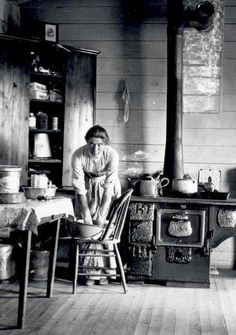
The kitchen was the favorite spot. A square, cheerful room, not too
large considering its many uses, it was sunny in winter and cool in
summer because of the awnings, three-way exposure and tall trees
towering outside close to the walls. There were the usual sink and
covered washtubs of the period, long dish closet, high narrow window
with pasted, paper lattice in black and red diamond-shaped design, a
table at which the family ate meals on week-days, two larger windows
with deep inside windowsills. On the latter, the cat slept among
geraniums in winter and pansy pots in summer, and I curled up and
read for hours on many a rainy day. The charm of the kitchen was its
simplicity. It contained no unnecessary items. Yet, as functional as
its predecessor, the one-room cabin of the pioneer, it satisfied
completely all fundamental needs.
How many starched petticoats, dimity dresses and broad blue or
pink satin sashes were ironed in this room? How many family washes
rose cleansed and steaming from the tub? How often Grandma sat with
a wooden bowl upon her lap and chopped giblets or hash! Here she
dozed rocking slowly back and forth by the hearth, as all old folks
should doze for a little while each day. Here molasses taffy,
sharpened by a drop of vinegar and a pat of butter, was spun on
winter afternoons. Here corn was popped in the fall. No wonder that
I loved the kitchen. For me its activity was unhurried and
unplanned.
Within it also was to be found a corner unlike any other in the
houses of friends or relatives. A low, small coal stove, squatting
flat, evidently replaced an open hearth for the latter protruded
beneath it, and the red brick fireplace still stood, framing the
stove on top and sides. Saturday brought rejuvenation to the stove,
also, its lids becoming satiny black and its handles bright. Lifter
and pot holders and a set of irons standing on end reposed on the
mantel, flanked by a pair of beer steins. Coal scuttle and shovel
and round bundles of wooden blocks stood ready at the side.
Today, we switch on and off the controls of radio, refrigerator
or car with thoughtless ease and instant result. Gone is the
personal touch that tempered the heat of the iron or scrubbed spot.
How many today could compete with the sure, swift, simple skill that
built the fire, turned dampers to send flames roaring up the chimney
or banked the red embers to hold a cozy warmth for a long winter
night?
Last of all, standing aloof and watchful in its corner, was that
lifeline of earlier days, the dumbwaiter. A shrill blast of the
whistle announced that something awaited below. The door was opened.
A loud "YES?" was sent down into the dark depths and a feeble
answering reply returned. Perhaps Tony the ice-man was raising a
block of ice, or a three-foot bag of coal was rising with its
accompanying bundle of wood. Perhaps, protruding from a basket,
tonight's dinner was arriving; or the news of the universe, via the
Pulitzer World, clamored for admission. Change making was also
carried on. A dollar bill fastened down with a large bit of coal
descended in payment. In due time, three cents arose. What a
versatile gadget it was!
A very exciting process, but one frowned upon by elders, was to
open the door a few inches to note, as the laden conveyance slowly
passed, what Mrs. B. on the floor above would be feeding her family.
The descent was, if possible, of even greater interest. About
five o'clock in the afternoon blasts were heard in each kitchen,
indicating that the janitor below was ready to collect and remove
refuse. The empty dumbwaiter, light in weight, with ropes slapping
the sides of the shaft, swiftly rose to the top floor. The family
there deposited its garbage can and bundles of sweepings and papers
on the top shelf. It slowly descended to our level. We likewise
filled the second shelf, while a discerning eye couldn't help noting
that at last Mrs. B. was discarding the hat with the pink feather,
that Jane had broken her doll beyond repair or that the crash
earlier that afternoon must have been the brown crockery tea pot now
reposing in fragments before us.
Nor was the procedure without its moments of pathos. I remember
standing rigid while I watched the small white form of my kitten
spread limp and lifeless on the shelf, start on its last journey. It
had been my pet for just three weeks, yet part of my heart descended
into the black depths with it, as I stood licking the salt tears
that rolled down my cheeks.