|
|
|
|
Page Views: 4 |
| Hashtags: #GrandCanyon #Archaeology #ConspiracyTheories |
| Complete article from a 1909 issue of the Phoenix Gazette describing anomalous discoveries in Grand Canyon that have since been suppressed. |
| Estimated reading time: 9 minute(s) (2066 words) |
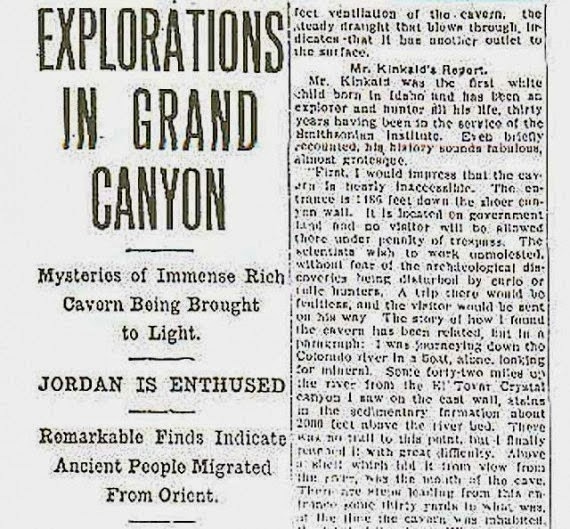
April 5th, 1909
EXPLORATIONS IN GRAND CANYON
Mysteries of Immense Rich Cavern being brought to light
Jordan is enthused
Remarkable finds indicate ancient people migrated from Orient
The latest news of the progress of the explorations of what is now
regarded by scientists as not only the oldest archeological discovery in the
United States, but one of the most valuable in the world, which was
mentioned some time ago in the Gazette, was brought to the city yesterday by
G.E. Kinkaid, the explorer who found the great underground citadel of the
Grand Canyon during a trip from Green River, Wyoming, down the Colorado, in
a wooden boat, to Yuma, several months ago.
A Thorough Examination
Under the direction of Prof. S. A. Jordan, the Smithsonian Institute is
now prosecuting the most thorough explorations, which will be continued
until the last link in the chain is forged. Nearly a mile underground, about
1480 feet below the surface, the long main passage has been delved into, to
find another mammoth chamber from which radiates scores of passageways, like
the spokes of a wheel.
Several hundred rooms have been discovered, reached by passageways
running from the main passage, one of them having been explored for 854 feet
and another 634 feet. The recent finds include articles which have never
been known as native to this country, and doubtless they had their origin in
the orient. War weapons, copper instruments, sharp-edged and hard as steel,
indicate the high state of civilization reached by these strange people. So
interested have the scientists become that preparations are being made to
equip the camp for extensive studies, and the force will be increased to
thirty or forty persons.
Mr. Kinkaid's Report
Mr. Kinkaid was the first white child born in Idaho and has been an
explorer and hunter all his life, thirty years having been in the service of
the Smithsonian Institute. Even briefly recounted, his history sounds
fabulous, almost grotesque.
"First, I would impress that the cavern is nearly inaccessible. The
entrance is 1,486 feet down the sheer canyon wall. It is located on
government land and no visitor will be allowed there under penalty of
trespass. The scientists wish to work unmolested, without fear of
archeological discoveries being disturbed by curio or relic hunters.
A trip there would be fruitless, and the visitor would be sent on his
way. The story of how I found the cavern has been related, but in a
paragraph: I was journeying down the Colorado river in a boat, alone,
looking for mineral. Some forty-two miles up the river from the El Tovar
Crystal canyon, I saw on the east wall, stains in the sedimentary formation
about 2,000 feet above the river bed. There was no trail to this point, but
I finally reached it with great difficulty.
Above a shelf which hid it from view from the river, was the mouth of the
cave. There are steps leading from this entrance some thirty yards to what
was, at the time the cavern was inhabited, the level of the river. When I
saw the chisel marks on the wall inside the entrance, I became interested,
securing my gun and went in. During that trip I went back several hundred
feet along the main passage till I came to the crypt in which I discovered
the mummies. One of these I stood up and photographed by flashlight. I
gathered a number of relics, which I carried down the Colorado to Yuma, from
whence I shipped them to Washington with details of the discovery. Following
this, the explorations were undertaken.
The Passages
"The main passageway is about 12 feet wide, narrowing to nine feet toward
the farther end. About 57 feet from the entrance, the first side-passages
branch off to the right and left, along which, on both sides, are a number
of rooms about the size of ordinary living rooms of today, though some are
30 by 40 feet square. These are entered by oval-shaped doors and are
ventilated by round air spaces through the walls into the passages. The
walls are about three feet six inches in thickness.
The passages are chiseled or hewn as straight as could be laid out by an
engineer. The ceilings of many of the rooms converge to a center. The
side-passages near the entrance run at a sharp angle from the main hall, but
toward the rear they gradually reach a right angle in direction.
The Shrine
"Over a hundred feet from the entrance is the cross-hall, several hundred
feet long, in which are found the idol, or image, of the people's god,
sitting cross-legged, with a lotus flower or lily in each hand. The cast of
the face is oriental, and the carving this cavern. The idol almost resembles
Buddha, though the scientists are not certain as to what religious worship
it represents. Taking into consideration everything found thus far, it is
possible that this worship most resembles the ancient people of Tibet.
Surrounding this idol are smaller images, some very beautiful in form;
others crooked-necked and distorted shapes, symbolical, probably, of good
and evil. There are two large cactus with protruding arms, one on each side
of the dais on which the god squats. All this is carved out of hard rock
resembling marble. In the opposite corner of this cross-hall were found
tools of all descriptions, made of copper. These people undoubtedly knew the
lost art of hardening this metal, which has been sought by chemists for
centuries without result. On a bench running around the workroom was some
charcoal and other material probably used in the process. There is also slag
and stuff similar to matte, showing that these ancients smelted ores, but so
far no trace of where or how this was done has been discovered, nor the
origin of the ore.
"Among the other finds are vases or urns and cups of copper and gold,
made very artistic in design. The pottery work includes enameled ware and
glazed vessels. Another passageway leads to granaries such as are found in
the oriental temples. They contain seeds of various kinds. One very large
storehouse has not yet been entered, as it is twelve feet high and can be
reached only from above. Two copper hooks extend on the edge, which
indicates that some sort of ladder was attached. These granaries are
rounded, as the materials of which they are constructed, I think, is a very
hard cement. A gray metal is also found in this cavern, which puzzles the
scientists, for its identity has not been established. It resembles
platinum. Strewn promiscuously over the floor everywhere are what people
call "cats eyes', a yellow stone of no great value. Each one is engraved
with the head of the Malay type.
The Hieroglyphics
"On all the urns, or walls over doorways , and tablets of stone which
were found by the image are the mysterious hieroglyphics, the key to which
the Smithsonian Institute hopes yet to discover. The engraving on the tables
probably has something to do with the religion of the people. Similar
hieroglyphics have been found in southern Arizona. Among the pictorial
writings, only two animals are found. One is of prehistoric type.
The Crypt
"The tomb or crypt in which the mummies were found is one of the largest
of the chambers, the walls slanting back at an angle of about 35 degrees. On
these are tiers of mummies, each one occupying a separate hewn shelf. At the
head of each is a small bench, on which is found copper cups and pieces of
broken swords. Some of the mummies are covered with clay, and all are
wrapped in a bark fabric.
The urns or cups on the lower tiers are crude, while as the higher
shelves are reached, the urns are finer in design, showing a later stage of
civilization. It is worthy of note that all the mummies examined so far have
proved to be male, no children or females being buried here. This leads to
the belief that this exterior section was the warriors' barracks.
"Among the discoveries no bones of animals have been found, no skins, no
clothing, no bedding. Many of the rooms are bare but for water vessels. One
room, about 40 by 700 feet, was probably the main dining hall, for cooking
utensils are found here. What these people lived on is a problem, though it
is presumed that they came south in the winter and farmed in the valleys,
going back north in the summer.
Upwards of 50,000 people could have lived in the caverns comfortably. One
theory is that the present Indian tribes found in Arizona are descendants of
the serfs or slaves of the people which inhabited the cave. Undoubtedly a
good many thousands of years before the Christian era, a people lived here
which reached a high stage of civilization. The chronology of human history
is full of gaps. Professor Jordan is much enthused over the discoveries and
believes that the find will prove of incalculable value in archeological
work.
"One thing I have not spoken of, may be of interest. There is one chamber
of the passageway to which is not ventilated, and when we approached it a
deadly, snaky smell struck us. Our light would not penetrate the gloom, and
until stronger ones are available we will not know what the chamber
contains. Some say snakes, but other boo-hoo this idea and think it may
contain a deadly gas or chemicals used by the ancients. No sounds are heard,
but it smells snaky just the same. The whole underground installation gives
one of shaky nerves the creeps. The gloom is like a weight on one's
shoulders, and our flashlights and candles only make the darkness blacker.
Imagination can revel in conjectures and ungodly daydreams back through the
ages that have elapsed till the mind reels dizzily in space."
An Indian Legend
In connection with this story, it is notable that among the Hopi Indians
the tradition is told that their ancestors once lived in an underworld in
the Grand Canyon till dissension arose between the good and the bad, the
people of one heart and the people of two hearts. Machetto, who was their
chief, counseled them to leave the underworld, but there was no way out. The
chief then caused a tree to grow up and pierce the roof of the underworld,
and then the people of one heart climbed out. They tarried by Paisisvai (Red
River), which is the Colorado, and grew grain and corn.
They sent out a message to the Temple of the Sun, asking the blessing of
peace, good will and rain for people of one heart. That messenger never
returned, but today at the Hopi villages at sundown can be seen the old men
of the tribe out on the housetops gazing toward the sun, looking for the
messenger. When he returns, their lands and ancient dwelling place will be
restored to them. That is the tradition.
Among the engravings of animals in the cave is seen the image of a heart
over the spot where it is located. The legend was learned by W.E. Rollins,
the artist, during a year spent with the Hopi Indians.
There are two theories of the origin of the Egyptians. One is that they
came from Asia; another that the racial cradle was in the upper Nile region.
Heeren, an Egyptologist, believed in the Indian origin of the Egyptians. The
discoveries in the Grand Canyon may throw further light on human evolution
and prehistoric ages.