|
By: David Hatcher Childress |
|
|
Page Views: 40 |
| Hashtags: #GrandCanyon #Archaeology #ConspiracyTheories #history #HumanOrigins |
| Indiana Jones isn't the only archaeologist to have his discoveries suppressed. |
| Estimated reading time: 13 minute(s) (3086 words) |
Archaeological Cover-ups?
David Hatcher Childress
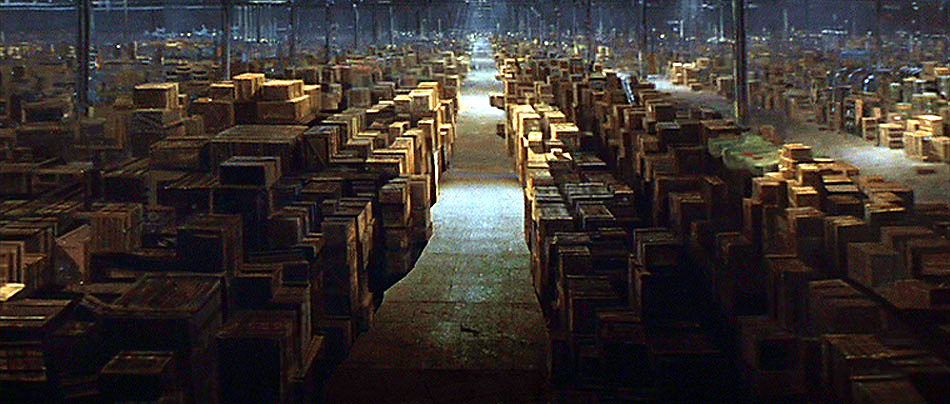
Most of us are familiar with the last scene in the popular Indiana Jones
archeological adventure film Raiders Of The Lost Ark, in which an important
historical artifact, the Ark of the Covenant from the Temple in Jerusalem, is
locked in a crate and put in a giant warehouse, never to be seen again—thus
ensuring that no history books will have to be rewritten and no history
professor will have to revise the lecture that he has been giving for the
previous forty years.
While the film was fiction, the scene in which an important ancient relic
is buried in a warehouse is uncomfortably close to reality for many
researchers. To those who investigate allegations of archaeological cover-ups,
there are disturbing indications that the most important archaeological
institute in the United States, the Smithsonian Institute, an independent
federal agency, has been actively suppressing some of the most interesting and
important archaeological discoveries made in the Americas.
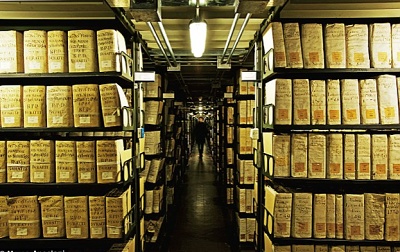
They aren't the only ones. The Vatican, too, has been long accused of
keeping artifacts and ancient books in their vast cellars, without allowing
the outside world access to them. These secret treasures, often of a
controversial historical or religious nature, are allegedly suppressed by the
Catholic Church because they might damage the church's credibility, or perhaps
cast their official texts in doubt. Sadly, there is overwhelming evidence that
something very similar is happening with the Smithsonian Institution.
The cover-up and alleged suppression of archaeological evidence began in
late 1881 when John Wesley Powell, the geologist famous for exploring the
Grand Canyon, appointed Cyrus Thomas as the director of the Eastern Mound
Division of the Smithsonian Institution's Bureau of Ethnology.
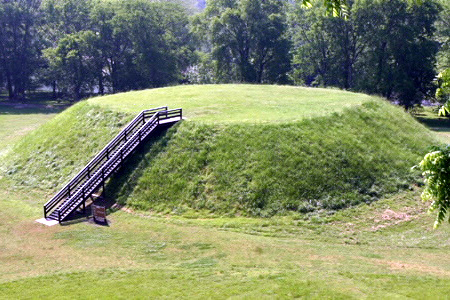
The Mounds, discovered in the Americas through the south and Midwest, had
been built by a sophisticated people for over a thousand years before
Europeans conquered the New World. While "mounds" don't sound very impressive,
excavating them showed them to be the remains of sophisticated cities, in
which some buildings may have even had plaster walls.
However, John Wesley Powell, the director of the Bureau of Ethnology, was
very sympathetic toward the American Indians, since he had lived with
the peaceful Winnebago Indians of Wisconsin for many years as a youth. He felt
that American Indians were unfairly thought of as primitive and savage. As
soon as Thomas's appointment was complete, the Smithsonian began to promote
the idea that Native Americans were descended from advanced civilizations, in
spite of Thomas's previously published position; and, thus, were
worthy of respect and protection.
The Smithsonian also began a program of suppressing any archaeological
evidence that lent credence to the school of thought known as Diffusionism, a
school which believes that throughout history there has been widespread
dispersion of culture and civilization via contact by ship and major trade
routes.
The Smithsonian opted for the opposite school, known as Isolationism.
Isolationism holds that most civilizations are isolated from each other and
that there has been very little contact between them, especially those that
are separated by bodies of water. In this intellectual war that started in the
1880s, it was held that even contact between the civilizations of the Ohio and
Mississippi Valleys were rare, and certainly these civilizations did not have
any contact with such advanced cultures as the Mayas, Toltecs, or Aztecs in
Mexico and Central America. By Old World standards this is an extreme, and
even ridiculous idea, considering that the river system reached to the Gulf of
Mexico and these civilizations were as close as the opposite shore of the
gulf. It was like saying that cultures in the Black Sea area could not have
had contact with the Mediterranean.
When the contents of many ancient mounds and pyramids of the Midwest were
examined, it was shown that the history of the Mississippi River Valleys was
that of an ancient and sophisticated culture that had been in contact with
Europe and other areas. Not only that, the contents of many mounds revealed
burials of huge men, sometimes seven or eight feet tall, in full armor with
swords and sometimes huge treasures.
For instance, when Spiro Mound in Oklahoma was excavated in the 1930's, a
tall man in full armor was discovered along with a pot of thousands of pearls
and other artifacts, the largest such treasure so far documented. There were
many witnesses to this excavation; yet, the whereabouts of the man in armor is
unknown. It is quite likely that it eventually was taken to the Smithsonian
Institution.
In a private conversation with a well-known historical researcher (who
requests that he remain nameless), I was told that a former employee of the
Smithsonian, who was dismissed for defending the view of Diffusionism in the
Americas (i.e. the heresy that other ancient civilizations may have visited
the shores of North and South America during the many millennia before
Columbus), alleged that the Smithsonian at one time had actually taken a barge
full of unusual artifacts out into the Atlantic and dumped them in the ocean.
Though the idea of the Smithsonian' covering up a valuable archaeological
find is difficult for some to accept, there is, sadly, a great deal of
evidence to suggest that the Smithsonian Institution has knowingly covered up
and "lost" important archaeological relics. The Stonewatch Newsletter of the
Gungywamp Society in Connecticut, which researches megalithic sites in New
England, had a curious story in their Winter, 1992, issue about stone coffins
discovered in 1892 in Alabama which were sent to the Smithsonian Institution
and then "lost". According to the newsletter, researcher Frederick J. Pohl
wrote an intriguing letter in 1950 to the late Dr. T.C. Lethbridge, a British
archaeologist:
A professor of geology sent me a reprint (of the) Smithsonian
Institution, The Crumf Burial Cave by Frank Burns, US Geological
Survey, from the report of the US National Museum for 1892, pp 451-454,
1984. In the Crumf Cave, southern branch of the Warrior River, in Murphy's
Valley, Blount County, Alabama, accessible from Mobile Bay by river, were
coffins of wood hollowed out by fire, aided by stone or copper chisels.
Either of these coffins were taken to the Smithsonian. They were about 7.5
feet long, 14" to 18" wide, 6" to 7" deep. Lids open.
I wrote recently to the Smithsonian, and received a reply March 11th from
F.M. Setzler, Head Curator of Department of Anthropology (He said) 'We have
not been able to find the specimens in our collections, though records show
that they were received.
David Barron, President of the Gungywamp Society was eventually told by the
Smithsonian in 1992 that the coffins were actually wooden troughs and that
they could not be viewed anyway because they were housed in an
asbestos-contaminated warehouse. This warehouse was to be closed for the next
ten years and no one was allowed in except the Smithsonian personnel!
Ivan T. Sanderson, a well-known zoologist and frequent guest on Johnny
Carson's Tonight Show in the 1960s (usually with an exotic animal like a
pangolin or a lemur), once related a curious story about a letter he received
regarding an engineer who was stationed on the Aleutian island of Shemya
during World War II. While building an airstrip, his crew bulldozed a group of
hills and discovered under several sedimentary layers what appeared to be
human remains. The Alaskan mound was in fact a graveyard of gigantic human
remains, consisting of crania and long leg bones.
The crania measured from 22 to 24 inches from base to crown. Since an adult
skull normally measures about eight inches from back to front, such a large
crania would imply an immense size for a normally proportioned human.
Furthermore, every skull was said to have been neatly trepanned (a process of
cutting a hole in the upper portion of the skull).
In fact, the habit of flattening the skull of an infant and forcing it to
grow in an elongated shape was a practice used by ancient Peruvians, the
Mayas, and the Flathead Indians of Montana. Sanderson tried to gather further
proof, eventually receiving a letter from another member of the unit who
confirmed the report. The letters both indicated that the Smithsonian
Institution had collected the remains, yet nothing else was heard. Sanderson
seemed convinced that the Smithsonian Institution had received the bizarre
relics, but wondered why they would not release the data. He asks, "…is it
that these people cannot face rewriting all the textbooks?"
In 1944 an accidental discovery of an even more controversial nature was
made by Waldemar Julsrud at Acambaro, Mexico. Acambaro is in the state of
Guanajuato, 175 miles northwest of Mexico City. The strange archaeological
site there yielded over 33,500 objects of ceramic; stone, including jade; and
knives of obsidian (sharper than steel and still used today in heart surgery).
Jalsrud, a prominent local German merchant, also found statues ranging from
less than an inch to six feet in length depicting great reptiles, some of them
in active association with humans—generally eating them, but in some bizarre
statuettes an erotic association was indicated. To observers many of these
creatures resembled dinosaurs.
Jalsrud crammed this collection into twelve rooms of his expanded house.
These startling representations of Negroes, Orientals, and bearded Caucasians
were included as were motifs of Egyptians, Sumerian and other ancient
non-hemispheric civilizations, as well as portrayals of Bigfoot and aquatic
monster-like creatures, weird human-animal mixtures, and a host of other
inexplicable creations. Teeth from an extinct Ice Age horse, the skeleton of a
mammoth, and a number of human skulls were found at the same site as the
ceramic artifacts.
Radio-carbon dating in the laboratories of the University of Pennsylvania
and additional tests using the thermoluminescence method of dating pottery
were performed to determine the age of the objects. Results indicated the
objects were made about 6,500 years ago, around 4,500 BC. A team of experts at
another university, shown Jalrud's half-dozen samples but unaware of their
origin, ruled out the possibility that they could have been modern
reproductions. However, they fell silent when told of their controversial
source.
In 1952, in an effort to debunk this weird collection which was gaining a
certain amount of notoriety, American archaeologist Charles C. DiPeso claimed
to have minutely examined the 32,000 pieces in a four hour period spent at the
home of Julsrud. In a forthcoming book, long delayed by continuing
developments in his investigation, archaeological investigator John H.
Tierney, who has lectured on the case for decades, points out that to have
done that DiPeso would have had to have inspected 133 pieces per minute
steadily for four hours. In actuality, it would have required weeks merely to
have separated the massive jumble of exhibits and arranged them properly for a
valid evaluation.
Tierney, who collaborated with the late Professor Hapgood, the late William
N. Russell, and others in the investigation, charges that the Smithsonian
Institution and other archaeological authorities conducted a campaign of
disinformation against the discoveries. The Smithsonian had, early in the
controversy, dismissed the entire Acambaro collection as an elaborate hoax.
Also, utilizing the Freedom of Information Act, Tierney discovered that
practically the entirety of the Smithsonian's Julsrud case files are missing.
After two expeditions to the site in 1955 and 1968, Professor Charles
Hapgood, a professor of history and anthropology at the University of New
Hampshire, recorded the results of his 18-year investigation of Acambaro in a
privately printed book entitled Mystery in Acambaro. Hapgood was initially an
open-minded skeptic concerning the collection but became a believer after his
first visit in 1955, at which time he witnessed some of the figures being
excavated and even dictated to the diggers where he wanted them to dig.
Adding to the mind-boggling aspects of this controversy is the fact that
the Instituto Nacional de Antropologia e Historia, through the late Director
of PreHispanic Monuments, Dr. Eduardo Noguera, (who, as head of an official
investigating team at the site, issued a report which Tierney will be
publishing), admitted "the apparent scientific legality with which these
objects were found." Despite evidence of their own eyes, however, officials
declared that because of the objects' "fantastic" nature, they had to have
been a hoax played on Julsrud!
A disappointed but ever-hopeful Julsrud died. His house was sold and the
collection put in storage. The collection is not currently open to the public.
Perhaps the most amazing suppression of all is the excavation of an
Egyptian tomb by the Smithsonian itself in Arizona. A lengthy front page story
of the Phoenix Gazette on 5 April
1909, gave a highly detailed report of the discovery and excavation of a
rock-cut vault by an expedition led by a Professor S.A. Jordan of the
Smithsonian. The Smithsonian, however, claims to have absolutely no knowledge
of the discovery or its discoverers.
The World Explorers Club decided to check on this story by calling the
Smithsonian in Washington, D.C., though we felt there was little chance of
getting any real information. After speaking briefly to an operator, we were
transferred to a Smithsonian staff archaeologist.
I told her that I was investigating a story from a 1909 Phoenix newspaper
article about the Smithsonian Institution's having excavated rock-cut vaults
in the Grand Canyon where Egyptian artifacts had been discovered, and whether
the Smithsonian Institution could give me any more information on the subject.
"Well, the first thing I can tell you, before we go any further," she said,
"is that no Egyptian artifacts of any kind have ever been found in North or
South America. Therefore, I can tell you that the Smithsonian Institute has
never been involved in any such excavations." She was quite helpful and polite
but, in the end, knew nothing. Neither she nor anyone else with whom I spoke
could find any record of the discovery or either G.E. Kinkaid and Professor
S.A. Jordan.
While it cannot be discounted that the entire story is an elaborate
newspaper hoax, the fact that it was on the front page, named the prestigious
Smithsonian Institution, and gave a highly detailed story that went on for
several pages, lends a great deal to its credibility. It is hard to believe
such a story could have come out of thin air.
Is the Smithsonian Institution covering up an archaeological discovery of
immense importance? If this story is true it would radically change the
current view that there was no transoceanic contact in pre-Columbian times,
and that all American Indians, on both continents, are descended from Ice Age
explorers who came across the Bering Strait.
Is the idea that ancient Egyptians came to the Arizona area in the ancient
past so objectionable and preposterous that it must be covered up? Perhaps the
Smithsonian Institution is more interested in maintaining the status quo than
rocking the boat with astonishing new discoveries that overturn previously
accepted academic teachings.
Historian and linguist Carl Hart, editor of World Explorer, then obtained a
hiker's map of the Grand Canyon from a bookstore in Chicago. Poring over the
map, we were amazed to see that much of the area on the north side of the
canyon has Egyptian names. The area around Ninety-four Mile Creek and Trinity
Creek had areas (rock formations, apparently) with names like Tower of Set,
Tower of Ra, Horus Temple, Osiris Temple, and Isis Temple. In the Haunted
Canyon area were such names as the Cheops Pyramid, the Buddha Cloister, Buddha
Temple, Manu Temple and Shiva Temple. Was there any relationship between these
places and the alleged Egyptian discoveries in the Grand Canyon?
We called a state archaeologist at the Grand Canyon, and were told that the
early explorers had just liked Egyptian and Hindu names, but that it was true
that this area was off limits to hikers or other visitors, "because of
dangerous caves."
Indeed, this entire area with the Egyptian and Hindu place names in the
Grand Canyon is a forbidden zone—no one is allowed into this large area!
We could only conclude that this was the area where the vaults were
located. Yet today, this area is curiously off-limits to all hikers and even,
in large part, park personnel.
I believe that the discerning reader will see that if only a small part of
the "Smithsoniangate" evidence is true, then our most hallowed archaeological
institution has been actively involved in suppressing evidence for advanced
American cultures, evidence for ancient voyages of various cultures to North
America, evidence for anomalistic giants and other oddball artifacts, and
evidence that tends to disprove the official dogma that is now the history of
North America.
The Smithsonian's Board of Regents still refuses to open its meetings to
the news media or the public. If Americans were ever allowed inside the
"nation's attic", as the Smithsonian has been called, what skeletons might
they find?
Phoenix Gazette
|
|
|
|
Page Views: 3 |
| Hashtags: #GrandCanyon #Archaeology #ConspiracyTheories |
| Complete article from a 1909 issue of the Phoenix Gazette describing anomalous discoveries in Grand Canyon that have since been suppressed. |
| Estimated reading time: 9 minute(s) (2066 words) |
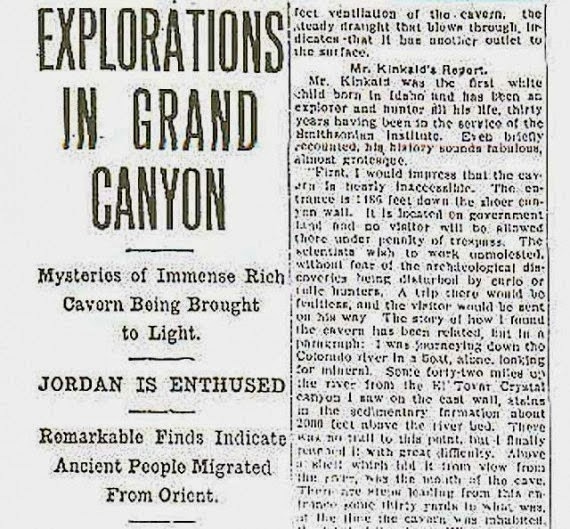
According to the story related to the Gazette by Mr. Kinkaid, the
archaeologists of the Smithsonian Institute, which is financing the
expeditions, have made discoveries which almost conclusively prove that the
race which inhabited this mysterious cavern, hewn in solid rock by human
hands, was of oriental origin, possibly from Egypt, tracing back to Rameses.
If their theories are borne out by the translation of the tablets engraved
with hieroglyphics, the mystery of the prehistoric peoples of North America,
their ancient arts, who they were and whence they came, will be solved.
Egypt and the Nile, and Arizona and the Colorado will be linked by a
historical chain running back to ages which staggers the wildest fancy of
the fictionist.