|
By: Paul S Cilwa |
Posted: 4/13/2026 |
|
Page Views: 216 |
| Hashtags: #Supplements #Health #Aging #Depression #Folate |
| A pharmacist friend asked why I wasn't taking methyl folate. Two days later I understood why. |
| Estimated reading time: 7 minute(s) (1440 words) |
The Hot Spring
In January of 2024, I took my friend out to El Dorado Hot Springs
in Tonopah—about an hour west of Phoenix, out where the
desert gets serious and the cell signal does not. The water comes
up at about 104 degrees, no sulfur smell, and if you sit in it
long enough you start to feel like your skeleton is optional.
At the time I was dealing with a mild but persistent depression.
I was coming to grips with the fact that I was facing the final
years of my life and that my right hip, despite surgery, was
making mobility an increasingly theoretical concept. The
combination of mortality and immobility is not a cheerful one.
I was not in crisis. I was just…gray. Everything was gray.
The kind of gray where you can still function and still laugh at
jokes but the laughter does not quite reach the place where joy
lives.

My friend and I were soaking and talking about the supplements I
was taking—a conversation that happens naturally when one
person is seventy-two and the other is studying pharmacology. I
ran down my list: the usual suspects, including a "Super" B
Complex that I was quite proud of, because it said "Super" right
there on the label and I am nothing if not a sucker for
anything sounding even faintly Kryptonian.
He looked at me the way a mechanic looks at someone who just said
they changed the oil but forgot the filter. "You're not taking
methyl folate?"
"I'm taking a B Complex," I said. "It's got all the B
vitamins in it. It says so on the bottle."
And then he explained, patiently, through the rising steam, why that was not
the same thing at all.
The Problem With Folic Acid
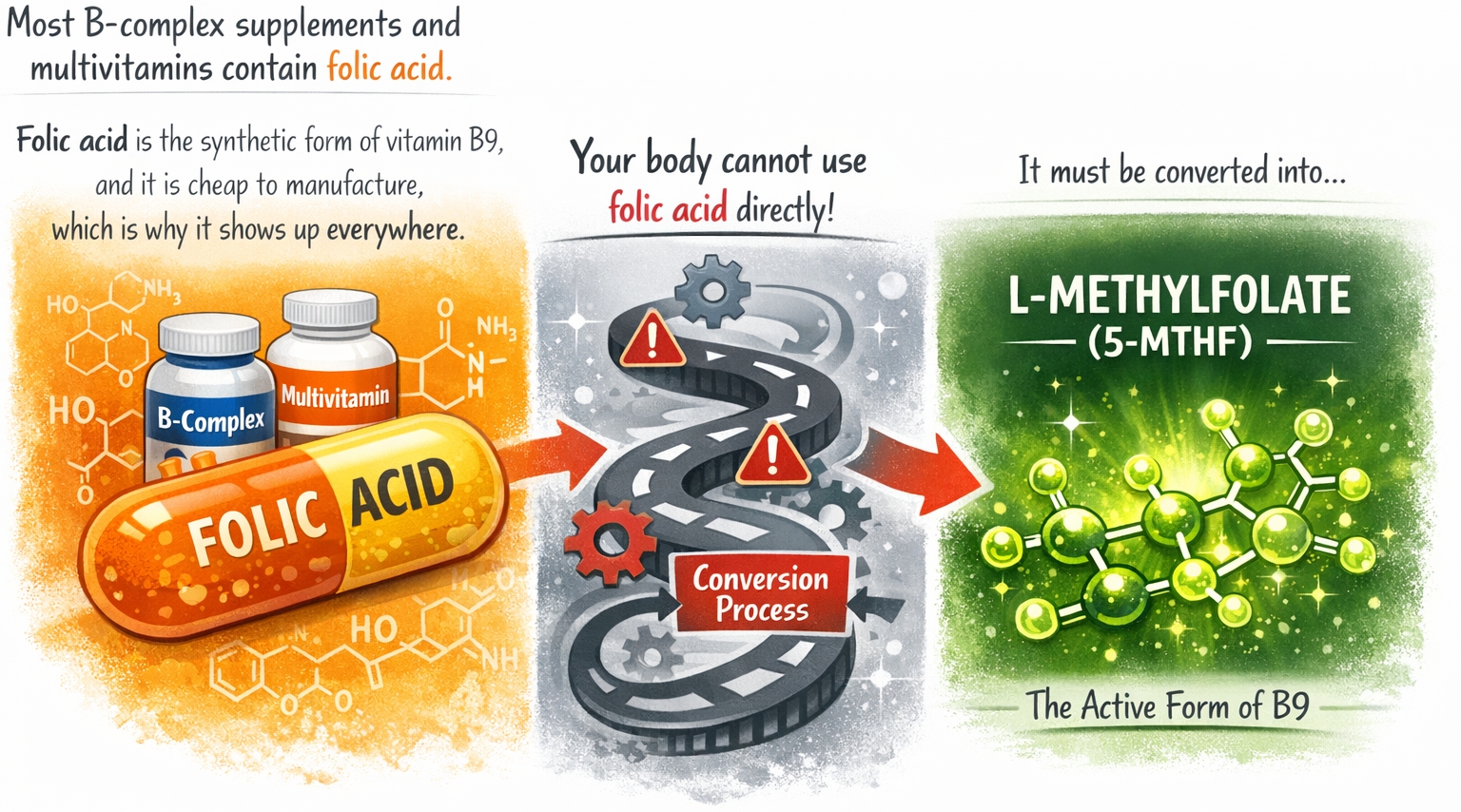
Most B-complex supplements and multivitamins contain folic acid.
Folic acid is the synthetic form of vitamin B9, and it is cheap
to manufacture, which is why it shows up everywhere. The problem
is that your body cannot use folic acid directly. It has to
convert it, through a multi-step enzymatic process, into
L-methylfolate—also called 5-MTHF—which is the
form that actually does the work.
This conversion depends on an enzyme called MTHFR. And here is
where genetics enters the chat: roughly 40% of the population
carries one or more variants of the MTHFR gene that impair this
conversion. Some people convert folic acid reasonably well. Some
convert it poorly. Some barely convert it at all. And unless you
have had genetic testing, you have no idea to which group you belong.
Even if your MTHFR enzyme works perfectly, the conversion
efficiency decreases with age. So a B-complex supplement that
provided adequate folate when you were thirty may be doing almost
nothing for you at seventy. You are swallowing a check your
body cannot cash.
What Methyl Folate Actually Does
L-methylfolate is the biologically active form of folate. It
skips the entire conversion process—no MTHFR required, no
enzymatic bottleneck, no genetic lottery. You take it, your body
uses it. Period.
What it does, once it gets where it is going, is participate in
something called the methylation cycle. This is one of those
biochemical processes that sounds abstract until you learn what it
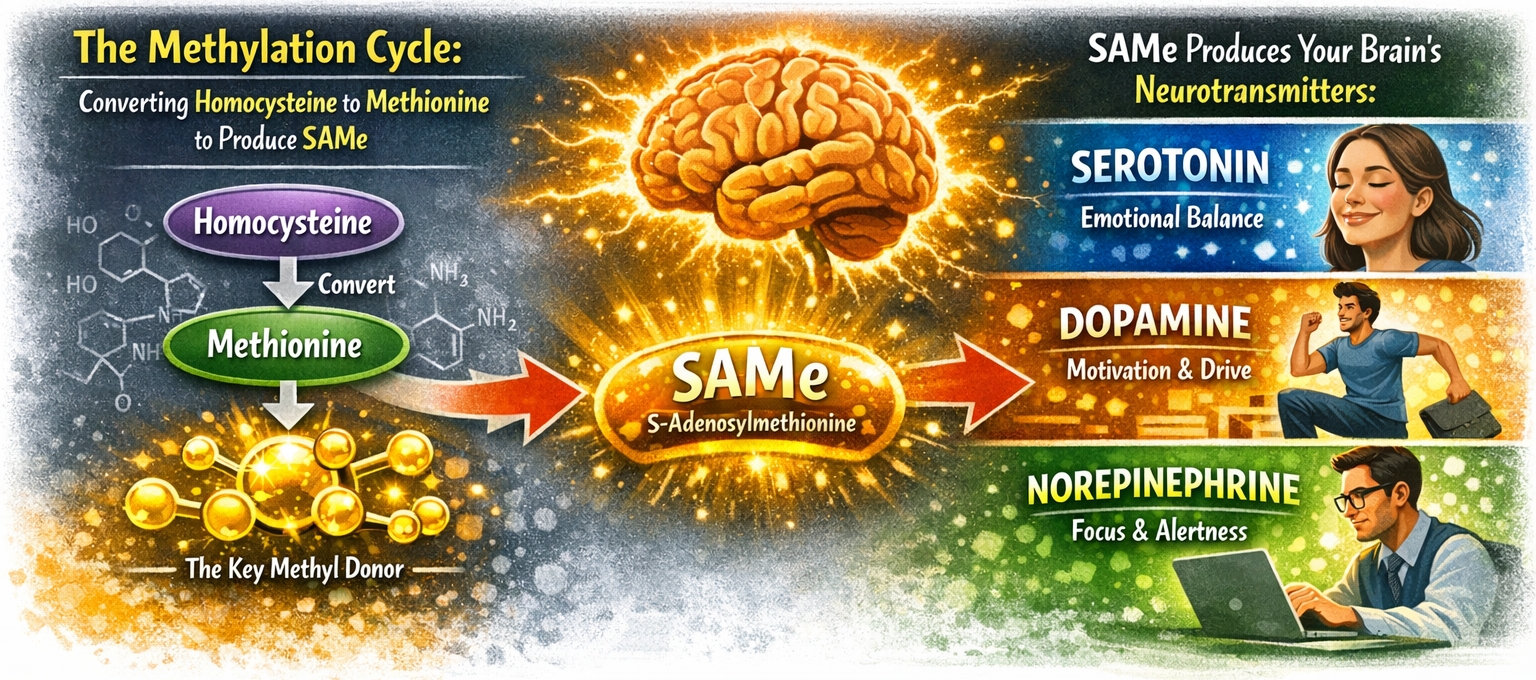
produces. The methylation cycle converts homocysteine into
methionine, which in turn produces SAMe
(S-adenosylmethionine)—and SAMe is the molecule your brain
needs to synthesize serotonin, dopamine, and norepinephrine.
Those three neurotransmitters are, collectively, your mood. Serotonin
is the one that keeps you from feeling like the world is ending.
Dopamine is the one that makes you want to get out of bed and do
something. Norepinephrine is the one that helps you focus and
respond to the world around you. If any of them runs low, you
feel it. If all three run low, you feel like I felt: gray.
Clinical studies back this up. Between 15 and 38 percent of adults
diagnosed with depression have low folate levels. When
L-methylfolate was added to standard antidepressant treatment
in randomized trials, the response rate more than doubled—32
percent versus 15 percent with a placebo. The pharmaceutical
industry noticed: there is a prescription product called Deplin
that is nothing more than L-methylfolate at 15 milligrams a day,
marketed specifically as an adjunct for treatment-resistant
depression.
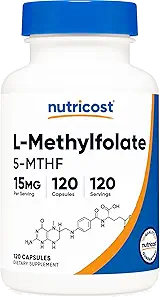
Fifteen milligrams. Which is exactly the dose I take.
Two Days

I ordered methyl folate from Amazon that evening—still
slightly pruney from the hot spring—and started taking
15 mg a day when it arrived. I figured that if I had been
running low for years, I might as well make up for lost time.
And since B vitamins are water-soluble, whatever my body did
not need would simply leave by the usual route. You cannot
really overdose on folate; your kidneys handle the excess the
way a bartender handles a customer who has had enough.
My friend had not specified why I should be taking it. He
just seemed to think it was an obvious gap in my regimen, the
way a dentist might notice you are not flossing. He did not
promise it would fix my mood. He did not promise anything.
Within two days, the gray began to lift.
It was not dramatic—not the way the glutathione
hit, where I could point to a single conversation and say
there, that is where it changed. This was more like
waking up one morning and noticing that the world had color in
it again. Not bright, exuberant, dancing-in-the-streets color.
Just…color. The sky was blue instead of gray. The dogs
were funny instead of just there. I wanted to write something,
which I had not wanted to do in months.
The depression did not vanish. But it retreated from the
foreground to the background, from a weather system to a memory
of one. I could function again. I could want things
again. That is a distinction people who have never been
depressed do not always understand: depression does not just make
you sad. It makes you not want. Not want to eat, not want to
move, not want to talk, not want to want. Getting the wanting
back is everything.
Why It Probably Works
I am not a biochemist, and I did not get genetic testing to
confirm whether I carry an MTHFR variant. But the circumstantial
case is strong. I am seventy-five. I had been taking folic acid
in a B-complex for years, which means I thought I was
getting adequate folate. I was not. Either my MTHFR conversion
was impaired by genetics, by age, or by both—and my brain
was slowly starving for the raw material it needed to make
the neurotransmitters that keep the lights on.
When I bypassed the broken conversion pathway by taking the
active form directly, my brain finally got what it had been
missing. The serotonin came back. The dopamine came back. The
norepinephrine came back. And the gray went away.
This is not a miracle. It is plumbing. The pipe was clogged, and
methyl folate went around the clog.
I still take 15 mg of methyl folate every day. My mood is
stable in a way it has not been in years. I still have bad days,
because I am a human being living in a country that currently
seems determined to test the limits of my patience, but the bad
days are bad days—not bad months, not bad seasons,
not the kind of ambient grayness that makes you forget what
sunlight feels like.
The only way my mood could improve further would be if I won the
lottery on the day of Trump's funeral.
But short of that, methyl folate will do.