|
By: Paul S Cilwa |
Posted: 4/12/2026 |
|
Page Views: 309 |
| Hashtags: #Supplements #Health #Aging #Glutathione |
| How a supplement I almost didn't try gave me back the ability to finish a sentence. |
| Estimated reading time: 8 minute(s) (1748 words) |
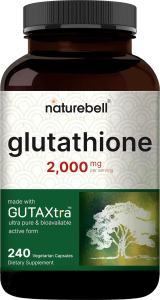
The Problem
In 2011 I was hospitalized for six months with necrotizing
fasciitis—the flesh-eating bacteria that sounds like something
from a horror movie and, I can assure you, looks and feels like one too. I
was in pain, I was anxious, and I was not shy about asking for
something to take the edge off. The something was Ativan, a
benzodiazepine that does a fine job of making you not care that
your leg is trying to kill you.
What nobody mentioned—or if they did, I was too anxious to
hear it—is that Ativan has a well-documented side effect: it
eats your short-term memory like a moth eats wool. Not all at once,
but steadily, one hole at a time.
The way it showed up in me was mid-sentence. I would start talking,
and somewhere between the subject and the verb the thought would
simply vanish. Not trail off. Not get muddled. Vanish, the
way a soap bubble does—one instant it is there, the next it
is not, and you are left staring at the spot where it used to be.
This happened several times a day. Then several times an hour.
I learned to compensate by not speaking. This turned out to be
an excellent way to develop listening skills, and I recommend it
if you can manage the discipline. But for a lifelong storyteller,
it was like being a singer who has lost his voice. The stories were
still in there. I just could not get them out.
It wasn't just speaking aloud, either. I could be typing away, and
suddenly forget what I was even writing about. I learned
that these lapses typically lasted just aboput 40 seconds,
so I would just wait them out, and then the thought would come back.
Usually.
The problem didn't start until I left the hospital. I had
stopped taking Ativan, of course; but the memory lapses continued
and if anything, they were getting worse. By the time I moved in with my
daughter in 2023, I had more or less accepted that this was just
how my brain worked now.
The Infusion

My daughter was going through a phase where she was experimenting
with longevity treatments. IV infusions of various substances,
each one promised by someone
on the internet to add years to your life. One of those substances
was glutathione.
She invited me to try an infusion. I said sure, because I was
living in her house and the least I could do was
be a good sport about her experiments. Also, as we all know, I am generally willing
to try anything. I did not expect anything dramatic to
happen. I had never heard of glutathione. I went along the way you
go along when someone offers you a sample at the grocery store:
politely, without expectations, and mostly to avoid a conversation
about why you will not try it.
That very day—not the next week, not gradually over a month,
that day—the lapses began to diminish. I noticed it
that evening, when I was telling my daughter how the infusion had gone.
I had learned to not try for more than short sentences, but I made it
through my entire story without losing the thread. I could not believe it.
And it's gotten since. I almost never have a lapse anymore, and when I do,
it is usually when I am very tired.
What Glutathione Actually Is
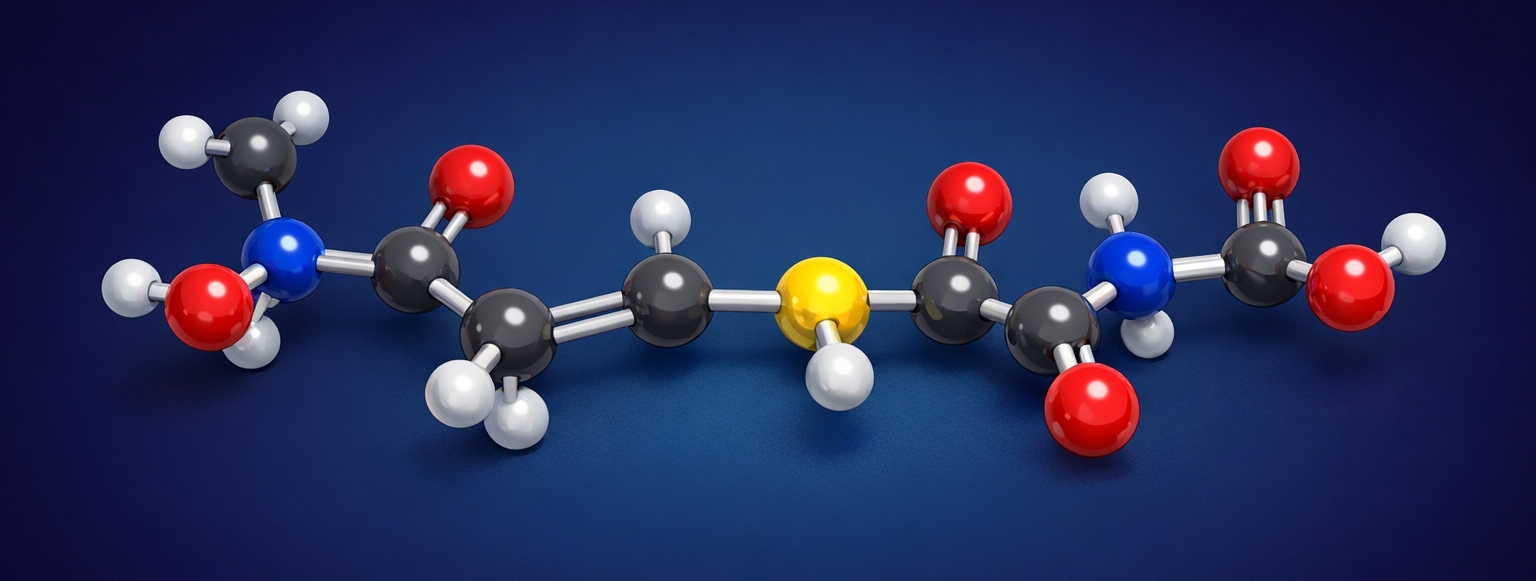
Glutathione is a tripeptide—three amino acids (glutamate,
cysteine, and glycine) linked together—that your body
manufactures primarily in the liver. It is present in virtually every
cell you have. Biochemists call it the "master antioxidant," not
because it sounds impressive on a supplement label but because it
does something no other antioxidant does: it recycles the other
antioxidants. Vitamins C and E, for example, neutralize free
radicals and are then used up. Glutathione restores them so they
can go back to work. It is the manager of the cleanup crew.
It also plays a central role in detoxification. Your liver uses
glutathione to bind to toxins—heavy metals, drug metabolites,
the chemical byproducts of simply being alive—and escort them
out of the body. Without adequate glutathione, those toxins
accumulate. This is not speculation; it is basic biochemistry, the
kind taught in first-year medical school courses that most doctors
promptly forget.
Here is the inconvenient part: your body produces less glutathione
as you age. By your seventies, your levels may be half what they
were at twenty. This decline correlates with increased oxidative
stress, reduced immune function, and—importantly for my
story—neurodegeneration.
What Ativan Did to My Brain
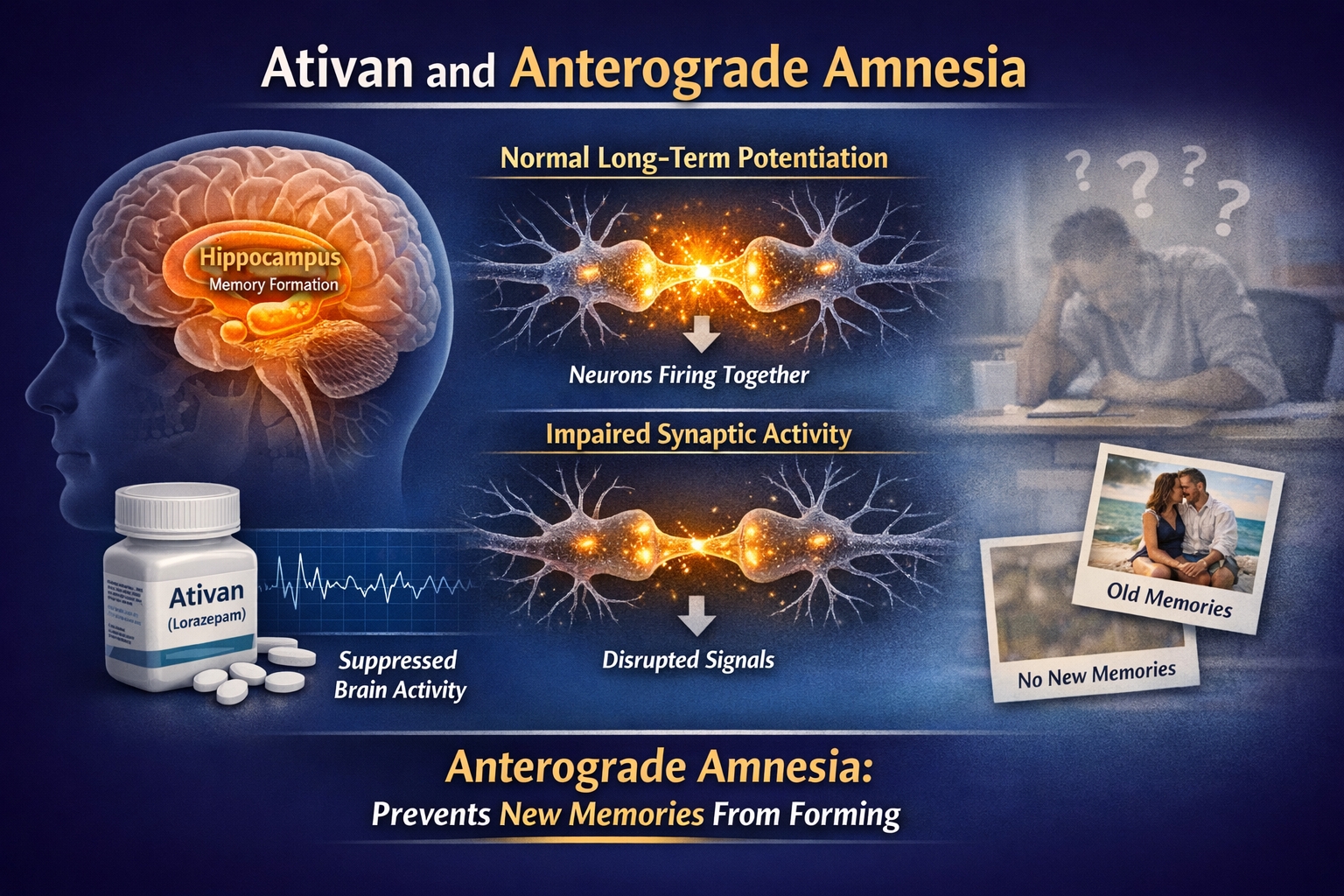
To understand why glutathione helped, it is useful to understand
what Ativan broke.
Ativan (lorazepam) is a benzodiazepine. It works by enhancing the
effect of a neurotransmitter called GABA, which is your brain's
built-in brake pedal. GABA slows neurons down. That is why
benzodiazepines reduce anxiety—they tell your brain to stop
revving so hard.
The problem is that the hippocampus—the brain structure
responsible for forming new memories—relies on a process
called long-term potentiation, which is essentially neurons
learning to fire together by firing together. Ativan suppresses
exactly this process. It does not erase existing memories; it
prevents new ones from forming properly. The clinical term is
"anterograde amnesia," and it is not a rare side effect. It is
the expected effect. Anesthesiologists use benzodiazepines
specifically because they cause amnesia—they do not
want you remembering the surgery.
What the textbooks are less clear about is what happens when the
drug is gone but the damage lingers. Prolonged benzodiazepine use
can leave the brain in a state of chronic oxidative stress. The
neurons that were suppressed do not always bounce back to full
function. They are weakened, inflamed, and struggling with an
accumulation of reactive oxygen species—the biochemical
equivalent of rust.
How the Repair Might Work
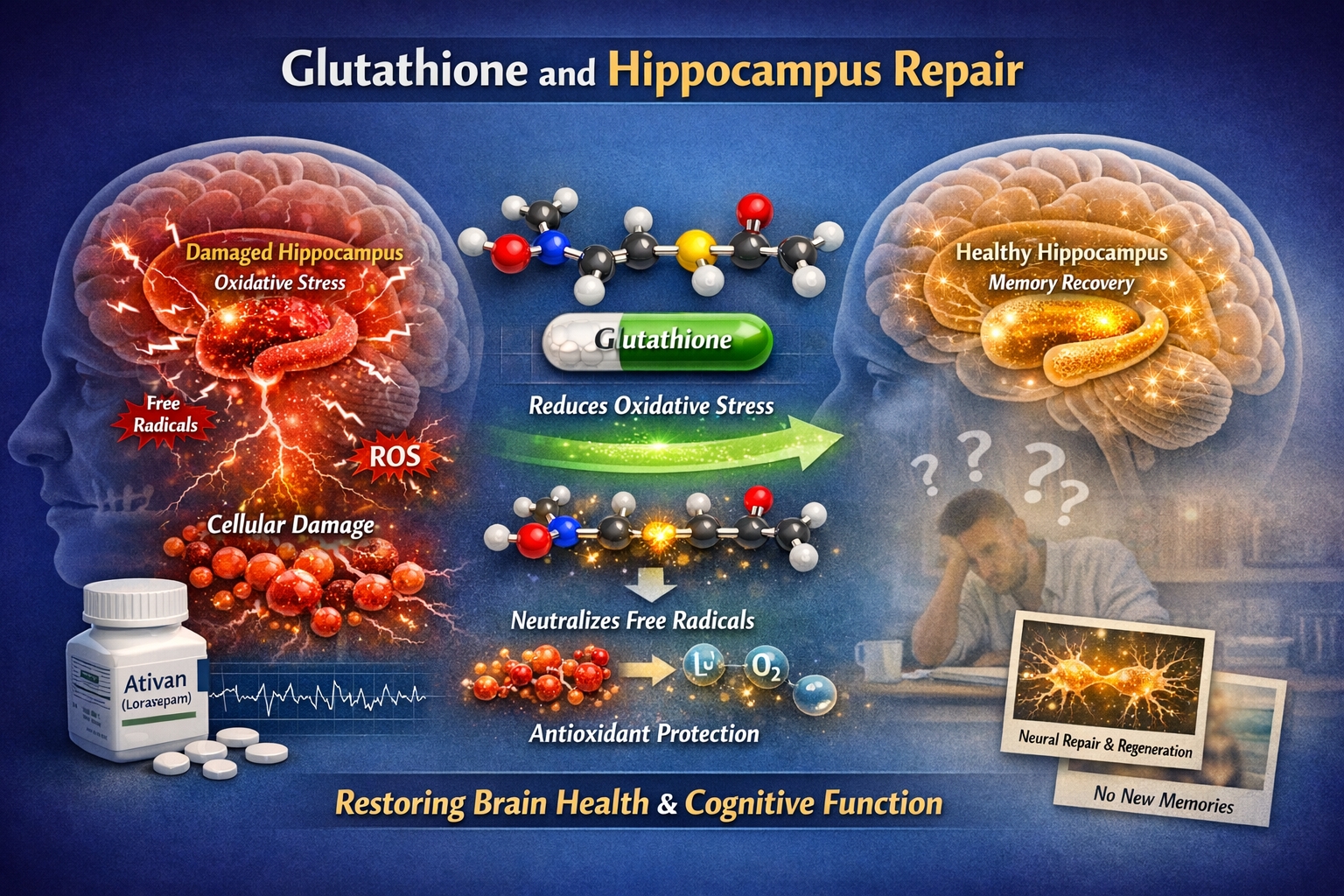
Glutathione is the brain's primary defense against oxidative stress.
It is present in high concentrations in healthy brain tissue,
and depleted glutathione levels have been linked to Parkinson's,
Alzheimer's, and other neurodegenerative conditions. The connection
is not subtle: when the brain runs low on glutathione, neurons
die faster.
My theory—and I want to be clear that this is an informed
layperson connecting dots, not a neurologist publishing a
paper—is that the prolonged Ativan use left my hippocampal
neurons in a state of oxidative distress. They were functional
enough to let me remember where I lived and who my grandchildren
were, but too compromised to reliably hold a thought for the
thirty seconds it takes to finish a sentence. The glutathione
infusion flooded those neurons with exactly what they needed to
start cleaning up the damage.
This would explain why the effect was so immediate. Glutathione
does not need to build up over weeks the way some supplements do.
It goes to work as soon as it reaches the cells. If those cells
were starving for antioxidant protection, delivering a concentrated
dose would be like giving water to someone who has been walking
through the desert—the relief is not gradual. It is instant.
Why Liposomal?
After the infusion demonstrated that glutathione worked for me, I
was not about to schedule IV appointments for the rest of my life.
I looked for an oral supplement. And here I ran into the problem
that makes glutathione tricky: your digestive system destroys it.
Regular oral glutathione—the kind in a standard capsule—has
a bioavailability of roughly three to five percent. That means for
every hundred milligrams you swallow, your body absorbs maybe
three to five. The rest is broken down by digestive enzymes before
it ever reaches your bloodstream. You might as well be swallowing
confetti.
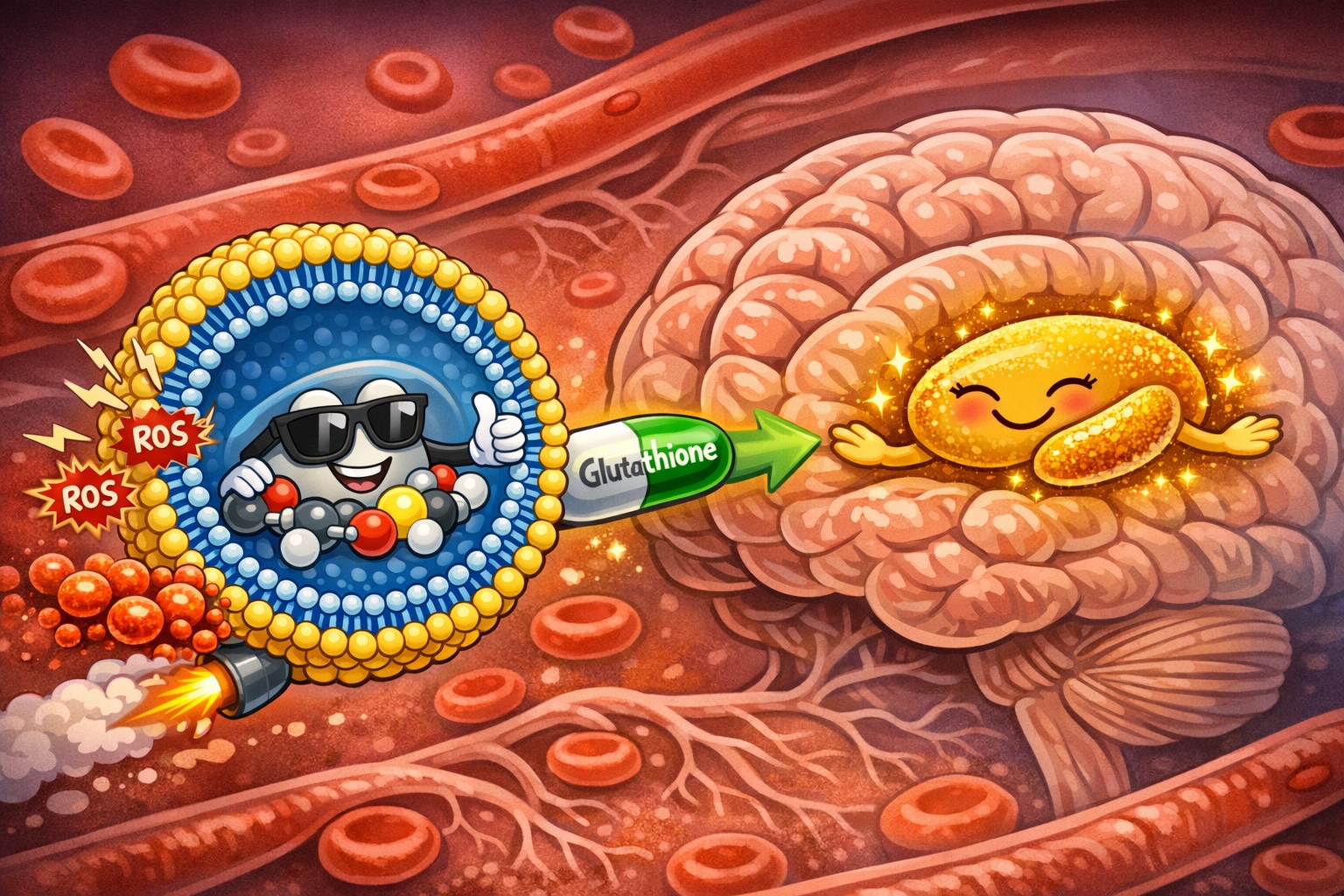
Liposomal glutathione solves this by wrapping the molecule in a
phospholipid shell—a tiny bubble made of the same material
as your cell membranes. This shell survives the acid bath of your
stomach, passes through the intestinal wall intact, and delivers
its payload directly into the cells. Studies show liposomal
delivery increases blood glutathione levels by roughly forty percent
compared to non-liposomal forms. It is not quite as effective as
an IV infusion, but it is close enough, and it comes in capsules,
two of which I take with breakfast. (And the rest of my morning "stack".)
Three Years Later

I started ordering liposomal glutathione capsules from Amazon about three
years ago. I have taken them every day since. The memory lapses have
all but vanished entirely—they still surface when I am very tired,
the way an old injury aches when the weather changes. But the
difference between where I was and where I am is the difference
between a storyteller who cannot finish a sentence and one who can
hold a room.
I am not a doctor. I am not recommending that anyone throw away
their prescriptions and start ordering supplements from Amazon. What
I am saying is that this particular supplement, in this
particular delivery system, produced a result in me that was
immediate, measurable, and sustained. I started a sentence and I
finished it. I told a story and I got to the end. After years of
silence, I got my voice back.
For a storyteller, that is not a small thing. That is everything.