|
By: Paul S. Cilwa |
Posted: 4/10/2026 |
|
Page Views: 306 |
| Hashtags: #Autobiography #Sayings #Wisdom #Aphorisms |
| Some lost sayings and wisdom from my grandmother. |
| Estimated reading time: 8 minute(s) (1865 words) |

Dorothy wasn't one to judge; she simply noticed things. Unlike my mother, who could find a moral
failing in a slightly wrinkled tablecloth, Gramma viewed the world as a series of interesting facts
that required the right label. If you were running late, you weren't irresponsible; you were just
"busier than a one-armed paperhanger." It was an assessment, not a condemnation.
I was born in 1951, exactly half a century after her, and growing up with her in Florida, I spent
hours watching her navigate the world. She saw everything. Nothing went past her, but she carried
that knowledge with a light touch that made you feel seen rather than scrutinized. Her speech was a
museum of turn-of-the-century logic, preserved in amber and delivered with a dry, folksy wit. For
example:
A Man On A Galloping Horse Wouldn't Notice

This was Gramma's favorite way to acknowledge a flaw without making a fuss. It refers to a minor
imperfection that is so small it would only be visible to someone standing perfectly still and
looking for trouble. To a person moving at speed—the way most of us actually live
our lives—it is effectively invisible.
The saying is a relic of the 19th-century agrarian world, where the "galloping horse" was the
standard for a cursory inspection. If a farmer was building a fence and one rail was an inch higher
than the rest, he'd remind himself that a man on a galloping horse wouldn't notice. It
was practical engineering for a busy life.
In our modern world of 4K resolution and high-density displays, we've mostly lost this grace. We've
replaced it with the tech-heavy "it's not a showstopper" or the cynical "good enough for government
work." Personally, I prefer Gramma's version; it acknowledges the flaw exists but suggests we all
have better things to do than stare at it.
Some's Good, More's Better

Gramma usually reserved this for the kitchen, often while pouring an extra glug of cream into the
coffee. It's a humorous endorsement of abundance, suggesting that if a little bit of a
good thing is beneficial, a lot of it must be magnificent.
While its exact "first use" is hard to pin down, it became a staple of American colloquialisms in
the late 1800s. It captures that pre-war optimism that more of everything—more land, more steel,
more pie—was the key to progress.
Today, we've flattened this into the aggressive "Go big or go home" or the corporate "scaling up."
When I'm building a database and decide to double the cache size "just because," I'm channeling
Gramma's logic. If eight gigs is good, sixteen is better.
Many Hands Make Light Work
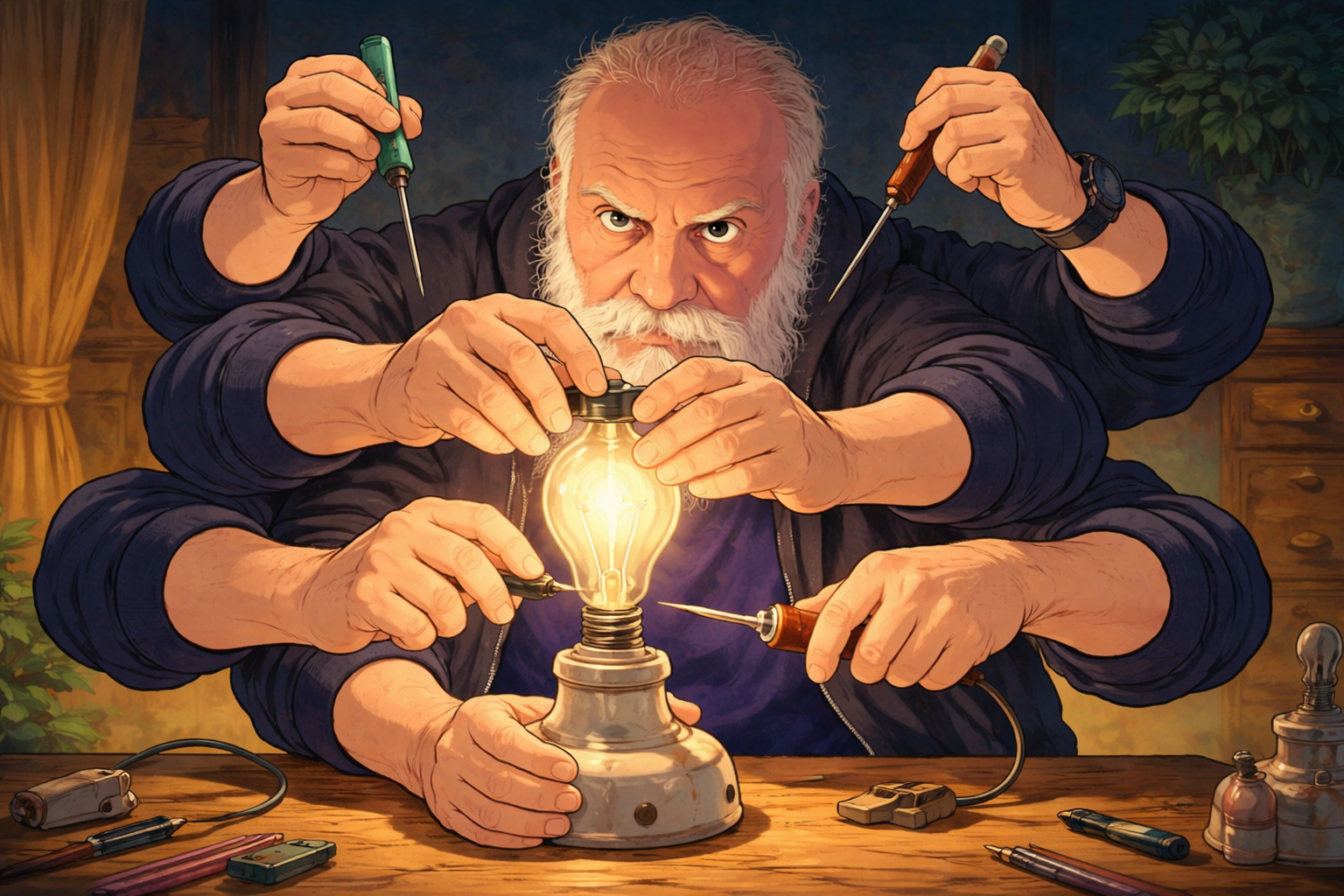
Meaning: a task becomes easy when shared by a group. Gramma used this not as a command, but as an
invitation. When the whole family had had dinner and the mountain of dishes afterwards was daunting,
would have been the perfect time to say "let's all pitch in and clean up."
But, oddly enough, she seemed to actually prefer to do the dishes by herself.
Her reminders that working on chores together seemed more advice to us,
than anything she felt she needed to follow herself.
This is one of the oldest proverbs in the English language. It's fundamentally about the efficiency
of cooperation. Before we had machines to do the heavy lifting, we had neighbors.
We still use the principle, but we call it "crowdsourcing" or "distributed computing." In
the office, it's often mutated into the hollow "synergy," which lacks the tactile reality of
several sets of hands actually lifting a heavy table.
A Stitch in Time Saves Nine

This is pure 1901 logic. It means that fixing a problem immediately (one stitch) prevents it from
becoming a catastrophe that requires a massive effort (nine stitches) later.
The first known appearance is in 1732. It comes from an era when you didn't just buy a new pair of
socks when a hole appeared; you mended what you had. It was about stewardship of your
possessions.
In my world of software, we call this "addressing technical debt." If you fix the
misconfigured SSL setting on your local machine now, you won't be spending three days debugging a
production crash later. Gramma didn't know about HTTPS, but she knew about holes in
pockets.
Six of One, Half a Dozen of the Other

This was her way of noting that two choices were identical. It wasn't a dismissive "I don't care,"
but an observation that the outcome would be the same regardless of the path.
The phrase appeared in the early 1800s. It's mathematically redundant, which is where the humor
comes from. It's a polite way to tell someone they are overthinking a trivial choice.
Now, we just say "it's a wash" or shorten it to "same difference." In web development, it's like
choosing between two different CSS frameworks that both result in the exact same layout.
Scarce As Hen's Teeth

Gramma used this to describe something exceptionally rare. If she'd been alive
when I moved to Arizona, she might have observed that a cold day in July
was as scarce as hen's teeth. It was an
observation of scarcity, not a complaint about the heat.
This Americanism dates back to the mid-19th century. It uses a biological impossibility to
emphasize how hard something is to find. It's more colorful than simply saying "rare."
The modern equivalent is calling someone or something a "unicorn." If you find a developer who is
also a world-class graphic designer and enjoys writing documentation, you've found someone scarce
as hen's teeth. (And thanks, but I'm retired!)
Busier Than a One-Armed Paperhanger
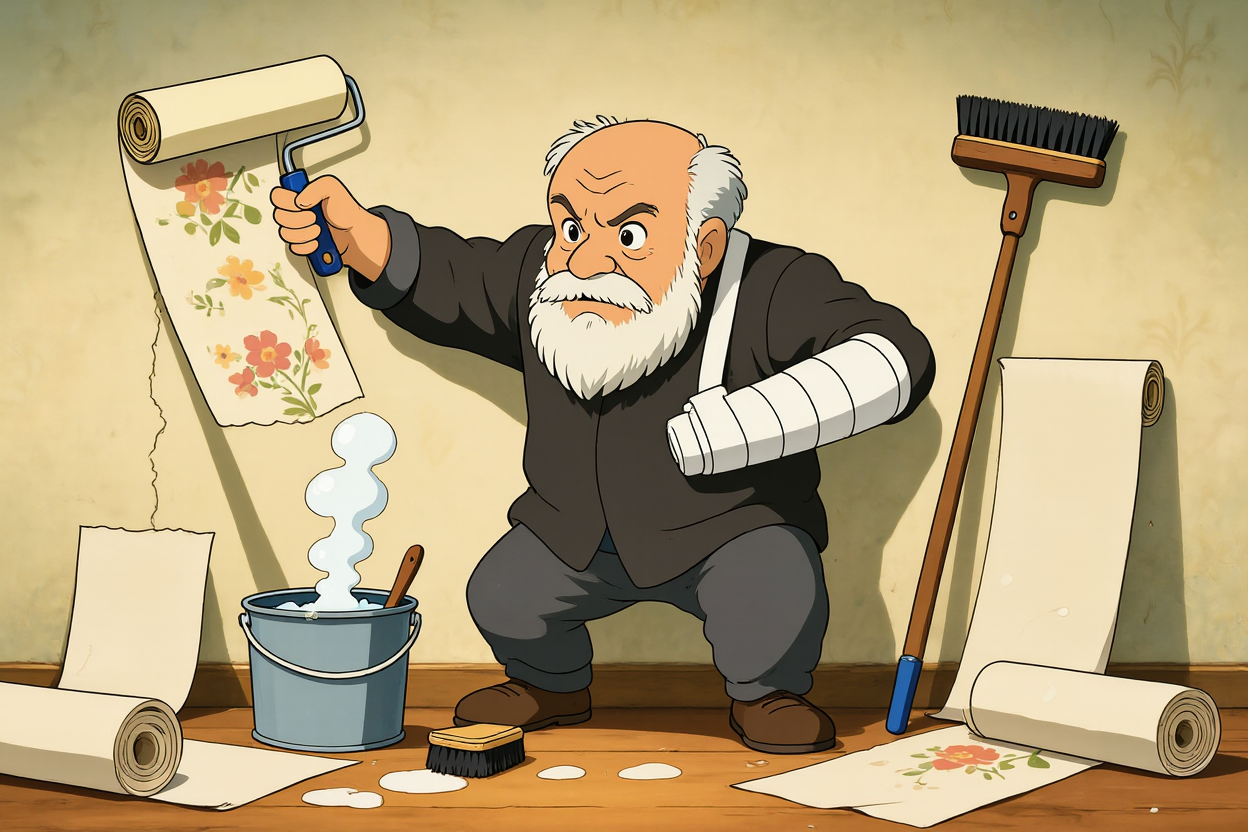
Meaning: to be frantically active, often to the point of absurdity. Paperhanging requires two hands
to keep the sticky sheets from folding over on themselves; doing it with one would involve a blur
of motion.
Popularized in the early 1900s, this phrase was common when Gramma was a young woman. It captured
the frantic pace of the emerging modern life.
We've replaced this vivid image with the dull "I'm slammed" or "I don't have the bandwidth."
Gramma's version is much better because it acknowledges the humor in the struggle.
That is, if you have the slighest idea what wallpaper is, or what a paperhanger would do with it.
He's Not The Sharpest Knife In The Drawer

As an observer, Gramma would use this to describe someone's cognitive limits without being
mean-spirited. It was just a fact, like noticing a car had a flat tire. It didn't mean the
car was bad; it just wasn't going to win a race today.
This specific variant of the "dull tool" metaphor became popular in the mid-20th century. It fits
the domestic imagery of a woman who spent a lot of time in a well-organized kitchen.
Today, we might say someone is "clueless" or, in tech circles, that they are "lagging." Gramma's
version is kinder; even a dull knife has a place in the drawer.
I Haven't Seen You in a Month of Sundays

Meaning: a very long time. In the 1901 world, Sunday was a distinct, slow-moving day of rest and
reflection. A "month" of them would take over half a year to accumulate, signifying a
significant gap in time.
The expression dates back to the early 1800s. It reflects a time when the calendar was measured by
the rhythm of the church and the community, not by the pings on a smartphone.
Now, we use the confusingly ironic "it's been a minute." We've lost the sense of patient,
ritualized time that Gramma lived by.
That's The Pot Calling The Kettle Black
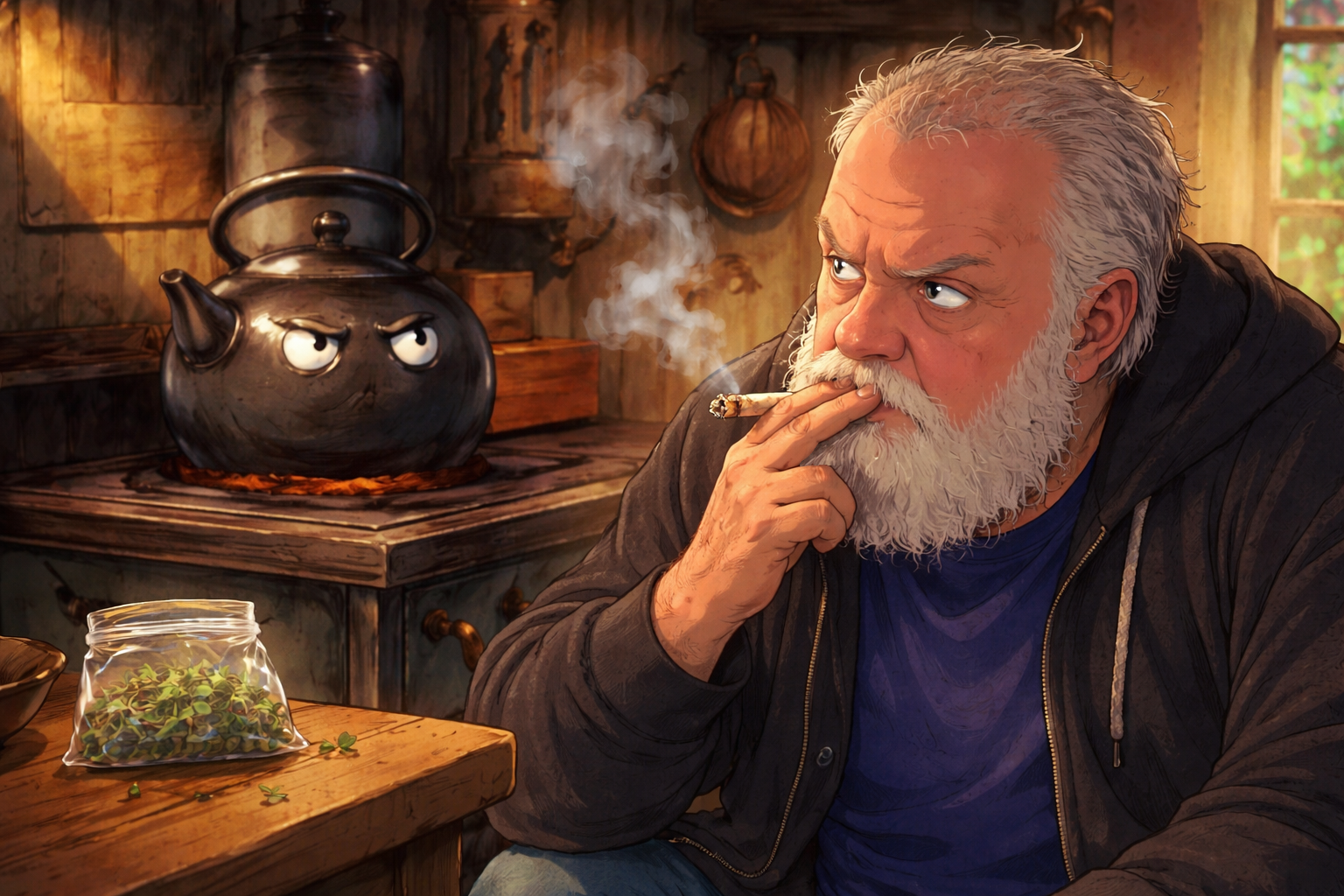
I hesitated to include this one, because I was afraid it had a racist origin.
Another of Gramma's phrases, "whip it into shape" turned out to be, as I found out
when a Black friend gently pointed out that it was a reference to whipping slaves.
I had spent the first 35 years of my life believing it was about whipping cream
into tufted shapes on desserts, which is what Gramma used it for. But it turns out
this phrase actually predates American slavery.
This is the ultimate observation of hypocrisy. Gramma didn't use it to start an argument, but to
point out a logical inconsistency. If you were complaining about someone's loud radio
while your own TV was blaring, she'd drop this one in.
It's an ancient image, famously used by Cervantes in 1605. In a world of open hearths, every piece
of cookware ended up covered in the same black soot. For one to criticize the other was absurd.
Modernity prefers "projection" or "whataboutism." Gramma's version is more grounded; it reminds us
that we're all sitting in the same fire.
Make Hay While The Sun Shines
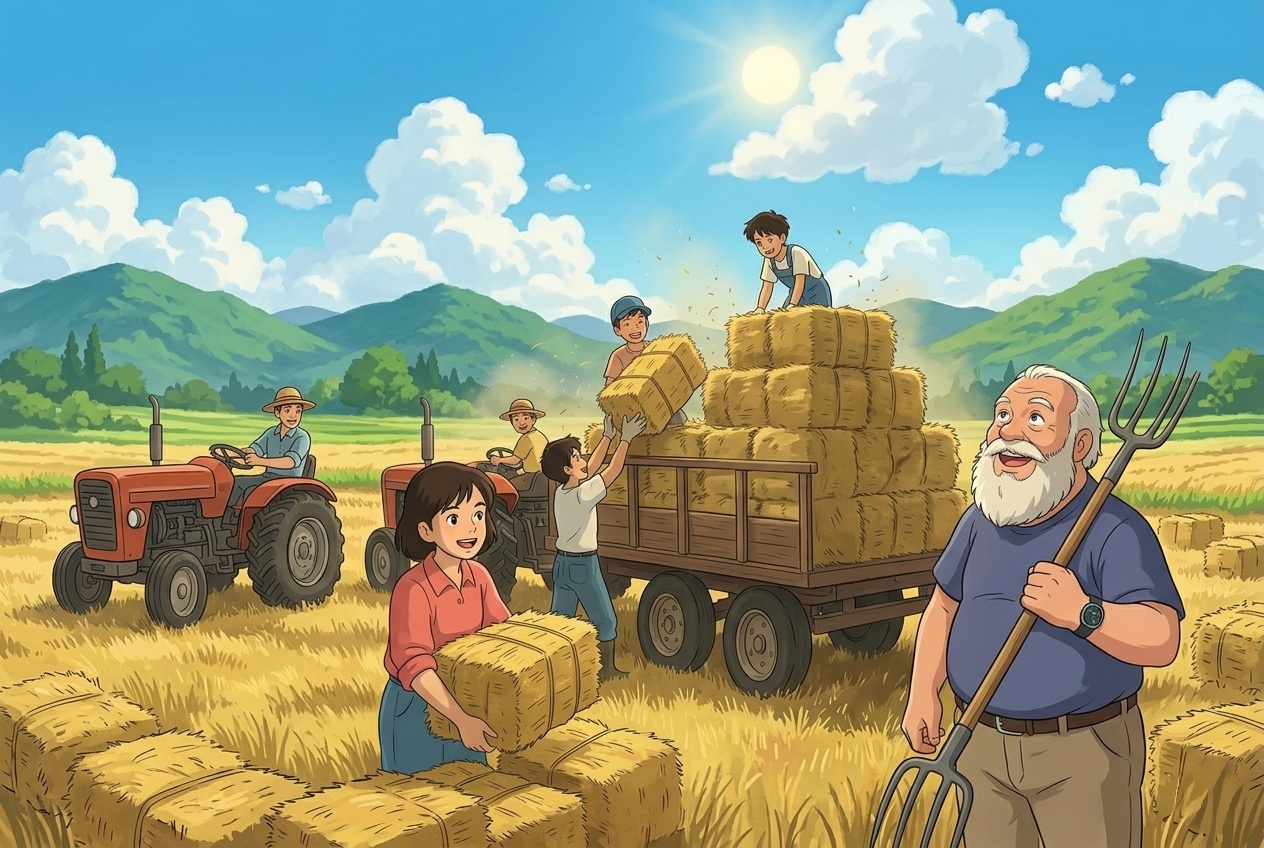
Meaning: seize an opportunity while the conditions are perfect. Gramma understood that windows of
possibility are often brief. You don't wait for a better sun; you use the one you
have.
This dates back to at least 1546. It's the fundamental rule of the harvest. If you don't cut and
dry the hay while it's sunny, the rain will ruin the crop and the cows will starve in the
winter.
In the business world, we talk about "windows of opportunity" or "first-mover advantage." I like
the hay version. It reminds me that the "sun" of a good idea or a clear afternoon is a gift you
shouldn't squander.
Looking back, I realize Gramma's sayings weren't just linguistic curiosities from a
vanished America; they were a worldview disguised as household chatter. Each
phrase carried an assumption about how to move through life—lightly,
observantly, without taking yourself too seriously. She didn't preach resilience
or mindfulness or emotional intelligence; she simply lived them, wrapped in the
vocabulary of soot-black kettles and galloping horses. And in a world that now
measures everything in metrics and micro-optimizations, her language feels almost
radical in its gentleness. It reminds me that wisdom doesn't have to be loud to
last.
I don't use all her expressions anymore—some have aged better than
others—but the spirit behind them still shapes how I see the world. When I
catch myself fretting over a misaligned div or a crooked picture frame, I hear her
voice reminding me that no one on a galloping horse is going to notice. When I'm
tempted to put something off, I remember the stitch that saves nine. These sayings
are fossils of a life lived with attention and humor, and carrying them forward
feels like a small act of preservation. They connect me to her, to the Florida
kitchen where I first heard them, and to a way of being that still has something to
teach, even now.