|
By: Paul S Cilwa |
Posted: 3/19/2026 |
|
Page Views: 152 |
| Hashtags: #Autobiography #Aging #Longevity #Supplements #Medicine |
| On knowing more about keeping yourself alive than the person you're paying to help. |
| Estimated reading time: 9 minute(s) (2041 words) |
I am seventy-four years old and will be seventy-five in
April. I have been programming computers since 1972, writing
professionally since 1990, and managing my own health with
increasing seriousness since about 2022, when the phrase
"aging gratefully" stopped being a philosophical
position and started being a daily engineering problem. I
approach my body the way I approach my code: study the
documentation, identify the failure points, and patch what
you can before the whole thing crashes to desktop.
The Knowledge Gap

Here is a thing nobody prepares you for: at a certain age,
you will know more about keeping yourself alive than the
person you are paying to help. This is not a criticism of
doctors. It is a structural observation. Most physicians
were trained in disease management—you get
sick, they fix you. The emerging field of longevity
optimization, where you try to slow or reverse the
mechanisms of aging before they produce symptoms, is
not what they studied in medical school. It was not offered
in medical school. In many cases, it did not exist when
they were in medical school. Especially if the doctor is
nearly as old as I am.
I'm so old, I can remember having a doctor who smoked.
Cigarettes.
In the examining room. While he was examining me.
Meanwhile, I have time. Retirement will do that. I can
spend three hours reading about NAD+ precursors on a
Tuesday afternoon, cross-referencing the Sinclair lab's
findings with the Mayo Clinic's senolytic trials, comparing
bioavailability data on liposomal versus standard delivery
systems, and then place an order on Amazon before dinner.
My doctor cannot do that. He has forty patients to see
before lunch. The best he can do is stay current on the
prescriptions he writes and trust that I am not actively
poisoning myself with the rest.
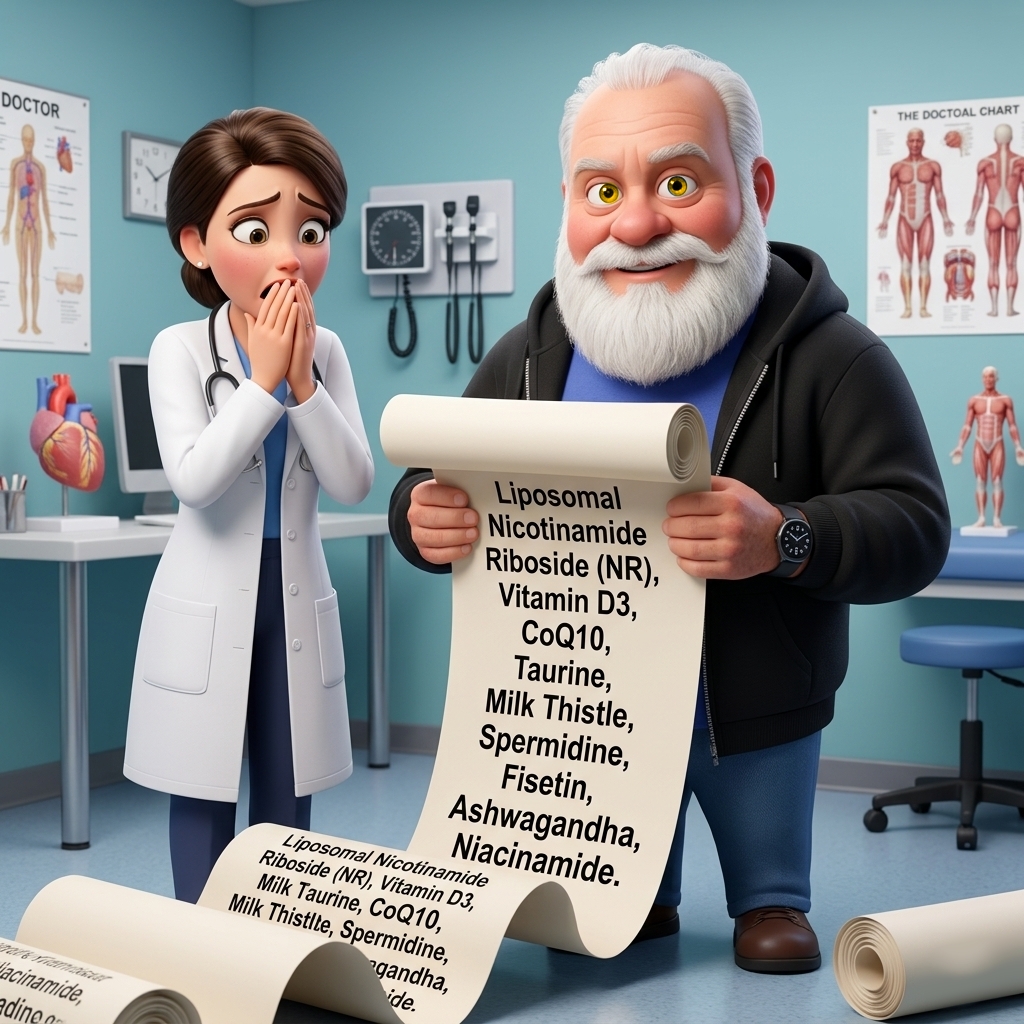
To his credit, he does trust me. When I bring him
my list, he scans it, asks about anything new, checks for
interactions with my prescriptions, and moves on. He does
not try to talk me out of supplements he has not studied,
which I appreciate. He does not pretend to know more than
he does, which I appreciate even more. Intellectual honesty
in a physician is worth more than a degree from Johns
Hopkins, and I say that as someone who has met both kinds.
What Am I Actually Doing?!
The short version: I take six prescription medications and
roughly three dozen supplements, divided into morning and
evening stacks with a few split between the two. The
prescriptions handle blood pressure, cholesterol, fluid
retention, pain, and a couple of other things that come
with being a seventy-four-year-old man who has not always
treated his body like a temple. (Well, maybe I did, but the temple
was Dionysus'.) The supplements target
everything from cellular energy and mitochondrial function
to inflammation, joint repair, liver support, and—this
is the part that makes my doctor's eyes glaze—the
selective elimination of senescent cells.
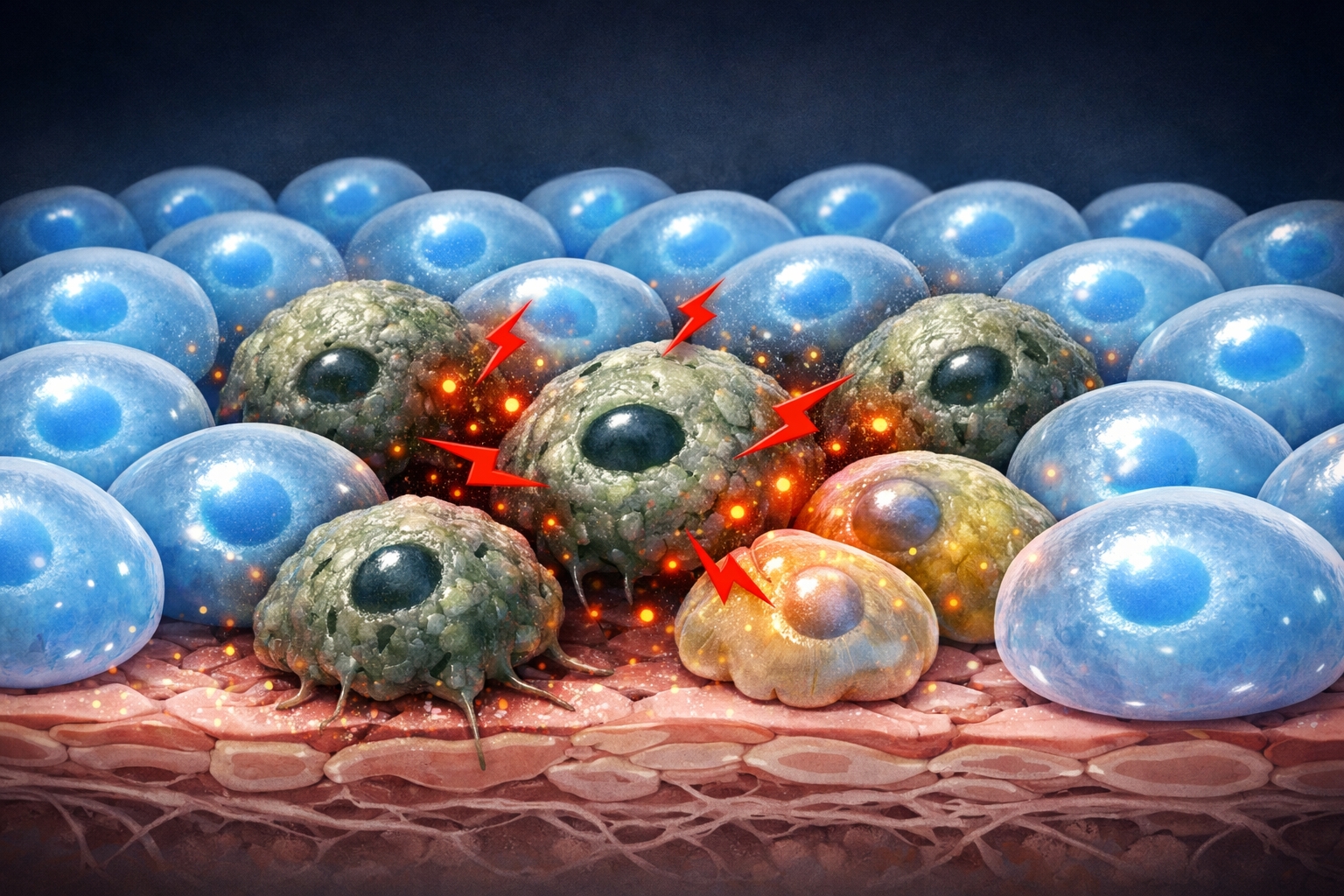
That last category is the frontier. Senolytics—compounds
like fisetin and the research-grade combination of dasatinib
plus quercetin—are being studied at places like the
Mayo Clinic with genuinely promising early results in human
trials. The idea is simple: as you age, your body accumulates
cells that have gone rogue, and if you can periodically
clear them out, the remaining healthy cells function better.
It is, essentially, garbage collection for the human body.
Any programmer will tell you how important garbage collection is!
(When it's not done right, that's why you have to restart your computer or phone every few days.)
The catch is that the field is young. The definitive
twenty-year longitudinal studies have not been done. The
optimal dosing protocols are still being debated. The
distinction between "promising early evidence"
and "proven therapy" is real, and I am not
naive about it.
But the field is young and I am not. That is the whole
calculation, right there. If I wait for the gold-standard
evidence, I will be dead before it arrives. If I act on
the best available science now—cautiously, with my
doctor in the loop, monitoring my labs—I might gain
a few years that I would not otherwise have had. And a few
years, at my age, is not a rounding error. A few years is
another grandchild's graduation. Another book. Another
sunset over the Sonoran Desert that I would have missed.
The Art of the Educated Guess

People who are uncomfortable with uncertainty tend to fall
into one of two camps: they either reject anything that
has not been conclusively proven, or they embrace everything
that sounds plausible. The first group will tell you
supplements are a waste of money. The second group will
sell you colloidal silver and magnetic bracelets. Both
groups are wrong, and both are wrong for the same reason:
they have replaced thinking with a policy.
What I try to do—what I think any informed patient
should try to do—is hold each intervention
to a standard that is honest about its own uncertainty.
CoQ10 has decades of solid evidence behind it, especially
for people on statins. Magnesium bisglycinate is well
understood. Curcumin with piperine has robust
anti-inflammatory data. These are not guesses. These are
bets with good odds.
Fisetin on a burst protocol? That is a bet with
interesting odds. The mechanism is plausible, the
preclinical data is strong, the early human trials are
encouraging, and the downside risk is a flavonoid that, at
worst, does nothing. I will take that bet. I will take it
because I am seventy-four, not in spite of it.
Gotu kola at four grams a day for cognitive enhancement?
That was a bet with bad odds, and I have since dropped it.
The evidence was thin, the dose was high, and the capsule
count was annoying. Part of being an informed patient is
being willing to fire a supplement that is not pulling its
weight, the same way you would refactor out a function that
looked clever six months ago but turned out to be dead code.
(That said, a supplement would have to make me feel really
bad for me to drop it before I've emptied out the bottle.
Thanks to my mom for instilling into me a strong sense of poverty
consciousness, it's hard for me to throw out a bottle that still has
stuff in it. Besides, it's not unreasonable to think it might start
working in the next week or two, and I don't want to waste the money.
So I give everything a good, long trial before I make a final call on it.
And, to be honest, I personally never took a supplement that made me feel
ill…but I've had several prescriptions I had to quit because they
did. Curse you, Lisinipril!)
What My Doctor Does Not Know

My doctor does not know that rhodiola rosea should be taken
in the morning because it is energizing and can interfere
with sleep if taken at night. He does not know that
prednisone depletes potassium, magnesium, vitamin C, vitamin
D, and zinc—or rather, he probably knows it in the
abstract but has not connected it to the fact that I am
already supplementing all five, which is why my labs keep
coming back normal despite being on a moderate steroid dose.
He does not know that the Super B Complex I used to take in
the evening was actively working against my melatonin and
ashwagandha because B vitamins are stimulating. I figured
that out on my own and moved it to morning.
He does not know any of this because it is not his job to
know it. His job is to prescribe the prednisone and monitor
my inflammation markers. My job—and I did not ask for
this job, it was thrust upon me by the intersection of
aging and curiosity—is to make sure the rest of the
stack does not work against the prescriptions, and ideally
works with them.
This is, I realize, a privilege. Not everyone has the time,
the literacy, or the internet access to do what I do. Not
everyone has a doctor who will listen rather than dismiss.
And not everyone has the temperament for it. My friend
who takes whatever his doctor tells him to take and nothing
else is not wrong. He is making a different bet—that
the medical establishment, for all its blind spots, is more
likely to keep him alive than his own research. That is a
reasonable position. It is just not mine.
The Programmer's Approach to Mortality

I have spent fifty-four years debugging systems. You learn
certain habits. You learn to read the error messages
instead of panicking. You learn that the first fix you try
is usually wrong, but it teaches you something. You learn
that documentation is often incomplete and sometimes
actively misleading, and that the only way to really
understand a system is to instrument it and watch what
happens.
That is what I am doing with my own body. The supplements
are the patches. The lab work is the logging. The doctor
is the senior developer I check in with to make sure I
have not introduced a regression. And the body itself is
the legacy codebase—magnificent in its complexity,
maddening in its lack of documentation, and running on
hardware that is slowly, inevitably wearing out.
I can't stop the hardware from wearing out. Nobody can,
and if someone did, that might cause more problems than it would solve.
But I can keep the software patched, monitor the
logs, and make informed decisions about which experimental
fixes are worth deploying to production. Some of them will
turn out to be brilliant. Some will turn out to be gotu
kola. The point is not to be right every time. The point
is to keep paying attention.
I should clarify something, because people tend to assume
it: I am not afraid of dying. I have had seventy-four years
to get used to the idea, which is more than enough. I
actually have memories of past lives that I have been able
to validate to my own satisfaction, so I have reason to
believe the show goes on. But even if reincarnation is not
the way it works—even if we just go out like a light
and that is the end of it—well, that is only scary if
you are desperate to cling to whatever it is you think you
have. And that desperation is itself an illusion, because
none of us ever truly possesses anything but our own will.
So this longevity thing? It is not about preventing my
eventual death. My eventual death is not in question. It is
a game—a personal challenge, the same kind of
challenge that makes me spend forty minutes deciding whether
a property should return a List or an
IEnumerable. How long can I make this body
last? Can I squeeze another decade out of it? Two? Wouldn't
it be something if I made it into the Guinness Book of
Records as the world's oldest man!
Even if I was already dead and couldn't read it.
Or—if reincarnation is true—I could.
Either way, the alternative is to stop paying attention.
To take what you are given and ask no questions and hope
for the best. And I have never, in seventy-four years of
living, been any good at that.