|
By: Paul S. Cilwa |
Posted: 5/2/2026 |
|
Page Views: 15 |
| Hashtags: #HistoricalFiction #LucianOfSamosata #Miletus #Epicureanism #Philosophy |
| Lucian learns philosophy, pleasure, consent, and the difference between lust and love. |
| Estimated reading time: 14 minute(s) (3142 words) |
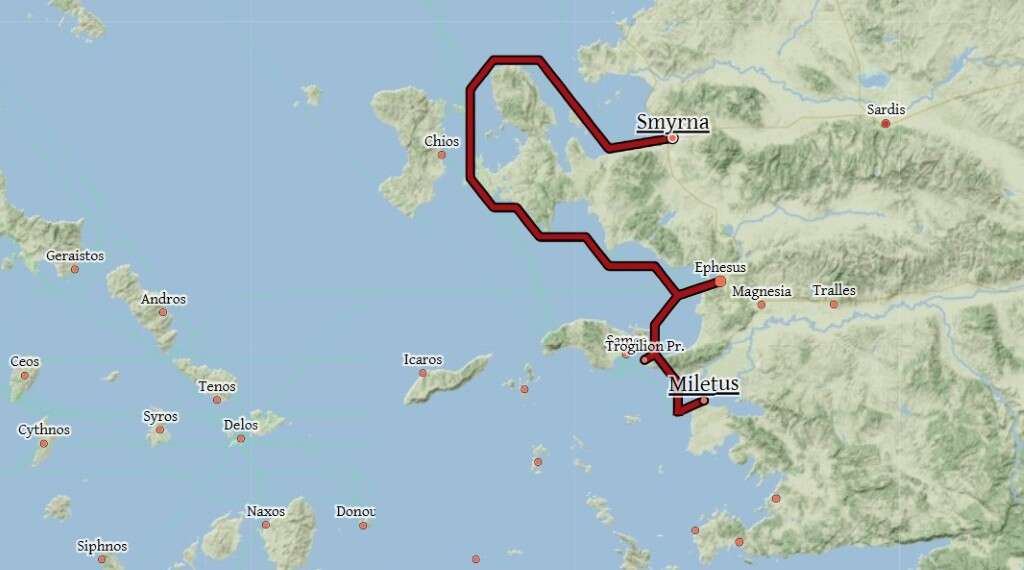
They took advantage of the coaster's stop at Ephesus to run back to Philostratos's for
clean clothes, and for Philostratos to check for any letters that might have been delivered in his absence.
Then they scurried back to the ship, arriving in plenty of time before the next
outgoing tide.
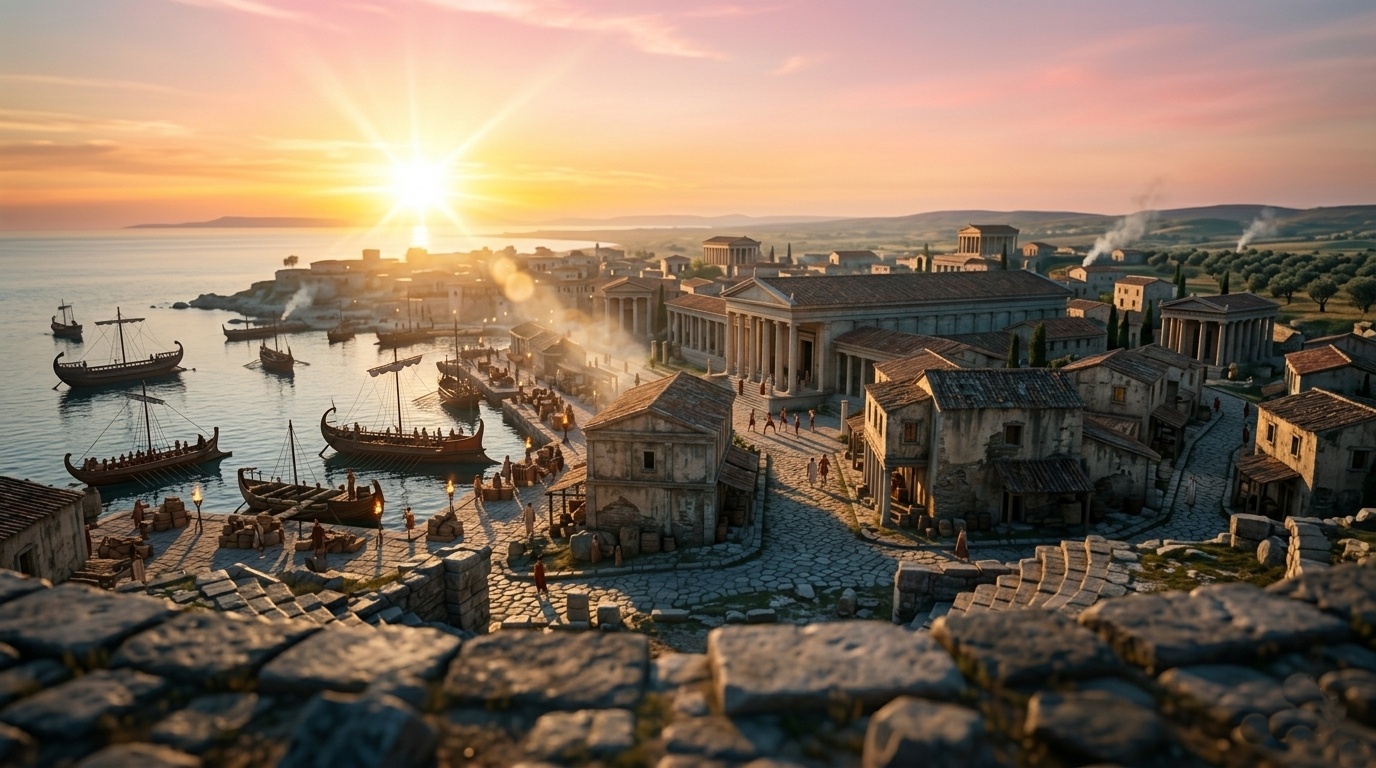
The Lion Harbor
They came into the Lion Harbor at Miletus on the morning of the fourth day. The harbor
announced itself, as it had announced itself to every ship coming this way for six
centuries, by the two great marble lions that flanked its entrance—relaxing on
their pedestals, heads turned outward, the white stone gone soft at the edges from a
thousand years of weather and sailors' touches. Lucian, watching them go past from the
deck, found himself raising one hand at the nearer of the two, the way he had seen the
sailors do, half ritual and half greeting. The lion did not raise a paw in answer. Marble lions,
in his experience—and he'd had experience with them at his uncle's shop—never did.
The harbor was busy in the way an old city's harbor is busy—with traffic, but not
new traffic. The same families ran the same docks they had run for three generations. The
boats coming in were the same boats that had been coming in for many, many years. The cargo was olive oil, wine,
marble blocks, finished pottery from the kilns up the coast. The exotic things now docked
at Ephesus, two days' sail to the north, where the great grain ships from Alexandria put
in on their way to Rome. Miletus had become, without quite noticing, the second port of
Ionia.
Philostratos had been here before. He led them across the broad pavement of the inner
harbor, past a small stone shrine to Poseidon whose offering-box had been worn smooth by
the hands of every sailor who had passed it that morning, and into the wide colonnaded
street that ran inland from the dockside.
The North Agora opened on their right after perhaps two hundred paces, a great paved
square surrounded by colonnades. Lucian had been told that the Milesians once held trials
and elections here under the open sky; today there was a fish-market in one corner, a
row of cloth-sellers along one colonnade, and in the center a marble plinth where a
statue of some emperor had once stood and now there was only the inscription on the
base, half-illegible. The plinth was being used to dry someone's washing.
"The city has been at this point for a hundred years," Philostratos said, watching
Lucian notice the empty plinth. "Not declining, exactly. Just not minding. It is content
to be a less interesting version of what it was when it was inventing the world."
Past the agora, the colonnaded street climbed gently toward the bouleuterion—the
council house where the Milesians had governed themselves before Rome had taken over the
governing. The bouleuterion was still in use; men in plain wool tunics stood under its
portico talking quietly, and a clerk with a wax tablet was checking off names on a list.
Beyond it, on the slope above the harbor, rose the great theater, half-cut into the
hillside, its tiers of seats rising in pale limestone arcs against the sky. The theater
could seat fifteen thousand, Philostratos said. There had not been an audience of
fifteen thousand in it since before he had been born.
They turned off the main street into a narrow paved lane that climbed away from the
public spaces toward the residential quarter on the lower slope. The lane was quiet;
small shops opened off it—a baker's, a sandal-maker's, a herbalist's whose front
room smelled of dried thyme and something Lucian could not name. Children played in the
open doorways. A cat watched them go past from the top of a wall.
Kallimachos' house stood near the top of the lane, against the wall of an older building
that might once have been a temple to something nobody now worshipped. The door was plain
wooden, painted dark green, with a small bronze knocker in the shape of a hand.
Philostratos rang it. A young freedman with close-cropped hair opened the door,
recognized Philostratos with a pleased gasp of surprise, and bowed them in.
Kallimachos himself was a man in his sixties, with the lean, weathered look of someone who
had spent his life denying himself unnecessary things. "This," Philostratos said, watching
Lucian's expression as Kallimachos served them a simple meal of bread, cheese, and watered
wine, "is Epicureanism properly understood. The finest pleasure is the absence of pain. And
this is achieved not through excess, but through the careful elimination of unnecessary desires."
"So he's poor by choice?" Lucian whispered.
"I am free by choice," Kallimachos laughed heartily. "The man who desires only bread
and water cannot be made miserable by the loss of wine. He has the greatest security a mortal
can have: he needs almost nothing, and what he needs, he can easily obtain. Therefore, I am
wealthier than the richest merchant, because I cannot be robbed of my contentment."
It occurred to Lucian that a simple mosquito could probably do to Kallimachos what the
vilest human thief could not; but he kept the idea to himself.
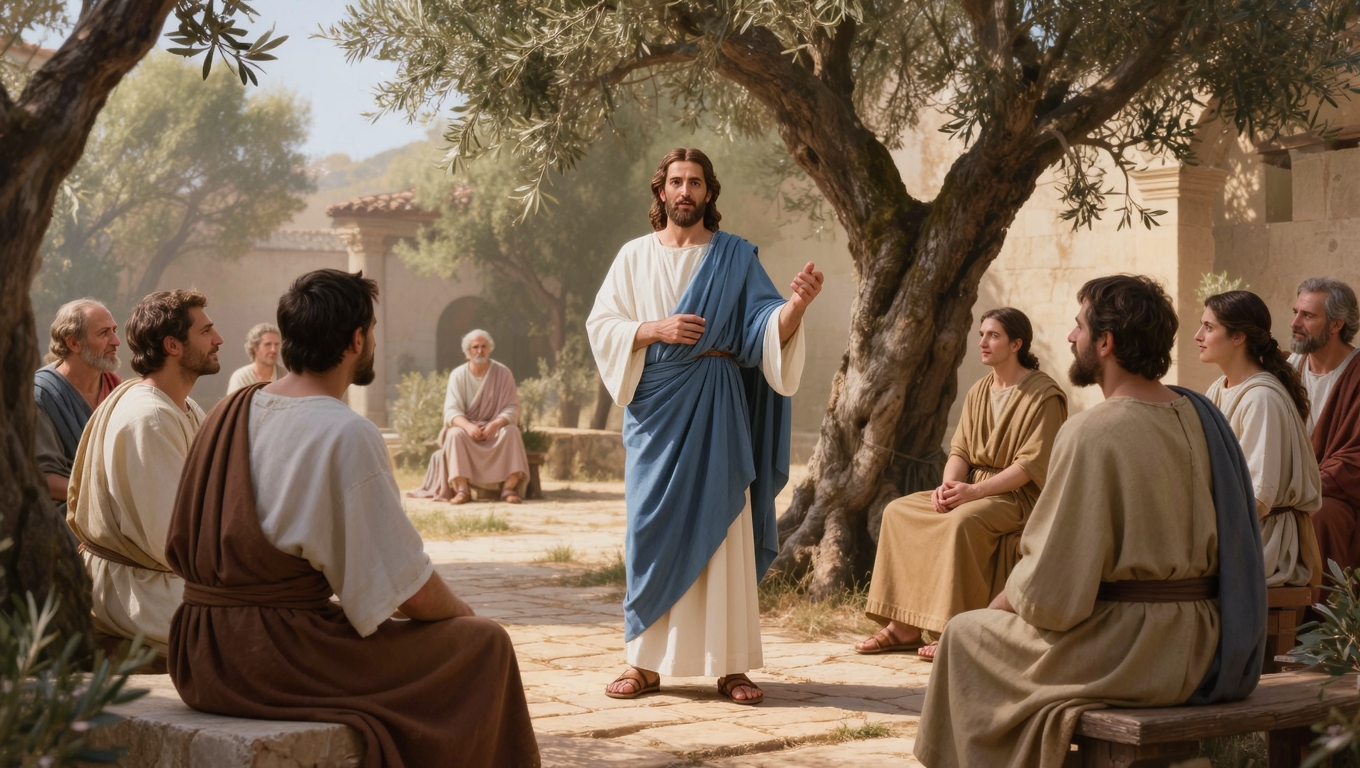
The Lecture on Desire
The Epicurean lecture was held in a garden courtyard, under the shade of old olive trees. The
lecturer was a younger man than Kallimachos, perhaps forty, with soft brown hair and
intelligent eyes and a way
of speaking that suggested he genuinely believed what he was saying, rather than performing
for effect.
"Epicurus teaches us to examine our desires," the lecturer said. "There are necessary
desires: food, shelter, friendship. There are unnecessary desires: fine food,
elaborate clothing, status. And there are destructive desires: power, wealth beyond
measure, revenge. The wise man pursues the necessary, allows himself the unnecessary only
when it costs nothing or little, and avoids the destructive entirely, because even the
pursuit causes suffering…usually to the pursuer, and always to anything
in the way of that pursuit."
Lucian listened, and he found himself thinking about his own desires. He wanted to be an
orator. Was that necessary or unnecessary? It was necessary for his sense of purpose,
perhaps, but not for his survival. He desired the companionship of Demetrios. That seemed
necessary—human beings needed connection. He desired beauty, in words, in ideas, in
the world around him. Was that necessary? Not for survival. But it felt essential to living
rather than merely existing.
"The goal," the lecturer continued, "is not to eliminate desire, but to understand it.
To be its master rather than its servant. For it is the pursuit of unnecessary and destructive
desires that generates unhappiness. The man who covets his neighbor's wealth is perpetually
anxious. The man who seeks power is perpetually vulnerable. But the man who has examined his
desires and chosen wisely can rest easy."
It was, Lucian thought, less abstract than Platonism, more encouraging than Stoicism. The
Stoic said: accept everything without complaint. The Epicurean said: examine what you truly
need, pursue that wisely, and find contentment in simplicity. Not avoid pleasure, but
understand what true pleasure actually is.
When the lecture ended, Kallimachos invited them back to his house for the evening meal.
Philostratos accepted.
They walked back through the streets of Miletus in the long slanting light of a Mediterranean
afternoon, the colonnades throwing pale stripes across the paving and the smell of the
harbor coming up to meet them at the corners. A wine-shop on the way to the bouleuterion
had begun lighting its small clay lamps for the evening trade; a knot of dockworkers stood
in the doorway with cups in their hands, and one of them raised his cup at Philostratos
as they went past, in the small respectful gesture men in working clothes sometimes give
to a passing scholar they don't know but recognize the look of.
And as they walked, Lucian realized that he was beginning to understand something about
his teacher. Philostratos was not merely collecting philosophical schools like coins. He
was genuinely seeking, genuinely learning, genuinely trying to understand which parts of
each school's wisdom he could incorporate into his own life.
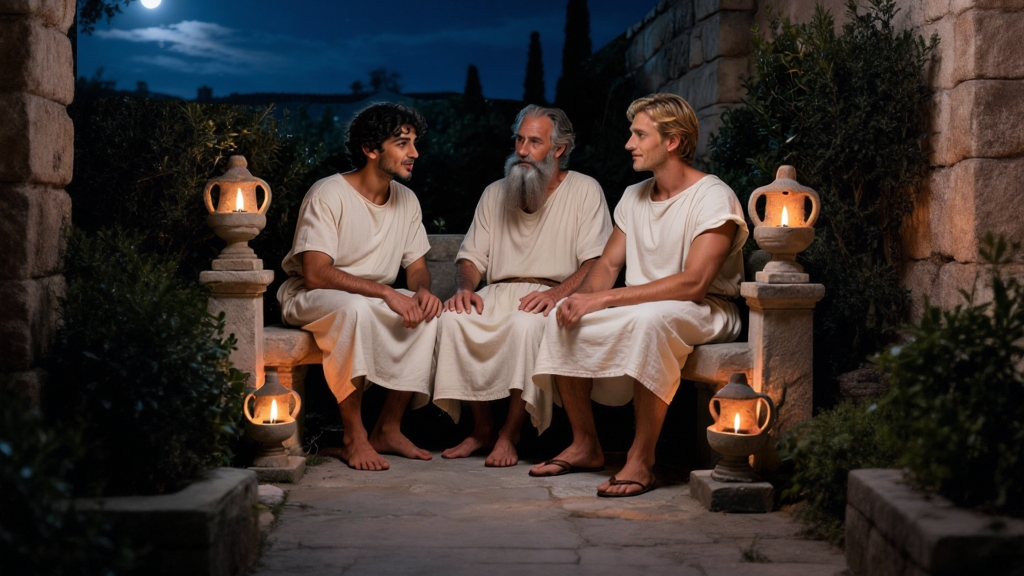
The Conversation
After dinner, when the evening had grown dark and oil lamps had been lit in the courtyard,
Philostratos asked Lucian and Demetrios to walk with him in Kallimachos's garden. There was
a bench there, surrounded by night-blooming flowers, and they sat. For a long moment, no one
spoke.
Then Philostratos said: "I think you are intelligent enough to have noticed, Lucian, that
my relationship with Demetrios is not the relationship of a teacher to a student alone."
Lucian felt heat rise in his face. In Samosata, such things were not discussed. They were
done, perhaps, in dark corners, but never named, never made public, never treated as anything
but shameful. And yet, Philostratos was naming it, here in the garden, as calmly as if he
were discussing the weather.
Growing up, Lucian had occasionally heard "Greek lover" used as an insulting term boys
sometimes inflicted on each other. He'd been fourteen before he found out what it actually
meant. And then, it mostly felt to him like a rather stupid epithet, given how everyone
tried to so hard embrace everything else about the Greek culture around them.
"I notice," Lucian said carefully.
"I want you to understand what we are," Philostratos said. "Not to condemn, and not
to condone—but to understand. In Plato's Symposium, the highest love is not
between a man and a woman. It is between men who share intellectual and spiritual devotion.
The physical expression is part of it, but it is the love of the soul that gives it meaning."
Lucian's mind was racing. In his mother's household, love was what she had borne for his
father—a companion, a provider, someone to build a life with. The idea that the highest
love could be between two men seemed not just wrong but incomprehensible. And yet, as he
looked at Philostratos and Demetrios sitting close together in the darkness, he saw something
that looked like genuine affection. There was no performance in it. No pretense.
"Why do you tell me this?" Lucian asked.
"Because you deserve to understand," Philostratos said. "Because you travel with us,
and it is better that you understand what you are witnessing than to be confused or
judgmental. And because I suspect, Lucian, that you will encounter many things in your
travels that your upbringing has not prepared you for. The world is larger than Samosata.
It contains…multitudes."
Demetrios reached over and squeezed Lucian's hand. "I hope this doesn't change things,"
he said quietly.
Lucian thought about the night he had discovered them in Smyrna. He thought about the
gentleness that had existed between them since then. He thought about Demetrios, who had
taken him under his wing on the road to Antioch, who had been his friend and protector, who
had only ever been kind to him.
"It doesn't," Lucian said. "It's just another weird thing the world has in its
makeup. As a Stoic would say, I'll just take it all as it comes!"
And he squeezed Demetrios's hand back.
That night, lying alone in their room, Lucian found himself thinking about bodies. Not in the
way the merchants in Antioch had taught him to think about them—as commodities, as
transactions, as relief. But in a way that was more complicated.
In Samosata, he had been surrounded by bodies constantly. His family's house was small.
Everyone slept near everyone else. There was a constant comfort in proximity, in the warmth
of another body, in the casual touch of family. On the road and at sea, he had learned to
miss it—had learned that a man could be surrounded by people and still be lonely for
that particular kind of ease.
When he had traveled with Demetrios, sleeping in inns and on ships, they had slept close
together for warmth. It had been easy, natural, unthinking. But now, in Kallimachos's house,
with a room to himself and a proper bed, he found himself lying awake, listening for the sound
of Demetrios returning from wherever he was spending his evenings with Philostratos.
It wasn't desire, exactly. Or it was desire, but not the kind the merchants had taught him
about. It was a desire for presence. For someone to lie next to him in the dark. For the
simple comfort of another human being choosing to be close.
He wondered if this was what Philostratos had been trying to explain—that the body's
needs and the soul's needs could be the same thing, if the person was the right person.
The Gift
On the third day in Miletus, the brown-haired Epicurean lecturer invited them all to a dinner at his
house. It was more elaborate than Kallimachos' simple meals, but still modest by the
standards of wealthy merchants. Good wine, good food, good conversation. And at the end of
the evening, as they were preparing to leave, the lecturer pulled Lucian aside.
"I have noticed," he said, "that you are a young man of some refinement, and of
considerable charm. Kallimachos speaks highly of your mind. I would like to offer you a
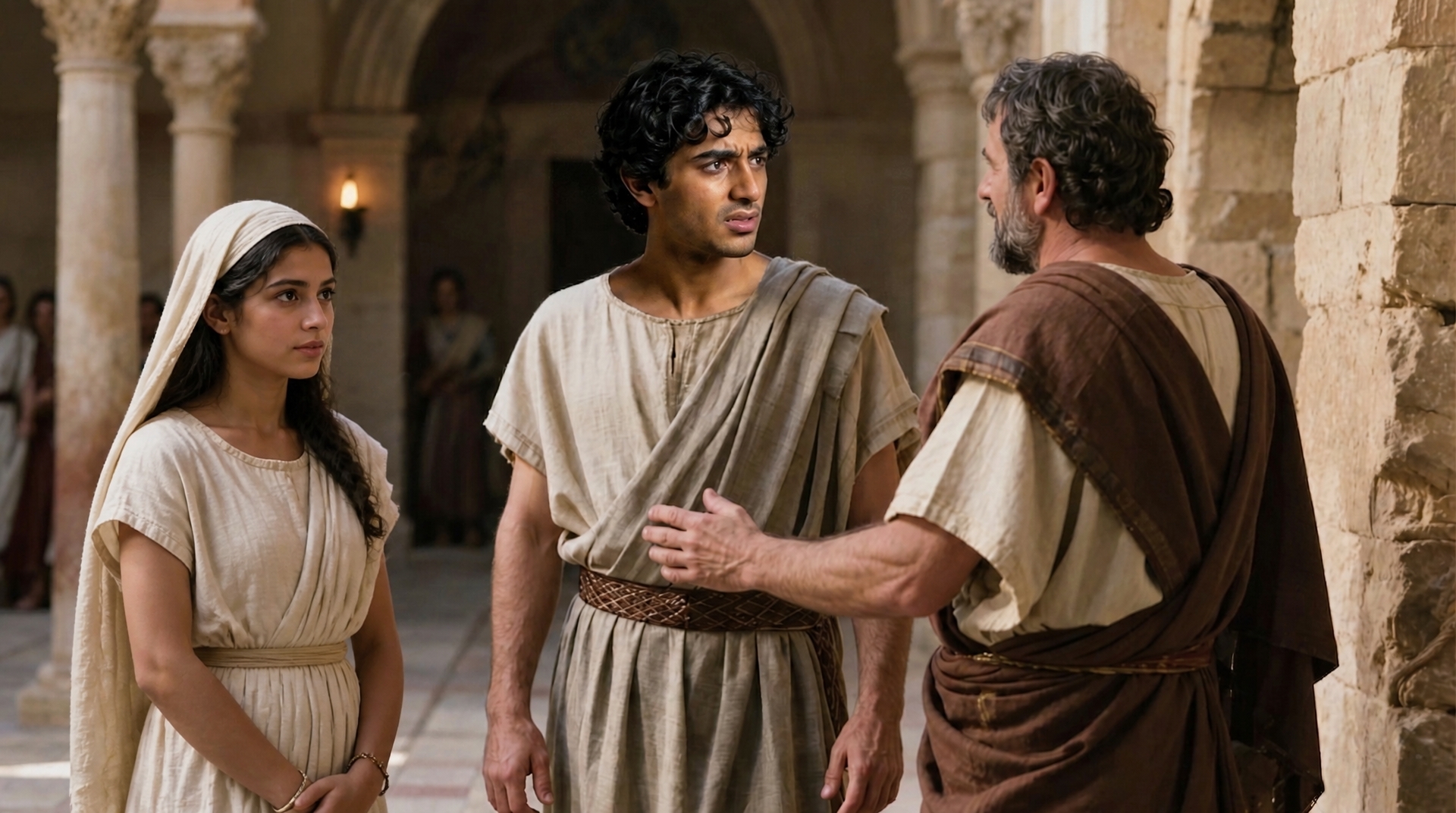
gift." He gestured, and a slave woman appeared from the shadows. She was perhaps fifteen,
or would be, soon; with dark eyes and the subservient expression of someone accustomed to being property.
"Her name is Thalia," the lecturer said. "She is intelligent, skilled, and available
for your pleasure during your time in Miletus. A gift from one philosopher to another, as a
token of our intellectual friendship."
Lucian felt the ground shift under him. It was a generous gift, by the standards of the
world he was in. It was an honor. It was also a test, perhaps—to see if he understood
Epicureanism as most people did, as license for indulgence.
"Thank you," he said carefully. "You are more than generous, and I am honored by
your gift. But I cannot accept."
The lecturer's expression flickered. "Is she not to your taste? I can arrange for a
different—"
"Oh, no! It's not that," Lucian said. "She's lovely. It's just
that—it's just that she cannot refuse."
There was a silence. Around them, Philostratos and Kallimachos and Demetrios had all stopped
talking.
"Forgive me," the lecturer said, blankly, "but I don't understand."
Lucian took a breath. He was thinking of his mother, who had chosen his father, who had
agency in her life, who could say no. He was thinking of Claudia on the caravan, who had
smiled at him and flirted with him, but who could (and eventually did) walk away. He was thinking of the
difference between a woman who wants to be with you and a woman who is compelled to be.
"If I lie with a slave," Lucian said slowly, "I am not with her by her choice. I am
using her body for relief—relief I could obtain by myself, actually, if that were all
I wanted. But what I want, what I actually want, is not relief. It's the presence of someone
who chooses to be with me. Who wanted to be there. There's a difference, I think, between that
and—" He paused, searching for the word. "—and lust. True lust, I mean.
Not just desire for relief, but desire for another specific person. For their presence, their choice,
their will to be near me." He looked up, still trying to convert his thoughts into words.
"My desire is not just for relief, it's for someone who wants me as much as I want them.
But also to be with me, as much as I want to be with them."
He stopped, aware that he was talking too much, revealing too much of his own confusion.
Kallimachos smiled slowly. "You are wiser than most men twice your age," he said.
Lucian shrugged. "Who knows if I'll ever find her? Who knows if she even exists?"
He sighed. "But that's my desire. And I intend to hold out for it."
The Epicurean lecturer looked thoughtful, then nodded. "I understand. You
are…fastidious. It is a virtue, I suppose, though not one Epicureanism particularly values."
"On the contrary!" Philostratos exclaimed. "What Lucian has described is precisely what
Epicureanism values most—the pursuit of genuine pleasure rather than mere relief. He
has examined his desires and found that his greatest pleasure lies in genuine human
connection. That is exactly the wisdom Epicurus taught."
The streets of Miletus at night were quieter than they had been at the afternoon hour, but
not silent. Lamps burned in iron brackets at the corners; a baker's apprentice was already
at his oven, getting the morning's bread ready, and the warm smell of yeast and woodsmoke
drifted up the lane. Somewhere a few streets over, a woman was singing to a child in a
language Lucian didn't recognize. The marble lions at the entrance to the harbor were
invisible in the dark; you could only locate the harbor by the sound of the water at the
quays, and by the glow of the boatmen's small braziers on the moored hulls.
Demetrios fell into step beside Lucian.
"That was brave," Demetrios said.
"That was stupid," Lucian replied. "I just refused a gift from a man who was showing
us hospitality."
"That was brave," Philostratos agreed. "Because you were honest about what you
actually wanted. Most people never do that. They just take what's offered and pretend it
satisfies them."
That night, when Demetrios came back to the room where Lucian had been lying awake
listening for him, Lucian reached out and pulled him close. Not for the kind of comfort
Philostratos had been discussing. Just for the simple warmth of another body. For the presence
of someone who had chosen, in his own way, to be there.
And Demetrios, understanding without words what Lucian needed, held him as the night deepened
around them, neither of them asking for anything more.