|
By: Paul S Cilwa |
Occurred: 1/15/2003 |
|
Page Views: 417 |
| Hashtags: #18Wheeler #TruckDriving #BigRigs #Schneider #TruckDriver |
| Weighing the truck, and my willingness to be out of the closet. |
| Estimated reading time: 8 minute(s) (1844 words) |
Wednesday, January 15, 2003
Or could I? The chocolate milk manufacturer from whom I had gotten the loaded
trailer didn't have a scale, and the little truck stop, the only one in that
town, didn't have one, either. I didn't want a repeat of the fiasco of a couple
of weeks earlier at the Arizona border, which meant the load needed to be
weighed. But where?
If Schneider was really serious about our weighing our loads, a place to do
so would be included in our trip plans or assignments. The mileage to an
out-of-the-way scale would be included. But they don't do any of that. The onus
is on us.
As I drove, I prayed I would encounter a truck stop with a scale before
I came upon a state weigh station. I didn't—but the Illinois station I
encountered was closed. A reprieve.
Part of any excess weight I was carrying had to include the accumulated body
dirt from three days without a shower. So I was happy when I came upon, not just
any truck stop, but one listed on my fuel map as an approved location for the
fueling of Schneider trucks. So, I could fuel, take a shower with the coupon we
get when fueling, and weigh my load.
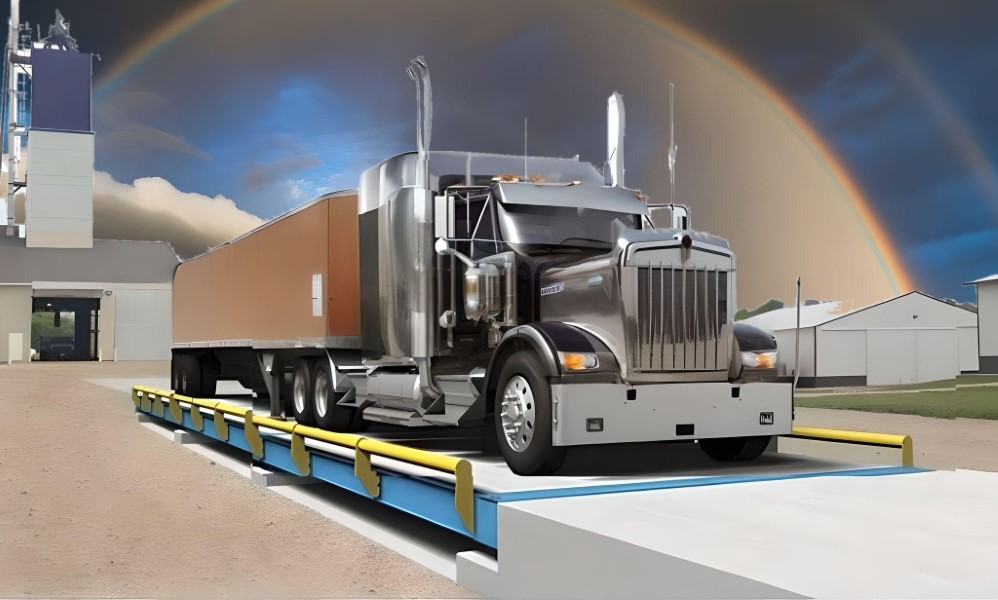
I fueled, had lunch and my shower, then got back in the truck for the job of
weighing. As one pulls into this truck stop, as with most, the truck entrance
leads directly to the fuel pumps, with one lane leading to the scales. In this
case, there were two scales, side-by-side. I had to actually exit the
truck stop, drive around the front to the truck entrance, then onto
whichever scale was vacant. I made sure the steer tires were on one platform,
the drive tires on another, and the tandems on the last. Weight laws allow
different maximum weights for each axle. The rules vary from state to state; but
we stick to the Federal guidelines (which are the most stringent). They allow
12500 pounds on the steer tires, and 34000 on each of the drives and the
tandems, with an allowed gross weight of 80,000 pounds.
After weighing the rig, I had to find a place to park so I could go inside to
get the readout. This wasn't a well-designed truck stop; there were trucks all
over, jockeying for positions to park, or leave. I turned on my CB radio.
Go ahead, Red Peterbilt,
someone said.
Thanks, driver!
came the reply; and I saw a red Peterbilt tractor surge
forward towards the exit. One less truck in my way.
There were still a few rigs blocking me, and I waited patiently, my driver
side facing the row of trucks already lucky enough to be parked. Suddenly, on
the CB, I heard, Say, Schneider—what's that rainbow sticker on your window
mean?
The voice seemed good-humored. Someone else might have heard it as
mocking. Surprised, I felt like I did on the school playground, waiting to be
picked for a team in basketball, and finding myself the leftover kid.
I picked up the microphone and said, I bet you can guess, driver.
The driver chuckled, and said, I thought it meant you were in favor of gay rights.
Before I could answer, a woman's voice cut in. The rainbow was used by De
Colores long before the gays started using it.
From my playground days on, I've discovered that assuming an air of
unimpeachable intellectual authority is a good go-to attitude to defuse these situations. It keeps them
from getting too personal. Actually,
I said into the microphone, De
Colores uses just five colors, in the shape of an actual bow. Gay Pride uses
six in any shape. And a true rainbow, of course, has seven.
What's the seventh color?
someone else asked. The pressure was off.
Indigo,
I explained. In terms of wavelength, it is the same amount longer
than purple, as blue is from it, or green is from blue.
The traffic ahead of me
moved, and I was able to proceed down the lane to the far end where there
weren't many trucks parked. As I did, I heard snatches of chatter: The white
Schneider truck?
What rainbow sticker?
On the window.
Oh, right.
No one
sounded violent or frightening, yet I felt very exposed. It's one thing to have
a Pride sticker in the window, and quite another to be a one-man Pride parade.
I parked far enough away that, probably, most of the drivers wouldn't know
I was the gay driver as I walked inside to the fuel desk to get the
weighing results.
Although my gross weight was legal, my tandems were overweight by 620 pounds.
That meant I had to shift that weight forward to the drive axle, which I could
do by sliding the tandems back a few notches. It also meant I would have to
re-weigh afterwards.
How much weight is shifted with each pin setting, depends on the weight of
the cargo and how it is situated. I hadn't seen the trailer loaded—it was sealed
when I got it—so I had to guess. The book says a good estimate is 500 pounds per
pin. I had more than a thousand pounds to spare on my drives, so I moved the
tandems back two pins. Good thing I'm not going to California, I thought.
California will not allow the tandems to be moved farther back than pin five,
and I was moving mine to pin seven—and yet still didn't know if that would be enough.
In order to re-weigh, I had to exit onto the street again, drive
around the front of the truck stop, and back onto the scale. When the voice in
the loudspeaker told me I could come in for the results, I had to again park.
The traffic was less dense now, and I quickly drove to the back row, rather
than parade myself before the front line of trucks again. Inside, I inspected
the results. I had moved 500 pounds—in other words, 250 pounds per pin. One more
pin would do it. This time the tandem slider was stuck. I had to hit the pins
with my rock—a rock I had picked up in Albuquerque for this very purpose. Most
drivers carry a mallet. I'd love to have a mallet. I wonder what they cost.
Schneider provides us with a truck and trailers as needed. They pay for
insurance, fuel, maintenance, and permits. They provide snow chains. They do
not buy us shovels (recommended for getting stuck in snow), CB radios (needed at
most larger customer yards and weigh stations), brooms (many customers insist on
clean, empty trailers for some reason), bunk warmers (but they don't want us to
idle the engine unless the air temperature is below 10°F), cell phones (how could
I work without mine?), or tandem pullers. These last are devices which assist a
solo driver in pulling the pins of a recalcitrant tandem slider.
I understand that Schneider once did provide at least the tandem puller and
CB radio. Apparently a lot of drivers sold theirs and then did without.
Schneider decided to put a stop to that loss by no longer providing these tools.
It didn't occur to them that another way to prevent the loss would be to pay
drivers enough so that they didn't have to sell their work tools to live.
Big corporations are infamous for being penny wise and pound foolish. A
programmer at a company I once worked for, told the story of how they had hired
a new office manager, who decided entirely too many pens were being stolen
and it had to stop! He reasoned that people wouldn't take pens home if they
had no caps. So he purchased 30,000 pens, hired three temps for three days, and
had them remove all the caps from the pens.
Three months later, they had to throw away 25,000 dried-up pens. It seems
pens have caps for a reason.
Anyway, I moved the tandems the additional pin and then had to decide: Do I
re-weigh again, or trust my math? There is an advantage to weighing
again. I would be certain, and I would have proof. If I came in overweight on a
state scale, I would have the paper proving I was of legal weight. The
commercial scales are more likely to be correct than the state scales. If I
seemed to weigh too much, and showed the officers my proof of weight from the
commercial scale, they probably would not write me a ticket. If they did, the
company that owns the commercial scale would send an expert witness to court
with me, to testify that my weight was really legal no matter what the weigh
station thought.
On the other hand, the traffic at this truck stop was horrendous. Winter
weather was on its way, and traffic in and out was frantic. I hated the idea of
driving around the truck stop yet again, weighing myself, parading past all the
trucks and parking a third time so I could run in and get the paper. And I
was certain the weight was now legal. So I took a deep breath, and left the
truck stop.
The chatter about the rainbow sticker still rankled. It hadn't been vicious
or unkind, merely curious, as if I had been an orangutan driving a truck.
Wow! Look!
is what they were really saying. A real, live, gay guy!
This had to be
a lot like what women experience when they walk past a construction site. The
workers there don't really expect to have sex with female passersby. They are
merely curious, staring at something they probably don't really want and, in any
case, can't have. For the passerby, the experience is unsettling because she is
being reduced to an object, rather than being perceived as a person.
However, a woman has no choice in looking like a woman—at least, not without
surgery or by breaking the law in the several states and municipalities that
still prohibit cross-gender dressing. I don't have to have the rainbow
flag on my truck. It was my choice. I put it there intentionally, as a means of
helping my gender variant to achieve visibility. And I had responded on
the CB, thus proving myself to be a person who could carry his own weight in
truck lot banter.
It could be worse, I reasoned. Orangutans have a devil of a time earning their CDLs.