|
By: Paul S Cilwa |
Posted: 8/15/2019 |
|
Page Views: 22 |
| Hashtags: #Science #Electricity #EverydayScience #CellPhones #Chargers |
| Why you can't have just one charger for all your devices, and what will happen if you use the wrong one. |
| Estimated reading time: 9 minute(s) (1971 words) |
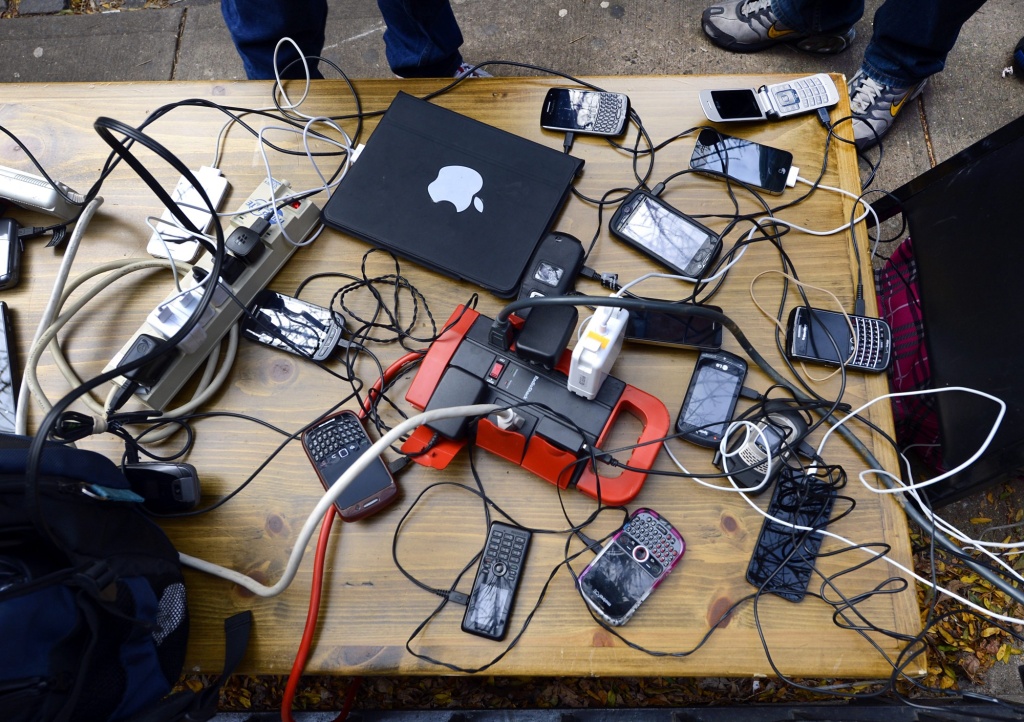
The primary question is: How can you match up a charger with a device that needs to be charged?
Chargers are a class of device called converters. Converters include anything
that changes one thing into another thing. Blenders, water filters, and even fire are converters.
You put in one thing, and get out that thing altered in form.
The thing that goes into a charger is electricity of some form, and what comes out is electricity
in a different form. The most common form of these take as input house current, and emit a much
weaker current suitable for charging a device battery. But…the current isn't just weaker,
because electricity has more aspects than simple strength. Specifically, electricity
has voltage, amperage, and current type (alternating or direct).
To understand these aspects it's easiest to use an analogy. Electricity is often compared to water.
Both flow; both can be constrained and conducted via tubes (wires or pipes); both can be turned off and
on with switches, and so on. In the paragraphs to follow, I will make frequent use of this analogy.
Current
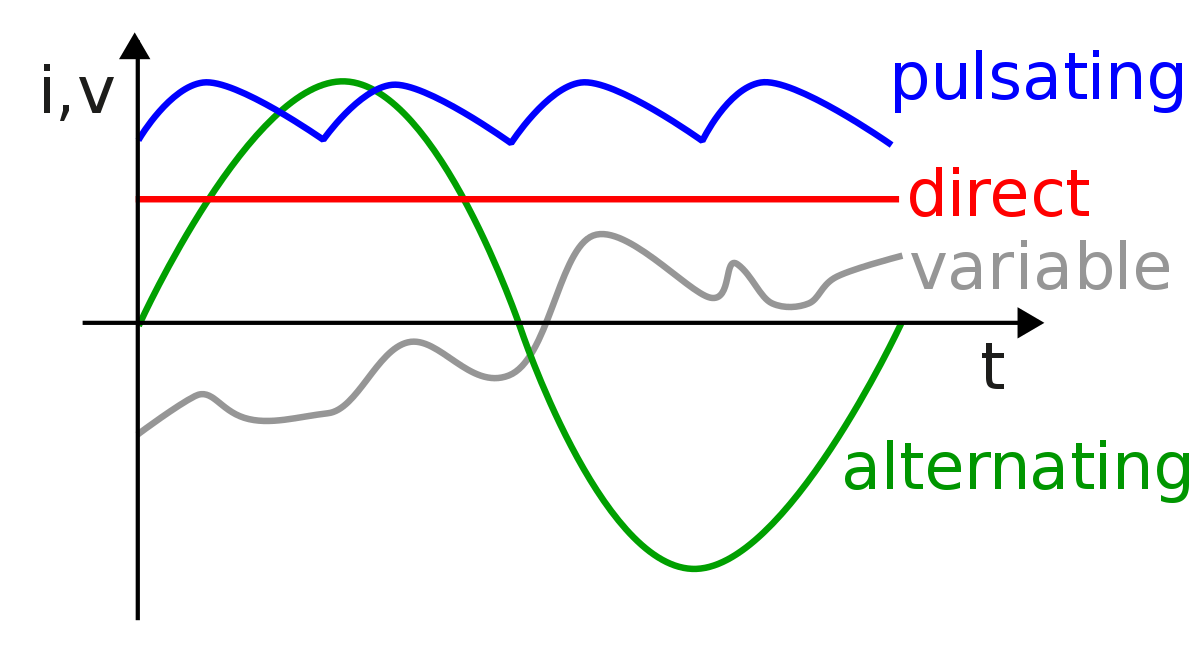
The biggest difference between the way electricity and water typically operate is in the realm of
current. It's easy for us to picture direct current; water and electricity flow in
just one direction. After all, that's what we expect with a garden hose. With alternating current,
however, water would swish back and forth and nothing would actually come out of the hose. That's
not really very useful with water; but, it turns out, it is the most efficient way to transmit
electrical power over wires.
Now, just to be complete, let me point out two other, less-used options: Pulsating current,
in which voltage (I'll explain that in a moment) varies but overall never flows backwards.
A variable current is also possible but not very useful. So direct and alternating
are all you have to worry about.

Alternating current is produced by a device called an alternator. It uses strong magnets
and coiled wire to move electricity back and forth at a steady rate and strength (or voltage).
Direct current can be produced by a generator (remembering that what most people call
a generator is actually an alternator) but is most commonly produced by a battery or solar panel.
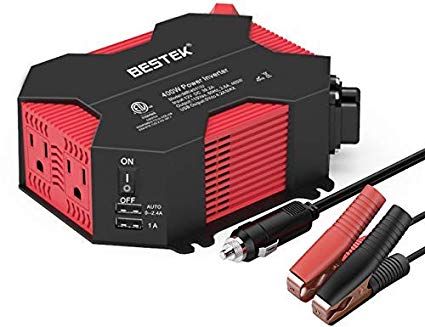
Direct current, such as is produced by your car battery, can be converted into house current. Devices that
accomplish this are called inverters; they are inexpensive and can be purchased in most auto
shops and department stores. The opposite device, one that changes Alternating Current (AC) into
Direct Current (DC) is called a rectifier. All, or nearly all, of your device chargers
will technically be rectifiers.
When you are trying to match up devices and converters, current type must match, or you
will destroy your device. (Only incandescent light bulbs are indifferent to alternating versus
direct current.)
Voltage

Voltage, quite simply, is electricity's "kick"; the strength with which the electrons
move (whether in one direction or back-and-forth). Its analogy in the water world is pressure.
Low "voltage" water trickles out of the hose; a high pressure flow can clean stains off
a driveway.

Voltage is not the truly dangerous aspect of electricity. A high voltage (with low amperage) can kill,
but generally the voltage just indicates how much the shock will hurt.

Most batteries produce the small voltage of 1.5 volts. This is too small to hurt or even feel.
That's why we let kids put batteries in flashlights. The rectangular batteries we used to call
"transistor radio batteries" have a higher kick of 9 volts. If you stick both electrodes
of a 9 volt battery on your tongue, you'll feel a tingle.
And no, bigger batteries are not necessarily higher voltage. D, C, AA, and AAA batteries are all
1.5 volts. The difference in size produces a higher amperage so larger batteries last longer.
House current in North America is about 110 volts. That's strong enough to cause a heart attack if it
passes through your chest. 220 volts is also used in North America for devices such as stoves and
electric dryers. 220 volts is used throughout Europe.
(Here is a list
of what voltage is used in each country of the world.)
And lightning? A cloud-to-ground lightning strike is typically one billion volts.
When you are trying to match up devices and converters, voltage must be pretty close to that which the device
you wish to charge requires, or you will destroy your device. For example, if your device wants 4 volts
and you have a 5 volt charger, that should be safe. Devices that require 120 volts work fine plugged
into a 110 volt outlet. But if you try to charge your 4 volt device with a 12 volt charger, you will
probably kill it.
Amperage
Amperage, or "amps", can be thought of as the amount of electricity passing through
the wire. In water we would call it volume. The way to increase volume of water is two-fold: Increase
the amount of water moving, but also enlarge the vessel carrying it. In other words, no matter
how much water you are trying to move, you will move more of it through a fat hose than a skinny one.
Similarly, if you have a high amperage you'll need a thicker wire to transmit it. (A smaller wire
would heat up and melt if the amps it's trying to transmit exceed its ability.)
At 200 mA (millamps, one-thousandth of an amp), severe burns and muscle contractions occur.
Internal organs can be damaged. The heart can stop due to chest muscles applying pressure to the heart,
but this clamping effect can prevent ventricular fibrillation, greatly improving the chances of survival
if the victim is quickly removed from the electrical circuit.
Matching a Charger to a Device
Every charger, and every device that uses one, has a label—usually embossed so it can't
come off—that specifies the characteristics required. For example, here's the input connector
of a device (blood pressure monitor) that takes a charger:
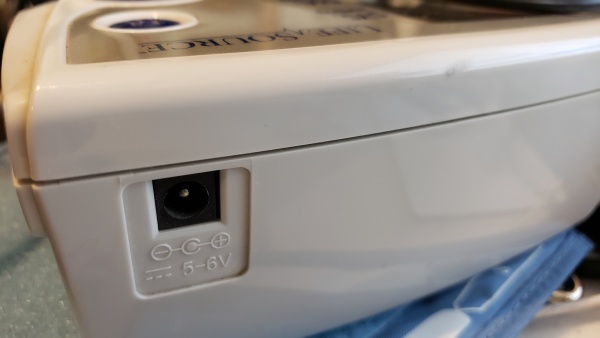
And here's a charger that would be compatible, as long as it was being used in a 120 volt area:
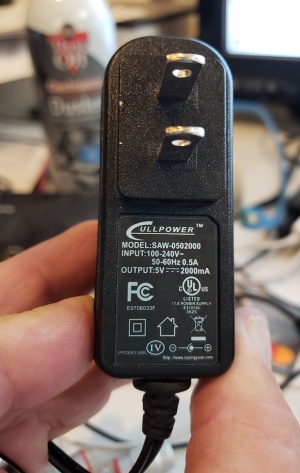
The idea is to match the charger output with the device's required input…and
matching connectors.
When you are trying to match up devices and converters, the charger amperage must be what
the device requires or higher. A high amperage will not harm your device, which only
takes what it needs. But too low an amperage will not charge your device.
Connectors
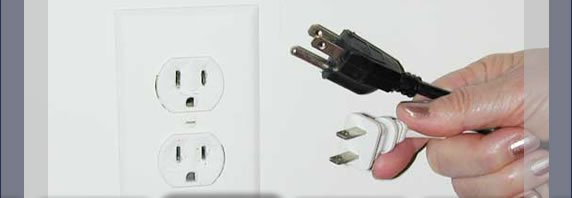
Even small children understand the concept of plugging a device that requires house current
into an outlet (even when they have not yet grasped the fact that only electrical plugs
should go into the outlets). That's at least partly because these components have become standardized.
And that's because, in the early days of harnassed electricity, many devices were destroyed and many
fires started by connecting a low-voltage device into a high-voltage connector.
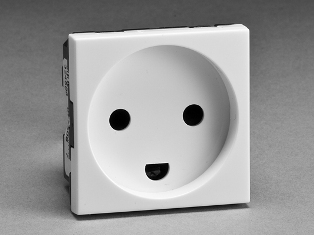 That's why American devices won't plug directly into a European outlet; the voltage is incompatible
and if you could plug an American device in, it would promptly blow out and die.
That's why American devices won't plug directly into a European outlet; the voltage is incompatible
and if you could plug an American device in, it would promptly blow out and die.
But, as I mentioned, these standards arose after decades of hard experience. And we have only
been using chargers in quantity for a few years. So the standardization process, while underway,
has not yet reached the point where we can count on it. Consequently, while most low-voltage
connectors look similar to each other, they are not actually the same.
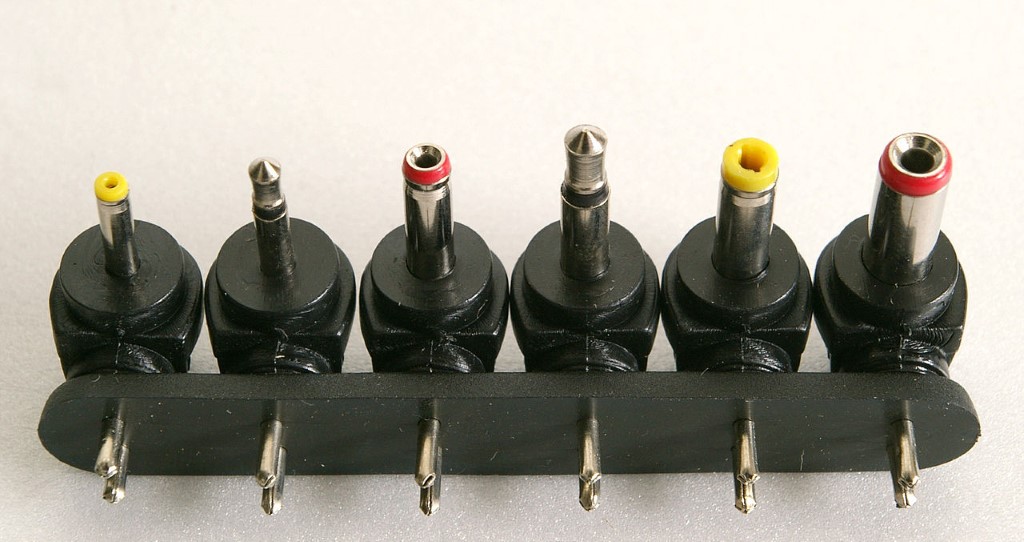
These connectors have in common that they are coaxial. That means the wires are knitted
into tubes, one of which slides into the other, so that they share an axis. This coaxial arrangement
continues into the connecting plug.
You'd think that there'd be some consistency (perhaps the smaller connectors are for
lower voltages?) but, in fact, there isn't. Sometimes the plug dimensions are limited by the
size of the device itself; often, a new connector is invented by a company simply to require
their customers to buy their chargers rather than save money on a third-party charger.
So the answer to our conundrum of how to match up a charger with a device has to include
a matching connector as well as matching current, voltage and amperage. The matching connector
alone will not be enough, as different voltages use the same connectors.
USB Chargers
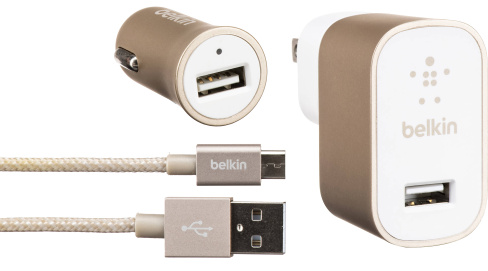
Recently a new scheme of charging has come up: using a USB connector.
USB stands for Universal Serial Bus. It is a cabling standard that
allows for power and data transfer. Some USB cables are missing the data-carrying
wires and so can be used only for charging. (If you ever found that a charging cable wouldn't
let you connect your phone to a computer to transfer photos, now you know why.) Any USB
cable can be used for charging, whether it works for data or not.
Since nearly everyone
has a computer and virtually all computers have many USB sockets device manufacturers have found
it's a lot less expensive for them to not have to include a charger with every device
they sell. Plus, as described above, most people have many more chargers than devices and many
of these chargers include a USB outlet. By designing the device to be charged via a USB connector,
the manufacturer can save money and shipping costs, and at no inconvenience to the consumer!
USB connectors come in a variety of shapes and sizes, as their use has proliferated far beyond the
original concept. However, as long as the connector fits your device, it will work for charging since
the rest of the USB concept is well-defined and standardized.
Wireless Chargers
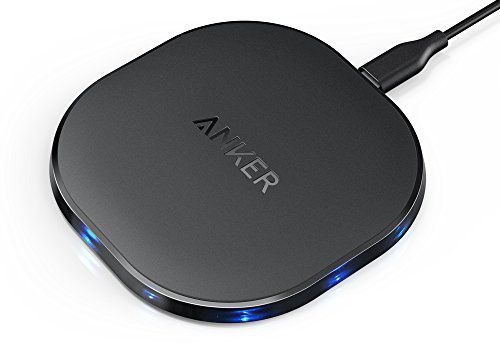
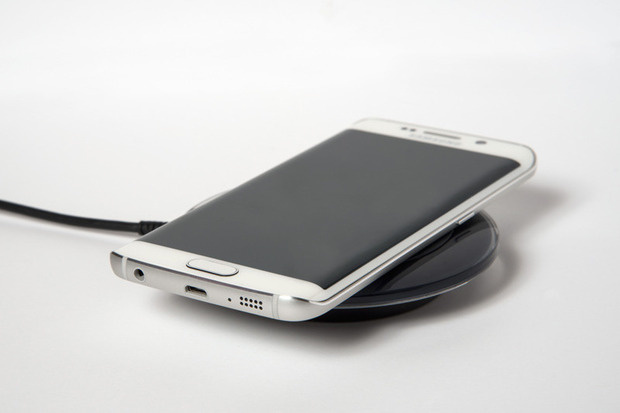
An even newer charging technology is the wireless charging pad. Most commonly used for charging cellphones,
other devices (such as Bose personal speakers) also use this charging method. Most wirelessly-chargeable
devices also have cable connectors for chargers as described above. But cable connectors can be damaged
by the repetitious insertion and removal of the connector; wireless charging avoids that issue.
How does a wireless charger work? By magnetic induction. Do you remember in fifth grade learning about
"electromagnetism"? Electricity and magnetism are closely related forces (or, rather, different aspects
of the same force). Electricity can create a magnetic field, and magnetism can induce electric current in
neighboring wires.
And the best part is, you don't have to worry about voltage, amperage, or current. Although different
types of phones are paired by the manufacturers with their own wireless chargers, actually you
can try any phone with any charger. At worst, it simply won't charge. More commonly, the "wrong"
charger just won't charge as fast. But in general, any wireless charger can be used to charge pretty
much any wirelessly-chargeable device.
And in conclusion...
You should now have the information needed to intelligently sort your chargers and use them
with the correct devices. You're welcome!