|
By: Paul S Cilwa |
Posted: 1/6/2010 |
|
Page Views: 37 |
| Hashtags: #Geology #Coal #OutofPlaceArtifacts |
| Let's look at coal: Its formation, mining, uses, legends, and what odd artifacts have been found embedded in it. |
| Estimated reading time: 10 minute(s) (2192 words) |
When my kids were young and asked me what I was getting them for
Christmas, I always replied, "A bag of coal." Of course, I never
gave them coal for Christmas, or at any other time. And in fact, few
modern Americans have even seen coal, though they think they
have. That's because most people think charcoal is the same
as coal; and everyone has seen charcoal briquettes at barbeques,
right?
But charcoal is not coal. And coal is way more
interesting. (For starters, kids getting coal for Christmas was once
considered a good thing!)
First of all, the basic difference: coal is a mineral that
comes from the ground. Unlike most minerals, it burns. It's been
known about since ancient times.
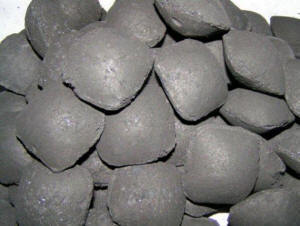
Charcoal is wood or any flammable substance that has been heated and
dried enough to reduce it to almost pure carbon, with just a few
impurities. It resembles coal, both in appearance and in the fact
that it can be burnt. In fact, it's name comes from Old English charren coal
which means "turn into coal". Our modern word "char" (meaning "scorch")
is a back-formation from charcoal.
The purpose of creating charcoal then, as now, is to make
transport of wood for fires easier. Wood is filled with water; and
the water component of wood doesn't burn. So transporting light
charcoal is much more efficient than transporting wood.
Charcoal, then, is fake coal. So, what is real coal?
Coal was first described in 370 BCE (almost 2500 years ago) by
Theophrastus
in his treatise "On Stones" under the name
lithos anthrakos
(English: anthrax; the stone, not the
disease). More recently, in Scotland and in New England a gift of
coal on New Year's Day was a token of good luck, guaranteeing a
"warm hearth" for the coming year.
Although coal was recognized by the ancient Greeks, it wasn't in
great demand for 2,000 years. After all, wood was plentiful and
renewable and a lot easier to get to than digging underground for
coal. Thus, when a Greek wanted to say that it was silly to bring
something to a place where there was already lots of that stuff, he
would say it was like "bringing owls to Athens." The phrase
"bringing coals to Newcastle" was
first recorded in 1538
well after Newcastle had become world-famous as a source of coal.
Coal doesn't always have to be dug. Like any mineral, coal is
sometimes found in outcroppings where erosion has exposed deeper
layers of earth to the air. Because coal burns hotter than wood, it
is useful in funeral pyres and its use has been detected in pyres in
Bronze Age Britain (4000-5000 years ago). By 300 CE the Romans were exploiting coal fields in
England and Wales.
But by 1000 CE the easily accessible coal supplies had been
exhausted, and coal had enough specialized uses to justify mining.
There was originally a resistance to mining of any sort. Many
cultures considered it to be a "raping" of Mother Earth. However, as
big money was to be had in coal, local religions were persuaded (via
large donations) to "explain" to the congregations that "Mother
Earth" did not exist, and Father God had given these things to
humanity for us to do with as we pleased. Anyone who disagreed was
"raked over the coals" as a heretic, which has always been a
particularly effective means of squelching dissent. (Note: The coals
were burning at the time.)
It was the development of a practical steam engine that suddenly
propelled coal into the limelight as a premier energy source.
The earliest known steam engine was the
aeolipile described by
Hero of Alexandria.
But neither it, nor the experimental devices
that followed in places as diverse as Turkey (1551) and Italy (1621)
were practical enough to do real work. That changed in 1712 when
Thomas Newcomen
introduced his "atmospheric engine", and shortly
afterwards when James Watt's redesign of Newcomen's engine used 75%
less coal to do the same work. So significant was Watt's
contribution that today, we use Watt's name (the watt) as a
measurement of the work a given amount of energy can achieve.
Watt's steam engine made it possible to build a factory that did
not rely on a water wheel and therefore did not need to be located
on the banks of a stream. Thus was born the Industrial Revolution.
Bertrand Russell described conditions thus:
The industrial revolution caused unspeakable misery both on
England and in America. … In the Lancashire cotton mills (from
which Marx and Engels derived their livelihood), children worked
from 12 to 16 hours a day; they often began working at the age
of six or seven. Children had to be beaten to keep them from
falling asleep while at work; in spite of this, many failed to
keep awake and were mutilated or killed. Parents had to submit
to the infliction of these atrocities upon their children,
because they themselves were in a desperate plight. Craftsmen
had been thrown out of work by the machines; rural labourers
were compelled to migrate to the towns by the Enclosure Acts,
which used Parliament to make landowners richer by making
peasants destitute; trade unions were illegal until 1824; the
government employed agents provocateurs to try to get
revolutionary sentiments out of wage-earners, who were then
deported or hanged. Such was the first effect of machinery in
England.
It was an industrialist's wet dream, until by 1847 laws passed
(pushed hard by liberals of the time, and fought by conservatives)
limiting workers to a mere 10 hours per day.
By the way, while child labor is no longer legal in America or
Europe, it still is very active in many parts of the world. Pretty
much anything you buy from Wal-Mart was manufactured by Chinese
four-year-olds between their cigarette breaks.

And coal, China's primary source of electrical power (which is
made by turning electrical generators by steam power), is still
behind it all…an unexpected fate for a mineral that was mostly
formed between 360 and 299 million years ago.
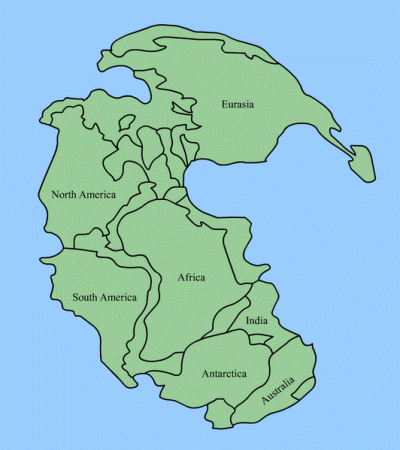
At that time, which we now call the "Carboniferous
Period," all the tectonic plates that make up Earth's land
masses had floated together to make up a single supercontinent we
call Pangaea. (The southern regions are sometimes referred to as
Gondwana.) That means weather was markedly different than ours. At
the start of the Carboniferous Period, earth's atmosphere was
heavily laden with carbon dioxide which, as we all now know, is a
"greenhouse gas" that holds in the Sun's heat. So at the beginning
of this period earth's average temperature was relatively high. Most
of Pangaea was stretched out around the equator, so on it developed
something that had never existed before on Earth: a forest.
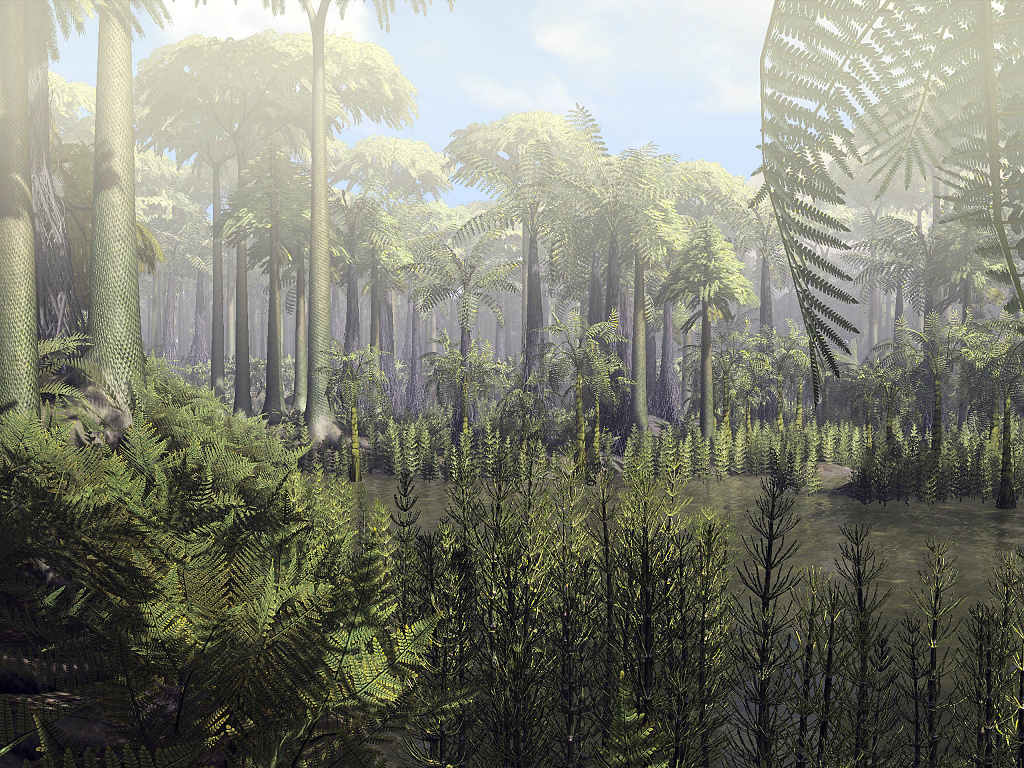
This wasn't just any forest. Remember, all the land masses of
Earth were squashed together and most mountains had not yet formed.
So this forest was low, swampy, and unbroken: Think the
Okefenokee Swamp
times 135,000, except with 200-foot-tall trees with six-foot-thick
trunks. Oh, and the "trees" were actually giant ferns.
Still, a swamp is a swamp, and that means a lot of shallow,
oxygen-poor water. When these giant trees fell, they fell into the
water; and because there wasn't much oxygen there wasn't a lot of
bacteria—and, therefore, the trees didn't rot; they just laid there,
where more trees fell on top of them and still more trees fell on
top of them. The weight squashed them flat, and still
more trees fell…for 60 million years, almost as long as the
time between the dinosaurs and the present day.
Now, as I said, at the beginning of the Carboniferous Period
there was a lot of carbon dioxide in the atmosphere. But as these
trees grew, they absorbed the carbon dioxide and exhaled oxygen, as
all plants do. However, because of the swamp, fallen trees did not
rot and therefore didn't release that carbon dioxide when
they died. They simply kept it. And gradually, over those 60 million
years, the atmosphere lost much of its carbon dioxide and gained a
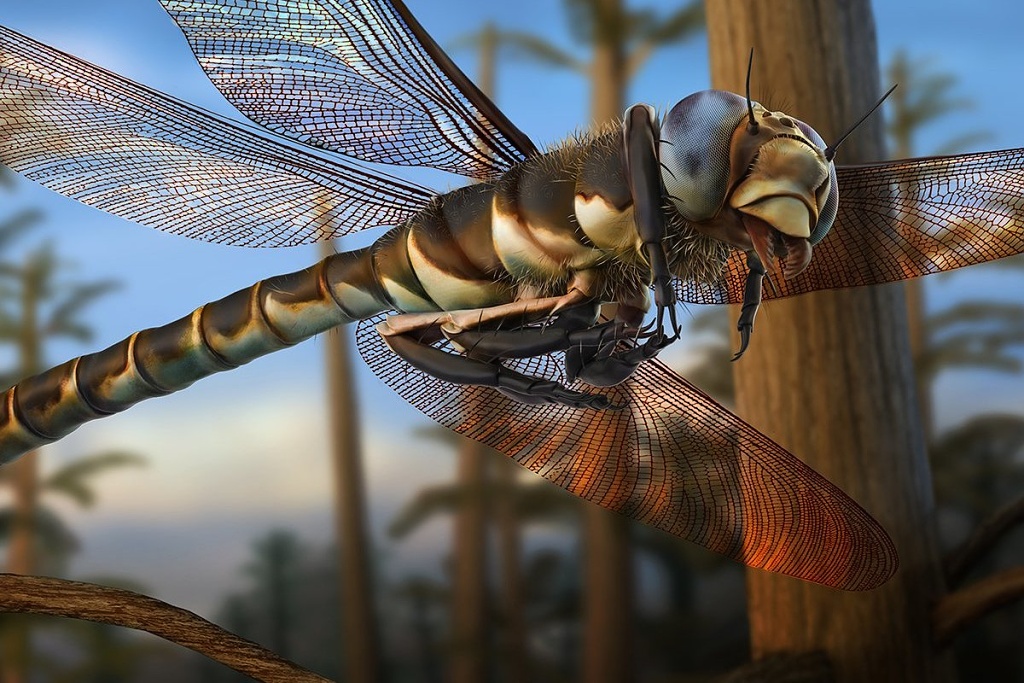
lot of oxygen, much more than we have today (which had the very cool
effect of allowing the growth of giant insects, such as six-foot
centipedes and dragonflies with two-foot wingspans).
The Carboniferous Period came to end when the loss of greenhouse
gas resulting in an abrupt Global Cooling. The southern portion of
Pangaea became glaciated as an ice age began, which carried into the
Permian Period that followed.
With the passing of more millions of years and the continued
movement of the tectonic plates, which go up and down as well as
back and forth, the layers that had been tree-filled swamp subsided
and oceans came and went above, depositing layers of limestone on
top. Eventually as much as 2,000 feet of rock formed above the
trees, adding intense heat and pressure to the dead vegetation. This
squeezed out any water and broke down the more complex molecules,
leaving coal (and sometimes oil and natural gas) behind.
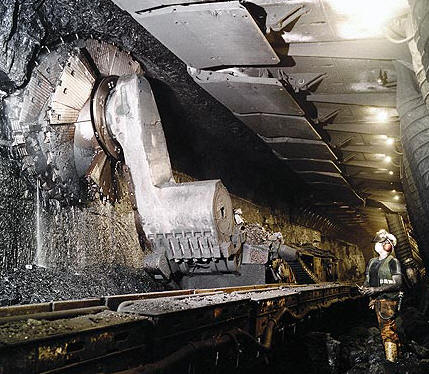
In the United States, only about 40% of our coal comes from deep mines
(the rest is closer to the surface). Most texts tell us (or imply)
that all coal was formed during or shortly after the
Carboniferous Period, and that the difference in depth is due to
differences in geologic deposition and erosion during the
intervening 299,000,000 years.
And yet there are some so-called OOPArts (Out-of-Place Artifacts)
associated with coal. These artifacts, which are admittedly very
rare, nevertheless shouldn't occur at all if the story
that all coal comes from the Carboniferous is correct.
For example: In 1891, Mrs. S. W. Culp, of Morrisonville, Ill. was
fragmenting coal into smaller pieces for her kitchen stove when she
noticed a chain stuck in the coal. The chain measured about 10
inches long and was later found to be made of eight-carat gold, and
described as being "of antique and quaint workmanship." According to
the Morrisonville Times of June 11, 1891, investigators concluded
that the chain had not simply been accidentally dropped in with the coal, since some of
the coal still clung to the chain, while the part that had separated
from it still bore the impression of where the chain had been
encased.
I shouldn't have to mention that there were no mammals, let alone
humans, to work gold into chains 300 million years ago.
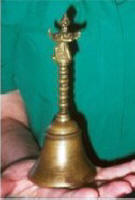
And that's not the only example. A brass bell (made of an odd combination of
metals that is not typical of any historical examples of brass) was
found in 1944 in a coal deposit in West Virginia. The investigators
who studied the bell couldn't disprove the finding but they couldn't
explain it, either.
What's obvious to me is that coal doesn't have to cook for
300 million years. A few thousand, in fact, might be sufficient if
conditions are right.
For example, suppose that some 13,000 years ago a meteorite
smashed into what is now Hudson Bay, causing a mega-tsunami to
encircle the Earth. It's not too hard to imagine some kind of
civilization in existence then that would have been wiped out. The
forests of the world would have been destroyed at the same time,
flattened and swept out to sea and gathering in lake bottoms. All
this dead matter would have caused a "bloom" of bacteria that would
quickly suck the oxygen out of the lakes and seas and the vegetable
matter would have also been covered by loose gravel, sand, rocks,
and anything else the tsunami could pick up, providing the required
pressure. If the debris washed along with the trees included the
occasional bell or gold chain, well, they'd have become inextricably
connected to the coal as it formed.
Is that what happened? Well, I certainly can't prove it. All I
know is, there are OOPArts found in coal, as well as in other
rocks and gems where they shouldn't be possible. Too bad that
carbon dating wasn't invented back in 1891.
A carbon-dated lump of coal with a gold chain embedded in it:
That's what I want in my stocking for Christmas!